4- 145 2010. In Pinto, M. F. & Kawasaki, T. F. (Eds.). Proceedings of the 34th Conference of the International Group for the Psychology of Mathematics Education, Vol. 4, pp. 145-152. Belo Horizonte, Brazil: PME.
Leonor Santos; Jorge Pinto
University of Lisbon; Polytechnic Institute of Setubal
This study was done in the context of a pr oject on learning assessment practices. It aims to understand the professional development of a math’s teacher, regarding her practice in feedback production over a period of three years. Following an interpretive methodology, the data was collected from documents and interviews and the data analysis was done from pre-defined categories supported by the theoretical framework. This study shows that the teacher gives increased importa nce to feedback as a learning resource. Although she uses a standard feedback, her evolution points out to the establishment of favorable moments for student’s reflection, to noting fewer errors, encouraging correction and varying the feedback’s syntactic form.
INTRODUCTION
Studies on the contribution of participation in projects and activities for the teacher‟s professional development have been carried out for several years (Borko & Putnam, 1995; Hiebert, Gallimore & Stigler, 2002). In Portugal, particularly through the four year AREA project [1], one can begin to understand its contribution to the team‟s professional development, especially in the assessment area. Bearing in mind that recent studies indicate that assessment practices for learning are still unexpressive in day to day classroom (Black & William, 1998), the AREA project‟s main purpose is to develop, to put into practice and evaluate assessment practices, integral to the teaching and learning process. This project counts with a team of twelve elements composed of researchers and teachers of different education levels (from the pre-school and elementary level to middle and high pre-school students in Mathematics). The team meets regularly, once a month, to share and consider current and several interventions as well as to discuss publications on topics worked within the project.
In this article, we will study a team mathematics teacher‟s professional development in what concerns written feedback in early student‟s versions, over the three years of her practice.
THEORETICAL FRAMEWORK
upon ways of thinking and doing, either between the teacher and his students or between the teacher and his peers or even between the teacher and other elements exterior to the school, linked to the educational process (Steinberg et al., 2004). This ownership grants the opportunity to discuss and assess new knowledge and practices which provide new moments of reflection and discussion. Associated with this sense of ownership, these authors also refer the willpower to change and the sense of being a participant in the changing process.
In this way, professional development develops in a continuous way (Nipper & Sztajn, 2008). It may occur through multiple and diverse opportunities, where the teachers can develop new knowledge, skills, approaches and predisposition to improve their professional practice, either in their teaching practice, either at the organizational level (Loucks-Horsley et al., 1998).
The teaching practice consists of several elements of which, undoubtedly, student‟s learning assessment is an essential dimension. But nowadays, when talking about assessment one must consider assessment for learning and its practices (Pinto & Santos, 2006). Now, if there are fields that do enhance professional development, assessment is certainly one of them, for it requires from the teacher an appropriation and reconstruction of the teaching and learning processes in order to build his/her own observation, interpretation and intervention system (Perrenoud, 1998). Among the assessment practices for learning one should highlight feedback as a key element (Sadler, 1989). Feedback is perceived as the information that shows how apart is the “performed” to the “expected” trying to minimize that difference. However, giving feedback, and especially a written one, is not a learning guarantee. It is the quality of feedback and not just the quantity that deserves our attention (Sadler, 1998). For example, feedback can help improving the students´ learning performance when: (i) feedback focuses what needs to be done, (ii) more detailed information is given on how to proceed; (iii) the student is given time in advance to think and work on a certain task; and (iv) the work hasn‟t been subject to any rating (Santos, 2002; Wiliam, 1999). In order to make learning endure over time, Jorro (2000) refers how important it is that the students identifies their errors, correct them and reaches the correct answers, on their own. However, such conditions are not by themselves a guarantee of success. The syntactic form and the feedback‟s extent, the type of student and their perceptions are factors that may influence the effectiveness of this assessment practice (Santos & Pinto, 2009).
The type of feedback and the way it is given can be differentially effective (Hattie & Timperley, 2007). So, giving appropriate feedback to each student represents a great challenge for teachers. If the improvement of assessment practices for learning does not follow a linear process (Wiliam et al., 2004) it is also likely that the same thing will happenin the case of feedback. Its evolution is the purpose of this work.
PME 34 - 2010 4-147 This study follows an interpretative methodology as it seeks to understand the evolution of a math teacher in what concerns her practice of written feedback as part of a joint work project. Next we present a case study design with a teacher named Sara. She is a young third cycle and secondary mathematics teacher. Having obtained a degree in Mathematics´ Teaching, in 2008 she finished her Masters in Mathematics Teaching with the highest grade. In 2009/2010, she is now in her 11th year of profession, and is teaching at a school near Lisbon. Although with short time of service, she has worked as a training supervisor.
The feedback in question was done over three years (2005/06 to 2007/08[2]) by Sara to students from twelve to fourteen years old. Data was collected from a documental analysis of the students´ first productions, the given feedback and an interview conducted in November 2009. This interview was open, being the teacher asked to describe her perception on her own written feedback evolution.
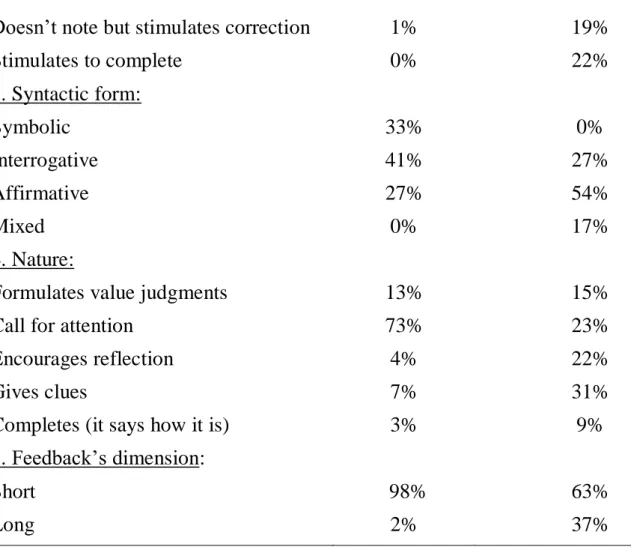
In order to examine the provided feedback, the following dimensions and their respective categories were considered: focus (student/task/student and task), error treatment (notes and corrects/notes but does not correct/does not note but stimulates correction/stimulates to complete); syntactic form (symbolic/interrogative/affirmative /mixed), nature (formulates value judgments/call for attention/encourages reflection/ gives clues/completes – it says how it is) and the feedback’s size (long/short).
RESULTS AND ANALYSIS
In 2005/06, Sara only provided feedback for the early versions of the same kind of task: bibliographic researches. The students were supposed to select, organize and present the information collected, in their own words. This kind of task has as main purpose to develop the capacity of mathematics communication. In 2007/08, this teacher used the feedback in different tasks, especially in problem solving, in open tasks, in tests and bibliographic researches.
The analysis that follows rests upon 106 given feedbacks in the first year and 81 in the third year. Each feedback was analyzed and classified in the considered dimensions and categories (see Table 1).
Dimensions 2005/06 2007/08
1. Focus:
Student
Task
Student and task
0%
100%
0%
12%
67%
21%
2. Error treatment:
Notes and corrects
Notes but does not correct
23%
76%
15%
Doesn‟t note but stimulates correction Stimulates to complete
1%
0%
19%
22%
3. Syntactic form:
Symbolic
Interrogative
Affirmative
Mixed
33%
41%
27%
0%
0%
27%
54%
17%
4. Nature:
Formulates value judgments
Call for attention
Encourages reflection
Gives clues
Completes (it says how it is)
13%
73%
4%
7%
3%
15%
23%
22%
31%
9% 5. Feedback‟s dimension:
Short
Long
98%
2%
63%
37%
Table 1: Feedback‟s distribution by dimensions and categories of analysis, in 2005/06 and 2007/08
In the focus dimension we can see that the two year given feedbacks mainly focused on the student‟s performed tasks. However, there is some variation. While in the first year all types of feedback focused exclusively on the task, in the third year, one notices Sara‟s concern to address the student as the task creator, always through the identification of the achieved aspects by adding or not adding the guidelines to carry on the work: “Well done! You understood the problem and the scheme you used is quite clear”; “You have made many and good findings. Keep up but don‟t forget you have to find a way to „guess‟ the period without operating the division.”
PME 34 - 2010 4-149 error or similar errors. As this kind of feedback proved to be ineffective I sensed I had to change it”.
However, it was in the stimulation to complete the task that Sara evolved more clearly. Her concern in helping students with their learning, developing the idea that it is always possible to do better, explains this evolution: “Especially in some tasks, I carried on giving feedback to the students so that they would accomplish something that, despite being well done, could be completed or improved. That is a reasoning which can become more explicit or an explanation that can be improved. This change, I think, also had to do with my evolution as a teacher, because I began by trying to pass the students the message that no work is ever finished. It may be very good but it is always possible to improve in some aspects”.
As to the syntactic form dimension we can see that, at first, you may find symbolic feedbacks which disappear completely in the third year. As Sara states: “When I started giving feedback (...) I used the teaching symbols that teachers, generally use to correct their student‟s assessment tools. But (...) this kind of feedback is not very effective for most students”. This finding, carefully thought out through reflection, change her perspective on the feedback‟s syntactic aspects. So she gradually withdrew from the symbolic form, adopting a wider-ranging style, but always compliant with her questioning, as she stated: “One thing I never gave up is questioning. By posing questions I intend to help the students reflect on their answers, to remind them about something that can help correcting or improving those answers (...) I also use this strategy a lot in class, that is, I often question the students and try to answer their questions with more questions.” However, Sara says that feedback doesn‟t always work as she expected: “But these issues do not always reach the goal for which they were written. Sometimes students just feel that the questions are to be answered and do not always consider them as a basis for reflection.” This makes her resort to a wider variety of ways, using the affirmative and mixed form more often.
something I try to do very often with the students, sometimes resorting to certain aspects in their answers and other times using my own examples”.
Finally, in the third year, Sara increases feedback‟s production. Currently, she feels the need to resort to long feedbacks especially in certain tasks, as she explains: “I believe that, in general, my written feedback is short. However, depending on the tasks, sometimes that feedback becomes longer.” Nevertheless, this option seems to create some difficulties amongst the students, as she states: “When that happens, the students tend to come and tell me what is difficult to understand in my feedback. Thus, in the last productions I gave feedback to, I tried to reduce its size, using very direct clues.”
CONCLUSIONS
The first conclusion to be drawn is that the use of feedback is a very complex task. It requires improvement through constant reflection on its form in the studied dimensions and the obtained results, in terms of their learning effects. This reflection is facilitated by a critical dialogue, trust and mutual respect, that promotes a sustained professionalism (Day, 2007) as it happens in the context of a working project.
As we can see in Sara‟s case, this reflection about feedback requires a committed intentionality to a conception of assessment for learning that helps her to make choices in the selection of tasks, in the way she examines them and, especially, in the way she uses her analysis while giving it back to the students so as to make it productive in terms of learning. In Sara‟s evolution we can identify a certain standard that she uses in a regular basis, over time, in her feedbacks: they are focused on the task (Wiliam, 1999), highlighting the errors or not, but always allowing the student to appropriate and work on it according to the suggestions given (Jorro, 2000); they encourage reflection giving more or less clues, use mainly the questioning method (Santos, 2002) and tend to be short. However, from the first to the third year, we can see that Sara developed plasticity in her feedback, adjusting it whether to specific students or to the tasks themselves. Thus, she succeeds in creating more suitable moments for student‟s reflection, with more elaborate clues, indicating fewer errors, but, at the same time, encouraging its correction and varying the feedback‟s syntactic form.
Thus, the evolution of feedback‟s construction, from the first to the third year, suggests the acknowledgment of the student‟s central place in the learning process. In fact, Sara recognizes it both as the producer and the author of his/her learning narrative through assessment interactions and the feedback given to the students. In other words, she tries to give feedback in the sense of student‟s self-regulation (Hattie & Timperley, 2007). However, as a teacher, she‟s assuming the important role of a specialist, identifying the students‟ needs in their productions, issuing challenges but, at the same time, suffering the uncertainty of this learning journey.
PME 34 - 2010 4-151 (Black & William, 1998; Sadler, 1989). In short, all the changes emerging from this study can only be understood as a very strong element in Sara‟s professional development, which is beyond the assessment but has an ethical impact on professional practices and relationships.
NOTES
[1] The AREA project (Monitoring Assessment in Teaching and Learning) is a research project funded by the Science and Technology Foundation (PTDC/CED/64970/2006). Its main purposes are to develop, implement and study assessment practices which can contribute for learning. Further information can be found in http://area.fc.ul.pt
[2] For space reasons we will only compare the given feedback in 2006/07 and 2008/09.
REFERENCES
Black, P. & Wiliam, D. (1998). Assessment and classroom learning. Assessment in Education, 5(1), 7-74.
Borko, H. & Putman, R. (1995). Expanding a teacher‟s knowledge base: A cognitive
psychological perspective on professional development. In T. Guskey & Huberman (Eds.), Professional development in education: New paradigms and practices (pp. 35-65). New York: Teachers College Press.
Day, C (2001). Desenvolvimento profissional de professores: Os desafios da aprendizagem permanente. Porto. Porto Editora.
Day, C. (2007). School reform and transition in teacher professionalism and identity. In T.
Townsend & R. Bates (Eds.), Handbook of teacher education (pp. 597-612).
Netherlands: Springer.
Hattie, J. & Timperley, H. (2007). The power of feedback. Review of Educational Research, 77(1), 81-112.
Hiebert, J., Gallimore, R. & Stigler, J. (2002). A knowledge ba se for the teaching profession. What would it look like and how can we get one? Educational Researcher, 31(5), 3-15.
Jorro, A. (2000). L´enseignant et l´évaluation. Des gestes évaluatifs en question. Bruxelles: De Boeck Université.
Loucks-Horsley, S.; Hewson, P.; Love, N. & Stiles, (1998). Designing professional development for teachers of science and mathematics. California: Corwin Press, Inc.
Nipper, K. & Sztajn, P. (2008). Expanding the instructional triangle: conceptualizing mathematics teacher development. USA: Springer.
Perrenoud, Ph. (1998). L’évaluation des élèves: de la fabrication de l’excellence à la régulation des apprentissages. Entre deux logiques. Bruxelles: De Boeck & Lacier.
Pinto, J. & Santos, L. (2006). Modelos de avaliação das aprendizagens Lisboa:
Sadler, D. R. (1989). Formative assessment and the design of instructional systems. Instructional Science, 18, 119-144.
Sadle, D. R. (1998). Formative assessment: Revisiting the territory. Assessment in
Education, 5(1), 77-83.
Santos, L. (2002). Auto-avaliação regulada: porquê, o quê e como? In Paulo Abrantes e Filomena Araújo (Orgs.), Avaliação das Aprendizagens. Das concepções às práticas (pp. 75-84). Lisboa: Ministério da Educação, Departamento do Ensino Básico.
Santos, L. & Pinto, L. (2009). Lights and shadows of feedback in mathematics learning. Proceedings of the 33rd Conference of International Group for the Psychology of Mathematics Education, 5, 49-56.
Steinberg, R.; Empson, S. & Carpenter, T. (2004). Inquiry into children‟s mathematical thinking as a means to teacher change. Journal of Mathematics Teacher Education, 7, 237-267.
Wiliam, D. (1999). Formative assessment in mathematics. Equals: Mathematics and Special Educational Needs, 5(3), 8-11.