Luciana Mara Monti Fonseca
I, Natália Del’ Angelo Aredes
I, Danielle Monteiro Vilela Dias
I,
Carmen Gracinda Silvan Scochi
I, José Carlos Amado Martins
II, Manuel Alves Rodrigues
III Universidade de São Paulo, Ribeirão Preto School of Nursing, Department of Maternal and Child Nursing and Public Health,
Nursing Graduate Program. Ribeirao Preto-SP, Brazil.
II Escola Superior de Enfermagem de Coimbra, Research Unit in Health Sciences – Nursing. Coimbra, Portugal.
Submitted: 30-11-2014 Approved: 07-02-2015
ABSTRACT
Objective: to evaluate students opinion regarding e-Baby educational technology. Methodology: exploratory descriptive study in which participated a sample composed of 14 nursing Portuguese students that used e-Baby digital educational technology in an extracurricular course. To achieve the aim of the study, the data collection was realized through an opinion instrument in Likert scale including the possibility of commentaries by students. Is was also collected data of participants’ characterization.
Results: students made very satisfactory evaluations regarding the game e-Baby, varying since usability acceptation through
suggestions of expansion of the game to other nursing themes. Conclusion: serious game e-Baby can be considered a didactic
innovation and motivator tool of learning. Besides, it demonstrates have adequate interface in design and educative function aspects, evocating intense interaction between user and computational tool.
Key words: Neonatal Nursing; Educational Technology; Students Nursing.
Serious game e-Baby: nursing students’ perception on learning about
preterm newborn clinical assessment
INTRODUCTION
Nowadays, there are many educational tools that have in-corporated digital technologies. We highlight virtual learning environments (VLE), digital learning objects, social networks and educational games - also called serious games.
Serious games are, by definition, games used for training, simulation or education that can be run on computing
de-vices(1). The aim of these games is to practice daily situations
and promote training of children and adults to make decisions in the field of education on specific topics for which they are developed. They also make the everyday simulations more attractive(2).
Regarding the term serious games, there is an ongoing discussion between the experts who are separated, some be-lieve that the term “serious” disqualifies the rigor of the game/ simulation while others believe the term reinforces the
seri-ousness of it in its educational character(3). We have adopted
the concept of serious game as a game used in education and making use of virtual simulation to mimic reality, this is what represents our interest: the clinical practice of nurses when facing premature babies.
The literature suggests important advantages in the use of digital technologies in education, especially when it comes to generation Y, who grew up in the middle of technological ad-vances. In this context, we developed the serious game e-Baby as a proposal for a post-doctoral project by the Ribeirao Preto School of Nursing, in partnership with the Coimbra School of Nursing. E-Baby is a game that has the environment of a vir-tual incubator in which the user performs the clinical assess-ment of oxygenation in preterm infants. The game meets the characteristics considered fundamental in educational tools raised at nearly a decade by scholars, including availability of scenario for the student to solve problems experienced in the simulation, hypothesis formulation for decision-making and
interaction with an interesting playful tool(4).
In the e-Baby, the user knows the history of the preterm in-fant, chooses tools for clinical assessment according to their judgment on the case, answer the question associated with that moment of interaction with the baby and checks if the assess-ment/answer is appropriate, testing their knowledge and simu-lating their action with a virtual baby. The virtual baby presents different levels with respiratory impairments, ranging from little to more complex clinical involvement. There are buttons on the interface where the user has the option to film the entire assess-ment procedure and share their performance on social network. The serious game has the potential to assist in the teaching and learning process representing a more flexible, attractive and interactive way through simulations, approaching the reality found in a neonatal unit, allowing the most appropriate training for students concerning oxygenation clinical assessment of a
risk population segment, the newborn preterm infants (NPI)(5).
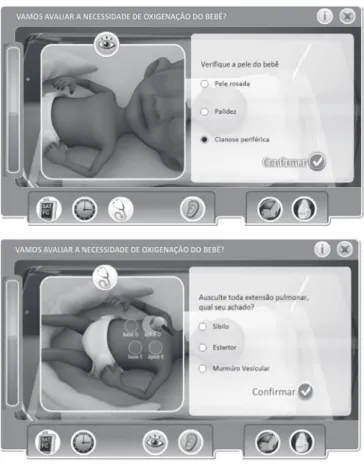
Figure 1 shows the serious game two screenshots during clinical assessment performed by the user.
In this digital educational technology of development con-text, the study aimed to evaluate this technology in view of the opinion of nursing students (target group), as an important
part of the tool for the implementation of impact measure-ment in the teaching-learning process and success under the perspective of the user.
Figure 1 - Screenshots of e-Baby game
METHOD
This is a descriptive exploratory study, in which an assess-ment of the educational technology e-Baby was performed based on feedback of nursing students about their use.
This study was submitted to the Research Ethics Commit-tee of the Health Sciences Investigation Unit - Nursing at the Coimbra School of Nursing and approved under the protocol 73-02/2012.
The study population was composed of 14 students in their final year of undergraduate Nursing course at the Coimbra School of Nursing (ESEnfC) of Portugal who agreed to partici-pate in this study voluntarily and agreed to attend an extracur-ricular course of 30 hours divided in two weeks during the university holiday’s period.
they completed the instrument and gave their opinion, their an-swers were automatically sent to the e-Baby database.
Students’ assessment instrument used in the study consists of items that verified: friendly use of the educational game, assess-ment of the feedback offered, contribution to learning, motiva-tional feature for the user to learn playing, possibility of teaching tool substitution and recommendation of the game’s strategy for other topics in nursing, among other aspects described below.
The statistical analysis was descriptive through frequencies for categorical variables and central tendency measures for quantitative variables.
RESULTS
Out of the 14 Portuguese students, 12 (85.7%) were women with age ranging between 21 and 29 years (mean: 22.36 years and standard deviation: 2.06 years) showing strong homogenei-ty in the categories gender and age among participants. None of the participants reported to be working and studying, regarding computer usage frequency 78.6% (n=11) reported they usu-ally use computers, while others reported regular use (21.4%/ n=3). As the preferred location for using computer, 64.3% (n=9) answered at home; 28.6% (n=4) at the university; 7.1% (n=1) at home of relatives and friends. All students reported having a computer, and of these, 28.6% (n=4) have laptops and 71.4% (n=10) have a desktop computer, but regardless of the type of computer, everyone has access to internet.
Table 1 presents data obtained from the students’ assess-ment instruassess-ment on serious game e-Baby.
We highlight some feedbacks from students’ written answers of the instrument to help us understand the results of this study, presented in Table 1, which also enriched data analysis.
Regarding the interaction of students with the game, which is a critical factor for the success of the instrument usability, a student said:
The fact that this game is interactive makes it much easier to study and absorption of the information it transmits. I think e-Baby helped me to supplement my knowledge on premature babies in the sense that, in this software, I had a direct interaction with the baby. (S1)
Regarding the importance of the e-Baby game for learning the subject, three students said:
This technology was useful for learning about the clinical assessment of premature infants. (S5)
The technology used was very enriching for the evolution of my learning about the clinical assessment in preterm baby subjects. (S11)
Access to educational technology was important to meet the basic human needs of premature baby. I think that it is an optimal way to deepen knowledge (on premature in-fants). (S13)
The statements below support innovative and simulation qualities of the reality that the game has:
I think that if ESEnfc could use this project would be very enriching because it would provide a new way for studying for future nurses. (S1)
Regarding the e-Baby, it helps us a lot because the situa-tion is very real and helped me practicing the assessment of respiratory rate in preterm infants, which sometimes be-comes difficult. (S4)
The technology used is very important to integrate new knowledge. It helps us to reflect on practice and facilitates
Table 1 - Frequencies of answers on students’ assessment instrument on the serious game e-Baby
e-Baby technology features Totally agree Agree NA/ND* Disagree Totally
disagree
Easy to use 57.1% (8) 42.9% (6) 0 0 0
Friendly 78.6% (11) 14.3% (2) 7.1% (1) 0 0
Imediate Feedback 42.9% (6) 42.9% (6) 14.3% (2) 0 0
Didactic 64.3% (9) 35.7% (5) 0 0 0
Autonomy 35.7% (5) 57.1% (8) 7.1% (1) 0 0
Enable learning preterm oxygenation needs 64.4% (9) 35.7% (5) 0 0 0
I can choose what I want to learn 71.4% (10) 14.3% (2) 14.3% (2) 0 0
It would be interesting to have such technologies
with other topics 85.7% (12) 14.3% (2) 0 0 0
Technologies like this can replace teachers 0 7.1% (1) 21.4% (3) 71.4% (10) 0 The use of e-Baby helped me in my learning
process 71.4% (10) 28.6% (4) 0 0 0
I felt motivated to use e-Baby 71.4% (10) 28.6% (4) 0 0 0
I believe that the time of access to e-Baby was
satisfactory to enrich my learning 50% (7) 50% (7) 0 0 0
the acquisition of knowledge. It is undoubtedly essential during this course, due to the ease use and because it pro-vides instant feedback. (S12)
Generally, it is well structured and it is very useful for train-ing, for example, auscultation. (S14)
Students also gave feedback on the educational aspects, ease, flexibility and autonomy that the game offers students:
Regarding the e-Baby, I think it’s well developed, it is easy to access and understandable and it promotes learn-ing, because it requires us to be able to apply theoretical knowledge in the game. I think this learning system is very positive because it allows choosing what topics we want to study and do not “force” us to have a schedule, which can make it easier to some people to participate in courses. (S3)
Educational technologies used in this course were a plus because they are easily accessible, it is very well orga-nized. (S4)
I believe that this educational technology covered in this course is didactic and raise students’ interest stimulating learning and the pursuit of knowledge autonomously. (S6)
I think this way of learning is very good because it always allows access to information at any time of day and so we can combine our free time for this type of training. It is a logical relevant and organized source of information. (S7)
I believe that its application is very useful and relevant; (N9)
The software is very interesting, since it allows us to develop skills in accordance with the personal characteristics and the possibilities (in terms of time) that each one has. (S10)
For those who, for example, a student who works and has less time to go to school, or to those who are sick and forced to study from home, it seems to have great utility. (S14)
Students also expressed interest that the game could be expanded not only to other basic human needs beyond the oxygenation already addressed in this version, as well as other topics that could simulate nursing care in the digital environment:
I think e-Baby is well developed, but I think it could be adapt-ed to all the basic human neadapt-eds of prematurity. Thus we would have a didactic learning source for all our needs. (S2)
It would be interesting if it was extended to other subjects, in addition to oxygenation in the case of premature new-born, or even to other areas of knowledge and intervention in nursing. (S5)
I believe that the e-Baby could address the remaining needs of the preterm newborn, thus increasing the level of demand at the level of theoretical knowledge. (S6)
I think it could provide a wider range of situations. (S8)
The e-Baby is useful, it could, however, consider other needs (basic human needs). (S10)
Overall the project is very good and it seems a good idea to be extended to other topics. (S14)
Regarding the professor replacement by the tool or its as-sociation with the teaching practice, the feedbacks were:
I think we always need a few hours with the professor to answer questions that may arise and the almost permanent availability of teacher helped a lot. (S7)
[...] I believe that these technologies should be seen as a complementary way of learning and should not replace professors. (S13)
Referring to the replacement of the professor I think that this is not true because this would increase people’s iso-lation at home and it would not promote socialization. Specifically for me, it is a little bit more difficult for my learning compared to the actual classes, because I learn a lot through what I hear from the professor. (S14)
Below, we transcribed the criticism of the students on the study object and improvements of the tool:
I think this technology should be more accessible to all computers, as sometimes it does not work on some com-puters, making it difficult to access and learn. (S6)
[...] another (suggestion) is due to the fact that there were computerized problems which complicated the learning process as in my case I had to deal with the simulations. (S7)
On some computers I could not access the e-Baby, which limited my use. (S14)
DISCUSSION
“agree” for most of the sample (92.9%/ n=13) highlighting an interesting digital environment for studies. Motivation through graphical advantages of computing resources was mentioned by many scholars as one of the main attractions that lead stu-dents to feel satisfied with the tool(6-7).
In addition, the ease use allows students to develop their tasks with the tool at any location or time, respecting the spec-ificities of each individual and the pace of learning, as two stu-dents pointed out in their feedbacks on the lack of mandatory
access at predetermined times (S3 and S14)(6-8). This facility
also refers to the friendly navigation through the digital game, 85.7% of students (n=12) agreed or totally agreed that the game allows free choice of navigation paths, that is, the game format does not prevent students to proceed to a new task without running the previous one, although they have been developed didactically in a graduated scale of complexity and logical sequence based on clinical case of infants studied.
The possibility choice concept of what one wants to learn is complemented with the autonomy given by the game to the student during learning, since the free and atemporal use of the tool is also added to individual or groups possibilities of use. Autonomy was reported by 92.9% of the sample (n=13) proving it to be a remarkable advantage of the tool and also very important from the perspective of valuing the learner as an
active and leading member of the teaching-learning process(9).
It is important to note that three students reported failures of access to the game on different computers (S6, S7 and S14). We believe that these criticisms are very important for the improve-ment of the tool and incorporation of the same course at the uni-versity as an assisting tool for the professor. The required changes validated by the computer team analysis were subsequently cor-rected to ensure that the students of the study could access the e-Baby game, instructions were given during the 15 days of access. The feedback was reported by 85.7% of students (n=12) with agreement or total agreement, as well as stated by one of them (S12) as one of the advantages of the serious game. The importance of feedback is given by the possibility that the stu-dent has, based on the assessment of their simulated actions, to review both correct and wrong answers reflecting on these
and building knowledge based on experience(10).
When the feedback indicates an error, they can try again in another simulation to improve their skills and rebuild an old concept or acquire new knowledge.
We emphasize greatly on students’ feedback, the satisfaction in being able to conduct a training that simulates reality with property, allowing virtual simulation opportunities and giving more chances to explore the clinical examination of prematurity. This is critical both from the point of view of patient safety as for the learning process, as it leads us to think that due to the fragility of the NPI, there would be no possibility of exhaustive clinical examination in a real environment, while the virtual baby can be treated as often as needed so that students may learn and practice to acquire self-confidence, and enable the student to recall the skills needed to perform the tasks, critically reason and comply
with the decision-making based on this process analysis(11-13).
One of the students commented that the game allows the practice of auscultation (S14) and yet another commented on
the measurement of respiratory rate (S4). One study(14)
pub-lished in Brazil in 2006, conducted with nursing students pointed out and discussed that they often had inability to rec-ognize breath sounds and other difficulties about this health need, confirming the importance of educational tools to facili-tate the learning process and enable the creation of environ-ments for training and simulation that explore the topic.
The e-Baby game was developed addressing only oxygen-ation and the choice of this basic human need is due to its pri-mary and vital importance to humans as well as for being one of the main targets in the premature population. Moreover, it is crucial that future nurses have ability to deal with patient possibilities to the risk in this field and take appropriate at-titudes to its professional category.
However, we believe the expansion of the e-Baby game in order to address other topics and incorporate other basic hu-man needs to the case studies is quite valid. Students agreed unanimously with this statement and some represented, through their feedback, desire for new challenges of the game, and other nursing topics. One of the students even stated that by expanding to new needs of preterm infants the level of de-mand in terms of theoretical knowledge would be increased, which reflects motivation for studying and interest in the tool.
Interest in the educational resource herein should be em-phasized as described in many of the feedbacks, encouraging their use and incorporating it into the regular course, as well as expansion of educational opportunities and challenges. Thus, we observed high satisfaction and acceptance of the serious game e-Baby developed to provide students an opportunity to digital simulation before actual contact with premature infants.
Regarding the replacement of professor by tools like this, the results found in this study (71.4% of disagreement/ n=10) are similar to those found in a previous study with Brazilian students
(75% of disagreement/ n=9)(15). Thus, we conclude that such
pos-sibility is remote to the context of education where the interac-tion between students and professors is valued as a collaborainterac-tion strategy for the construction of knowledge. It is increasingly rein-forced the importance of the professor’s role, tutoring or facilitat-ing the learnfacilitat-ing process, especially when they lead the way with emphasis on students’ active role and when they appropriate and
incorporate teaching strategies tools for motivating learning(15-16).
The active role of the student and professor as facilitator of learning are incorporated in the model of active learning methodologies and integrated curriculum, which aims to bet-ter prepare students for care, management and political spheres
through interdisciplinary and differentiated teaching strategies(17).
It is believed that the incorporation of educational technologies to active teaching and learning methods can contribute to the construction of knowledge and assist teachers in their practice.
E-Baby game was evaluated by students as very satisfactory in many aspects and proved to be a tool with great potential to assist professors and students during the processes of teach-ing and learnteach-ing. We believe that its use can still contribute to the simulated practice focused on nurses working in the labor market while used as continuing education strategy, this may be subjected to future studies. We agree with other
of technology in their work process, which is a strategy that enables the flexibility of working hours and pace of learning.
CONCLUSION
Users showed to be integrated to e-Baby, considering it an important educational tool as a means of didactic innovation and motivating learning. Design and interactivity interfaces of the technology were considered appropriate, making these essentials items for the success of educational technologies.
We believe the results of this study provide improvements to this digital educational technology developed and to be ex-panded in future actions, as well as instigate researchers to reflect on the development of new technological resources ap-plied to education in order to enhance human-technology in-teraction. Furthermore, the valuation of educational technolo-gies significantly observed on the feedbacks of the students who participated in this study motivates the development of this line of research and urges the incorporation of reflection of new tools to teaching practice.
REFERENCES
1. Susi T, Johannesson M, Backlund P (School of Humanities and Informatics, University of Skovde, Sweden. Serious games - an overview. Sweden (SE): University of Skovde; 2007. Technical Report No. HS-IKI-TR-07-001.
2. Matsunaga RM, Moraes RLO, Borges MAF, Matta MAP, Ozelo MC. Development of a serious game for children with hemophilia. J Health Inform [Internet]. 2014 [cited 2013 October 10];6(Spec No):114-9. Available from: file:///C:/Users/Cliente/Downloads/371-1454-1-PB.pdf
3. Crookall D. Serious games, debriefing, and simulation/gam-ing as a discipline [editorial]. Simulation Gamsimulation/gam-ing [Internet]. 2010 [cited 2013 October 10];41(6):898-920. Available from: http://www.unice.fr/sg/authors/docs/Crookall-2010_Se-rious-Gs-debrief-discipline_898-920.pdf
4. Fontoura TR. O brincar e a educação infantil. Rev Pátio Educação Infantil. 2004;1(3):7-9.
5. Fonseca LM, Dias DM, Seixas CA, Scochi CG, Martins JCA, Rodrigues MA, et al. Development of the e-Baby se-rious game with regard to the evaluation of oxygenation in preterm babies: contributions of the emotional design. Comput Inform Nurs [Internet]. 2014 [cited 2015 Febru-ary 15];32(9):428-36. Available from: http://www.ncbi. nlm.nih.gov/pubmed/25010051
6. Blake H. Computer-based learning objects in health-care: the student experience. Int J Nurs Educ Scholarsh. 2010;7(1):1-15.
7. McCormick MJ, Slavy JR, Fuller B. Embracing technology: using an unfolding case simulation to enhance nursing students’ learning about Parkinson disease. J Neurosci Nurs. 2013;45(1):14-8.
8. Cogo ALP, Silveira DT, Pedro ENR, Tanaka RY, Catalan VM. Aprendizagem de sinais vitais utilizando objetos educacionais digitais: opinião de estudantes de enferma-gem. Rev Gaúch Enferm. 2010; 31(3):435-41.
9. Johnson L, Adams Becker S, Estrada V, Freeman A. The NMC Horizon Report: 2014 Higher Education Edition [In-ternet]. Austin (US): The New Media Consortium; 2014 [cited 2013 October 10]. Available from: http://cdn.nmc. org/media/2014-nmc-horizon-report-he-EN-SC.pdf
10. Fonseca LMM, Góes FSN, Ferecini GM, Leite AM, Mello DF, Scochi CGS. Inovação tecnológica no ensino da se-miotécnica e semiologia em enfermagem neonatal: do de-senvolvimento à utilização de um software educacional.
Texto & Contexto Enferm [Internet]. 2009 [acesso em 10 de outubro de 2013];18(3):549-58. Disponível em: http:// www.scielo.br/pdf/tce/v18n3/a19v18n3.pdf
11. Collins AS, Graves BA, Gullette D, Edwards R. Develop-ing an interactive microsimulation method in pharmacol-ogy. J Nurs Educ [Internet]. 2010 [cited 2013 October 10];49(7):410-3. Available from: http://www.ncbi.nlm. nih.gov/pubmed/20411862
12. Foronda C, Bauman EB. Strategies to incorporate virtual simulation in nurse education. Clinical Simulation Nurs-ing [Internet]. 2014 [cited 2013 October 10];10:412-8. Available from: http://www.nursingsimulation.org/article/ S1876-1399(14)00065-6/abstract
13. Aebersold M, Tschannen D, Stephens M, Anderson P, Lei X. Second life: a new strategy in education nursing students. Clinical Simulation Nursing [Internet]. 2012 [cited 2013 October 10];8(9):469-75. Available from: http://www.nurs-ingsimulation.org/article/S1876-1399%2811%2900058-2/ abstract
14. Melo FNP, Damasceno MMC. A construção de um sof-tware educativo sobre ausculta dos sons respiratórios. Rev Esc Enferm USP [Internet]. 2006 [acesso em 10 de ou-tubro de 2013];40(4):563-9. Disponível em: http://www. ee.usp.br/reeusp/upload/pdf/290.pdf
15. Del’ Angelo, N. Objeto digital no ensino da avaliação clí-nica do pré-termo: a aprendizagem de estudantes [disser-tação]. Ribeirão Preto: Escola de Enfermagem de Ribeirão Preto, Universidade de São Paulo; 2012.
16. Silveira DT, Catalan VM, Neutzling AL, Martinato LHM. Objetos educacionais na consulta de enfermagem: ava-liação da tecnologia por estudantes de graduação. Rev Latinoam Enferm. 2010;18(5):1005-12.
17. Souza MCC, Otoni A, Santos LL, Campos LG, Oliveira VJ. Oficina sobre projeto pedagógico de curso de enferma-gem: refletindo sobre inovações, desafios e potencialida-des. Referência [Internet]. 2012 [acesso em 10 de outubro de 2013];Série III(8):67-73. Disponível em: http://www. scielo.gpeari.mctes.pt/pdf/ref/vserIIIn8/serIIIn8a07.pdf