Revista Gaúcha
de Enfermagem
DOI: http://dx.doi.org/10.1590/1983-1447.2014.04.44793
Spending with unnecessary complementary tests
for hypertension and diabetes in health services
Gastos com exames complementares desnecessários
para hipertensos e diabéticos nos serviços de saúde
Gastos con pruebas de laboratorio para hipertensos
y diabéticos en los servicios de salud
a Physician, Doctoral Student and Professor of the
Medical Course of Centro Universitário Barão de Mauá.
b PhD Professor of the Specialized Nursing
Depart-ment of FAMERP.
c Nurse, PhD in Health Sciences at USP School of
Nursing, Nursing Management Program – PPGEn.
d Associate Professor of the Professional Guidance
De-partment of USP School of Nursing. São Paulo, Brazil.
e PhD Professor of the Professional Guidance
Depart-ment of USP School of Nursing. São Paulo, Brazil.
Thiago Roberto Castellane Arenaa
Marli de Carvalho Jericób
Liliana Cristina de Castroc
Valéria Castilhod
Antonio Fernandes Costa Limae
ABSTRACT
The aims of this study were to analyze unnecessary laboratory exams for patients with hypertension and diabetes and to check the expenditures involved. This is an exploratory-descriptive, cross-sectional study with a quantitative approach. We used data from med-ical records of 293 patients registered in primary units – the Family Health Center (NSF3); secondary: School Health Center (CSE); and tertiary: Hospital das Clínicas (HC) from 2006 to 2009 in a city in Southeastern Brazil. We identifi ed a total of 9,522 laboratory tests, of which 5.97% were unnecessary. Of these, about 58% were requested by NSF3 and 42% by CSE. Results suggest there is a lack of integration among diff erent levels of health care, which result in misallocation of resources and unnecessary spending.
Descriptors: Health expenditures. Hypertension. Diabetes mellitus. Family health. Health services.
RESUMO
Este estudo objetivou analisar asolicitação e os gastos com exames complementares desnecessários para pacientes hipertensos e diabéticos nos serviços de saúde. Trata-se de estudo transversal retrospectivo, utilizando dados de prontuários de 293 pacientes cadastrados nas unidades de níveis primário – Núcleo de Saúde da Família (NSF3), secundário – Centro de Saúde Escola (CSE) e terciário – Hospital das Clínicas (HC), no período de 2006 a 2009 em um município da região sudeste do Brasil. Observou-se um total de 9.522 exames laboratoriais totalizando R$ 28.208,28, sendo 568 (5,97%) desnecessários – R$1.641,58. Destes, cerca de R$ 952,12 (58%) foram solicitados pela NSF3, e R$689,46(42%), pelo CSE. Os resultados sugerem que ocorre falta de integração nos diferentes níveis de atenção à saúde, acarretando má alocação de recursos e gastos desnecessários.
Descritores: Gastos em saúde. Hipertensão. Diabetes mellitus. Saúde da família. Serviços de saúde.
RESUMEN
El objetivo del estudio fue analizar la solicitación y los gastos con exámenes auxiliares innecesarios para pacientes con hipertensión y diabetes en los servicios de salud. Se trata de un estudio transversal retrospectivo, utilizando datos de las historias clínicas de 293 pacientes registrados en las unidades de niveles primario -el Núcleo de Salud de la Familia (NSF3), secundario- Centro de Salud de la Escuela (CSE) y terciario Hospital de Clínicas (HC), en el período de 2006 a 2009 en una ciudad del sudeste de Brasil. Hubo un total de 9.522 exámenes de laboratorio, de los cuales un 5,97% innecesarios. De estos, cerca del 58% fue solicita por el NSF3 y el 42% en el CSE. Los resultados sugieren que ocurre falta de integración entre los diferentes niveles de atención de salud, causando mala distribución de recursos y gastos innecesarios.
INTRODUCTION
Chronic non-communicable diseases (CNCDs), such as systemic arterial hypertension (SAH) and diabetes mellitus (DM), are one of the biggest challenges for health services, due to the high rates of morbimortal-ity that are threatening the qualmorbimortal-ity of life of millions of people (carriers for the disease, family, society) and increasing the costs for health systems around the world(1).
Within the next decades, it is believed that the cost of CNCDs could reach $ 7 trillion dollars in the United States, and in Brazil, it would account for 4% of the GDP(2). Given this situation, actions of prevention, diagnosis and early treatment, especially for SAH and DM, must be considered a priority by health services.
According to the International Diabetes Federation, the total of patients with DM was 371 million around the world in 2012, which resulted in 4.8 million deaths and spending reaching $ 471 billion dollars(3).
In this context, Brazil is among the ten countries with the highest number of DM patients aged between 20 and 79, totaling 13.4 million of diabetic people in 2012, with an average cost of US$ 1,031.44 per patient(3).
Systemic arterial hypertension is considered both a disease and a risk factor for cardiovascular, cerebro-vascular and renal diseases. It is responsible for 51% of deaths resulting from cerebrovascular diseases and 41% of coronary diseases. It is estimated that SAH will affect 60% of people by 2025, reaching an incidence of 40%. (4) This increase in hypertension incidence is attributed
to population growth, aging, and behavior-based risk factors such as inadequate diet, alcohol abuse, seden-tary lifestyle, obesity, stress, smoking, high cholesterol and diabetes mellitus. Moreover, a high number of cas-es is not properly treated, which contributcas-es to the oc-currence of several complications, such as target organ injuries – cerebral vascular accident, acute myocardial infarction, chronic renal failure, and hypertensive reti-nopathy – which contribute to the increase of costs re-lated to hypertension.(5)
A Brazilian study conducted between January and December 2005 reported the Unified Health System (SUS, as per its acronym in Portuguese) spent $ 398.9 million dollars with SAH treatment. Of this total, spend-ing with medication corresponded to 52.3% (208 million dollars), followed by medical consultations (20.6% – $ 82.5 million dollars) and complementary exams (16.5% – 65.9 million dollars)(5).
Although there are many preventive strategies with the aim to reduce the incidence of risk factors for CNCDs, these strategies have presented low eff ectiveness due to the dif-fi culty to get access to the health system, limited availabil-ity of complementary exams and medications, as well as the sociodemographic, cultural and epidemiological char-acteristics of the Brazilian population(6).
Given this situation, trying to control CNCDs, more spe-cifi cally SAH and DM, is a major challenge for the Family Health Strategy (FHS), which has to develop health policies based on clinical-epidemiological evidence in order to ensure effi cient treatment and to reduce the number and severity of potential complications that increase socioeco-nomic costs.
In Brazil, 80% of people depend on the public health system and 20% can rely only on the private health sys-tem(5); in this sense, economic and epidemiological analy-ses are covered by health services.
The aims of the present study were to analyze the re-quests and expenditures with unnecessary complementa-ry exams for hypertensive and diabetic patients in health services.
METHODS
This is a cross-sectional retrospective study carried out in four year-period (2006-2009). It was conducted in the Family Health Unit (NSF3, as per its acronym in Portuguese) – primary level, Health Center School (CSE, as per its acronym in Portuguese) – secondary level, and at Hospital das Clínicas (HC) – tertiary level, all of which are associated with the Ribeirão Preto College of Nursing. The research proposal was approved by the Research Ethics Committee of the Health Center of the School of Medicine of Ribeirão Preto – USP (protocol 274/2009).
Of the total 455 patients registered in NSF3, accord-ing to data from the Primary Care Information System (SIAB, as per its acronym in Portuguese) of May 12th 2008, 287 patients with SAH and/or DM participated in the study, of which 134 were treated in the NFS3, and the others used more than one service in the aforemen-tioned period (71 patients used NFS3 and CSE; 34 34 patients used NHC; 48 and HC, 48 patients used NSF3, CSE and HC).
For data collection, individual forms were used in each patient, including data regarding identifi cation details, physical examination, medication, laboratory tests per-formed, record of diagnosis within the period and related complications.
The analyzed information in the project scope was related to routine laboratory tests performed with pa-tients with SAH and DM, as defined by the protocol of the Municipal Health Secretariat (SMS, as per its acro-nym in Portuguese) of Ribeirão Preto, which is shown in Chart 1.
For fi lling the forms regarding blood and/or urine lab-oratory tests, all notes from lablab-oratory tests performed for each patient from 2006 to 2009 were considered.
For statistical analysis and conclusion, all the necessary conversions of laboratory test fi gures were made when they had diff erent units of measure.
An “unnecessary” classifi cation was given to all tests of the same type, for the same patient, on close dates and in duplicate, requested by diff erent health units, and which did not respect the frequecy established by the SMS of Ri-beirão Preto.
The Unifi ed Health System costs table was used, as per resolution 10/2009 of the Management System of the List of Procedures, Drugs, Prosthesis and Synthetic Materials (SIGTAP/DATASUS) in order to evaluate the costs of com-plementary exams.
Data were organized in the form of descriptive statisti-cal fi gures (absolute and relative frequencies) by means of the 2002 Microsoft Excel® software and the amounts were expressed in Reais, the Brazilian currency.
RESULTS
In this study, there was a prevalence of female patients (mean of 60%) at the three levels of care, with a lower rate among people aged over 45 years old (mean of 5.7%), and a signifi cant rate among people aged over 65 years old (55%).
The percentage of care services provided was 60% for women at all levels (NSF3, CSE and HC).
Data were obtained from 293 hypertensive and/or dia-betic registered patients.
Regarding their clinical profi le (Table 1), there was a great-er incidence of patients with SAH at the three levels of care.
Routine of laboratory test requested for patients with hypertension and diabetes in the city of Ribeirão Preto (2006)
Tests to be requested annually for patients with hypertension and/or diabetes
Urea Creatinine
Uric acid Sodium Potassium Total cholesterol
Triglyceride
High Density Lipoprotein (HDL)
Fasting blood glucose Routine urine
Sodium Microalbuminuria* Electrocardiogram (ECG)
Chest radiography Fundus oculi
Tests to be requested with quarterly frequency for diabetics with fasting blood glucose control ≤126 mg/dL
Fasting blood glucose Post-prandial blood glucose
Glycohemoglobin
Tests to be requested annually for patients with type 1 diabetes and, if necessary for type 2
Thyroid Stimulating Hormone (TSH)
* Microalbuminuria – To be requested for patients with diabetes, hypertension and diabetes, hypertension with metabolic syndrome or hypertension with 3 or more risk factors, when annual proteinuria is <300 mg/24 hours.
Chart 1. Routine of laboratory tests for patients with hypertension and diabetes in the city of Ribeirão Preto, 2006.
Tables 1 and 2 show the discrepancy between the total number of patients treated at the three levels of care (N=496) and the actual number of patients studied (N=293), since the same patient was exam-ined in more than one level of care within the stud-ied period.
Regarding care coordination (Table 2), it is possible to observe that, of a total of 455 patients registered at NSF3, according to data from SIAB 05/12/2008, 293 individuals (64.4%) were treated within the last four years in one of the three public health units (NSF3, CSE or HC) and, of
these, 134 (45.7%) were treated at NSF3 and 287 (97.95%) were being followed up at NSF3.
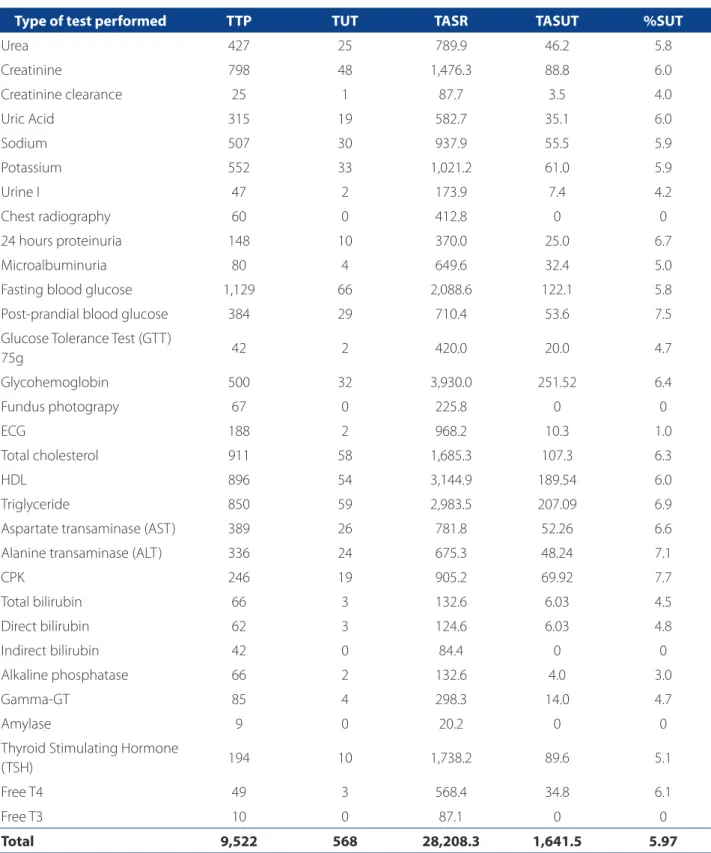
As for laboratory tests performed (Table 3), we ob-served that for 293 patients studied, 9,522 tests were requested (mean of 32.5 tests per patient), of which 568 tests were considered to be unnecessary (nearly 6%), as they were requested outside the period recommended by the SMS protocol or for the same patient in two dif-ferent care units of diff erent levels, in close dates. The the reasons for which patients sought care in other units were not investigated.
Initial diagnoses
NSF3 CSE HC
N % N % N %
SAH 173 60.3 57 46.7 50 57.5
DM 22 7.6 16 13.1 10 11.5
DM + SAH 92 32.1 49 40.2 27 31
Total 287 100 122 100 87 100
Table 1. Patients’ clinical profi le according to the level of treatment (n=496), between 2006 and 2009. Ribeirão Preto, São Paulo, Brazil, 2010.
Source: research data.
NSF3 – Family Health Unit; CSE – Health Center School; HC – Hospital das Clínicas; SAH – Systemic Arterial Hypertension; DM – Diabetes Mellitus.
NSF3 CSE HC NSF3+ CSE CSE + HC HC + NSF3 NSF3 + CSE + HC Total
N % N % N % N % N % N % N %
SAH 93 69.4 1 100 1 33.3 30 42.3 1 50 23 67.6 27 56.3 176
DM 7 5.2 0 0 1 33.3 8 11.3 0 0 2 5.9 5 10.4 23
SAH+DM 34 25.4 0 0 1 33.3 33 46.4 1 50 9 26.5 16 33.3 94
Total 134
100 1
100 3
100 71
100 2
100 34
100 48
100 293
45.7 0.3 1 24.2 0.7 11.6 16.4
Table 2. Patients according to the association of places of treatment (n=293), between 2006 and 2009. Ribeirão Preto, São Paulo, Brazil, 2010.
Type of test performed TTP TUT TASR TASUT %SUT
Urea 427 25 789.9 46.2 5.8
Creatinine 798 48 1,476.3 88.8 6.0
Creatinine clearance 25 1 87.7 3.5 4.0
Uric Acid 315 19 582.7 35.1 6.0
Sodium 507 30 937.9 55.5 5.9
Potassium 552 33 1,021.2 61.0 5.9
Urine I 47 2 173.9 7.4 4.2
Chest radiography 60 0 412.8 0 0
24 hours proteinuria 148 10 370.0 25.0 6.7
Microalbuminuria 80 4 649.6 32.4 5.0
Fasting blood glucose 1,129 66 2,088.6 122.1 5.8
Post-prandial blood glucose 384 29 710.4 53.6 7.5
Glucose Tolerance Test (GTT)
75g 42 2 420.0 20.0 4.7
Glycohemoglobin 500 32 3,930.0 251.52 6.4
Fundus photograpy 67 0 225.8 0 0
ECG 188 2 968.2 10.3 1.0
Total cholesterol 911 58 1,685.3 107.3 6.3
HDL 896 54 3,144.9 189.54 6.0
Triglyceride 850 59 2,983.5 207.09 6.9
Aspartate transaminase (AST) 389 26 781.8 52.26 6.6
Alanine transaminase (ALT) 336 24 675.3 48.24 7.1
CPK 246 19 905.2 69.92 7.7
Total bilirubin 66 3 132.6 6.03 4.5
Direct bilirubin 62 3 124.6 6.03 4.8
Indirect bilirubin 42 0 84.4 0 0
Alkaline phosphatase 66 2 132.6 4.0 3.0
Gamma-GT 85 4 298.3 14.0 4.7
Amylase 9 0 20.2 0 0
Thyroid Stimulating Hormone
(TSH) 194 10 1,738.2 89.6 5.1
Free T4 49 3 568.4 34.8 6.1
Free T3 10 0 87.1 0 0
Total 9,522 568 28,208.3 1,641.5 5.97
Table 3. Laboratory tests collected, percentage of spending with unnecessary tests for patients (N=293) monitored be-tween 2006 and 2009. Ribeirão Preto, São Paulo, Brazil, 2010.
Source: research data.
Legend: TTP = total number of tests performed, TUT = total number of unnecessary tests, TASR = total amount spent in Brazilian reais, TASUT = total amount spent with unnecessary tests = 49,364.53 dollars*, %SUT = percentage of spending with unnecessary tests = 2,872.63 dollars*. (conversion: 1 dollar = 1.75 reais, December 2009)*
In terms of expenses, according to the Unifi ed Health System costs table, resolution 10/2009 of SIGTAP/DATA-SUS (DATASIGTAP/DATA-SUS, 2009), these 9,522 tests cost R$ 28,208.28 to public funds, whereas the expense with 568 unneces-sary exams was R$ 1,641.58, representing 5.97% of the total spending.
The most frequently requested tests were fasting blood glucose (nearly 11.9% of the total), creatinine (nearly 8.4% of the total), followed by total cholester-ol, HDL and triglyceride (9.6%, 9.4% and 9% respec-tively).
The most-requested ested unnecessary tests were CPK (creatine phosphokinase), post-prandial glucose and ALT (aspartate transaminase) (7.7%, 7.5% and 7.1% re-spectively), but the largest expenses, in terms of money, involved requests of glycohemoglobitriglyceride), try-gliceride (R$ 207.00), HDL (R$ 189.50) and fasting blood glucose (R$ 122.10).
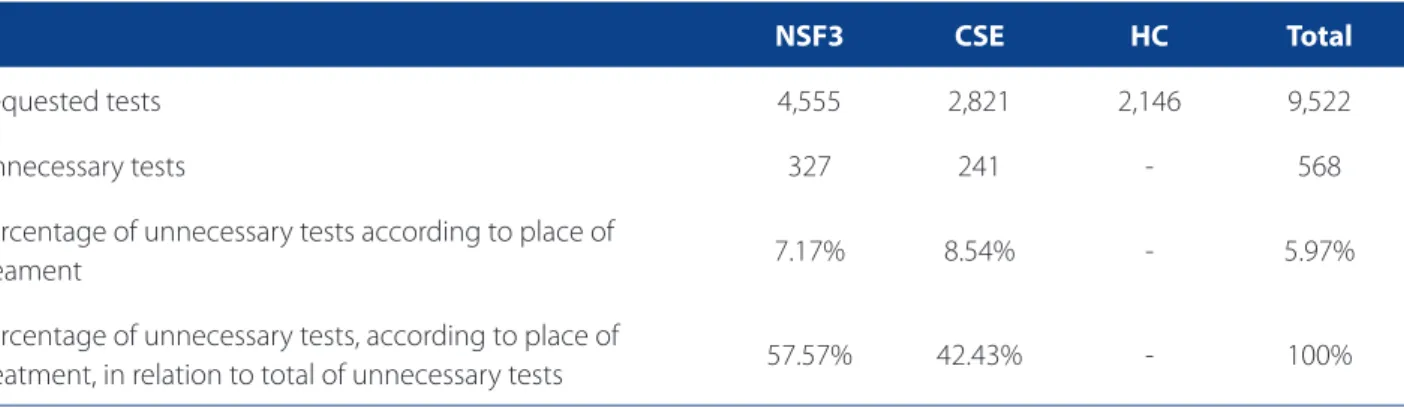
According to Table 4, of the 5.97% of spending on un-necessary tests, NSF3 was responsible for nearly 58% of re-quests, against 42% of requests from CSE. In addition, of the 4,555 tests requested by NSF3, 7.17% were unneeded, whereas in CSE, 8.54% of the 2,821 requested tests were redundant.unnecessary.
The absence of an information system that allows for the communication between health professionals at diff er-ent levels – NSF3, CSE and HC (reference and counter-refer-ence systems) contributed to the request of 5.97% unnec-essary complementary tests.
The results revealed that, within a health system with multidisciplinary services, there is still a lack of care com-prehensiveness through a single clinical record, and this
results in misallocation of resources and unnecessary spending.
DISCUSSION
The costs with complementary tests of 293 patients with diabetes and arterial hypertension of a reference unit in the east side of São Paulo was US$ 49,364.53. Accord-ing to a study conducted in Mexico(8), laboratory tests for patients with DM is among the three highest costs, with a mean of US$ 692.70 for patients hospitalized in an ICU, US$ 396.80 in admission, US$ 240.20 in the outpatient clin-ic, US$ 218.60 in the emergency unit and US$ 137.20 in the surgical center.
Another study carried out in São Paulo showed that 16.5% of the total cost with hypertensive patients corre-sponded to laboratory tests, totaling 66 million dollars, in-cluding drugs and consultations.(5) A study in Recife, Brazil, showed costs with hypertension drugs of R$ 1,195,966, which represents 24.6% of the total cost.(9)
Arterial hypertension is considered to be a major public health problem, accounting for 45% of deaths resulting from heart diseases, totaling 9.4 million deaths over the world. Generally speaking, high-income coun-tries have a lower incidence of hypertension (35%) when compared to medium and low-income countries (40%). In addition, as a result of inefficient or limited health systems, the number of people with undiagnosed, un-treated or poorly controlled SAH is also higher in these locations.(10)
A study conducted in Recife analyzed the costs with care of DM and SAH patients, and the direct cost
NSF3 CSE HC Total
Requested tests 4,555 2,821 2,146 9,522
Unnecessary tests 327 241 - 568
Percentage of unnecessary tests according to place of
treament 7.17% 8.54% - 5.97%
Percentage of unnecessary tests, according to place of
treatment, in relation to total of unnecessary tests 57.57% 42.43% - 100%
Table 4. Relationship between requested and unnecessary tests, according to the place of treatment (n=293), between 2006 and 2009. Ribeirão Preto, São Paulo, Brazil, 2010.
and the amount reimbursed by the SUS totaled R$ 4,855,291.82 and R$ 2,118,893.56, respectively. The items or services with the highest expenditures were: drugs (R$ 1,762,424.42 – 36.3%), third-party services (R$ 996,637.82 – 20.5%) and personnel (R$ 978,096.10 – 20.1%). All proce-dures had a higher estimate cost than the actual amounts paid by the SUS table.(9)
As a result of the growing concern with high costs in CNCS, studies are showing the great impact of costs with patients with diabetes and arterial hypertension. Most health systems are organized so as to provide care to isolat-ed cases and in an unstructurisolat-ed manner, without focusing on coordinated and continuous care, which is essential for CNCS management.
For CNCS prevention and treatment, regardless of the level of care, it is paramount to have an adequate informa-tion system, as well as the broad consensus among health professionals, patients and family, in order to establish a “shared care”(11:57-76) with the aim to achieve better quality and access to health care.
In this sense, some factors like overvaluation of lab-oratory tests to the detriment of physical examination or clinical history, defensive attitude of medical staff, professional insecurity or inexperience, shorter med-ical consultations, influence of media and conflicts of interest, lack of knowledge of procedures and lack of communication/integration between health services contributed to the growth of demand for complemen-tary tests that help diagnosis and clinical treatment.(12) However, medical recommendations must be based on the epidemiological situation and on regularly reviewed protocols(13), thus preventing the excess of laboratory test requests, which are expensive and could be better used in health services.(12)
Therefore, in this context, the analyses of costs – wheth-er they are related to matwheth-erials, pwheth-ersonnel, structure and/ or procedures – must result in streamlining and reducing costs, and also as a means of better using and prioritizing fi nancial resources in order to achieve eff ectiveness of health care services.
FINAL CONSIDERATIONS
To search for new strategies of cost reduction, to lower the number of hospitalizations, to fight health issues and to achieve effectiveness of resources used in health services become the focus of health service managers; however, most CNCD programs basically focus on the disease and neglect care models that
work in an integrated fashion and focus on patients’ needs.
Therefore, the calculation of expenditures made the poor allocation of resources evident represents an import-ant strategy to assess the CNCD care process, which is still infl uenced by the hospital-centered and biomedical mod-el, to the detriment of promotion of primary health care, which is the SUS gateway.
In that sense, in order to consolidate the principles of SUS, and considering the access and comprehensive-ness of care services, it is necessary to organize integrated healthcare services by means of care networks that work in an articulated manner, with all levels involved, where reference and counter-reference systems are eff ective and strategic in the process of care management. These weak-nesses, clearly shown throughout this study, suggest the need for further research and discussion of the subject in order to put in place the epistemological aspects that guide the SUS.
REFERENCES
1. Ministério da Saúde (BR), Secretaria de Atenção à Saúde, Departamento de Atenção Básica. Diretrizes para o cuidado das pessoas com doenças crôni-cas nas redes de atenção à saúde e nas linhas de cuidado prioritária. Brasília; 2013.
2. Bloom DE, Cafi ero ET, Jané-Llopis E, Abrahams-Gessel S, Bloom LR, Fathima S, et al. The global economic burden of non-communicable diseases. Geneva: World Economic Forum; 2011.
3. Federação Internacional de Diabetes. Atlas de la diabetes de la FID [Internet]. 5. ed. Brussels; 2012 [citado 2013 mar 03]. Disponível em: www.idf.org/diabete-satlas.
4. Organización Mundial de Salud. Estadísticas sanitarias mundiales: una instantá-nea de la salud mundial [Internet] Ginebra; 2012 [citado 2013 mar 03]. Disponí-vel em: http://apps.who.int/iris/bitstream/10665/44858/1/9789243564449_ spa.pdf?ua=1
5. Dib MW, Riera R, Ferraz MB. Estimated annual cost of arterial hypertension treatment in Brazil. Rev Panam Salud Publica. 2010;27(2):125-31.
6. Santos IS, Victora CG. Serviços de saúde: epidemiologia, pesquisa e avaliação. Cad Saúde Pública 2004; 20 Suppl 2:337-41.
7. Ministério da Saúde (BR), Secretaria de Atenção à Saúde, Departamento de Atenção Básica. Diabetes mellitus. Brasília, 2006. Cadernos de Atenção Básica, 16.
8. Rodríguez BRA, Reynales SLM, Jiménez RJA, Juárez MSA, Hernández AM. Cos-tos direcCos-tos de atención médica en pacientes con diabetes mellitus tipo 2 en México: análisis de microcosteo. Rev Panam Salud Publica. 2010;28(6):412-20.
10. World Health Organization. A global brief on hypertension: world health day 2013 [Internet]. Geneva; 2013 [citado 2013 abr 05]. Disponível em: http://apps.who. int/iris/bitstream/10665/79059/1/WHO_DCO_WHD_2013.2_eng.pdf?ua=1 11. Casajuana-Brunet J. Cordinación entre atención primaria y atención
especia-lizada. In: Casajuana-Brunet J. Gestión del día a día en el equipo de atención primaria. Barcelona: SEMFYC Ediciones; 2007. p. 57-76.
12. Aguiar FJB, Ferreira-Júnior M, Sales MM, Cruz-Neto LM, Fonseca LAM, Sumita NM, et al. Proteína C reativa: aplicações clínicas e propostas para utilização racional. Rev Assoc Med Bras [Internet]. 2013 [citado 2013 out 27];59(1):85-92.
13. Moura A, Viriato A. Gestão hospitalar: da organização ao serviço de apoio diag-nóstico e terapêutico. Barueri: Manole; 2008. p.105.
Author’s address:
Marli de Carvalho Jericó
Rua Benjamin Constant, 4035/91, Vila Imperial 15015-600, São José do Rio Preto, SP
E-mail: [email protected]