Correlation of the EuroSCORE with the onset of
postoperative acute kidney injury in cardiac surgery
INTRODUCTION
Acute kidney injury (AKI) in the postoperative period after cardiac surgery has long been known to be a prevalent and severe complication.(1) his disorder persists despite technological advances in extracorporeal circulation, intensive care and intra- and postoperative practices. Research and identiication in the preoperative period are inadequate, as they are mostly subclinical. herefore, research and identiication are potential sources of postoperative morbidity and mortality.
Edmilson Bastos de Moura1, Saint-Clair Gomes Bernardes Neto2, Fábio Ferreira Amorim3, Renato Camargo Viscardi1
1. Intensive Care Unit, Hospital de Base do Distrito Federal - HBDF - Brasília (DF), Brasil. 2. Universidade Católica de Brasília - UCB - Brasília (DF), Brasil.
3. Escola Superior de Ciências da Saúde - ESCS - Brasília (DF), Brasil.
Objective: he objective of this study was to assess the correlation between the European System for Cardiac Operative Risk Evaluation (EuroSCORE) score and the risk of developing acute kidney injury in cardiac surgery patients.
Methods: his retrospective study was conducted at a tertiary hospital on consecutive cardiac surgery patients (e.g., valvular, ischemic and congenital heart diseases) between October 2010 and July 2011.
Results: One hundred patients were assessed. Among the 100 patients, six were excluded, including ive because of prior kidney disease or dialysis therapy and one because of incomplete medical records. he primary surgical indications were myocardial revascularization in 55 patients (58.5% of cases) and valve replacement in 28 patients (29.8%). According to the EuroSCORE, 55 patients were classiied as high risk (58.5%), 27 patients as medium risk (28.7%) and 12 patients as low risk (12.8%). In the postoperative period, patients were classiied with the Risk, Injury, Failure, Loss and End-stage kidney
disease (RIFLE) score. Among the 31 patients (33%) who displayed an increase in serum creatinine, 18 patients (19.1%) were classiied as RIFLE “R” (risk), seven patients (7.4%) were classiied as RIFLE “I” (injury) and six patients (6.5%) were classiied as RIFLE “F” (failure). Among the patients who were considered to be high risk according to the EuroSCORE criteria, 24 patients (43.6%) showed acute kidney injury. Among the patients who were classiied as medium or low risk, acute kidney injury occurred in 18.5 and 16.6% of the cases, respectively. he correlations between risk stratiication (low, medium and high) and the EuroSCORE and postoperative RIFLE scores were statistically signiicant (p=0.03).
Conclusion: In the studied population, there was a statistically signiicant correlation between the EuroSCORE and the risk of developing acute kidney injury in the postoperative period after cardiac surgery.
This study was conducted at the Hospital de Base do Distrito Federal - HBDF - Brasília (DF), Brazil
Conflicts of interest: None.
Submitted on November 2, 2012 Accepted on January 21, 2013
Corresponding author:
Edmilson Bastos de Moura SHLS 716, conjunto E, Asa Sul Zip code: 70390-903 - Brasília (DF), Brazil E-mail: [email protected]
Correlação do EuroSCORE com o surgimento de lesão renal aguda
pós-operatória em cirurgia cardíaca
ABSTRACT
Keywords: Acute kidney injury;
horacic surgery; Postoperative complications; Renal dialysis; Severity of illness index; Risk assessment
he laboratory screening for kidney injury in the general population is performed by measuring plasma creatinine levels and plasma creatinine clearance levels, which relect the glomerular iltration rate. Compared to more promising biomarkers, serum creatinine ofers a relatively late diagnosis of kidney injury in critically ill patients,(2,3) but serum creatinine measurements are essential within the Brazilian public healthcare system, as these tests are afordable and widely available in laboratories.
he use of serum creatinine for AKI classiication was standardized with the establishment of the Risk, Injury, Failure, Loss and End-stage kidney disease (RIFLE) score,(4) which assists researchers and clinicians in classifying the severity of renal injury. here are two RIFLE criteria: serum creatinine at hospital admission and variation in the absolute value of serum creatinine. he patient may fulill one or both of the criteria, and the criterion that leads to the worst classiication should always be used.
When a preexisting kidney injury is suspected in the preoperative period of cardiac surgery, patients are commonly subjected to an assessment of renal function. he assessment is necessary because of the high prevalence of AKI (41.3%) that is associated with the surgery.(5) he diseases that cause silent renal alterations (e.g., hypertension and diabetes mellitus) are common comorbidities in cardiac patients with advanced age. Even without a known association with AKI, the postoperative increase in creatinine is associated with a worse prognosis in patients who underwent cardiac surgery for valve replacement.(6)
here is no standard to determine which individuals should be subjected to preoperative screening for previous renal dysfunction, and there is no deinition of the level of preoperative renal dysfunction (which is provided by changes in serum creatinine or serum creatinine clearance levels); however, the level of preoperative renal dysfunction may have a negative efect on the postoperative outcome. herefore, preoperative conditions in cardiac surgery patients who had not been diagnosed with nephropathy were correlated by correlating the European System for Cardiac Operative Risk Evaluation (EuroSCORE) score with the onset of postoperative AKI, which was deined by the RIFLE score.
METHODS
his retrospective study was performed at the Hospital de Base do Distrito Federal (HBDF), which is a tertiary institution of the Distrito Federal public health system. he study relied on pre- and postoperative data from patients who were consecutively admitted to the hospital
with surgical indications for heart disease (e.g., valvular, ischemic and congenital types). he following inclusion criteria were used: adult subjects with an indication for cardiac surgery, the absence of previous nephropathy and clinically and laboratory conirmed results (considering serum creatinine levels of more than 1.3mg/dL and/or
a creatinine clearance of less than 75mL/min/1.73m2 in
women or 80mL/min/1.73m2 in men). he exclusion
criteria were the presence of diagnosed kidney disease, the use of any form of renal replacement therapy prior to surgery and missing information in the medical records. he study was approved by the institution Research and Ethics Committee under number 349,630 that waived the need of informed consent due to its observational nature.
he following information was collected from the patient medical records: (1) epidemiological data, including age and gender; (2) clinical history data, including the presence of chronic obstructive pulmonary disease (COPD), extracardiac arteriopathy (a Doppler examination of the cervical vessels), neurological dysfunction, previous cardiac surgery, critical preoperative state, unstable angina, recent acute myocardial infarction (less than 90 days), the need for renal replacement therapy during hospitalization and death during the intensive care unit (ICU) stay; (3) echocardiogram data, including the presence of active endocarditis, left ventricular function and pulmonary hypertension; (4) factors associated with surgery, including the emergency procedure, revascularization surgery associated with valve surgery or corrections of a congenital defect, surgery of the thoracic aorta and the presence of a septal rupture after the myocardial infarction; and (5) laboratory data, including preoperative (the baseline creatinine clearance was calculated using the Cockcroft-Gault equation) and maximum creatinine levels (using the Jafé method) during the ICU stay.
Based on the obtained data, the logistic and standard EuroSCORE was calculated, and the risk was classiied as low, medium or high (scores of 0 to 2, 3 to 5 and 6 or more, respectively).
he results were subjected to the following statistical tests: Pearson’s chi-squared tests for categorical variables (gender, type of surgery, RIFLE score, progression to hemodialysis and death), one-way ANOVA tests for continuous variables with normal distributions (age, extracorporeal circulation time and serum creatinine levels) and the Kruskal-Wallis H test for continuous variables without a normal distribution (length of ICU stay). he software Statistical Package for the Social Sciences (SPSS) version 19.0 was used.
RESULTS
One hundredpatients were admitted to the ICU and
assessed from October 2010 to July 2011. Six patients were excluded, including ive who had previous kidney disease or dialysis therapy and one who had incomplete medical records. A total of 94 patients remained in the study, including 63 patients (67%) who had no change in the baseline serum creatinine (less than 50%) during the ICU stay. he other 31 patients (33%) showed increases in creatinine that could be classifying according to the RIFLE score: 18 were classiied as “R” (19.1%), seven were classiied as “I” (7.4%) and six were classiied as “F” (6.5%). According to the RIFLE score criteria, one-third of the patients (33%) had some form of AKI (Figure 1).
septal defect repairs, 7.4%; one ventricular septal defect repair, 1.1%; and one resection of the subaortic membrane, 1.1%) and left ventricular aneurysmectomies in two patients (2.1%). Nine surgeries (9.5%) were emergencies, eight (8.5%) of which were myocardial revascularizations and one (1%) of which was a surgical replacement of a mechanical aortic valve prostheses with acute dysfunction.
he EuroSCORE classiied 58.5% of the patients as high risk, 28.7% of the patients as medium risk and 12.8% of the patients as low risk (n=55, 27 and 12 patients, respectively). here were ive deaths in the sample population (5.3%). he data are summarized in table 1.
Figure 1 - Distribution of the patient sample according to the presence or absence of acute kidney injury and the RIFLE classification (R, I and F).
here was a prevalence of males in the sample (54 patients, 57.4%). he average age was 55.3±16.5 years, and the average length of ICU stay was 8.2±11.4 days (range, 2 to 89 days). he surgical indications were myocardial revascularization in 55 patients (58.5%), valve replacement in 28 patients (29.8%), congenital heart disease corrections in nine patients (seven atrial
Table 1 - Epidemiological, laboratory and echocardiographic data
Variables Results
Gender
Male 54 (57.4)
Female 40 (42.6)
Age (years) 55.3±16.5
Type of surgery
Revascularization 55 (58.5)
Valve 28 (29.8)
Congenital 9 (9.6)
Others 2 (2.1)
ECC time (minutes) 106.3±49.6
EuroSCORE
Logistic 11±14
Standard 6.4±3.6
EuroSCORE - Risk
Low 12 (12.8)
Medium 27 (28.7)
High 55 (58.5)
Baseline creatinine clearance (mL/min/1.73 m2) 78.7±26.3 Creatinine
Baseline 0.9±0.2
IPO 1.0±0.3
Maximum 1.5±1.0
RIFLE score
Risk 18 (19.1)
Injury 7 (7.4)
Failure 6 (6.5)
Length of ICU stay (days) 8.2±11.4
Hemodialysis 6 (6.5)
Death 5 (5.3)
In the group that was classiied as high risk by the
EuroSCORE criteria (58.5% of the cases), 24 patients
(43.6%) showed some type of acute kidney injury. In the medium- and low-risk groups, AKI was present in 18.5 and 16.6% of the cases, respectively.
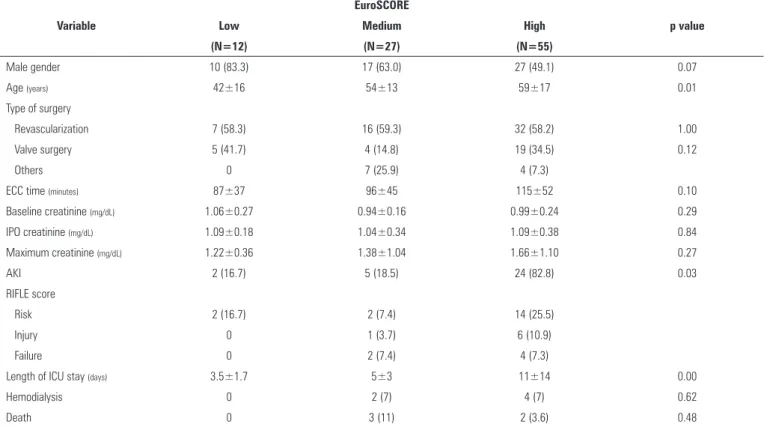
Using the EuroSCORE classiication, the sample of patients was divided into three groups (Table 2). In the postoperative period after cardiac surgery, a Pearson’s chi-squared test showed a statistically signiicant correlation between the EuroSCORE risk stratiication (low, medium and high) and the onset of AKI (p=0.03). here was also a statistically signiicant correlation between the EuroSCORE classiication and the length of ICU stay (p=0.00). No other signiicant correlations were found in the analysis.
DISCUSSION
he causes of postoperative kidney injury after cardiac surgery can be attributed to the use of extracorporeal circulation that is associated with non-pulsatile blood low, renal hypoperfusion and hypothermia.(7) In addition to this factor, the nephrotoxic efects of pre-, trans- and postoperative drug use must be considered.
he AKI that was observed in patients who were classiied as high risk by the EuroSCORE (43.6%) surpassed the AKI that was identiied in the medium- and low-risk patients (18.5% and 16.6%, respectively). None of the patients in this sample were subjected to a detailed evaluation of renal function; that is, their kidney function was considered to be within acceptable parameters. Many kidney injuries are subclinical, as the operative risk underestimates renal changes by only valuing the serum creatinine level without a concomitant functional evaluation. Consistent with this observation, the present
creatinine clearance was78.7±26.3mL/min/1.73m2in the
total sample, and the clearance in the high-risk patients
was 71.1±22.7mL/min/1.73m2. In the postoperative
period after cardiac surgery, there are possible independent risk factors associated with the onset of AKI, such as blood components and re-surgeries. A lack of this information was identiied as a limitation of the present study.
Using the RIFLE score, AKI was detected in 33% of the patients. Antunes et al. obtained a value of 5.6% (which they classiied as postoperative renal dysfunction), and they deined renal dysfunction as postoperative serum creatinine levels of more than 2.1mg/dL and an increase of 0.9mg/dL from the baseline level.(7) Using the RIFLE
Table 2 - Epidemiological and laboratory data of the studied population: comparison based on the EuroSCORE classification
Variable
EuroSCORE
p value
Low Medium High
(N=12) (N=27) (N=55)
Male gender 10 (83.3) 17 (63.0) 27 (49.1) 0.07
Age (years) 42±16 54±13 59±17 0.01
Type of surgery
Revascularization 7 (58.3) 16 (59.3) 32 (58.2) 1.00
Valve surgery 5 (41.7) 4 (14.8) 19 (34.5) 0.12
Others 0 7 (25.9) 4 (7.3)
ECC time (minutes) 87±37 96±45 115±52 0.10
Baseline creatinine (mg/dL) 1.06±0.27 0.94±0.16 0.99±0.24 0.29
IPO creatinine (mg/dL) 1.09±0.18 1.04±0.34 1.09±0.38 0.84
Maximum creatinine (mg/dL) 1.22±0.36 1.38±1.04 1.66±1.10 0.27
AKI 2 (16.7) 5 (18.5) 24 (82.8) 0.03
RIFLE score
Risk 2 (16.7) 2 (7.4) 14 (25.5)
Injury 0 1 (3.7) 6 (10.9)
Failure 0 2 (7.4) 4 (7.3)
Length of ICU stay (days) 3.5±1.7 5±3 11±14 0.00
Hemodialysis 0 2 (7) 4 (7) 0.62
Death 0 3 (11) 2 (3.6) 0.48
Objetivo: Veriicar se há correlação entre valores do EuroSCORE e o risco de desenvolver lesão renal aguda em pacientes submetidos à cirurgia cardíaca.
Métodos: Estudo retrospectivo, realizado em hospital terci-ário, em pacientes consecutivos com indicação para abordagem cirúrgica cardíaca (valvares, isquêmicas e congênitas) entre ou-tubro de 2010 a julho de 2011.
Resultados: Foram avaliados cem pacientes. Destes, seis foram excluídos (cinco por doença renal ou terapia dialítica
prévias e um devido a informações incompletas no prontuário médico). As principais indicações cirúrgicas foram revasculari-zação miocárdica em 55 pacientes (58,5% dos casos) e trocas valvares em 28 pacientes (29,8%). Conforme o EuroSCORE, 55 pacientes foram classiicados como risco alto (58,5%), 27 pacientes como risco médio (28,7%) e 12 pacientes como risco baixo (12,8%). No período pós-operatório, 31 pacientes (33%) evoluíram com aumento da creatinina sérica (18 (19,1%) RIFLE “R”; 7 (7,4%) RIFLE “I”; e 6 (6,5%) RIFLE “F”). Na amostra considerada de alto risco pelos critérios do EuroSCORE, 24
RESUMO
score, Machado et al. identiied 48.7% of their patients as having AKI.(8) Various studies have signiicant variation in the incidence of AKI, which is likely because of conlicting deinitions ofcardiac surgery-associated acute
kidney injury (CSA-AKI).(9) he present study conirms
the high prevalence of this complication in this group of patients and highlights the importance of early detection and adequate treatment. Nevertheless, the incidence of patients who require hemodialysis remains low (6.5% in our series), which is consistent with the literature.(10)
he association between preoperative conditions and postoperative outcomes has been the subject of several
publications. Roques et al. were the precursors of the
EuroSCORE, which is a widely used predictor of hospital mortality that was created by the European Association of
Cardiothoracic Surgery.(11-13) Although the EuroSCORE
contains information related to renal function,(14,15)
there are no studies showing the association between the EuroSCORE’s level of preoperative risk and the level of postoperative renal dysfunction.
Among patients who underwent cardiac surgery, D’Onofrio et al.(16) showed a correlation between risky preoperative factors and the development of postoperative AKI. he present study only used the RIFLE criteria for the maximum level of postoperative serum creatinine. When assessing the preoperative risk factors, some of the factors are included in the EuroSCORE classiication (e.g., age, peripheral arterial disease, left ventricular ejection fraction and thoracic aorta surgery). Some of the risk factors that were identiied by Perez-Valdivieso et al.,(17) such as low left ventricular ejection fraction and emergency surgery, are also found in the EuroSCORE.
For detecting declining renal function, the relevance and sensitivity of progressive changes in serum creatinine are highlighted in the review of studies on CSA-AKI
conducted by Shaw et al.(10) With no mention of
the minimum urinary output that is achieved in the postoperative period after cardiac surgery, the authors emphasize that the rising serum creatinine levels may be a relevant parameter in the progression to AKI. As highlighted in the work of Prowle et al.,(18) the oliguria (urine output lower than 0.5mL/kg/h) is not a reliable marker of AKI but may serve as a precursor in the use of early biomarkers of kidney injury.
Despite the identiication of several early preventive strategies of AKI post-cardiac surgery,(19) many of the strategies have not yet reached statistical power to be validated as guidelines. he risk assessment of AKI onset in these patients should be actively performed with the screening and identiication of candidate risk factors.
he modiiable risk factors should be optimized,(17) and
speciic perioperative protocols should be created for these patients, which will minimize the emergence of AKI. Knowledge of the speciicities and background of patients should be combined with risk scores to guide surgery, anesthesia and ICU teams in each case.
his study has several limitations, including a small patient sample size and the retrospective analysis of information from medical records. hese limitations prevented the acquisition of relevant information, such as the use of blood derivatives. Furthermore, the sample size did not allow the use of a multivariate analysis.
CONCLUSION
Descritores: Lesão renal aguda; Cirurgia torácica; Complicações pós-operatórias; Diálise renal; Índice de gravidade de doença; Medição de risco
REFERENCES
1. Abel RM, Buckley MJ, Austen WG, Barnett GO, Beck CH Jr, Fischer JE. Etiology, incidence, and prognosis of renal failure following cardiac operations. Results of a prospective analysis of 500 consecutive patients. J Thorac Cardiovasc Surg. 1976;71(3):323-33.
2. Westhuyzen J, Endre ZH, Reece G, Reith DM, Saltissi D, Morgan TJ. Measurement of tubular enzymuria facilitates early detection of acute renal impairment in the intensive care unit. Nephrol Dial Transplant. 2003;18(3):543-51.
3. Mishra J, Dent C, Tarabishi R, Mitsnefes MM, Ma Q, Kelly C, et al. Neutrophil gelatinase-associated lipocalin (NGAL) as a biomarker for acute renal injury after cardiac surgery. Lancet. 2005;365(9466):1231-8. Comment in Lancet. 2005;365(9466):1205-6.
4. Bellomo R, Ronco C, Kellum JA, Mehta RL, Palevsky P; Acute Dialysis Quality Initiative workgroup. Acute renal failure - definition, outcome measures, animal models, fluid therapy and information technology needs: the Second International Consensus Conference of the Acute Dialysis Quality Initiative (ADQI) Group. Crit Care. 2004;8(4):R204-12. Comment in Crit Care. 2007;11(2):411.
5. Yehia M, Collins JF, Beca J. Acute renal failure in patients with pre-existing renal dysfunction following coronary artery bypass grafting. Nephrology (Carlton). 2005;10(6):541-3.
6. Anderson RJ, O’Brien M, MaWhinney S, VillaNueva CB, Moritz TE, Sethi GK, et al. Mild renal failure is associated with adverse outcome after cardiac valve surgery. Am J Kidney Dis. 2000;35(6):1127-34.
7. Antunes PE, Prieto D, Ferrão de Oliveira J, Antunes MJ. Renal dysfunction after myocardial revascularization. Eur J Cardiothorac Surg. 2004;25(4):597-604.
8. Machado MN, Miranda RC, Takakura IT, Palmegiani E, Santos CA, Oliveira MA, et al. Lesão renal aguda após revascularização do miocárdio com circulação extracorpórea. Arq Bras Cardiol. 2009;93(3):247-52.
9. Hoste EA, Cruz DN, Davenport A, Mehta RL, Piccinni P, Tetta C, et al. The epidemiology of cardiac surgery-associated acute kidney injury. Int J Artif Organs. 2008;31(2):158-65.
pacientes (43,6%) apresentaram comprometimento renal agu-do. Nos pacientes classiicados como de médio e de baixo risco, ocorreu lesão renal aguda em 18,5 e 16,6% dos casos, respecti-vamente. A associação entre a estratiicação de risco (baixo, mé-dio e alto) do EuroSCORE e o escore do RIFLE pós-operatório foi estatisticamente signiicante (p=0,03).
Conclusão: Na população estudada, houve correlação es-tatisticamente signiicante entre o EuroSCORE e o risco de desenvolvimento de lesão renal aguda no pós-operatório de cirurgia cardíaca.
10. Shaw A, Swaminathan M, Stafford-Smith M. Cardiac surgery-associated acute kidney injury: putting together the pieces of the puzzle. Nephron Physiol. 2008;109(4):55-60.
11. Roques F, Nashef SA, Michel P, Gauducheau E, de Vincentiis C, Baudet E, et al. Risk factors and outcome in European cardiac surgery: analysis of the EuroSCORE multinational database of 19030 patients. Eur J Cardiothorac Surg. 1999;15(6):816-22; discussion 822-3.
12. Roques F, Nashef SA, Michel P; EuroSCORE study group. Risk factors for early mortality after valve surgery in Europe in the 1990s: lessons from the EuroSCORE pilot program. J Heart Valve Dis. 2001;10(5):572-7; discussion 577-8.
13. Roques F, Michel P, Goldstone AR, Nashef SA. The logistic EuroSCORE. Eur Heart J. 2003;24(9):882-3
14. Guaragna JC, Bodanese LC, Bueno FL, Goldani MA. Proposta de escore de risco pré-operatório para pacientes candidatos à cirurgia cardíaca valvar. Arq Bras Cardiol. 2010;94(4):541-8.
15. Shahian DM, O’Brien SM, Filardo G, Ferraris VA, Haan CK, Rich JB, Normand SL, DeLong ER, Shewan CM, Dokholyan RS, Peterson ED, Edwards FH, Anderson RP; Society of Thoracic Surgeons Quality Measurement Task Force. The Society of Thoracic Surgeons 2008 cardiac surgery risk models: part 3--valve plus coronary artery bypass grafting surgery. Ann Thorac Surg. 2009;88(1 Suppl):S43-62.
16. D’Onofrio A, Cruz D, Bolgan I, Auriemma S, Cresce GD, Fabbri A, et al. RIFLE criteria for cardiac surgery-associated acute kidney injury: risk factors and outcomes. Congest Heart Fail. 2010;16 Suppl 1:S32-6. 17. Perez-Valdivieso JR, Monedero P, Vives M, Garcia-Fernandes N,
Bes-Rastrollo M; GEDRCC (Grupo Español de Disfunción Renal en Cirugía Cardiaca). Cardiac-surgery associated acute kidney injury requiring renal replacement therapy. A Spanish retrospective case-cohort study. BMC Nephrol. 2009;10:27.
18. Prowle JR, Liu YL, Licari E, Bagshaw SM, Egi M, Haase M, et al. Oliguria as a predictive biomarker of acute kidney injury in critically ill patients. Crit Care. 2011;15(4):R172.