Motor physical therapy in hospitalized patients in
an intensive care unit: a systematic review
Fisioterapia motora em pacientes internados na unidade de
terapia intensiva: uma revisão sistemática
INTRODUCTION
he care provided by health professionals is aimed to restore the clinical condition of patients and return them to their normal lives and quality of life. However, critically ill patients with unstable conditions, poor prognosis and high risk of death, represent a diferent challenge; the goal of care in such cases focuses on maintaining the patient’s life, often with no estimate for discharge.(1) Immobility, physical deconditioning and muscle weakness often become pro-blems that are associated with greater disability and prolonged rehabilitation.(2) Muscular weakness in critically ill patients presents in a difuse and symme-trical form, involving appendicular and axial striated skeletal musculature. he Alessandra Rigo Pinheiro1, Gustavo Christofoletti2
1. Multidisciplinary Residency Program in Health, Federal Universidade Federal de Mato Grosso do Sul – UFMS – Campo Grande (MS), Brazil. 2. Multidisciplinary Residency Program in Health, Universidade Federal de Mato Grosso do Sul – UFMS – Campo Grande (MS), Brazil; Sensu Strictu Post-Graduate Program in Health and Development of the Mid West Region – Campo Grande (MS), Brazil.
ABSTRACT
Objective: To analyze the outcomes achieved by motor physical therapy in critically ill patients admitted to inten-sive care units.
Methods: A systematic literatu-re literatu-review was performed, and clinical trials published between 2002 and 2011 were included in the study. he search involved the LILACS, SciELO, MedLine, EMBASE and Cochrane da-tabases, using the keywords “intensive care unit”, “physiotherapy”, “physical therapy”, “mobility”, “mobilization” and “randomized controlled trials.” Two researchers screened the articles independently and included works that addressed the efect of physical therapy on critically ill patients.
Results: From an initial analysis of 67 potentially relevant articles, only 8 met the selection criteria and addressed the outcomes of electrostimulation, cycle ergometry and kinesiotherapy techniques. he sample sizes ranged from 8 to 101 subjects, with mean ages
between 52 and 79 years. All patients were undergoing invasive mechanical ventilation. Among the analyzed arti-cles, 6 reported signiicant beneits of motor physical therapy, such as impro-vement in peripheral muscle strength, respiratory capacity and functionality, in critically ill patients.
Conclusion: With this systema-tic review, it is possible to conclude that motor physical therapy is a fea-sible and safe therapy for critically ill patients and can minimize the deleterious efects of prolonged im-mobilization. Approaches involving electrostimulation, cycle ergometry and kinesiotherapy showed positive responses in patients under intensive care. Available evidence regarding the impact of motor physical therapy on length of stay in intensive care units and on mortality is still scarce, and further study in this area is warranted.
Keywords: Intensive care units, Intensive care, Early deambulation; Exercise therapy; Muscular atrophy
Conflicts of interest: None.
Submitted on November 5, 2011 Accepted on March 29, 2012
Corresponding author:
Alessandra Rigo Pinheiro Travessa Itaporã, 51 - BNH
proximal muscle groups are generally more afected than distal muscles, with variable involvement of deep tendon relexes and sensory-motor innervation.(3) Polyneuropathy is quite common in critically ill patients undergoing me-chanical ventilation (MV) in intensive care units (ICU) for more than 7 days; it afects 25.3% of patients.(4) his inding is important because neuropathy is responsible for prolonging the duration of mechanical ventilation and the patient’s length of stay in the ICU.(5)
here are several factors that may contribute to the occurrence of neuropathy in critically ill patients. Chief among them are advanced age in females, diabetes melli-tus, metabolic abnormalities, hyponatremia, hyperure-mia, hyperglycehyperure-mia, prolonged use of medications (such as corticosteroids, sedatives and neuromuscular blockers), dysfunction of two or more organs, MV, long stays in the
ICU and immobility.(6,7) he diagnosis of neuropathic
disorders is complex and is hampered by patients’ level of consciousness, which in many cases is reduced due to sedation and which makes them unable to cooperate in testing and evaluation. It thus becomes necessary to use complementary tests to complete the clinical diagnosis.(6)
here is currently no efective therapy available for the treatment of neuropathy in critically ill patients. Howe-ver, using a multidisciplinary approach, there are indica-tions that physical therapy is an efective aid to patient recovery. Healthcare professionals in this context must go beyond “just treating” and use prophylactic measures to prevent musculoskeletal complications in the patient. To ensure a better functional status of individuals sufering from critical illness neuropathy, it is important to adopt a multi-therapeutic approach, including tight glycemic con-trol, appropriate nutrition, early mobilization, supericial sedation, precautionary use of steroids and neuromuscular blocking agents.(6-9)
Recent studies show that more attention has been paid to early mobilization of the critically ill patient, as it is an intervention that is considered safe and feasible following cardiorespiratory and neurological stabilization and that rarely causes adverse reactions. Early mobilization is used by many physiotherapists and should be applied daily to critically ill but stable patients in the ICU, including those who are bedridden and unconscious (under MV), those who are conscious and those who are able to walk indepen-dently.(9,10) However, despite evidence showing that early mobilization of the patient reduces the deleterious efects of immobility and thereby provides a better clinical
outco-me for individuals,some healthcare professionals remain
reluctant to mobilize patients under MV and ultimately restrict them to inactivity.(11-14) Some hospitals choose to
start such therapy only after the patient is discharged from the ICU, as many professionals are unaware that critically ill patients are not necessarily “too sick” to tolerate exercise in the initial treatment phase.(13-15)
In keeping with the above reasoning, studies indica-te improvement in critically ill patients undergoing early motor physical therapy. Positive indicators promoted by the motor approach include improvement in functional status, faster recovery of the ability to leave bed and deam-bulate and shorter hospital stay.(9,10)
Some researchers argue that not all risks associated with early mobilization are well deined and that, despite the fact that beneits of physical therapy in critically ill pa-tients have been found in some scientiic studies, there are few randomized controlled studies involving a representa-tive sample size.(14,15) here is also still some disagreement in the scientiic literature about the best type of activity, the optimum treatment duration and the frequency of ac-tivity for critically ill patients during their hospitalization.
No meta-analyses or systematic literature reviews were found in the Cochrane library that demonstrate the bene-it of motor physical therapy in crbene-itically ill adult patients being treated in an intensive care setting. hus, this study aims to conduct a systematic review of the literature to clarify the outcomes provided by the completion of motor physical therapy in critically ill adult patients being trea-ted in ICUs.
METHODS
Identification and selection criteria
A search for articles involving the required clinical outcome was performed on the following databases: La-tin American and Caribbean Health Sciences Literature (Literatura Latino-Americana e do Caribe em Ciências da Saúde - LILACS), Scientiic Electronic Library Onli-ne (SciELO), Medical Literature Analysis and Retrieval System Online (MedLine/PubMed), Biomedical Answers (EMBASE) and the Cochrane Library. Articles were ob-tained using the following keywords: “intensive care unit”, “physiotherapy”, “physical therapy”, “mobility”, “mobili-zation” and “randomized controlled trials”, employing the Boolean descriptors “and”, “not” and “and not”. Additio-nal studies were identiied through a manual search of re-ferences obtained from these articles.
abs-tracts, dissertations, theses and case reports were excluded, as were studies using animal models.
Evaluation of study validity
he titles and abstracts of articles identiied by the se-arch strategy were blindly assessed by two independent researchers. Studies that met the inclusion criteria were evaluated using the Physiotherapy Evidence Database
(PEDro) scale.(16) his instrument was developed by the
Australian Physiotherapy Association and is recognized worldwide. It aims to quantify the quality of publications that include randomized and controlled clinical trials, the-reby acting as a guide to the merit of each publication and facilitating the rapid identiication of studies containing suicient information for professional practice.
he PEDro scale assesses tests using 11 pre-established items. he irst item is an additional criterion and repre-sents the external validity (“potential for generalization” or “applicability”) of the trial; it is not included in the total score. he other items examine two aspects of the article’s quality: internal validity (items 2-9) and whether the arti-cle contains suicient statistical information for the results to be interpreted (items 10 and 11). hese items are rated as “applicable” or “not applicable”, generating a total score ranging from 0 to 10 points.(17)
To ascertain the methodological quality and rigor of the selected articles, they were analyzed and classiied as “high quality” when they achieved a score of ≥ 4 points on the PEDro scale and as “low quality” when they achieved a score of < 4 on that scale.(18)
It should be noted that the PEDro score was not used as a criterion for inclusion or exclusion of items but as an indicator of the quality of scientiic evidence in the studies that were included.
RESULTS
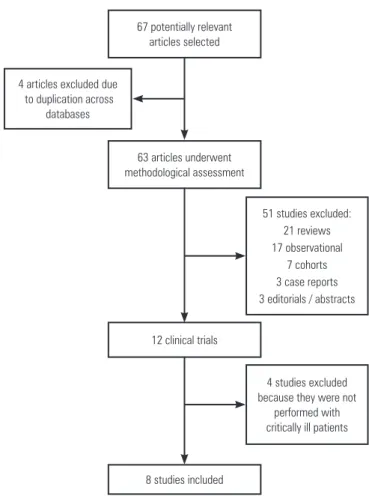
After analysis by two researchers, 59 articles were ex-cluded either because they were duplicated across databa-ses or because they did not posdataba-sess the appropriate me-thodological design for inclusion. Only eight trials that met the methodological criteria stipulated for the desired outcome were included in the inal selection, as shown by the lowchart in igure 1.
Table 1 contains information on the PEDro scores obtained by the randomized clinical trials. As indicated, all studies had eligibility criteria, conducted intergroup comparisons, and used both point measures and mea-sures of variability. No study had “blinding” of subjects and therapists, and assessors were “blind” in four
stu-Figure 1 - Flowchart of article search strategy.
Table 1 - Classification of randomized clinical trials
Studies
Zanotti et al.
(19)
Gerovasili et al.
(20)
Gruther et al.
(21)
P
oulsen et al.
(22)
P
orta et al.
(23)
Burtin et al.
(24)
Chiang et al.
(25)
Schweick
ert et al.
(26)
PEDro scale
1. Eligibility criteria were specified
Yes Yes Yes Yes Yes Yes Yes Yes
2. Subjects were randomly allocated to groups
1 1 1 1 1 1 0 1
3. Allocation was concealed 0 0 0 0 0 1 0 1
4. Groups were similar at baseline
1 1 1 1 1 0 1 1
5. “Blinding” of all subjects 0 0 0 0 0 0 0 0
6. “Blinding” of all therapists 0 0 0 0 0 0 0 0
7. “Blinding” of all assessors 0 1 0 1 0 0 1 1
8. Appropriate monitoring 0 0 0 1 0 0 0 1
9. Intention to treat analysis 0 0 0 0 1 0 0 1
10. Intergroup comparisons 1 1 1 1 1 1 1 1
11. Point measures and measures of variability
1 1 1 1 1 1 1 1
Total score 4/10 5/10 4/10 6/10 5/10 4/10 4/10 8/10
According to the PEDro* scale, with 1 representing items covered and 0 representing
items not covered. *Data source: http://www.pedro.org.au.(16)
67 potentially relevant articles selected
63 articles underwent methodological assessment
51 studies excluded: 21 reviews 17 observational
7 cohorts 3 case reports 3 editorials / abstracts
4 studies excluded because they were not
performed with critically ill patients 12 clinical trials
8 studies included 4 articles excluded due
dies (50%). Another relevant fact is that, in seven stu-dies (87.5%), there was initial similarity between the groups. Using PEDro scale classiication, 100% of the studies scored ≥ 4 points and were classiied as “high quality” according to the criteria of Van Peppen et al.(18)
Of the eight included studies, four(19-22) dealt with the use of electrostimulation, two(23,24) used cycle ergo-meter exercises, and two(25,26) used motor
kinesiothera-py with upper- and lower-limb exercises, functionality, training in basic and instrumental activities of daily living, changes in decubitus, balance, orthostasis and deambulation (Chart 1). he sample size varied betwe-en 8 and 101 subjects of both gbetwe-enders, with ages ran-ging from 52 to 79 years, who were subjected to IMV. Group homogeneity was included in most studies; the only exception was the study by Burtin et al.(24)
Chart 1 - Characteristics of selected randomized controlled clinical trials published between 2002 and 2011 that address motor physical therapy in critically ill patients
Author Sample (N) EG CG
Characteristics of the sample
Intervention Intervention time
Key variables evaluated Significant outcomes
Zanotti et al.(19)
12 12 Chronic COPD under IMV, bedridden more than 30 days, with severe peripheral atrophy
EG: active exercises (maximum 30 minutes) and electrostimulation in LL (30 minutes); CG: only active exercises
5 times a week for 4 weeks
Peripheral MS and days needed to transfer from bed to chair
Increase in MS in both groups, but higher in the EG; the EG was able to transfer from bed to chair in fewer days
Gerovasili et al.(20)
13 13 Patients in the ICU, under IMV, with APACHE II (admission)
≥ 13
EG: daily sessions of electrostimulation in LL (55 minutes); CG: Unspecified
Daily
electrostimulation from the 2nd to the 9th day of hospitalization
Muscle diameter by ultrasound
Decrease in the diameter of the femoral quadriceps muscle in both groups; however, the decrease was lower in EG
Gruther et al.(21)
16 17 ICU patients, stratified into 2 groups: early and late
EG: early (30-60 minutes) (internment <1 week) and late (internment > 2 weeks) electrostimulation in quadriceps; CG: placebo
Daily session, 5 times a week for 4 weeks
Muscular diameter of the femoral quadriceps by means of ultrasonography
Muscle thickness decreased in both groups of early electrostimulation. The group that received late electrostimulation showed increased muscle mass
Poulsen et al.(22)
8 Patients admitted to the ICU with septic shock, under IMV
Unilateral electrostimulation (60 minutes) with the contralateral thigh serving as a paired control + routine physiotherapy
7 consecutive days
Evaluation of muscle mass by computed tomography of the thigh
There were no differences between baseline and post-electrostimulation values in the volume of muscle mass between the stimulated and non-stimulated sides
Porta et al.(23)
25 25 Intermediate ICU patients under prolonged IMV, with weaning > 48 hours and < 96 hours
EG: General physiotherapy (45 minutes) + UL cycle ergometer (20 minutes); CG: only general physiotherapy
15 total sessions, held daily
Incremental and endurance tests; perception of dyspnea and fatigue
Improvement in incremental test and endurance test, when compared to controls. Decrease in the perception of dyspnea in both groups. Reduction in the perception of fatigue in EG Burtin
et al.(24)
26 32 Patients with probable need to stay in the ICU for more than 7 days
EG: LL cycle ergometer for 20 minutes + physical therapy (motor and respiratory); CG: only conventional physiotherapy
5 times a week SF-36, 6MWT, Berg scale, scale of categories of functional ambulation, quadriceps strength, time of weaning, length of stay in ICU and hospital and mortality
Increase in distance covered in 6MWD, in the SF-36 scores, and in quadriceps strength. No significant differences in the Berg scale, the length of stay in ICU and hospital or mortality
Chiang et al.(25)
17 15 Patients on IMV > 14 days, hospitalized in a respiratory care unit
EG: physical training program (strengthening of limbs, functional activities, walking); CG: only verbal encouragement
5 times a week for 6 weeks
Peripheral MS (dynamometry) and respiratory (compound gauge), Barthel Index, FIM, and 2-minute walk test
Increase in peripheral and respiratory MS in EG and decline in CG. Increased functionality in EG. Increased time away from IMV. Ultimately, 53% of EG were able to deambulate and 0% CG
Schweickert et al.(26)
46 55 ICU patients under IMV < 72 hours and pre-admission functional independence (Barthel index ≥ 70)
EG: motor physical therapy and OT since early inclusion in the study; CG: therapy only after medical clearance
Daily session from study enrollment until recovery of the initial functionality, or discharge
FIM, Barthel index, number of ADLs performed independently, unassisted walking distance, muscle strength (MRC), grip strength, functional milestones
The CG group did not receive therapy during the IMV. Improved functionality and increase in distance walked in EG. EG came out of bed earlier, stood up, moved to the chair and walked before CG
Clinical trials involving electrostimulation varied in the modulation of the apparatus and time of
te-chnique application. One was performed late,(19) two
were performed early(20,22) and one used both early and late electrostimulation(21) (Chart 2).In the two studies using a cycle ergometer, one used a late form of the
technique on the upper limbs of patients,(23) and the
other used an early form of the technique on the lower
limbs,(24) as was the case with trials that used motor
kinesiotherapy.(25,26)
Chart 2 - Characteristics of electrostimulation in the clinical trials analyzed
Modulation of electrostimulation
Zanotti et al.(19)
Gerovasili et al.(20)
Gruther et al.(21)
Poulsen et al.(22)
Frequency (Hz) 35 45 50 35
Pulse Width (ms) 0.35 0.40 0.35 0.30
Intensity Unspecified Visible contraction
Visible contraction
Visible contraction Session duration
(minutes)
30 55 30-60 60
Stimulated muscle group
Quadriceps and gluteus
Quadriceps and peroneus
longus
Quadriceps Quadriceps
Of the eight studies, six showed signiicant beneits of motor physical therapy to critically ill patients,(9,21,23-26) with improvements in peripheral muscle strength, brea-thing, exercise capacity and functionality and increased
time away from MV. Only two studies(24,26) evaluated
the length of the hospital stay, the duration of MV/we-aning and mortality after 1 year. Burtin et al.(24) found no diferences in weaning time, length of ICU stay or clinical outcome after 1 year. he study by Schweickert
et al.(26) found a signiicant reduction in the duration
of MV for the group that underwent motor physical therapy (p<0.05), but no diferences were found in the other two outcome variables.
DISCUSSION
Neuropathies and prolonged immobility are com-mon causes of muscle weakness in critically ill patients. Physical therapy plays an important role in the clinical recovery of these individuals and produces functional beneits. In the present study, which aimed to analyze diferent outcomes of motor physical therapy in cri-tically ill patients being treated in ICUs, a beneicial response to physical therapy was observed and substan-tiated by methodological and statistical corroborative evidence from published clinical trials.(16)
All items included in this study were considered “high quality”, as they achieved a score ≥ 4 on the
PE-Dro scale.(18) However, it is important to note that sco-res on this scale should not be used to compare the qua-lity of clinical studies because in some areas of physical therapy practice, it is not possible to satisfy all scale ite-ms, such as “blinding” of both subjects and examiners. As observed in some of the studies discussed in this re-view, the impossibility of meeting PEDro scale criteria is a function of the technique employed rather than a methodological bias generated by the researchers.
he studies included in this review demonstrated that the performance of motor physical therapy (elec-trostimulation, exercises on a cycle ergometer and classic motor kinesiotherapy) in critically ill patients represents a safe intervention that is feasible and well tolerated by patients.(19,22,24,26) Severe adverse reactions are uncommon, the need to discontinue therapy is mi-nimal (only approximately 4%) and is commonly as-sociated with asynchrony between the patient and the
mechanical ventilator.(24-26) In this context, one must
consider that aggressive mobilization is not recommen-ded in patients with hemodynamic and respiratory ins-tability, and the care team would need to decide on the feasibility of moving a critically ill patient at an early stage. here is a need to consider not only the risks arising from such mobilization but also the severe deleterious efects caused by prolonged immobility of the patient in bed. For instance, loss of muscle mass tends to increase exponentially with time spent in the hospital (with peak muscle loss occurring during the irst 2 weeks of immobilization, further justifying the importance of adopting an early approach to physical therapy).(7,8)
Among the activities performed in motor physical therapy in the ICU are changes in decubitus and lying position, passive mobilization, actively assisted exercises and free activity, use of a cycle ergometer, electrostimu-lation, training activities for daily living and functiona-lity, sitting up, orthostasis, static walking, transfer from bed to chair and deambulation.(7) All of these activities were represented among the clinical trials included in the present review.
It should be noted that patients were subjected to invasive MV. Neuromuscular abnormalities are com-monly acquired in the ICU by this patient population because prolonged MV is considered an independent risk factor for the development of severe muscle we-akness and promotes impairment of patient functional
performance.(25) A prospective cohort study conducted
than one week.(4) Chiang et al.(25) demonstrated a strong correlation between increased time away from the MV and the functional performance of the patient.
he use of sedation and MV are often considered obs-tacles to rehabilitation programs in ICUs, as many pro-fessionals are still afraid to mobilize patients on MV and ultimately restrict those patients to inactivity.(11,23) Never-theless, techniques that do not require patient coopera-tion, such as neuromuscular electrostimulacoopera-tion, should be considered. Such techniques tend to promote peripheral and cortical activation when applied to peripheral mus-cles.(27) Electrostimulation, cycle ergometry and kinesio-therapy will be discussed in more detail below.
Electrostimulation
Among the studies using electrostimulation, the most satisfactory results were obtained when the tech-nique was introduced later to increase muscle mass in chronic and debilitated patients.(19,21) Zanotti et al.(19) compared electrostimulation to a protocol of active appendicular exercises in patients with severe chronic obstructive pulmonary disease who were bedridden and under prolonged MV. It was found that the group receiving electrostimulation achieved a significantly greater increase in muscle strength compared to the control group.
he double-blind clinical trial performed by Gru-ther et al.(21) evaluated the efect of electrostimulation in two groups of patients. he irst group was stimu-lated early to prevent loss of muscle mass, and the se-cond was stimulated late to reverse the muscle atrophy of patients undergoing a long ICU stay. Both groups were divided into intervention and control subgroups. A signiicant decrease of muscular layer thickness was observed in both subgroups of the early-intervention group, demonstrating that electrostimulation did not prevent the loss of muscle mass. In the group receiving late electrostimulation, the intervention subgroup sho-wed a signiicant increase in muscle mass compared to control subjects.
Studies evaluating the efect of early electrostimula-tion for the prevenelectrostimula-tion of muscle atrophy demonstrated that electrostimulation during the irst days of hospita-lization of critically ill patients was unable to prevent
the loss of muscle mass.(20,22) In the study conducted
by Gerovasili et al.,(20) the decrease in muscle mass was signiicantly lower in the intervention group; however, the baseline muscle thickness was greater in the control group than in the intervention group, which reduced the direct comparability between the groups and may
explain why the absolute muscle loss was signiicantly higher in the control group. Immobilization, even for a short period of time, promotes a catabolic state in the muscle, resulting in signiicant loss of muscle mass and
decreased strength.(28) his efect occurs more sharply
during the irst 3 weeks of
hospitalization/immobiliza-tion,(8) and it may explain why electrostimulation did
not afect the loss of muscle mass when applied early in critically ill patients.
In the analyzed trials, the loss of mass in the qua-driceps muscle in the first weeks of ICU internment ranged from 16 to 40% and was unaffected by daily application of electrostimulation.(21,22) The correlation between electrostimulation intensity and disease seve-rity shows that the excitability of muscle tissue may have been affected by the severity of disease; the most serious diseases may lead to muscular membrane di-sorders that impair muscle excitability and increase catabolism, thereby accentuating the loss of muscle mass and potentially affecting the anabolic stimula-tion by electrostimulastimula-tion.(22)
It is important to consider that the diversity en-countered among electrostimulation protocols and as-sessment methods limits direct comparisons between studies. here is no consensus as to the optimal mo-dulation required to promote strong contractions with
minimum fatigue.(22)
Exercise on a cycle ergometer
Among the reviewed studies that used a cycle er-gometer, one employed the technique at a later stage
onupper limbs and another used it at an early stage
on lower limbs. Both studies demonstrated positive ou-tcomes in individuals who underwent cycle ergometer training, showing an increase in exercise capacity and muscle strength of lower limbs.(23,24)
Porta et al.(23) demonstrated that the addition of
upper-limb cycle ergometer exercises to conventional physical therapy in patients on prolonged MV increa-sed exercise capacity and reduced the sensation of mus-cle fatigue and perception of dyspnea. In the popula-tion studied, baseline respiratory muscle strength was associated with a higher probability of improvement in exercise capacity, demonstrating the beneits of early intervention in critically ill patients admitted to ICUs.
he study by Burtin et al.(24) investigated whether
observed a signiicant increase in exercise capacity, self- perceived functional status and quadriceps strength of subjects who underwent physical therapy when com-pared to control subjects. he data also showed that muscle strength is positively correlated with patient self-perception of functional status and the distance walked at discharge, with the best independent walking distance achieved by the group that used the cycle
ergometer.(24) his inding is of great importance, as
independent walking is considered an important goal for patients before returning home.(9)
In combination, the reviewed studies show that cycle ergometer exercise, whether applied to the upper or lo-wer limbs or performed early or late, promoted impro-vements in exercise capacity and muscle strength in the study population. It should be noted that these exercises were performed simultaneously with conventional mo-tor physical therapy, thus demonstrating that this form of exercise can be used in a complementary way to im-prove the functional performance of patients in the ICU.
Motor kinesiotherapy
Chiang et al.(25) evaluated the application of a 6-week physical training program that included limb streng-thening and functional and deambulation activities of patients under prolonged MV. he authors found a signiicant increase of muscle strength and respiratory function in patients undergoing physical therapy tre-atment. In contrast, peripheral and respiratory muscle strength worsened in control group subjects over the course of the 6 weeks, suggesting that immobilization is an important cause of muscle weakness in patients requiring prolonged MV. hey also showed that motor functionality of the patients decreased in the both the intervention and control groups, demonstrating that immobility of critically ill patients has serious functio-nal consequences. However, after applying the physical training program, functional scores signiicantly incre-ased in the physical therapy group. Deambulation was of particular note because none of the subjects were ini-tially able to walk, and yet 53% of subjects were able to
walk independently by the end of the intervention.(25)
It is known that ICU internment leads to a sharp decline in patient quality of life. Studies indicate that quality of life, physical capacity, general health and so-cial health of patients is incompletely recovered even 6
months after discharge.(27-29) he work of van der
Scha-af et al.,(30) which assessed the state of patients within the irst week of ICU discharge, showed that they have poor functional status, with the majority of subjects
(67%) totally dependent in daily domestic activities and 30% having cognitive problems. In the present re-view, the studies of Chiang et al.(25) and Schweickert et
al.(26) showed cognitive function improvements in
pa-tients undergoing motor physical therapy. In the study by Chiang et al.,(25) all subjects undergoing physiothe-rapy showed improvement in cognitive scores. In the
study by Schweickert et al.,(26) physiotherapy reduced
the time patients spent in the ICU with delirium. hese studies show that motor physical therapy in critically ill patients not only promotes functional beneits but also stimulates cognitive activation.
Schweickert et al.(26) investigated the efect of daily interruption of sedation with early physiotherapy on the functionality of critically ill patients subjected to MV compared to a control group. he return to a state of functional independence at discharge was signiican-tly higher in the intervention group; age, absence of sepsis and early physiotherapy were all associated with the successful acquisition of functionality.
Garnacho-Montero et al.(5) established in their study that the polyneuropathy of critically ill patients signi-icantly increases the duration of MV and is conside-red an independent risk factor for the failure to “wean” (p <0.001). Prolonged MV is considered a risk factor for developing severe muscle weakness and consequent loss in functional performance.(4,25) MV creates muscle weakness and decreases function, making it diicult to wean patients. Such individuals remain immobilized and mechanically ventilated for longer, thus generating a vicious cycle that can be minimized with the imple-mentation of motor physical therapy. Motor activity in critically ill patients promotes improvements in respi-ratory muscle strength and increased time away from
MV, thereby reducing the overall duration of MV.(25,26)
In the study by Martin et al.,(3) a signiicant corre-lation was found between the muscle strength of upper limbs and the time of weaning from MV, suggesting that patients undergoing prolonged MV sufer signii-cant overall muscle weakness that limits their ability to wean and to perform the activities of daily life. here is therefore evidence that upper-limb muscle strength is a simple but signiicant predictor of weaning time.
CONCLUSIONS
he methodological analysis conducted in the pre-sent study showed that several studies address the efect of physical therapy in critically ill patients, but there are few clinical trials consisting of two randomly distri-buted independent groups.
Motor physical therapy has proven to be a feasi-ble and safe therapy that can minimize the deleterious efects of prolonged immobilization in bed. he most commonly used approaches for critically ill patients in-volve the techniques of electrostimulation, cycle ergo-metry and kinesiotherapy, all of which produce positi-ve responses in patients under intensipositi-ve care. Currently available evidence about the impact of motor physical therapy on length of stay in intensive care units and mortality is still scarce, and further study in this area is warranted.
RESUMO
Objetivo: Analisar os desfechos propiciados pela isioterapia mo-tora em pacientes críticos assistidos em unidade de terapia intensiva.
Métodos: Por meio de uma revisão sistemática da literatura, foram admitidos ensaios clínicos publicados entre 2002 e 2011.
A busca envolveu as bases de dados LILACS, SciELO, MedLine, EMBASE e Cochrane, usando os descritores “intensive care unit”, “physiotherapy”, “physical therapy”, “mobility”, “mobilization” e “randomized controlled trials”. Dois pesquisadores independentes realizaram a triagem dos artigos, tendo incluído trabalhos que abordassem a ação da isioterapia em pacientes críticos.
Resultados: De uma análise inicial de 67 artigos potencial-mente relevantes, apenas 8 contemplaram os critérios de seleção e abordaram os desfechos provenientes das técnicas de eletroesti-mulação, cicloergômetro e cinesioterapia. O tamanho amostral variou de 8 a 101 sujeitos, com média de idade entre 52 e 79 anos. Todos os pacientes estavam sob ventilação mecânica invasiva. Dos artigos analisados, seis indicaram benefícios signiicativos da i-sioterapia motora em pacientes críticos, como melhora na força muscular periférica, capacidade respiratória e na funcionalidade.
Conclusão: Por meio desta revisão sistemática, foi possível concluir que a isioterapia motora consiste em uma terapia segu-ra e viável em pacientes críticos, podendo minimizar os efeitos deletérios da imobilização prolongada. A abordagem envolven-do eletroestimulação, cicloergômetro e cinesioterapia motora mostrou respostas positivas no paciente sob terapia intensiva. O nível de evidencia atualmente disponível a cerca do impacto da ação da isioterapia motora sobre tempo de permanência na unidade de terapia intensiva e mortalidade ainda é baixo sendo necessários novos estudos.
Descritores: Unidades de terapia intensiva; Cuidados intensivos; Deambulação precoce; Terapia por exercício; Atroia muscular
REFERENCES
1. Valentin A. The importance of risk reduction in critically ill patients. Curr Opin Crit Care. 2010;16(5):482-6.
2. Schweickert WD, Hall J. ICU-acquired weakness. Chest. 2007;131(5):1541-9. 3. Martin UJ, Hincapie L, Nimchuk M, Gaughan J, Criner GJ. Impact of whole-body rehabilitation in patients receiving chronic mechanical ventilation. Crit Care Med. 2005;33(10):2259-65.
4. De Jonghe B, Sharshar T, Lefaucheur JP, Authier FJ, Durand-Zaleski I, Boussarsar M, Cerf C, Renaud E, Mesrati F, Carlet J, Raphaël JC, Outin H, Bastuji-Garin S; Groupe de Réflexion et d’Etude des Neuromyopathies en Réanimation. Paresis acquired in the intensive care unit: a prospective multicenter study. JAMA. 2002;288(22):2859-67.
5. Garnacho-Montero J, Amaya-Villar R, García-Garmendía JL, Madrazo-Osuna J, Ortiz-Leyba C. Effect of critical illness polyneuropathy on the withdrawal from mechanical ventilation and the length of stay in septic patients. Crit Care Med. 2005;33(2):349-54.
6. Canineu RFB, Cabral MM, Guimarães HP, Lopes RD, Saes LSV, Lopes AC. Polineuropatia no paciente crítico: um diagnóstico comum em medicina intensiva? Rev Bras Ter Intensiva. 2006;18(3):307-10.
7. Gosselink R, Bott J, Johnson M, Dean E, Nava S, Norrenberg M, et al. Physiotherapy for adult patients with critical illness: recommendations of the European Respiratory Society and European Society of Intensive Care Medicine Task Force on Physiotherapy for Critically Ill Patients. Intensive Care Med. 2008;34(7):1188-99.
8. Gruther W, Benesch T, Zorn C, Paternostro-Sluga T, Quittan M, Fialka-Moser V, et al. Muscle wasting in intensive care patients: ultrasound
observation of the M. quadriceps femoris muscle layer. J Rehabil Med. 2008;40(3):185-9.
9. Bailey P, Thomsen GE, Spuhler VJ, Blair R, Jewkes J, Bezdjian L, et al. Early activity is feasible and safe in respiratory failure patients. Crit Care Med. 2007;35(1):139-45.
10. Morris PE, Goad A, Thompson C, Taylor K, Harry B, Passmore L, et al. Early intensive care unit mobility therapy in treatment of acute respiratory failure. Crit Care Med. 2008;36(8):2238-43.
11. Skinner EH, Berney S, Warrillow S, Denehy L. Rehabilitation and exercise prescription in Australian intensive care units. Physiotherapy. 2008;94(3):220-9.
12. Nozawa E, Sarmento GJ, Vega JM, Costa D, Silva JE, Feltrim MI. Perfil de fisioterapeutas brasileiros que atuam em unidades de terapia intensiva. Fisioter Pesqui. 2008;15(2):177-82.
13. Stockley RC, Hughes J, Morrison J, Rooney J. An investigation of the use of passive movements in the intensive care by UK physiotherapists. Physiotherapy. 2010;96(3):228-33.
14. Borges VM, Oliveira LRC, Peixoto E, Carvalho NAA. Fisioterapia motora em pacientes adultos em terapia intensiva. Rev Bras Ter Intensiva. 2009;21(4):446-52.
15. Bailey PP, Miller RR 3rd, Clemmer TP. Culture of early mobility in mechanically ventilated patients. Crit Care Med. 2009;37(10 Suppl):S429-35. 16. Physiotherapy Evidence Database (PEDro) [Internet]. [cited 2011 Sept 7]
Available from: http://www.pedro.org.au.
18. Van Peppen RP, Kwakkel G, Wood-Dauphinee S, Hendriks HJ, Van der Wees PJ, Dekker J. The impact of physical therapy on functional outcomes after stroke: what’s the evidence? Clin Rehabil. 2004;18(8):833-62.
19. Zanotti E, Felicetti G, Maini M, Fracchia C. Peripheral muscle strength training in bed-bound patients with COPD receiving mechanical ventilation: effect of electrical stimulation. Chest. 2003;124(1):292-6.
20. Gerovasili V, Stefanidis K, Vitzilaios K, Karatzanos E, Politis P, Koroneos A, et al. Electrical muscle stimulation preserves the muscle mass of critically ill patients: a randomized study. Crit Care. 2009;13(5):R161.
21. Gruther W, Kainberger F, Fialka-Moser V, Paternostro-Sluga T, Quittan M, Spiss C, et al. Effects of neuromuscular electrical stimulation on muscle Layer thickness of knee extensor muscles in intensive care unit patients: a pilot study. J Rehabil Med. 2010;42(6):593-7.
22. Poulsen JB, Møller K, Jensen CV, Weisdorf S, Kehlet H, Perner A. Effect of transcutaneous electrical muscle stimulation on muscle volume in patients with septic shock. Crit Care Med. 2011;39(3):456-61.
23. Porta R, Vitacca M, Gilè LS, Clini E, Bianchi L, Zanotti E, Ambrosino N. Supported arm training in patients recently weaned from mechanical ventilation. Chest. 2005;128(4):2511-20.
24. Burtin C, Clerckx B, Robbeets C, Ferdinande P, Langer D, Troosters T, et al. Early exercise in critically ill patients enhances short-term functional
recovery. Crit Care Med. 2009;37(9):2499-505.
25. Chiang LL, Wang LY, Wu CP, Wu HD, Wu YT. Effects of physical training on functional status in patients with prolonged mechanical ventilation. Phys Ther. 2006;86(9):1271-81.
26. Schweickert WD, Pohlman MC, Pohlman AS, Nigos C, Pawlik AJ, Esbrook CL, et al. Early physical and occupational therapy in mechanically ventilated, critically ill patients: a randomised controlled trial. Lancet. 2009;373(9678):1874-82.
27. Han BS, Jang SH, Chang Y, Byun WM, Lim SK, Kang DS. Functional magnetic resonance image finding of cortical activation by neuromuscular electrical stimulation on wrist extensor muscles. Am J Phys Med Rehabil. 2003;82(1):17-20.
28. Berg HE, Eiken O, Miklavcic L, Mekjavic IB. Hip, thigh and calf muscle atrophy and bone loss after 5-week bedrest inactivity. Eur J Appl Physiol. 2007;99(3):283-9.
29. Hofhuis JG, Spronk PE, van Stel HF, Schrijvers GJ, Rommes JH, Bakker J. The impact of critical illness on perceived health-related quality of life during ICU treatment, hospital stay, and after hospital discharge: a long-term follow-up study. Chest. 2008;133(2):377-85.