Mitochondrial DNA influences in primary
open angle glaucoma (POAG) under
a scientometric insight
Influência do DNA mitocondrial no glaucoma primário de
ângulo aberto sob a visão da cienciometria
Leonardo Mariano Reis
1, Rodrigo Egídio da Silva
2, Francisco Weliton Rodrigues
31Ophthalmologist at VER Excellence in Ophthalmology and the Reference Centre for Ophthalmology of the Federal University of Goiás;
M.Sc Student in Genetics at the Pontifical Catholic University of Goiás, Goiânia/GO, Brazil.
2Ophthalmologist at VER Excellence in Ophthalmology; M.Sc in Genetics from the Pontifical Catholic University of Goiás, Goiânia/GO, Brazil. 3Ophthalmologist at VER Excellence in Ophthalmology; M.Sc in Genetics from the Pontifical Catholic University of Goiás; Ph.D. Student in
Healthcare Science at the Federal University of Goiás, Goiânia/GO, Brazil
The authors declare no conflicts of interest
Received for publication: 3/1/2013 - Accepted for publication: 17/6/2013.
R
ESUMOObjetivo: O glaucoma primário de ângulo aberto é uma doença degenerativa do nervo óptico que se encontra entre as principais
causas de cegueira no mundo. Aspectos familiares já foram implicados como fatores importantes e comprovados em inúmeros estudos. Nesse artigo, apresentamos uma revisão sistemática dos trabalhos sobre glaucoma primário de ângulo aberto e DNA mitocondrial e fazemos uma análise estatística à luz dos conceitos da cienciometria. Métodos: A pesquisa bibliográfica de trabalhos envolvendo DNA mitocondrial e glaucoma primário de ângulo aberto foi realizada por meio da base de dados do sítio Scopus. Foi feito o levantamento a partir das palavras-chaves “Mitochondrial DNA” e “Glaucoma” em todos os campos para publicações no período compreendido de 1992 até agosto de 2012. Finalmente, foi realizada a estatística e cienciometria com os principais dados: autores que publicaram sobre o assunto DNA mitocondrial e glaucoma; revistas e outras publicações que tiveram trabalhos relacionados com o tema; Centros de Pesquisa e Universidades que mais publicaram e países onde foram realizados os estudos sobre DNA mitocondrial e glaucoma. Resultados: Identificamos que esses estudos têm aumentado sobremaneira ao longo dos últimos anos, mas ainda se encontram confinados, na maior parte, a alguns centros de pesquisa e concentrados em seletos grupos de autores na área da oftalmologia em países desenvolvidos. No Brasil, ainda não temos pesquisas publicadas sobre o assunto até o momento. Conclusão: Esses estudos são de fundamental importância para a elucidação das causas genéticas do glaucoma e para o desenvolvimento de novas terapias que não visem tão somente a diminuição da pressão intraocular.
Descritores: DNA mitocondrial; Glaucoma primário de ângulo aberto; Cienciometria; Genética; Oftalmologia
A
BSTRACTObjective: Primary open angle glaucoma is a neurodegenerative disease of the optic nerve that represents one of the main causes of blindness worldwide. Familial aspects have been implicated in the development of the disease and proved in several studies. In this article, we present a systematic review of works about primary open angle glaucoma and mitochondrial DNA and a statistic analyses under a scientometric insight. Methods: Bibliographic research of the works on mitochondrial DNA and primary open angle glaucoma was made accessing the site Scopus. Then, search with the keywords “mitochondrial DNA” and “glaucoma” in all fields for publications between 1992 and august of 2012 was performed. Finally, we did the statistics and scientometric analyses with the main data, such as: authors who published articles on mitochondrial DNA and glaucoma; journals that had publications about the issue; Centers of Research, Universities and countries where most of the studies on glaucoma and mitochondrial DNA were made. Results: We identified that these articles have increased in the last few years, though yet confined, mostly, to some centers of research and concentrated in selected groups of researchers in ophthalmology of developed countries. In Brazil, we do not have any article published about the issue, yet. Conclusion: These studies are extremely important to the elucidation of the genetic causes of glaucoma and for the development of new therapies aiming not only the reduction of the intraocular pressure.
I
NTRODUCTIONR
esearch into human genetics has a long history dating back to studies on quantitative traits in the 19th century and Mendelian traits in the first decade of the 20th century. With the development of science, the various forms of inheritance have been recognised, having been initially classified as dominant or recessive: autosomal, sex-linked, or mitochondrial inheritance, as well as complex patterns involving more than one gene. According to the formal definition, a phenotype expressed similarly in homozygotes and heterozygotes is dominant, while a phenotype expressed only in homozygotes is recessive(1).A similar reasoning applies to mitochondrial inheritance, with the difference that it only involves maternal inheritance, since the mother transmits her mitochondrial DNA (mtDNA) to the entire offspring through the oocyte(2).
The complete sequence of the human mitochondrial (MT) genome was determined in 1981 by Anderson et al. It was then reassessed and reviewed by Andrews et al. in 1999, being then called the Cambridge Reference Sequence (CRS). MT genome contains 16,569 nucleotides and consists of circular, double-stranded DNA (3).
The circular mitochondrial chromosome has only 16.5 Kb in its sequence, with 13 known structural genes encoding polypeptides of the mitochondrial respiratory chain (subunits of oxidative phosphorylation enzymes), two types of ribosomal RNA, and 22 types of transfer RNA. It also has a non-coding region of approximately 1200 nucleotides at the zero position of the genome, known as the control region, the D-loop or the hypervariable region. It is called the control region because it contains the signal that controls the synthesis of RNA and DNA. The D-loop is linked to the initial phase of replication, when the newly synthesised strand detaches from the template strand forming a “bubble” or a “loop “ (Figure 1).
The possibility of a genetic predisposition to glaucoma was first suggested by Benedict (1842) in a report on two twin sisters with glaucoma. An oligogenic, polygenic or multifactorial mechanism is currently proposed for primary open angle glaucoma (POAG)(4).
In fact, genetics plays an important role both in the occurrence and the morbidity of POAG. A history of simple Mendelian inheritance is less common, although 13-47% of patients have a positive family history, and first-degree relatives of patients with POAG have a 7 to 10-fold increase in the chance of POAG(5).
Studies have shown that the prevalence of a maternal family history for glaucoma is 6 to 8 times higher than a paternal history(6-8). This occurs despite the fact that the prevalence of the disease is equal for both sexes and in the absence of any mater-nal influence on intraocular pressure (IOP). It is difficult to explain such a difference on a strictly Mendelian basis. Maternal inheritance, however, is characteristic of mitochondrial genetics(9). Given the important role of the mitochondrial genome in cell metabolism, several studies have investigated the association between DNA lineages, multifactorial diseases, and ageing(10-15). Andrews et al. conducted a pioneer study to assess the role of mitochondrial haplogroups in POAG(16). Haplogroup analysis was based on the phylogenetic network for European mtDNA as described by Finnilä et al. while assessing a population in Northeast England(17).
Two years later, Abu-Amero et al. also published a study reporting the role of mitochondrial haplogroups in glaucoma in the Arab population(18).
Based on a review of the literature on the relationship between mitochondrial DNA and the development of glaucoma and using the concepts of scientometrics, this study aimed to quantify the volume of publications on the subject, indicate the main authors working on mitochondrial DNA and glaucoma, particularly since 1992, and stratify the main institutions producing knowledge on the subject through their publications.
The first definitions by Mikhilov et al. (apud Spinak, 1996) defined scientometrics as “measuring the informatics proces-ses”, where “informatics” meant “the discipline that studies the structure and properties of scientific information and the laws of the communication process”(19,20). Tague-Sutcliffe (1992) defined scientometrics as “the study of the quantitative aspects of science as a discipline or economic activity” (21,22).
We assessed where these studies were being conducted and the countries where they were published in order to measure and compare the volume of science in each country and to deter-mine the regions of the world where, in the short, medium and long term, more information on the subject can be found, thus inferring the regions where more progress is being made. This is justified because research on the matter is still incipient, with few published works compared to other subjects, and because the applied methodologies vary greatly from author to author and even between different works by the same author; therefore it is difficult to conduct a meta-analysis.
Furthermore, studies on mitochondrial DNA are very specific and highly dependent on the geographic region, since mitochondrial haplogroups are evolutionary markers of populations and vary according to the origin of studied individuals. Finally, this article attempts to point out the possible genetic changes in primary open angle glaucoma, especially regarding mitochondrial DNA, and help illustrate the scientific progress made in elucidating the aetiology of the disease. Clarifying the molecular aspects of glaucoma may aid in the development of
Figure 1
Human mitochondrial DNA. Regions and their coding genes: 2 rRNA, 22 tRNA, and 13 proteins.
new diagnostic and/or therapeutic techniques. This may influence the prognosis of the disease and thus prevent a significant socioeconomic impact on the population.
M
ETHODSA literature search for works on mitochondrial DNA and POAG was conducted in the Scopus (http://www.scopus.com.br) database on August 6, 2012(23).
The search involved the keywords “Mitochondrial DNA” and “Glaucoma” in all fields for journals, periodicals, books, and other sources from 1992 to August 2012. We only used the “and” operator between words, because the “or” operator yielded a huge amount of articles unrelated to the study topic.
Publications containing the following information were included: (i) publication year; (ii) authors’ names, (iii) type of publication (article, review, paper, experimental research); (iv) study area; (v) publication name; (vi) keywords; (vii) affiliated institution; and (viii) country where the study was conducted.
Results were then classified based on the year of publication, from 1992 to 2012. Authors were ranked according to the number of published works. Studies were divided according to their area of knowledge and the type of publication. Scientific journals, periodicals, archives and other publications were listed according to the number of publications, and keywords were classified according to frequency. We also listed the institutions and countries that published more articles and the original language of publications.
The impact factor (IF) of publications was obtained from the SCI Journal Impact Factor for 2011. The IF of a journal is defined as the ratio between the number of citations in the current year and the number of articles published in the journal over the past two years (http://www.bioxbio.com/if/)(24).
Charts were generated for the variables year and type of work, and tables were prepared for the variables author, area of knowledge, type of publication, impact factor, keywords, institution, country, and language. Tables provide the following information per year:
- Authors publishing works on mitochondrial DNA and glaucoma with their respective number of publications;
- Journals, periodicals and other publications publishing works on glaucoma and mitochondrial DNA;
- Impact factor of most cited journals; - Keywords most frequently cited;
- Research centres and universities publishing works on mitochondrial DNA and glaucoma;
- Countries where the studies were conducted; - Language of published works.
R
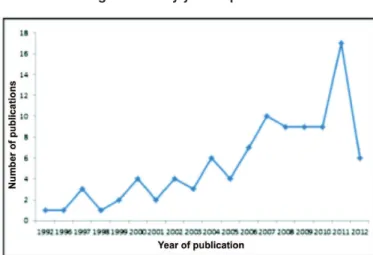
ESULTSThe literature search on the Scopus database yielded 98 works associating glaucoma with mitochondrial DNA. The first publication appeared in 1992, but most works were published after the year 2000 (Figure 2). This shows that the interest in this topic is growing over time.
Of the 98 papers correlating glaucoma and mitochondrial DNA, 56 were research studies and 29 were literature reviews. There were also 4 editorials, 3 papers, 2 letters, and 2 short surveys. We therefore found that there are still few practical studies on
the subject and hardly any clinical trial. Studies have been limited to case reports, cohort studies, and case-control studies.
Table 1 shows the names of authors who published works on the subject; Abu-Amero KK is the author with the most publications, having published 9 articles so far, followed by Bosley TM and Crowston JG, each with 6 publications; Flammer J and Trounce IA with 5 each; Izzotti A, Morales J, and Sacca SC with 4 publications; and various others with 3 and 2 publications.
The main areas of knowledge of studies were medicine, neuroscience, biochemistry, genetics, and molecular biology; agriculture and biological science; pharmacology, toxicology and pharmacy; and microbiology and immunology, with 80, 24, 12, 4, 4 and 3 publications each, respectively.
According to Macias-Chapula (1998) and Vanti (2011), the journal where a study is published is one of the criteria, among others, to assess its area of knowledge. Studies were published in 55 different publications, including journals, periodicals and others, most of which were directly related to ophthalmology. Among these, Molecular Vision published 12 works, followed by Investigative OphthalmologyandVisual Science with 10; Archives of Ophthalmology with 5; and British Journal of Ophthalmology, Experimental Eye Research, and Journal of Glaucoma with 3 each. The other journals were specialised in genetics, basic areas of biology, and other medical specialties such as neurology, as shown on Table 3.
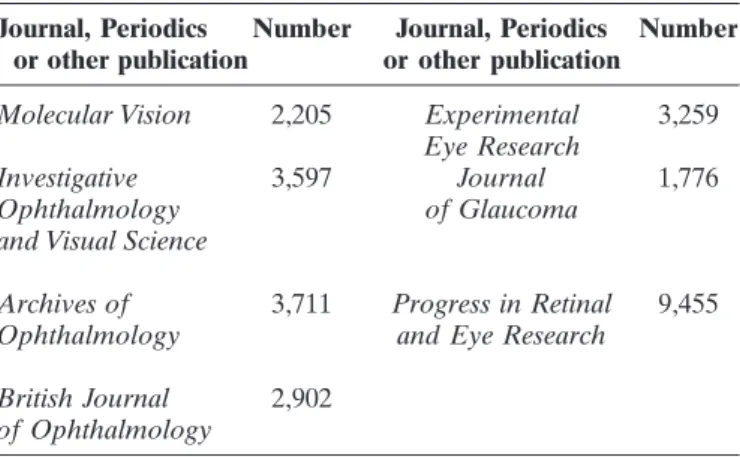
The Impact Factors of articles included in the study were obtained from the SCI Journal Impact Factor for the year 2011 at www.bioxbio.com/if/, accessed on November 10, 2012. The impact factors of the ten journals with the most publications were: Molecular Vision, 2.205; Investigative Ophthalmology and Visual Science, 3.597; Archives of Ophthalmology, 3.711; British Journal of Ophthalmology, 2.902; Experimental Eye Research, 3.259; Journal of Glaucoma, 1.776; Progress in Retinal and Eye Research, 9.455; European Journal of Protistology, 1.968; Clinical and Ex-perimental Ophthalmology, 1.977; Current Opinion in Ophthalmology, 2.647 (Table 4).
The most cited descriptors were: human (152); mitochondrial DNA (95); glaucoma (57); controlled study (35); female (33); nonhuman (33); male (32); mitochondria (32); review (29); gene mutation (28); mitochondrion (27); open angle glaucoma (27); adult (26); apoptosis (26); animals (25); disorders
Figure 2
Table 1
Authors publishing studies on mitochondrial DNA and glaucoma with their respective number of publications.
Author Number of Author Number of
publications publications
Abu-Amero, KK 9 Osman, EA 3
Bosley, TM 6 Griffiths, PG 3
Crowston, JG 6 Chrysostomou, V 3
Flammer, J 5 Larruga, JM 3
Trounce, IA 5 Longobardi, M 3
Izzotti, A 4 Gonzalez, AM 3
Morales, J 4 Al-Obeidan, SA 3
Sacca, SC 4 Cartiglia, C 3
Ju, WK 3 Mackey, DA 3
Cabrera, VM 3 Osborne, NN 3
Table 2
Áreas do conhecimento em que se enquadram a maior parte dos estudos sobre glaucoma e DNAmt
Area Number of Area Number of
publications publications
Medicine 80 Agriculture and 4
Biological science
Neuroscience 24 Pharmacology, 4
Toxicology and Pharmacy
Biochemistry, 12 Immunology and 3
Genetic and Microbiology
Molecular biology
Table 4
Impact factor of most cited journals.
Journal, Periodics Number Journal, Periodics Number
or other publication or other publication
Molecular Vision 2,205 Experimental 3,259 Eye Research
Investigative 3,597 Journal 1,776
Ophthalmology of Glaucoma
and Visual Science
Archives of 3,711 Progress in Retinal 9,455 Ophthalmology and Eye Research
British Journal 2,902 of Ophthalmology
Source: http://www.scopus.com Table 3
Journals, periodicals and other publications publishing studies on glaucoma and mitochondrial DNA.
Journal, Periodics Number Journal, Periodics Number
or other publication or other publication
Molecular Vision 12 Experimental 3 Eye Research
Investigative 10 Journal 3
Ophthalmology of Glaucoma
and Visual Science
Archives of 5 Progress in Retinal 3
Ophthalmology and Eye Research
British Journal 3 of Ophthalmology
Source: http://www.scopus.com
of mitochondrial functions (25); and Leber hereditary optic neuropathy (25) (Table 5).
Most studies were affiliated with universities or research centres in hospitals. The University of Melbourne produced the most works with 9, followed by the University of Florida with 6. Table 6 shows the list of institutions that published studies on the topic and their number of publications.
With regard to the countries of publication, we found that English-speaking countries occupied the first 3 positions in the ranking, with the United States first (36 studies) followed by the United Kingdom (15) and Australia (10). Saudi Arabia also published 10 articles thanks to the contribution of Abu-Amero et al. Other countries in the list (Table 7) were mostly developed nations, suggesting that a higher investment in science and research probably led to more publications and advances in the field. In Brazil there were no publications on the influence of mitochondrial DNA in primary open-angle glaucoma or other types of glaucoma.
Finally, with respect to the language of publication, 93 papers were written in English, 3 in Japanese, 1 in Chinese and 1 in Dutch, showing a clear predominance of English publications, which benefits native English speakers and those fluent in the language (Table 8).
D
ISCUSSIONTable 7
Countries where studies on mitochondrial DNA and glaucoma were conducted.
Country Number Country Number
United State 36 Áustrália 10
United Kingdom 15 Saudi Arabia 10
Table 8
Language of published studies.
As regards the authors of studies, we highlight the importance of the work of Khaled K., Abu-Amero et al. in Saudi Arabia on the relationship between mitochondrial haplogroups in the Arab population and the various types of glaucoma, and Andrews et al., who also correlated POAG with mitochondrial DNA in the Caucasian population in England. Our assessment showed that these were pioneer studies.
Most studies were published in medical journals, especially ophthalmology journals with a high impact factor (IF) for the year 2011. The journals that published the most articles included: Molecular Vision with an IF of 2.205; Investigative Ophthalmology and Visual Science with 3.597; Archives of Ophthalmology with 3.711; British Journal of Ophthalmology with 2.902; Experimen-tal Eye Research with 3.259; Journal of Glaucoma with 1.776; and Progress in Retinal and Eye Research with 9.455, the highest IF. The institutions that produced more than three articles on glaucoma and mitochondrial DNA were: University of Melbour-ne (Australia), University of Florida (United States), Cooper University Hospital (United States), King Saud University Medical College (Saudi Arabia), Azienda Ospedaliera Universitaria San Martino (Italy), Nuffield Department of Clinical Medicine (England), King Faisal Specialist Hospital and Research Centre (Saudi Arabia), King Khaled Eye Specialist Hospital (Saudi Arabia), Università degli Studi di Genova (Italy), Shafallah Medical Genetics Centre (Katar), University Eye Clinic Basel (Switzerland), Universidad de la Laguna (Spain), Duke University School of Medicine (United States), University of Auckland (New Zealand), Newcastle University (England), University of North Texas Health Science Centre (United States), Royal Victoria Infirmary (England), Emory Eye Centre (United States), University of California San Diego (United States).
This shows a clear predominance of English-speaking countries, with the United States, England and Australia leading the field. They are followed by other developed countries with the exception of Saudi Arabia, which published 10 papers. Few developing countries appear among the leading producers of science in this area; among these, we highlight the Shafallah Medical Genetics Centre, from Katar, with 3 important publications.
C
ONCLUSIONThe production of knowledge in this area is concentrated in a few countries, with only 30 countries producing publications, limited to a few studies with a select group of researchers leading the field. English-speaking countries produced more studies, especially the USA, the UK, and Australia, as well as New Zealand with a few studies. The main institutions producing papers were the University of Melbourne, the University of Florida and the Cooper University Hospital. However, two Arab countries also produced important papers, namely Saudi Arabia with the work of Abu-Amero et al. and Katar with research in the Shafallah Medical Genetics Centre.
These studies were published in respected journals with a very high impact factor for 2011, such as Molecular Vision, Investigative Ophthalmologyand Visual Science, and the Archives of Ophthalmology.
It is therefore clear that this research is important to elucidate the genesis of glaucoma and develop more effective treatments with a genetic approach, going beyond the use eye drops to lower intraocular pressure or surgical valves to drain the aqueous humour. This will certainly save the sight of millions Table 6
Research centres and universities publishing studies on mitochondrial DNA and glaucoma.
Institution Number Institution Number
University of 9 Nuffield Department 4 Melbourne of Clinical Medicine
University 6 King Faisal Specialist 4
of Florida Hospital and
Research Centre
Cooper University 5 King Khaled Eye 4
Hospital Specialist Hospital
King Saud University 5 Università degli 4 Medical College Studi di Genova
Azienda Ospedaliera 4 Universitaria
San Martino
Table 5
Keywords most frequently cited on studies on glaucoma and mitochondrial DNA.
Keywords Number of Keywords Number of
publications chave publications
Human 152 Nonhuman 33
Mitochondrial DNA 95 Male 32
Glaucoma 57 Mitochondria 32
Controlled study 35 Review 29
Female 33 Gene mutation 28
Language Number Language Number
Inglês 93 Chinês 1
Corresponding author
Pontifical Catholic University of Goiás VER – Excelência em Oftalmologia
Av. Americano do Brasil, 260. Setor Marista CEP 74.180-010 Goiânia/GO, Brazil Fax: +5562 3096 9696
E-mail: [email protected]
of people around the world and reduce the socioeconomic impact of the disease.
In Brazil, nothing has yet been produced to assess mitochondrial DNA and its relationship with the development of glaucoma in the population.
Such a study would be very auspicious and extremely important for comparisons with other findings, and perhaps for the future development of new therapies for glaucoma.
R
EFERENCES1. Korf BR, Sathienkijkanchai A. Introduction to human genetics. In: Robertson D, Williams GH, editors. Clinical and translational science: principles of human research. Philadelphia: Elsevier; 2009. p. 265-87. 2. Snustad DP, Simmons MJ. Fundamentos de genética. 4a ed. Rio de
Janeiro: Guanabara Koogan; 2008.
3. Paneto GG. Utilização do DNA mitocondrial no contexto forense brasileiro [dissertação]. Araraquara: Programa de Pós-Graduação em Análises Clínicas, Faculdade de Ciências Farmacêuticas, Universidade Estadual Paulista; 2006.
4. Benedict TW. Abhandlungen aus dem Gebiete der Augenheilkunde. Breslau: L Freunde; 1842. p.123-32.
5. Quigley HA. Glaucoma. Lancet. 2011;377(9774):1367-77.
6. Charliat G, Jolly D, Blanchard F. Genetic risk factor in primary open-angle glaucoma: case-control study. Ophthalmic Epidemiol. 1994;1(3):131-8.
7. Morgan RW, Drance SM. Chronic open-angle glaucoma and ocular hypertension. An epidemiological study. Br J Ophthalmol. 1975;59(4):211-5.
8. Shin DH, Becker B, Kolker AE. Family history in primary open-angle glaucoma. Arch Ophthalmol. 1977;95(4):598-600.
9. Giles RE, Blanc H, Cann HM, Wallace DC. Maternal inheritance of human mitochondrial DNA. Proc Natl Acad Sci U S A. 1980; 77(11):6715-9.
10. De Benedictis G, Rose G, Carrieri G, De Luca M, Falcone E, Passarino G, et al. Mitochondrial DNA inherited variants are associated with success-ful aging and longevity in humans. FASEB J. 1999;13(12):1532-6. 11. Ruiz-Pesini E, Lapeña AC, Díez-Sánchez C, Pérez-Martos A, Montoya
J, Alvarez E, et al. Human mtDNA haplogroups associated with high or reduced spermatozoa motility. Am J Hum Genet. 2000;67(3):682-96.Comment in Am J Hum Genet. 2001;68(6): 1535-7. Am J Hum Genet. 2000;67(3):543-8.
12. Carrieri G, Bonafè M, De Luca M, Rose G, Varcasia O, Bruni A, et al. Mitochondrial DNA haplogroups and APOE4 allele are non-inde-pendent variables in sporadic Alzheimer’s disease. Hum Genet. 2001;108(3):194-8.
13. Niemi AK, Hervonen A, Hurme M, Karhunen PJ, Jylhä M, Majamaa K. Mitochondrial DNA polymorphisms associated with longevity in a Finnish population. Hum Genet. 2003;112(1):29-33.
14. Mancuso M, Conforti FL, Rocchi A, Tessitore A, Muglia M, Tedeschi G, et al. Could mitochondrial haplogroups play a role in sporadic amyo-trophic lateral sclerosis? Neurosci Lett. 2004;371(2-3):158-62. 15. van der Walt JM, Dementieva YA, Martin ER, Scott WK, Nicodemus
KK, Kroner CC, et al. Analysis of European mitochondrial haplogroups with Alzheimer disease risk. Neurosci Lett. 2004;365(1):28-32. 16. Andrews R, Ressiniotis T, Turnbull DM, Birch M, Keers S, Chinnery
PF, et al. The role of mitochondrial haplogroups in primary open angle glaucoma. Br J Ophthalmol. 2006;90(4):488-90.
17. Finnilä S, Lehtonen MS, Majamaa K. Phylogenetic network for Euro-pean mtDNA. Am J Hum Genet. 2001;68(6):1475-84. Comment in
Am J Hum Genet. 2001;68(6):1315-20.
18. Abu-Amero KK, Morales J, Bosley TM, Mohamed GH, Cabrera VM. The role of mitochondrial haplogroups in glaucoma: a study in an Arab population. Mol Vis. 2008;14:518-22.
19. Spinak E. Diccionario enciclopédico de bibliometría, cienciometría e informetría. Caracas: UNESCO; 1996. p. 245.
20. Vanti NA. Links hipertextuais na comunicação científica: uma análise webométrica. Natal: EDUFRN; 2011; p.286.
21. Tague-Sutcliffe J. An introduction to infometrics. Information Process-ing & Management. 1992;28(1):1-3.
22. Mooghali A, Alijani R, Karami N, Khasseh A. Scientometric analysis of the scientometric literature. Int J Inform Sci Manag . 2011; 9(1):19-31. 23. Scopus [Internet]. Elsevier; 2012. [cited 2012 Aug 6]. Available from:
http://www.scopus.com.