Objective: To verify the prevalence of poor sleep quality and its association with personal characteristics and symptoms of depression, anxiety and stress in amateur adolescent athletes.
Methods: 309 adolescent athletes aged between 10 and 19 years were enrolled. Data collection included: a structured questionnaire, with personal information; the Pittsburgh Sleep Quality Index (PSQI); and the Depression, Anxiety and Stress Scale (DASS‑21). Results are described in mean and standard deviation (numeric variables) and absolute and relative frequencies (categorical variables). For the inferential analysis, Student’s t‑test and chi‑ square test were performed, in addition to Poisson regression. Prevalence ratios (PR) were calculated in a 95% confidence interval (95%CI).
Results: The mean age of participants was 14.1±2.1, being 13.8±2.0 and 15.0±2.1, respectively, for those with good and poor sleep quality. Poor sleep quality was recorded in 28.2% (n=87), depression in 26.9% (n=83) and anxiety/stress in 40.1% (n=124). Poor sleep quality was associated with ages between 15 and 19 years (PR 1.24; 95%CI 1.14–1.37), overweight (PR 1.12; 95%CI 1.01–1.24) and psychological symptoms of depression (PR 1.23; 95%CI 1.08–1.40) and anxiety/stress (PR 1.16; 95%CI 1.04–1.28).
Conclusions: The presence of overweight and psychological symptoms and the age over 15 years were risk factors for increasing the likelihood of poor sleep quality in adolescent athletes.
Keywords: Sleep wake disorders; Afective symptoms; Adolescent; Sport psychology.
Objetivo: Veriicar a prevalência de má qualidade de sono e sua associação com características pessoais e sintomas de depressão, ansiedade e estresse em adolescentes atletas amadores.
Métodos: Foram avaliados 309 adolescentes atletas, entre 10 e 19 anos. Para a coleta de dados foram utilizados: questionário estruturado, contendo informações pessoais; Índice de Qualidade do Sono de Pittsburgh (PSQI); e Escala de Ansiedade, Depressão e Stress de 21 itens (EADS‑21). Na análise descritiva foram calculados a média e o desvio padrão das variáveis numéricas e as frequências absolutas e relativas das variáveis categóricas. Para a análise inferencial foram realizados teste t de Student e teste do qui‑ quadrado, além de regressão de Poisson, sendo calculadas as razões de prevalência (RP) em um intervalo de coniança de 95% (IC95%). Resultados: A média de idade dos participantes foi de 14,1±2,1, sendo 13,8±2,0 para o grupo de adolescentes com boa qualidade do sono e 15,0±2,1 para o grupo com má qualidade do sono. A má qualidade do sono foi registrada em 28,2% (n=87), a depressão, em 26,9% (n=83) e a ansiedade/estresse, em 40,1% (n=124) da amostra. A má qualidade do sono se associou à faixa etária de 15 a 19 anos (RP 1,24; IC95% 1,14–1,37), a adolescentes com sobrepeso (RP 1,12; IC95% 1,01–1,24) e com sintomas de depressão (RP 1,23; IC95% 1,08–1,40) e de ansiedade/estresse (RP 1,16; IC95% 1,04–1,28).
Conclusões: A presença de sobrepeso e sintomas psicológicos, bem como a idade superior a 15 anos, se mostraram fatores de risco para aumentar a chance da má qualidade do sono em adolescentes atletas.
Palavras‑chave: Transtornos do sono‑vigília; Sintomas afetivos; Adolescente; Psicologia do esporte.
ABSTRACT
RESUMO
*Corresponding author. E‑mail: [email protected] (G.C. Gomes). aUniversidade de Pernambuco (UPE), Petrolina, PE, Brazil.
bUPE, Recife, PE, Brazil.
Received on August 3, 2016; approved on December 22, 2016; available on‑line on July 18, 2017.
SLEEP QUALITY AND ITS
ASSOCIATION WITH PSYCHOLOGICAL
SYMPTOMS IN ADOLESCENT ATHLETES
Qualidade de sono e sua associação com
sintomas psicológicos em atletas adolescentes
Gabriel Cordeiro Gomes
a,*, Muana Hiandra Pereira dos Passos
b,
317
INTRODUCTION
Sleep is a physiological condition characterized by a revers-ible behavioral state, with changes in the level of conscious-ness and responsiveconscious-ness to stimuli.1 In this context, studies
have assessed the relationship between sleep and physiolog-ical mechanisms essential to life, such as the production of energy, neural plasticity and secretion of the growth hor-mone.2,3 In adolescence, sleep quality goes through
signii-cant changes due to diferent sources of inluence, leading to insomnia, excessive daytime sleepiness, changes in sleep-wake cycle, and other disorders.4,5
Even though the need for sleep is an individual charac-teristic, an average of at least 8.3 hours of sleep per night is recommended for adolescents, to prevent excessive daytime sleepiness.6 Good sleep quality is essential for young
ath-letes for ensuring better performance in psychomotor and cognitive activities, and for reducing the chances of devel-oping risk factors for musculoskeletal pain.7,8 Nationally, it
has been pointed out that 48.5% of young athletes sleep less than 8 hours a day, with prevalence of low sleep qual-ity of 41.7%.9
Sleep loss during adolescence is not triggered by less need for sleep, but by a convergence of biological, psychological and sociocultural inluences related to changes in circadian rhythm, autonomy to choose sleeping hours, academic pres-sure, use of screen devices and social network.4 It is worth to
mention that the repercussions of poor sleep quality may be related with the reciprocity of psychological symptoms, such as depression, which can trigger suicidal thoughts among ado-lescents.10 Around the age of 15, about half of the
psychiat-ric disorders can appear, indicating that this phase is marked by major changes, able to expose adolescents to situations of emotional vulnerability.11
Considering the need of good sleep quality for the neu-ropsychomotor development of adolescents and their cog-nitive and mental well-being, it is extremely important to study the association between poor sleep quality and the presence of symptoms of anxiety, depression and stress, in order to provide subsidies to health professionals who fol-low-up athlete adolescents in terms of physical and behav-ioral domains. Despite the existence of studies that show the association of poor sleep quality and psychological symptoms, there are still a few assessing the athlete ado-lescent population specifically. Therefore, this study aimed at verifying the prevalence of poor sleep quality and symp-toms of depression, anxiety and stress among amateur ado-lescent athletes, besides assessing the association between poor sleep quality and personal characteristics and psycho-logical symptoms.
METHOD
his is an observational, correlational, cross-sectional study. he study included adolescents of both sexes, aged between 10 and 19 years, who were amateur athletes of diferent sports, with at least one year of practice, in the city of Petrolina, Pernambuco. Adolescents were considered amateur athletes when practicing their sports without earning any payment and who participated in regular or punctual competitions, in the educational level, promoted by municipal or state institu-tions. Adolescents who did not ill out the questionnaires ade-quately or refused to take the anthropometric measurements were excluded from the sample.
he number of amateur adolescent athletes was observed in 20 sports centers and schools of the city, reaching the total number of 521 individuals. Based on this population, sample size was calculated using the WinPepi software, version 11,6, with the following criteria: estimated population of 521 ath-letes, estimated prevalence of poor sleep quality of 37.2%, 10% sample loss, and design efect of 1.3; reaching a minimum sam-ple of 308 participants.
he sampling procedure followed the following steps: the irst stage was the observation of the total number of school and training centers that presented sports teams. he second stage included the clustered sampling procedure of sports modalities as sample units, considering the proportion of the modalities. he choice of the teams was deined by a list generated ran-domly in the WinPepi software, version 11,6, determining the sequence of schools or training centers that should be included until the minimum of subjects per modality was reached.
Finally, the data were collected in 10 institutions, includ-ing schools and traininclud-ing centers, reachinclud-ing a inal sample of 317 adolescents. he study included all eligible participants whose Informed Consent Form was signed by their tutors or partici-pants older than 18 years old. he study was approved by the Research Ethics Committee at Universidade de Pernambuco, protocol CAAE 38321114.0.0.0000.520.
A structured questionnaire was elaborated to collect per-sonal information, such as age and sex. Anthropometric mea-sures of weight and height were collected and, right after that, the body mass index (BMI) of the individuals was calculated. he nutritional status of participants was categorized accord-ing to the criteria suggested by Cole et al.12,13
he Brazilian version of the Pittsburgh Sleep Quality Index (PSQI) was used to assess the sleep quality among athletes. he index was validated by Bertolazi et al.,14 who proposed to
assess the quality of sleep of an individual for the period of one month. his questionnaire was validated for the adolescent pop-ulation by Passos et al.15, and became a highly consistente
in the evaluation of sleep disorders afecting this population. It is constituted of 7 components, which may be scored from 0 to 3, with a total score ranging from 0 to 21 points. Values higher than 5 indicate poor sleep quality.
he 21-item Depression, Anxiety and Stress Scale (DASS-21) was used to assess the presence of symptoms of depression, anxiety and stress among the participnats. he original ver-sion of this scale was translated and validated by Vignola and Tucci,16 which contains three domains to assess the emotional
states of depression, anxiety and stress in the former week. his study used the version in Portuguese validated for ado-lescents,17 in which the constructs of anxiety and stress were
assessed together, based on an exploratory factorial analysis of the scale items. It was observed that, in the adolescent popula-tion, the domains anxiety and stress presented items with strong factorial loads, making it diicult to discriminate both, and allowing better data analysis with only two domains: depres-sion; anxiety and stress. Cronbach’s alpha coeicient for the domains of anxiety and stress were 0.82, and for depression, 0.80. Besides, the results of the instrument were reorganized in a dichotomous variable, deined by either the presence or the absence of symptoms.
he data were inserted in the software Microsoft Excel, and the analysis was conducted using the Statistical Package for the Social Scienes (SPSS), version 2.0. he Kolmogorov-Smirnov test veriied the normality of data. In the descrip-tive stage of the analysis, mean and standard deviation of numerical variables were calculated, as well as the absolute
and relative frequencies of categorical variables. he ana-lytical stage included the Student’s t Test for independent samples, in order to assess the existence of signiicant dif-ferences between the numerical variables in both groups of adolescents, with good and poor sleep quality. Besides, the chi-square test was conducted to verify the diference between the frequencies of categorical variables in both groups, and also to examine the association between both variables. he Poisson Regression was also used, with robust variance, to calculate the prevalence ratio (PR) and its respective 95% conidence intervals (95%CI). he Omnibus test was also carried out to verify the signiicance of the developed mod-els. he statistical signiicance level was considered in 5% for the analyses.
RESULTS
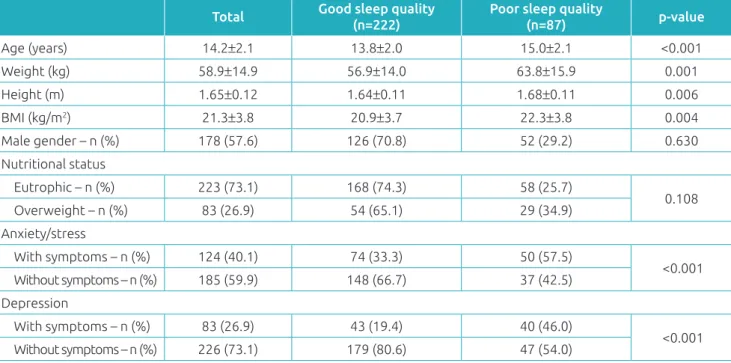
We collected data from 317 amateur adolescent athletes; how-ever, 8 participants were excluded for not illing out the instru-ments completely, leading to a inal sample of 309 adolescents. he data describing this sample, stratiied as to the classiica-tion of sleep quality, are presented in Table 1.
Regarding the sports modalities, 31.7% (n=98) practiced volleyball; 25.2% (n=78), handball; 18.4% (n=57), basketball; 13.6% (n=42), swimming; and 11% (n=34), judo. Poor sleep quality afected 87 (28.2%) adolescents; psychological symp-toms of depression were observed in 83 (26.9%); and anxiety/ stress symptoms, in 124 (40.1%).
Table 1 General characteristics of the total sample and groups of adolescentes with good and poor sleep quality.
Total Good sleep quality (n=222)
Poor sleep quality
(n=87) p‑value
Age (years) 14.2±2.1 13.8±2.0 15.0±2.1 <0.001
Weight (kg) 58.9±14.9 56.9±14.0 63.8±15.9 0.001
Height (m) 1.65±0.12 1.64±0.11 1.68±0.11 0.006
BMI (kg/m2) 21.3±3.8 20.9±3.7 22.3±3.8 0.004
Male gender – n (%) 178 (57.6) 126 (70.8) 52 (29.2) 0.630
Nutritional status
Eutrophic – n (%) 223 (73.1) 168 (74.3) 58 (25.7)
0.108
Overweight – n (%) 83 (26.9) 54 (65.1) 29 (34.9)
Anxiety/stress
With symptoms – n (%) 124 (40.1) 74 (33.3) 50 (57.5)
<0.001
Without symptoms – n (%) 185 (59.9) 148 (66.7) 37 (42.5)
Depression
With symptoms – n (%) 83 (26.9) 43 (19.4) 40 (46.0)
<0.001
Without symptoms – n (%) 226 (73.1) 179 (80.6) 47 (54.0)
319
Table 2 presents the results in the Poisson regression model, with the PR values of the variables sex, age, BMI and symptoms of depression and anxiety/stress regarding poor sleep quality. his model presented satisfactory results in the Omnibus test (p<0,001).
DISCUSSION
he health of adolescents has been analyzed more and more often, and their sleep patterns are a matter of concern. In this study, the prevalence of poor sleep quality was 28.2%. his prevalence is diferent from the result found by Paiva et al.,18 in which poor sleep quality was registered in 37.2%
of the adolescents assessed. It is important to mention that such divergence can be explained by the diferent popula-tions evaluated, since this study analyzed amateur adolescent athletes, and physical exercise, when practiced regularly, pro-motes beneits for sleep quality.18 An investigation conducted
with young athletes showed that the prevalence of poor sleep quality was 62.3%; however, participants were assessed prior to a competition. It is known that excitement and anxiety favor the occurrence of poor sleep quality, prolonged sleep latency and night waking in the nights preceding a sports evaluation or competition.18
Among the psychological symptoms assessed in the pres-ent sample, there was a prevalence of 26.9% for depression
and 40.1% for anxiety/stress. The high prevalence of psy-chological disorders is in accordance with epidemiological studies that show an increasing pattern in the prevalence of these symptoms among adolescents.19 Data collection
regarding psychological symptoms using scales and ques-tionnaires can be one of the explanations for this finding. Such methods facilitate the overestimation of mild and momentary mood disorders, in comparison to more con-ventional methods, such as interviews. However, the acqui-sition of these data from self-reports is indispensable, since it informs the unique perception of the individual about his or her own behavior.20
Complaints about sleep quality are more common among adolescents with depression, who require more attention for reporting suicidal and self-harm intentions.21
In this study, the athlete adolescents who presented with poor sleep quality had higher chances of reporting symp-toms of depression. The explanation for this association may lie on the fact that lack of sleep leads to the inap-propriate modulation of emotional cerebral responses to aversive stimulation, since young people who suffer from sleep deprivation show hyper-limbic response through the amygdala as a consequence of exposure to more and more negative imaging stimuli.21 It is worth to mention
that the lack of sleep has been pointed out as a factor of interference in the ability of adolescents to deal with the
Variables Crude PR (95%CI) p‑value Adjusted PR (95%CI) p‑value
Sex
Female 1
0.628 1 0.999
Male 1.02 (0.93–1.13) 1.00 (0.93–1.08)
Age (years)
10 to 14 1
<0.001 1 <0.001
15 to 19 1.26 (1.14–1.59) 1.18 (0.80–1.77)
BMI
Eutrophic 1
0.121 1 0.033
Overweight 1.10 (0.98–1.23) 1.12 (1.01–1.24)
Symptoms of depression
Present 1.31 (1.17–1.48)
<0.001 1.23 (1.08–1.40) <0.001
Absent 1 1
Symptoms of anxiety/stress
Present 1.23 (1.11–1.36)
<0.001 1.16 (1.04–1.28) 0.007
Absent 1 1
Table 2 Crude and adjusted prevalence ratio for factors associated with poor sleep quality in amateur adolescent athletes.
daily stress, and as a harmful aspect of their relationships with colleagues and adults.22
he study by Jin et al.23 evaluated 5,259 Chinese
adoles-cents and young adults aged between 13 and 26 years, and concluded that 14.1% of them reported symptoms of anxiety alone. In the present study, in a diferent manner, adolescents presented both anxiety and stress, and both were included in a single category (anxiety/stress). Athlete adolescents with poor sleep quality also have more chances of reporting symp-toms of anxiety/stress. In a study conducted with high school students in periods of one month, one week and one night before sports competitions, poor sleep quality was observed, as well as prolonged sleep latency and more moments of night waking in the night prior to the evaluation, in relation to the prior week or month,17 which may have been caused by the
stress to which adolescent athletes are subjected at a time of a competition.24
Among the personal variables associated with poor sleep quality, it was observed that older adolescent athletes and those overweight had higher chances of reporting poor sleep quality. By corroborating these indings, a meta-analysis that assessed the patterns of sleep on the health of adolescents showed that sex, age, and geographic region impact the sleep patterns. herefore, girls tend to sleep 11 extra minutes per night in relation to boys; adolescents tend to lose 14 min-utes during the day and 7 min14 min-utes at night in the duration of sleep each year; and Asian adolescents sleep approximately 40 to 60 minutes less than Americans, and 60 to 120 min-utes less than Europeans.25
This study found more chances of older adolescents, aged between 15 and 19 years, reporting poor sleep qual-ity, corroborating the study by Felden et al.,26 who
iden-tified that the risk of poor sleep quality increased with age. This association may be explained by the fact that, while there is a cumulative increase of academic and recre-ational activities, there is also a reduction of time of sleep throughout the years.27 Besides, the delay in the biological
process of melatonin secretion, hormone that is respon-sible for controlling the sleep-wake cycle, is related with the advancement of puberty and with the reduced sleep hours among adolescents.22
About the higher probability of overweight adolescents reporting poor sleep quality, obesity is not only related with the lack of diet or physical inactivity, but also with the neg-ative perception of sleep.28 Among them, sleep deprivation
seems to be associated with increasing stimuli to activate the orbitofrontal cortex, insula, thalamus, precuneus, cingulate gyrus, supramarginal gyrus, which are related with motivation
and the value of food reward, as well as cognitive processing, decision-making and self-control. herefore, sleep depriva-tion would change the neuron activity, making individuals more prone to food stimuli, which partly explains the asso-ciation between poor sleep quality and high BMI values.29
In addition, other mechanisms are described in the literature as being responsible for the association between lack of sleep and increasing weight, such as changes in appetite hormones. Besides, insuicient sleep tends to afect energy consumption and use, resulting in more time and opportunities for the intake of food, especially high calorie items.30
he limitations of this study are related with its cross-sec-tional design, which does not allow to establish a causality relationship between personal characteristics, psychological symptoms and poor sleep quality. Besides, the dichotomization of results in the EADS-21 scale and the sum of the domains of anxiety and stress may have overestimated the prevalence of psychological symptoms. It is important to mention that the evaluation of sleep quality among the participants did not consider the calendar of sports activities, therefore not distin-guishing periods of training, pre-competition and competition, and it is a known fact that these moments may inluence the athletes’ sleep quality.
Finally, by concluding that good sleep quality is essential for both physical and mental well-being, especially for ath-lete adolescents, it is suggested that further studies assess the eicacy of the insertion of techniques and methods aiming at relaxation and development of cognitive health in training rou-tines. he objective would be to preserve the behavioral and psychological aspects of the adolescents.
he indings in this study indicate that athlete adolescents present with high prevalence of poor sleep quality and symp-toms of depression and anxiety/stress. Besides, there was sig-niicant association between poor sleep quality with age, BMI and the psychological symptoms assessed.
Acknowledgments
he authors would like to thank Programa de Fortalecimento Acadêmico (PFA), from Universidade de Pernambuco (UPE), and Fundação de Amparo à Ciência e Tecnologia de Pernambuco (FACEPE) for the inancial support.
Funding
he irst author had a scientiic initiation scholarship from PFA, UPE.
Conflict of interests
321
REFERENCES
1. Ciampo LA. O sono na adolescência. Adolesc Saude. 2012;9:60‑6.
2. Berger RJ, Phillips NH. Energy conservation and sleep. Behav Brain Res. 1995;69:65‑73.
3. Fernandes RM. O sono normal. Medicina, Ribeirão Preto. 2006;39:157‑68.
4. Carskadon MA. Sleep in adolescents: the perfect storm. Pediatr Clin North Am. 2011;58:637‑47.
5. Gould CE, Beaudreau SA, O’Hara R, Edelstein BA. Perceived anxiety control is associated with sleep disturbance in young and older adults. Aging Ment Health. 2016;20:856‑60.
6. Pereira ÉF, Barbosa DG, Andrade RD, Claumann GS, Pelegrini A, Louzada FM. Sono e adolescência: quantas horas os adolescentes precisam dormir? J Bras Psiquiatr. 2015;64:40‑4.
7. Myrtveit SM, Sivertsen B, Skogen JC, Frostholm L, Stormark KM, Hysing M. Adolescent neck and shoulder pain‑the association with depression, physical activity, screen‑based activities, and use of health care services. J Adolesc Health. 2014;55:366‑72.
8. Auvinen JP, Tammelin TH, Taimela SP, Zitting PJ, Järvelin MR, Taanila AM, et al. Is insuicient quantity and quality of sleep a risk factor for neck, shoulder and low back pain? A longitudinal study among adolescents. Eur Spine J. 2010;19:641‑9.
9. Bleyer FT, Barbosa DG, Andrade RD, Teixeira CS, Felden ÉP. Sleep and musculoskeletal complaints among elite athletes of Santa Catarina. Rev Dor. 2015;16:102‑8.
10. Lustberg L, Reynolds CF. Depression and insomnia : questions of cause and efect. 2000;4:253‑62.
11. Brand S, Kirov R, Kalak N, Gerber M, Schmidt NB, Lemola S, et al. Poor sleep is related to lower emotional competence among adolescents. Behav Sleep Med. 2016; 14:602‑14.
12. Cole TJ, Bellizzi MC, Flegal KM, Dietz WH. Establishing a standard definition for child overweight and obesity worldwide: international survey. BMJ. 2000;320:1240‑3. 13. Cole TJ, Flegal KM, Nicholls D, Jackson AA. Body mass index
cut ofs to deine thinness in children and adolescents: international survey. BMJ. 2007;335:194.
14. Bertolazi AN, Fagondes SC, Hof LS, Dartora EG, Miozzo IC, de Barba ME, et al. Validation of the Brazilian Portuguese version of the Pittsburgh Sleep Quality Index. Sleep Med. 2011;12:70‑5.
15. Passos MH, Silva HA, Pitangui AC, Oliveira VM, Lima AS, Araújo RC. Coniabilidade e validade da versão brasileira do Índice de Qualidade do Sono De Pittsburgh em adolescentes. J Pediatr (Rio J). 2017;93:200‑6.
16. Vignola RC, Tucci AM. Adaptation and validation of the depression, anxiety and stress scale (DASS) to Brazilian Portuguese. J Afect Disord. 2014;155:104‑9.
17. Silva HA, Passos MH, Oliveira VM, Palmeira AC, Pitangui AC, Araujo RC. Short version of the Depression Anxiety Stress Scale : is it valid for Brazilian adolescents ? Einstein (São Paulo). 2016;14:486‑93.
18. Paiva T, Gaspar T, Matos MG. Sleep deprivation in adolescents: correlations with health complaints and health‑related quality of life. Sleep Med. 2015;16:521‑7.
19. Kessler RC, Avenevoli S, Merikangas KR. Mood disorders in children and adolescents: an epidemiologic perspective. 2001;49:1002‑14.
20. Kohlsdorf M, Junior ÁL. O Autorrelato na Pesquisa em Psicologia da Saúde: Desaios metodológicos. Psicol Argum. 2009;27:131‑9.
21. Gangwisch JE, Babiss LA, Malaspina D, Turner JB, Zammit GK, Posner K. Earlier parental set bedtimes as a protective factor against depression and suicidal ideation. Sleep. 2010;33:97‑106.
22. Carskadon MA, Wolfson AR, Acebo C, Tzischinsky O, Seifer R. Adolescent sleep patterns, circadian timing, and sleepiness at a transition to early school days. Sleep. 1998;21:871‑81.
23. Jin Y, He L, Kang Y, Chen Y, Lu W, Ren X, et al. Prevalence and risk factors of anxiety status among students aged 13‑26 years. Int J Clin Exp Med. 2014;7:4420‑6.
24. Romyn G, Robey E, Dimmock JA, Halson SL, Peeling P. Sleep, anxiety and electronic device use by athletes in the training and competition environments. Eur J Sport Sci. 2016;16:301‑8.
25. Olds T, Blunden S, Petkov J, Forchino F. The relationships between sex, age, geography and time in bed in adolescents: A meta‑analysis of data from 23 countries. Sleep Med Rev. 2010;14:371‑8.
26. Felden ÉP, Filipin D, Barbosa DG, Andrade RD, Meyer C, Louzada FM. Fatores associados à baixa duração do sono em adolescentes. Rev Paul Pediatr. 2015;34:64‑70.
27. Iglowstein I, Jenni OG, Molinari L, Largo RH. Sleep duration from infancy to adolescence: reference values and generational trends. Pediatrics. 2003;111:302‑7.
28. Petribú MM, Tassitano RM, Nascimento WM, Santos EM, Cabral PC. Fatores associados ao sobrepeso e à obesidade em estudantes do ensino médio da rede pública estadual do município de caruaru (PE). Rev Paul Pediatr. 2011;29:536‑45.
29. St‑Onge MP, McReynolds A, Trivedi ZB, Roberts AL, Sy M, Hirsch J. Sleep restriction leads to increased activation of brain regions sensitive. Am J Clin Nutr. 2012;95:818‑24.
30. Chaput JP, Dutil C. Lack of sleep as a contributor to obesity in adolescents: impacts on eating and activity behaviors. Int J Behav Nutr Phys Act. 2016;13:103.