BRIEF COMMUNICATION
Profile of Brazilian smokers in the National Program for
Tobacco Control
Na´dia C. Rodrigues,
1,2Regina D. Neves,
1Daniela de S. Mendes,
1Cristiane P. Mendes,
1Isa H. Martins, Ineˆs N. Reis,
1Valeria T. Lino,
1Gisele O’Dwyer,
1Regina P. Daumas,
1Tania Maria Esteves,
1Moˆnica K. Andrade,
1,3Denise L. Monteiro,
2Moˆnica B. Barros
1 1Escola Nacional de Sau´de Pu´blica Sergio Arouca, Fundac¸a˜o Oswaldo Cruz, Rio de Janeiro, RJ, Brazil.
2Faculdade de Cieˆncias Me´dicas,
Universidade do Estado do Rio de Janeiro (UERJ), Rio de Janeiro, RJ, Brazil.3Centro de Estudo e Pesquisa do Envelhecimento, Instituto Vital Brazil, Rio de Janeiro, RJ, Brazil.
Objective:The treatment of tobacco addiction in Brazil has expanded in recent years; however, we must increase knowledge about the characteristics of individuals who adhere to cessation programs in order to adjust treatments to specific characteristics of the target population that favor success. The aim of this study was to describe the characteristics of smokers who present to Brazilian public health units seeking help to quit smoking based on the experience of a primary health care unit that covers a poor community in the city of Rio de Janeiro.
Methods:Data were collected at a Teaching Health Center from January 03 2012 to January 03 2014.
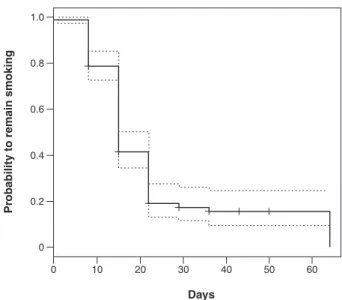
Results: Mean patient age was 49.32611.82 years, and 71% were women. About half of the participants successfully quit smoking (n=125, 51%). Higher levels of nicotine dependence were associated with lower levels of smoking cessation. There was a notable decrease in the probability of remaining smoking throughout the first month of treatment. After 3 weeks of treatment, only 19% had not quit smoking. The probability of quitting smoking decreases by 2% for every additional year of age.
Conclusion:There is a need to revise and expand current strategies to make them more effective in preventing smoking since childhood.
Keywords: National Program for Tobacco Control; smoking; smoking cessation; tobacco; tobacco use cessation products
Introduction
Smoking is the leading preventable cause of death worldwide. It causes six million deaths worldwide per year, mostly in low- and middle-income countries.1 For
many years, smoking was viewed as a lifestyle and was ostensibly encouraged by advertising. Currently, there is an understanding that smoking is a disease caused by nicotine dependence, and it is therefore classified in the ICD-10 under the group of mental disorders and behaviors resulting from the use of psychoactive sub-stances. In addition to nicotine, various substances which are present in the composition of cigarettes are causal factors for tobacco-related diseases.2
Despite efforts in implementing the Brazilian National Program for Tobacco Control, the rate of successful treatment is still low (about 20%).3The odds of success can be improved by further knowledge of the character-istics of individuals who adhere to the program, so that
treatment can be adjusted to the specific characteristics of the target population.4
The aim of this study was to describe the character-istics of smokers who seek help to quit smoking in Brazilian public health units, based on the experience of a primary health care unit that covers a poor community in the city of Rio de Janeiro.
Methods
This was a retrospective cohort study. Clinical records of all patients undergoing treatment for tobacco control during the study period (from January 03 2012 to January 03 2014) at the Teaching Health Center of Escola Nacional de Sau´de Pu´blica Sergio Arouca, Fundac¸a˜o
Oswaldo Cruz (FIOCRUZ), Rio de Janeiro, Brazil, were extracted and recorded in an electronic database.
The health professionals of the Teaching Health Center have assisted the low-income population of the Manguin-hos community, covering approximately 20,000 inhabi-tants, since 1967. Manguinhos is located in the north zone of the city of Rio de Janeiro. In this region, the household density is 2.8 persons per dwelling. For more than 50% of residents, the mean educational attainment level does not exceed primary education.
Correspondence: Na´dia Cristina Pinheiro Rodrigues, Rua Leopoldo Bulho˜es, 1480, CEP 21041-210, Manguinhos, Rio de Janeiro, RJ, Brazil.
E-mail: [email protected]
Submitted Nov 10 2014, accepted Feb 14 2015.
Associac¸a˜o Brasileira de Psiquiatria
Treatment consisted of seven weekly visits: one (the first) to complete clinical records, four for cognitive-behavioral therapy (CBT), and the last two for patient follow-up. Participants who came to the first visit but did not attend every visit were not excluded, but those who did not come to at least four meetings were considered cases of treatment failure (patients who did not stop smoking) (Figure 1). The proportion of treatment success (main response variable) was calculated using the number of patients who quit smoking after treatment onset (first visit) as the numerator, and the total number of the patients who began treatment (those who attended the first visit) as the denominator.
Blood pressure and body weight were measured at all visits. Drug treatment was prescribed to all participants during the first CBT session. The prescribed treatment, which was provided regularly to all study participants, consisted of transdermal nicotine replacement therapy (NiQuitin Patches). All participants joined the drug treatment. The dosage was selected according to the Brazilian Ministry of Health protocol. Briefly patients who smoke more than 20 cigarettes per day use the following scheme: weeks 1 to 4 weeks, 21-mg patch, 24 hours a day; weeks 5 to 8, 14-mg patch, 24 hours a day; weeks 9 to 12, 7-mg patch, 24 hours a day. Patients who smoke 10-20 cigarettes a day and those who smoke their first cigarette within 30 minutes of waking up use the following scheme: weeks 1 to 4, 14-mg patch, 24 hours a day; weeks 5 to 8, 7-mg patch, 24 hours a day.
Tobacco dependence was assessed using the Fager-stro¨m scale (classification criterion: 0-2 points, very low; 3-4 points, low; 5 points, moderate; 6-7 points, high; 8-10 points, very high).5 Alcohol dependency screening was performed using the CAGE scale, a four-item questionnaire that can indicate potential problems with alcohol abuse. The CAGE questionnaire (Cutting down, Annoyance by criticism, Guilty feeling, and
Eye-openers) is useful in helping to make a diagnosis of alcoholism.6
Statistical analysis
Relative frequencies and means 6 standard deviations were calculated for the characteristics of interest. The factors included in the analyses were sociodemographic characteristics, tobacco use variables, tobacco history, medical history, lifestyle habits, and body weight and blood pressure measurements. Statistical tests were employed as appropriate and 95% confidence intervals (95%CI) were calculated. A Kaplan-Meier curve was plotted to assess the probability of remaining smoking throughout the first 64 days of treatment. Cox proportional hazards modeling was used to evaluate the effect of age on the time required to quit smoking, adjusted by gender, dependence level, and income. All analyses were performed in the R-3.1.1 software environment.
Ethics statement
The study followed the principles set forth in the Declaration of Helsinki and was approved by the Institutional Review Board of the facility where the study was carried out through the Ethics Committee of Escola Nacional de Sau´de Pu´blica Sergio Arouca, Fundac¸a˜o Oswaldo Cruz
(ENSP/FIOCRUZ) (protocol 624,550).
Results
During the study period, 246 smokers sought treatment at the Teaching Health Center. Smokers were enrolled in a tobacco treatment group mainly due to friends’ advice (36%) or their own initiative (30%). A large portion of smokers (36%) lived with other smokers.
Mean participant age was 49.38611.86 years, and 71% were female. Almost half of the group was single,
and 34% were married. The majority of participants (68%) had a monthly income of two times the Brazilian minimum wage or less (i.e., US$ 786.76 or less) and low educational attainment (Table 1).
A large proportion of participants reported that their smoking habits were strongly associated with anxiety reduction (92%), sadness (79%), coffee intake (85%), and the end of a meal (91%).
The leading reason to continue smoking reported was the supposed calming effect of tobacco (83%), and the main reasons to quit smoking were concern for future health (95%), being a bad example for children (92%), family wellbeing (84%), actual dependence (84%), and economic issues (84%).
Most smokers reported moderate (49%) or poor (36%) self-perceived health. The main health problems reported were depression (55%), gastric disorder (49%), and hypertension (32%).
Participants who had already tried to quit smoking reported that the main abstinence symptoms were anxiety (67%), agitation (62%), irritability (58%), and craving (58%).
The majority of smokers (76%) presented high or very high levels of tobacco dependence before starting treatment, and half (53%) were also alcohol dependent.
The mean Fagerstro¨m scale score was 6.7462.06, which represents high tobacco dependence (Table 1).
About half of the participants achieved smoking cessation (n=125, 51%). As 85 participants (15%) did not attend least four treatment visits, these cases were classified as treatment failures (Figure 1). Mean length of time to smoking cessation after the start of treatment was approximately 2 weeks (mean = 15.916
8.14 days).
The Kaplan-Meier curve shows a marked decline in the probability of still smoking throughout the first month of treatment. Within 3 weeks of starting treatment, only 19% of participants had not quit smoking (Figure 2). The probability of quitting decreased 2% for every additional year of age (adjusted by sex, dependence level, and income) (hazard ratio = 0.98; po0.03).
Systolic and diastolic blood pressure did not change significantly 3 months after the start of treatment (mean decrease, 10 mmHg). Approximately 37% of participants reported a fear of gaining weight. The mean variation in body weight 3 months after treatment was +1.10 kg (95%CI 0.25-2.00).
Discussion
Smokers’ family and friends were the most frequent sources for smoking cessation support.7Government programs for tobacco control have helped curtail the smoking epidemic in Brazil and elsewhere in the world.8
In Brazil, the group that most often seeks help at smoking cessation support groups in public health units are women with a mean age of 50 years and low educational attain-ment.9Perhaps, this group represents a population that does not work and thus has a more flexible schedule to attend weekly therapy sessions at health units. Tobacco control program sessions generally occur on weekdays,
Table 1 Proportion of success in quitting smoking according to sociodemographic factors and level of tobacco and alcohol dependence
Total Quit smoking
Female 165 (71) 80 (48)
Male 69 (29) 39 (57)
Age, years 49.38611.86 50.00610.71
Marital status
Single 102 (44) 47 (46)
Married 86 (37) 48 (56)
Separated/divorced 20 (8) 11 (55)
Widowed 17 (7) 9 (53)
Other 9 (4) 4 (44)
Income (minimum wage)*
p2 159 (68) 79 (50)
2-4 55 (23) 30 (55)
4-7 11 (5) 7 (64)
47 9 (4) 3 (33)
Educational attainment
Less than primary education 105 (46) 51 (46) Primary education 47 (20) 24 (51) Secondary education 63 (27) 36 (57)
Higher education 15 (7) 5 (33)
Alcoholismw 46 (53) 27 (58.7)
Tobacco dependence level=
Very low 9 (4) 6 (66.7)
Low 21 (9) 12 (57.1)
Moderate 31 (13) 14 (45.2)
High 88 (37) 47 (53.4)
Very high 94 (39) 44 (46.8)
Data presented as n (%) or mean6standard deviation.
*Minimum wage = US$ 393.38 per month (July 10 2014). wMeasured using the CAGE scale.
=
Measured using the Fagerstro¨m scale.
during business hours, which hinders the participation of smokers who work.
Individual characteristics as well as the influence of friends and family are proving to be important precipitating factors of smoking onset. It is common to find two or more smokers within the same family. Smokers generally choose to associate with friends who also smoke, while nonsmokers prefer to relate with other people who do not smoke.10
People who smoke for many years have difficulty reporting specific situations that are more related to an urgent need to smoke. This may be because almost all situations in their lives are already tobacco-related. Among the situations most strongly associated with the need to smoke, anxiety, sadness, and nervousness are commonly reported by smokers. However, in opposite situations, such as times of happiness and celebrations, smokers report a similar urge to smoke.11
When smokers are asked about the benefits of tobacco use, they generally report that smoking is able to calm them.12This probably occurs because, in general, drugs are used as a means of escaping from a problem.13,14
A study revealed that reducing psychologic symptoms of distress improves quality of life in people with drug dependence.15 Otherwise, smokers report that health issues are one of the main reasons that lead smokers to quit. Many people seek help to stop smoking because they are already starting to feel the harmful effects of smoking on their health.16A study conducted in Europe in
2005-2010 revealed that more than 40% of former smokers mentioned a current health condition as the main reason to stop smoking, and about 30% stopped to prevent future health problems.17
Several symptoms of smoking abstinence have been described in the literature, including a craving for cigarettes, anger, anxiety, depression, difficulty concentrating, impa-tience, insomnia, restlessness, constipation, cough, dizzi-ness, and increased dreaming.18 These symptoms are
more frequent in the first weeks after smoking cessation, and disappear over time. The craving for cigarettes is unique in that, although it also decreases over time, it can still recur several years after smoking cessation.13
Hypertension is a frequent problem among smokers. In this study, we did not detect a significant change in blood pressure after tobacco cessation, as participants in the tobacco treatment group were still using nicotine patches during the evaluation period.19
Weight gain is very common in early treatment of tobacco cessation. The appetite increase often reported by recent ex-smokers is probably related to anxiety, which is one of the most common symptoms of withdrawal.20
Treatment outcomes for patients with concurrent alcohol and tobacco dependence are generally worse than for people addicted to only one drug. Many treatments do not promote smoking cessation during alcoholism therapy. Some research, however, has suggested that concurrent treatment for both addictions may improve outcomes.20
The level of nicotine dependence found among people seeking smoking cessation treatment at health services appears to be high, indicating that smokers with greater
nicotine dependence seek more help to quit than those who are less dependent.20However, this specific group of smokers seems to be less successful in achieving smoking cessation than those with a low degree of dependence.21
Because the present study was retrospective and involved secondary data collected from clinical records, some potential data quality issues must be considered (e.g., missing or incomplete information, data collection by different professionals, use of different measuring instruments), as the data used for analysis were not originally collected for research purposes.
The increase in public policies to fight smoking in recent decades has already shown some beneficial results in reducing the prevalence of smoking in Brazil. In 2012, the prevalence of smoking among Brazilian adults had decreased 3.9 percentage points compared to 2006.22 Some authors consider smoking a pediatric
disease, because it usually begins in adolescence.23 However, the treatment provided through the public health care system in Brazil predominantly reaches older individuals and females. Despite some actions undertaken in public schools, there is a need to revise and expand tobacco control strategies in the country to make them more effective in preventing smoking since childhood.
Acknowledgements
The authors thank Maria Antoˆnia Silva Costa, Wanessa Arau´jo Pereira, Maria Clara Dutra, and Joa˜o Carlos de Souza for their assistance with data collection.
Disclosure
The authors report no conflicts of interest.
References
1 World Health Organization (WHO). 2012 global progress report. On implementation of the WHO Framework Convention on Tobacco Control [Internet]. 2012 [cited 2014 Aug 08]. http://www.who.int/fctc/ reporting/2012_global_progress_report_en.pdf.
2 2008 PHS Guideline Update Panel, Liaisons, and Staff. Treating tobacco use and dependence: 2008 update U.S. Public Health Ser-vice Clinical Practice Guideline executive summary. Respir Care. 2008;53:1217-22.
3 Chatkin JM, Mariante de Abreu C, Haggstra¨m FM, Wagner MB, Fritscher CC. Abstinence rates and predictors of outcome for smoking cessation: do Brazilian smokers need special strategies? Addiction. 2004;99:778-84.
4 Lancaster T, Stead L, Silagy C, Sowden A. Effectiveness of inter-ventions to help people stop smoking: findings from the Cochrane Library. BMJ. 2000;321:355-8.
5 Heatherton TF, Kozlowski LT, Frecker RC, Fagerstro¨m KO. The Fagerstro¨m Test for Nicotine Dependence: a revision of the Fager-stro¨m Tolerance Questionnaire. Br J Addict. 1991;86:1119-27. 6 Ewing JA. Detecting alcoholism. The CAGE questionnaire. JAMA.
1984;252:1905-7.
7 Toghianifar N, Sarrafzadegan N, Roohafza H, Sadeghi M, Eshrati B, Sadri G. Smoking cessation support in Iran: availability, sources & predictors. Indian J Med Res. 2011;133:627-32.
National Health Interview Survey. Am J Public Health. 2007;97: 1464-9.
9 Meier DAP, Vannuchi MTO, Secco IAO. Abandono do tratamento do tabagismo em programa de municı´pio do norte do Parana´. Rev Espac¸o Sau´de. 2011;13:35-44.
10 Abreu MN, Caiaffa WT. [Influence of family environment and social group on smoking among Brazilian youth aged 15 to 24 years]. Rev Panam Salud Publica. 2011;30:22-30.
11 Liu Y, Li X, Wang W, Li Z, Hou M, He Y, et al. Investigation of space-time clusters and geospatial hot spots for the occurrence of tuber-culosis in Beijing. Int J Tuberc Lung Dis. 2012;16:486-91.
12 Ferreira SA, Teixeiraa Cde C, Correˆa AP, Lucena Ade F, Echerc IC. [Reasons that make individuals in a higher education institution to become or not to become smokers]. Rev Gaucha Enferm. 2011;32: 287-93.
13 Instituto Nacional de Caˆncer Jose´ Alencar Gomes da Silva (INCA CNI). Programa Nacional de Controle do Tabagismo [Internet]. 2014 [cited 2014 Aug 26]. http://www2.inca.gov.br/wps/wcm/connect/ acoes_programas/site/home/nobrasil/programa-nacional-controle-tabagismo/tratamento-do-tabagismo.
14 Arau´jo LF, Gontie´s B, Nunes Junior J. Representac¸o˜es sociais da
cocaı´na: estudo comparativo entre universita´rios das a´reas de sau´de e jurı´dica. Estud Psicol (Campinas). 2007;24:315-23.
15 Hosseinzadeh Asl NR, Hosseinalipour F. Effectiveness of mindfulness-based stress reduction intervention for health-related quality of life in drug-dependent males. Iran Red Crescent Med J. 2014;16:e12608.
16 Center for Disease Control and Prevention (CDC). Health effects of cigarette smoking [Internet]. 2014 [cited 2014 Aug 11]. http://www. cdc.gov/tobacco/data_statistics/fact_sheets/health_effects/effects_cig_ smoking/
17 Gallus S, Muttarak R, Franchi M, Pacifici R, Colombo P, Boffetta P, et al. Why do smokers quit? Eur J Cancer Prev. 2013;22:96-101. 18 Hughes JR. Effects of abstinence from tobacco: valid symptoms and
time course. Nicotine Tob Res. 2007;9:315-27.
19 Tanus-Santos JE, Toledo JC, Cittadino M, Sabha M, Rocha JC, Moreno H Jr. Cardiovascular effects of transdermal nicotine in mildly hypertensive smokers. Am J Hypertens. 2001;14:610-4.
20 Castro MRP, Nunes SOV, Faria DD, Rocha CEB, Bacchi RS. A dependeˆncia da nicotina associada ao uso de a´lcool e outras substaˆncias psicoativas. Cienc Biol Saude. 2008;29:131-40. 21 Fagerstro¨m KO, Kunze M, Schoberberger R, Breslau N, Hughes JR,
Hurt RD, et al. Nicotine dependence versus smoking prevalence: comparisons among countries and categories of smokers. Tob Control. 1996;5:52-6.
22 Unidade de Psquisa em A´lcool e Drogas (UNIAD), Instituto Nacional de Cieˆncia e Tecnologia para Polı´ticas Pu´blicas do A´lcool e outras Drogas (INPAD). II Lenad - Levantamento Nacional de A´ lcool e Drogas [Internet]. 2012 [cited 2015 Jan 01]. http://inpad.org.br/ wp-content/uploads/2014/03/Lenad-II-Relat%C3%B3rio.pdf. 23 Barbosa Filho VC, Campos Wd, Lopes Ada S. Prevalence of alcohol