Original Article
Rev. Latino-Am. Enfermagem2014 Nov.-Dec.;22(6):1048-55 DOI: 10.1590/0104-1169.0050.2515
www.eerp.usp.br/rlae
Copyright © 2014 Revista Latino-Americana de Enfermagem This is an Open Access article distributed under the terms of the Creative Commons Attribution Non-Commercial License (CC BY-NC).
This license lets others distribute, remix, tweak, and build upon your work non-commercially, and although their new works must also acknowledge you and be non-commercial, they don’t have to license their derivative works on the same terms.
Objective: to analyze the factors associated with the underreporting on the part of nurses within
Primary Health Care of abuse against children and adolescents. Method: cross-sectional study with
616 nurses. A questionnaire addressed socio-demographic data, profession, instrumentation and
knowledge on the topic, identification and reporting of abuse cases. Bivariate and multivariate
logistic regression was used. Results: female nurses, aged between 21 and 32 years old, not
married, with five or more years since graduation, with graduate studies, and working for five
or more years in PHC predominated. The final regression model showed that factors such as
working for five or more years, having a reporting form within the PHC unit, and believing
that reporting within Primary Health Care is an advantage, facilitate reporting. Conclusion: the
study’s results may, in addition to sensitizing nurses, support management professionals in
establishing strategies intended to produce compliance with reporting as a legal device that
ensures the rights of children and adolescents.
Descriptors: Mandatory Reporting; Violence; Child; Adolescent; Primary Health Care.
Corresponding Author: Ana Carine Arruda Rolim Universidade de Fortaleza Av. Washington Soares, 1321 Bairro: Edson Queiroz
CEP: 60811-905, Fortaleza, CE, Brasil E-mail: [email protected]
1 Paper extracted from master’s thesis “Mandatory reporting of child abuse in municipalities of Ceará, Brazil”, presented to Universidade de
Fortaleza, Fortaleza, CE, Brazil. Supported by Fundação Cearense de Apoio ao Desenvolvimento Científico e Tecnológico (FUNCAP), Brazil, process # 306061/2008-2.
2 Doctoral student, Faculdade de Ciências Médicas, Universidade Estadual de Campinas, Campinas, SP, Brazil.
3 Doctoral student, Programa de Pós-graduação em Saúde Coletiva, Associação Ampla – Universidade Estadual do Ceará, Fortaleza, CE, Brazil,
Universidade Federal do Ceará, Fortaleza, CE, Brazil and Universidade de Fortaleza, Fortaleza, CE, Brazil.
4 RN, student of the Specialization course in Occupational Nursing, Universidade Estadual do Ceará, Fortaleza, CE, Brazil.
5 RN, student of the Specialization course in Management and Audit of Systems and Health Services, Faculdade Leão Sampaio, Fortaleza, CE,
Brazil.
6 PhD, Full Professor, Universidade de Fortaleza, Fortaleza, CE, Brazil.
Factors associated with reporting of abuse against children and
adolescents by nurses within Primary Health Care
1Ana Carine Arruda Rolim
2Gracyelle Alves Remigio Moreira
3Sarah Maria Mendes Gondim
4Soraya da Silva Paz
5Introduction
Acknowledged worldwide as a social and public health problem due to its impact on the morbidity and mortality of the population and also on the routine of human experiences(1), violence is deeply rooted in social,
economic and political structures, as well as in individual consciousness and cultural dynamics. Violence against children and adolescents entails a breach of the duty on the part of adults and society, in general, to protect these individuals, as well as a trivialization of the rights of children and adolescents to be treated as subjects and people under special conditions of growth and development.
The magnitude of this problem can be found in studies that show violence against children and adolescents to be the main causes of death and disease among these populations in many countries(2-4), including Brazil(5).The
magnitude of this problem in the international scenario concerns governments, researchers and civil society, because its repercussions for the future lives of this members of these groups are signiicant(2,6).
In the Brazilian context, as part of the strategy used to cope with this problem, the Child and Adolescent Statute (ECA)has established that healthcare workers and those in the ield of education are supposed to report maltreatment against children and adolescents(7). In the
health ield, this practice is supported by Decree No. 1.968/2001, which institutionalized mandatory reporting of abuse against children and adolescents who receive care from the Uniied Health System (SUS)(8) and also by
Decree No. 104/2011, which establishes that domestic violence, sexual and/or other types of violence is the 45th event in a list of mandatory reporting(9).
As part of the Brazilian healthcare model, Primary Health Care (PHC) presents a privileged opportunity to identify and manage situations of abuse perpetrated against children and adolescents. The reason is that this model is intended to prevent disease and harm and is grounded on health promotion to encourage coping with violence against this population.
In this ield of collective health, nurses stand out because they have academic background that qualify them to perform actions that promote health as well as family care(10). This profession has incorporated new
practices that transcend the technical-healing model due to the complex demands presented within PHC(11). In this
context, maltreatment of children and adolescents and its consequences reverberate in the routines of family strategy health teams and demand from nurses and other healthcare workers an ethical and legal response in accordance with the precepts that govern this topic.
Nonetheless, studies indicate that PHC-unit-originating reports of violence are a challenge for many reasons including lack of preparation and poor management of cases, in addition to a fear of personal or professional
retaliation(11-12). From this perspective, this study is
relevant because it lists the factors that facilitate reporting of abuse against children and adolescents in regard to the professional and citizenship roles of nurses working in PHC, an aspect seldom addressed in the literature.
We expect that these results will support the planning of actions to facilitate the reorientation of practices involving management and care provided by PHC units so that reporting becomes effective. Hence, the objective was to analyze the factors associated with juvenile abuse reporting by nurses working in PHC.
Method
A cohort cross-sectional analysis was performed using the database of a larger study titled “Violence involving children and adolescents: conditioning factors, reporting processes and coping mechanisms”, the objective of which was to analyze the reporting, on the part of healthcare workers (physicians, nurses, and dentists) from the Health Family team, of abuse committed against children and adolescents in cities in Ceará, Brazil. This paper speciically elaborates on reporting on the part of nurses.
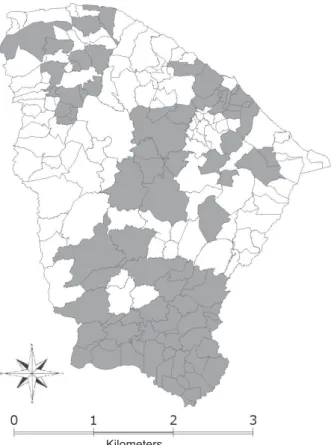
The state of Ceará is composed of 184 cities. This study included the investigation of 46.2% of those cities, i.e., 85 cities, spread out in all the health regions within the state (Figure 1).
Figure 1 - Map of the state of Ceará, Brazil showing the
cities under study
Rev. Latino-Am. Enfermagem 2014 Nov.-Dec.;22(6):1048-55.
The population of nurses was obtained based on
data provided by the Primary Care Department (PHD),
which at the time of the study, listed 1,014 nurses; 616
(60.7%) of these completed the survey.
Data were collected between 2010 and 2012. All
the nurses working in PHC units in the participant cities
received letters inviting them to participate in the study,
free and informed consent forms to sign and submit, and
the questionnaire. These papers, previously organized in sealed envelopes identiied by city, were sent to the managers of the Regional Health Coordinators and/or
the City Health Departments, which became responsible
for sending the envelopes to the nurses in each city. The
completed forms were returned following the inverse low.
The structured questionnaire was composed of
32 adapted and revised questions with the following
analytical domains: socio-demographic data, professional
background, instrumentation and knowledge regarding the topic, identiication and reporting of maltreatment against children and adolescents.
The study’s outcome was the reporting of abuse
against children and adolescents and the predictor
variables included: sex; age; marital status; time since
graduation; graduate studies; time working in the PHC
unit; and whether training was received; being aware of
ECA; being aware of the reporting form; being aware of
the reporting form within the PHC unit; trust in protection
agencies; knowing where to refer cases; fearing legal
involvement; reading about the subject; discussing
the subject at work; knowing assistance was provided
to victims; and believing that the implementation of
reporting within PHC was an advantage.
The Chi-square test (c2) was used to analyze
potential association between the outcome and the
predictor variables. P<0.05 was established to determine statistical signiicance. Multiple logistic regression was used, in which the predictor variables that showed association with the outcome with a signiicance of p<0.25 were included. The variables with a level of signiicance p<0.05 remained in the multiple model. The strength of association between the outcome and the
predictor variables was expressed in raw and adjusted Odds Ratio (OR), with a Conidence Interval (CI) of 95%. All the questionnaires were checked and entered into
the database through double entry to verify consistency
of data, which were input into the SPSS (SPSS Inc.,
Chicago, United States), version 17.0. STATA was used
for the analysis (Stata Corp LP, College Station, TX
77845, USA), version 11.0.
The study was approved by the Institutional Review
Board at the University of Fortaleza – UNIFOR (referee
report No. 072/2007).
Results
The nurses were 32.5 years old (SD±7.6) on average. The following proile predominated: women (86.4%); from 21 to 32 years old (60.1%); not married (51.7%); with ive or more years since graduation (59.2%); with graduate studies (83.1%); and ive or more years working within PHC (52.4%).
In regard to the identiication of abuse against children and adolescents in their professional practice, 56.9% of the nurses reported they had not identiied cases of abuse, while 43.1% afirmed they had. Of these, 69.7% identiied the abuse situations through the reports of the victims themselves, family members, or others. In regard to the reporting of identiied cases, 58.4% did not ile a report and 41.6% did report the abuse.
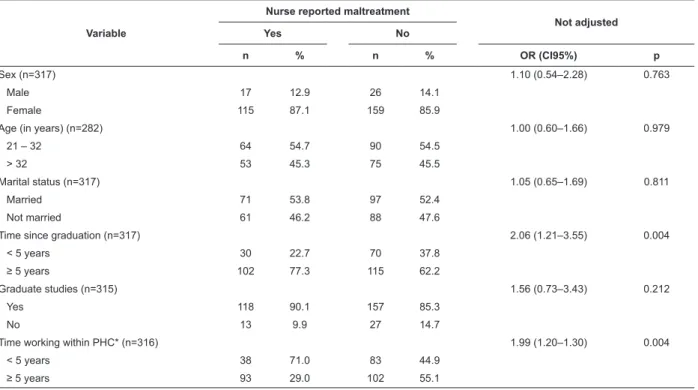
The variables of time since graduation (p=0.004)
and time working within PHC (p=0.004) were statistically
associated with the reporting of abuse against children
and adolescents, while sex, age, marital status and
graduate studies presented p>0.05 (Table 1).
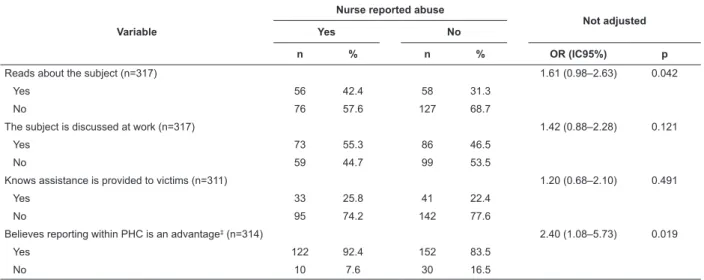
The variables of received training in the subject, is
familiar with the reporting form, with the reporting form
at the PHC unit, trusts in protection agencies, knows
where to refer cases, fears legal involvement, reads
about the subject, and believes that implementing
reporting in PHC units is an advantage, were statistically
associated with the outcome (p<0.05). The remaining variables did not present statistically signiicant differences(Table 2).
The variables selected (p<0.25) for the multiple
analysis included: time since graduation; graduate
studies; time working within PHC; received training; is
familiar with ECA; is familiar with the reporting form; is
familiar with the reporting form from the PHC unit; trusts
protection agencies; knows where to refer cases; fears
legal involvement; reads about the subject; the subject
is discussed at work; and believes it is an advantage to
implement reporting within PHC.
Table 3 presents the results of the logistic
regression. Time working within PHC, reporting form
from the PHC unit, knows where to refer cases, fears legal
involvement, and believes that implementing reporting
Table 1 – Bivariate analysis of abuse reporting and socio-demographic data and professional background of
nurses. Primary Health Care, CE, Brazil, 2010-2012
Variable
Nurse reported maltreatment
Not adjusted
Yes No
n % n % OR (CI95%) p
Sex (n=317) 1.10 (0.54–2.28) 0.763
Male 17 12.9 26 14.1
Female 115 87.1 159 85.9
Age (in years) (n=282) 1.00 (0.60–1.66) 0.979
21 – 32 64 54.7 90 54.5
> 32 53 45.3 75 45.5
Marital status (n=317) 1.05 (0.65–1.69) 0.811
Married 71 53.8 97 52.4
Not married 61 46.2 88 47.6
Time since graduation (n=317) 2.06 (1.21–3.55) 0.004
< 5 years 30 22.7 70 37.8
≥ 5 years 102 77.3 115 62.2
Graduate studies (n=315) 1.56 (0.73–3.43) 0.212
Yes 118 90.1 157 85.3
No 13 9.9 27 14.7
Time working within PHC* (n=316) 1.99 (1.20–1.30) 0.004
< 5 years 38 71.0 83 44.9
≥ 5 years 93 29.0 102 55.1
*Primary Health Care
Table 2 – Bivariate analysis between abuse reporting and instrumentation and knowledge of nurses. Primary Health
Care, CE, Brazil, 2010-2012
Variable
Nurse reported abuse
Not adjusted
Yes No
n % n % OR (IC95%) p
Received training (n=313) 2.46 (1.49–4.06) <0.001
Yes 64 48.5 50 27.6
No 68 51.5 131 72.4
Is familiar with ECA* (n=315) 1.60 (0.81–3.26) 0.146
Yes 114 87.7 151 81.6
No 16 12.3 34 18.4
Is familiar with the reporting form (n=315) 3.96 (2.28–6.98) <0.001
Yes 107 81.1 95 51.9
No 25 18.9 88 48.1
Is familiar with the reporting form from the PHC unit†
(n=307)
3.47 (2.10–5.75) <0.001
Yes 79 62.7 59 32.6
No 47 37.3 122 67.4
Trusts in the agencies of protection (n=310) 1.67 (1.02–2.76) 0.030
Yes 86 67.2 100 54.9
No 42 32.8 82 45.1
Knows the proper place to refer cases (n=311) 4.17 (2.11–8.71) <0.001
Yes 116 89.9 124 68.1
No 13 10.1 58 31.9
Fears legal involvement (n=309) 1.57 (0.97–2.55) 0.049
Yes 61 48.0 108 59.3
No 66 52.0 74 40.7
Rev. Latino-Am. Enfermagem 2014 Nov.-Dec.;22(6):1048-55.
Table 3 – Multivariate analysis of abuse reporting and associated factors. Primary Health Care, CE, Brazil, 2010-2012
Variable
Nurse reported abuse
Adjusted
Yes No
N % n % OR (IC95%) p
Time working within PHC* (n=316) 3.09 (1.74–5.49) <0.001
< 5 years 38 71.0 83 44.9
≥ 5 years 93 29.0 102 55.1
Reporting form from the PHC unit† (n=307) 3.73 (2.18–6.38) <0.001
Yes 79 62.7 59 32.6
No 47 37.3 122 67.4
Knows where to refer cases (n=311) 3.33 (1.60–6.93) 0.001
Yes 116 89.9 124 68.1
No 13 10.1 58 31.9
Fears legal involvement (n=309) 1.87 (1.09–3.20) 0.021
Yes 61 48.0 108 59.3
No 66 52.0 74 40.7
Believes that implementing reporting within PHC is an advantage* (n=314)
2.83 (1.21–6.63) 0.016
Yes 122 92.4 152 83.5
No 10 7.6 30 16.5
*Primary Health Care †Primary Health Care Unit
Variable
Nurse reported abuse
Not adjusted
Yes No
n % n % OR (IC95%) p
Reads about the subject (n=317) 1.61 (0.98–2.63) 0.042
Yes 56 42.4 58 31.3
No 76 57.6 127 68.7
The subject is discussed at work (n=317) 1.42 (0.88–2.28) 0.121
Yes 73 55.3 86 46.5
No 59 44.7 99 53.5
Knows assistance is provided to victims (n=311) 1.20 (0.68–2.10) 0.491
Yes 33 25.8 41 22.4
No 95 74.2 142 77.6
Believes reporting within PHC is an advantage‡ (n=314) 2.40 (1.08–5.73) 0.019
Yes 122 92.4 152 83.5
No 10 7.6 30 16.5
*Child and Adolescent Statute ‡Primary Health Care
Those working within PHC for ive or more years were 3.09 times more likely to report abuse. Having
a reporting form for within the PHC unit increased the likelihood of illing a report by three times. Likewise, knowing where to refer cases of child abuse increased
by 3.33 times the reporting practice. Not being afraid
of legal involvement almost doubled the likelihood
of reporting. Finally, believing that abuse reporting
within PHC is an advantage increased the likelihood
of complying with devices that regulate reporting by
almost three times (Table 3).
Discussion
Even though this study reports factors associated
with the reporting of abuse among PHC nurses, data
show that underreporting predominates, even when
nurses do identify cases of abuse against children
and adolescents. The organization of the work
process within the context of PHC to meet social
demands is not conducive to meeting the political
guidelines and principles intended to reorient the
This weakness regarding reporting of abuse in the practice of nurses is also veriied in other Brazilian regions(11,13) and in countries from other socio-cultural
contexts(14-16). One study conducted in Israel with 143
nurses and 42 physicians revealed that 60.0% of the
professionals did not report abuse(16). Even though more
advanced systems have been established in the USA for
the reporting of child abuse for a longer period of time, there still are barriers that hinder nurses from iling abuse reports(15).
One potential explanation for underreporting is
the misinterpretation of the term “reporting”, because,
in Brazil, it is culturally and historically associated with
denouncement(17). In this sense, considering the role
healthcare workers within PHC play in regard to the
community and area covered, according to the logic
of the Brazilian health model, nurses may be choosing
timid behavior in regard to sensitive and complex issues,
as is the case of violence. This represents an obstacle
because underreporting prevents health management
from completely recognizing the magnitude of the
problem; health managers depend on information at the
local level to implement effective strategies.
Association between child and adolescent abuse
reporting and longer time working within PHC, as
revealed in the analysis, shows that workers with greater
professional experience feel better prepared to deal with
this problem. One hypothesis is that the professional
who develops activities within PHC over longer periods
of time may have had more opportunities to witness
situations of violence, and therefore, may be more
familiar with the proper management of such cases. The
importance of having greater experience in the service
is shown in a study(18) reporting that “daily contact with
violence perpetrated against children awakens in the
professional a state of alertness, which mobilizes him/
her to identify signs indicating violence.”
Another hypothesis is that nurses may have
improved the way they deal with situations of child abuse,
including the decision to report it, for having become
more professionally mature and having received training
on the subject. The State Health Department in Ceará,
Brazil has promoted systematic training on coping with
violence, focusing on the reorientation of the practice of
PHC workers. Some nurses composing the study sample
may have received such training, which would explain
the increased likelihood of reporting observed here.
Having reporting forms available at the PHC unit
is also associated with higher levels of reporting among
nurses. Other studies have shown that the existence
of protocols establishing conduct within the health unit
provides tools for professionals to be more active, even
if what is available is not the reporting form, per se;
other forms to communicate violence to competent
authorities may exist(19).
Therefore, management should at least ensure the workers have the material necessary for qualiied practice within PHC. Complaints of workers and patients
regarding the inadequacy of the physical structure and insuficiency of supplies in health units are frequently reported by the Brazilian media and conirmed in the literature(20-21). These complaints conirm that
problem-solving actions intended to meet these demands should
be a priority; otherwise, there is a risk of compromising the low of care delivery and hindering procedures that would enable solutions recommended by the law.
Being aware of where cases should be referred also
increases the likelihood of reporting. In some sense, it may relect the commitment of nurses to the integral health of children and adolescents in situations of violence and their conidence in agencies that provide support and protection. Studies highlight the nurse as
an important professional in the management of cases
of abuse within PHC, especially when compared to other
professionals(11-12).
Nonetheless, would nurses “cease” their
co-participation in following up the cases after referring
situations of violence to competent authorities and
experiencing a feeling of ‘mission accomplished’ (in
accordance with the law)? Does it mean that other
professionals within the support and protection network
will monitor the cases? Because the conditions of
violence have not yet been internalized in the
health-work process; professionals often do not feel prepared
and competent to face the problem. One study(11)
shows reports of PHC nurses who believe that child
and adolescent abuse is within the sphere of other
professionals (e.g., social workers or psychologists).
The fact that nurses do not fear becoming legally
involved also encouraged the reporting of abuse. This information conirms that having a protection and support network for those suffering violence, as well as
professionals who become responsible for the reporting,
is essential. The establishment and operationalization
of this network is the role of managers and involves
the three governmental spheres. This network
should be linked to other social segments, while the
support provided by the Public Prosecutor in holding
perpetrators accountable is key to minimizing personal
Rev. Latino-Am. Enfermagem 2014 Nov.-Dec.;22(6):1048-55.
Another investigation reveals that PHC workers face
a real dilemma concerning the decision to report abuse,
even when they are aware of their legal obligations,
and may opt for a “friendly neighbor policy” in order to
ensure their own safety within the work environment
when exposed to situations that put their physical or
moral integrity at risk (11).
Another relevant aspect is that nurses who
believe that reporting within PHC is an advantage are more inclined to iling reports. Perhaps, in accordance with the socio-sanitary considerations, these workers
acknowledge the importance of ties established with
the living territory and regard the nuclear family as the
driving force in the recovery of values. They also perceive
violence as a problem in the health sector, acknowledging
the concept of multidimensional health addressed in the
Brazilian Constitution(22). Another relevant aspect is that
nurses who believe that implementing reporting within PHC are more inclined to ile reports.
After presenting these interpretations and arguing
for their validity, it is important to note the study’s
limitations. A total of 60.7% of the nurses consented to
participate in the study, which may imply that the ones
who adhered to the study are more committed to health
actions, more familiar with the topic, and/or received
prior training. Despite these considerations, which would explain the signiicant percentage of reporting observed, there are weaknesses in the identiication and reporting of child and adolescent abuse. Additionally, even though
this study presents an analysis based on primary data,
generalizations within the nursing profession are not
possible, though the data presented here corroborates
the literature portraying other levels of healthcare.
Conclusion
This study clariied aspects related to reporting of abuse against children and adolescents by nurses within
PHC. The regression logistic model showed that factors such as working within PHC for ive or more years, having a reporting form within the PHC unit, knowing where to
refer cases, not being afraid of legal involvement, and
believing that reporting within PHC is advantageous,
favor complying with this legal device that ensures the
rights of this population.
We believe these results will sensitize nurses and also
be used by management professionals to guide strategies
for effective reporting. This study reveals the need to
include continuous education processes within the PHC
services to encourage, both professionals delivering care
and those in management functions, to relect upon this issue and identify intervenient factors that perpetuate
underreporting of violence perpetrated against children
and adolescents and, at the same time, weaken the
system that ensure the rights of this population.
Reference
1. Lima MADS, Rückert TR, Santos JLG, Colomé ICS, Costa
AM. Atendimento aos usuários em situação de violência:
concepções dos profissionais de unidades básicas de
saúde. Rev Gaúcha Enferm. 2009;30(4):625-32.
2. Troiano MA. Child Abuse. Nurs Clin North Am.
2011;46(4):413-22.
3. Liao M, Lee AS, Roberts-Lewis AC, Hong JS, Jiao K.
Child maltreatment in China: An ecological review of the
literature. Child Youth Serv Rev. 2011;33(9):1709-19.
4. Finkelhor D, Turner H, Ormrod R, Hamby SL.
Violence, crime, and abuse exposure in a national
sample of children and youth: an update. JAMA Pediatr.
2013;167(7):614-21.
5. Matos KF, Martins CBG. Mortalidade por causas
externas em crianças, adolescentes e jovens: uma
revisão bibliográfica. Rev Espaço para a Saúde.
2013;14(1):82-93.
6. Fenton MC, Geier T, Keyes K, Skodol AE, Grant BF,
Hasin DS. Combined role of childhood maltreatment,
family history, and gender in the risk for alcohol
dependence. Psychol Med. 2013;43:1045–57.
7. Lei 8.069, de 13 de julho de 1990 (BR). [Internet].
Dispõe sobre o Estatuto da Criança e do Adolescente
e dá outras providências. 1990. [acesso 5 ago 2013].
Disponível em: http://www.planalto.gov.br/ccivil_03/
leis/l8069.htm.
8. Portaria GM/MS n. 1.968, de 25 de outubro de
2001 (BR). [Internet]. Dispõe sobre a notificação,
às autoridades competentes, de casos de suspeita
ou de confirmação de maus-tratos contra crianças e
adolescentes atendidos nas entidades do Sistema Único
de Saúde. (2001). [acesso 10 set 2013]. Disponível em:
http://brasilsus.com.br/legislacoes/gm/12960-1968.
9. Portaria n. 104, de 25 de janeiro de 2011 (BR).
[Internet]. Define as terminologias adotadas em
legislação nacional, a relação de doenças, agravos e
eventos em saúde pública de notificação compulsória
em todo território nacional e estabelece fluxos, critérios,
responsabilidades e atribuições aos profissionais de
saúde. (2011). [acesso 27 ago 2013]. Disponível em:
http://bvsms.saude.gov.br/bvs/saudelegis/gm/2011/
10. Oliveira RG, Marcon SS. Trabalhar com famílias
no Programa de Saúde da Família: a prática do
enfermeiro em Maringá-Paraná. Rev Esc Enferm USP.
2007;41(1):65-72.
11. Aragão AS, Ferriani MGC, Vendruscollo TS, Souza
SL, Gomes R. Primary care nurses’ approach to cases of
violence against children. Rev. Latino-Am. Enfermagem.
2013;21(Spe):172-9.
12. Lima MCCS, Costa MCOC, Bigras M, Santana MAO,
Alves TDB, Nascimento OC, et al. Atuação profissional
da atenção básica de saúde face à identificação e
notificação da violência infanto-juvenil. Rev Baiana de
Saúde Pública. 2011;35(Supl 1):118-37.
13. Silva MAI, Ferriani MGC. Domestic violence: from
the visible to the invisible. Rev. Latino-Am. Enfermagem.
2007;15(2):275-81.
14. Eisbach SS, Driessnack M. Am I sure I want to
go down this road? Hesitations in the reporting of
child maltreatment by nurses. J Spec Pediatr Nurs.
2010;15(4):317-23.
15. Smith JS, Rainey SL, Smith KR, Alamares C, Grogg
D. Barriers to the mandatory reporting of domestic
violence encountered by nursing professionals. J Trauma
Nurs. 2008;15(1):9-11.
16. Natan MB, Faour C, Naamhah S, Grinberg K,
Klein-Kremer A. Factors affecting medical and nursing staff
reporting of child abuse. Int Nurs Rev.
2012;59(3):331-7.
17. Dobke VM, Santos SS, Dell’Aglio DD. Abuso sexual
intrafamiliar: da notificação ao depoimento no contexto
processual-penal. Temas Psicol. 2010;18(1):167-76.
18. Angelo M, Prado SI, Cruz AC, Ribeiro MO. Vivências
de enfermeiros no cuidado de crianças vítimas de
violência intrafamiliar: uma análise fenomenológica.
Texto Contexto Enferm. 2013;22(3):585-92.
19. Deslandes S, Mendes CHF, Lima JS, Campos DS.
Indicadores das ações municipais para a notificação e o
registro de casos de violência intrafamiliar e exploração
sexual de crianças e adolescentes. Cad Saúde Pública.
2011;27(8):1633-45.
20. Conill EM. Ensaio histórico-conceitual sobre a
Atenção Primária à Saúde: desafios para a organização
de serviços básicos e da Estratégia Saúde da Família
em centros urbanos no Brasil. Cad Saúde Pública.
2008;24(Supl. 1): s7-s16.
21. Senna MCM, Costa AM, Silva LN. Atenção à saúde
em grandes centros urbanos: desafios à consolidação do
SUS. Soc Debate. 2010;16(1):121-37.
22. Constituição (1988) (BR). Constituição da República
Federativa do Brasil. Brasília, DF: Senado Federal; 1988.
Received: Feb 28th 2014