Original Article
Rev. Latino-Am. Enfermagem2012 July-Aug.;20(4):718-26
www.eerp.usp.br/rlae
Corresponding Author: Mariana Roberta Lopes Simões
Universidade Federal do Vale do Jequitinhonha e Mucuri Departamento de Enfermagem
Rua da Glória, 187 Centro
CEP: 39100-000, Diamantina, MG, Brasil E-mail: [email protected]
Factors associated with absenteeism-illness in rural workers in a
timber company
1Mariana Roberta Lopes Simões
2Adelaide De Mattia Rocha
3Carla Souza
4The monitoring of absenteeism-illness has revealed its high prevalence, and a strong
relationship with work. This study aimed to analyze the factors associated with
absenteeism-illness among the rural workers in a timber company in Minas Gerais, Brazil. It is an
analytical cross-sectional study, carried out among 883 workers. The medical certificates
issued in the company over one year were surveyed. For the analysis, use was made of
descriptive statistics and bi- and multivariable analyses. The strength of association was
measured by the odds ratio (OR) with help from logistic regression (p<0.05). A prevalence
of 54% of medical certificates was found in the population. Bivariate analysis revealed an
association between job (forestry assistant (OR=13.1), carpenter (OR=15) and chainsaw
operator (OR=39.6)), length of service in the company, departments and length of schooling
with absenteeism-illness. In the multi-variate analysis, the association between length of
schooling and being a carpenter disappeared, while the other associations remained. It is
concluded that there is important evidence about the occupational and demographic factors
and absenteeism-illness among forestry workers.
Descriptors: Occupational Health; Absenteeism; Rural Workers.
1 Paper extracted from Master’s Thesis “Análise do absenteísmo-doença dos trabalhadores rurais de uma empresa florestal” presented
to Escola de Enfermagem, Universidade Federal de Minas Gerais, Brazil.
2 MSc, Adjunct Professor, Departamento de Enfermagem, Universidade Federal dos Vales do Jequitinhonha e Mucuri, Brazil.
3 PhD, Adjunct Professor, Escola de Enfermagem, Universidade Federal de Minas Gerais, Brazil.
Fatores associados ao absenteísmo-doença dos trabalhadores rurais
de uma empresa lorestal
O acompanhamento do absenteísmo-doença tem revelado altas prevalências e forte
relação com o trabalho. Objetivou-se analisar os fatores associados ao
absenteísmo-doença dos trabalhadores rurais de uma empresa lorestal em Minas Gerais, Brasil.
Trata-se de estudo transversal, analítico, realizado com 883 trabalhadores. Foram levantados
os atestados médicos desses trabalhadores, durante um ano. Utilizaram-se, para análise
estatística descritiva, análises bi e multivariadas. A força de associação foi medida pelo
odds ratio (OR) com auxílio da regressão logística (p<0,05). Foi encontrada prevalência
de 54,0% de atestados na população. A análise bivariada revelou associação entre a
função (ajudante lorestal (OR=13,1), marceneiro (OR=15) e operador de motosserra
(OR=39,6)), tempo de trabalho, setores e escolaridade com o absenteísmo-doença. Na
análise multivariada houve desaparecimento da associação com o marceneiro e com
a escolaridade, sendo mantidas as demais. Conclui-se que há evidências importantes
sobre a relação entre fatores ocupacionais e demográicos e o absenteísmo-doença dos trabalhadores lorestais.
Descritores: Saúde do Trabalhador; Absenteísmo; Trabalhadores Rurais.
Factores asociados al absentismo-enfermedad de los trabajadores rurales de una empresa forestal
El acompañamiento del absentismo-enfermedad ha revelado altas prevalencias y fuerte
relación con el trabajo. Se objetivó analizar los factores asociados al
absentismo-enfermedad de los trabajadores rurales de una empresa forestal en Minas Gerais- Brasil.
Se trata de un estudio transversal, analítico, realizado con 883 trabajadores. Fueron
levantados los testiicados médicos durante un año. Se utilizó para análisis estadístico
descriptivo, análisis bi y multivariadas. La fuerza de asociación fue medida por el odds
ratio (OR) con auxilio de la regresión logística (p<0,05). Fueron encontradas prevalencia
del 54,0% de testiicados en la población. El análisis bivariada reveló asociación entre
la función (ayudante forestal (OR=13,1), ebanista (OR=15) y operador de motosierra
(OR=39,6)), tiempo de trabajo, sectores y escolaridad con el absentismo-enfermedad.
En la multivariada hubo desaparición de la asociación con el ebanista y con la escolaridad,
siendo mantenidas las demás. Se concluye que hay evidencias importantes sobre la
relación entre factores ocupacionales y demográicos y el absentismo-enfermedad de los
trabajadores forestales.
Descriptores: Salud Laboral; Absentismo; Trabajadores Rurales.
Introduction
Currently, addressing the theme of health and
work in a rural Brazilian environment presents various
challenges, principally deriving from the complexity and
diversity of work in the sector(1).
The sphere of rural forestry work is constituted
as much of maintaining the forest as of removing
material from it and transforming it into products(2). It
is this diversity – characterized by manual productive
processes allied with industrial technology - which
makes the sector such an important actor in the building
of the new scenario of labor in the Brazilian countryside.
With the increase in demand for timber, principally
dating from the 90s, the Brazilian forestry sector
720 Rev. Latino-Am. Enfermagem 2012 July-Aug.;20(4):718-26.
and more suitable alternatives for production, which
might guarantee economic, environmental and social
sustainability(3).
The growth in production of Brazilian forestry
companies, and in international demands for the
products of this chain, have turned Brazil into one of
the largest exporters of forest-derived products. Over
the years, the forestry sector has stood out as one of
the country’s major growth sectors, contributing to the
creation of jobs and income(4).
In a general way, the growth of production and
technological modernization in the rural environment
have meant an intense mobilization of human
contingents, however, they have not contributed to
the improvement of living or work conditions – on the
contrary, the historic exploitation of the work force
and the increase in risk factors for workers’ health has
worsened(5-7).
The risk factors and the workloads give rise,
forcibly, to adaptation mechanisms among the workers.
These mechanisms occur through the human body’s
capacity to respond to speciic conditions and – when
the worker’s ability is overcome – result in exhaustion(8).
Besides simply representing illness, the worker’s
exhaustion may be understood as a loss of the worker’s
potential and/or effective physical and psychological
capacity. Normally, the forms of exhaustion are shaped
by the collective actions, deining a pathological proile
for the different groups of workers, which characterizes
the phenomenon as dynamic, dependent, and historically
determined(8).
The process of becoming worn-out may lead the
worker to absent himself from his work commitments so
as to recover physically or psychologically. The absence
of a worker from his working activities is commonly
deined in the literature as absenteeism.
Although absenteeism represents the absence of the
worker from work, it may be categorized in the following
ways: voluntary absenteeism, where the worker misses
work for private reasons; legal absenteeism, where
missing work is backed by the law, rather like maternity
leave; compulsory absenteeism, where the worker
misses work as a result of a disciplinary procedure and,
lastly, absenteeism-illness, which is due to the worker
falling ill; this last being able to be sub-divided into
work-related illnesses, work-work-related accidents, and illnesses
not directly related to the work(9-10). Occurrences of
absenteeism-illness are usually granted with medical
certiicates.
The absences from work from illness are important
indicators, as much of health problems as of the causes of
losses of productivity and of workers’ ability to cope with
their work(11). This observation allows one to understand
part of the dificulties in obtaining information referent
to the reality of workers’ health, especially the workers
in rural environments in Brazil(12).
The identiication of illness through monitoring
absenteeism-illness has revealed its high prevalence
and its strong relationship with work. Faced with this,
the present study is intended to analyze the factors
associated with absenteeism-illness among the rural
workers in a forestry company in Minas Gerais, by
carrying out a survey of the socio-demographic and
occupational proile of the workers, and relating it to
absenteeism-illness.
Methodology
This is a cross-sectional and analytical
epidemiological study.
This study was developed in a forestry company
which manages eucalyptus forest in the central region
of Minas Gerais in Brazil.
The company is of great representativeness to the
region where it is based. It is dedicated to the production
of eucalyptus forests which are destined to be turned
into charcoal, craft furniture and chemically-treated
wood products.
The work contract is governed by the Brazilian
Labor Code (CLT, in Portuguese) with working hours of
44 hours per week.
From the organizational perspective of the
company, the sectors existing are:
- Silviculture – practices for cultivating the eucalyptus
which are carried out in the forest, in the open air, such
as: Preparing, planting and maintaining the forests;
- Logging – activities of manual harvesting, de-limbing
(re-cutting the wood), semi-mechanized de-barking
and the transporting of the logs. This also takes place
in the open air, with the use of chainsaws, cranes and
de-barking machines;
- The Wood Treatment Unit (WTU) – where the wood
is chemically-treated, under pressure, in an autoclave.
The maintenance and organization of the stock, and
the dispatch of the treated logs, is also done in this
department;
- Carpentry – a small test workshop for furniture, with
small-scale production of rustic furniture destined for
Simões MRL, Rocha AM, Souza C.
- Administrative: activities undertaken for the
administrative functions of planning, management,
supervision and technical support of other departments.
To make it easier to understand this work, some of
the jobs existing in the company have been grouped into
categories due to their small numbers and the similarity
of their activities, while others have been kept separate,
being identiied by their Brazilian occupation code
(BOC), in the following way: administrative category:
includes managers, coordinators, supervisors, foremen,
administrative assistants and helpers, security, health
and social staff, forestry and human resources analysts,
who carry out ofice work, planning or management; drivers (CBO-7823-05); forestry assistants
(CBO-6321-25) a role which involves carrying out activities using
physical force at all stages of the process of timber
production and in all departments, with the exception
of administration; general work assistants
(CBO-6326-15) who carry out activities principally of control and
organization of the wood and maintenance services in
general; carpenters (CBO- 7711-05) carry out tasks in
the small-scale production of furniture, using machines;
machine operators (CBO–6420-15) operate machines
and agricultural or forestry implements; chainsaw
operators (CBO-6321-20); and the category “others”
for the remaining jobs with low numbers (from to two
workers) such as porters, watchmen and cleaners.
The population studied was made up of 883
workers from all the jobs and from all departments of
the company, in activity for some period of the year
studied.
For monthly surveying and monitoring of the
information relating to the medical certiicates, initially a spreadsheet using the Microsoft Ofice Excel tool
(electronic spreadsheet program) was developed,
in which the study’s variables were addressed. Data
collection took place based on an active direct search
of the certiicates presented by the workers during 12
consecutive months. The other information, not included
in the certiicates, was sought in secondary databases,
such as records in the health or personnel departments
of the company, this activity being undertaken
exclusively by the researcher. This information was:
job, department and length of service, gender, age (in
years) and schooling: Illiterates (with no formal years
of study), junior school (up to 8 years of study) and
secondary school (from 9 to 11 years of study) and over
12 years of study.
The information organized on the spreadsheet was
transferred to the statistics program Statistical Package
for Social Science (SPSS), version 16.0. The population
was characterized according to the variables researched,
which consisted of the calculation of prevalences, means
and medians. Afterwards, the medical certiicates were
distributed according to duration of the event, job
department, length of service in the company and role;
and separated according to the workers’ age and gender.
To verify associations between the variables,
initially a bivariate analysis with a Chi-square test was
carried out. The strength of association was measured
by the Odds Ratio (OR) and calculated with the aid of
the technique of logistic regression. In these analyses,
the level of statistical signiicance established was 5% (p<0.05). This was followed by multi-variate analysis
by unconditional logistic regression, also with a level of
signiicance of 5% (p<0.05).
This research was approved by the Research Ethics
Committee of the Federal University of Minas Gerais
(COEP, in Portuguese) under Approval Protocol nº ETIC
379/08.
Results
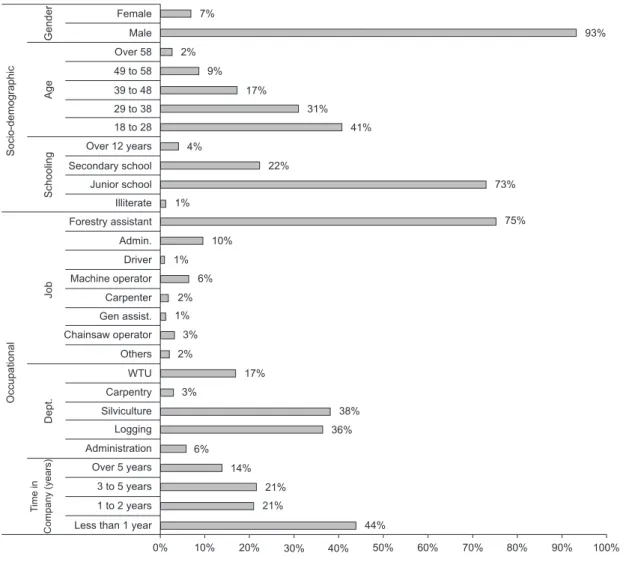
The study group was made up of 883 workers, with
a monthly average of 560 workers. This population’s
distribution, according to socio-demographic and
722 Rev. Latino-Am. Enfermagem 2012 July-Aug.;20(4):718-26.
Female
Male
Over 58
49 to 58
39 to 48
29 to 38 18 to 28
Over 12 years
Secondary school Junior school Illiterate Forestry assistant Admin. Driver Machine operator Carpenter Gen assist. Chainsaw operator Others WTU Carpentry Silviculture Logging Administration Over 5 years
3 to 5 years
1 to 2 years
Less than 1 year
G e n d e r Ag e Sch o o lin g Jo b D e p t. T ime i n C o mp a n y (ye a rs) So ci o -d e mo g ra p h ic O ccu p a ti o n a l 7% 93% 2% 9% 17% 31% 41% 4% 22% 73% 1% 75% 10% 1% 6% 2% 1% 3% 2% 17% 3% 38% 36% 6% 14% 21% 21% 44%
0% 10% 20% 30% 40% 50% 60% 70% 80% 90% 100%
Figure 1 – Distribution of the population of forestry workers, according to socio-demographic and occupational
characteristics. Minas Gerais, Brazil, 2009
In the period studied, 54% of the population had
one or more medical certiicates issued, accounting for 2,047 medical certiicates and 7,655 days lost. The prevalences of medical certiicates, depending on the
socio-demographic variables, kept at between 40 and
60%, with the exception of the level of schooling over
12 years (17%). There was a decreasing tendency in
prevalence with increase in age, of 60% between those
from 18 to 28 years of age, and 41% in the category
of over 58 years of age. The prevalence of certiicates
among women (61%) was greater than among the men
(53%).
The bi-variate analysis revealed that the behavior
of absenteeism-illness was not associated with the
factors of age and gender. However, there was evidence
of a signiicant association (p<0.05) with the other
factors, such as role, department, length of service with
the company and schooling (Table 1).
Variable N* n† Prevalence (%) OR CI (95%) P-value
Sex
Male 822 437 53.16 1
-Female 61 37 60.66 1.36 0.80-2.31 0.259
Table 1 - Prevalence, Odds ratio (OR) and Conidence Interval (CI95%) for medical certiicates, according to
socio-demographic and occupational characteristics of forestry workers. Minas Gerais, Brazil, 2009
Simões MRL, Rocha AM, Souza C.
Table 1 - (continuation)
Variable N* n† Prevalence (%) OR CI (95%) P-value
Occupation
Driver 10 1 10 1
-Administrator 84 18 21.43 2.46 0.29-20.67 0.409
Forestry assistant 663 393 59.28 13.1 1.65-104.00 0.015
Gen. Work assistant 10 4 40 6 0.53-67.65 0.147
Carpenter 16 10 62.5 15 1.50-149.70 0.021
Machine operator 56 22 39.29 5.8 0.68-49.22 0.106
Chainsaw operator 27 22 81.48 39.6 4.04-388.23 0.002
Others 17 4 23.53 2.7 0.26-29.05 0.396
Age (years)
From 18 to 28 359 215 59.89 1.24 0.53-2.94 0.62
28 to 38 273 139 50.92 1.16 0.49-2.76 0.74
38 to 48 152 76 50 0.99 0.40-2.41 0.977
48 to 58 77 35 45.45 1.2 0.46-3.1 0.706
Over 58 22 9 40.91 1
-Department
Administration 51 8 15.69 1
-Logging 321 189 58.88 7.7 3.50-16.90 0
Silviculture 336 159 47.32 4.82 2.204-10.58 0
Carpentry 26 19 73.08 14.59 4.62-46.03 0
WTU 149 99 66.44 10.64 4.65-24.35 0
Time in the company
Less than 1 year 387 168 43.41 1.11 0,74-1.67 0.622
Between 1 and 2 years 185 133 71.89 2.71 1.69-4.35 0
Between 2 and 5 years 189 120 63.49 2.16 1.36-3.44 0.001
Over 5 years 122 53 43.44 1
-Schooling
Illiterate 10 6 60 7.25 1.55-33.84 0.012
Junior school 641 354 55.23 5.96 2.44-14.56 0
Secondary school 197 108 54.82 5.86 2.33-14.76 0
>12 years of study 35 6 17.14 1 - 0
NB: * = Total population of the study, equal to 883 in each variable; † = Population with certiicates, equal to 474 in each variable.
After adjusting for the ive variables signiicant
for p<0.2, the analysis presented the disappearance of
the association of occurrence medical certiicates with
the role of carpenter and with schooling; maintaining
the association with the roles of forestry assistant
and chainsaw operator, with the carpentry and WTU
departments, and with variable length of service with
the company.
In relation to the cause given, or diagnosis
referred to in the medical certiicate, what stood out
were musculoskeletal illnesses with 23.5% of the
occurrences, followed by respiratory illnesses in 14% of
the certiicates.
Discussion
The proile presented by the population in the study
is corroborated by other studies on rural work, in the
agricultural and extractive sector(13); with the sugarcane
industry(14); with people who work in logging and
charcoal production(3,15). All of these studies identiied
a masculine prevalence, low levels of schooling, and an
age range of 18 to 38 years. Evidence was shown for high job turnover, characterized by short links with the
company, less than 12 months, which is conirmed by
other studies(3,13) .
The prevalence of medical certiicates was of 54%,
that is to say, more than half of the workers presented
at least one medical certiicate in the year. This reality
is also surveyed in another study of logging workers, in
which a prevalence of medical certiicates of 61% was
found(3).
The statistical analyses made it possible to identify important associations between the occurrence of
absenteeism-illness and the variables: job, length of
service in the company, and department worked in. With relation to length of service in the company,
724 Rev. Latino-Am. Enfermagem 2012 July-Aug.;20(4):718-26.
between the occurrence of medical certiicates and
service-length of between one and two years, suggesting
a risk category for the event. There was also evidence
for a smaller concentration of certiicates among workers
who had been with the company for less than a year and
among those with service-length of over ive years. The low prevalence of certiicates among the
workers who had spent little time with the company may
be related to questions of insecurity or a greater need to
keep the job among these persons.
On the other hand, possible consequences of the
work on the workers´ health may require different times
to become apparent – and these may not be easily
estimated. The association found provides indications
of a relationship which deserves better investigation.
The careful evaluation of the length of exposure to the
workloads is a fundamental factor for establishing a
supposed relationship between a labor activity and a
health hazard.
Concerning the ´job´ variable, the jobs of chainsaw
operator and forestry assistant were positively associated
with absenteeism-illness, even after adjustment for
other variables studied.
The occurrence of medical certiicates among the
chainsaw operators may be attributed to the extreme
physical demands of the activity. The undertaking of
repetitive movements with the upper limbs, carrying
of weight, inappropriate posture, vibration and
organization of work by tasks are indicated as factors
for overwork in the activity(3). The cumulative effects
of physical overload are relected principally in health
hazards related to the musculoskeletal system(3).
In the role of forestry assistant (the majority of
the population), what stands out is manual work, low
levels of qualiications, a routine of movement and lifting
weight and the proximity of risk factors linked with
forestry work.
In the forestry sector, the manual handling of
loads represents one of the most important ergonomic
problems, responsible for injuries which incapacitate the
worker and which generally require treatment and time
for rehabilitation(3).
The high physical demands of forestry work are also
associated with the occurrence of medical certiicates
in other studies, such as that carried out in Guanhães,
Minas Gerais(3).
In both roles (chainsaw operators and forestry
assistants), it can be observed that physical demands
produce a work environment which is hostile to health.
Among the company´s departments, carpentry and
the WTU were positively associated with the occurrence
of medical certiicates. In general terms, both are
characterized as areas where wood is processed. As
such, they have work processes which, to a certain
degree, are different from the other departments,
principally in that they deal with technology.
The workers´ health is related to their type of
professional activity, to the conditions in which the latter
is carried out, the division and organization of work,
the content of the tasks, the relationships of power and
supervision, and others(16-17). This conclusion explains
the differentness of each department, although they all
belong to the same organization.
Work in a carpentry area is described as extremely
dangerous and exhausting, with a high incidence of
work-related accidents and illnesses. The dangers to the
health of workers in carpentry arise principally from the
desire for productivity. The coexistence of risk factors
such as potentially dangerous machines, noise, sawdust,
and the fumes from the chemicals used in treating
wood, allied with the misuse or non-use of protective
equipment in this activity, also stands out(18-19).
As it is an experimental facility, the carpentry
unit studied is located within the physical limits of
the WTU, and has a small production run. Thus, the
workers involved in treating wood, and the workers
in the carpentry area studied, share both risks and
organizational characteristics of work environments.
In addition to this, the two departments stand out
because of the technological interface, in which the
activities – which have a high level of human physical
demands – are carried out alongside the operation of
heavy, dangerous machines with a high capacity for
transformation.
Concerning the most prevalent illnesses, those of the
musculoskeletal system stood out most in the population.
This issue is frequently related to technological gaps,
to tasks which require great physical strength, carried
out by the workers who undertake manual work(8).
In forestry activities, the musculoskeletal system is
compromised by the lifting and transporting of loads
whose weight is above tolerable limits, with incorrect
movements and inappropriate posture(20-21). Besides this,
the intense rhythm associated with chasing productivity
and the absence of work breaks is a factor which, when
present in the rural work environment, contributes to
the appearance of musculoskeletal illnesses(6).
After the musculoskeletal system, it is the respiratory
Simões MRL, Rocha AM, Souza C.
certiicates. Some studies identify the environmental
conditions of rural work, in particular the dusts arising
from organic and mineral sources, as associated with
the increase in the prevalence of respiratory illnesses
among the workers(6,14). As well as this, hazards such
as upper respiratory tract infections and colds may be
strengthened by the low ingestion of liquids in forest
environments, by the hot, dry climate of the region
studied and by the presence of sawdust ejected in the
processes involved in dealing with eucalyptus wood.
The results indicate the need for a speciic
evaluation of the conditions and work relations which
give rise to the disparities referent to
absenteeism-illness among individuals, departments and roles within
the organization. It should be emphasized that this issue
must be understood in the perspective of workloads,
recognized as a set made up of external elements
(physical, chemical, mechanical and biological) and
internal ones (physiological and psychiatric) present in
the work environments and conditions, which interact
with human beings, being able to create or not speciic
patterns of exhaustion(8). This dynamic interaction,
in which the various loads are augmented even by
individual characteristics, determines the multicausal
nature of absenteeism-illness, making it a complex
issue.
Conclusion
Generally speaking, the proile surveyed is made
up of young, male workers with low levels of schooling.
In terms of occupational characteristics, what most
stood out were high turnover and the job of forestry
assistant, which is the most closely related to the manual
activities of the process of rural work.
In relation to absenteeism-illness, it was possible to
visualize the massive loss of work-days as documented
by the medical certiicates in the population studied. The indings also provided important evidence
about the relationship between occupational factors and
absenteeism-illness among forestry workers.
The following were associated positively with
absenteeism-illness among the population studied:
Length of service of between one and two years; the
roles of forestry assistants and chainsaw operators;
and work department, with carpentry and the Wood
Treatment Unit standing out, both representing the
process of transformation of the wood.
The present study, by dealing with medical
certiicates, indicators in the study of
absenteeism-illness, did not intend to delineate either health as
the mere absence of illness, or illness as the only
representation of workers´ exhaustion. Such an attitude
would signify a reversal in the process of knowledge
production and would deny the dynamic of the
health-work relationship. However, what was aimed for with this
classical approach was to identify relevant associations
in health-work-illness in the workplace in a forest
environment, with a view to fostering new investigations
and new perspectives concerning these workers, so far
unexplored in this aspect.
Considering the limitations and possibilities to be
gained from attaining the objectives of this research,
it has to be considered that the identiication of the
variables associated with absenteeism-illness of the
workers represents a great advance in understanding
the health-work-illness relationship in the forest
environment. Although these relationships do not
necessarily signify a causal relationship, they represent
important factors in the process of falling ill, and need
further investigation, with a view to contributing to
improvements in the processes and conditions of work
in the Brazilian forest environment.
References
1. Alessi NP, Navarro VL. Saúde e trabalho rural: o caso
dos trabalhadores da cultura canavieira na região de
Ribeirão Preto, São Paulo, Brasil. Cad Saúde Pública.
1997;13(sup2):111-21.
2. Poschen P. Forestry, a safe and healthy profession?
Unasylva. 1993;44(172):3-12.
3. Silva EP, Minette LJ, Souza AP, Baêta FC, Fernandes
HC, Mafra SCT, et al. Caracterização da saúde dos
trabalhadores florestais envolvidos na extração
de madeira em regiões montanhosas. Rev Árvore.
2009;33(6):1196-74.
4. Valverde SR, Soares NS, Silva ML, Jacovine LAG,
Neiva SA. O comportamento do mercado de madeira
de eucalipto no Brasil. Rev Biomassa & Energia.
2004;1(4):393-403.
5. Peres F. Saúde, trabalho e ambiente no meio rural
brasileiro. Ciênc. Saúde Coletiva. 2009;14(6):1995-2004.
6. Silva JM, Nonato-Silva E, Faria HP, Pinheiro TMM.
Agrotóxico e trabalho: uma combinação perigosa para
a saúde do trabalhador rural. Ciênc Saúde Coletiva.
2005;10(4):891-903.
7. Silva JG, Grossi MD, Campanhola C. O que há de
realmente novo no rural brasileiro. Cad Ciênc Tecnol.
726 Rev. Latino-Am. Enfermagem 2012 July-Aug.;20(4):718-26.
Received: Dec. 15th 2011
Accepted: June 25th 2012
8. Laurell AC, Noriega M. Processo de produção e saúde:
trabalho e desgaste operário. São Paulo: Hucitec; 1989.
333 p.
9. Quick TC, Lapertosa JB. Análise do absenteísmo
em usina siderúrgica. Rev Bras Saúde Ocup.
1982;10(40):62-7.
10. Sala A, Carro ARL, Correa NA, Seixas PHD. Licenças
médicas entre trabalhadores da Secretaria de Estado da
Saúde de São Paulo no ano de 2004. Cad Saúde Pública.
2009;25(10):2168-78.
11. North F, Syme SL, Feeney AJ, Shirpley MJ,
Marmot MG. Explaining socieconomic differences in
sickness absence: the Whitehall II study. Br Med J.
1993;306(6874):361-6.
12. Dias EC. Saúde do Trabalhador Rural. In: Pinheiro
TM, organizador. Condições de vida, trabalho, saúde
e doença dos trabalhadores rurais no Brasil. Belo
Horizonte; 2006. p. 1-25.
13. Andrietta AJ. Evolução do perfil dos trabalhadores
da agropecuária paulista de 1985 à 2002. Inform
Econômicas. 2004;34(9):7-19.
14. Rocha FLR, Marziale MHP, Robazzi MLC. Poverty as
a predisposing factor of illness tendencies in sugar cane
workers. Rev. Latino-Am. Enfermagem. 2007;15(n.
spe):736-41.
15. Pimenta AS, Minette LJ, Faria MM, Souza AP, Vital
BR, Gomes JM. Avaliação do perfil de trabalhadores e
de condições ergonômicas na atividade de produção de
carvão vegetal em bateria de fornos de superfície do tipo
“rabo-quente”. Rev Árvore. 2006;30(5):779-85.
16. Silva DMPP, Marziale MHP. Condições de trabalho
versus absenteísmo-doença no trabalho de enfermagem.
Ciênc Cuidado Saúde. 2006;5(sup):166-72.
17. Becke SG, Oliveira MLC. Study on the absenteeism
of nursing professionals in a psychiatric center
in Manaus, Brazil. Rev. Latino-Am. Enfermagem.
2008;16(1):110-4.
18. Pignati WA, Machado JMH. Riscos e agravos à saúde
e a vida dos trabalhadores das indústrias madeireiras de
Mato Grosso. Ciênc Saúde Coletiva. 2005;10(4):961-73.
19. Silva KR, Souza AP, Minetti LJ. Avaliação do perfil
de trabalhadores e das condições de trabalho em
marcenarias no município de Viçosa-MG. Rev Árvore.
2002;26(6):769-75.
20. Fernandes RCP, Carvalho FM, Assunção AA, Silvany
AM Neto. Interactions between physical and psychosocial
demands of work associated to low back pain. Rev Saúde
Pública. 2009;43(2):326-34.
21. Picoloto D, Silveira E. Prevalência de sintomas
osteomusculares e fatores associados em trabalhadores
de uma indústria metalúrgica de Canoas - RS. Ciênc