(1) Departamento de Fonoaudiologia da Universidade Federal
da Paraíba – UFPB, João Pessoa, Paraíba, Brasil.
(2) Universidade Federal da Paraíba – UFPB, João Pessoa,
Paraíba, Brasil.
Conlict of interest: non-existent
a conversation, which will confer meaning to the spoken word.
Each speech utterance carries not only the message itself, but also, physical characteristics, personality and the speaker’s attitude through the intonation, tone and quality of habitual voice1. In
this context, in a conversational situation, there is a continuous low of information between the participants, expressed and perceived by means of speech prosodic elements.
These are the intermediary between form and content itself of speech and comprise acoustic elements of fundamental frequency, duration and intensity, which combined will form the intonation, accent, speech rate, pauses, emphases and own speech rhythm. The combination of these factors will determine the understanding of the message and carry the expression of subject’s emotions in speech act2.
One must consider that the prosodic parameters appear early in the language development because the child understands the voice melody from early, even before understanding the words. And it is on the preverbal stages that these parameters begin
INTRODUCTION
The use of language is always related to a purpose to be achieved: act on the other, inluence him, waking him emotions, images, convince him. Therefore, the statements are guided so that they have meaning, which, in speech, is conveyed through prosody, natural characteristic of the speaker, also important for the interpretation and understanding of speech1.
Through interaction, the human being is able to change his voice according to the context, the speaker, and the intentions to be achieved in a dynamic process and almost inherent to its commu -nicative ability. The expressiveness of speech happens just from the various prosodic variations of parameters loudness, pitch and duration during
PROSODY AND LANGUAGE DISORDERS:
LIST OF PUBLICATIONS IN INDEXED JOURNALS
BETWEEN 1979 AND 2009
Prosódia e transtornos da linguagem: levantamento
das publicações em periódicos indexados entre 1979 e 2009
Leonardo Wanderley Lopes(1), Ivonaldo Leidson Barbosa Lima(2)
ABSTRACT
This study has as its subject the relationship between prosody and language disorders, this relationship being investigated from the survey of publications indexed in international databases. The analysis of the articles showed that there is a growth in publications that relate to language disorders deicits production and perception of speech prosody. It also reinforces that the loss or dificulty in skills relating to prosody, pragmatic compromises the function of language, and therefore the interaction of the subject in its social environment. Aphasia is a disorder most studied, probably also inluenced by the global increase of the elderly population. And the more thematic publications was found in speech perception.
KEYWORDS: Speech, Language and Hearing Sciences; Language Disorders; Speech Perception;
A survey of papers relating the prosody to language disorders, indexed on Medline and PubMed databases published between January 1979 and August 2009 and using the search term “prosody”, through the software for bibliographical research EndNote X3 Thomson Reuters.
To use an international terminology, it was chosen the deinition of terms from DeHS (Descriptors in Health Sciences), created by the Virtual Health Library (BIREME) for indexing journals on the databases. Thus, the term “language disorder” was used throughout this work, referring to any condition characterized by impairment of comprehension or expression of forms of written and spoken language, including developmental disorders and acquired.
Following this criterion, articles that related perceptual parameters and/or production of prosody to language disorders were selected. Subsequently, articles were grouped according to the speciied disorder: aphasia, dementia, dyslexia, speciic disorder of language development (SDLD), psychi -atric disorders of language and stuttering.
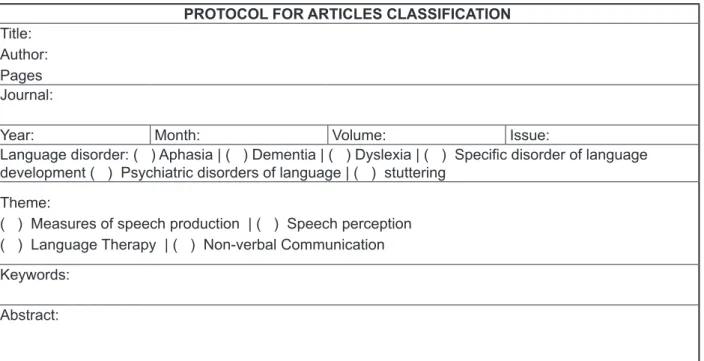
For analysis and data categorization, a protocol for classiication and analysis of articles (Figure 1) was elaborated. Texts dealing exclusively with disorders of speech articulation, hearing, and those dealing with the prosody only under the acquisition scope and processing in subjects without communi -cation disorders were excluded.
to settle, since before producing the irst words, the child has already mastered the intonation patterns of its native language3.
Throughout its development, the human being acquires language skills, including the ability to discriminate and produce intention by prosody, which can be regarded as a pragmatic skill. This will become possible if the conditions related to the environment and subject himself propitiate the use (production) and feedback (reception). However, there are situations in which the linguistic devel -opment of the child or the use of language by the adult is affected by lesions in the central nervous system, psychiatric disorders, and/or neurodegen -erative diseases.
Whereas language has a communicative function and that, by foregoing the prosody plays a primary role in the transmission of meaning during the interaction, this study aims at conducting a survey of indexed publications on international databases that relate to perception/production of prosody to language disorders.
METHODS
This study is characterized as cross-sectional retrospective.
PROTOCOL FOR ARTICLES CLASSIFICATION
Title: Author: Pages Journal:
Year: Month: Volume: Issue:
Language disorder: ( ) Aphasia | ( ) Dementia | ( ) Dyslexia | ( ) Speciic disorder of language development ( ) Psychiatric disorders of language | ( ) stuttering
Theme:
( ) Measures of speech production | ( ) Speech perception ( ) Language Therapy | ( ) Non-verbal Communication Keywords:
Abstract:
the prominences along an utterance and may be phrasal or lexical7.
The magnitude marks a situation of relief or prominence of a syllable or word, being measured in decibels (dB).
Variations in sound wave amplitude produced in the emission of a particular syllable or series of syllables correspond to the psychophysical sensation perceived by the listener called loudness, recognizing a sound as strong or weak8, which in
psychological level allows numerous interpretations because it expresses how dealing with the notion of own limit and other’s boundary4.
The prominence is detected when comparing one word with another along the utterance, and therefore, there are several ways to emphasize a unit in the speech stream1. It is a quantiiable perceptual
parameter that can be reduced or increased by any of the sound attributes such as duration, pitch, emphasis and vocal quality.
The prominence of a syllable relates to an overall degree of differentiation, consisting of the combined effect of vocal quality, duration, emphasis and intonation in the segment. The emphasis has relation only to the degree of force of an utterance, being independent of the duration and intonation, despite being combined with them sometimes (in prominence)1.
Furthermore, the ability to use the emphasis on speciic parts of speech denotes understanding the exact meaning that one intends to give the message1.
The speech rate is also a prosodic element and can be measured by the succession of the number of syllables, varying individually and according to the communicative context, it can also be used as instrument of emphasis8.
The speech rate parameter is calculated by the number of syllables per second, being performed the calculation of the total duration of the speech segment and divided by the number of syllables9.
And it can be classiied into three stages: slow, medium and fast.
Another prosodic parameter, duration, indicates the extent of time involved in the articulation of a sound or syllable, being measured in units of time.
The duration relates to the sensation perceived by the listener for changes in the emission time of one or more successive syllables. In articulatory terms, it corresponds to the time period in which the speaker keeps its sound production2.
In summary, it is observed that the prosodic parameters are placed in the discourse as key agents of senses, going beyond words. They can provide information about biological, psycho -logical and social aspects of the speaker, besides Data were analyzed qualitatively and quantita
-tively, being presented in the form of graphs.
LITERATURE REVIEW
The prosody is related to changes in frequency, intensity and duration, which, during the speech, confer meaning to what is being said. It includes parameters such as intonation, accentuation, stress/ prominence, speech rate and duration of segments (vowel or consonant)4.
Intonation refers to the distinctive use of patterns of pitch, being described overall as contours and
performing various functions including, grammatical and paralinguistic, conveying meaning effects in utterance4.
It interacts with elements of linguistic knowledge and the communication situation, as well as beliefs, intentions and feelings of the speaker, contributing to the complete interpretation of an utterance in a speciic speech situation4. And its main acoustic
parameter is the fundamental frequency and its evolution over a sentence or utterance5.
The intonation patterns can be described both by the characteristics of its contours as ascending, descending, ascending-descending, descending-ascending or leveled; as their sequence of tones6.
Intonation has several functions in the language and can convey information about the grammar (declarative, interrogative, imperative and exclam -atory patterns) as well as conveying meaning effects as anger, surprise, among others2.
Among its best known functions are included: attitudinal function, once the intonation is the most effective means of expressing the experience of attitude, being able to assess both the speaker’s intention as its degree of involvement in a commu -nicative situation; function of structuring the infor -mation; communicative; syntactic; textual and stylistic functions4.
Another related prosody parameter is the funda -mental frequency. This is measured in Hertz (Hz) and corresponds physiologically to the number of vibratory cycles of the vocal cords per second. Aurally, it corresponds to the sense of height, severe or acute5.
The use of a particular pitch is directly related
to the speech intention, so that a joyous mood is transmitted through more acute tones, while deeper tones are related to a sad mood. Since the deeper voices are associated with authoritarian personality, those more acute with more dependent people4.
and spoken language, including those acquired and developed.
In this study, the following language disorders were addressed: aphasia, psychiatric language disorders, dementia, stuttering, speciic language disorder and dyslexia.
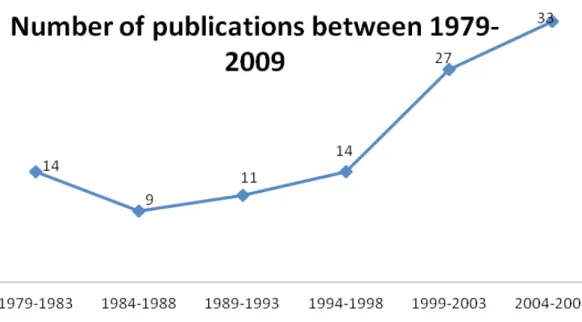
A total108 indexed papers relating some of these disorders to prosody were found between 1979 and 2009. Figure 2 illustrates the distribution of articles over the years.
determining the positioning of the speakers during an interaction.
Thus, the presence of a language disorder that impairs expressive (production) or receptive aspects (perception) of prosody may compromise the communication effectiveness.
According to DeHS (2009), language disorders are conditions characterized by deiciencies of comprehension or expression of forms of written
Figure 2 - Distribution of scientiic articles according to the year of publication
The upward point of the graph, observed from the year 1984, draws attention to the increasing number of publications in recent years. The various possibilities of experiments in the perceptive area and production of prosody, as well as different manifestations in various language disorders, show that this is not an exhausted topic, but expanding on the achievement of scientiic papers.
Furthermore, the development and access to computed voice and speech laboratories, as well as new techniques for studying language processing developed in the last decade may have also inlu -enced the production of new knowledge.
The publication in journals is the main form of dissemination of scientiic knowledge, since it legiti -mates and records the advancement of knowledge. Although there is no absolute correspondence between scientiic production and publication, the amount of indexed publications also serves as a reference to vouch for the scientiic accuracy of a
given area, in this case, the relationship of prosody with communication disorders10.
Another interesting point is the analysis that perhaps this increase in the number of publications follows a historical trend. Gradually, professionals who work with communication disorders come to understand that the focus of assessment, diagnosis and therapy of patients with language deicits should not only be on organic basis and manifesta -tions presented, but the real impact that this deicit causes in the individual’s communication.
Thus, whereas prosody occupies a very special place in human communication, the increasing number of studies involving prosodic aspects may be related to this increased concern with the pragmatic aspects of language.
0 10 20 30 40 50 60
Aphasias
Psychiatric disorders of language
Dementia
Stuttering
Specific disorders of language development
Dyslexia
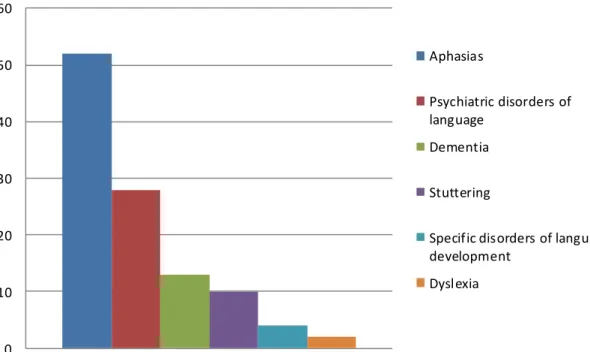
Figure 3 - Distribution of the number of articles according to language disorder
The predominance of studies on aphasic individuals seems to be an indication of the signii -cance of prosodic manifestations in these disorders and their consequent injury to the communicative process.
Moreover, the increased survival of elderly in recent decades, as well as the increasing number of patients suffering from traumatic injuries of the central nervous system, has led to increased number of researches to understand the manifesta -tions presented by the subjects in these areas.
In general, aphasia is considered one of the most studied neurological disorders. The incidence of diseases related to the causes of aphasia can justify the number of publications in the area.
Aphasia is a change in content, form and use of language and its underlying cognitive processes, including perception and memory. It manifests in both receptive expressive plans.
Some of the articles discuss the impact that the prosodic deicits may result in aphasic patients, affecting speech and interaction itself, since the prosody would be one of the major responsible for the pragmatic function.
Most articles searched associates prosodic manifestations in aphasic patients to injured brain areas. This recurrence is justiied even because aphasia is a language disorder caused by brain damage and many of these studies have only this local character, which point out that the ability
to exercise the language in the human species is characterized by the difference in the participation of cortical and subcortical structures, considering also the hemispheric specialization11.
One study showed that patients with damage to the right hemisphere compared to those with lesion on the left hemisphere have impaired compre -hension of emotional prosody12. That’s because
affectivity and prosody are processed in the same area of the brain, the right hemisphere13.
However, there is controversy in studies inves -tigating the role of the right hemisphere in the processing of prosodic aspects of language. The perception and production of linguistic/emphatic prosody and emotional prosody may be altered in patients who have suffered damage to the right hemisphere, being most common the impairment of emotional prosody11.
Furthermore, research on the skills of non-verbal communication in aphasic patients found that most of them lost the ability to grasp intention from the speech prosody14.
Intentionality refers to the various ways in which individuals use discourses to pursue and perform their communicative intentions, mobilizing therefore, appropriate resources to achieving the target objectives4.
other types of speech disluency may be involved, including interjections, broken words, audible or silent blocking, circumlocutions, words produced with excess of physical tension and monosyllabic repetitions of every word.
This change may occur as a condition of the childhood development or as acquired disorder that can be associated with cerebral infarctions and other brain diseases.
One of the main articles studied even deine stuttering as a disorder of prosody20.
Four articles addressing the relationship between the speciic developmental disorder of language and prosody were found. In such disorder, children have impairment of two or more areas of language, concomitant with the absence of any neurological, psychiatric, physical, sensory or intellectual deicit20.
The focus of articles in this area was the difi -culty that these children may have in recognizing emotions from prosody21.
One study indicated that children with DEDL behave pragmatically less eficiently than their peers with expected development of language, making more communication initiatives, but in a less elaborate way22.
Finally, two articles relating dyslexia to prosody addressing that the dyslexics would have dificulty in processing the affective prosody were found23.
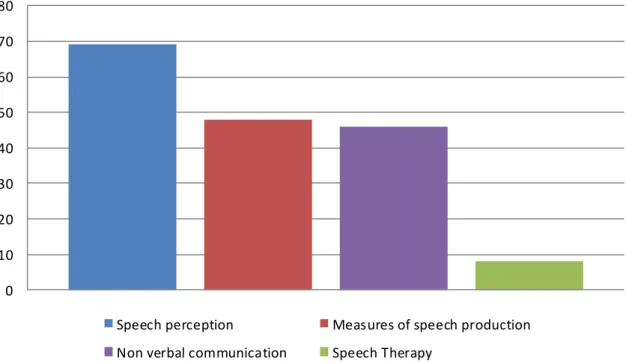
Subsequently, according to the protocol, the analysis of the main theme of the articles was performed (Figure 4). Whereas an article could present more than one axis, it was found that 63.8 % (69) were in the area of speech perception, 44.4 % (48) dealt with measures of speech production, 42.6 % (46) focused on nonverbal communication and 7.4% (08) emphasized the language therapy.
The speech perception is the process by which a speech is decoded into a representation in terms of linguistic units: sequences of phonetic segments which combine to form lexical and grammatical morphemes.
Several authors point to the listener’s ability to identify emotions, social, biological and sexual features and even identify genres of discourse from speech, more speciically voice quality and prosody4,24,25.
The prosody in the speaker’s speech causes the listener to interpret the utterance, reconstructing its meaning. There will never be a single sense; they are precisely the non-verbal features that would facilitate the comprehension strategies26.
The number of articles in this area would justiies the concern of both the Health Sciences and Linguistics with the pragmatic aspects of language, since most of the articles studied the ability of the experiences and their knowledge of the world. For
example, someone who witnessed a serious car accident records in its memory the emotions and images related to this context. In recounting this fact to another person, probably it brings in his speech prosodic features that help recreate the context and the emotions related to the fact.
The second highest number of articles was found in the area of psychiatric disorders of language, speciically the autism, which is deined as a condition of early onset with behavioral character -istics such as disturbances of affective relationships with the environment, inability to use language for communication, presence of good cognitive potenti -alities, ritualistic behavior15.
Therapy with autistic spectrum children is deeply related to the linguistic perspectives, in particular the pragmatic theories, since the observed features in the behavior of these children are just deicient in aspects proposed by these theories, i.e., the relationship between language use and the social and cognitive aspects of development.
In this area, the articles emphasized the relationship between prosodic deicits found in these children, and pragmatic dificulties, both in terms of production and speech perception, stating that these subjects would have dificulty to perceive emotional aspects from prosody16.
Whereas speech always lend itself to the thought representation in verbal form and representation of motives, intentions, needs and expressive emphases as intonation, besides representing the emotional, momentary or permanent individual states, the difi -culty in the production of prosody may undermine the subject’s communicative competence17.
The relationship of prosody with dementia was studied in 13 articles. The dementia, a syndrome in which there is chronic deterioration of intellectual functioning, personality and communication, refers to the loss of intellectual abilities such that interfere with the functional areas of life, either social, occupa -tional, communication, among others18,19.
The studies are focused on the relationship between cognitive deicits and understanding of the prosodic aspects, as well as the pragmatic aspects of caused by the dificulty of apprehending intention and meaning from prosodic aspects during an interaction19.
Regarding the stuttering, 10 articles that addressed the intonation patterns, speech rate, as well as the relationship of difluent segments with prosodic parameters were found.
0 10 20 30 40 50 60 70 80
Speech perception Measures of speech production
Non verbal communication Speech Therapy
Figure 4 - Distribution of the number of articles according to the thematic area addressed
subjects to assess intentions and general infor -mation from prosody.
In disorders addressed in this study, it is observed that the deicit of apprehending information from prosody compromises the role of the subject as interacting during a conversation; it harms, including, maintaining the conversational focus.
With respect to measures of speech production, which in this case, involve the measurement of prosodic parameters, restriction in the use of these resources during the interaction affects the subject’s expressiveness.
The speech is signiicant, precisely because its production conditions allow ininite adjustments, subtle changes in pitch, loudness and duration of speech segments, creating different marks throughout a conversation.
Notably, it was found that autistic patients and with stuttering are among those most disadvantaged regarding the use of speech prosody.
Autistic people tend to use a stereotyped intonation pattern, although with respect to echolalia may there be change in intonation curve by repeating some stretch emitted by the adult27.
The use of prosodic parameters occurs naturally during a conversation, without people being concerned with variations of intonation and emphasis they perform. The context itself, the roles of each subject in conversation, the social and linguistic rules intrinsic to each one, will help determine the
prosodic features used by the speaker, which are largely responsible for the success of the interaction.
It is the intentionality, related to cognition along with prosodic choices related to the sound that will build a sense of what is said. There is a close relationship between intention and prosody, between sound and meaning, making the same statement can be interpreted in different ways according to the intention and/or prosodic features.
The speech, in any situation that is, through the vocal characteristics, has the function of establishing a pragmatic representation in both the speaker and the listener memory26.
The choice of intonation pattern by the speaker then, will be related to both the situational context as the informational, since the listener response will be conditioned to the suprasegmental infor -mation associated with the linguistic structure in the segmental level.
In this sense, there are cases in which intonation is used only to qualify the statement, because the segmental part already has all the necessary infor -mation to the listener. But there are cases in which the intonation carries all the information26.
meanings during the interaction, prosodic manifes -tations in different language disorders may be among the factors that most affect the quality of communication in these subjects.
CONCLUSIONS
The analysis of articles showed increase in publi -cations relating language disorders to the deicits in production and perception of speech prosody. Also, they reinforce that in all disorders studied, loss or dificulty in skills related to prosody compromises the pragmatic function of language and therefore, the interaction of the individual in his social environment.
Aphasia was the most studied disorder, also inluenced by the global increase in the survival of the elderly population. The most found thematic axis was the area of speech perception.
Articles whose main thematic line was language therapy emphasized the importance of working the expression and understanding of the prosodic aspects in patients with aphasia and autism, as a way of improving the communicative performance of these patients.
Whereas a branch of linguistics, the pragmatics, studies the relationship between the social meaning of language, expressed by the interactional context and its semantic content expressed by the meaning of the communicative act itself, the deicit, either in production or in the perception of prosody, generates pragmatic dificulties for the subject.
Pragmatic language disorders are manifested by dificulties in correctly interpreting the actions of others and/or adequately express their desires and intentions. These disorders are usually made by losses in expressive and receptive components22.
Thus, considering that the prosody is one of the main responsible for the construction of sense/
RESUMO
Este estudo tem como tema a relação entre a prosódia e os transtornos da linguagem, sendo esta relação investigada a partir do levantamento das publicações indexadas em bases de dados interna -cionais. A análise dos artigos mostrou que há um crescimento nas publicações que relacionam os transtornos de linguagem aos déicits de produção e percepção da prosódia da fala. Também reforça que, a perda ou diiculdade nas habilidades relativas à prosódia, compromete a função pragmática da linguagem e, portanto, a interação do sujeito em seu meio social. A afasia foi o transtorno mais estudado, provavelmente inluenciado também pelo aumento mundial da população de idosos. E o eixo temático mais encontrado nas publicações foi a percepção da fala.
DESCRITORES: Fonoaudiologia; Transtornos da Linguagem; Percepção da Fala; Medida da
Produção da Fala
REFERENCES
1. Borrego MCM, Behlau M. Recursos de ênfase utilizados por indivíduos com e sem treinamento de voz e fala. Rev Soc Bras Fonoaudiol. 2012;17(2):216-24.
2. Viola IC, Ghirardi ACAM, Ferreira LP. Expressividade no rádio: a prática fonoaudiológica em questão. Rev Soc Bras Fonoaudiol. 2011;16(1):64-72.
3. Rocha LC, Bei-Lopes DM. Análise pragmática das respostas de crianças com e sem distúrbio especíico de linguagem. Pró-Fono R Atual. Cient. 2006;18(3):229-38.
4. Rodero E. Intonation and Emotion: Inluence of Pitch Levels and Contour Type on Creating Emotions. J Voice. 2007;25(1):e25-e34.
5. Guimarães I, Abberton E. Fundamental Frequency in Speakers of Portuguese for Different Voice Samples. J Voice. 2005;19(4):592-606. 6. Murry T, Brown Jr. WS, Morris RJ. patterns of fundamental frequency for three types of voice samples. J Voice. 1995;9(3):282-9.
7. Birch S, Clifton C Jr. Focus, accent, and argument structure: effects on language comprehension. Lang Speech. 1995;38(Pt 4):365-91.
subthalamic nucleus stimulation and medication on parkinsonian speech impairment. J Voice. 2008;22(3):365-72.
19. Bucks RS, Radford SA. Emotion processing in Alzheimer’s disease. Aging ment health. 2004;8(3):222-32.
20. Bergmann G. Studies in stuttering as a prosodic disturbance. J speech hear res. 1986;29(3):290-300. 21. Fujiki M, Spackman MP, Brinton B, Llig T. Ability of children with language impairment to understand emotion conveyed by prosody in a narrative passage. Int j lang commun disord. 2008;43(3):330-45. 22. Bei-Lopes DM, Puglisi ML, Rodrigues A, Giusti E, Gândaras JP, Araújo K. Peril comunicativo de crianças com alterações especíicas no desenvolvimento da linguagem: caracterização longitudinal das habilidades pragmáticas Rev Soc Bras Fonoaudiol. 2007;2(4):265-73.
23. Patel TK, Litch R. Verbal and affective laterality effects in P-dyslexic, L-dyslexic and normal children. Neuropsychol Dev Cogn. 2000;6(3):157-74.
24. Andrianopoulos MV, Darrow KN, Chen J. multimodal standardization of voice among four multicultural populations: fundamental frequency and spectral characteristics. J Voice. 2001;15(2):194-219.
25. Bonnet G. A study of intonation in the soccer results. J Phon. 1980;21(8):21-37.
26. Scherer KR. expression of emotion in voice and music. J Voice. 1995;9(3):235-48.
27. Bishop DV, Norbury CF. Exploring the borderlands of autistic disorder and speciic language impairment: a study using standardised diagnostic instruments. Child Psychol Psychiatr Rev. 2002;43(7):917-29.
call-centre customer service advisors. Folia Phoniatr Logop. 2003;55(4):163-76.
9. Andrade CR. Protocolo para avaliação da luência da fala. Pró-Fono R Atual. Cient. 2000;12(2):131-4. 10. Berberian AP, Ferreira LP, Jacob LC, Azevedo JBM, Mendes JM. A produção de conhecimento em Distúrbios da Comunicação: análise de periódicos (2000-2005). Rev Soc Bras Fonoaudiol. 2009;14(2):153-9.
11. Pinto JA, Corso RJ, Guilherme ACR, Pinho SR, Nóbrega MO. Dysprosody nonassociated with neurological diseases - A case report. J Voice. 2004;18(1):90-6.
12. Barret AM, Crucian GP, Raymer AM, Heilman KM. Spared comprehension of emotional prosody in a patient with global aphasia. Neuropsychiatry neuropsychology behav neurol. 1999;12(2):117-20. 13. Hammerschmidt K, Jurgens U. acoustical correlates of affective prosody. J Voice. 2007;21(5):531-40.
14. Aubert S, Barat M, Campan M, Dehail P, Joseph PA, Mazaux JM. Non verbal communication abilities in severe traumatic brain injury. Ann readapt med phys. 2004;47(4):135-41.
15. Tamanaha AC, Perissinoto J, Chiari BM. Uma breve revisão histórica sobre a construção dos conceitos do autismo infantil e síndrome de Asperger. Rev Soc Bras Fonoaudiol. 2008;13(3):296-9. 16. Jarvinen-Pasley A, Peppe S, King-Smith G, Heaton P. The relationship between form and function level receptive prosodic abilities in autism. J autism dev disord. 2008;38(7):1328-40.
17. Scherer KR. Vocal communication of emotion: A review of research paradigms. Speech Communication. 2003;(40):227-56.
18. D’Alatri L, Paludetti G, Contarino MF, Galla S, Marchese MR, Bentivoglio AR. Effects of bilateral
Received on: September 25, 2012 Accepted on: February 21, 2013
Mailing address:
Leonardo Wanderley Lopes
Departamento de Fonoaudiologia, Centro de Ciências da Saúde
Cidade Universitária - Campus I, Bairro Castelo Branco
João Pessoa – PB – Brasil CEP: 58051-900