KNOWLEDGE ABOUT STUTTERING
IN THE CITY OF SALVADOR
Conhecimento sobre a gagueira na cidade de Salvador
Naiara Tatiele Matos Fonseca (1), Rina Tereza D’Angelo Nunes (2)
(1) Speech Therapist graduated from Speech Therapy Course the University of State of Bahia – UNEB, Salvador, BA, Brazil.
(2) Speech Therapist; Professor of Speech Pathology, Univer-sity of Bahia – UNEB; Master by the post-graduation Pro-gram in Speech from the Pontiice Universidade Católica de São Paulo – PUC-SP.
Conlict of interest: non-existent
that disrupt verbal luency. Only be considered
as a disorder if the intensity of the disturbance
remarkably incapacitates the the low of speech. One of the biggest researchers on the topic and also a person who stutters, mentioned a great dificulty in describing stuttering stating that the ones who really know it are the people who stutter2.
The etiology of stuttering is another controversial issue. Most current theories believe in
multifacto-riality. One of the latest models presented to this discussion proposes a deicit in neural processing as an essential condition associated with the inherent characteristics of the language, which when performed in speech favors the occurrence
of moments of stuttering, and modulating factors considered individuais3. Previously, researchers
have suggested a lack of cerebral dominance for
the neural mechanism of language in people who stutter. For some time, it was held the idea that
stuttering is related to handedness ambiguous or
inconsistent, concept that was incorporated into
the discourse of popular beliefs about the disorder.
INTRODUCTION
Stuttering is a communication disorder that causes human estrangement layman’s ears, making
it identiiable and raising questioning by the public about its nature. It is a complex issue constantly
discussed in the media, like the movie “The King’s
Speech”, the Oscar-winning 2011.
Its descriptions are varied and seek to clarify
its complexity. According to the International Classiication of Diseases and other disorders, CID-101, Stuttering is characterized by frequent
repetitions or prolongations of sounds, syllables
or words, or by frequent hesitations or pauses
ABSTRACT
Purpose: to verify knowledge about stuttering among residents of the city of Salvador. Method: this
research is descriptive, cross sectional and quantitative with the voluntary participation of residents of the city of Salvador. They answered the questionnaire Attention to Stuttering and were matched in
terms of gender, age and education. Results: of the 417 people interviewed 78.2% claimed to have
seen or known people who stutter, 52.2% reported that the person who stuttered belonged to their circle of acquaintances, 62.4% believed that more than 5% of the population stutter; 53.6% responded that stuttering begins between the ages two and ive years old; 53.5% reported that stuttering occurs more often in boys than in girls, 88.7% reported that this disorder occurs in all races, 28.9% reported that its cause is psychological; 84.2% stated that stuttering has treatment, 79.6% consider people who stutter with intelligence equal to that of normal speakers, 47.6% stated that use of hearing aids is worse than stuttering and 52.8% responded that would consult a speech language therapist. Conclusion:
the population of the city of Salvador who answered the questionnaire easily identiied people with stuttering, but demonstrated limited knowledge about the issues associated with it. This is a relevant
factor for planning public education and health actions.
However, there was no evidence for such ideas and Cerebral Dominance Theory became frágil4. In an
attempt to understand the genetic factors involved
in stuttering, we performed a genome-wide linkage in a family with people who stutter in Pakistan. So, it revealed a signiicant linkage on chromosome 3q13.2-3q13.33 under a model of autosomal recessive heritage showing that genetics may be a factor for this complex disorder5.
Stuttering has a prevalence of 1% among the world population, with an incidence of 5% because many children can recover with or without speech
therapy4. In general, it appears between the ages of
two and ive, affecting both genders, but at a ratio of three to four men for a woman, it means, stuttering
affects more men, reaching for times the number
of women4,6. Another feature is that this disorder
usually happens within families that have members who stutter or have gaguejaram4.
Stuttering is a common disorder that appears in all cultures. It is one of those issues that “haunts
the human race”, which manifests itself in all ethnic
groups, despite the different prevalence rates3,7.
Thus, it can be stated that stuttering is a social
problem in association with physical components.
Some countries have developed socially oriented
studies related to the disorder to examine the knowledge and information that the local population
has about it. In Belgium and in China, in Shanghai,
the research used a questionnaire with 13 questions
about the prevalence of stuttering, age of onset,
frequency among genders, occurrence among left handed and right handed and within other cultures, its
causes, treatment, inheritance and the relationship
between intelligence quotient (IQ) and Stuttering. In Shanghai 1968 people were interviewed and the
researchers concluded that, although there is no
speciic profession to care for people who stutter in
that country, the general public had a good level of
knowledge about the disorder and in some aspects
they issued more appropriate opinions than their Belgian counterparts8.
Research carried out in Turkey, Bulgaria, Russia and the United States investigated and compared the
identiication of cluttering and Stuttering. We used a questionnaire in which there were the deinitions of the disorders. From the results, it was stated that, by means of a deinition or description, the public can identify the cluttering, as well as stuttering9.
A pilot study using the questionnaire of Public Opinion Research of Human Attributes – Stuttering (POSHA-S), compared the results of three countries:
Brazil, Bulgaria and Turkey and concluded that
the interaction between nationality, religion, native language, culture and ethnicity may inluence the differences in attitudes between the participants
of the three countries10. The POSHA-S in Turkey
was also used to compare the effect of two kinds
of statistical analyzes about the data obtained.
It was concluded that the statistical of random
sampling method is a better strategy than
conve-nience sampling to the use of S-POSHA in speciic
regions. The authors also suggested that attitudes
within different populations are not uniformly more
negative or positive and, yes, diversify according to11 the parameters considered. Another study used
the experimental data from versions of POSHA-S to compare to each other and interpret of results. Data were gathered from 12 countries in eight different languages . It was concluded that the POSHA-S can provide comparisons more and more signiicant
for those interested in measuring public attitudes
toward stuttering 12.
Based on the study conducted in Belgium and
China, the questionnaire of was applied Attention
to Stuttering in Brazil, in individuals living in Rio
de Janeiro, in order to verify the knowledge of the population of this town about stuttering. 606 respon -dents took part in this study. The authors concluded that the population of Rio ignores some basic points related to stuttering and that the level of education
inluences the degree of knowledge. They also suggested the development of eficient strat
-egies for guidance and clariication regarding the
disorder 13-14.
The aim of this work was to verify the knowledge
about stuttering among residents of the city of Salvador.
METHOD
All study participants signed an informed consent
regulated by Law No. 196/96 of CONEP. The study was approved by the Ethics in Research Committee
of the University of the State of Bahia, in the opinion
of number 23462.
This is a descriptive, cross-sectional and of
quantitative nature with the voluntary participation
of residents of the city of Salvador.
The material used for the research was the questionnaire of Attention to Stuttering properly
adapted and validated in Brazil. It comprises 10
objective questions that ask about the age of onset of stuttering, frequency in relation to gender and
cerebral dominance, occurrence in different races, heredity, severity, intelligence, treatment and
attitude of family members, and three subjective questions that ask if the respondent has seen or known people who stutter, the occurrence of this
condition in the population and its etiology, totaling 13
education (basic – elementary level, complete or incomplete, medium – high school, complete or incomplete, and – college level, complete or incomplete) and age (young, adult and elderly).
Considering as young informants between 18-20 years, adults between 21-55 years and elderly over 55 years. Thus, it was guaranteed standards with comparative work carried out in Rio de Janeiro.
To start the study there was a selection of
research assistants to participate in data collection according to the order of registration and availability.
Subsequently, the 13 assistants selected were called 8 for a meeting, in which they received training
for the applicationof the Attention to Stuttering
questionnaire and were instructed on the collection site. The application was made on the streets of the six most populated districts of the city of Salvador, according to IBGE data of 2010, which are, respec -tively, Brotas, Itapuã, Pituba, Pernambués, Paripe and São Cristovão. In order to obtain a comparable population, each assistant used an table during the collection for monitoring the characteristics of
the respondents. As each person was interviewed,
the assistant marked on the table the informant’ s
proile. 417 people were interviewed, selected at random, without distinction of class or race, being 215 women and 202 men.
The number of people who refused to participate was collected in order to guide future research.
The inclusion criteria used in this research was
to reside in the city of Salvador, not necessarily in
the neighborhood of the questionnaire. Exclusion criteria were having degree in Speech Pathology and / or Medicine, self declaring stutter, illiterate and
being younger than 18 years old.
The data collected through the questionnaire were statistically analyzed using the statistical analysis program SPSS version 19. We used the Chi – square test to check the signiicant difference between the parameters gender, age and education of respondents. The signiicance level was less than 5% (p <0,05).
RESULTS
Identiication of people who stutter and level of relationship with respondents
The results showed that stuttering is a disorder identiiable. Of the 417 responses, 78.2% of respondents claimed to have seen or known people who stutter and 52.2% said that the person with stuttering belonged to his circle of acquaintances,
and may be a relative, a friend, a neighbor or other
of designation that refers closeness. There was no signiicant difference between the variables gender,
age and education.
Prevalence of stuttering
With regard to the prevalence of stuttering, 62.4% of respondents believe that more than 5% of the population stutters, showing a high estimated prevalence. Only 1.2% declared to be unaware. There was statistically signiicant difference in
relation to gender (p = 0.002). Prevalence greater
than 5% was stronger in women, 58.3%. Of the 11.6% who said the prevalence is less than or equal to 1%, the amount of people of the male gender reaches the double of the female gender, 62.5%. Of respondents who believe that stuttering has a prevalence between 2% and 5%, most were male (59.2%). In relation to age and education, there was no statistically signiicant difference.
Age of onset of stuttering
In relation to age of onset of stuttering, 53.6% responded that stuttering begins between two and ive years old. This question showed statisti
-cally signiicant differences for the variables age
(p = 0.009) and education (p = 0.001). Adults
Rossi JP. Questionário de Atenção à Gagueira. Available at:
http://www.uva.br/mestrado/dissertacoes_fonoaudiologia/jamile_perni.pdf
Figure 1 – Attention to Stuttering Questionaire
Protocol for Identification of Participants
Gender: ( ) Male ( ) Female
Age: ( ) Young (18 to 20 years old)
( ) Adult
(21 to 55 years old)
( ) Elderly
(older than 55 years old) School educational Level: ( ) Basic (elementary level, complete or incomplete)
( ) High School (high school educational level, complete or incomplete) ( ) Higher education (college educational level, complete ou incomplete)
QUESTIONAIRE
Have you seen or known anyone who stutters? ( ) Yes ( ) No
Do you have any acquaintance Who stutters (relatives, friends, neighbors) ( ) Yes ( ) No
In your opinion, how many people out of 100, stutter?
In your opinion what is the stuttering onset? years old.
In your opinion does stuttering occur more frequently or less frequently or with the same frequency among boys or girls?
Boys: ( ) More ( ) Less ( ) With the same frequency
In your opinion does stuttering occur more frequently or less frequently or with the same frequency among lefthanders and right-handers (right handed/ writes using right hand; Left hand/ lefthander? efthanders: ( ) More ( ) Less ( ) With the same frequency
In your opinion does stuttering occur only among the White race or does it also happen, i.e. among African-Brazilians and Asians?
( ) Only white race ( ) Also African-Brazilians and Asians In your opinion what is the cause of stuttering?
In your opinion can stuttering be treated? ( ) Yes ( ) No
In your opinion do people Who stutter have higher, lower or the same IQ as to normal speakers? Among stutterers: ( ) higher ( ) lower ( ) same
In your opinion, is stuttering hereditary? (transmitted from parents to kids)? ( ) Hereditary ( ) Non hereditary
Which of the following do you consider more grievous and which less grievous?Wearing glasses,wearing hearing aid devices or stuttering?
More grievous: ___________ Less grievous: ___________ If you had a four year old child who stuttered, what would you do? ( ) Wait
( ) Look for the family physician ( ) Look for a speech therapist ( ) Other
Distribution in relation to gender
Most respondents, 53.5% reported that
stuttering occurs more often in boys than in girls.
Figure 2 shows the position of the respondents in relation to the other answer choices. There was
Handedness and stuttering
On laterality and stuttering, 77.1% of respondents believe stuttering occurs with the same frequency in left-handed and right-handed, with no signiicant difference between the subgroups.
Race and stuttering
The ethnic distribution of stuttering, 88.7% of
respondents reported that this disorder occurs
in all races. There was no statistically signiicant difference between subgroups.
Causes of stuttering
In this question seven categories of responses were deined: 28.9% of participants reported the cause of stuttering as emotional; 26.3% as organic;13.3% Genetics, 5.1% combination of factors, 1.4% believe it is by learning (imitation,
cohabitation ...) and 15.9% reported not knowing. Figure 3 shows the order of the categories according
to the percentage. The category “other causes”
received 9.2% of the responses which covered the following examples use “paciier”, “can not speak
at the same speed you think”, “something one eats
“, “wrong wind,” “the person develops it because s/ he wants to “,” the person does not learn to speak
properly “,” by habit “,” lie “,” lack of correction”
and “lack of medical care”. Statistically signiicant
difference in the subgroups of education (p = 0.050).
Of those who reported emotional cause, participants with high school edcuational level were majority (44.2%), while those who college educational level, mostly (57.1%) reported association of factors as the cause of stuttering. Of those who reported learning as cause 50% were those with elementary
educational level. The high school educational level
Visualization of the opinion of the participants in descending order on gender distribution of stuttering. Chi – Square.
Figure 2 – Positioning of the interviewees regarding gender distribution of stuttering
Visualization of the opinion of the participants in descending order on the cause of stuttering. Chi – Square.
was majority (47%) of those who said they did not know the cause of stuttering and who reported other causes (42.1%). There was no signiicant difference
in gender and age variables.
Treatment
For the vast majority of respondents (84.2%)
stuttering has treatment. Education levels differed
statistically (p = 0.042). Among participants with college educational level, 91.2% believe that the
disorder may be minimized. In subgroups gender
and age have not showed statistically signiicant
differences.
Intelligence and stuttering
Regarding intelligence, 79.6% of the respon
-dents stated that QI of people who stutter is equal to
the normal speakers. The responses did not differ
signiicantly in subgroups.
Heredity and stuttering
Most respondents (68.1%) reported that
stuttering is a non hereditable disorder. There
were no statistically signiicant differences between
gender, age and educational level.
Handicap and stuttering
Referring to handicap between wearing glasses, using hearing aid devices and stuttering 47.6% of
the participants classiied using hearing aid devices as the most disadvantageous, 33.2% considered stuttering and 19.2% wearing glasses. There was signiicant difference in age (p = 0.010). Adults were majority (39.4%) in considering the use of hearing aid devices and of the ones who stated that stuttering was more disadvantageous condition (43.5%).
Attitude of family members
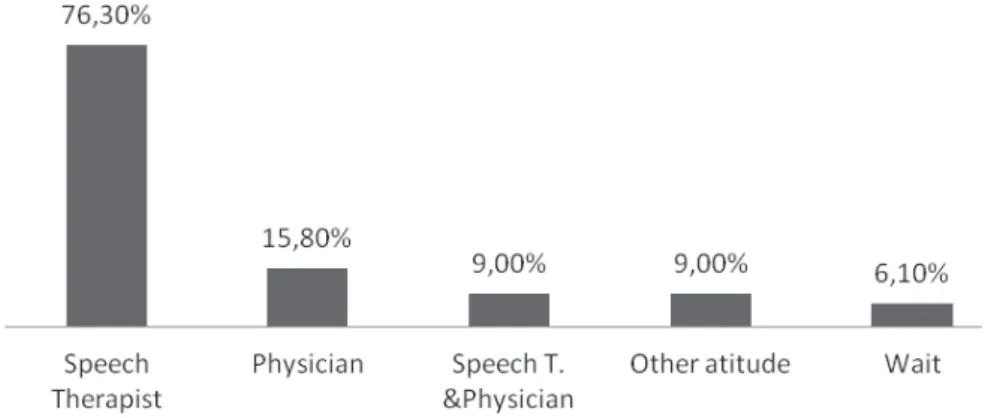
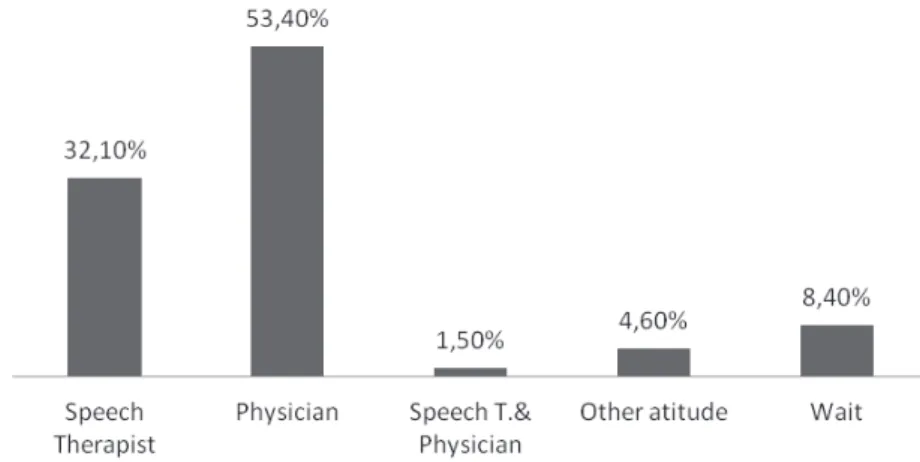
In question that investigates the attitude that the family member would adopt if he had a four year old kid who stuttered, 52.8% of respondents answered that they would consult a speech therapist, 34% would consult the family physician, 9.4% would wait, 2 4% would adopt another atittude and 1.4% said they would consult the physician and a speech therapist. The data showed statistically signiicant
differences in the educational level variable (p =
0.000) since 76.3% of respondents with college
educational level believe that the speech therapist is
the most qualiied professional to perform guidance on stuttering, as well as to treat it, in opposition to 53.4% of those with elementary educational level that would refer to the family physician. In Figures
4 and 5 one can see the opinion of these
partici-pants. There were no signiicant differences for the
variables of gender and age.
The level of signiicance of variables for each question can be found in Table 1. A total of 139
people refused to participate in this research.
Visualization of the opinion of the participants in descending order on family attitude. Chi – Square.. p = 0,000.
DISCUSSION
The results on the identiication of people with stuttering corroborate the indings listed on the work
done in Rio de Janeiro. In both cities stuttering is a disorder recognized by its residents and gender,
age and education levels did not inluence this issue.
In Shanghai the same result has been found, but
with a statistically signiicant difference for the age variable. The group of 21 to 55 knew or had seen a person who stuttered with frequency of of 91.3%, whereas in the group with less than 21 years, this rate reached 80.6%.
Considerations about the prevalence of
stuttering showed high estimate in Salvador, as well
as in Rio de Janeiro, but in Salvador the gender
variable statistically differed. Women believe more than men in the high occurrence of stuttering, which
can be related to a greater involvement of mothers in issues related to the development of children. The males approached of statistical data stating that the prevalence of stuttering is a less than or
equal to 1%. In the capital of Rio, educational level inluenced the results, because a small proportion of respondents with college educational level reported that the prevalence of stuttering is higher than 5%. In the Chinese city, 40.3% of participants indicated
Visualization of the opinion of the participants in descending order on family attitude. Chi – Square.. p = 0,000.
Figure 5 – Positioning of college educational level interviewees on family attitude
Significance Level (p < 0,05)
Questions Gender Age Educational level
A 0,798 0,398 0,167
B 0,450 0,328 0,527
1 0,002 0,245 0,568
2 0,133 0,009 0,001
3 0,201 0,088 0,398
4 0,732 0,265 0,407
5 0,478 0,421 0,825
6 0,455 0,486 0,050
7 0,494 0,119 0,042
8 0,686 0,321 0,113
9 0,624 0,670 0,591
10 0,058 0,010 0,444
11 0,890 0,264 0,000
Table1 – Variables and signiicance level
Signiicance Level (p < 0,05)
the prevalence consistent with the known statistical
data.
In terms of age of onset of stuttering, residents
of both cities knew about this information, but in Salvador that number was higher, 53.6% compared to 41.3% in the city of Rio de Janeiro. While in Salvador signiicant differences referred to age and
educational level, in the capital of Rio they referred
to the genus. In Shanghai, 60.5% of respondents placed the onset of stuttering between two and ive
year old kid.
Concerning the distribution of stuttering in relation to boys and girls, both cities claimed it to be
more prevalent in boys. In Rio de Janeiro there was signiicant difference to educational level, the college educational level indicated a greater knowledge. For the vast majority of the Shanghainese respondents,
stuttering is more prevalent in boys and the results differed statistically for age. The older age group
most frequently indicated that response suggesting that the lifetime allowed more experience with people who have the disorder and thus they can
analyze it in terms of gender.
Respondents of Rio de Janeiro, Salvador and
Shanghai agree that this disorder occurs equally in left-handers and right-handers, which may
mean that the three cities do not recognize the
relationship between handedness and stuttering. On the occurrence of stuttering in different races
Salvador data corroborate the data from Rio de Janeiro and Shanghai, demonstrating that for the participants of the research, this disorder occurs
in all races. However with a higher number in Salvador, 88.7% compared to 77.2% in Rio de Janeiro. Respondents from Rio with college educa
-tional level were more frequent in this response, in Salvador and in the Chinese city there was no statistical difference between the groups.
With regard to the causes of stuttering, most
respondents from Rio and from Salvador said that the emotional factor is the reason for developing
this disorder. This response was more frequent in Rio de Janeiro with 56.9%. In Salvador that number dropped to 28.9%. Classiications of response differed between the cities, but the two have adopted
seven categories. In Rio, the authors considered the
following: emotional, neurological, genetic, changes
in speech, imitation, organic factors and any other cause. According to the responses of respondents
from Salvador, there was the need to create a
category for the association of other factors and
for those who said they did not know the cause of stuttering. The neurological factor was incorporated
in the category organic cause. Thus, removing the created categories and comparing the same in both
cities, the following order of causes mentioned by
participants in Salvador: organic, genetic, and other
causes learning (imitation) was followed. In Rio, the group other causes appeared secondly followed by
neurological (organic), Genetics and imitation. For the people from Salvador, the educational level
inluenced the responses while in Rio there was no statistically signiicant difference between the
variables gender, age and educational level. In
the Chinese city, the most cited categories were complex causes, emotional and ignorance.
With regard to treatment, both cities believe that stuttering can be treated, but the questionnaire does not address the distinction between treatment and cure. In Rio de Janeiro this number was quite high, 94.05%, as well as in Shanghai, with 96.1%. In Salvador that number dropped to 84.2%. The two Brazilian cities showed a statistically signiicant difference with respect to educational level (p = 0.042). The vast majority of respondents with college educational level showed that response with 97.1% in Rio and 91.2% in Salvador.
Regarding the degree of intelligence of people
who stutter, the two cities agreed that there is no difference in IQ between normal speakers and speakers who stutter, this number being higher in Salvador (79.6%) than in Rio de Janeiro (66.3 %). These data conirm the results obtained in the Chinese city. There was no signiicant difference
in the capital of Bahia, but in the city of Rio de
Janeiro genres differ. The men said that people who stuttered have higher intelligence, while women believe more in equality of intelligences.
About heredity and stuttering, the results conirm
those from Salvador of Rio de Janeiro. Participants residing in both cities believe that stuttering is not
hereditary with 68.1% and 69.3% respectively. In both researches there were no signiicant differ
-ences between the variables. According to a study
conducted in São Paulo that investigated the level of
knowledge about the disorder in relatives of children who had stuttering as their main complaint, the
participants considered stuttering as a disorder non hereditary and can be cured15. In Shanghai, 76.8%
believe in non heredity of stuttering.
Concerning handicap, the respondents from Salvador claimed that the use of hearing aid devices is more disadvantageous leaving stuttering
in second place. The adults were majority for both conditions, with a signiicant difference (p =
0.010). In Rio de Janeiro the groups did not differ
statistically occurring the same percentage for two responses: 48% considered stuttering worse off, as well as, 48% considered the use of hearing aids. In the Chinese city, 30.9% weighed stuttering more
It is known that stuttering has an impact in lives of those who have this disorder. Research conducted in the United States examined the inluence that stuttering has on work performance and employ
-ability. The study included 232 people who stuttered with ages from 18 years old on. The data collected indicated that 33% of respondents believe that stuttering interferes with their job performance and that more than 70% agree that it decreases the chances of being hired or promoted. However, 20% said they had a job or promotion due to the
disorder16.
Regarding the attitude of the family members,
the majority of respondents from both cities agreed that would seek a speech therapist if they had
a four year old child that stuttered, and in Rio the
percentage was higher, 63.8% compared to 52.8% in Salvador. Subsequently the respondents from Rio said they would seek the family physician, would wait and would adopt another attitude. In Rio de Janeiro, there was no signiicant difference while in Salvador, the educational level statistically inluenced the responses: 76.3% of respondents with college educational level would seek a speech therapist and 53.4% of respondents with elementary educational level would refer to the family physician. In Salvador, 1.4% of the participants said that they would seek a speech therapist and a physician. In
the city of Rio de Janeiro none of the participants reported association of responses. In Shanghai,
the vast majority of respondents would look for a
speech and language therapist, although there is no regulated profession that addresses this issue.
In the early twentieth century, people who stuttered felt anxiety almost great due to unavail -ability of alternative communication and because
of the fact that speech therapists were people who stutter. This last fact would bring concern because to the patients there was no suficient improvement since his/her own therapist continued to be a person who stuttered17. Currently the speech therapist is
often the irst professional to be sought when there is a change of luency and paradigm shifts on the care of people who stuttered have shown the beneits of
speech therapy18.
The conceptions and attitudes about the disorder
were also studied in a population of individuals who
stuttered. Among the issues addressed, individuals
were asked about attitudes that could minimize the disturbance. They suggested to take to a witch doctor or perform magic spells, to scare the person who
stutters, slapping, not taking lectures from persons
occupying a higher work position, read aloud, attend
to swimming classes and doing yoga19. Previously,
the Orthodox Jews who just started the stuttered
speech therapy after receiving the blessing of his rabbi17.
Another study also investigated the knowledge and attitudes towards about stuttering, but in a
population of public school teachers and private
elementary school. Of the 55 participants, 72.7% responded that they have the knowledge that comes from general common sense, which creates uncer
-tainty when dealing with a student who stutters. The study concluded that teachers need more speciic
guidelines so that they can have tools to be used in
the classroom to work with students who stutter20.
Research conducted in the United States,
northwest of the state of Ohio had 185 partici
-pants and examined people’s knowledge about
stuttering, access to sources of information and the
inluence of these sources on this knowledge. The researchers used a questionnaire containing 44 questions. Among these were items about sources of information, designed speciically for this study, and on about stuttering items that were selected from pre-existing surveys. The results indicated that people of Northwest Ohio do not have speciic knowledge about the disorder, although they possess familiarity with stuttering. Responsible for
the survey also indicated limitations on the study21.
CONCLUSION
The respondet population of the city of Salvador
was found to have easily identify people with who stutter and that, in general, know issues about the disorder. However, this knowledge was shown limited on certain aspects, which may have contributed to the view of the handicap. Many of them were optimistic about the treatment and more
than half of the participants attributed this role to the
Speech Therapist. It was observed that the level of education affected the degree of knowledge and the results corroborate previous studies, relecting the
universality of the theme.
Research has shown that the easy identiication of the person who stutters by the layman, due to the strangeness of speech, coexists with misinfor
-mation about the complexity of the problem and, consequently, the lack of resources of the family and the school in necessary care, factor which was considered relevant in the planning of public
education and health actions 8,9,13,15,20.
It is on this knowledge, based on the opinion of the
preventive actions for citizen’s health. The clinical
speech therapy is also ampliied since aspects of lay knowledge that interfere with the therapeutic process are punctuated. Extending the relection, It also stands out in this context the responsibility of
institutions to train professionals speech therapists and guarantee in their curriculum components the presence, theoretical and practical, compatible
with the complexity and demands that involves the
condition of stuttering.
ACKNOWLEDGEMENTS
We thank the research assistants Aline dos
Santos, Ana Carla dos Santos, Beatriz Santos,
Débora Ramos, Izabella Jesus, Luciana Santiago,
Manuela Caldas, Marcos Sousa, Midiã Sardinha,
Mirella Pereira, Monique da Rocha, Raianne Montargil e Renata dos Reis; à Silvia Ferrite, and
the teachers of the University of the State of Bahia,
Luciana Casais, Ney Boa Sorte e Rivail Brandão
for their great contribution to this survey.
REFERENCES
1. Classiicação Internacional de Doenças e outros Transtornos CID-10 [Acesso em: 22 abr. 2013]. Disponível em: http://www.datasus.gov.br/cid10/ V2008/cid10.htm
2. Van Riper C. The nature of stuttering. Englewood Cliffs, NJ: Prentice Hall, 1971.
3. Packman A. Theory and thepapy in stuttering:
A complex relationship. J Fluency Disord.
2012;37:225-33.
4. Barbosa LMG. Noções básicas sobre a gagueira: suas características, sua etiologia e as teorias
sobre sua natureza. In: Ribeiro IM, Marchesan
IQ, Zorzi JL (orgs.). Conhecimentos essenciais
para atender bem a pessoa com gagueira. S. José dos Campos: Pulso; 2005. p.17-32. Acesso
em 06 nov. 2012. Disponível em: http://books. google.com.br/books?hl=pt-BR&lr=&id=HcVQT0k
Va64C&oi=fnd&pg=PA17&dq=gagueira+e+latera lidade&ots=vbmrbnBLgr&sig=qUT6oyLeZxuFpuK zlZbnkk5Bg-M#v=onepage&q=gagueira%20e%20 lateralidade&f=false
5. Raza MH, Riazuddin S, Drayna D. Identiication
of an autosomal recessive stuttering locus on
chromosome 3q13.2–3q13.33. Hum Genet. 2010;128:461-3.
6. Andrews G. Genetic factor in stuttering conirmed.
Arch.Gen Psychiat. 1991; 48:1034-5.
7. Van Riper C. The Treatment of Stuttering.
Englewood Cliffs: Prentice Hall, 1963.
8. Ming J X, Jing Z, Yi Wen Z,Van Borsel. Public awareness of stuttering in Shangai, China. Log Phon Vocol. 2001;26:145-50.
9. Louis KOSt, Filatova Y, Kun MC, Topbas S, Ozdemir S, Georgieva D, Mccaffrey E, George RD. Identiication of cluttering and stuttering by the
RESUMO
Objetivo: veriicar o conhecimento sobre a gagueira entre moradores da cidade de Salvador. Método:
trata-se de um estudo descritivo, de corte transversal e natureza quantitativa com a participação voluntária de residentes da cidade de Salvador. Todos responderam ao questionário de Atenção à Gagueira e foram equiparados quanto ao gênero, idade e escolaridade. Resultados: das 417
pes-soas entrevistadas 78,2% airmaram ter visto ou conhecer pespes-soas que gaguejam; 52,2% relataram que a pessoa com gagueira pertencia ao seu círculo de relações; 62,4%, acreditam que mais do que 5% da população gagueja; 53,6% responderam que a gagueira se inicia entre os dois e os cinco anos de idade; 53,5%, referiram que a gagueira ocorre com maior frequência em meninos do que em meninas; 88,7% relataram que essa desordem ocorre em todas as raças; 28,9% referiram ser emocional a causa da gagueira; 84,2% airmaram que a gagueira possui tratamento; 79,6% consi
-deraram pessoas que gaguejam com inteligência igual ao de falantes normais; 47,6% airmaram que o uso de aparelho auditivo é mais grave do que a gagueira e 52,8% responderam que consultariam um fonoaudiólogo. Conclusão: a população respondente da cidade de Salvador revelou facilidade
na identiicação de pessoas com gagueira, porém demonstrou possuir conhecimento limitado sobre questões associadas a esta, fator relevante no planejamento de ações em Educação e Saúde.
public in four countries. Int J Speech Lang Pathol. 2010;12(6):508-19.
10. Louis KOSt, Andrade CRF de, Georgieva D, Troudt OF. Experiência e relato pessoal sobre pesquisa de cooperação internacional - Brasil,Bulgária e Turquia - que avalia as atitudes em relação à gagueira. Pró-Fono R Atual Cient. 2005;17(3):413-6.
11. Ozdemir RS, Louis KOSt, Topbas S. Public attitudes toward stuttering in Turkey: Probability versus convenience sampling. J Fluency Disord. 2011;36:262-7.
12. Louis KOSt. The Public Opinion Survey of Human Attributes-Stuttering (POSHA-S): Summary framework and empirical comparisons. J Fluency Disord. 2011;36:256-61.
13. Pereira MMB, Rossi JP, Van Borsel J. Public
awareness and knowledge of stuttering in Rio de Janeiro. J Fluency Disord. 2008;33:24-31.
14. Rossi JP. Conhecimento da população da
cidade do Rio de Janeiro sobre a Gagueira
[Dissertação]. Rio de Janeiro (RJ): Universidade
Veiga de Almeida; 2008.
15. Ciboto TE, Schiefer AM. O conhecimento sobre a gagueira apresentado pelos pais de crianças gagas: senso comum. Fono Atual. 2001;4(16):31-8.
16. Klein JF, Hood SB. The impact of stuttering on employment opportunities and job performance. J Fluency Disord. 2004;29:255-73.
17. Ezrati-Vinacour, R, Weinstein N. A dialogue
among various cultures and its manifestation in
stuttering therapy. J Fluency Disord. 2011;36:
174-85.
18. Degiovani VM. Diagnóstico diferencial das disluências. In: Ribeiro IM, Marchesan IQ, Zorzi JL (orgs.). Conhecimentos essenciais para atender
bem a pessoa com gagueira. S. José dos Campos:
Pulso; 2003. p. 33-4. Acesso em 06 jan. 2012. Disponível em: http://iles.aprofopi.webnode.com. br/200000124-3477f3571f/ebook%20gagueira.pdf 19. Carvalho APG de, Galvão VS. Concepções e atitudes de sujeitos gagos sobre a gagueira. Rev Inic Cient FFC. 2006;5(1/2/3):15-24.
20. Ferriolli BHVM, Leitão PM, Pereira FLF. O
conhecimento e as atitudes dos professores frente
à gagueira. JBF. 2005;5(22):321-30.
21. Gabel R, Brackenbury T, Irani F. Access to Information About Stuttering and Societal
Knowledge of Stuttering. Perspect Fluen Fluen Disord. 2010;2(20):51-7.
Received on: November 24, 2012 Accepted on: April 12, 2013 Mailing address:
Rina Tereza D’Angelo Nunes
Rua Engenheiro Adhemar Fontes, 254, apto 601 –