Original Article
Artigo Original
Dobrinka Georgieva1
Descritores
Gagueira Qualidade do cuidados de saúde,
acesso e avaliação Efetividade Keywords
Stuttering Health care quality, access, and evaluation
Effectiveness
Correspondence address: Dobrinka Georgieva 2700 Blagoevgrad, Bulgaria. E-mail: [email protected]
Received: 02/16/2014
Accepted: 03/15/2014
Study carried out at South-West University Stuttering Research Centre – Blagoevgrad, Bulgaria. (1) Department of Logopedics, South -West University “Neoit Rilski” – Blagoevgrad, Bulgaria.
Financial support: Bulgarian Science Fund project “Evidence-based practice in luency and voice disorders (2009–2012)” and Fulbright 2013 grant.
Intensive non-avoidance group therapy with stutterer
adults: preliminary results
Terapia intensiva de enfrentamento em grupo com adultos
gagos: resultados preliminares
ABSTRACT
Purpose: The purpose of the present study was to evaluate and document the use and eficacy of intensive non-avoidance group treatment for Bulgarian adults who stutter (AWS), to specify that changes are adopted in different speech situations (in the stabilization phase), and to demonstrate that changes are maintained after intensive therapy. Methods: Participants were AWS (n=15, 12 males) with an average age of 25.2 years) Bulgarian native-speakers. Twelve participants were University students and three were clients with tertiary education in different areas. All participants were enrolled in First (overall effect) and Second (interim effect) Stages of Intensive Non-Avoidance Treatment for Stuttering. Van Riper’s stuttering modiication therapy approach was employed; the latter considers a non-avoidance treatment for stuttering. The treatment was conducted in participants’ native Bulgarian language. Results:AWS, as a group (n=15), signiicantly decreased the number of stuttered utterances after intensive treatment; indings were consistent for participants with moderate as well as severe stuttering. Likewise, there was a signiicant decrease in duration (in seconds) of disluencies after treatment; indings were consistent for participants with moderate as well as severe stuttering. Eighty percent of AWS used cancellation immediately and six months after treatment, 65% mastered preparatory sets immediately and six months after treatment, 35% exhibited pull-outs immediately after treatment and 55%, six months post-treatment.Conclusion:These preliminary indings were taken to suggest that intensive non-avoidance treatment for stuttering can be successfully employed with Bulgarian adults who stutter. Special focus was on the positive luency changes that occurred during the course of therapy regarding the duration of disluencies in seconds, and index of disluencies.
RESUMO
INTRODUCTION
Over the past 25 years, several publications relating to treatment effectiveness for stuttering have been widely-studied by Bulgarian speech-language pathologists(1-4). In particular, Cordes and Ingham’s(3) described a set of measurements and designed standards for stuttering treatment research in different age groups, including adults. More recently, in Bulgaria(5) spe-cial attention has been paid to evidence-based practice, includ-ing the measurement of disluencies in attempts to evaluate the eficacy and effectiveness of treatment for people who stutter.
Consistent with these international attempts to improve treat-ment for people who stutter, Bulgarian logopedists (i.e., speech-language pathologists) have also begun to adopt new paradigms in their professional practice. Such adoption has been focused on better understanding as well as application of existing international standards for evidence-based practice(6-8). For example, the South-West University (SWU) intensive program was developed and car-ried out within the framework of the Evidence-Based Practice proj-ect sponsored by the National Science Fund 2009–2012. As part of that initiative, by Bulgarian logopedists, the present study was conducted. Speciically, the present researcher analyzed prelimi-nary results obtained during the First Stage of the project (October 2010 — a ive-day intensive program) followed by a Second Stage (nine month stabilization period from November 2010 to July 2011). The approach focused on objectively-determined changes in adult stutterers’ stuttering that resulted from a non-avoidance treatment program(9). The need for such a study is witnessed by the fact that the Bulgarian health system does not provide logo-pedic treatment for adults who stutter(5,10,11). To this researcher knowledge, the present non-avoidance therapy intensive course was the irst one in Bulgaria conducted for adults with stuttering.
Therefore, it was the purpose of the present study to (1) measure and document the eficacy of the intensive non-avoid-ance group therapy for adults who stutter (AWS), (2) describe changes in stuttering behaviour (in the stabilization phase), and (3) investigate if changes were maintained post therapy.
METHODS
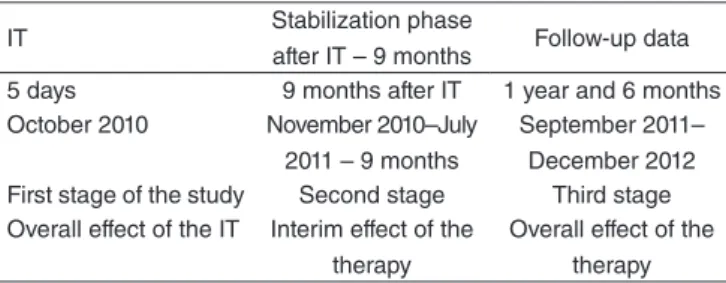
All types of measurement in the present study are pre-sented in Table 1.
a) duration of disluencies in seconds (DDs) – the dura-tion, in seconds, of the three longest stuttering events was measured;
b) index of disluencies (ID) – the number of stuttering events was divided by the number of syllables. Each speaking sample contained at least between 300–400 syllables for more reliable results.
In the present study, we assessed treatment results using stuttering frequency and scores by application of the Stuttering Severity Instrument for Adults, Third Edition (SSI-3)(12). 2) Wright & Ayer Stuttering Self-rating Proile (WASSP)(14,15).
Useful WASSP proile information was collected from the logopedic iles about how the participants used non-avoid-ance approach and modiication techniques and how their affective/cognitive reactions to stuttering change. In this article, only group results are presented.
3) The clients’ use of modiication techniques at the end of IT from the perspective of the speech-language pathologist.
Subjects
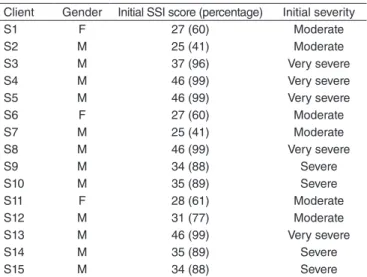
Fifteen AWS (average age of 25.2 years, 12 males) served as participants for this study. All subjects participated in the irst and second phases (to be explained) of a three-phase treat-ment project. Four participants exhibited severe, six moderate and ive exhibited very severe stuttering (Table 2). The male– female ratio was 4:1.
Table 1. Components providing comprehensive view of stuttering and guiding the documentation of treatment results in the present study
Component for measurement in the present study
Applied effectiveness instrument in the present study Evaluation and assessment
of the fluency disorders
Stuttering Severity Instrument – SSI(12)
Assessment of the reactions related to stuttering
Stuttering Self-Rating of Reactions to Speech Situations(13)
Evaluation of the stutterer’s self-examination
Wright & Ayer Stuttering Self-rating Profile(14,15)
Table 2. Stuttering Severity Instrument for Adults, Third Edition results from stuttering assessment before intensive therapy – percentile and equivalents
Client Gender Initial SSI score (percentage) Initial severity
S1 F 27 (60) Moderate
S2 M 25 (41) Moderate
S3 M 37 (96) Very severe
S4 M 46 (99) Very severe
S5 M 46 (99) Very severe
S6 F 27 (60) Moderate
S7 M 25 (41) Moderate
S8 M 46 (99) Very severe
S9 M 34 (88) Severe
S10 M 35 (89) Severe
S11 F 28 (61) Moderate
S12 M 31 (77) Moderate
S13 M 46 (99) Very severe
S14 M 35 (89) Severe
S15 M 34 (88) Severe
Caption: F = female; M = male; SSI = Stuttering Severity Instrument
The present preliminary study includes measurements of: 1) Changes in speech luency before and after the intensive
therapy (IT):
Educational and social proile of the clients involved in the treatment
All of them were luent in English and Bulgarian, and the ther-apy was performed in their native language, Bulgarian.
Inclusion criteria
To be included as a participant in the present study, indi-viduals had to: (1) be adults older than age 20, (2) participate previously in therapy, and (3) exhibit a range of stuttering severities to ensure a representative sample.
Data collection
The data collection included review of the client’s iles (assessment reports and progress reports). The Yaruss(16,17) components providing comprehensive view of stuttering and guiding the documentation of treatment results were accepted as the oficial standards in the study’s framework (Table 1).
Three types of files were recorded during the initial diagnostic evaluation, at the onset of treatment, and at the end of the five-day intensive program. The preliminary results after the nine-month complete stabilization period are included in this study.
Therapy approach
The therapy approach was late Van Riper’s(9) stuttering modiication therapy approach, which constitutes a non-avoid-ance approach.
Intensive program description (Table 3)
• Day one: information is given concerning the goals of the
therapy program based on Van Riper’s stuttering explana-tions. Goals of the therapy program include:
• to learn how to handle interruptions in the low of speech
from tensed and struggled blocks to a slow, easy and soft stuttering;
• to reduce negative feelings and desensitize the emotions
due to reactions from the environment;
• to learn new courses of action in relation to speech and
communication;
• to learn how to be your own stuttering therapist and to
be active and responsible for changing your stuttering behaviour to more luent stuttering;
• to improve the understanding of each individual client’s
stuttering through observation of video recordings.
Motivation for this therapeutic approach is a very important part of the therapy, and there is a central focus on motivation throughout the therapy. In the identiication stage, the client and the clinician identify all the behaviours, feelings, and attitudes associated with the person’s stuttering. Observation of prolonga-tions, repetiprolonga-tions, blocks, avoiding behaviours etc. is recorded.
• Day two: desensitization is conducted in three stages. First,
the client engages in activities to help him/her learn to accept that he/she stutters. Next, the client has to hold or continue the stutter; the goal is to make the client less emotional and more tolerant of the stuttering. The last part of desensitization is when the client voluntarily stutters. This helps the client remain calm when a stutter happens. Voluntary stuttering is when the person stutters on purpose. By choosing when and how to stutter, the individual begins to gain control over the stuttering, and the fear and anxiety begin to diminish.
• Day three: variation/modiication is followed by approxima
-tion with the three strategies for altering stuttering: cancel-lation, pull-out, and preparatory set. Stuttering modiication emphasizes how to change dificult stuttering into easier and more manageable stuttering. Clients can start with select-ing one of their own ways of stutterselect-ing, and later modify their stuttering behaviour through:
• cancellation, in which the person stutters all the way
through a word, stops immediately, and then repeats the word, stuttered in a different way;
• pull-out, in which the person gains control over a moment
of stuttering while it is happening and smoothes it out; and
• preparatory sets, in which the person prepares for a
moment of stuttering before it happens, starts it gen-tly and glides through it smoothly. Strategies such as bouncing, sliding, easy onset, and light contacts repre-sent variations on these three techniques.
• Day four: assimilation involves training in the new luency
modiication techniques and modelling different speech situations. This is an essential part of the therapy.
• Day ive: stabilization includes the transfer of the new
speech techniques into real everyday situations (under a speech-language pathologist’s supervision). The goal of stabilization is to change the client’s view of being a stutter to a person who is luent. Stuttering reassessments, as well as inal observations and directions for future intervention are discussed. The stabilization part of the therapy has to be continued over a long period in order to ensure mainte-nance of the new stuttering behaviours.
Procedure: treatment environment
The therapy sessions were conducted within the Stuttering Research Centre at South-West University in Blagoevgrad, Bulgaria (http://usrc.swu.bg). The transfer practice took place in nearby public settings such as shopping malls and service centres. Group and individual therapy was offered daily for six hours (10 a.m. – 1 p.m. and 2 p.m. – 5 p.m.). Clients were assigned
IT Stabilization phase
after IT – 9 months Follow-up data 5 days 9 months after IT 1 year and 6 months October 2010 November 2010–July
2011 – 9 months
September 2011– December 2012 First stage of the study Second stage Third stage Overall effect of the IT Interim effect of the
therapy
Overall effect of the therapy
*The first two columns indicate reported data in the present study
Caption: IT = intensive therapy
numerous speaking tasks during the mornings, including tele-phone calls, role playing, planning for exercising in the city, ask for a book in the bookstore etc.
The stabilization phase was also conducted at the University Stuttering Research Centre, every second Saturdays (11 a.m.–4 p.m). Speech situations were determined by the Darley and Spriesterbach(13) assessment. The clients were involved in the therapy process by developing a hierarchy of situation, listed from the easiest to the most difficult sit-uations for the individual client.
Procedure: clinician background
The intensive program was directed by Steen Fibiger, who had received training in administration of the non-avoidance approach in Sweden and Denmark. He has also served as a consultant for the University Stuttering Research Centre in Bulgaria during the last seven years. The other three Bulgarian clinicians involved in the IT course and stabilization phase were the author of the article (full professor in Public Health, also trained at Northwestern University’s stuttering modiication approach workshop), and two assistant professors in Logopedics (Miglena Simonska, PhD and Anna Andreeva).
The present non-avoidance therapy intensive course was the irst one in the country conducted for adults (PWS).
Measurement reliability
All of the 15 participants were re-assessed by two trained speech-language pathologists concerning ID and DDs before
and after IT, as well as after nine-month stabilization phase. Both of them reported “measurement agreement” — 95% agreement index.
Dependent measures
After the IT course and each of the stabilization phase ses-sions, a ive-minute video-recorded spontaneous speech sample was obtained from each of the participants. Those inal IT record-ings were used for calculating the inal SSI point and severity.
Statistics
The data obtained were calculated using (1) the Wilcoxon signed-ranks test for hypotheses testing, and (2) the Mann-Whitney rank-sum test. For the statistics, the 15 subjects were divided into two main groups: Severe (Very severe and Severe), and Moderate.
RESULTS
Changes in speech luency
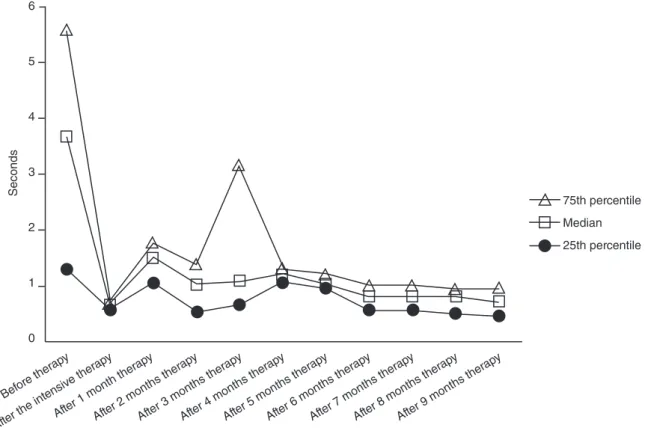
Duration of disluencies in seconds (Figure 1)
The Wilcoxon signed-ranks test conirmed that there was a reduction of DDs after IT (Z=3.408; p<0.001) except for the irst month of IT (Z=1.877; p>0.061).
Results indicate that the overall effect of a sustained reduc-tion in DDs was achieved (p<0.001) – there was a signiicant
6
5
4
3
2
1
0
Seconds
Before ther apy
After the int ensiv
e ther apy
After 1 month ther apy
After 2 months ther
apy
After 3 months ther
apy
After 4 months ther
apy
After 5 months ther
apy
After 6 months ther
apy
After 7 months ther
apy
After 8 months ther
apy
After 9 months ther
apy
75th percentile
Median
25th percentile
reduction in the average duration of luency disruptions. Our explanation is that, perhaps a month after the IT, PWS have not yet mastered the three major techniques underlying the stutter-ing modiication approach. The variance coeficient for some of the cases takes on a very high value, 109.74, which points out that some of the individual clients also encountered dificulties in mastering the techniques during the irst month after the IT (S3, S8, and S13).
The study of the interim effect on DDs shows positive results and there is a statistically signiicant reduction of DDs with respect to: after IT and one month after IT (Z=3.408; p<0.001); two months after (Z=2.272; p<0.023); three months after (Z=2.528; p<0.011); four months after (Z=3.181; p<0.001); five months after (Z=2.984; p<0.003); seven months after (Z=2.984; p<0.003); eight months after (Z=3.181; p<0.001), and nine months after (Z=3.181; p<0.001). Thus, the values for DDs are permanently reduced except for the sixth month after IT (Z=1.292; p>0.196). This slow change in sixth months can be explained by the decision to employ stuttering modiication approaches in the therapy. It is dificult to maintain a long last-ing motivation for therapy and there is a gradual acquisition of skills and progress for being oneself’s stuttering therapist.
In the group of adults with moderate stuttering, there has been a signiicant reduction of DDs after IT (Z=2.201; p<0.028) and nine months thereafter (Z=2. 201; p<0.028) according to an application of Mann-Whitney rank-sum test. The same trend was observed in the group of clients with severe stuttering.
There was a signiicant reduction of DDs after the IT and nine months later (Z=2.668; p<0.008). An analysis of the results shows that DDs was not inluenced by the severity of stutter-ing in both groups.
This gives us grounds to assume that the stuttering modii-cation approach is suitable for individuals with both moderate and severe stuttering.
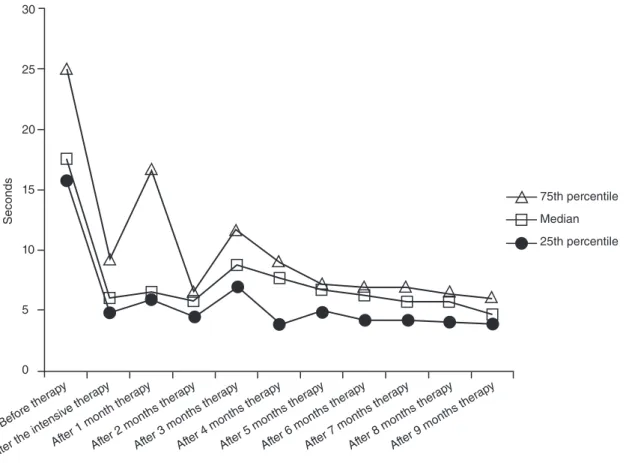
Index of disluencies (Figure 2)
The Wilcoxon signed-ranks test also conirmed the data that the overall effect indicates signiicant luency changes. There was a positive progression over time in ID with the exception of the third month after IT (Z=1.136; p>0.256).
Signiicant changes regarding ID reduction were found after IT (Z=3.408; p<0.001), after the first month (Z=3. 295; p<0.001), after the second month (Z=2.556; p<0.011), after the fourth month (Z=3.351; p<0.001), after the ifth month (Z=3.408; p<0.001), after the sixth month (Z=3.408; p<0.001), after the seventh month (Z=3.351; p<0.001), after the eight month (Z=3.408; p<0.001), and after the ninth month (Z=3.295; p<0.001).
ID was also examined in groups, according to the sever-ity of impairment in PWS (Moderate and Severe). Because of the smaller number of participants in these groups, the Mann-Whitney U-test was used for these comparisons. We assume again that the severity of stuttering does not affect the reduction of the impaired luency index. In the group of individuals with
Figure 2. Index of disfluencies at the begining versus end of the intensive therapy, and nine months after the intensive therapy for all subjects (n=15) 30
25
20
15
10
5
0
Seconds
Before ther apy
After the int ensiv
e ther apy
After 1 month ther apy
After 2 months ther
apy
After 3 months ther
apy
After 4 months ther
apy
After 5 months ther
apy
After 6 months ther
apy
After 7 months ther
apy
After 8 months ther
apy
After 9 months ther
apy
75th percentile
Median
moderate stuttering, the differences in response before and nine months after therapy was signiicant (Z=2.201; p<0.028). The same tendency was observed in persons with severe stuttering (Z=2.666; p<0.008). For both groups, the index of impaired lu-ency decreased signiicantly — this indicated that both groups responded equally well to therapy.
DISCUSSION
Wright & Ayer Stuttering Self-rating Proile application
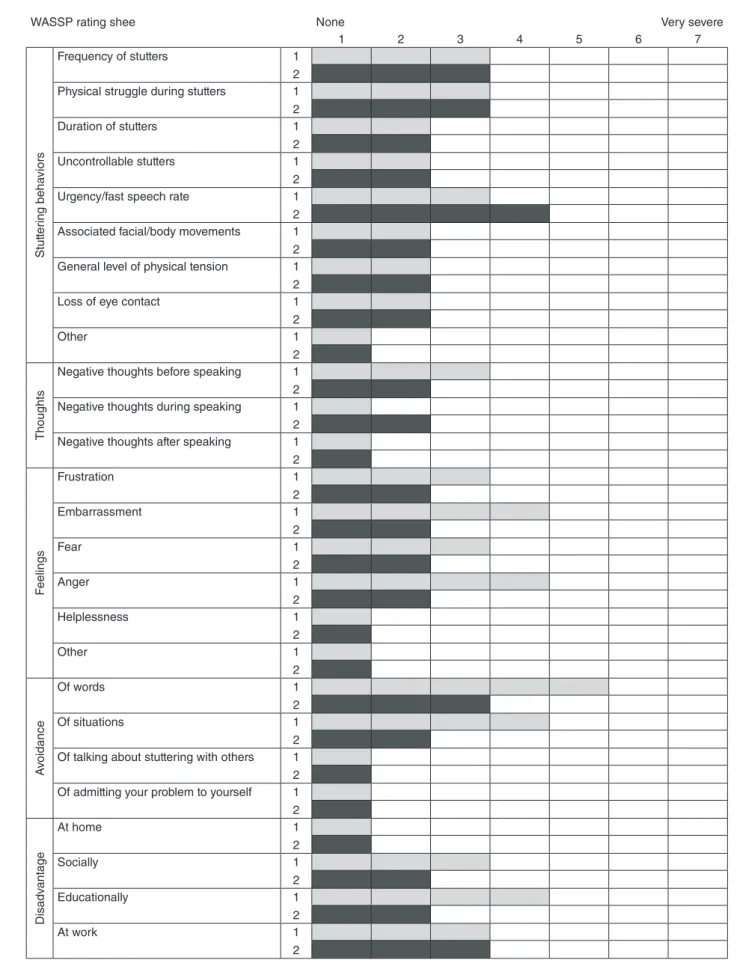
The set of ifth subscale of the WASSP revealed considerable positive changes in response to course participation in 12 of the 15 participants immediately after the intensive course. A small positive change after therapy was observed in only three PWS (S3, S8, and S13). Between ten and 12 of those clients, WASSP proile parameters were not changed after the intensive course. We attribute those participants’ limited progress to several factors, such as poor awareness of their stuttering behaviours, signiicant levels of avoidance, and low initial motivation. We may explain this fact by the inability of the clients to admit the severity of their stuttering, as well as their feelings and avoidance at the beginning of the course. Furthermore, it was dificult to obtain their motiva-tion for the therapy, although we believe that, after the therapy, they were able to rate the proile elements more realistically (see the completed proile for client S3 in Figure 3). He reports posi-tive change and awareness of the parameters: frequency of stut-ters; physical struggle during stuttering; uncontrollable stutstut-ters; negative thoughts before speaking; embarrassment; fear; anger; avoidance of situations and talking about stuttering with others; socially and educationally disadvantage due to stuttering. The initial completion of his WASSP proile showed that the client had high expectations “to reduce and to eliminate completely my stuttering”. In the inal proile, he wrote:
During this block I understood that I talk faster than I thought. During the recorded visual identiication, I saw that I do some facial movements, especially blinking with my eyes. The modiication techniques we worked on were not very useful to me because I consider myself a less severe stut-tering person. The modiication technique, which probably may be useful for me, is the pull-out. I don’t use it very often but I focus on working with the pull-out technique it might work out for me.
The rest of the clients reported a visible change of prog-ress and reduction of scores for all ive subscales in WASSP. Their explanatory comments in the last section of their pro-iles reveal they had developed realistic expectations for the stuttering outcomes.
Our overall experience shows that, in order to stabilize the new stuttering behaviours acquired during therapy, continued therapy and support for a longer period are necessary. Such a longer term of support allows stabilization to continue and helps manage relapses to the old stuttering behaviours.
The clients’ use of modiication techniques at the end of intensive therapy from the perspective of the speech-language pathologist
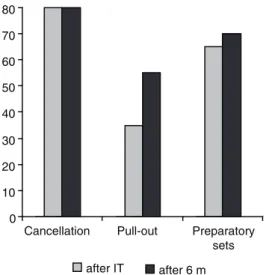
Figure 4 illustrates the percentages of clients’ (n=15) abil-ity to use the three main modiication techniques (cancellation, pull-out and preparatory sets) in different speech situations (conversation) at the end of the IT and after the six-month stabilization phase. This evaluation was made by SLPs who judged whether a client was able to use the three modiication techniques practiced during the IT. The data were obtained by seven clinical reports per person — one after the IT and six for each of the following six months (i.e., a total of 105 reports for all 15 participants). Our SLPs used the Yaruss(18) suggested criterion level of modiication in at least 80% of the opportunities during structured speech situations in the clinical Speech-Therapy room and outside the clinic.
Cancellation
Eighty per cent of our clients were able to use the cancel-lation modiications immediately after the IT and 80%, after six months.
Pull-out
Approximately 35% of the clients showed pull-out modi-ications after the IT and 55% after six months.
Preparatory set
Sixty-ive per cent mastered preparatory sets after the IT and 70%, after six months.
The results show that, after the IT, the modiication tech-niques have been learned and successfully practiced in the six-month stabilization phase but not yet suficiently well.
The present study resulted in four main indings. First, there was a signiicant improvement in stuttering frequency associ-ated with this non-avoidance treatment program, both immedi-ately after treatment and nine months post-treatment. Second, there was a signiicant reduction of DDs after this treatment program as well as six months later. Third, the positive changes regarding ID were obtained. Fourth, of the three modiication techniques, clients were most successful with cancellations, then preparatory sets and least successful with pull-outs. Only three of the clients have been unsuccessful in the long modi-ication process.
Figure 3. Wright & Ayer Stuttering Self-rating Profile Summary of the subject S3
In the third column — 1 = the first WASSP evaluation; 2 = the second WASSP evaluation (after the intensive therapy)
WASSP rating shee None Very severe
1 2 3 4 5 6 7
Stut
ter
ing beha
vior
s
Frequency of stutters 1
2 Physical struggle during stutters 1 2
Duration of stutters 1
2
Uncontrollable stutters 1
2
Urgency/fast speech rate 1
2 Associated facial/body movements 1 2 General level of physical tension 1 2
Loss of eye contact 1
2
Other 1
2
Thoughts
Negative thoughts before speaking 1 2 Negative thoughts during speaking 1 2 Negative thoughts after speaking 1 2
F
eelings
Frustration 1
2
Embarrassment 1
2
Fear 1
2
Anger 1
2
Helplessness 1
2
Other 1
2
A
voidance
Of words 1
2
Of situations 1
2 Of talking about stuttering with others 1 2 Of admitting your problem to yourself 1 2
Disadv
ant
age
At home 1
2
Socially 1
2
Educationally 1
2
At work 1
set training. The SLPs team helped very strongly the stuttering shaping behavior through cancellation technique. For S3, S8, and S13, cancelling was not simple and easy to learn accord-ing to the new response to the speciic stimuli related with the abnormal stuttering response. It was manifested during the stuttering moments.
Modiication of stuttering during pull-outs occurrence was also dificult to be realized. In the IT modiication phase and nine months later, the three subjects tried to stimulate them-selves in any attempt to change the stereotyped stuttering model before the speech element (word) is spoken. It was not easy to transfer this model into the normal luent speech (frequently reported) in the post-therapy stabilization meetings.
For the team, it was interesting to describe the strong stuttering ixation, including sounds and syllables repetitions and dificulties. For subjects S3 and S8, it was dificult to explore and implement the new timing way of transition slight movements. For S13, this sub goal was hard to understand and exercise for a long period (even long prolongations in the stuttering moments). The severity of stuttering including atypical and abnormal articulatory posture or tremor observed in some sounds pronunciation hampered the slight pull-out application. They found dificulties in continuing and changing the initial behavior model during the overall nine-month post-therapy period. They reported lack of success in completing pull-out exercises in their daily tasks “portions”.
The abnormal preparatory sets were reported by the same three subjects. As Riper(9) gave brief explanation many years ago, “the new slow-motion form of luent stuttering that had been learned through the cancellation and pull-out techniques appear in their speech” (p. 338). Unfortunately, the expected new way of attempting frustrated words has not been learned. For them, it was impossible to reject their old abnormal stereotype to use hard contacts resulting in observed disintegration between timing and phonation. The motor transition was compromised.
One possible explanation is the previous therapy experience based on the luency shaping model application in Bulgaria. They have been trained for years to prolong the irst sound of the word. Implementation of the proportional model of speech elements prolongations failed. After exploration of the talking, formulation and organization of the motor process in stutter-ing, it could be possible to conclude that this requires a high level of awareness and self regulation.
CONCLUSIONS
The preliminary results of this study represent only one initial step in evaluating the outcomes obtained by intensive group therapy for adults in Bulgaria. The present results are rel-evant only with respect to an intensive group treatment format. The changes in speech luency before and after the IT and in the stabilization phase (irst nine months) were obtained regarding the duration and index of disluency.
Also concerning duration of disluencies, a signiicant reduc-tion of durareduc-tion after the IT and nine months later was observed for both groups: the group with severe stuttering and the group with moderate stuttering.
Signiicant changes in the index of disluencies were found in comparisons before and after IT. In the period of the nine-month stabilization phase, these positive changes were maintained.
We assume from the mentioned results that the stuttering non-avoidance modiication approach is suitable for adults with both moderate and severe stuttering.
In sum, results from this study demonstrate that Van Riper’s non-avoidance approach of stuttering was successfully applied for the Bulgarian conditions and provided a modern and com-prehensive treatment for the stuttering disorder. The existing Bulgarian experience over the last 40 years put an accent on the SLP leading role in the therapy process. With the present study of the Riper’s non-avoidance approach, a new “spirit” and view to the stuttering therapy process are suggested.
ACKNOWLEDGEMENT
The author gratefully acknowledges the help of Professor Edward Conture in preparing the structure, igure presentations and comments for this article.
REFERENCES
1. Conture E. Treatment efficacy: stuttering. J Speech Hear Res. 1996;39:18-26.
2. Cordes AK. Current status of the stuttering treatment literature. In: Cordes AK, Ingham RJ, editors. Treatment eficacy for stuttering: a search for empirical bases. San Diego: Singular; 1998. p. 117-44. 3. Cordes A, Ingham RJ, editors. Treatment eficacy for stuttering: a search
for empirical bases. San Diego: Singular Publ. Group; 1998.
4. St. Louis KO, Westbrook JB. The effectiveness of treatment for stuttering. In: Rustin L, Purser H, Rowley D, editors. Progress in the treatment of luency disorders. London: Taylor and Francis; 1987. p. 235-57. 5. Georgieva D, Goranova E. The treatment of luency disorders: experience
in Bulgaria. Presentation at the 7th Oxford Dysluency Conference; 2005. 6. Dollaghan CA. The handbook for evidence-based practice in
communication disorders. Baltimore: Paul. H. Brookes Publishing; 2007. Figure 4. Percentages of subjects (n=15) judged by speech-language
pathologists to show use of the three main modification techniques in different speech situations after intensive therapy (IT) and six months (m) after the IT
0 10 20 30 40 50 60 70 80
Cancellation Pull-out Preparatory
sets
7. Roddam H, Skeat J. Embedding evidence-based practice in Speech and Language Therapy. International examples. Hoboken: Wiley-Blackwell; 2010.
8. Ward D, Scoler Scott K. Cluttering. A Handbook of Research, Intervention and Education. Hove and New York: Psychology Press; 2011.
9. Van Riper C. The treatment of stuttering. New Jersey: Prentice- Hall; 1973.
10. Fibiger S, Peters H, Euler H, Neumann K. Health and human services for persons who stutter and education of logopedists in East-European countries. J Fluency Disord. 2008;33:66-71.
11. Fibiger S, Peters H, Touzet BB, Neumann K. Therapy for persons who stutter: Eastern Europe and Latin America. In: 5th World Congress on Fluency Disorders, 25-28th July, 2006, Dublin, Ireland.
12. Riley G. Stuttering severity instrument for children and adults. 3rd edition. Austin: Pro-Ed; 1994.
13. Darley FL, Spriesterbach DC. Diagnostic methods in speech pathology. 2nd edition. New York: Harper and Row; 1978. p. 317-9.
14. Ayre A, Wright L. WASSP: an international review of its clinical application. Int J Speech Lang Pathol. 2009;11(1):83-90.
15. Wright L, Ayre A. WASSP: Wright and Ayre Stuttering Self-rating Proile. Bicester: Speechmark; 2000.
16. Yaruss JS. Measuring multiple outcomes in stuttering treatment. In: 7th Oxford Dysluency Conference, Oxford; 2005. p. 5-11.
17. Yaruss JS, Quesal RW. Overall Assessment of the Speaker’s Experience of Stuttering (OASES): documenting multiple outcomes in stuttering treatment. J Fluency Disord. 2006;31:90-115.