Workers’ Health Reference Centers performance in
mental health: a survey in Brazil
Os Centros de Referências em Saúde do Trabalhador e as ações
em saúde mental: um inquérito no Brasil
Article Revista Brasileira de Saúde Ocupacional
ISSN: 2317-6369 (online)
http://dx.doi.org/10.1590/2317-6369000118115
RB
SO
Mariana de Castro Brandão Cardoso a
Tânia Maria de Araújo a
Received: 06/15/2015 Revised: 10/27/2015
Approved: 11/23/2015
Abstract
Introduction: nowadays mental disorders constitute the third cause for workers’ leave. Objective: to identify main initiatives in work-related mental health carried out by Workers’ Health Reference Centers (CEREST). Methodology: descriptive study using online survey conducted with CERESTs in Brazil in 2014. Results: 80.1% (n = 161) of the eligible CERESTs took part in this study. Most of them (87.5%) were operating for more than five years, 89.2% were managed with resources from the National Network of Integral Attention in Occupational Health (Renast), 61.3% had good infrastructure and 67.7% had trained staff in mental health care. However, 63.5% did not have social control, only 46.9% provided ambulatory care, 47.8% developed health education activities in Psychosocial Attention Center (CAPS), 40.9% carried out matrix support initiatives, 18.7% had a therapeutic group, 35.5% developed constantly informative activities, 53.2% carried out work environment inspections and 58.8% made a systematic record work-related mental disorders cases in the Notifiable Diseases Information System (SINAN). Conclusion: we observed that work-related mental health initiatives carried out by CERESTs are still incipient.
Keywords: occupational health; mental health; Brazilian Unified Health System; mental disorders.
1
Work developed from Mariana de Castro Brandão Cardoso master’s thesis, “Os Centros de Referência em Saúde do Trabalhador e as ações em saúde mental relacionadas ao trabalho”, defended in 2015 in the Programa de Pós-Graduação em Saúde Coletiva (Collective health postgraduate program) of Faculdade Estadual de Feira de Santana, Bahia.
The work was not subsidized.
The authors claim that there is no conflict of interest and that the work was not presented at scientific meetings.
a Universidade Estadual de Feira de Santana, Departamento de Saúde, Programa de Pós-Graduação em Saúde Coletiva. Feira de Santana, BA, Brasil.
Contato:
Mariana de C. B. Cardoso
E-mail:
Introduction
In the world today, the way workers get sick and die changed because of economic restructuring and of the new production and labor management models1. According to the National Institute of Social Security (INSS), the number of work accidents in Brazil decreased 7.2% between 2008 and 2010, however, mental and behavioral disorders have not decreased, new medical leaves increasing 0.3% every year, representing 7.1% of money spent on new sickness benefits2. Mental disorders are the third cause of sick leave with benefits from INSS, with average annual rate of 9.3% or 34.9/10,000 policyholders, being 6.2% work-related3.
Working conditions as determinant factors of the health-disease process have been recognized and included in the Brazilian public health policies since the 1980s, after the sanitary reform, the 1988 Federal Constitution and the creation of the Brazilian Unified Health System (SUS) under law No. 8,080 of September 19, 19904-6.
The occupational health sector gained importance in the SUS in 2002 because of the creation of the National Network for Integral Attention in Occupational Health (Renast) , through ordinance GM/MS nº 1.6797, whose purpose was to implement public policies for promotion, surveillance and assistance, mostly through Workers’ Health Reference Centers (CEREST).
The CERESTs are responsible for coordinating intra- and intersectoral actions regarding occupational health, providing technical support for occupational health initiatives and matrix support to services of SUS Health Attention Network8-10. These centers are classified by their range of action: state, regional and municipal levels. Out of this classification is only the state of Sergipe, which does not have a state level center due to its occupational health structure configuration.
CERESTs expansion in Brazil occurred from 2002 to 2012, and in the last year of expansion there were 210 qualified centers spread all over the country according to Economically Active Population (EAP) distribution. Economically Active Population in 2010 was of 86,353,839 workers, in formal and informal jobs, distributed among the country’s five regions: 38,111,800 in the Southeast region (44.1%); 20,854,301 in the Northeast region (24.2%); 14,249,772 in the South region (16.5%); 6,875,625 in the Midwest region (8.0%); and 6,262,341 in the North region (7.2%)11. The coverage of regional and municipal CERESTs in 2010 has reached 82.5% of the country’s EAP12.
In over ten years of operation, CERESTs have gradually made advances within SUS, but still insufficient in some specific areas, e.g. work-related mental health, both in initiatives, as in specific public policies and construction of instruments or guiding protocols13-15.
Mental health and work have been discussed in studies that point out how hard it is to develop initiatives in this area: absence of protocols or guiding lines for professionals; lack of trained professionals; complexity of relating work and mental disorders; no guarantees of full assistance for workers experiencing work-related mental disorders; and cases becoming invisible because underreported within health information systems13,14,16-23.
Occupational Health General Coordination (Ministry of Health), performed two surveys, during 2008-2009 and 2010-2011, called “1st and 2nd Inventories in Workers’ Health: Evaluation of the Rede Nacional de Atenção Integral à Saúde do Trabalhador – RENAST (National Network for Integral Attention in Occupational Health), which include facilities, organizational conditions, human resources conditions and initiatives undertaken by CERESTs in Brazil6,24. However, we could not find studies on initiatives in the area of mental health and work carried out by these services in the Country.
Given these facts, we may point out that, because of work-related mental disorders topicality and difficulties already identified in initiatives in occupational health care, mental health is one of the most urgent demands for occupational health services. It is important to generate information on CERESTs practices, to the elaboration of effective programs and public policies. In this perspective, the objective of this study was to identify major initiatives in work-related mental health by CERESTs in Brazil.
Methodology
A descriptive study was conducted through online survey including state, regional and municipal CERESTs. In Brazil, 210 centers were entitled by the Ministry of Health in 2014. Although entitled, five of these have not started functioning until data collection and were considered not eligible for this study. Besides this exclusion criterion we also excluded centers we could not contact by phone or e-mail (n = 4).
and 12 regional and municipal CERESTs; Northeast region with 8 state and 47 regional and municipal; Midwest region with 4 state and 14 regional and municipal; Southeast region with 4 state and 76 regional and municipal; and South region with 3 state and 26 regional and municipal. From total eligible population (n=201), 161 CERESTs participated in the study, representing a global answer rate of 80.1%.
Research tool
Data were collected through structured questionnaire entitled “CERESTs and initiatives in work-related Mental Health”. The questionnaire has been prepared considering Renast attention model25, Network of Psicossocial Attention26 and National Male and Female Worker’s Health Policy (PNSTT)10. In the questionnaire elaboration process we included questions that were part of the “1st Inventory in Occupational Health, 2009: Evaluation of the National Network for Integral Attention in Occupational Health (Renast), 2008-2009”24, to compare results from inventories with data collected in this research.
For elaboration of the questionnaire and data collection we used Google Drive, a storage and synchronization service, which was chosen for being free, public domain and of easy access and management for the researcher and the respondent.
The questionnaire had 55 questions divided into three groups: (I) identification data, (II) organizational level and (III) initiatives developed.
In this study, in groups I and II we assessed issues related to service’s structure: 1) state in which CEREST is located; 2) level of action: state, regional and municipal, in which the last two were put together because they have similar structure characteristics and EAP coverage; regional and municipal levels CERESTs were defined thus as regional; 3) respondent position: management (coordinators, directors and managers), psychologist and others (including physician, physiotherapist, nurse and others); 4) years of operation; 5) source of funds received; 6) existence of active management council; 7) have an active Intersectoral Occupational Health Committee (CIST); 8) structure evaluation; 9) permanent materials and equipment evaluation.
With respect to human resources, variables have been included in group II, which evaluated: 1) if the team was compatible with the demand; 2) if the team was compatible with assignments under existing laws; 3) which professionals made up the service’s current team; 4) existence of trained professional in mental health care; 5) if yes, what is the professional category; 6) which Network Psicossocial Attention
means are available in the area covered by the CEREST.
In group III regarding developed initiatives we included variables referring to: 1) occupational health care and matrix support: a) ambulatory attendance for harms caused to workers’ health; b) ambulatory attendance for assessment of Work-related Mental Disorders (WRMD); c) identification of services to which WRMD cases were referred to; d) permanent education in occupational health at CAPS; e) permanent education in outpatient mental health service; f) informative initiatives for workers in general in mental health and work; g) guarantee of matrix support in mental health initiatives in the SUS; h) if Yes, for which service; i) participation or accomplishment of any research in mental health and work; 2) occupational health surveillance: a) conducting inspections in work environments for investigation of exposure to occupational psychosocial risks; b) WRMD case reporting in the Reportable Disease Information System (SINAN); c) which services are able to notify WRMD; d) existence of services that notified WRMD; e) data dissemination through newsletters or reports with WRMD data in SINAN.
The questionnaire was reviewed by experienced health professionals and pre-tested to verify the level of questions understanding and appropriateness.
Data collection
Data collection instrument was a virtual questionnaire conducted in the period from October to December 2014. The first contact with CEREST professionals was made by e-mail, informing the purpose of the survey and inviting them to participate, asking them to fill in the questionnaire on the platform, whose access link was in the body of the email. They also received guidance on how to fill in the questionnaire: should be done only once for each service, for these are institutional data and should be, preferably, answered by the coordinator or professional reference in mental health initiatives.
Data analysis
Data analysis was carried out separately for state and regional CERESTs because these services differ in organizational complexity and initiatives. Measures of occurrence were used (absolute and relative).
Data were analyzed through descriptive statistics, which investigated the services features, their structure, team composition and the main initiatives in mental health assistance and care.
Ethical aspects
The research was approved by the Research Ethics Committee of Universidade Estadual de Feira de Santana, under report no. 778.007, respecting all ethical and legal principles established in resolution no. 466/2012.
Results
Structure and human resources
Out of 201 state or regional units eligible for the study, there were 161 responses (80.1%). Among losses (n=40; 19.9%), three (1.5%) were refusals and the others (n=37; 18.4%) did not participate even after contacts by e-mail and phone. Considering the distribution of returns obtained, there was a proportional representation of all Brazil regions greater than or equal to 75%; only one state in the Northern region did not participate. Most respondents were occupying management positions (n=93; 57.8%) or were psychologists (n=39; 24.2%).
The response rate among state CERESTs was 96.2%; thus, in all country’s regions we had 100% of responses, except for the Northern region which registered participation of 85.7%, because there was no reply from one service in this region, as already mentioned in the previous paragraph. Among regional CERESTs we obtained responses rate of 77.7%, with variations among regions: North and Southeast regions had the lowest rates (75.0%), along with Northeast region (78.7%), higher responses rates came from South region (80.8%) and Midwest region (85.7%).
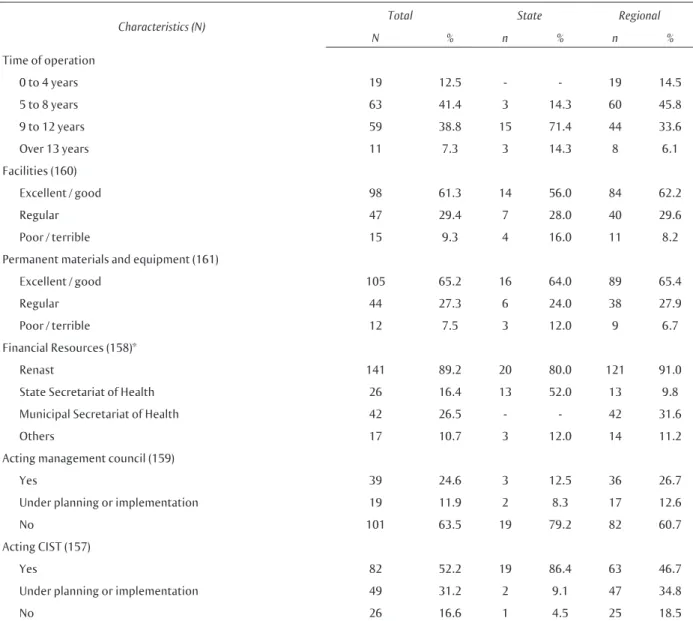
Among facilities features of state CERESTs, higher percentage of years of operation was from 9 to 12 years (71.4%); among regional CERESTs there was significant percentage from 5 to 8 years (45.8%) and 9 to 12 years of operation (33.6%) (Table 1). Structure was considered excellent or good for 56.0% of state centers and 62.2% of regional centers. Evaluation of permanent materials and equipment was considered excellent or good for almost 65.0% of the state and of regional centers (Table 1).
When questioned on financial resources used in service management, 80.0% of state centers and 91.0% of regional centers answered Renast’s National Health Fund, followed by 52.0% of state centers that answered they use resources from State Secretariat of Health and 31.6% of regional centers that used resources from Municipal Secretariat of Health (Table 1).
Concerning social control, 79.2% of state CERESTs reported that they had no active management council, but in 86.4% of the municipalities there was an active Intersectoral Occupational Health Committee (CIST). Among regional services, 60.7% had no active managing council and 46.7% reported they had a CIST in operation (Table 1).
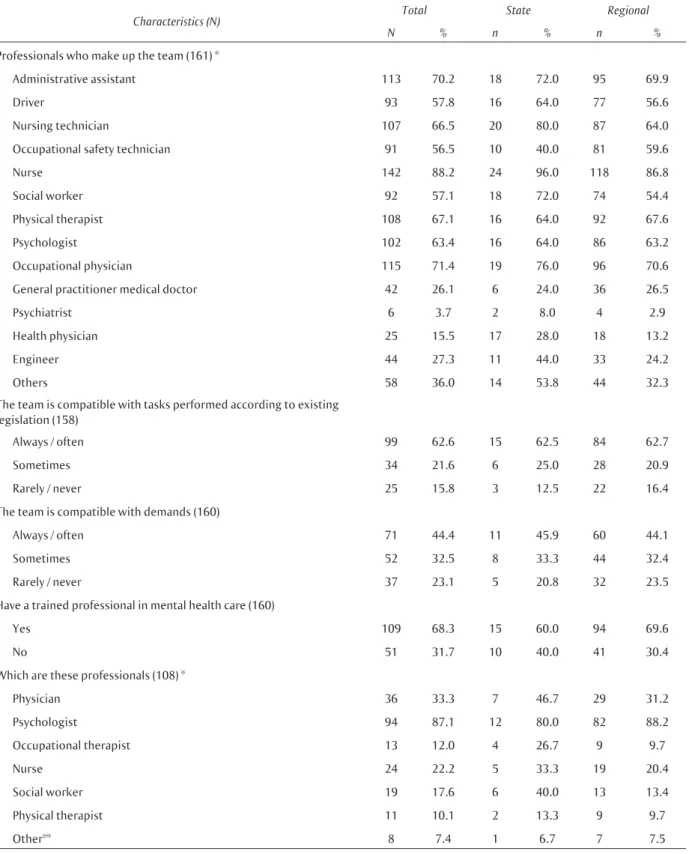
As for human resources, nurse category was the one with higher frequency among state level (96.0%) and regional level (86.8%) professionals, followed by occupational physicians (76.0% and 70.6% respectively). When respondents were asked about their evaluation of the compatibility of the professional team with tasks performed according to current legislation, 62% answered it was always or often compatible. However, in the evaluation of the team in relation to demands of the covered area, these proportions have dropped significantly in state (45.9%) and regional (44.1%) centers (Table 2).
More than a half of state (60.0%) and regional (69.6%) CERESTs informed they had trained mental health care professionals, most of them psychologists and physicians, either on state centers (80.0% and 46.7%) or regional centers (88.2% and 31.2%) (Table 2).
As for National Psychosocial Attention Network devices available in the area covered by the CEREST, almost all had CAPS installed (n=155, 97.5%); 76.1% (n=121) had alcohol and drugs CAPS and 55.6% (n=88) mental health clinics; 39.6% (n=63) psychiatric hospitals and 12.5% (n=20) other services (data not presented in table).
Initiatives developed
Concerning initiatives developed to aid workers, 8 state CERESTs (32.0%) reported having an ambulatory for assessment of aggravations in worker’s general health; 93 regional centers (68.4%) reported they conduct this activity (data not presented in table).
Table 1 Characterization of state and regional workers’ health reference centers structures. Brazil, 2014
Characteristics (N) Total State Regional
N % n % n %
Time of operation
0 to 4 years 19 12.5 - - 19 14.5
5 to 8 years 63 41.4 3 14.3 60 45.8
9 to 12 years 59 38.8 15 71.4 44 33.6
Over 13 years 11 7.3 3 14.3 8 6.1
Facilities (160)
Excellent / good 98 61.3 14 56.0 84 62.2
Regular 47 29.4 7 28.0 40 29.6
Poor / terrible 15 9.3 4 16.0 11 8.2
Permanent materials and equipment (161)
Excellent / good 105 65.2 16 64.0 89 65.4
Regular 44 27.3 6 24.0 38 27.9
Poor / terrible 12 7.5 3 12.0 9 6.7
Financial Resources (158)*
Renast 141 89.2 20 80.0 121 91.0
State Secretariat of Health 26 16.4 13 52.0 13 9.8
Municipal Secretariat of Health 42 26.5 - - 42 31.6
Others 17 10.7 3 12.0 14 11.2
Acting management council (159)
Yes 39 24.6 3 12.5 36 26.7
Under planning or implementation 19 11.9 2 8.3 17 12.6
No 101 63.5 19 79.2 82 60.7
Acting CIST (157)
Yes 82 52.2 19 86.4 63 46.7
Under planning or implementation 49 31.2 2 9.1 47 34.8
No 26 16.6 1 4.5 25 18.5
*For this question more than one answer was possible and multiple answers were registered. Therefore, percentages are over 100%.
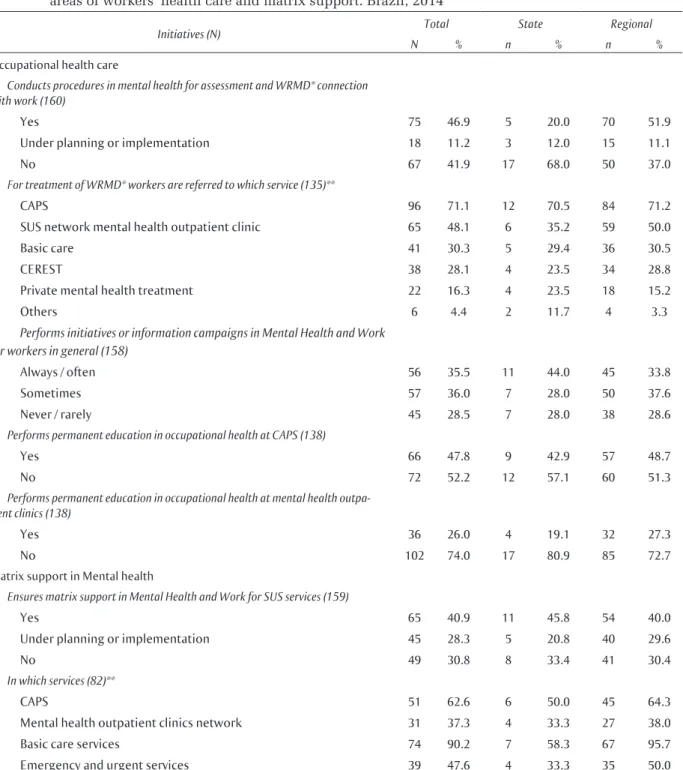
Workers with WRMD were sent by CERESTs to receive treatment in the following services: CAPS (70.5% of state and 71.2% of regional CERESTs), mental health outpatient clinic of SUS Network Care (35.2% of state and 50.0% of regional centers) and in basic care (approximately 30% of all CERESTs). The treatment of WRMD cases was performed by CEREST using its own services in 23.5% of state and 28.8% of the regional centers (Table 3).
Informative initiatives in mental health and work for workers in general were always or frequently performed at 44.0% of state centers; among regional centers, the highest response rate found was sometimes (37.6%), indicating that both
in state and regional centers these initiatives were not carried out often.
Permanent education in occupational health in the Network of Psychosocial Attention had the following rates among state and regional CERESTs: CAPS 42.9% and 48.7% respectively and in mental health outpatient clinics 19.1% and 27.3% (Table 3). 16.0% of state centers carried out or participated in mental health researches, a lower percentage than regional centers had (12.5%).
Table 2 Distribution of human resources of state and regional workers’ health reference centers. Brazil, 2014
Characteristics (N) Total State Regional
N % n % n %
Professionals who make up the team (161) *
Administrative assistant 113 70.2 18 72.0 95 69.9
Driver 93 57.8 16 64.0 77 56.6
Nursing technician 107 66.5 20 80.0 87 64.0
Occupational safety technician 91 56.5 10 40.0 81 59.6
Nurse 142 88.2 24 96.0 118 86.8
Social worker 92 57.1 18 72.0 74 54.4
Physical therapist 108 67.1 16 64.0 92 67.6
Psychologist 102 63.4 16 64.0 86 63.2
Occupational physician 115 71.4 19 76.0 96 70.6
General practitioner medical doctor 42 26.1 6 24.0 36 26.5
Psychiatrist 6 3.7 2 8.0 4 2.9
Health physician 25 15.5 17 28.0 18 13.2
Engineer 44 27.3 11 44.0 33 24.2
Others 58 36.0 14 53.8 44 32.3
The team is compatible with tasks performed according to existing legislation (158)
Always / often 99 62.6 15 62.5 84 62.7
Sometimes 34 21.6 6 25.0 28 20.9
Rarely / never 25 15.8 3 12.5 22 16.4
The team is compatible with demands (160)
Always / often 71 44.4 11 45.9 60 44.1
Sometimes 52 32.5 8 33.3 44 32.4
Rarely / never 37 23.1 5 20.8 32 23.5
Have a trained professional in mental health care (160)
Yes 109 68.3 15 60.0 94 69.6
No 51 31.7 10 40.0 41 30.4
Which are these professionals (108) *
Physician 36 33.3 7 46.7 29 31.2
Psychologist 94 87.1 12 80.0 82 88.2
Occupational therapist 13 12.0 4 26.7 9 9.7
Nurse 24 22.2 5 33.3 19 20.4
Social worker 19 17.6 6 40.0 13 13.4
Physical therapist 11 10.1 2 13.3 9 9.7
Other** 8 7.4 1 6.7 7 7.5
*For these questions more than one answer was possible and multiple answers were registered. Therefore, percentages are over 100%.
Table 3 Mental health initiatives carried out by state and regional workers’ health reference centers in the areas of workers’ health care and matrix support. Brazil, 2014
Initiatives (N) Total State Regional
N % n % n %
Occupational health care
Conducts procedures in mental health for assessment and WRMD* connection with work (160)
Yes 75 46.9 5 20.0 70 51.9
Under planning or implementation 18 11.2 3 12.0 15 11.1
No 67 41.9 17 68.0 50 37.0 For treatment of WRMD* workers are referred to which service (135)**
CAPS 96 71.1 12 70.5 84 71.2
SUS network mental health outpatient clinic 65 48.1 6 35.2 59 50.0
Basic care 41 30.3 5 29.4 36 30.5
CEREST 38 28.1 4 23.5 34 28.8
Private mental health treatment 22 16.3 4 23.5 18 15.2
Others 6 4.4 2 11.7 4 3.3
Performs initiatives or information campaigns in Mental Health and Work for workers in general (158)
Always / often 56 35.5 11 44.0 45 33.8
Sometimes 57 36.0 7 28.0 50 37.6
Never / rarely 45 28.5 7 28.0 38 28.6 Performs permanent education in occupational health at CAPS (138)
Yes 66 47.8 9 42.9 57 48.7
No 72 52.2 12 57.1 60 51.3 Performs permanent education in occupational health at mental health
outpa-tient clinics (138)
Yes 36 26.0 4 19.1 32 27.3
No 102 74.0 17 80.9 85 72.7 Matrix support in Mental health
Ensures matrix support in Mental Health and Work for SUS services (159)
Yes 65 40.9 11 45.8 54 40.0
Under planning or implementation 45 28.3 5 20.8 40 29.6
No 49 30.8 8 33.4 41 30.4 In which services (82)**
CAPS 51 62.6 6 50.0 45 64.3
Mental health outpatient clinics network 31 37.3 4 33.3 27 38.0
Basic care services 74 90.2 7 58.3 67 95.7
Emergency and urgent services 39 47.6 4 33.3 35 50.0
*WRMD = work-related mental disorders
**For these questions more than one item was possible and multiple answers were registered. Therefore, percentages are over 100%.
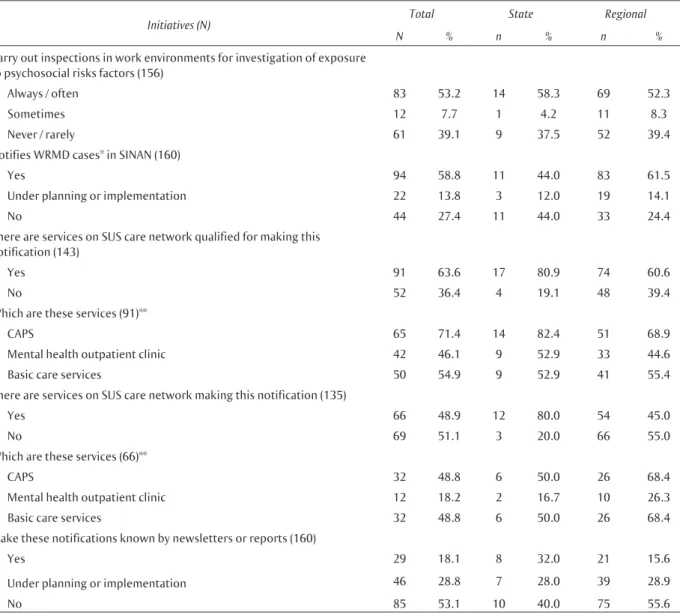
As for initiatives in Occupational Health Surveillance (VISAT), 17 state CERESTs (68.0%) reported they made inspections in work environments, whereas 110 regional centers reported positively (80.9%). Among VISAT initiatives in mental health, approximately half of the state CERESTs (58.3%) and regional centers (52.3%)
Table 4 Mental health initiatives carried out by state and regional workers’ health reference centers in the area of workers’ health surveillance. Brazil, 2014
Initiatives (N) Total State Regional
N % n % n %
Carry out inspections in work environments for investigation of exposure to psychosocial risks factors (156)
Always / often 83 53.2 14 58.3 69 52.3
Sometimes 12 7.7 1 4.2 11 8.3
Never / rarely 61 39.1 9 37.5 52 39.4
Notifies WRMD cases* in SINAN (160)
Yes 94 58.8 11 44.0 83 61.5
Under planning or implementation 22 13.8 3 12.0 19 14.1
No 44 27.4 11 44.0 33 24.4
There are services on SUS care network qualified for making this notification (143)
Yes 91 63.6 17 80.9 74 60.6
No 52 36.4 4 19.1 48 39.4
Which are these services (91)**
CAPS 65 71.4 14 82.4 51 68.9
Mental health outpatient clinic 42 46.1 9 52.9 33 44.6
Basic care services 50 54.9 9 52.9 41 55.4
There are services on SUS care network making this notification (135)
Yes 66 48.9 12 80.0 54 45.0
No 69 51.1 3 20.0 66 55.0
Which are these services (66)**
CAPS 32 48.8 6 50.0 26 68.4
Mental health outpatient clinic 12 18.2 2 16.7 10 26.3
Basic care services 32 48.8 6 50.0 26 68.4
Make these notifications known by newsletters or reports (160)
Yes 29 18.1 8 32.0 21 15.6
Under planning or implementation 46 28.8 7 28.0 39 28.9
No 85 53.1 10 40.0 75 55.6
*WRMD = work-related mental disorders
**For these questions more than one item was possible and multiple answers were registered. Therefore, percentages are over 100%.
WRMD cases notification in SINAN were made in 44.0% of state services and 61.5% of regional services. Most of state CERESTs (80.9%) and regional CERESTs (60.6%) reported that there were services on the Network of Health Care capable of notifying WRMD cases, mainly CAPS, with percentage of 82.4% of state and 68.9% regional centers (Table 4).
Based on the information obtained, we made calculations to ascertain the percentage of services that had been trained to notify WRMD cases and those that actually registered the cases: 70.6% (12/17) of state qualified centers and 72.9% (54/74) of regional qualified centers. CAPS and basic care services stood out among notifying services with similar percentages, 50.0% of state services and
68.4% of regional services. Making public these notifications through newsletters or reports recorded low percentages: 32.0% of state services and 15.6% of regional services (Table 4).
Discussion
(more than a third of regional centers and nearly half of state centers) reported inadequate conditions; this is a contradiction that still deserves attention from management offices.
Most teams were compatible with legal demands, but there was no compatibility with demand of the area covered by the CEREST. Comparing these data with those obtained in surveys conducted in CERESTs by Renast in the 2008-200924 and 2010-20116 periods, we observed similar results in facility conditions, equipment, materials and human resources. However, the percentage of good or excellent team adequacy, considering the area demands is decreasing 5 to 15% over the years. We observed then that CERESTs had throughout this period managed to maintain good facilities and human resources, but has increasingly been unable to meet occupational health demands. Regional CEREST teams inadequacy to demands may be explained by the fact that some of these services have been carrying out initiatives only in municipalities where they are located20; and thus demands of workers from other municipalities within their range of action are not met. This is a crucial dilemma to be tackled in all regional centers initiatives: how to make sure that initiatives are, in fact, regional, based on a model whose service management is bound just to the administration of the municipality where it is located? This is an issue that deserves wide and deep reflection in search of more promising and efficient models to manage these services in a wide geographical area.
Occupational health funding is a responsibility of three spheres of government10,27, but it is understood from this study that only Renast National Health Fund has been destined to CERESTs, often the sole financial resource, for only half of these state centers count with state budget and a quarter of regional centers with municipal budget. We noticed that Renast resources have made possible for CERESTs to keep good structures and human resources to maintain their activities, but not to meet demands of the area they cover. The fact that state and municipal budget is not destined to reference services in occupational health, as stated above, may explain why regional centers only carry out initiatives in their own municipality20. Without municipal financial aid, travel expenses become a drawback. It is important to highlight the relevance of financial issues as hindrance to initiatives, restricting them considerably, for although CERESTs have regional coverage, they are managed by a municipality.
Community participation is one of SUS principles, established in 1988 Federal Constitution28 and highlighted on PNSTT10, guaranteeing workers’ participation in the formulation, planning, and
evaluation of public policies. This participation is assured by social control devices. Data obtained showed that this participation has decreased over the past six years, mostly in management councils in regional centers, whose proportion has decreased by half when compared to data from Renast’s 1st inventory for the year of 200812,29.
The first social movements in favor of occupational health began in the early 1970s, with the participation of workers’ social movements – driven by the strengthening of trade union movements – and it was pivotal in formulating and defending proposals in national health policies4-5. This picture, however, contrasts with present moment at which we observe a backflow in social participation, mostly because trade union movements are weakened and fragmented, setting a stage of low social participation in decision-making processes, as noticed also in other studies4. It is thus necessary to establish strategies to encourage a more active participation of these agents, so that public policies development may be more efficient and based on collective interests.
CERESTs had in general adequate structures and qualified mental health care staff, which did not guarantee the development of initiatives in this area for most of them and these initiatives, when developed, were developed unequally in the country, as mentioned before30. So in Brazil there is no uniformity of work-related mental health practices.
We observed that, according to data obtained, support initiatives have been more often developed in regional units than in state units – as would be expected because state CERESTs function as a technical backup for the entire state7.
Establishing relations of injury with work is the main goal of outpatient occupational health centers, but it turns out that the establishment of such a relation with mental disorders is still a challenge. However, this issue has been discussed in a few research and scientific papers only recently and there are still no mechanisms and technical documents commonly accepted or widely spread and recognized that could guide professionals31. These difficulties are mostly due to complex relationships between mental disorders and work, besides the fact of work-related mental health be permeated by two programmatic areas, mental health and occupational health, which for decades have been acting in isolation13.
work is still not commonly recognized as illness determining factor. For example, in mental health still prevail conceptions of psychic suffering as a result only of intrapsychic conflicts, developed during childhood, experienced in sexuality or in the family, at the expense of a broader view that takes into account other spheres of individuals lives and of collectivity, as the work environment13,32. So, initiatives involving mental health and work have not been carried out in an integrated manner or cooperatively by these two areas (Mental Health and Occupational Health), demonstrating lack of support for workers’ mental health13,14.
According to PNSTT10, outpatient ambulatory service specialized in mental health must suspect or identify the relation with work, articulated with CEREST team whenever necessary, besides being responsible for assessment, treatment and rehabilitation, already part of its functions. In accordance with the existing public policies, this study showed that, with regard to treatment of cases identified, these were often refered to the Network of Psychosocial Attention, especially to CAPS, mental health and primary health care outpatient clinics. But it was also significant the number of CERESTs which worked under the support logic, as a gateway to workers, with a clinic for care and treatment of harms to workers’ health, as noted also in other studies30,33,34. The fact that mental health professionals are often trained and prepared to act individually13 may contribute to this, for usually they are not prepared to develop collective initiatives in which work is an important factor for building subjectivity.
Another important factor that may contribute to CEREST professionals develop support initiatives, despite the existing regulations, is the small number of mental health outpatient clinics throughout the country. Not having a service to report identified cases contribute to this responsibility be assumed by CEREST. These outpatient services are reference above all in cases of minor mental disorders, considered less serious35, which are often WRMD cases. Today there are more than two thousand CAPS in Brazil36, covering almost all municipalities participating in this research. On the other hand, the existence of mental health outpatient clinics were missing in half of the sites studied. It is important to notice that outpatient mental health clinics, although regulated by ordinance SAS/MS No. 224, from 199237, they are not cited in ordinance No. 3.088, from 2011, which established the Network of Psychosocial Attention26. So, when available, these devices have worked in isolation, without coordination with the health care network, undermining thus guarantee of integral care to users35.
Permanent education initiatives and matrix support in other SUS services are of the utmost importance, since worker’s health demands intersectoral actions that should be incorporated by all Health Care Network services, as described in PNSTT10, which states that only increasing capacity of identifying the relationship between work and health/disease process may thus ensure workers integral care.
Despite this and other SUS policies highlight matrix support as a very important tool in the construction and deployment of the Health Network, it was observed that few CERESTs carried out matrix support initiatives, understood as intersectoral actions carried out by a multi-professional team from reference centers alongside teams from SUS, aiming at expanding clinical practice, promoting and surveilling occupational health10. It is important to emphasize that among centers that were providing matrix support, almost all did it along Family Health Strategy units, gateway to SUS users and Health Care Network organizer. Initiatives thus developed at this level are priorities to occupational health policies10.
Whereas assessment, treatment and establishing relations between sickness and work are important to guarantee occupational health promotion, VISAT initiatives are essential to prevent new cases of illness in work environment. As preconized by public policies, VISAT is a priority for occupational health services10 and should occupy a central position in intervention on social determinants in occupational health, given that individual support initiatives have little impact collectively in promoting prevention of diseases.
We observed that inspection and investigation of psychosocial risks are still insufficient among CERESTs, if we consider that only half of the centers carried them out. This can be explained by almost inexistence of technical documents, technologies and research in this area that includes mental health in occupational health surveillance, only found quite recently one study published in the area23. It is important to highlight one more time restraints in mental health professional training, for whom work has systematically been denied as a locus of subjectivity building and, therefore, of mental illness13.
of work environments and for promotion and prevention of new cases of occupational illness.
Injuries notification in health information systems is a very important tool to foster knowledge gathering on morbimortality and planing promotion and prevention initiatives. Notification of threats to workers’ health, mainly occupational accidents, is already more embedded in health professional practices, but WRMD notification has been a challenge for SUS21. We point out that this initiative was the one that CEREST professionals informed to carry out the most, but that still remains incipient.
In a recent study21 on WRMD notifications, registered cases on SINAN and INSS were compared, highlighting that in the period from 2006 to 2012, INSS registered 38 WRMD cases to one case registered by SINAN, despite INSS be a system exclusive for formal workers, whereas SINAN has universal coverage and must notify cases of formal and informal workers. Although INSS attends only half of the country’s working population, WRMD record is exponentially higher than in SINAN.
The study also revealed that notifications in SINAN have been recorded almost exclusively by CERESTs, accounting for 71.0% of the cases registered in that period; basic care services and CAPS had no meaningful participation in registered notifications (8.4% and 6.2% respectively). Despite this, Oliveira21 points out that, during the six years analyzed (from 2006 to 2012), notifications in SINAN have increased gradually.
Altogether, these data seem to indicate that: (a) there are still many improvements to be achieved in this field, even considering the current services network – as only 58.8% of the services systematically registered WRMD cases in SINAN, there is a significant margin of possible expansion of these initiatives, incorporating this activity in all existing services, what would increase cases identification, approximating data available to reality; (b) even with the limitations highlighted, there has been a continuous process, albeit slow and located, of systematic registry of TRMT in SINAN by basic care services and CAPS21.
Disclosure of notifications is inexpressive at all CERESTs, even if we consider monitoring
and assessment of worker’s health indicators as essential instruments in the evaluation of the epidemiological profile of workers’ illness, to guide action planning effective and rationally10. Little emphasis on diagnosis and knowledge based on empirical evidences are also verified by little incentive and support given to studies and researches. Knowledge production is a good strategy for determining initiatives and priorities capable of meeting adequate and satisfactorily real existing demands. It is also a very useful tool to support creation of standards, mechanisms and tools to resolve problems that Renast tackles. Thus, the use of existing, easy to access data and its incorporation in initiatives planning process and in diagnosing concrete health-related situations are mechanisms that may contribute effectively to the development of initiatives in occupational health and should be strengthened and encouraged.
There is a pressing need of new studies and researches that aim at developing tools and guidance protocols to health professionals acting in this complex area of work-related mental health, mostly in health surveillance, focusing on health promotion and reduction/extinction of harms to workers. Moreover, public policies and strategies should be created to promote initiatives towards integral care of workers having work-related mental disorders and to prevent such disorders.
Conclusions
We conclude that work-related mental health initiatives carried out by CERESTs are still incipient, both in assistance and in health education and health surveillance. We identified from data gathered and from previous studies that mental health has not been a priority for SUS in the occupational health area. We point out thus initiatives importance when carried out by workers’ health reference centers, as well as intersectoral actions involving these centers and the Network of Psychosocial Attention, for only with such initiatives it will be possible to advance and provide integral care to workers with work-related mental disorders.
Authors’ contribution
References
1. Costa D, Lacaz FAC, Jackson Filho JM, Vilela RAG. Saúde do Trabalhador no SUS: desafios para uma política pública. Rev bras saúde ocup. 2013;38(128):11-30.
2. Ministério da Previdência Social (Brasil).
Previdência em questão. Cai número de acidentes de trabalho e aumenta afastamentos por
transtornos mentais. Informativo Eletrônico do Ministério da Previdência Social. 2012;59.
3. Silva Junior JS, Fischer FM. Adoecimento mental incapacitante: benefícios previdenciários no Brasil entre 2008-2011.Rev Saúde Pública. 2014;48(1):186-90.
4. Minayo-Gomez C. Campo da saúde do trabalhador: trajetória, configurações e transformações. In: Minayo-Gomes C, Machado JMH, Pena PGL. Saúde do trabalhador na sociedade brasileira contemporânea. Rio de Janeiro: Fiocruz; 2011. p. 23-34.
5. Nobre L. A política de Saúde do Trabalhador no Brasil e na Bahia. In: Nobre L, Pena P, Baptista R, organizadores. A Saúde do Trabalhador na Bahia: história, conquista e desafios. Salvador: Edufba; 2011. p. 25-94.
6. Ministério da Saúde (Brasil). Fundação Oswaldo Cruz. Universidade Federal da Bahia.2ºInventário de saúde do trabalhador, 2009:avaliação da rede nacional de atenção integral em saúde do trabalhador, 2008-2009. Brasília: Ministério da Saúde; 2013.
7. Ministério da Saúde (Brasil). Portaria nº 1.679, de 19 de setembro de 2002. Dispõe sobre a estruturação da Rede Nacional de Atenção Integral à Saúde do Trabalhador no SUS e dá outras providências. Diário Oficial [da] República Federativa do Brasil, Brasília; 2002.
8. Ministério da Saúde (Brasil). Portaria nº 2.437, de 7 de dezembro de 2005. Dispõe sobre a ampliação e o fortalecimento da Rede Nacional de Atenção Integral à Saúde do Trabalhador (Renast) no Sistema Único de Saúde (SUS) e dá outras providências. Diário Oficial [da] República Federativa do Brasil, Brasília; 2005.
9. Ministério da Saúde (Brasil). Portaria nº 2.728, de 11 de novembro de 2009. Dispõe sobre a Rede Nacional de Atenção Integral à Saúde do Trabalhador (Renast) e dá outras providências. Diário Oficial [da] República Federativa do Brasil, Brasília; 2009.
10. Ministério da Saúde (Brasil). Portaria nº 1.823, de 23 de agosto de 2012.Institui a Política Nacional de Saúde do Trabalhador e Trabalhadora. Diário Oficial [da] República Federativa do Brasil, Brasília; 2012.
11. Instituto Brasileiro de Geografia e Estatística. Censo demográfico 2010 [Internet]. IBGE 2010 [citado em 20 maio 2014]. Disponível em: http:// www.ibge.gov.br/home/estatistica/populacao/ censo2010/default.shtm
12. Machado JMH, Santana VS, Campos A, Ferrite S, Peres MC, Galdino A, et al. Situação da Rede Nacional de Atenção Integral em Saúde do Trabalhador (Renast) no Brasil, 2008-2009.Rev. bras. saúde ocup. 2013;38(128):243-56.
13. Bernardo MH, Garbin AC. A atenção à saúde mental relacionada ao trabalho no SUS: desafios e possibilidades.Rev bras saúde ocup. 2011;(36)123:103-17.
14. Merhy-Silva FN. Contribuições para a construção de uma clínica ampliada e do apoio matricial na expansão da Rede Nacional de Atenção Integral à Saúde do Trabalhador no Sistema Único de Saúde (Renast-SUS) (2001-2011).Cad Saúde Colet. 2013;21(3):346-7.
15. Amazarray MR, Câmara SG, Carlotto MS.
Investigação em saúde mental e trabalho no âmbito da Saúde Pública no Brasil. In: Merlo ARC, Bottega CG, Perez VK, organizadores. Atenção à Saúde Mental do Trabalhador: sofrimento e transtorno psíquicos relacionados ao trabalho. Porto Alegre: Evangraf; 2014. p. 75-92.
16. Glina DMR, Rocha LE, Batista MA, Mendonça MGV. Saúde mental e trabalho: uma reflexão sobre o nexo com o trabalho e o diagnóstico, com base na prática.Cad. Saúde Pública. 2001;17(3):607-16.
17. Sato L, Bernardo MH. Saúde mental e trabalho: os problemas que persistem.Ciênc. saúde coletiva. 2005;10(4):869-78.
18. Sato L, Lacaz FAC, Bernardo MH. Psicologia e saúde do trabalhador: práticas e investigações na Saúde Pública de São Paulo.Estud. psicol. (Natal). 2006;11(3):281-8.
19. Merlo ARC. O trabalho e a saúde mental no Brasil: caminhos para novos conhecimentos e novos instrumentos de intervenção. In: Minayo-Gomez C, Machado JMH, Pena PGL. Saúde do trabalhador na sociedade brasileira contemporânea. Rio de Janeiro: Fiocruz; 2011. p. 369-84.
20. Santos APL, Lacaz FAC. Saúde do trabalhador no SUS: contexto, estratégias e desafios. In: Minayo-Gomez C, Machado JMH, Pena PGL. Saúde do trabalhador na sociedade brasileira contemporânea. Rio de Janeiro: Fiocruz; 2011. p. 87-106.
22. Merlo ARC, Bottego CG, Perez KV. Atenção à saúde mental do trabalhador: sofrimento e transtornos psíquicos relacionados ao trabalho. Porto Alegre: Evangraf; 2014.
23. Leão LHC, Minayo-Gomez C. A questão da saúde mental na vigilância em saúde do trabalhador.Ciênc. saúde coletiva. 2014;19(12):4649-58.
24. Ministério da Saúde (Brasil). Fundação Oswaldo Cruz. Universidade Federal da Bahia.1ºInventário de saúde do trabalhador, 2009: avaliação da rede nacional de atenção integral em saúde do trabalhador, 2008-2009. Brasília: Ministério da Saúde; 2011.
25. Ministério da Saúde (Brasil). Rede Nacional de Atenção Integral à Saúde do Trabalhador (Renast): manual de gestão e gerenciamento. Brasília: Ministério da Saúde; 2006.
26. Ministério da Saúde (Brasil). Portaria nº 3.088, de 23 de dezembro de 2011. Institui a Rede de Atenção Psicossocial para pessoas com sofrimento ou transtorno mental e com necessidades
decorrentes do uso de crack, álcool e outras drogas, no âmbito do Sistema Único de Saúde (SUS). Diário Oficial [da] República Federativa do Brasil, Brasília; 2011.
27. Ministério da Saúde (Brasil). Portaria nº 8.080, de 19 de setembro de 1990. Dispõe sobre as condições para a promoção, proteção e recuperação da saúde, a organização e o funcionamento dos serviços correspondentes e dá outras providências. Diário Oficial [da] República Federativa do Brasil, Brasília; 20 set 1990, Seção 1, p. 18055.
28. Brasil, Constituição da República Federativa do Brasil. Texto promulgado em 5 de outubro de 1988. Diário Oficial [da] República Federativa do Brasil, Brasília; 1988.
29. Galdino A, Santana VS, Ferrite S. Os Centros de Referência em Saúde do Trabalhador e a notificação de acidentes de trabalho no Brasil.Cad Saúde Pública. 2012;28(1):145-59.
30. Bittencourt LC, Belome MC, Merlo ARC. Centros de referência em Saúde do Trabalhador, Sistema Único de Saúde e a saúde mental. In: Merlo ARC, Bottega CG, Perez VK, organizadores. Atenção à Saúde Mental do Trabalhador:sofrimento e transtorno psíquicos relacionados ao trabalho. Porto Alegre: Evangraf; 2014. p. 228-243.
31. Lourenco EAS, Lacaz FAC. Os desafios para a implantação da política de Saúde do Trabalhador no SUS: o caso da região de Franca-SP.Rev bras saúde ocup. 2013;38(127):44-56.
32. Araújo TM. O olhar do sujeito sobre o trabalho que executa: sua percepção sobre os riscos e as tarefas: um estudo com trabalhadores em telecomunicações. In: Sampaio JR, organizador. Qualidade de vida no trabalho e Psicologia Social. 2ª ed. São Paulo: Casa do Psicólogo; 2004. p. 367-398.
33. Leão LHC, Vasconcellos LCF. Rede Nacional de Atenção Integral à Saúde do Trabalhador (Renast): reflexões sobre a estrutura de rede. Epidemiol Serv Saúde. 2011;20(1):85-100.
34. Leão LHC, Castro AC. Políticas públicas de saúde do trabalhador: análise da implantação de dispositivos de institucionalização em uma cidade brasileira.Ciênc saúde coletiva. 2013;18(3):769-78.
35. Ministério da Saúde (Brasil). Secretaria de Atenção à Saúde. Relatório de Gestão, 2003-2006: saúde mental no SUS: acesso ao tratamento e mudança do modelo de atenção. Brasília; 2007.
36. Ministério da Saúde (Brasil). Departamento de Informática do SUS-DATASUS. Dados em Saúde Mental. Número de CAPS por tipo de UF [relatório na internet]. Ministério da Saúde 2014 [citado em 5 abr 2014]. Disponível em: http://tabnet.datasus. gov.br/cgi/deftohtm.exe?cnes/cnv/estabbr.def.