Rev Bras Saude Ocup 2016;41:e10 1/25
Hearing loss associated with organic solvent
exposure: a systematic review
Perda auditiva associada à exposição ocupacional a solventes
orgânicos: uma revisão sistemática
Review Revista Brasileira de Saúde Ocupacional
ISSN: 2317-6369 (online)
http://dx.doi.org/10.1590/2317-6369000113615
RB
SO
Received: 31/03/2015 Revised: 23/09/2015
Approved: 28/09/2015
Abstract
Introduction: evidences indicate chemicals as potentially otoneurotoxic agents; however, there is no consensus as to the associations between exposure characteristics and the ototoxicity of different chemicals present in industrial environments. Objective: to review the available scientific literature in order to identify studies that point to evidence of association, or non-association, between hearing impairment and occupational exposure to organic solvents. Method: systematic review of the literature, through query on electronic databases, considering only original articles, published from January 1987 to February 2013. Results: thirty-one studies were included in the systematic review. Discussion: studies have confirmed exposure to certain solvents as a risk factor for occupational hearing loss, especially in the presence of noise. Various assessment and classification methods were used regarding cochlear and/or central hearing impairment, contributing to the understanding of the extent of chemical-induced hearing loss as well as to the identification of populations at risk. However, data on appropriate diagnostic procedures, safe levels of chemical exposure and dose-response effect have not yet been fully elucidated.
Keywords: hearing loss; organic solvents; occupational exposure; systematic
review. 1
Paper based on the master’s thesis of Lucienne Rezende Mont’Alverne titled “Perda auditiva associada à exposição ocupacional a solventes orgânicos: uma revisão sistemática”, presented as part of the Programa de Pós-Graduação em Saúde, Ambiente e Trabalho da Faculdade de Medicina of Universidade Federal da Bahia (UFBA) in 2014.
The authors declare no conflict of interest and that this work was not funded nor presented at any scientific gathering.
Lucienne Rezende Mont’Alverne a,b
Ana Paula Corona c
Marco Antônio Vasconcelos Rêgo d
a Universidade Federal da Bahia,
Programa de Mestrado em Saúde, Ambiente e Trabalho. Salvador, BA, Brasil.
b Secretaria de Saúde do Estado da Bahia,
Centro de Prevenção e Reabilitação da Pessoa com Deficiência. Salvador, BA, Brasil.
c Universidade Federal da Bahia, Instituto
de Ciências da Saúde, Departamento de Fonoaudiologia. Salvador, BA, Brasil. d Universidade Federal da Bahia,
Faculdade de Medicina, Departamento de Medicina Preventiva e Social. Salvador, BA, Brasil.
Contato:
Lucienne Rezende Mont’Alverne
E-mail:
Rev Bras Saude Ocup 2016;41:e10 2/25
Introduction
Despite its widespread occurrence within various production processes, noise is not the only determinant of work-related hearing loss. Currently, evidence shows different potentially otoneurotoxic occupational exposures, comprising the exposure to chemical agents, whether alone or in combination with noise1,2. Chemicals are considered exogenous
ototoxic substances capable of inducing ototoxic hypoacusis3 in workers of different occupational
sectors.
The lack of accurate data on the toxicity of chemicals routinely used or recently spread by the manufacturing industry, in their many possible combinations, as well as the unawareness of their effects on hearing, especially those resulting from exposure to low doses, is a challenge for professionals committed to the prevention of Occupational Hearing Loss (OHL)1,4.
Due to the general neurotoxicity of certain chemicals, the auditory system might be affected beyond the cochlear structures. However, the ototoxic action of some products shares certain features found in noise2,5. These common characteristics of agents
delay the differential diagnosis and recognition of industrial chemicals as potentially hazardous to hearing.
OHL resulting from co-exposure to ototoxic agents is still often assigned exclusively to noise2,6,7. None
of the tolerance limits prescribed in international regulations on solvents considers the ear to be a target organ8.
OHL may be aggravated by exposure to chemical solvents in environments with the presence of noise, both of them being above or even within legally allowed levels9-14. By means of an interaction
mechanism, the combined action of the agents may aggravate their isolated adverse effects on hearing2,15,16. Impairment caused by agents acting
together may exceed the simple sum of impairment produced by each agent separately2,5. Data on the
magnitude and characteristics of auditory effects due to chronic exposure to chemicals, as well as possible interactions, concentration levels, quantity and length of exposure without any known damage to hearing, although widely discussed, are as yet insufficient or divergent1,10,17-19.
Noting the lack of definition of such information, the following question was proposed: might hearing impairment observed in workers be associated with exposure to organic solvents in the workplace?
Therefore, this study aimed to review the available scientific literature to identify studies pointing to
evidence of association or non-association between hearing loss and exposure to organic solvents, including their different configurations and features.
Methods
The research databases consulted in this review were: MEDLINE, Scopus, Web of Science, Science Direct, CINAHL, LILACS and SciELO.
Starting out from the proposed question, the search strategy for the bibliography research was based on a combination of descriptors and qualifiers indexed in Medical Subject Headings (MeSH) and in health Descriptors (DeCS), besides some free terms. Using Boolean operators and truncation techniques (both adapted to the rules established in each database), the keywords were combined, in English, in three levels of inclusion strategy: target population, investigated clinical outcome and risk factor (exposure). The search strategy was performed by entering the terms accordingly to the order of established levels in the databases or, in some cases, simultaneously, according to the setting of the consulted database: “worker” OR “employee” OR “occupational exposure” AND “hearing loss” OR “hearing impairment “OR” hearing disorder “OR” hypoacusis “OR” dysacusis “OR” central auditory dysfunction “AND” solvent “OR” organic solvents “OR” chemical-induced “OR” solvent exposure “OR” chemical compound exposure.”
The study included original articles of epidemiological research, with statistical measures of association between exposure and outcome of interest, published in Portuguese, English and Spanish between January 1987 and February 2013. The last manual search carried out in electronic databases occurred in February 2013.
To meet the exclusion criteria established in research protocol, the study did not include any literature review articles or case reports, letters and editorials, nor duplicated articles (investigating the same population and data) or those describing diagnostic procedures, self-reported hearing complaints or other types of health assessment besides auditory function.
Rev Bras Saude Ocup 2016;41:e10 3/25
Results
A total of 838 titles was identified in all databases. During the first stage (reading of titles) and the second stage (reading of abstracts), 729 documents were excluded for the following reasons: incompatibility with the scope of the study (430); research with guinea pigs (84); documents (letters and editorials) that were not articles (111); type of study (56 literature reviews and 18 case reports); and language (30).
Of the 109 documents initially selected, 27 were found in two or more databases. After analyzing the repetition of articles among the databases, 51 titles were considered relevant for the study; among these, one was not retrieved due to insufficient information contained in the database. Thus, 50 articles were selected for full reading.
After the texts were read, and still following the inclusion and exclusion criteria, 19 articles were excluded: one due to duplication of study population; three for using non-valid hearing evaluation methods; and 15 for not featuring statistical analyses consistent with the eligibility criteria for this study.
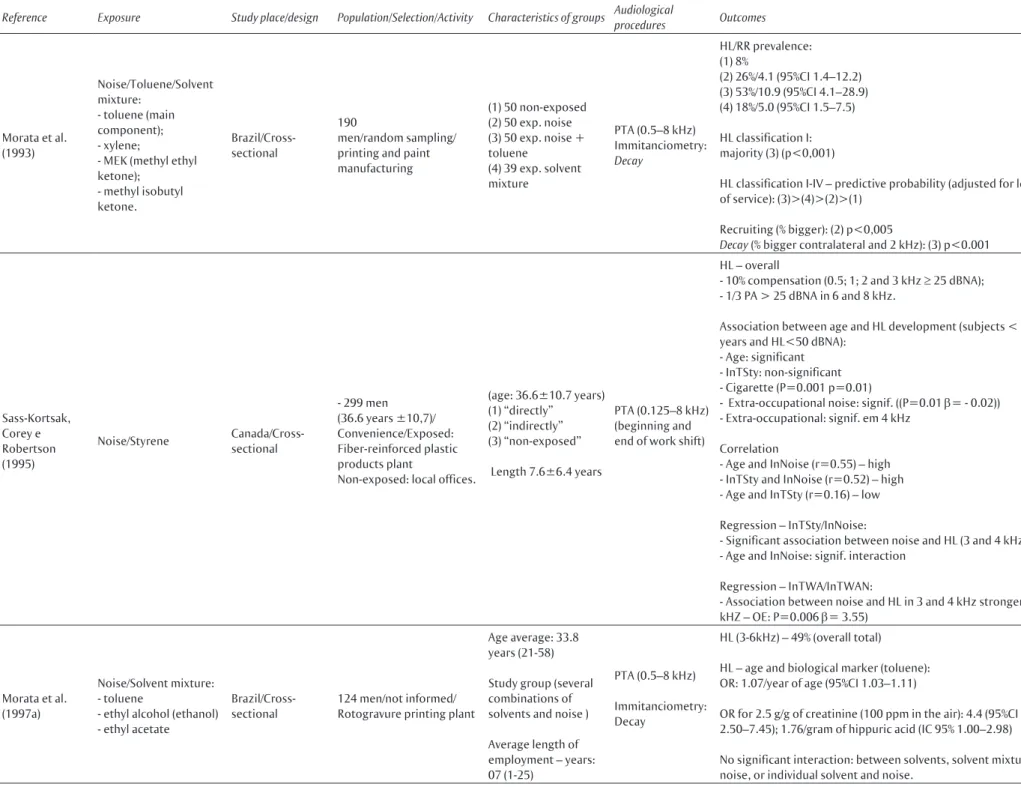
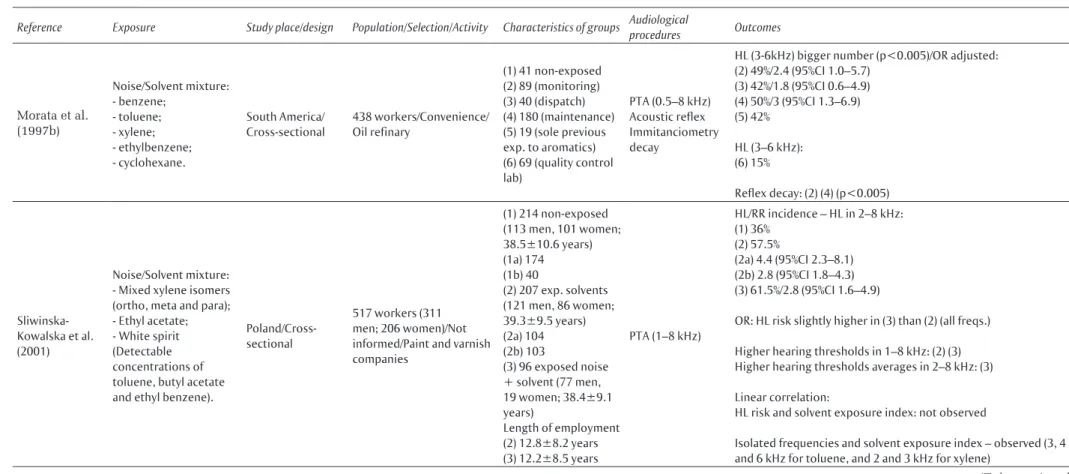
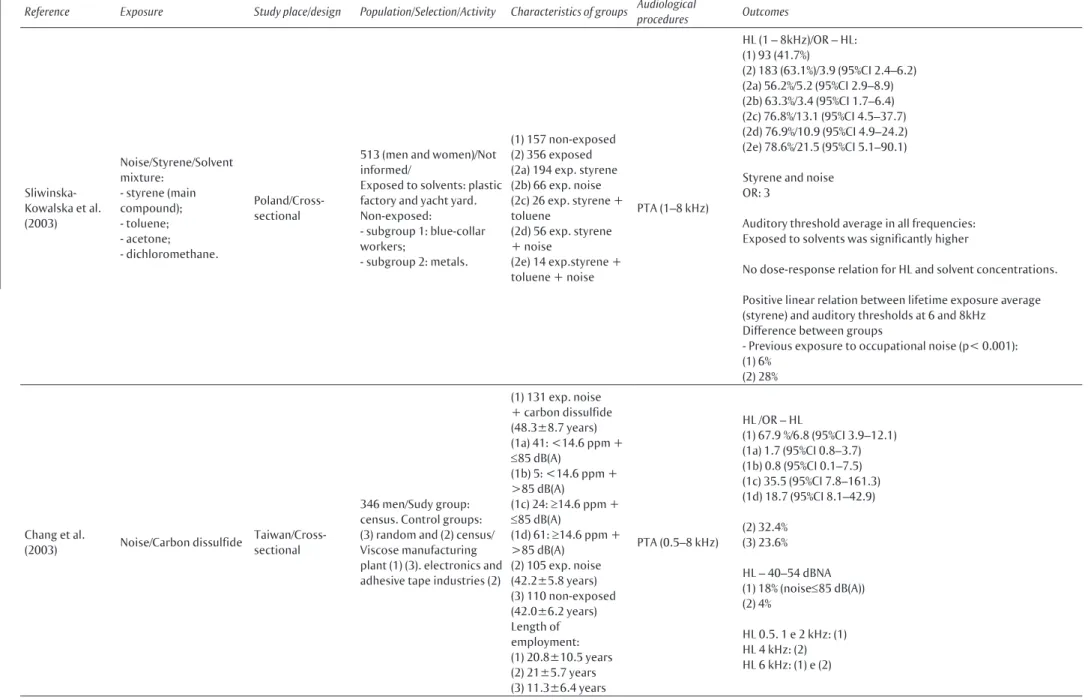
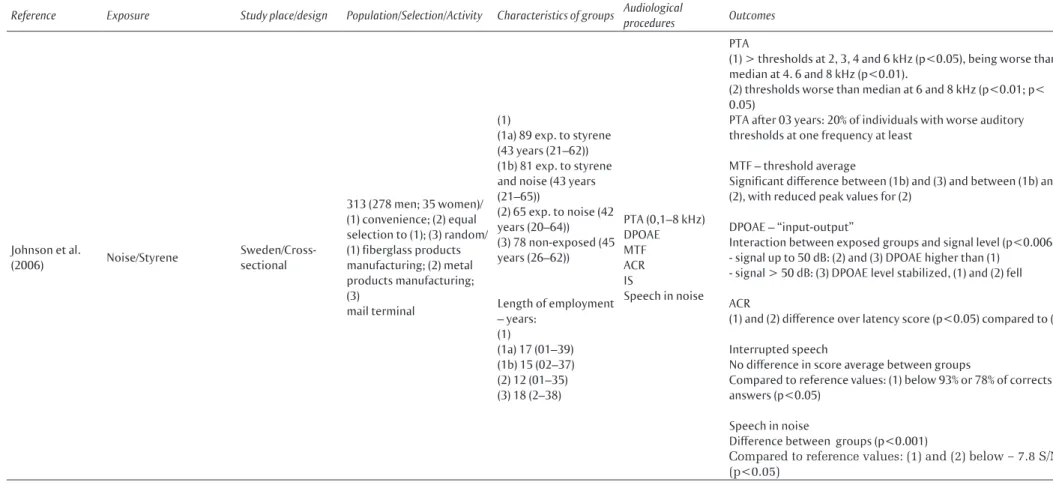
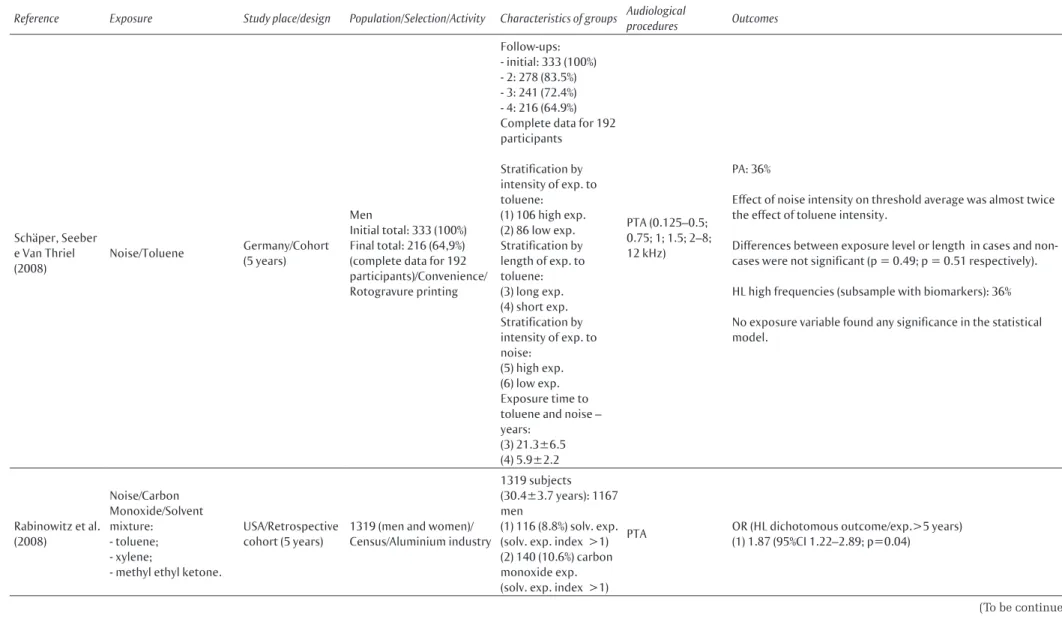
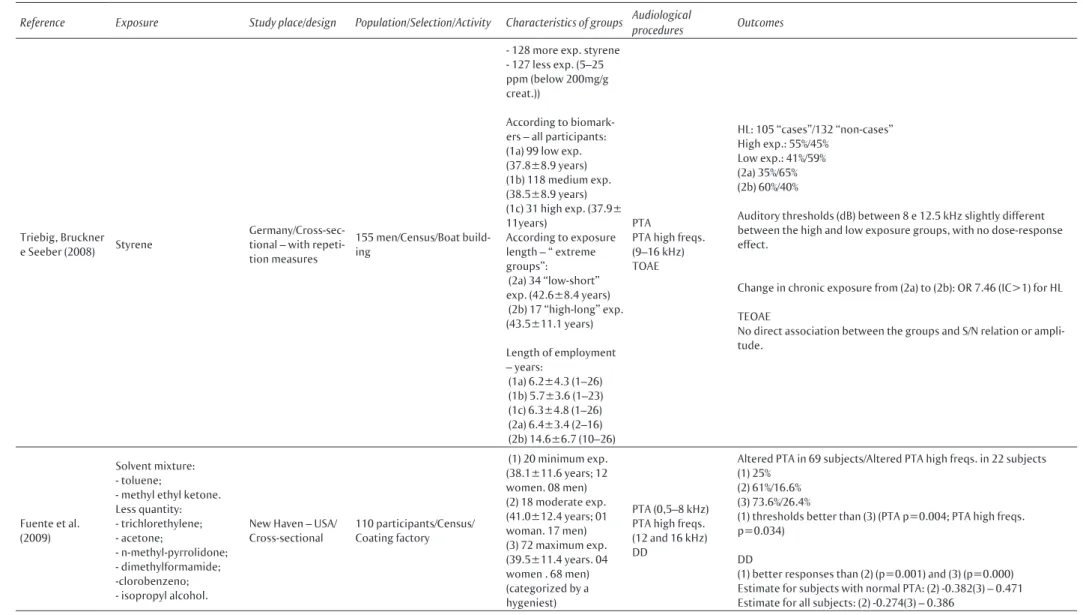
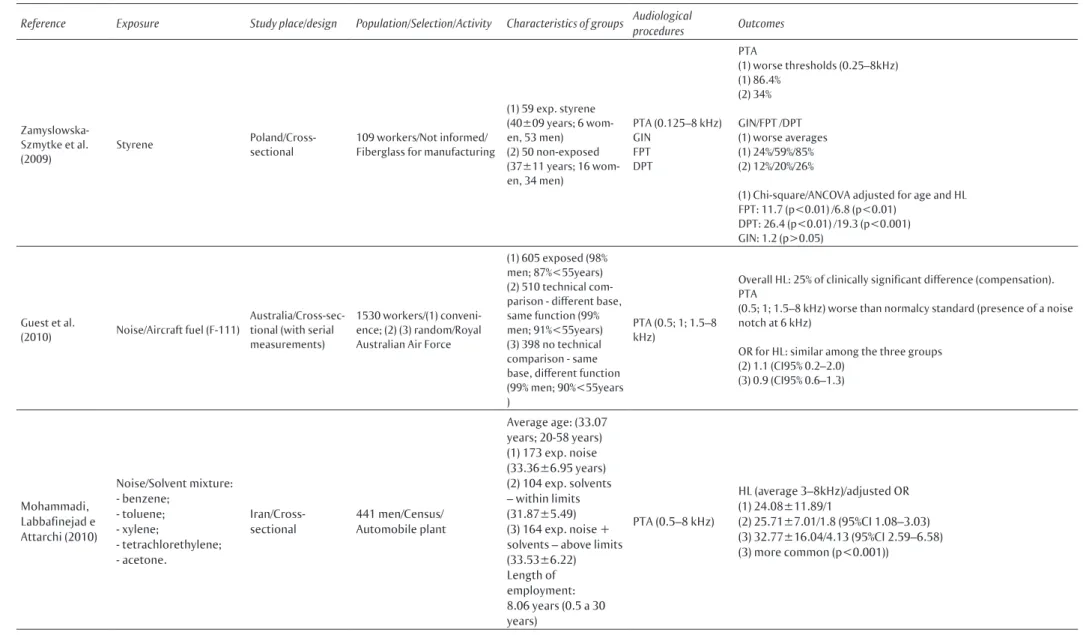
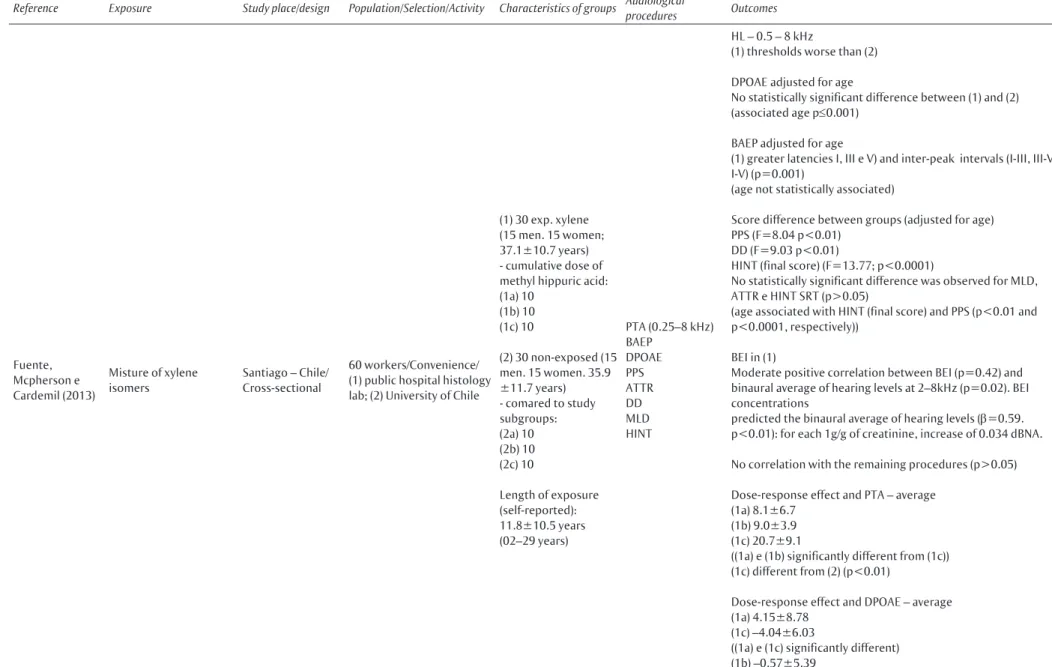
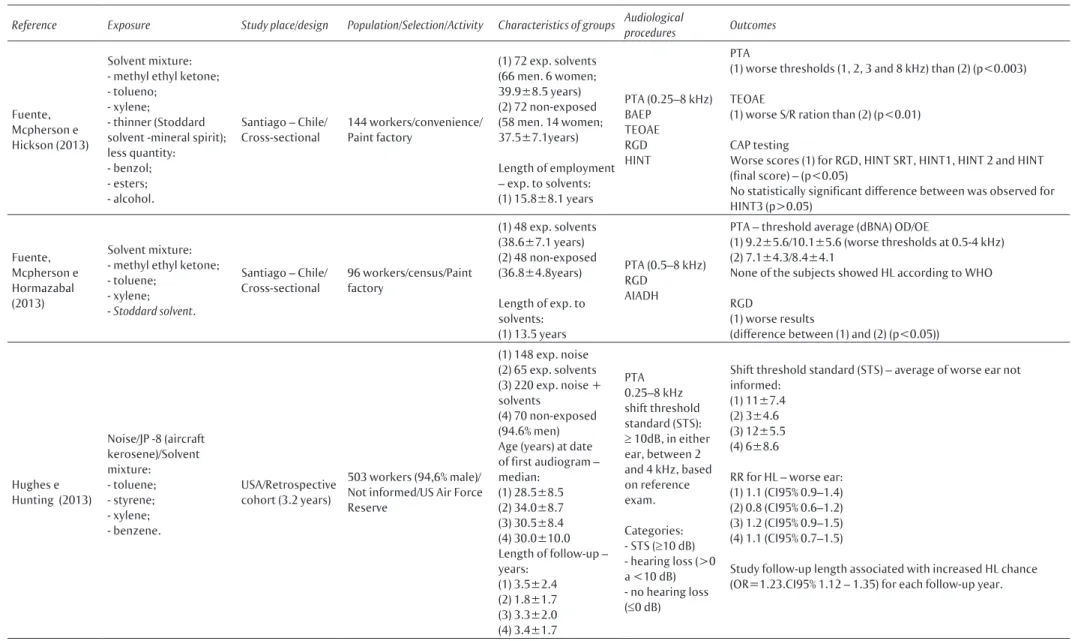
In the end, 31 articles met the inclusion criteria. All studies included in this review were observational, 27 cross-sectional studies and three historical cohort studies (Table 1).
Exposure to solvent mixture featured in 21 studies, associated or not with noise, with toluene (17 studies) and xylene (16 studies) being the most frequent solvents in mixtures. The compounds found in isolated exposures were styrene (7 studies), toluene (4 studies) and carbon disulfide (one study) (Table 1).
Evaluations of the peripheral auditory pathway through Pure Tone Audiometry (PTA) were included in all studies reviewed, with 10 of them also assessing damage to the Central Auditory Nervous System (CANS) via electroacoustic tests (Immitanciometry, Immitance Decay, Otoacoustic Emissions - OAE), electrophysiological tests (Brainstem Auditory Evoked Potential - BAEP, Auditory Cortical Response – ACR) and Central Auditory Processing (CAP) (Table 1).
Measures of association showed statistically significant values for “exposure to organic solvents and hearing impairment” in 21 studies (Table 2).
R
e
v
B
ras
Sau
de
Ocu
p
2
0
1
6
;4
1
:e
1
0
4
/2
5
Table 1 Description of studies on occupational chemical exposure associated with Occupational Hearing Loss
Reference Exposure Study place/design Population/Selection/Activity Characteristics of groups Audiological
procedures Outcomes
Morata et al. (1993)
Noise/Toluene/Solvent mixture:
- toluene (main component); - xylene;
- MEK (methyl ethyl ketone);
- methyl isobutyl ketone.
Brazil/Cross-sectional
190
men/random sampling/ printing and paint manufacturing
(1) 50 non-exposed (2) 50 exp. noise (3) 50 exp. noise + toluene
(4) 39 exp. solvent mixture
PTA (0.5–8 kHz) Immitanciometry:
Decay
HL/RR prevalence: (1) 8%
(2) 26%/4.1 (95%CI 1.4–12.2) (3) 53%/10.9 (95%CI 4.1–28.9) (4) 18%/5.0 (95%CI 1.5–7.5)
HL classification I: majority (3) (p<0,001)
HL classification I-IV – predictive probability (adjusted for length of service): (3)>(4)>(2)>(1)
Recruiting (% bigger): (2) p<0,005
Decay (% bigger contralateral and 2 kHz): (3) p<0.001
Sass-Kortsak, Corey e Robertson (1995)
Noise/Styrene
Canada/Cross-sectional
- 299 men (36.6 years ±10,7)/ Convenience/Exposed: Fiber-reinforced plastic products plant
Non-exposed: local offices.
(age: 36.6±10.7 years) (1) “directly”
(2) “indirectly” (3) “non-exposed”
Length 7.6±6.4 years
PTA (0.125–8 kHz) (beginning and end of work shift)
HL – overall
- 10% compensation (0.5; 1; 2 and 3 kHz ≥ 25 dBNA); - 1/3 PA > 25 dBNA in 6 and 8 kHz.
Association between age and HL development (subjects < 50 years and HL<50 dBNA):
- Age: significant - InTSty: non-significant - Cigarette (P=0.001 p=0.01)
- Extra-occupational noise: signif. ((P=0.01 β= - 0.02)) - Extra-occupational: signif. em 4 kHz
Correlation
- Age and InNoise (r=0.55) – high - InTSty and InNoise (r=0.52) – high - Age and InTSty (r=0.16) – low
Regression – InTSty/InNoise:
- Significant association between noise and HL (3 and 4 kHz) - Age and InNoise: signif. interaction
Regression – InTWA/InTWAN:
- Association between noise and HL in 3 and 4 kHz stronger (4 kHZ – OE: P=0.006 β= 3.55)
Morata et al. (1997a)
Noise/Solvent mixture: - toluene
- ethyl alcohol (ethanol) - ethyl acetate
Brazil/Cross-sectional
124 men/not informed/ Rotogravure printing plant
Age average: 33.8 years (21-58)
Study group (several combinations of solvents and noise )
Average length of employment – years: 07 (1-25)
PTA (0.5–8 kHz)
Immitanciometry: Decay
HL (3-6kHz) – 49% (overall total)
HL – age and biological marker (toluene): OR: 1.07/year of age (95%CI 1.03–1.11)
OR for 2.5 g/g of creatinine (100 ppm in the air): 4.4 (95%CI 2.50–7.45); 1.76/gram of hippuric acid (IC 95% 1.00–2.98)
No significant interaction: between solvents, solvent mixture and noise, or individual solvent and noise.
R
e
v
B
ras
Sau
de
Ocu
p
2
0
1
6
;4
1
:e
1
0
5
/2
5
Table 1 Continuation…
Reference Exposure Study place/design Population/Selection/Activity Characteristics of groups Audiological
procedures Outcomes
Morata et al. (1997b)
Noise/Solvent mixture: - benzene;
- toluene; - xylene; - ethylbenzene; - cyclohexane.
South America/ Cross-sectional
438 workers/Convenience/ Oil refinary
(1) 41 non-exposed (2) 89 (monitoring) (3) 40 (dispatch) (4) 180 (maintenance) (5) 19 (sole previous exp. to aromatics) (6) 69 (quality control lab)
PTA (0.5–8 kHz) Acoustic reflex Immitanciometry decay
HL (3-6kHz) bigger number (p<0.005)/OR adjusted: (2) 49%/2.4 (95%CI 1.0–5.7)
(3) 42%/1.8 (95%CI 0.6–4.9) (4) 50%/3 (95%CI 1.3–6.9) (5) 42%
HL (3–6 kHz): (6) 15%
Reflex decay: (2) (4) (p<0.005)
Sliwinska-Kowalska et al. (2001)
Noise/Solvent mixture: - Mixed xylene isomers (ortho, meta and para); - Ethyl acetate; - White spirit (Detectable concentrations of toluene, butyl acetate and ethyl benzene).
Poland/Cross-sectional
517 workers (311 men; 206 women)/Not informed/Paint and varnish companies
(1) 214 non-exposed (113 men, 101 women; 38.5±10.6 years) (1a) 174 (1b) 40
(2) 207 exp. solvents (121 men, 86 women; 39.3±9.5 years) (2a) 104 (2b) 103
(3) 96 exposed noise + solvent (77 men, 19 women; 38.4±9.1 years)
Length of employment (2) 12.8±8.2 years (3) 12.2±8.5 years
PTA (1–8 kHz)
HL/RR incidence – HL in 2–8 kHz: (1) 36%
(2) 57.5%
(2a) 4.4 (95%CI 2.3–8.1) (2b) 2.8 (95%CI 1.8–4.3) (3) 61.5%/2.8 (95%CI 1.6–4.9)
OR: HL risk slightly higher in (3) than (2) (all freqs.)
Higher hearing thresholds in 1–8 kHz: (2) (3) Higher hearing thresholds averages in 2–8 kHz: (3)
Linear correlation:
HL risk and solvent exposure index: not observed
Isolated frequencies and solvent exposure index – observed (3, 4 and 6 kHz for toluene, and 2 and 3 kHz for xylene)
R
e
v
B
ras
Sau
de
Ocu
p
2
0
1
6
;4
1
:e
1
0
6
/2
5
Reference Exposure Study place/design Population/Selection/Activity Characteristics of groups Audiological
procedures Outcomes
Morata et al.
(2002) Noise/Styrene
Sweden/Cross-sectional
313 workers (278 men; 35 women)/Convenience/ Fiberglass and metal products industry
(1)
(1a) 65 exp. to styrene (43 years (21–62)) (1b) 89 exp. to styrene and noise (43 years (21–65))
(2) 78 exp. to noise (42 years (20–64)) (3) 81 non-exposed (45 years (26–62))
Length of employment – years:
(1)
(1a) 17 (01–39) (1b) 15 (02–37) (2) 12 (01–35) (3) 18 (2–38)
PTA (0,1–8 kHz) PTA
(1) > thresholds in 2, 3, 4 and 6 kHz (p<0.05), being worse than the median in 4, 6 and 8 kHz (p<0.01).
(2) thresholds worse than the median in 6 and 8 kHz (p<0.01; p<0.05)
HL (1a) 47% (1b) 48% (2) 42% (3) 33%
(no statistically significant difference between the groups)
2–6kHz thresholds:
Worse for (1) compared to (2) and (3)
OR (for each year of age) 1.19 (95%CI 1.11–1.28)
OR (for each 1 mmol of mandelic acid per gram of urinary creatinine)
2.44 (95%CI 1.01–5.89).
OR (for each 1dB of noise > 85 dB) 1.18 (95%CI 1.01–1.34)
Sulkowski et al. (2002)
Solvent mixture: - ethylbenzene; - xylene;
- trimethylbenzene isomers;
- toluene; - ethyl toluene; - styrene; - n-propylbenzene.
Poland/Cross-sectional
101 men/Not informed/ Paint and varnish company
(1) 61 exp. solvents (39.8±11.2 years) (2) 40 non-exposed (39.2±10.5 years) (1a) 20
(1b) 23 (1c) 18
Length of employment (1) 15.8±9.1 years
PTA
TEOAE, DPOAE Acoustic reflexes ENG
HL (above 1 kHz) (1) 42%
(2) 5%
DPOAE amplitude – dBNPS (1a) 1.99±6.14
(1b) -0.31±10.90 (1c) -2.87±9.06 (2) 7.48±4.67
Table 1 Continuation…
R
e
v
B
ras
Sau
de
Ocu
p
2
0
1
6
;4
1
:e
1
0
7
/2
5
Table 1 Continuation…
Reference Exposure Study place/design Population/Selection/Activity Characteristics of groups Audiological
procedures Outcomes
Sliwinska-Kowalska et al. (2003)
Noise/Styrene/Solvent mixture:
- styrene (main compound); - toluene; - acetone; - dichloromethane.
Poland/Cross-sectional
513 (men and women)/Not informed/
Exposed to solvents: plastic factory and yacht yard. Non-exposed:
- subgroup 1: blue-collar workers;
- subgroup 2: metals.
(1) 157 non-exposed (2) 356 exposed (2a) 194 exp. styrene (2b) 66 exp. noise (2c) 26 exp. styrene + toluene
(2d) 56 exp. styrene + noise
(2e) 14 exp.styrene + toluene + noise
PTA (1–8 kHz)
HL (1 – 8kHz)/OR – HL: (1) 93 (41.7%)
(2) 183 (63.1%)/3.9 (95%CI 2.4–6.2) (2a) 56.2%/5.2 (95%CI 2.9–8.9) (2b) 63.3%/3.4 (95%CI 1.7–6.4) (2c) 76.8%/13.1 (95%CI 4.5–37.7) (2d) 76.9%/10.9 (95%CI 4.9–24.2) (2e) 78.6%/21.5 (95%CI 5.1–90.1)
Styrene and noise OR: 3
Auditory threshold average in all frequencies: Exposed to solvents was significantly higher
No dose-response relation for HL and solvent concentrations.
Positive linear relation between lifetime exposure average (styrene) and auditory thresholds at 6 and 8kHz
Difference between groups
- Previous exposure to occupational noise (p< 0.001): (1) 6%
(2) 28%
Chang et al.
(2003) Noise/Carbon dissulfide
Taiwan/Cross-sectional
346 men/Sudy group: census. Control groups: (3) random and (2) census/ Viscose manufacturing plant (1) (3). electronics and adhesive tape industries (2)
(1) 131 exp. noise + carbon dissulfide (48.3±8.7 years) (1a) 41: <14.6 ppm +
≤85 dB(A)
(1b) 5: <14.6 ppm + >85 dB(A)
(1c) 24: ≥14.6 ppm +
≤85 dB(A)
(1d) 61: ≥14.6 ppm + >85 dB(A)
(2) 105 exp. noise (42.2±5.8 years) (3) 110 non-exposed (42.0±6.2 years) Length of employment: (1) 20.8±10.5 years (2) 21±5.7 years (3) 11.3±6.4 years
PTA (0.5–8 kHz)
HL /OR – HL
(1) 67.9 %/6.8 (95%CI 3.9–12.1) (1a) 1.7 (95%CI 0.8–3.7) (1b) 0.8 (95%CI 0.1–7.5) (1c) 35.5 (95%CI 7.8–161.3) (1d) 18.7 (95%CI 8.1–42.9)
(2) 32.4% (3) 23.6%
HL – 40–54 dBNA (1) 18% (noise≤85 dB(A)) (2) 4%
HL 0.5. 1 e 2 kHz: (1) HL 4 kHz: (2) HL 6 kHz: (1) e (2)
R
e
v
B
ras
Sau
de
Ocu
p
2
0
1
6
;4
1
:e
1
0
8
/2
5 Reference Exposure Study place/design Population/Selection/Activity Characteristics of groups Audiological
procedures Outcomes
Sliwinska-Kowalska et al. (2004)
Noise/Solvent mixture: - xylene isomers; - ethylbenzene; - ethyl acetate; - butyl acetate; - n-butanol; - white spirit.
Poland/Cross-sectional
906 (men and women)/Not informed/
Exposed:
dockyard. Not exposed: white-collar workers.
Controls of the same company
(1) 517 exp. noise + solvent (37.4±9.2 years)
(2) 184 exp. noise (42.2±9.3 years) (3) non-exposed (39.8±.3 years)
PTA (1–8 kHz)
HL/OR – HL:
(1) 67.5 %/4.8 (IC 95% 3.9–7.6) (2) 64.7 %/3.3 (IC 95% 2.0–5.4) (3) 39.5 %
OR for each year of age: 1.12
OR for for each dB(A) average of total exposure time to noise: 1.07
OR for each increase in lifetime exposure index to solvents: 1.00
Lower thresholds for (1) and (2), especially at 8 kHz (worst at (1) – positive linear correlation with exposure time to solvents)
Kim et al. (2005)
Noise/Solvent mixture: - toluene;
- xylene;
- methyl ethyl ketone (all samples).
Korea/Cross-sectional
328 men/Convenience/ Aircraft industry
According to “Cumulative exposure index”:
(1) 151 non-exposed (31.1±6.3 years) (2) 146 exp. noise (31.2±6.1 years) (3) 18 exp. solvent (38.6±6.0 years) (4) 13 exp. noise + solvent (39.6±4.7 years)
PTA (0.5 – 8 kHz)
HL/OR (adjusted) for HL: (1) 6.0%
(2) 17.1%/4.8 (IC 95% 1.71–10.75) (3) 27.8%/2.57 (IC 95% 0.64–10.31) (4) 54.6%/8.12 (IC 95% 2.03–32.53)
Kaufman et al. (2005)
Noise/Solvent mixture: - benzene;
- toluene; - xylene; - hexane; - heptane;
- kerosene (aviation).
USA/Cross-sectional
138 workers/Not informed/ Military facility (aircraft maintenance and other workers)
(1) 90 exposed (42.8±6.0 years) (2) 48 non-exposed (40.8±9.9 years) Years of employment: (1) 15.8±5.4 (2) 15.6±7.2
Automatic PTA (0.5–6 kHz)
OR for HL by combined “noise and solvent” exp.: 03 years – 1.70 (95%CI 1.14–2.3)
12 years – 8.25 (95%CI 1.67–55.6)
OR for regular intake of alcoholic beverage: 3.03 (IC95% 1.42–6.45)
Seeber et al.
(2005) Toluene
Germany/ Retrospective cohort (5 years of follow-up)
216 workers
(initially: 333 workers)/ Convenience/Printing plant
(1) 106 high exp. (2) 86 low exp.
(a) short exp. (b) long exp.
Exposure time – average: (a) 6 years (b) 21 years
PTA (0.125; 0.25; 0.5; 0.75; 1; 1.5; 2 – 12 kHz)
“Cases” (1) 29 (2) 28
OR: 0.791 (95%CI 0.42–1.50)
Table 1 Continuation…
R
e
v
B
ras
Sau
de
Ocu
p
2
0
1
6
;4
1
:e
1
0
9
/2
5
Reference Exposure Study place/design Population/Selection/Activity Characteristics of groups Audiological
procedures Outcomes
Sliwinska-Kowalska et al. (2005)
Noise/Solvent mixture: - xylene as main component; - mainly to styrene; - n-hexane and toluene.
Poland/Cross-sectional
1117 workers/Not informed/ (1) (2) (3):
lacquers and paints, footwear, plastics, ship and yacht. (4a): metal factory. (4b): white-collar workers
(1) 731 exp. solvent mixture (xylene) (38.0±9.4 years) (2) 290 exp. styrene (34.5±7.9 years) (3) 96 exp. n-hexane and toluene (39.0±8.7 years) (4) 223 non-exposed to solvents
(40.0±9.4 years) (4a) 66 exp. noise (4b) 157 non-exp. noise
PTA (1; 1.5–8 kHz)
HL/OR/ PTA freqs.:
(1) 63.1%/2.4 (p<0.001)/4; 6 e 8 kHz (2) 63.1%/3.9 (p<0.001)/1–8 kHz (3) 73%/5.3 (p<0.001)/6 e 8 kHz (4) 41.7%
Only exp. to solvents
OR: 4.1–5.2 times greater than controls
Only exp. to noise
OR: 3.8 times greater than controls
Co-exp. to “noise e solvent” OR: 6.7–21.5
Co-exp. to “noise and two solvents” OR: 20
Chang et al.
(2006) Noise/Toluene
Taiwan/Cross-sectional
174 men/Census/Adhesive material manufacturing
(1) 58 exp. toluene + noise
(1a) (1b) (1c)
(2) 118 reference (2a) 58 exp. noise (2b) 60 management Average age: (1) 40.0±9.7 (2a) 41.5±3.1 (2b) 40.9±3.4 Length of employment: (1) 12.3±8.81 (2a) 11.5±5.73 (2b) 9.52±5.26
PTA (0.5–6 kHz)
HL – including 0.5 kHz/excluding 0.5 kHz (1) 86.2%/67.2%
(2a) 44.8%/32.8% (2b) 5.0%/8.3%
OR – including 0.5 kHz/excluding 0.5 kHz
(1) 10.9 times higher than (2a)/5.8 times higher than (2a)
Poor thresholds in all frequencies, markedly at 4 and 6 kHz, for (1) e (2a), with 1 kHz worse in (1).
Adjusted OR – including 0.5 kHz/excluding 0.5 kHz (1) 140 (95%CI 32.1–608)/29.1 (95%CI 9.3–91.4)
Table 1 Continuation…
R
e
v
B
ras
Sau
de
Ocu
p
2
0
1
6
;4
1
:e
1
0
1
0
/2
5
Reference Exposure Study place/design Population/Selection/Activity Characteristics of groups Audiological
procedures Outcomes
Johnson et al.
(2006) Noise/Styrene
Sweden/Cross-sectional
313 (278 men; 35 women)/ (1) convenience; (2) equal selection to (1); (3) random/ (1) fiberglass products manufacturing; (2) metal products manufacturing; (3)
mail terminal
(1)
(1a) 89 exp. to styrene (43 years (21–62)) (1b) 81 exp. to styrene and noise (43 years (21–65))
(2) 65 exp. to noise (42 years (20–64)) (3) 78 non-exposed (45 years (26–62))
Length of employment – years:
(1)
(1a) 17 (01–39) (1b) 15 (02–37) (2) 12 (01–35) (3) 18 (2–38)
PTA (0,1–8 kHz) DPOAE MTF ACR IS
Speech in noise PTA
(1) > thresholds at 2, 3, 4 and 6 kHz (p<0.05), being worse than median at 4. 6 and 8 kHz (p<0.01).
(2) thresholds worse than median at 6 and 8 kHz (p<0.01; p< 0.05)
PTA after 03 years: 20% of individuals with worse auditory thresholds at one frequency at least
MTF – threshold average
Significant difference between (1b) and (3) and between (1b) and (2), with reduced peak values for (2)
DPOAE – “input-output”
Interaction between exposed groups and signal level (p<0.006) - signal up to 50 dB: (2) and (3) DPOAE higher than (1)
- signal > 50 dB: (3) DPOAE level stabilized, (1) and (2) fell
ACR
(1) and (2) difference over latency score (p<0.05) compared to (3)
Interrupted speech
No difference in score average between groups
Compared to reference values: (1) below 93% or 78% of corrects answers (p<0.05)
Speech in noise
Difference between groups (p<0.001)
Compared to reference values: (1) and (2) below – 7.8 S/N (p<0.05)
Table 1 Continuation…
R
e
v
B
ras
Sau
de
Ocu
p
2
0
1
6
;4
1
:e
1
0
1
1
/2
5
Reference Exposure Study place/design Population/Selection/Activity Characteristics of groups Audiological
procedures Outcomes
Schäper, Seeber e Van Thriel (2008)
Noise/Toluene Germany/Cohort
(5 years)
Men
Initial total: 333 (100%) Final total: 216 (64,9%) (complete data for 192 participants)/Convenience/ Rotogravure printing
Follow-ups: - initial: 333 (100%) - 2: 278 (83.5%) - 3: 241 (72.4%) - 4: 216 (64.9%) Complete data for 192 participants
Stratification by intensity of exp. to toluene:
(1) 106 high exp. (2) 86 low exp. Stratification by length of exp. to toluene: (3) long exp. (4) short exp. Stratification by intensity of exp. to noise:
(5) high exp. (6) low exp. Exposure time to toluene and noise – years:
(3) 21.3±6.5 (4) 5.9±2.2
PTA (0.125–0.5; 0.75; 1; 1.5; 2–8; 12 kHz)
PA: 36%
Effect of noise intensity on threshold average was almost twice the effect of toluene intensity.
Differences between exposure level or length in cases and non-cases were not significant (p = 0.49; p = 0.51 respectively).
HL high frequencies (subsample with biomarkers): 36%
No exposure variable found any significance in the statistical model.
Rabinowitz et al. (2008)
Noise/Carbon Monoxide/Solvent mixture:
- toluene; - xylene;
- methyl ethyl ketone.
USA/Retrospective cohort (5 years)
1319 (men and women)/ Census/Aluminium industry
1319 subjects (30.4±3.7 years): 1167 men
(1) 116 (8.8%) solv. exp. (solv. exp. index >1) (2) 140 (10.6%) carbon monoxide exp. (solv. exp. index >1)
PTA OR (HL dichotomous outcome/exp.>5 years)
(1) 1.87 (95%CI 1.22–2.89; p=0.04)
Table 1 Continuation…
R
e
v
B
ras
Sau
de
Ocu
p
2
0
1
6
;4
1
:e
1
0
1
2
/2
5
Reference Exposure Study place/design Population/Selection/Activity Characteristics of groups Audiological
procedures Outcomes
Triebig, Bruckner
e Seeber (2008) Styrene
Germany/Cross-sec-tional – with repeti-tion measures
155 men/Census/Boat build-ing
- 128 more exp. styrene - 127 less exp. (5–25 ppm (below 200mg/g creat.))
According to biomark-ers – all participants: (1a) 99 low exp. (37.8±8.9 years) (1b) 118 medium exp. (38.5±8.9 years) (1c) 31 high exp. (37.9± 11years)
According to exposure length – “ extreme groups”:
(2a) 34 “low-short” exp. (42.6±8.4 years) (2b) 17 “high-long” exp. (43.5±11.1 years)
Length of employment – years:
(1a) 6.2±4.3 (1–26) (1b) 5.7±3.6 (1–23) (1c) 6.3±4.8 (1–26) (2a) 6.4±3.4 (2–16) (2b) 14.6±6.7 (10–26)
PTA
PTA high freqs. (9–16 kHz) TOAE
HL: 105 “cases”/132 “non-cases” High exp.: 55%/45%
Low exp.: 41%/59% (2a) 35%/65% (2b) 60%/40%
Auditory thresholds (dB) between 8 e 12.5 kHz slightly different between the high and low exposure groups, with no dose-response effect.
Change in chronic exposure from (2a) to (2b): OR 7.46 (IC>1) for HL
TEOAE
No direct association between the groups and S/N relation or ampli-tude.
Fuente et al. (2009)
Solvent mixture: - toluene;
- methyl ethyl ketone. Less quantity: - trichlorethylene; - acetone;
- n-methyl-pyrrolidone; - dimethylformamide; -clorobenzeno; - isopropyl alcohol.
New Haven – USA/ Cross-sectional
110 participants/Census/ Coating factory
(1) 20 minimum exp. (38.1±11.6 years; 12 women. 08 men) (2) 18 moderate exp. (41.0±12.4 years; 01 woman. 17 men) (3) 72 maximum exp. (39.5±11.4 years. 04 women . 68 men) (categorized by a hygeniest)
PTA (0,5–8 kHz) PTA high freqs. (12 and 16 kHz) DD
Altered PTA in 69 subjects/Altered PTA high freqs. in 22 subjects (1) 25%
(2) 61%/16.6% (3) 73.6%/26.4%
(1) thresholds better than (3) (PTA p=0.004; PTA high freqs. p=0.034)
DD
(1) better responses than (2) (p=0.001) and (3) (p=0.000) Estimate for subjects with normal PTA: (2) -0.382(3) – 0.471 Estimate for all subjects: (2) -0.274(3) – 0.386
Table 1 Continuation…
R
e
v
B
ras
Sau
de
Ocu
p
2
0
1
6
;4
1
:e
1
0
1
3
/2
5
Table 1 Continuation…
(To be continued)
Reference Exposure Study place/design Population/Selection/Activity Characteristics of groups Audiological
procedures Outcomes
Zamyslowska-Szmytke et al. (2009)
Styrene
Poland/Cross-sectional
109 workers/Not informed/ Fiberglass for manufacturing
(1) 59 exp. styrene (40±09 years; 6 wom-en, 53 men) (2) 50 non-exposed (37±11 years; 16 wom-en, 34 men)
PTA (0.125–8 kHz) GIN
FPT DPT
PTA
(1) worse thresholds (0.25–8kHz) (1) 86.4%
(2) 34%
GIN/FPT /DPT (1) worse averages (1) 24%/59%/85% (2) 12%/20%/26%
(1) Chi-square/ANCOVA adjusted for age and HL FPT: 11.7 (p<0.01) /6.8 (p<0.01)
DPT: 26.4 (p<0.01) /19.3 (p<0.001) GIN: 1.2 (p>0.05)
Guest et al.
(2010) Noise/Aircraft fuel (F-111)
Australia/Cross-sec-tional (with serial measurements)
1530 workers/(1) conveni-ence; (2) (3) random/Royal Australian Air Force
(1) 605 exposed (98% men; 87%<55years) (2) 510 technical com-parison - different base, same function (99% men; 91%<55years) (3) 398 no technical comparison - same base, different function (99% men; 90%<55years )
PTA (0.5; 1; 1.5–8 kHz)
Overall HL: 25% of clinically significant difference (compensation). PTA
(0.5; 1; 1.5–8 kHz) worse than normalcy standard (presence of a noise notch at 6 kHz)
OR for HL: similar among the three groups (2) 1.1 (CI95% 0.2–2.0)
(3) 0.9 (CI95% 0.6–1.3)
Mohammadi, Labbafinejad e Attarchi (2010)
Noise/Solvent mixture: - benzene;
- toluene; - xylene;
- tetrachlorethylene; - acetone.
Iran/Cross-sectional
441 men/Census/ Automobile plant
Average age: (33.07 years; 20-58 years) (1) 173 exp. noise (33.36±6.95 years) (2) 104 exp. solvents – within limits (31.87±5.49) (3) 164 exp. noise + solvents – above limits (33.53±6.22) Length of employment: 8.06 years (0.5 a 30 years)
PTA (0.5–8 kHz)
HL (average 3–8kHz)/adjusted OR (1) 24.08±11.89/1
R e v B ras Sau de Ocu p 2 0 1 6 ;4 1 :e 1 0 1 4 /2 5
Reference Exposure Study place/design Population/Selection/Activity Characteristics of groups Audiological
procedures Outcomes Beshir, Elserougy e Amer (2011) Noise/Solvent mixture: - acetone; - butanol; - ethanol; - ethyl acetate; - isopropanol; - toluene; - xylene.
Sadat – Egypt/ Cross-sectional
204 men/(1) census; (2) (3) not informed/Ceramics plant
(1) 44 exp. solvent mixture (36±2 years) (2) 73 exp. noise (38.1±7.3 years) (3) 87 non-exposed (37±3.5 years)
Length of exposure: (1) 16±6
(2) 15±9
PTA (0.25–2; 4; 8 kHz)
HL – 0.5; 1 and 4 kHz (1) 72.7%; 45.5%; 45.5% (2) 94.5%; 69.9%; 67.1% (p<0.05)
(1) more common at 8 kHz than 4 kHz (2) more common at 4 kHz than 8 kHz v-notched
(1) 63.3% (2) 31.5% (p<0.01)
Correlation between exp. length and freqs. of 4 and 8 kHz (adjusted)
(1) 0.795 (p=0.000) and 0.869 (p=0.000)
Fuente, Mcpherson e Hickson (2011) Solvent mixture: - toluene; - xylene;
- methyl ethyl ketone; - varsol.
Chile/Cross-sectional
92 workers/(1) not informed; (2) convenience/ (1) paint factories; (2) University of Chile/Chilean police officers
(1) 46 exp. solvent mixture (37.3±8.2 years; 41 men and 05 women)
(2) 46 non-exposed (36.1±6.1 years; 41 men and 5 women)
Length of exposure: (1) 02 to 30 years (13.3±8.2 years)
PTA (0.5–8 kHz) RGD MLD PPS DD FS HINT
Normal auditory thresholds (inclusion criterion), but worse for (1) at freqs. of 1, 2 and 3 kHz.
Score differences between groups (adjusted) DD (F=4.77; p=0.032)
PPS (F=2.87; p=0.014) FS (F=5.85; p<0.0001)
RGD (1; 2; 4 kHz) (F=3.22; 2.83; 4.20 p<0.02, respectively) HINT SRT (F= 13.3 p<0.0001)
No statistically significant difference was observed for MLD and HINT (speech-in-noise subtests)
Morata et al.
(2011) Noise/Styrene
Finland, Sweden and Poland/Cross-sectional
Initial totall:
1620 workers (1276 men; 312 women; 32 gender not informed). Final total: 1404 workers/Not informed/ Fiberglass products plants; industries: metal, wood products, yacht yard and office work.
(1) 423 exp. solvents (2) 268 exp. noise + solvents
(3) 359 exp. noise (4) 354 non-exposed
Age – years: 18–63
PTA (0.125–8 kHz)
(1) and (2) worse thresholds than reference standard at all frequencies.
(1) p=0.0001 (2) p=0.0192
OR for HL (for each year of age and each increase of 1 mg/m³ of styrene):
(1) 1.0188 (95%CI 1.0140–1.0236) (2) 1.0055 (95%CI 1.0009–1.0102) (3) 1.01 (95%CI 0.99–1.03)
Kaewboonchoo et al. (2014)
Noise/Solvent mixture: - toluene;
- xylene; - ethyl acetate; - butyl acetate; - cyclohexane.
Thailand/Cross-sectional
149 men/Census/ Thailand Navy officers
Age: (20–56 years) Exposed to solvents: 103 (69.1%)
Length of employment: 01 a 36 years (31.5%>08 years; 6.9±8.5 years)
PTA (0.5;1; 2; 4; 8 kHz)
HL in 40 % of workers Inclination at 4 kHz: 22.8% High frequencies: 14.8%
Adjusted OR
Age: 15.83 (IC 95% 3.39–73.92)
Length of service: 2.19 (95%CI 1.01–4.97)
Correlation coefficient adjusted for age
Length of service – frequency of 4 kHz: 0.108 (p<0.05)
Table 1 Continuation…
R
e
v
B
ras
Sau
de
Ocu
p
2
0
1
6
;4
1
:e
1
0
1
5
/2
5
Table 1 Continuation…
(To be continued)
Reference Exposure Study place/design Population/Selection/Activity Characteristics of groups Audiological
procedures Outcomes
Fuente, Mcpherson e Cardemil (2013)
Misture of xylene isomers
Santiago – Chile/ Cross-sectional
60 workers/Convenience/ (1) public hospital histology lab; (2) University of Chile
(1) 30 exp. xylene (15 men. 15 women; 37.1±10.7 years) - cumulative dose of methyl hippuric acid: (1a) 10
(1b) 10 (1c) 10
(2) 30 non-exposed (15 men. 15 women. 35.9 ±11.7 years) - comared to study subgroups: (2a) 10 (2b) 10 (2c) 10
Length of exposure (self-reported): 11.8±10.5 years (02–29 years)
PTA (0.25–8 kHz) BAEP
DPOAE PPS ATTR DD MLD HINT
HL – 0.5 – 8 kHz
(1) thresholds worse than (2)
DPOAE adjusted for age
No statistically significant difference between (1) and (2) (associated age p≤0.001)
BAEP adjusted for age
(1) greater latencies I, III e V) and inter-peak intervals (I-III, III-V e I-V) (p=0.001)
(age not statistically associated)
Score difference between groups (adjusted for age) PPS (F=8.04 p<0.01)
DD (F=9.03 p<0.01)
HINT (final score) (F=13.77; p<0.0001)
No statistically significant difference was observed for MLD, ATTR e HINT SRT (p>0.05)
(age associated with HINT (final score) and PPS (p<0.01 and p<0.0001, respectively))
BEI in (1)
Moderate positive correlation between BEI (p=0.42) and binaural average of hearing levels at 2–8kHz (p=0.02). BEI concentrations
predicted the binaural average of hearing levels (β=0.59. p<0.01): for each 1g/g of creatinine, increase of 0.034 dBNA.
No correlation with the remaining procedures (p>0.05)
Dose-response effect and PTA – average (1a) 8.1±6.7
(1b) 9.0±3.9 (1c) 20.7±9.1
((1a) e (1b) significantly different from (1c)) (1c) different from (2) (p<0.01)
Dose-response effect and DPOAE – average (1a) 4.15±8.78
(1c) –4.04±6.03
((1a) e (1c) significantly different) (1b) –0.57±5.39
R e v B ras Sau de Ocu p 2 0 1 6 ;4 1 :e 1 0 1 6 /2 5
Reference Exposure Study place/design Population/Selection/Activity Characteristics of groups Audiological
procedures Outcomes
Fuente, Mcpherson e Hickson (2013)
Solvent mixture: - methyl ethyl ketone; - tolueno;
- xylene;
- thinner (Stoddard solvent -mineral spirit); less quantity:
- benzol; - esters; - alcohol.
Santiago – Chile/ Cross-sectional
144 workers/convenience/ Paint factory
(1) 72 exp. solvents (66 men. 6 women; 39.9±8.5 years) (2) 72 non-exposed (58 men. 14 women; 37.5±7.1years)
Length of employment – exp. to solvents: (1) 15.8±8.1 years
PTA (0.25–8 kHz) BAEP
TEOAE RGD HINT
PTA
(1) worse thresholds (1, 2, 3 and 8 kHz) than (2) (p<0.003)
TEOAE
(1) worse S/R ration than (2) (p<0.01)
CAP testing
Worse scores (1) for RGD, HINT SRT, HINT1, HINT 2 and HINT (final score) – (p<0.05)
No statistically significant difference between was observed for HINT3 (p>0.05) Fuente, Mcpherson e Hormazabal (2013) Solvent mixture: - methyl ethyl ketone; - toluene;
- xylene; - Stoddard solvent.
Santiago – Chile/ Cross-sectional
96 workers/census/Paint factory
(1) 48 exp. solvents (38.6±7.1 years) (2) 48 non-exposed (36.8±4.8years)
Length of exp. to solvents: (1) 13.5 years
PTA (0.5–8 kHz) RGD
AIADH
PTA – threshold average (dBNA) OD/OE
(1) 9.2±5.6/10.1±5.6 (worse thresholds at 0.5-4 kHz) (2) 7.1±4.3/8.4±4.1
None of the subjects showed HL according to WHO
RGD
(1) worse results
(difference between (1) and (2) (p<0.05))
Hughes e Hunting (2013)
Noise/JP -8 (aircraft kerosene)/Solvent mixture: - toluene; - styrene; - xylene; - benzene. USA/Retrospective cohort (3.2 years)
503 workers (94,6% male)/ Not informed/US Air Force Reserve
(1) 148 exp. noise (2) 65 exp. solvents (3) 220 exp. noise + solvents
(4) 70 non-exposed (94.6% men) Age (years) at date of first audiogram – median:
(1) 28.5±8.5 (2) 34.0±8.7 (3) 30.5±8.4 (4) 30.0±10.0 Length of follow-up – years: (1) 3.5±2.4 (2) 1.8±1.7 (3) 3.3±2.0 (4) 3.4±1.7 PTA 0.25–8 kHz shift threshold standard (STS):
≥ 10dB, in either ear, between 2 and 4 kHz, based on reference exam.
Categories: - STS (≥10 dB) - hearing loss (>0 a <10 dB) - no hearing loss (≤0 dB)
Shift threshold standard (STS) – average of worse ear not informed:
(1) 11±7.4 (2) 3±4.6 (3) 12±5.5 (4) 6±8.6
RR for HL – worse ear: (1) 1.1 (CI95% 0.9–1.4) (2) 0.8 (CI95% 0.6–1.2) (3) 1.2 (CI95% 0.9–1.5) (4) 1.1 (CI95% 0.7–1.5)
Study follow-up length associated with increased HL chance (OR=1.23.CI95% 1.12 – 1.35) for each follow-up year.
* MEK: methyl ethyl ketone. POS: Psycho-Organic Syndrome. PTA: Pure Tone Audiometry. SRT: Speech Reception Threshold. SRPI: Speech Recognition Percentage Index. IS: Interrupted Speech. DS: Distorted Speech. BAEP: Brainstem Auditory Evoked Potential. CRA: Auditory Cortical Response. ENG: Electronystagmography. CTE: Solvent-Induced Chronic Toxic Encephalopathy. TEOAE: Transient Otoacoustic Emissions. DPOAE: Distortion Product Otoacoustic
Emis-sions. S/R: Signal to Noise Ratio. RGD: Random Gap Detection.MLD: Masking Level Difference. PPS: Pitch Pattern Sequence. DD: Dichotic Digit. FS: Filtered Speech. HINT: Hearing-In-Noise Test. MTF: Psychoacoustic Modulation Transfer
Function. AIADH: Amsterdam Inventory for Auditory Disability and Handicap. GIN: Gaps-in-noise. FPT: Frequency Pattern Test. DPT: Duration Pattern Test. FS: Filtered Speech. ATTR: Adaptive Test of Temporal Resolution. STS: Shift
Threshold Standard.
Rev Bras Saude Ocup 2016;41:e10 17/25 Table 2 Description of studies regarding levels of exposure to noise and chemicals, status of statistical
asso-ciation measurements and hearing impairment
Substance
Below OEL and absence/noise
<85 dB(A)
Above OEL and absence/noise
<85 dB(A)
Below OEL and noise
≥85 dB(A)
Above OEL and/ noise
≥85 dB(A)
Association Hearing
impairment References
Styrene
X - P Sass-Kortsak, Corey and
Robert-son (1995)
X + P Morata et al. (2002)
X + P Sliwinska-Kowalska et al. (2003)
X + P Johnson et al. (2006)
X + P Triebig, Bruckner and Seeber
(2008)
X X + P and HS Zamyslowska-Szmytke et al.
(2009)
+ P Morata et al. (2011)
Toluene
X + P and C Morata et al. (1993)
X - P Seeber et al. (2005)
X + P Chang et al. (2006)
X X - P Schäper, Seeber and Van Thriel
(2008)
Carbon
dissulfide X X + P Chang et al. (2003)
Xylene X + P, C and HS Fuente et al. (2013)
Solvent Mixture
X + P Morata et al. (1997a)
X + P and C Morata et al. (1997b)
X + P Sliwinska-Kowalska et al. (2001)
X X + P Sulkowski et al. (2002)
X + P Sliwinska-Kowalska et al. (2004)
X + P Kaufman et al. (2005)
X + P Kim et al. (2005)
X X + P Sliwinska-Kowalska et al. (2005)
+ P Rabinowitz et al. (2008)
X + P and HS Fuente et al. (2009)
*X - P Guest et al. (2010)
X + P Mohammadi, Labbafinejad and
Attarchi (2010)
X - P Beshir, Elserougy and Amer
(2011)
X + P and HS Fuente et al. (2011)
X + P and HS Fuente et al. (2013)
X + P and HS Fuente et al. (2013)
X - P Hughes and Hunting (2013)
X + P Kaewboonchoo et al. (2014)
+: association observed; -: association not observed; *: not studied or not reported; P: peripheral;
C: central; HS: hearing skills.;
Rev Bras Saude Ocup 2016;41:e10 18/25
Styrene
Focused on the plastic and fiberglass industries, six studies found a positive association between exposure to styrene and Hearing Loss (HL)11,20-24,
four of which featured styrene exposure levels below recommended limits20-23. The worst PTA responses
for a wide range of frequencies (0.25 – 8 kHz) were found among individuals of the group exposed to the solvent 22-24.
Morata et al.20 found significantly worse
thresholds at frequencies between 2 and 6 kHz in the group exposed to noise and styrene, with an odds ratio of 1.19 for each increase of one year in age (CI95% 1.11 – 1.28); 1.18 for each dB of noise (95%CI 1.01 – 1.34); and 2.44 for each mmol of mandelic acid per gram of creatinine in urine (CI95% 1.01 – 5.89). In this study, an additive effect between noise and styrene was observed.
In another study11, the odds of developing
HL (1-8 kHz) was almost about four-fold among those exposed to styrene in comparison to not exposed group. In the group of “noise and styrene” co-exposure, the odds of HL (OR=10.9) was greater than the sum of the odds of those exposed to noise alone (OR=3.4) and styrene alone (OR=5.2), also suggesting an additive effect of co-exposure. The group of co-exposure to styrene, toluene and noise was 21- -fold more likely to develop HL, thus suggesting a synergistic action among multiple ototoxic agents.
The auditory thresholds for high frequency PTA were statistically different for groups with prolonged exposure to styrene levels within recommended limits (8 – 12.5 kHz)22.
The study by Johnson et al.21 showed changes in
both the peripheral auditory pathway, with BAEP results indicating damage to the organ of Corti (inner ear), and CANS. Differences were observed between the findings obtained for individuals exposed to styrene and normality scores for the ACR and speech-in-noise tests. Significant differences were also found among those exposed to styrene for the auditory skills tests Frequency Pattern Test (FPT) and Duration Pattern Test (DPT), but not for the Gaps-in-noise test (GIN)23.
In a multicenter study carried out in Sweden, Finland and Poland24, styrene exposure was
associated with poorer PTA hearing thresholds, with confirmed association between HL and co-exposure of styrene and noise. The data indicated a statistically significant interaction between noise and styrene in the generation of OHL. However, the lack of complete information on the history of exposure and other relevant parameters prevented
the precise identification of the contribution of each agent in triggering hearing damage. The authors also consider it inappropriate to attempt to calculate dose-response effect or set safe limits related to audition for styrene exposure from the data obtained in the study.
Toluene
Four studies evaluated the ototoxic effects of exposure to toluene through PTA: three in printing and rotogravure plants9,16,25 and one in an adhesive
material factory26. Only one study evaluated the
possible impairment of the central auditory pathway, through observation of peri-stimulatory fatigue of cranial nerve VIII, recorded by immitanciometry (decay decline). This observation suggested to the authors that hearing damage could not be solely attributed to noise exposure, since hearing impairment caused by that agent would not affect the neural portion of the auditory pathway (p <0.001)9.
In the study by Morata et al.9, all exposed groups
(noise, noise and toluene or solvent mixture) showed a high relative risk (RR) of HL, although the highest prevalence and probability (RR adjusted for length of employment) of HL was found in the group expose to toluene and noise, compared to those exposed only to noise. The lack of a group exposed only to toluene prevented the authors from investigating the nature of the interaction (additive or multiplicative) between noise and solvent.
Two studies suggested that toluene exposure lower than 50 ppm may not be associated with HL. With low concentration exposure, the odds of worsened audiometric thresholds over five years of follow-up were not statistically significant26.
Neither duration nor intensity of exposure revealed adverse effects on audiometric thresholds25.
Possible biases are cited in these studies, such as inexistence of control groups, healthy worker effect25
and inadequate definition of “case”25,26, which may
have influenced the absence of risk of OHL in exposures at levels below recommendation.
HL induced by combined “noise and toluene” exposure (speech frequencies) was six times higher than induced by noise only, being slightly lower among workers with lower exposure to toluene. However, no dose-response effect was found16.
Xylene
The study by Fuente et al.27 on histology
Rev Bras Saude Ocup 2016;41:e10 19/25
frequencies, between exposed and non-exposed workers, with a moderately significant correlation between methylhippuric acid and threshold average (2–8 kHz): increase of 0.034 dBHL for each increment of 1 g/g of creatinine. Dose-response effect for xylene concentration levels on hearing thresholds was also observed: the higher the dose of exposure, the worse the audiometric threshold.
There was no difference between exposed and non-exposed workers regarding the evaluation of Distortion Product Otoacoustic Emissions (DPOAE) and levels of methylhippuric acid; however, regarding the cumulative dose, correlation was found with the binaural average of DPOAE amplitude: the greater the exposure, the lower the amplitude27.
A difference was found between exposed and non-exposed workers in the analysis parameters of Brainstem Auditory Evoked Potential (BAEP) and the Central Auditory Processing (CAP) tests Pitch Pattern Sequence (PPS), Dichotic Digit (DD) and Hearing-In-Noise Test (HINT); however, no correlation with methylhippuric acid or cumulative dose was observed. No statistically significant difference was observed for Masking Level Difference (MLD), Adaptive Test of Temporal Resolution (ATTR) and Hearing-In-Noise – Speech Reception Threshold HINT – SRT (p> 0.05).
Carbon disulfide
One study evaluated the adverse effects of carbon disulfide on the hearing of workers of a silk viscose factory28, finding an apparent dose-response
association. Carbon disulfide levels greater than 14.6 ppm increased the effects of noise exposure on hearing (OR=35 in exposures associated with noise above the tolerance limit). The higher prevalence of HL in the co-exposure group suggested the worsening of HL due to the solvent.
The impairment involves a range of audiometric frequencies higher than initially reached by noise (also including speech frequencies). The authors describe the presence of limitations and biases in the study, such as lack of precision in sample characterization in relation to concentration levels (information bias), lack of homogeneity between the groups regarding the variables “age,” “duration of employment” and “education level,” besides the absence of the group exposed to the solvent alone.
Solvent mixture
Exposure to solvent mixture of various compositions, combined or not with noise, was investigated in 18 studies. One study made no
reference to chemical exposure levels29, but
mentioned high levels of exposure to noise.
The diversity of the examined work environments and branches of economic activity explains the variety found in solvent mixture compositions used in production processes: petrochemical, aluminum and metal industry; manufacture of paints, varnishes, ceramics, wooden furniture, automobiles and coating; printing and rotogravure; aircraft maintenance and mechanics; naval and military shipyards were fields of study of researchers of different nationalities.
Due to the complexity of exposure, few homogenous groups exposed to solvent mixture were mutually comparable. Differences were observed in nature of exposure, data collection period and follow-up, hearing assessment procedures and definition of outcomes, as well as analyses of data obtained in each study. The level of exposure to solvent mixture, within or outside allowed limits, was considered in order to facilitate the analysis of the studies.
Low exposure to mixture
Most of the studies mentioned exposure to organic solvent mixtures at levels within local and/or international recommended tolerance limits8,17,27,30-38. In those studies, noise exposure
levels varied according to compliance with the tolerance limit of 85 dB(A) for an eight-hour working day, recommended internationally.
Shifts in audiometric thresholds and increased prevalence and/or probability of OHL were some of the data found among the groups of co-exposure to noise and solvent mixture17,30,32-37,39.
In all studies of possible impairment to CANS and listening skills, the results suggested action of solvents on the central auditory pathways, indicating that PTA might not be the only recommended audiological test for this population17,34,36,37,39 .
Sliwinska-Kowalska et al.30 found a higher
incidence of HL among individuals with combined “noise and solvent” exposure; however, OR was similar in both groups. The group of isolated exposure to solvent had a slightly higher exposure, which may have underestimated the additive effect of combined exposure. The RR of 2.8 to 4.4 in individuals exposed to solvents suggested increased HL risk due to occupational exposure to organic solvents. The group exposed solely to solvent had a worse threshold average (1-8 kHz) than the non-exposed group.
Rev Bras Saude Ocup 2016;41:e10 20/25
exposure to solvent mixture, as did HL found in PTA: the higher the dose, the higher the audiometric thresholds and the lower the OAE amplitude. The presence of low noise levels associated with the individual concentrations of each solvent within or slightly above recommended limits led the authors to believe that the hearing findings resulted from the rate of exposure to the mixture (combined)18.
With regard to the cumulative effects of “noise and solvent” co-exposure on HL, the OR was practically the product of the OR of isolated exposures (significantly higher) for each agent. These findings suggested effects on the auditory system resulting from chronic exposure to solvents, besides a multiplicative interaction among agents. However, due to the difference in numbers among the groups (fewer workers exposed to solvents than non-exposed or exposed to noise), information on the HL pathway or mechanism caused by solvents could not be defined31.
A significant increase in the odds of HL resulting from combined “noise and solvent” exposure was found as length of exposure increased from three to 12 years. After 12 years of exposure, no statistically significant differences were observed. For the confounding variable “regular consumption of alcohol,” an odds of3.03 to trigger HL was found in the population with combined exposure32.
A five-year follow-up study identified hazardous effects on the PTA frequencies of 3.4 and 6 kHz. According to the authors, no extrapolations were possible of the dose-response relationship or safe hearing levels. They further emphasize that the measures of association may have been compromised by the absence of a not exposed control group33.
Apparently, exposure to solvent mixture may cause the early appearance of a notch (v-notched) in the audiogram and affects first and foremost the main frequency of 8 kHz. Smokers exposed to solvents showed higher hearing thresholds than smokers exposed to noise alone35.
Morata et al.17 found changes in audiometric
thresholds and increasing prevalence and risk of HL in simultaneous exposures to noise and solvent mixture. Measurements of immittance decay suggested possible retrocochlear impairment. The authors suggest the possibility that the data were underestimated, since the methods used may have failed to detect auditory disorders due to their locations in the auditory system.
Workers exposed to combined “noise and solvent mixture,” when compared with non-exposed controls, had worse results in CAP tests: Speech-in-Silence (SS), PPS36, HINT36,39, Random Gap
Detection (RGD)36,37,39 and DD 34,36, but no statistically
significant difference was observed for MLD36.
The results suggest that solvents may be adversely associated with central auditory dysfunction.
The results obtained for pure tone thresholds in investigations of possible CAP disorders related to co-exposure ranged from presence of normality, but with higher thresholds among exposed workers (1, 2, 3 and 6 kHz)37 to the observation of adverse effects
at the frequencies of 1, 2 and 3 kHz36, 3-6 kHz and
12-16 kHz, with a higher percentage of HL among more exposed individuals34. In the absence of noise,
subjects exposed to solvent mixture also showed worse hearing thresholds than those not exposed, at 1, 2, 3 and 8 kHz, with solvent exposure significantly associated with binaural average of audiometric thresholds39.
Peripheral changes have also been suggested among exposed individuals showing a lower signal/ noise ratio to Transient Otoacoustic Emissions (TOAE) than non-exposed individuals39.
In Thai navy officers, authors found an association between HL, age and length of service, but the noise exposure levels significantly exceeded the recommended limits, while exposure to solvents remained within tolerance limits. Thus, they concluded that the findings cannot be attributed to a combined effect of the exposures, and the effects of exposure to high levels of noise pressure were therefore predominant38.
Among US Air Force Reserve officers, HL was not associated with increased noise levels, and the OR for moderate solvent exposure was below 1.0. No interaction was shown to indicate that solvents are ototoxic in the presence or absence of noise – above 85 dB(A). The results showed that HL was associated with workers’ age at the date of the first audiogram, follow-up time and exposure to noise.
No additional risk was found for the co-exposure group, although follow-up time was sufficient to detect changes in hearing. The authors underline limitations in the study such as information bias, for not having data of other potential confounding variables and of the actual characterization of the exposure, which may have given the data some degree of uncertainty8.
High exposure to mixture
Levels of exposure to organic solvent mixture exceeded recommended local and/or international tolerance limits in some studies10,13,18,40. Among
Rev Bras Saude Ocup 2016;41:e10 21/25
Morata et al.10 described an increased likelihood
of HL with OR=1.76 for each gram of hippuric acid per gram of creatinine found in urine, with the risk of developing HL being four times higher (OR=4.4) when the considered threshold was 2.5 g/g of creatinine (100 ppm in the air). No statistically significant interaction between solvents and noise was observed, probably due to the short length of exposure of the population.
Among shipyard workers, the likelihood of developing HL was almost five times higher in the “noise and solvent” co-exposure group. Worse thresholds in the co-exposure group, compared to workers exposed solely to noise, suggested an additive effect of co-exposure to noise and solvents in the likelihood of developing HL. The latter, in turn, ranged between the frequencies of 2 to 8 kHz (affecting more 8 kHz). The authors suggested that at high exposure levels (noise and solvents), the effects of noise on hearing thresholds exceed those of solvents.
In a study of a population of workers from various industries, authors stated that occupational exposure to organic solvents is associated with a two- to five-fold increase in the odds of developing HL. Exposure to solvent mixture or combinations of two substances triggered HL between 4 and 8 kHz, while exposure to styrene alone affected a wide frequency range (1-8 kHz). Exposure combined with noise almost doubled the likelihood of HL compared to sole exposure to noise, suggesting an additive effect of co-exposure. There was a positive correlation between average lifetime exposure index (solvents) and HL at 4, 6 and 8 kHz; however, no dose-effect relationship was found for any of the combined or isolated exposures13.
An increase in HL rate was found among automobile plant workers with combined “noise and solvent mixture,” who were four times more likely to develop HL (3 and 8 kHz) compared to those exposed only to noise. Workers exposed solely to solvent mixture below limit values were also 1.8 times more likely to develop HL40.
In the study by Guest et al.29, limitations were
observed in the characterization of exposure to solvent mixture. The detected HL showed a high level and little variation between groups. An essential role of noise in determining HL between the groups was suggested by the existence of a noise notch at 6 kHz. However, the authors emphasized the difficulty in determining the role of chemical exposure in occupational hearing impairment based on the results.
Discussion
The effects of exposure on audiometric frequency thresholds and ranges, as well as on electrophysiological responses and scores of CAP assessment procedures showed differences between worker exposed and not exposed to chemicals. These hearing evaluation parameters did not show significant variation between types of exposure, whether to a single solvent or a solvent mixture. However, the prevalence or risk of developing OHL was higher among individuals exposed to “solvent(s) and noise”10-12,20,28,31-33,40 and “noise and
two solvents”11,13 combinations.
The typical onset in the frequency range of 3 to 6 kHz in Noise-Induced Hearing Loss (NIHL) also appeared in exposure to solvents and, sometimes more sharply, in co-exposure with noise34. However,
the action of solvents on a wider range of the cochlear structure (0.25 to 8 kHz) was observed in several studies13,22,28,30,34,36, especially in the frequencies of
2 and 8 kHz12,21,24,27,35,39,40. In one study there was no
statistically significant difference between subjects exposed and not exposed to solvents concerning hearing impairment in PTA; however, auditory thresholds were worse in the groups exposed to solvents37.
Three studies attributed OHL found among individuals of co-exposure groups to the likely action of noise25,38,41. This conclusion can be questioned
by observing limitations among the studies, which may have affected the quality of the analyses: absence of a control group with isolated exposure to noise25,41; healthy worker effect (sole permanence
at the workplace of workers with no impairment or health complaints) and inadequate case definition25;
or even differences between the exposure levels of agents (solvents within the allowed limit and noise considerably above the limit)38.
In addition to the impairment observed in PTA, further cochlear damage was observed in audiometry within higherfrequencies(between 9 and 16 kHz) and OAE. Decrease in the OAE response pattern suggested compromise of Outer Hair Cells (OHC) and, therefore, impairment of cochlear motor function in exposure to styrene and its combination with noise21, as well as exposure to solvent mixture
and noise18. However, two studies found no direct
association between the Otoacoustic Emissions Signal/Background noise ratio (SNR ratio) or OAE amplitude and groups exposed to styrene22 or
xylene35.
Rev Bras Saude Ocup 2016;41:e10 22/25
auditory pathways of the cerebral cortex responsible for central auditory processing skills.
The presence of peri-stimulatory fatigue observed with immittance decay suggested impairment of the retrocochlear portion – more specifically cranial nerve VIII – and was observed in studies involving exposure to toluene9 and solvent mixture17. However,
it was not observed in the study by Morata et al.10
with solvent mixture.
Changes in BAEP assessment parameters, suggesting brainstem impairment, were observed in individuals exposed solely to solvent mixture39,
fuel (gasoline) and xylene27. Only two studies jointly
investigated BAEP and hearing skills, which were compromised in frequency and duration pattern recognition27, temporal resolution39 and
figure-background 27,39.
Differences between normality scores in the Auditory Cortical Response (ACR) test and results obtained from individuals exposed to styrene21
suggested damage to more central portions of the auditory pathway. Also, the auditory skills of discrimination (figure-background), closure, temporal processing and frequency and duration pattern recognition had different scores compared to the normality patterns among individuals exposed to styrene, xylene and solvent mixture21,23,27,36,37,39.
No study administering ACR or CAP assessment procedures was carried out with individuals exposed solely to toluene or carbon disulfide.
In the studies by Fuente et al.36,37, evaluation of
central auditory skills was carried out in individuals with normal auditory acuity (normal auditory thresholds), resulting in lower scores compared to the parameters considered normal for the tests DD, PPS, Duration Pattern Sequence (DPS), Speech-in-Silence (SS), Filtered Speech (FS), Random Gap Detection (RGD) and HINT.
The authors previously mentioned point to the fact that normal audiometric thresholds do not guarantee normal auditory performance when an individual is in adverse listening situations. Analysis of auditory skills can demonstrate compatibility with hearing complaints that are often not compatible with the presence of normalcy in PTA. In some studies, PTA and auditory skills test results were outside the pattern expected for normalcy 21,23,27,39.
Thus, the results suggest that solvents may be adversely associated with decreased hearing thresholds in PTA and also with a dysfunction of the central auditory pathway, characterized by a decrease in the auditory processes of binaural integration, temporal ordering and speech perception in noise.
Analysis of biological exposure indices also pointed to an association between HL and exposure to solvent mixture10, styrene20 and xylene27.
An overview of the 31 studies analyzed shows association between occupational exposure to organic solvents and damage to the peripheral and/ or central auditory pathway. However, the difference in group stratifications and methods to evaluate and characterize exposure and studied variables (sometimes lack of complete data), and the absence of a suitable protocol to assess the peripheral and central auditory function, did not allow accurate inferences on dose-effect relationship for each single agent and, especially, for solvent mixtures.
Some studies showed adverse auditory effects in exposure below current internationally recommended exposure limits, especially when associated with noise above or within allowed limits. These findings indicate that combined exposure could modify the Lowest Observed Adverse Effect Level (LOAEL) and the No Observed Adverse Effect Level (NOAEL) of exposure to organic solvents. The difficulty in obtaining a detailed and/or reliable history of exposure and the existence of multiple confounders or modifying effects are obstacles in identifying LOAEL in humans.
A 7.46 times higher probability of HL resulting from changes in styrene exposure lengths (from short to long) was found in the study by Triebig et al.22 Sulkowski et al.18 found a close correspondence
between HL and reduction in Transient-Evoked Otoacoustic Emission (TEOAE) and DPOAE amplitudes with the cumulative exposure dose to solvent mixture: the higher the dose, the higher the audiometric thresholds and the lower the OAE amplitude (negative correlation). An apparent dose-response association between carbon disulfide and HL was reported by Chang et al.28: exposure levels
greater than 14.6 ppm might increase the effects of noise exposure on workers’ hearing. In the study by Fuente et al.34, groups of subjects working at different
intensities – minimum, moderate and maximum – of exposure to solvent mixture showed progressively worse audiometric thresholds as they were exposed to higher intensities. The percentages per group of individuals with hearing impairment were 25%, 61% and 73%, respectively.
It is noteworthy that current limits of occupational exposure to chemicals do not consider adverse effects on workers’ hearing. Thus, the current limits cannot guarantee the integrity of peripheral and central auditory pathways of that population8.