The Effect of Cardanol-Formaldehyde Resin in the
rheological properties of the Asphalt Binder
ANDRADE
a*, J. R. M., OLIVEIRA, S. N.
b, SOARES
c, J. B., SOARES
d, S. A.
a: Department of Organic and Inorganic Chemistry, Federal University of Ceará - UFC, Av Humberto Monte s / n, Campus do Pici, Fortaleza-CE, e-mail: [email protected].
b: Federal Institute of Rio Grande do Norte-IFRN, BR 405, KM 154, Chico Cajá, Pau dos Ferros - RN, 59900-000,e-mail:[email protected]
c:Department of Transportation Engineering, Av Humberto Monte s / n, Federal University of Ceará - UFC, Campus do Pici, Fortaleza-CE, e-mail: [email protected]..
d: Department of Organic and Inorganic Chemistry, Federal University of Ceará – UFC, Av Humberto Monte s / n, Campus do Pici, Fortaleza-CE, e-mail: [email protected]
Abstract-- Due to increasing traffic in federal and state roads,
asphalt pavements develop problems such as permanent deformation, fatigue cracks and thermal breakdown. This work aims to use a phenolic resin obtained from a renewable product (Cashew Nut Shell Liquid- CNSL) as an additive in asphalt mixtures. The resin was synthesized from the reaction of formaldehydewithcardanol, which was extracted from Cashew Nut Shell Liquid (CNSL) by liquid-liquid extraction. After FTIR characterization, the resin was added to the asphalt binder. This mixture called CAPRES presented interesting results, like reduction of approximately 10°C in the mixing and compaction temperature (MCT), improved elastic response and an increase in stiffness compared to pure asphalt cement (AC). These results reduce significantly problems found on asphaltic pavement with regard to structural problems such as permanent deformations.
Index Term--Renewable resource, cardanol formaldehyde resin,rheology, asphalt binder.
1. INTRODUCTION
Native from Tropical America, the cashew tree (AnacardiumOccidentaleLinn) is the only of its genus cultivated as well as the most dispersed. It belongs to the family Anacardiaceae, which include tropical and subtropical trees and shrubs and comprises about 60 to 70 genus and 400 to 600 species. Of all the identified species, only three are not found in the Brazil [1-4].
In the Amazon region it is located the most varied diversity of the genus Anacardium, with a secondary center of diversity in the central plateau. However, the most abundant
diversity of Anacardium Occidentale Linn is in northeastern of Brazil, in several ecosystems, especially in coastal areas, composing the vegetation of beaches, dunes and sandbanks. Besides, it is likely that its cultivation had origin in the Northeast as well [5-6]. In the last years, agribusiness cashew showed notable growth in its quantitative indicators, with culture covering an area of 650,000 hectares with an installed capacity of nut industrial processing of 250,000 tons per year [7].
Another product of cashew is its pseudo fruit that can be consumed raw or used in the production of sweets, juices and even animal food. There is also the Cashew Nut Shell Liquid (CNSL), extracted during industrial processing of cashew nut. The CNSL has been limitedly explored in Brazil and exported at low prices abroad, where it is processed and resold as friction products and coating materials. [6].
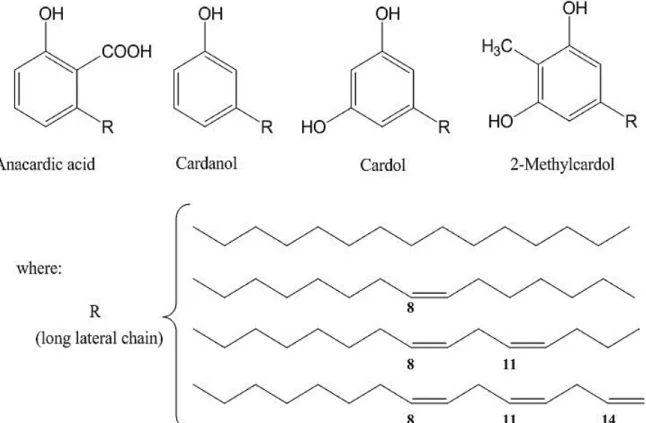
Fig. 1. Chemical structures of the main components of CNSL.
The CNSL can be found containing different proportions of its components depending on the way it is obtained. If extracted by solvent it has an average composition of anacardic acid (60%-65%), cardol (15%-20%), cardanol (10%) and traces of the methylcardol. While the Technical-CNSL (obtained by industrial process) contains, mainly, cardanol (60%-65%), cardol (15%-20%), polymeric material
(10%) and traces of methylcardol [5]. The Technical-CNSL has a higher concentration of cardanol because in the industrial process it is exposed to high temperatures (180ºC). In this process occurs anacardic acid decarboxylation (loss of grouping carboxyl– COOH) turning into cardanol (Figure 2). The CNSL produced by this procedure is known as Technical-CNSL [15-17].
C
15
H
31
- n
OH
COOH
180 ºC
C
15
H
31
- n
OH
+
CO
2
Fig.2.Reaction representation takes place the conversion of anacardic acid to cardanol by thermal decarboxylation. Road duplication and maintenance requires solutions
to the different physical and chemical problems. Among the main problems found in pavement engineering are: thermal susceptibility and adhesiveness, which are related to the characteristics of pavement surface course and weather conditions, permanent deformation on the wheel tracks and fatigue cracking, due to the volume of traffic and the overall pavement structure. To deal with such problems, there is
extensive literature on additives for asphalt binders in the pursuit of improving the asphalt cement (AC) performance.
with the polymer EVA, and positive effect on the stability of the AC storage modified with SBS polymer [19-20].There are several studies showing that cardanol carboxyl-polybutadiene (CTPB), polyester and polyaniline type resins are produced for various purposes. In these studies, it was verified that resins obtained from phenols derived from CNSL showed the same thermal behavior as those obtained from petrochemical phenols [21-24].
There are few reports in literature about the use of resins obtained from the cardanol and its use in asphalt binder. By means of asphaltic mixtures, this work seeks not only a solution for pavement problems, but also to give a new application to the resin obtained from a renewable product and still generates a higher added value to CNSL.
2. Materials and Methods 2.1 Materials
In this study we used the technical CNSL from the nut manufactures CIONE (Fortaleza, Ceará, Brazil); the Cardanol-formaldehyde resin produced from the reaction between cardanol (taken from CNSL) with formaldehyde and CAP with degree of penetration 50/70, processed by PETROBRAS / LUBNOR.
2.2 Methods
2.2.1 Synthesis of the phenolic resin
The phenolic resin was synthesized by adapting the methodology proposed by Bisanda and Ansell [25]. The procedure carried out involved about 1 mole of cardanol for each 0.7 mole of formaldehyde, which were weighed and added to the glass beaker. Formaldehyde solution (37%) was added to cardanol. After homogenization, 5% concentrated hydrochloric acid was added. Following completion of the reaction (1:40 min), it was washed to complete neutralization. The reaction took place under normal temperature and pressure conditions. Analysis of the chemical composition of cardanol and the resin was performed using infrared spectroscopy with Fourier transformation (FTIR), and comparison with literature data. All experiments were performed in the Shimatzu FTIR spectrometer-8300 model, using KBr tablet into the transmittance mode.
2.2.2 Preparation of the mix asphalt
The pure AC was modified with 4% of cardanol-formaldehyde resin. The mixture was held at Pavement Mechanics Laboratory (LMP / UFC) and called CAPRES. The AC modified with 4% of the resin was prepared using a high shear stirrer IKA model RW20 with constant stirring of 1600 rpm for a period of 1.5 hours at temperature of 160 °C + or - 5 °C.
2.2.3 Viscosity Determination
The viscosity of pure and modified AC was determined according to ASTM D4402 (2007) equivalent to NBR 15184, in the following temperatures: 135, 150 and 175 °C at different shear rates, using a cylindrical rotational viscometer Brookfield model DVII+ coupled to a Thermosel to the control of temperature, which measures viscosity by the torque required to run a test rod (spindle) immersed in the heated asphalt specimen.
2.2.4 Dynamic-Mechanical Characterization
The testes were performed on pure CAP and modified using a dynamic shear rheometer AR 2000 (AR Instruments). Proof-bodies were prepared in a silicone mold of approximately 1 mm thickness and 25 mm diameter. Then, frequency scanning assays were performed (range 0.01 to 100 Hz) in a temperature range of 45 to 90 °C sample before and after RTFOT.
The values of G*, G 'and δ were placed on a log-log scale to give the master curve, with 60 °C as the reference temperature.
The viscoelastic parameters related to the performance of asphalt binders in relation to permanent deformation are obtained by the graphic G */sin δ versus temperature. ASTM D6373 (1999) was used as the reference. 3. Results and discussion
3.1 Characterization of the additive or the FTIR
The absorption spectrum in the infrared region cardanol shows some very distinctive peaks. The band at 3379 cm-1 corresponds to stretching of OH bond. This band is very wide due to the presence of hydrogen bonding. The band at 3008 cm-1 is stretch characteristic of CH bonds of Csp², while the doublet at 2924 and 2854 cm-1 corresponds to stretch links CH2 and CH3 respectively, corresponding to long aliphatic chain. These bands are also present in the spectrum of cardanol-formaldehyde resin [26,27].
The dual band in 1487 and 1457 cm-1 is characteristic of connection C = C ring. The band in 1342 is due to angular deflection out of the plan of the OH. The band in 1265 cm-1 is asymmetric stretch characteristic of the CC link connected to -OH, whereas in 1157 cm-1 the band is due to stretching of bonds CO. One of the most important bands for comparison purposes is this band 779 cm-1 corresponding to three adjacent ring hydrogen present only in the spectrum cardanol [28].
spectrum is the condensation on the characteristic aromatic region indicating an occurrence of polymerization [28].
3.2 Viscosity Determination
The viscosity, defined as resistance to flow, is used to evaluate the workability of the AC at elevated temperatures. The change in viscosity values for the pure AC and modified with 4% of cardanol-formaldehyde resin (CAPRES) before and after aging in a rotary thin film oven (RTFOT) according to temperature can be visualized in Figure 3.
Fig. 3. Viscosity (n) versus temperature of pure AC and CAPRES before e after RTFOT
Figure 3 shows the viscosity results depending on the temperature of the pure AC and modified by resin before and after RTFOT in the rate of 20rpm. It is observed that the AC modified after aging showed higher viscosity than pure AC, which makes it less susceptible to temperature variations.
A high increase in viscosity implies higher energy costs when the modified ACs are subjected to the procedures used in paving, eg. pumping. The higher the temperature to flow the binder the greater the problems because it leads to formation of excessive fumes and release of gases, which affect who handles the AC.
Moreover, high temperature favor the thermal separation of the binder and the polymer and excessive oxidation of the material. Taking into account that the viscosity limit allowed for modified asphalt is 3000cP at 135 °C (SHRP, 1994), it can be inferred that the oligomer does not
excessively raise the viscosity, which makes it a viable additive since it provides an increase in viscosity, but not so much as to make it a AC inappropriate for use.
After RTFOT it is expected an increase in viscosity, since there is an increase of polar molecules due to oxidation of the resin, where they are transformed into asphaltene molecules due to the heating in the oxidative atmosphere. With the formation of these molecules occurs an increase of the molecular interactions in colloidal system, causing a greater stiffness in the binder. Table 1 shows the results obtained in rotational viscometer. It is found that the resin increases considerably the dynamic viscosity of the AC, changing its rheological properties.
Table I
Viscosity (n) pure CAP and CAPRES 135, 150 and 175 °C.
130 140 150 160 170 180
0 250 500 750 1000 1250 1500
Vi
scosi
ty
(cP)
Temperature (ºC)
Pure CAP
CAPRES
Pure CAP RTFOT
CAPRES RTFOT
Viscosity before RTFOT
Viscosity after RTFOT
Temperature(ºC)
135
150
175
135
150
175
(n) Pure CAP
510
268
99
863
385
138
Table II shows the viscosity values at 135 °C of the pure AC and of modified with 4% of the resin. The aging
index (AI) of each sample (established as being the ratio of the viscosity after and before RTFOT) was also calculated.
Table II
Viscosity of Pure samples from CAP, CAPRES before and after RTFOT, and estimation of the aging index.
It was observed in the samples shows no differences when comparing pure AC and modified, so it may be inferred that the additive did not act as an antioxidant.
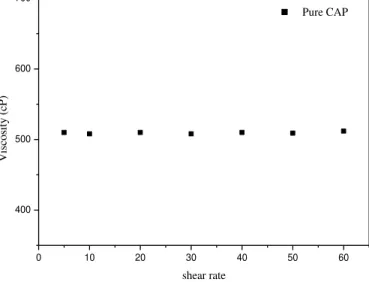
Fig. 4.Viscosity versus shear rate for the Pure AC to 135 °C.
For the analysis of the graph (Figure 4) there is the Newtonian be havior for pure AC, since the viscosity is independent of shear rate. This behavior has changed with the addition of resin (Figures 4 and 5) at temperatures above 100 °C, especially at low shear rates because, as noted, there is a viscosity variation with shear rate for modified asphalt
specimen. Since the viscosity decreases with the shear rate, the asphalt mix is classified as a pseudoplastic fluid, that is, it is a non-Newtonian fluid, which leads us to infer that used parameters applied to Newtonian fluids should not be used in the modified binder [29].
0 10 20 30 40 50 60
400 500 600 700
V
is
co
si
ty
(
cP
)
shear rate
Pure CAP
Sample
Viscosity (cP) to 135ºC IE
before RTFOT after RTFOT after RTFOT/ before RTFOT
Pure CAP
510
863
1,7
Fig. 5.Viscosity vs shear rate for CAPRES 135 º
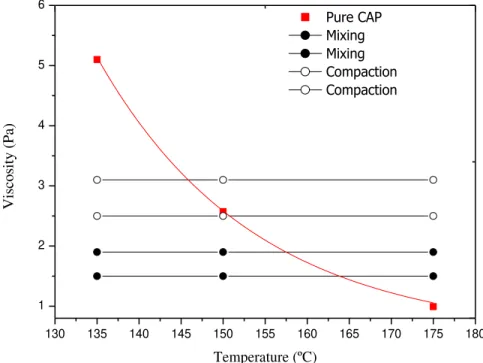
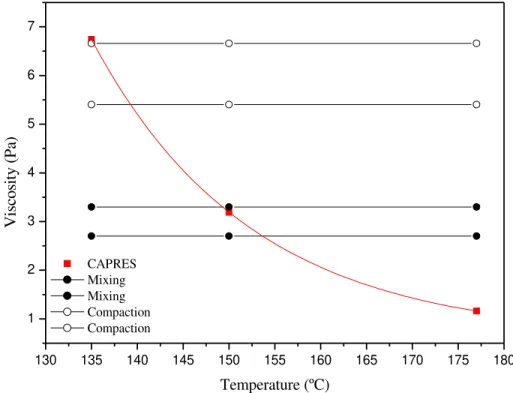
Asphalt mixtures have been produced at relatively high temperatures. Temperatures above 160 °C are required to obtain adequate viscosity in the mixture AC to coat the aggregates in the mixing process. [30]. However, there are risks related to the use of such high temperatures, such as release of volatiles, waste disposal and excessive oxidation of the binder [31]. The temperature compaction and mixing (MCT) graphics, based on ASTM method D2493 (1987) are shown in Figures 6 and 7.
Fig. 6. Compaction and mixing temperature for pure AC.
0 10 20 30 40 50 60
400 500 600 700
V
is
co
si
ty
(
cP
)
shear rate
Pure CAP
130 135 140 145 150 155 160 165 170 175 180
1 2 3 4 5 6
V
is
co
si
ty
(
P
a)
Temperature (ºC)
Fig. 7.Compaction and mixing temperature for CAPRES.
The results were recorded in Table 3.
Table III
Compression temperature and machining for pure and modified CAP.
For CAPRES (Figure 7) results of MCT were observed. There was a reduction of approximately 10°C. This is excellent, as values above the recommended for the MCTs may present operational risk due to the release of toxic gases, as well as the degradation of the AC. This decrease makes the binder less harmful to the environment, as well as to operators in the work field.
3.3 Dynamic-Mechanical Characterization
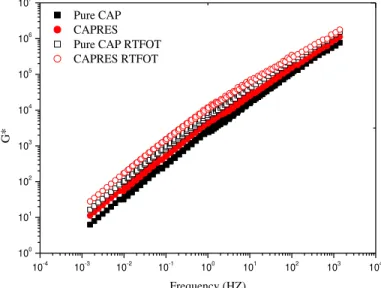
The effect of frequency in the complex modulus (G*) is shown in Figure 8a and 8b for pure and modified AC, before and after aging, respectively. These values are summarized in the Figure 9. To construct the master curve, a reference temperature was selected (60 °C) and all other temperatures were transported horizontally to adjust the reference curve (Curve Master). The temperature of 60 °C was used because the tests were performed at elevated temperatures only. The effect of addition of the oligomer was observed to evaluate the behavior of the parameters G* and
the δ of the binder. The complex modulus (G*) is related to the stiffness of the material at different shear rates, the phase
angle (δ) provides information on the ratio between elastic (G’) and viscous G’’) response during the shearing process; the storage modulus (G') can be compared with elastic return; the higher the G' greater the elasticity of the material in a given frequency. A high value of the complex modulus represent greater stiffness. A higher value of G' represents a more elastic material, as well as a lower phase angle is greater elastic response.
130 135 140 145 150 155 160 165 170 175 180
1 2 3 4 5 6 7
V
is
co
si
ty
(
P
a)
Temperature (ºC)
CAPRES Mixing Mixing Compaction Compaction
Pure AC CAPRES
Compaction range (ºC) 145 – 150 135 – 139
Fig. 8.Master Curve G * as a function of frequency of the Pure AC and CAPRES to the reference temperature of 60 °C before (a) and after (b) RTFOT aging.
Fig. 9.Master Curve G * as a function of frequency to pure AC and CAPRES to 60 °C reference temperature before and after RTFOT aging.
Fig. 10. Phase angle (δ) versus frequency for the AC pure CAPRES before (a) and after aging (b).
10-4 10-3 10-2 10-1 100 101 102 103 104
100 101 102 103 104 105 106 107 Pure CAP CAPRES Pure CAP RTFOT CAPRES RTFOT G* Frequency (HZ) 10-3 10-2 10-1 100 101 102 103 104 100 101 102 103 104 105 106 107 Pure CAP CAPRES (a) G* Frequêncy(Hz) 10-4 10-3 10-2 10-1 100 101 102 103 10 101 102 103 104 105
106 Pure CAP RTFOT
CAPRES RTFOT (b) G* Frequêncy (Hz) 10-3 10-2 10-1 100 101 102 103 104 55 60 65 70 75 80 85 90 95 100 Pure CAP CAPRES (a) P ha se a ng le Frequency (Hz) 10-4 10-3 10-2 10-1 100 101 102 103 104 55 60 65 70 75 80 85
90 Pure CAP RTFOT
Due to the validity time-temperature for asphalt binders, the effect of temperature is equivalent to the frequency, with high frequencies corresponding to low temperatures, and low frequencies corresponding to high temperatures. Looking at Figure 9, there is a typical behavior for asphalt binders; G* increases with frequency, that is, at
low temperatures the binder tends to be more rigid. While δ
tends to decrease with increasing frequency (Figure 10), that is, at low temperatures, there is an increased storage modulus (G'), in other words, the AC becomes more elastic.
When compared pure AC, the CAPRES showed an increase in the value of complex modulus (G*) at elevated and intermediate temperatures (low to intermediate frequencies). It was observed also that the AC modified showed a greater decrease in the phase angle (Figure 10) which leads us to infer that there was an increase in the storage modulus (G'), that is, the mixture showed a larger character elastic compared to pure AC. These results allow us to infer that the additive left the binder stiffer, providing the AC greater resistance to breakage by wheel tracks, for example.
Figure 10 shows a typical behavior for the binders.
δ tends to decrease with increasing frequency, that is at low temperatures there is an increased storage modulus (G')increasing the AC elastic character. It is observed that the CAPRES showed a greater decrease in the phase angle which is an increase in the storage modulus (G'), so the mixture showed a greater elastic nature if compared to pure AC. Another important factor to be noted is that the increase in G* and decreased in δ, both before and after oxidative aging.
Once the mixture showed a larger G* value and a lower value of δ, we can infer that the modified binder present a better response to permanent deformation which is a another major problem in paving in hot climates.
4. CONCLUSIONS
Chemical prospecting of cardanol and the addition of its derivative in the asphalt binder showed promising results regarding the improvement of physical-chemical and rheological properties of the AC, as well as providing an appreciation of CNSL.
There are several studies using the CNSL as an additive in asphalt binder, such as: research on the feasibility of using the CNSL as asphalt diluent after checking the formation of a homogeneous mixture with the AC, low residual content whit heating; the effectiveness of CNSL as a aging reducing agent asphalt binder modified with EVA polymer and Indication of CNSL as a potential alternative for improving the stability to storage of binder modified with SBS (replacing the aromatic oils) for being an abundant product, low cost and little aggressive to the environment [19,32,33]. In this study, the focus was on the synthesis of a phenolic resin derived from cardanol obtained from cashew nut liquid. The FTIR analysis of the resin showed characteristic bands as well. Through these, it was possible to confirm that the cardanol polymerized in the aromatic ring, forming the polymer resin.
Taking into consideration that binder service is subjected to a maximum temperature range that varies from 150 to 175 °C, it was observed by thermogravimetric analysis that the resin is an excellent additive since it begins to decompose only at 300 ºC.
The AC modified performed better than pure AC analyzing the rheological parameters, such as stiffness and lower phase angle, which gives CAPRES a better performance with respect to permanent deformation.
When it comes to compaction and mixing temperature values, the additive reduced about 10°C. Whereas at higher temperatures there is the release of toxic gases, aging, degradation, and a possible separation of polymer in relation to the binder, the reported decrease is significant.
Therefore, the use of resin obtained from CNSL as additives in asphalt binders seems very promising, not only for improvements presented here, but also as excellent opportunity to add value to the CNSL.
REFERENCES
[1] TREVISAN M. T. S.; PFUNDSTEIN B.; HAUBNER, R.; WÜRTELE, G.;SPIEGELHALDER. B.; BARTSCH, H.;et al.Food ChemToxicol. 2006; vol. 44, p. 188–97.
[2] PARAMSHIVAPPA, R. J.; KUMAR, P. S.; VITHAYATHIL, P. J.; SRINIVASA, R. A.; J. Agric. Food Chem.2001; vol. 49, p. 2548-2551.
[3] BARROS, L. M.; Embrapa Agroindústria,Tropical, 2002; vol. 148, p.148.
[4] SANTOS R. C. S.; AMORIM A. G. N.; THOMASI S. S.; FIGUEIREDO F. C.; CARNEIRO C. S.; SILVA P. R. P.; VASCONCELOS neto W. R.; FERREIRA A.G.; SANTOS JUNIOR J. R.; LEITE J. R. S.A.;Fuel. 2015; vol. 144, p. 415–422.
[5] LOMONACO D.; MAIA F. J. N.; CLEMENTE C. S.; MOTA J. P. F.; JUNIOR A. E. C.; MAZZETTO S. E. Fuel. 2012; vol. 97, p. 552–559.
[6] MAZZETTO, S. E.; LOMONACO, D.; MELE, G.; Química Nova,
2009; v. 32, p. 732-741.
[7] CASTRO, A.M.G.; LIMA, S. M.V.; GOEDWERT, W.J.; FREITAS F. A.; VASCONCELOS, J.R. P. EMBRAPA-SPI, 1998; cap.11, p.275-301.
[8] VELMURUGAN,A.; LOGANATHAN M.; GUNASEKARAN, E. J. Fuel. 2014; vol. 132, p. 236–245.
[9] ORAZIO A. A.; STEFANO B.; CINZIA F.; PAOLINO F.; GIUSEPPE M.; RAFFAELE S. Tetrahedron.2006; vol. 62, p. 6113–6120.
[10] MENON, A. R. R.; PILLAI, C. K. S.; SUDHA, J. D.; MATHEW, A. G. J. Sci. Ind. Res.1985; vol. 44, p. 324-338.
[11] SANTOS, M. L. D.; MAGALHÃES, G. C. D., J Braz Chem Soc.1999; vol. 10, p.13.
[12] AMORATI R., ATTANASI, O. A., FAVI G, MENICHETTI S, PEDULLI G, VIGLIANIS C. Org BiomolChem 2011; vol. 9, p. 1352–1355.
[13] RODRIGUES F.H.A.; FRANÇA F.C.F.; SOUZA, J.R.R.; RICARDO, N.M.P.S.; FEITOSA J.P.A. Polímeros 2011; vol. 21, p. 156–160.
[14] MAHANWAR, P. A.; KALE, D. D. J. Appl. Polym Sci.1996; vol. 61, p. 2107-2111.
[15] PIYALI Das; SREELATHA T.; ANURADDA, G. Biomass Bioenergy 2004;27: 265–275.
[16] TYMAN, J. H. P. Synthetic and Natural Phenols; Elsevier: Amsterdam, 1966.
[17] RISFAHERI; IRAWADI, T. T.; NUR, M. A.; SAILAH, I. Indones J. Agric.2009; vol. 2, p. 11–20.
[18] RIBEIRO, E. A.Master's Dissertation, Federal University of Ceará. Fortaleza, Ceara.2011.
[20] RODRIGUES, F. O.Master's Dissertation, Federal University of Ceará. Fortaleza,Ceara.2010.
[21] YADAV, R., SRIVASTAVA, D. Chemistry & cheimal technolog.
2008; vol. 2, p.173-184.
[22] MOTHE, C. G., AMARAL, P. S.T.,. Revista Analytica. 2004; vol. 11, p. 40-44.
[23] JUNIOR, F. G. S.; FERREIRA, P. R. R.; OLIVEIRA, G. E.; JUNIOR, P. A. M.; NELE, M.; SOARES, B. G.; PINTO, J. C. 9th Brazilian Congress of Polymers, Campina Grande. Paraíba, 2007. [24] PAPADOPOULO, E., CHISSAFIS, K. Thermochimica Acta.
2011; vol. 512, p. 105-109.
[25] BISANDA, E. T. N.; ANSELL, M.P. Journal of Materials Science.
1992; vol. 27, p. 1690-1700.
[26] SILVERSTEIN, R. M.; BASSLER, G. C.; MORRIL, T.C.1994.
[27]BARBOSA, L. C. A. 2007.
[28] PATEL, R. N; BANDYOPADHYAY, S. GANESH, A. Energy,
2011. vol. 36, p. 1535-1542.
[29] LUCENA, M. C. C. Thesis submitted to the Post-Graduation Program in Chemistry of the Federal University of Ceará-UFC.
2005.
[30] LANDA, P.A.; KNEEPKENS T.; ZUWAN, V.D.3th Eurasphalt δ
Eurobitume Congress, Vienna, 2004.
[31] LARSEN, O.R.; ROBERTUS, C.;KOENDERS, W. B.G. 3th
Eurasphalt δ Eurobitume Congress, Vienna, 2004.
[32] RABELO, A. N. Dissertation submitted to the Post-Graduation Program of Transport Engineering of the Federal University of Ceará-UFC. 2006.