How many rifting events preceded the development of the
Araçuaí-West Congo orogen?
Antônio Carlos Pedrosa-Soares
1& Fernando Flecha de Alkmim
21. CPMTC-IGC-UFMG, Belo Horizonte, MG. [email protected] 2. DEGEO-Escola de Minas-UFOP, Ouro Preto, MG. [email protected]
Received 18 October 2011, accepted 21 November 2011
ABSTRACT: The development of the Araçuaí-West Congo orogen (AWCO) started around 630 Ma, as suggested by U-Pb ages from the oldest rocks yet found in its pre-collisional magmatic arc. This orogeny was preceded by at least six events of rifting and/or anorogenic magmatism, which affected the area occupied by the AWCO and the adjacent São Francisco-Congo craton, namely: the Statherian E1 (1.77-1.7 Ga), Calymmian E2 (1.57-1.5 Ga), Early Stenian E3 (1.18 - ? Ga), Stenian-Tonian E4 (ca. 1 Ga), Tonian E5 (930-850 Ma) and Cryogenian E6 (750-670 Ga) events. The E1 event, currently referred to as the Statherian taphrogenesis, took place between ca. 1.77 Ga and 1.7 Ga. It is recorded by the rift-related sedimentary and volcanic rocks of the basal section of the Espinhaço Supergroup, as well as the anorogenic plutons of the Borrachudos and Lagoa Real suites. The E1 event was followed by a Calymmian episode, the E2 (ca. 1.57 Ga), recorded in the northern Espinhaço range and Chapada Diamantina by sediments and volcanics of the middle portion of the Espinhaço Supergroup. The manifestations of the Stenian E3 event started around 1.18 Ga with the syn-rift deposition of the Sopa-Brumadinho Formation (Espinhaço Supergroup), exposed in the Araçuaí belt. The first three events (E1, E2 and E3) are so far not found in the West Congo belt. In this belt, a magmatism took place at the Stenian-Tonian time boundary, the anorogenic Noqui granites (ca. 999 ± 7 Ma) and related volcanic rocks, recording a probably local extensional event, E4, which can be correlated to mafic dykes of similar age found in southern Bahia (eastern tip of the São Francisco craton). The thick bimodal volcanic pile of the Zadinian and Mayumbian groups and related intrusions are the main records of the Tonian E5 event in the West Congo belt. The A-type Salto da Divisa Suite and Tonian mafic dykes (e.g., Pedro Lessa and Northern Espinhaço range), as well as the deposition of the pre-glacial formations of the Macaúbas basin are manifestations of the E5 event in the Araçuaí orogen and São Francisco craton. Records of the Cryogenian E6 event include the Southern Bahia alkaline province (ca. 735-675 Ma) and, probably, the La Louila felsic volcanism in SW Gabon (≤ 713 Ma), as well as the deposition of the diamictitic formations of the Macaúbas Group and correlatives. The E6 event evolved to oceanic spreading in the central-southern Macaúbas basin, but this process died out toward north keeping unbroken the continental link between the São Francisco peninsula and Congo continent (the Bahia-Gabon bridge). In fact, all those extensional events were unsuccessful in splitting the São Francisco-Congo plate, which amalgamated in the Rhyacian-Orosirian time boundary (ca. 2.05 Ma) and remained as such until the Lower Cretaceous, as the Atlantic rifting then successfully broke through the old continental mass.
Keywords: rift, anorogenic magmatism, Araçuaí-West Congo orogen, São Francisco-Congo craton
RESUMO: QUANTOS EVENTOS DE RIFTEAMENTO PRECEDERAM O DESENVOLVIMENTO DO ORÓGENO ARAÇUAÍ-CONGO OCIDENTAL? A edificação do Orógeno Araçuaí-Congo Ocidental teve início por volta de 630 Ma, como indicam as idades U-Pb mais antigas até agora obtidas de rochas do seu arco magmático. Esta orogenia foi precedida de, pelo menos, seis eventos de rifteamento e/ou magmatismo anorogênico que afetaram a região ocupada pelo Orógeno Araçuaí-Congo Ocidental, bem como o domínio cratônico São Francisco-Congo a ele adjacente. São eles os eventos E1 (Estateriano, 1,77-1,7 Ga), E2 (Calimiano, 1,57-1,5 Ga), E3 (Esteniano, 1,18 - ? Ga), E4 (no limite Esteaniano-Toniano, ca. 1 Ga), E5 (Toniano, 930-850 Ma) e E6 (Criogeniano, 750-670 Ma). O evento E1, chamado de Tafrogênese Estateriana, teve lugar entre 1,77 e 1,70 Ga e tem como registros mais importantes a deposição rifte das unidades sedimentares e vulcânicas da base do Supergrupo Espinhaço, bem como o alojamento dos plutons anorogênicos das suítes Borrachudos e Lagoa Real. O evento E1 é sucedido por uma nova fase de distensão durante o período Calimiano, em torno de 1,57 Ga, que é representada no Espinhaço Setentrional e Chapada Diamantina por rochas sedimentares e vulcânicas da porção média do Supergrupo Espinhaço.Manifestações do evento E3 (Esteniano) tiveram início em torno de 1,18 Ga com a deposição da Formação Sopa-Brumadinho (Supergrupo Espinhaço), exposta na Faixa Araçuaí. Os três primeiros eventos (E1, E2 e E3) parecem não ter ocorrido na Faixa Congo Ocidental. Nesta faixa, os granitos Noqui (999 ± 7 Ma) e rochas vulcânicas associadas representam um magmatismo anorogênico do limite Esteniano-Toniano, registrando um evento provavelmente local (E4), mas que pode ser correlacionável aos diques máficos de idade similar que ocorrem no sul da Bahia, no extremo oriental do Cráton São Francisco. As espessas sucessões de rochas vulcânicas bimodais dos grupos Zadiniano e Mayumbiano (930-910 Ma) constituem os principais registros do evento E5 na Faixa Congo-Ocidental. O magmatismo anorogênico representado pela Suíte Salto da Divisa e enxames de diques máficos tonianos (e.g., Pedro Lessa e Espinhaço Setentrional), assim como, muito provavelmente, os depósitos pré-glaciais da bacia Macaúbas são manifestações de E5, em terrenos do Orógeno Araçuaí e Cráton do São Francisco. O evento criogeniano, E6, é evidenciado pela Província Alcalina do Sul da Bahia entre 735 e 675 Ma, e, muito provavelmente, pelas formações diamictíticas do Grupo Macaúbas e unidades correlativas na Faixa Congo Ocidental, e pelo vulcanismo félsico La Louila (≤ 713 Ma) do sudoeste do Gabão. O evento E6 evoluiu para espalhamento oceânico no setor centro-sul da Bacia Macaúbas, mas este processo não afetou a parte norte desta bacia e, por isto, deixou íntegra a ligação continental (a ponte Bahia-Gabão) entre a Península São Francisco e o Continente Congo. De fato, nenhum dos eventos distensionais mencionados logrou levar à ruptura a placa São Francisco-Congo que, aglutinada na transição Riaciano-Orosiriano (ca. 2,05 Ga), permaneceu íntegra até o Cretáceo Inferior quando, então, o rifte Atlântico finalmente conseguiu desmembrá-la.
Palavras-chave: rifte, magmatismo anorogênico, Orógeno Araçuaí-Congo Ocidental, Cráton São Francisco-Congo
1. INTRODUCTION
The history of the continents is punctuated by
relatively short intervals of convergence and
agglutination, which alternate with long periods of
fragmentation and drift (Nance
et al.
1988, Murphy
245 A.C. Pedrosa-Soares & F.F. de Alkmim / Geonomos, 19(2), 244-251, 2011
www.igc.ufmg.br/geonomos
words, the formation of a new continent, regardless
of its size, gives rise to orogenic systems of variable
configuration and architecture. Once formed, new
continents become a refractory cap hindering hot
release from Earth’s interior and, thus, providing
traps for accumulation of variable amounts of
ascending mantle material beneath them. Uprising
of hot mantle generally result in continental
extension, which is accommodated along rift
systems of variable size and styles, accompanied or
not by magmatic activity. The larger the continental
area, the greater its susceptibility to the action of
mantle derived processes.
The piece of Paleoproterozoic continental
lithosphere that included the São Francisco and
Congo cratons amalgamated by the beginning of the
Orosirian period, around 2.05 Ga, and remained as
such until the generation of the South Atlantic in the
Lower Cretaceous (
e.g.
, Ledru
et al.
1994, Silva
et al.
1997, Alkmim & Marshak 1998, Barbosa & Sabaté
2004, Lerouge
et al.
2006, Noce
et al.
2007, Heilbron
et al.
2010). At the time of its assembly, the São
Francisco-Congo lithosphere was probably part of a
large continent, the so-called Atlantica (Rogers 1996,
Rogers & Santosh 2004).
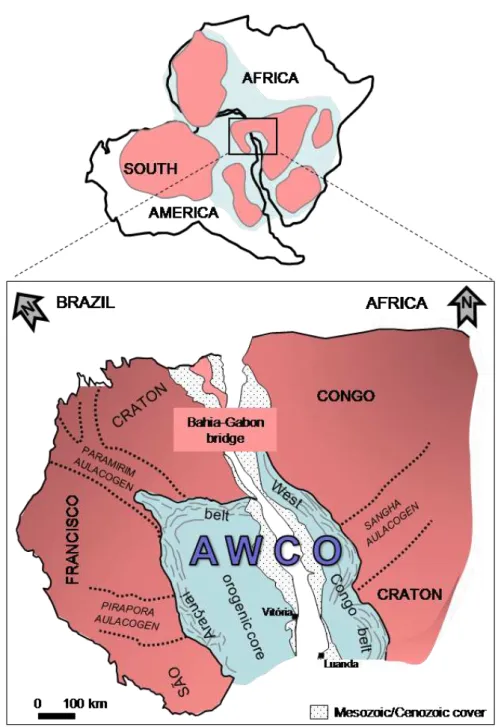
The Araçuaí-West Congo orogen (AWCO), which
encompasses the Araçuaí orogen of southeastern
Brazil and the West Congolian belt of southwestern
Africa (Fig. 1), developed during the amalgamation
of the Gondwana supercontinent by the end of the
Neoproterozoic Era (Pedrosa-Soares
et al.
2001,
2007; Alkmim
et al.
2006, 2007). The AWCO is, thus,
just a small portion of a giant orogenic network
generated along the margins of the various plates
that concurred to form West Gondwana
(Brito-Neves
et al.
1999, Cordani
et al.
2003). In this
scenario, the AWCO formed as the margins of a
terminal branch of the Adamastor ocean surrounded
by the São Francisco peninsula and Congo continent,
the Macaúbas gulf-like basin, converged and collided
(Fig. 1).
This paper discusses a series of extensional and
magmatic events that affected the São
Francisco-Congo plate in the time interval between its
assembly in the Paleoproterozoic and the
development of the AWCO during the Gondwana
amalgamation by the end of the Neoproterozoic.
Results of studies we conducted in the AWCO and
adjacent cratonic domains together with literature
data indicate that during this 1.5 Ga-long period the
São Francisco-Congo plate was not affected by
contractional events. Rather, it underwent at least
six major rifting/magmatic events that led to the
development of the Macaúbas basin, precursor of
the Araçuaí-West Congo orogen.
2. GEOTECTONIC SETTING
The Araçuaí-West Congo orogen evolved from
the Macaúbas basin inside an embayment bounded
on three sides by the Neoproterozoic continental
domain represented by the São Francisco and Congo
cratons (Fig. 1). This Neoproterozoic gulf, an
inland-sea basin partially floored by oceanic crust, was
opened to the Adamastor ocean and connected to
aulacogens located in the adjacent continental
areas. The aulacogenic branches accommodated the
enlargement of the Macaúbas basin and left intact
the so-called Bahia-Gabon cratonic bridge, the
crustal segment that linked the São Francisco and
Congo blocks. The Bahia-Gabon cratonic bridge
stood firm until the opening of the South Atlantic in
the Lower Cretaceous (
e.g.
, Porada 1989;
Pedrosa-Soares
et al.
2001, 2007, 2008; Cordani
et al.
2003;
Alkmim
et al.
2006, 2007).
In southeastern Brazil, the AWCO comprises the
external Araçuaí belt and the orogenic core (Fig. 1).
The type unit of the Araçuaí belt is the
Neoproterozoic Macaúbas Group, which includes rift
and passive margin successions (Pedrosa-Soares
et
al.
1992, 2008, 2011a; Uhlein
et al.
1998). Besides
the Macaúbas Group, the Araçuaí belt also involves
the Archean-Paloeproerozoic basement, Statherian
anorogenic granites, Statherian-Mesoproterozoic
metasedimentary and metavolcanic rocks of the
Espinhaço Supergroup, and anorogenic magmatic
rocks of Tonian age, like the A-type granites of Salto
da Divisa and mafic dykes (
e.g.
, Dussin & Dussin
1995, Uhlein
et al.
1998, Knauer 2007, Noce
et al.
2007, Pedrosa-Soares
et al.
2008, Silva
et al.
2008,
Chemale-Júnior
et al.
2011). The orogenic core is
made up of granitic and metamorphic high grade
rocks, including an Ediacaran magmatic arc (
e.g.
,
Pedrosa-Soares
et al.
2008, 2011b; Silva
et al.
2011).
The African portion of the AWCO is represented
by the West Congo belt which involves
Archean-Paleoproterozoic basement and the Neoproterozoic
metassedimentary and metavolvanic units of the
Zadinian, Mayumbian and West Congolian groups
(Tack
et al.
2001).
Figure 1. Geotectonic setting of the Araçuaí-West Congo orogen and related aulacogens and cratons (modified from Alkmim et al. 2006).
Figura 1. Situação geotectônica do Orógeno Araçuaí-Congo Ocidental, e aulacógenos e crátons relacionados (modificado de Alkmim et al. 2006).
The onset of the orogenic stage in the AWCO can
be traced by the crystallization ages of the oldest
igneous bodies formed in the pre-collisional
magmatic arc, which have been dated at around 630
Ma. This age constrains the starting time of the
convergence of the margins of the precursor basin
and consumption of its oceanic lithosphere. The
collisional stage reaches its climax around 580-570
Ma, as indicated by the ages of syn-collisional
granites and metamorphism (Pedrosa-Soares
et al.
2011b, Silva
et al.
2011).
3. THE EVENTS PRECEDING THE DEVELOPMENT OF
ARAÇUAÍ-WEST CONGO OROGEN
247 A.C. Pedrosa-Soares & F.F. de Alkmim / Geonomos, 19(2), 244-251, 2011
www.igc.ufmg.br/geonomos
3.1 - The Statherian E1 event
The oldest rifting event affecting the São
Francisco-Congo plate after its assembly in the
Rhyacian/Orosirian transition (
ca
. 2.05 Ga) is the
so-called Statherian taphrogenesis that took place in
the time between ca. 1.75 Ga and 1.70 Ga
(Brito-Neves
et al.
1995). Well documented in the Araçuaí
orogen and São Francisco craton, the E1 event was
so far not found in the West Congo belt and adjacent
region of the Congo craton (Tack
et al.
2001). The
main manifestation of the E1 event is the nucleation
of the Espinhaço rift system, which was associated
with:
-
deposition of the basal units of the
Espinhaço Supergroup, specifically, the
Bandeirinha and São João da Chapada
formations of the southern Espinhaço
range, the São Simão Formation of the
northern Espinhaço range, and the Rio dos
Remédios
Group
(Novo
Horizonte
Formation) in the Chapada Diamantina
(Brito-Neves
et al.
1995, Dussin & Dussin
1995, Schobbenhaus
et al.
1996, Uhlein
et
al.
1998, Guimarães
et al.
2008, Loureiro
et
al.
2008, Danderfer
et al.
2009,
Martins-Neto 2000, Chemale-Júnior
et al.
2010,
2011);
-
deposition of the base of the Araí Group
exposed in the northern Brasília belt (Brito
Neves
et al.
1995);
-
extrusion of a considerable volume of
bimodal volcanics, also represented by the
basal portion of the Espinhaço Supergroup
(Brito
Neves
et
al.
1979,
1995;
Schobbenhaus
et al.
1994, Babinski
et al.
1994, Dusssin & Dussin 1995, Danderfer
et
al.
2009, Chemale-Júnior
et al.
2011);
-
emplacement of the Borrachudos Suite
exposed in the southern segment of the
Araçuaí belt, which consists of anorogenic
granites dated around 1.75 Ga (Grossi Sad
et al.
1990, Dussin
et al.
1994,
Chemale-Júnior
et al.
1998, Fernandes 2001, Silva
et
al.
2002)
-
emplacement of the protoliths of the Lagoa
Real Complex and coeval plutons (São
Timóteo
Granite)
that
intrude
the
basement along the axis of the Paramirim
aulacogen (Fernandes
et al.
1982, Turpin
et
al.
1988, Cordani
et al.
1992, Pimentel
et al.
1994, Arcanjo
et al.
2000, Cruz 2004, Cruz
et al.
2007).
3.2 - The Calyminan E2 event
The second oldest episode of extensional
tectonism and magmatism is recorded by the middle
portion of the Espinhaço Supergroup in the
Paramirim Aulacogen. In the northern Espinhaço
range, this episode is represented by alluvial and
aeolian sandstones, and acid to intermediate
volcanics of the Bomba Formation, which have
yielded U-Pb ages of 1582 ± 8 Ma and 1569 ± 14 Ma
(Danderfer
et al.
2009). The deposition of alluvial
and aeolian sediments of the Tombador Formation
(Chapada Diamantina Group), and intrusion of dykes
and sills dated around 1.51 Ga are the
manifestations of the E2 event in the Chapada
Diamantina domain (Babinski
et al.
1994, Battilani
et
al.
2007; Guimarães
et al.
2008, Loureiro
et al.
2008,
Danderfer
et al.
2009). Rare 1.51-1.57 Ga detrital
zircons occur in the upper Espinhaço Supergroup
and younger units involved in the Araçuaí orogen
(Babinski
et al.
2011, Chemale-Júnior
et al.
2011,
Gonçalves-Dias
et al.
2011). They are the only record
of the E2 event yet found in the orogen. The E2
event has not been documented in the West Congo
belt and adjacent region of the Congo craton (Tack
et al.
2001).
3.3 - The Early Stenian E3 event
As recently demonstrated by Chemale-Júnior
et
al.
(2010, 2011), the thick package of alluvial, aeolian
and marine sediments of the middle and upper
Espinhaço Supergroup exposed in the Araçuaí belt,
i.e.
, the Sopa-Brumadinho and overlaying units,
represent a rift-sag sequence (Dussin & Dussin 1995,
Uhlein
et al.
1998, Martins-Neto 2000), whose
deposition started around 1.18 Ga. During the Early
Stenian E3 event, the Statherian Espinhaço basin
was reactivated and expanded, to host the above
mentioned units. However, the upper time limit of
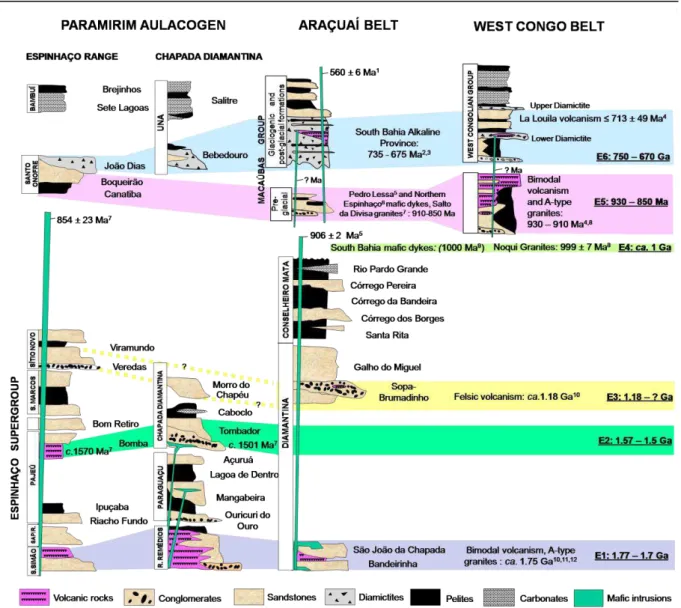
the E3 event is not constrained (Fig. 2). Evidence of
the E3 event seems to be absent in the West Congo
belt and adjacent region of the Congo craton.
3.4 - The Stenian-Tonian E4 event
Figure 2. Stratigraphic correlation chart highlighting the rifting and anorogenic magmatic events that preceded the uplift of the Araçuaí-West Congo orogen. Ages: 1, Martins et al. (2011); 2, Teixeira et al. (1969); 3, Rosa et al. (2007); 4, Thieblemont et al. (2011); 5, Machado et al. (1989); 6, Danderfer et al. (2009); 7, Silva et al. (2008); 8, Tack et al. (2001); 9, Renne et al.
(1990); 10, Chemale-Júnior et al. (2011); 11, Dussin et al. (1994); 12, Chemale-Júnior et al. (1998).
Figura 2. Carta de correlação estratigráfica, destacando os eventos de rifteamento e magmatismo anorogênico que precederam o soerguimento do Orógeno Araçuaí-Congo Ocidental. Idades: 1, Martins et al. (2011); 2, Teixeira et al. (1969); 3, Rosa et al. (2007); 4, Thieblemont et al. (2011); 5, Machado et al. (1989); 6, Danderfer et al. (2009); 7, Silva et al. (2008); 8, Tack et al. (2001); 9, Renne et al. (1990); 10, Chemale-Júnior et al. (2011); 11, Dussin et al. (1994); 12, Chemale-Júnior
et al. (1998).
3.5 - The Tonian E5 event
The main record of the E5 Tonian event is the
thick bimodal volcanic pile of the Zadinian and
Mayumbian groups and related intrusions of the
West Congo belt. The Zadinian Group consists of
rift-related siliciclastic sediments and peralkaline
rhyolites, covered by a thick succession of mafic
volcanic rocks. The Mayumbian Group, which is up
to 4 km thick, consists mostly of felsic volcanic rocks
intruded by abundant cogenetic bodies of
monzo-syenogranite to minor alkali-feldspar granite, and
subordinate sedimentary intercalations. Mayumbian
volcanic rocks have yielded U
–
Pb SHRIMP zircon
ages of 920 ± 8 Ma for the lower part of the pile and
912 ± 7 Ma for the upper section of the group (Tack
et al.
2001). Together, the Zadinian mafic
magmatism and overlying felsic Mayumbian
magmatism are a typical example of a bimodal
magmatic suite formed during continental rifting
(Cahen
et al.
1984, Tack
et al.
2001). Also, the
anorogenic granites and gabbros dated from
ca
. 904
Ma to
ca
. 867 Ma by Thieblemont
et al.
(2011)
represent the E4 event in the Gabon sector of the
West Congo belt.
249 A.C. Pedrosa-Soares & F.F. de Alkmim / Geonomos, 19(2), 244-251, 2011
www.igc.ufmg.br/geonomos
represents the E5 event in the Southern Espinhaço
range, and basic dykes of
ca
. 850 Ma record this
event in the Northern Espinhaço range (Danderfer
et
al.
2009). The A-type granites of the Salto da Divisa
Suite dated at 875 ± 9 Ma (Silva
et al.
2008)
represent the E5 event along the boundary between
the northeastern Araçuaí belt and the São Francisco
craton.
Although the subsidence mechanisms of the
Macaúbas basin are not well characterized, we
consider that the deposition of the diamictite-free
(pre-glacial) basal succession of the Macaúbas
Group, made up of breccias, conglomerates and
sandstones, took place in a rift stage during the E5
event (Pedrosa-Soares
et al.
2008, 2011a; Martins
et
al.
2008; Babinski
et al.
2011).
3.6. The Cryogenian E6 event
The main record of the E6 event is the
emplacement of the voluminous alkaline intrusions
that comprise the Southern Bahia alkaline province.
These anorogenic intrusions, dated between
ca
. 735
Ma and
ca
. 675 Ma, include peralkaline to
sub-alkaline rocks that occur in the eastern sector of the
São Francisco craton, close to the boundary to the
Araçuaí belt (Teixeira
et al.
1969, Rosa
et al.
2007).
In the northern portion of the West Congo belt,
in Gabon, the La Louila Formation includes rhyolites
and rhyolitic tuffs with a maximum age of 713 ± 49
Ma (Thieblemont
et al.
2011), representing another
manifestation of the Cryogenian E6 magmatism.
The glaciogenic diamictitic formations of the
Macaúbas Group together with their correlatives in
the West Congo belt and cratonic domains (
e.g.
,
Jequitaí
and
Bebedouro
formations)
might
constitute the sedimentary record of the E6 event.
Despite of the presence of mafic volcanic rocks
intercalated in diamictites of the Macaúbas Group,
the attempts to better constrain the age of this
rift-related glacial deposits were so far unsuccessful
(Babinski
et al.
2005, 2011). The available data
indicates that these units accumulated sometime
between 900 Ma and 740 Ma (Babinski
et al.
2011,
Pedrosa-Soares
et al.
2011a). The minimum age of
740 Ma is given by the basal portion of the Sete
Lagoas Formation, a cap-carbonate dated at 740 ±
22 Ma (Babinski
et al.
2007), that overlies the
glaciogenic Jequitaí Formation in the interior of the
São Francisco craton.
4. CONCLUSION
In the region occupied by the Ediacaran
Araçuaí-West Congo orogen and adjacent cratonic domains,
at least six events of rifting and anorogenic
magmatism can be identified, namely: the
Statherian E1 (1.77-1.7 Ga),
Calymmian
E2 (1.57-1.5
Ga), Early Stenian E3 (1.18 - ? Ga), Stenian-Tonian E4
(
ca
. 1 Ga), Tonian E5 (930-850 Ma) and Cryogenian
E6 (750-670 Ga) events (Fig. 2). The E6 event
evolved to oceanic spreading in the central-southern
Macaúbas basin, but this process died out toward
north keeping unbroken the continental link (the
Bahia-Gabon bridge) between the São Francisco
peninsula and Congo continent. In fact, all those
extensional events were unsuccessful in splitting the
São Francisco-Congo plate, which amalgamated in
the Rhyacian-Orosirian time boundary (
ca
. 2.05 Ma)
and remained as such until the Lower Cretaceous, as
the Atlantic rifting then successfully broke through
the old continental mass.
The time periods of some of these events seem
to be rather long and suggest more than only one
single extensional and/or magmatic episode,
requiring
more
detailed
sedimentological-stratigraphic
studies
accompanied
by
U-Pb
geochronological analysis.
5. ACKNOWLEDGEMENTS
This paper is a tribute to Carlos Maurício Noce,
our unforgettable friend and colleague. We
acknowledge the CNPq (Scientific and Technological
Research Council of Brazil) for the research grants.
6. REFERENCES
Alkmim F.F., Marshak S. 1998. Transamazonian orogeny in the southern São Francisco craton region, Minas Gerais Brazil: evidence for Paleoproterozoic collision and collapse in the Quadrilátero Ferrífero. Precambrian Research, 90: 29–58. Alkmim F.F., Marshak S., Pedrosa-Soares A.C., Peres G.G., Cruz S.,
Whittington A. 2006. Kinematic evolution of the Araçuaí-West Congo orogen in Brazil and Africa: Nutcracker tectonics during the Neoproterozoic assembly of Gondwana. Precambrian Research, 149: 43-64.
Alkmim F.F., Pedrosa-Soares A.C., Noce C.M. & Cruz S.C.P. 2007. Sobre a evolução tectônica do Orógeno Araçuaí-Congo Ocidental. Geonomos, 15: 25-43.
Alkmim F.F., Martins-Neto 2011.Proterozoic first-order sedimentary sequences of the São Francisco craton, eastern Brazil. Marine and Petroleum Geology, doi:10.1016/j.marpetgeo.2011.08.011 (in press).
Arcanjo J.B., Marques-Martins A.A., Loureiro H.S.C., Varela P.H.L. 2000. Projeto Vale do Paramirim, escala 1:100.000. PGBL, CPRM-DNPM.
Babinski M., Brito-Neves B.B., Machado N., Noce C.M., Uhlein A., Van Schmus W.R. 1994. Problemas da Metodologia U-Pb com Zircões de Vulcânicas Continentais: Caso do Grupo Rio dos Remédios, Supergrupo Espinhaço, no Estado da Bahia. In: SBG, Congresso Brasileiro de Geologia, 38, Anais, 2: 409-410. Babinski M., Gradim R.J., Pedrosa-Soares A.C., Alkmim F.F., Noce
C.M. & Liu D. 2005. Geocronologia U-Pb (SHRIMP) e Sm-Nd de xistos verdes basálticos do Orógeno Araçuaí: Implicações para a idade do Grupo Macaúbas. Revista Brasileira de Geociências, 35 (4-supplement): 77-81.
Babinski M., Pedrosa-Soares A.C., Trindade R.I.F., Martins M., Noce C.M., Liu D. 2011. Neoproterozoic glacial deposits from the Araçuaí orogen, Brazil: Age, provenance and correlations with the São Francisco craton and West Congo belt, Gondwana Research, doi:10.1016/j.gr.2011.04.008 (in press). Barbosa J.S.F., Sabaté P. 2004. Archean and Paleoproterozoic
crust of the São Francisco craton, Bahia, Brazil: geodynamic features. Precambrian Research, 133: 1-27.
Battilani G.A., Gomes N., Guerra W.J. 2007. The occurrence of microdiamonds in Mesoproterozoic Chapada Diamantina intrusive rocks, Bahia, Brazil. Anais da Academia Brasileira de Ciências, 79: 321-332.
Brito-Neves B.B., Kawashita K., Cordani U.G., Delhal J. 1979. A evolução gecronológica da Cordilheira do Espinhaço: dados novos e integração. Revista Brasileira de Geociências, 9(1): 71-85.
Brito-Neves B.B., Sá J.M., Nilson A.A, Botelho N.F. 1995. A Tafrogênese Estateriana nos blocos Proterozóicos da América do Sul e processos subsequentes. Geonomos, 3(2):1-21. Brito-Neves B.B., Campos-Neto M.C., Fuck R.A. 1999. From
Rodinia to Western Gondwana: An approach to the Brasiliano-Pan African cycle and orogenic collage. Episodes, 22: 155-199.
Cordani U.G., Brito-Neves B.B., D'Agrella M.S., Trindade R.I.F. 2003. Tearing-up Rodinia: the Neoproterozoic paleogeography of South American cratonic fragments. Terra Nova, 15: 343-349.
Cahen L., Snelling N.J., Delhal J., Vail. J.R. 1984. The Geochronology of Africa. Clarendon Press, Oxford, 512 pp. Chemale-Júnior F., Quade H., Van Schmus W.R. 1998.
Petrography, geochemistry and geochronology of the Borrachudos and Santa Bárbara metagranites, Quadrilátero Ferrífero, Brazil. Zbl. Geol. Paläont., 1997. p. 739-750. Chemale-Júnior. F., Dussin I.A., Martins M.S., Alkmim F.F.,
Queiroga G. 2010 The Espinhaço Supergroup in Minas Gerais: A Stenian Basin? In: 7th South American Symposium on Isotope Geology, Brasília, p. 552-555.
Chemale-Júnior F., Dussin I., Alkmim F., Martins M.S., Queiroga G., Armstrong R., Santos M. 2011. Unravelling a Proterozoic basin history through detrital zircon geochronology: The case of the Espinhaço Supergroup, Minas Gerais, Brazil, Gondwana Research, doi: 10.1016/j.gr.2011.08.016 (in press).
Cordani U.G., Iyer S.S., Taylor P.N., Kawashita K., Sato K., McReath I. 1992. Pb-Pb, Rb-Sr, and K-Ar sistematic of the Lagoa Real uranium province (south-central Bahia, Brazil) and the Espinhaço Cycle (ca. 1.5-1.0 Ga). J. South Am. Earth Sci., 1: 33-46.
Cordani, U.G., Brito-Neves, B.B., D’Agrella, M.S. & Trindade, R.I.F. 2003. Tearing-up Rodinia: the Neoproterozoic paleogeography of South American cratonic fragments. Terra Nova, 15: 343-349.
Cruz S.C.P. 2004. A interação tectônica entre o Aulacógeno do Paramirim e o Orógeno Araçuaí-Oeste Congo. Tese de Doutorado, Departamento de Geologia, UFOP, 505 p. Cruz S.C.P., Alkmim F. F., Leite C.M.M., Evangelista H.J., Cunha
J.C., Matos E C., Noce C.M., Marinho M.M. 2007. Geologia e arcabouço estrutural do Complexo Lagoa Real, Vale do Paramirim, Centro-Oeste da Bahia. Revista Brasileira de Geociências, 4 (suplemento), 28-146.
Danderfer A., Waele B., Pedreira A.J., Nalini H. A. 2009. New geochronological constraints on the geological evolution of Espinhaço basin within the São Francisco Craton Brazil. Precambrian Research, 170: 116-128.
Dussin T.M., Rossi P., Dussin I.A., Charvet J. 1994. The Borrachudos Suite, Mesoproterozoic A-type granitic magmatism in the southeastrn São Francisco craton (SE Brazil). In: Annexe III, Evoluction structurale de la region de
l’Espinhaço Meridional, bordure sud-est du Craton São Francisco, Brésil. Thése Doctorat, Univ. d’Orléans, p. 1-35. Dussin I.A., Dussin T.M. 1995. Supergrupo Espinhaço: Modelo de
evolução geodinâmica. Geonomos, 3: 19-26.
Fernandes P.E.C.A., Montes M.L., Braz E.R.C., Silva L.L., Oliveira F.L.L., Ghignone J.I., Siga Jr. O., Castro H.E.F. 1982. Geologia. In: BRASIL. Ministério das Minas e Energia. Secretaria Geral. Projeto RADAMBRASIL. Folha SD.23 Brasília: geologia, geomorfologia, pedologia, vegetação e uso potencial da terra. Rio de Janeiro, p. 25-204.
Fernandes M.L.S. 2001. O Granito Borrachudos na região entre Guanhães e Dores de Guanhães, MG (Plutonito Morro do Urubu): gênese e evolução. Tese de Doutorado, Universidade Federal do Rio de Janeiro. 110 p.
Gonçalves-Dias T., Pedrosa-Soares A.C., Dussin I.A., Alkmim F.F., Caxito F.A., Silva L.C., Noce C.M. 2011. Idade máxima de sedimentação e proveniência do Complexo Jequitinhonha na área-tipo (Orógeno Araçuaí): primeiros dados U-Pb (LA-ICP-MS) de grãos detríticos de zircão. Geonomos, 19(2): 121-130. Grossi-Sad J.H., Chiodi C., Santos J.F., Magalhães J.M.M., Carelos
P. 1990. Duas suítes graníticas do bordo sudeste do Cráton Sanfranciscano, em Minas Gerais: petroquímica e potencial metalogenético. In: Cong Bras Geol, 36., Anais, Natal, SBG, 4: 1836-1848.
Guimarães J.T., Santos R.A.S., Melo R.C. 2008. Geologia da Chapada Diamantina Ocidental. In: Guimarães J.T., Santos R.A., Melo R.C. Projeto Ibitiara – Rio de Contas. CBPM / CPRM, Salvador, Arquivos Abertos 31, 64 p.
Heilbron M., Duarte B., Valeriano C., Simonetti A., Machado N., Nogueira J. 2010. Evolution of reworked Paleoproterozoic basement rocks within the Ribeira belt (Neoproterozoic), SE-Brazil, based on U–Pb geochronology: Implications for paleogeographic reconstructions of the São Francisco-Congo paleocontinent. Precambrian Research, 178: 136-148. Knauer L.G. 2007. O Supergrupo Espinhaço em Minas Gerais:
considerações sobre sua estratigrafia e seu arranjo estrutural. Geonomos, 15(1): 81-90.
Ledru P.J., Johan V., Milési J.P., Teguy M. 1994. Markers of the last stage of the Paleoproterozoic collision: evidence for a 2 Ga continent involving circum-South Atlantic provinces. Precambrian Research, 69: 169–191.
Lerouge C., Cocherie A., Toteu S.F., Penaye J., Milési J.-P., Tchameni R., Nsifa E.N.C., Fanning M., Deloule E. 2006. Shrimp U–Pb zircon age evidence for Paleoproterozoic sedimentation and 2.05 Ga syntectonic plutonism in the Nyong Group, South-Western Cameroon: consequences for the Eburnean–Transamazonian belt of NE Brazil and Central Africa. Journal of African Earth Sciences, 44: 127–413. Loureiro H.S.C., Bahiense I.C., Neves J.P., Guimarães J.T., Teixeira
L.R., Santos R.A., Melo R.C. 2008. Geologia e recursos minerais da parte norte do corredor de deformação do Paramirim: (Projeto Barra – Oliveira dos Brejinhos). CBPM, Salvador, Série Arquivos Abertos 33, 113 p.
Machado, N. Schrank A., Abreu F.R., Knauer L.G. & Almeida-Abreu P.A. 1989. Resultados preliminares da geocronologia U-Pb na Serra do Espinhaço Meridional. Boletim do Núcleo Minas Gerais-Sociedade Brasileira de Geologia, 10: 171-174. Martins, M. S., Karfunkel, J., Noce, C. M., Babinski, M.,
Pedrosa-Soares, A. C., Sial, A. N. & Lyu, D. 2008. A seqüência pré-glacial do Grupo Macaúbas na área-tipo e o registro da abertura do rifte Araçuaí. Revista Brasileira de Geociências, 38: 768-779.
251 A.C. Pedrosa-Soares & F.F. de Alkmim / Geonomos, 19(2), 244-251, 2011
www.igc.ufmg.br/geonomos Martins-Neto M.A., 2000. Tectonics and sedimentation in a
paleo/mesoproterozoic rift-sag basin (Espinhaço basin, southeastern Brazil). Precambrian Research, 103: 147-173. Murphy J.B., Nance R.D. 1992. Mountain belts and the
supercontinent cycle. Scientific American, April 1992, p. 84-91 Nance R.D., Worsley T., Moody J.B. 1988. The supercontinent
cycle. Scientific American, July 1988, p. 44-51
Noce C.M., Pedrosa-Soares A.C., Silva L.C., Armstrong R., Piuzana D. 2007. Evolution of polyciclic basement complexes in the Araçuaí orogen, based on U–Pb SHRIMP data: Implications for Brazil–Africa links in Paleoproterozoic time. Precambrian Research, 159: 60-78.
Pedrosa-Soares A.C., Noce C.M., Vidal P., Monteiro R.L.B.P., Leonardos O.H. 1992. Toward a new tectonic model for the Late Proterzoic Araçuaí (SE Brazil) - West Congolian (SW Africa) Belt. Journal of South American Earth Sciences, 6: 33-47.
Pedrosa-Soares A.C., Noce C.M., Wiedemann C.M., Pinto C.P. 2001. The Araçuaí-West Congo orogen in Brazil: An overview of a confined orogen formed during Gondwanland assembly. Precambrian Research, 110: 307-323.
Pedrosa-Soares A.C., Vidal P., Leonardos O.H., Brito-Neves B.B. 1998. Neoproterozoic oceanic remnants in eastern Brazil: Further evidence and refutation of an exclusively ensialic evolution for the Araçuaí-West Congo Orogen. Geology, 26: 519-522.
Pedrosa-Soares, A.C., Noce, C.M., Alkmim, F.F., Silva, L.C., Babinski, M., Cordani, U., Castañeda, C. 2007. Orógeno Araçuaí: síntese do conhecimento 30 anos após Almeida 1977. Geonomos, 15: 1-16.
Pedrosa-Soares A.C., Alkmim F.F., Tack L., Noce C.M., Babinski M., Silva L.C., Martins-Neto M. 2008. Similarities and differences between the Brazilian and African counterparts of the Neoproterozoic Araçuaí-West Congo Orogen. In: Pankhurst, J.R.; Trouw, R.A.J.; Brito Neves, B.B.; De Wit, M.J.(eds) West Gondwana: Pre-Cenozoic Correlations across the South Atlantic Region. Geological Society of London, Spec. Publ., 294: 153-172.
Pedrosa-Soares A.C., Babinski M., Noce C., Martins M., Queiroga G., Vilela F. 2011a. The Neoproterozoic Macaúbas Group (Araçuaí orogen, SE Brazil) with emphasis on the diamictite formations. In: Arnaud, E., Halverson, G. P. & Shields-Zhou, G. (eds), The Geological Record of Neoproterozoic Glaciations. Geological Society, London, Memoirs, 36: 523–534.
Pedrosa–Soares A.C., De Campos C., Noce C.M., Silva L.C., Novo T., Roncato J., Medeiros S., Castañeda C., QueirogaG., Dantas E., Dussin I., Alkmim F.F. 2011b. Late Neoproterozoic– Cambrian granitic magmatism in the Araçuaí orogen (Brazil), the Eastern Brazilian Pegmatite Province and related mineral resources. Geological Society, London, Spec. Publ., 350: 25-51.
Pimentel M. M., Machado N., Lobato L.M. 1994. Geocronologia U-Pb de rochas graníticas e gnáissicas da região de Lagoa Real, Bahia, e implicações para a idade da mineralização de urânio. In: Congresso Brasileiro de Geologia, 38, SBG, Boletim de Resumos Expandidos, p. 389-390.
Porada H. 1989. Pan-African rifting and orogenesis in southern to equatorial Africa and Eastern Brazil. Precambrian Research, 44: 103–136.
Rosa M.L.S., Conceição H., Macambira M., Galarza M.C., Cunha M., Menezes R., Marinho M.M., Cruz-Filho B.E., Rios D.C. 2007. Neoproterozoic anorogenic magmatism in the Southern Bahia Alkaline Province of NE Brazil: U–Pb and Pb– Pb ages of the blue sodalite syenites. Lithos, 97: 88-97. Renne P.R., Onstott T.C., D’Agrella-Filho M.S., Pacca I.G., Teixeira
W. 1990. 40Ar/39Ar dating of 1.0–1.1 Ga magnetizations from the São Francisco and Kalahari Cratons: tectonic implications
for Pan-African and Brasiliano mobile belts. Earth Planet. Science Letters, 101: 349–366.
Rogers J.J.W. 1996. A history of continents in the past three billion years. Journal of Geology, 104 (1): 91–107.
Rogers J.J.W. & Santosh M. 2004. Continents and supercontinents. Oxford University Press.
Schobbenhaus C. 1996. As tafrogêneses superpostas Espinhaço e Santo Onofre, Estado da Bahia: revisão e novas propostas. Revista Brasileira de Geociências, 26(4): 265-276.
Schobbenhaus C., Hoppe A., Baumann A., Lork A. 1994. Idade U-Pb do vulcanismo Rio dos Remédios, Chapada Diamanatina, Bahia. In: SBG, Congresso Brasileiro de Geologia, 38, Boletim de Resumos Expandidos, v. 2, p. 397-398.
Silva L.C., McNaughton, N.J., Melo R.C., Fletcher I.R. 1997. U–Pb SHRIMP ages in the Itabuna-Caraíba TTG high-grade complex: the first window beyond the Paleoproterozoic overprinting of the eastern Jequié craton, NE Brazil. In: International Symposium on Granites and Associated Mineralizations, 2, Salvador. Proceedings, Sociedade Brasileira de Geologia, 282– 283.
Silva L.C., Armstrong R., Noce C.M., Carneiro M.A.,Pimentel M., Pedrosa-Soares A.C., Leite C.A., Vieiro V.S., Silva M.A., Paes V., Cardoso-Filho J.M. 2002. Reavaliação da evolução geológica em terrenos Pré- Cambrianos brasileiros com base em novos dados U-Pb SHRIMP, parte II: Orógeno Araçuaí, Cinturão Mineiro e Cráton São Francisco Meridional. Revista Brasileira Geociências, 32: 161-176
Silva L.C., Pedrosa-Soares A.C., Teixeira L.R., Armstrong R. 2008. Tonian rift-related, A-type continental plutonism in the Araçuaí Orogen, eastern Brazil: New evidence for the breakup stage of the São Francisco–Congo Paleocontinent. Gondwana Research, 13: 527-537.
Silva L.C., Pedrosa-Soares A.C., Armstrong R., Noce C.M. 2011. Determinando a duração do período colisional do Orógeno Araçuaí com base em geocronologia U-Pb de alta resolução em zircão: uma contribuição para a história da amalgamação do Gondwana Ocidental. Geonomos, 19(2): 180-197. Tack L., Wingate M.T., Liégeois J.-P., Fernandez-Alonso M.,
Deblond A. 2001. Early Neoproterozoic magmatism (1000-910 Ma) of the Zadinian and Mayumbian Groups (Bas-Congo): onset of Rodinian rifting at the western edge of the Congo craton. Precambrian Research, 110: 277-306.
Teixeira W., Kamo S.L., Arcanjo J.B.A. 1997. U–Pb zircon and baddeleyte age and tectonic interpretation of the Itabuna alkaline suite, São Francisco Craton, Brazil. Journal of South America Earth Sciences, 10: 91–98.
Teixeira W., Sabaté P., Barbosa J., Noce C.M., Carneiro M.A. 2000. Archean and Paleoproterozoic tectonic evolution of the São Francisco Craton. In: Cordani U.G., Milani E.J., Thomaz-Filho A., Campos D.A. (eds.), Tectonic Evolution of South America, Rio de Janeiro, 31st International Geological Congress, pp. 101–138.
Thiéblemont D., Prian J.P., Goujou J.C., Boulingui B., Ekogha H., Kassadou A.B., Simo-Ndounze S., Walemba A., Préat A., Theunissen K., Cocherie A., Guerrot C. 2011. Timing and characteristics of Neoproterozoic magmatism in SW-Gabon: First geochronogical and geochemical data on the West-Congolian orogen in Gabon (SYSMIN project, Gabon 2005-2009). In: 23 Colloquium of African Geology, posters and abstracts.
Turpin L., Maruèjol P., Cuney M. 1988. U-Pb, Rb-Sr and Sm-Nd chronology of granitic basement, hydrothermal albitites and uranium mineralization, Lagoa Real, South Bahia, Brazil. Contrib. Mineral. Petrol., 98: 139-147.