
DM
December
|
2014
Duarte Paulo Brazão Gouveia
MASTER IN INFORMATICS ENGINEERINGOrganizations Redesign
and Building of Information Systems
SUPERVISOR
David Sardinha Andrade de Aveiro
Duarte Paulo Brazão Gouveia
MASTER IN INFORMATICS ENGINEERING
Organizations Redesign
and Building of Information Systems
i
Technological Layer
P
roducing
A
pplications with
X
HTML
O
rganizations
R
edesign and
B
uilding of
I
nformation
S
ystems
T
emplated
E
xtendable
R
esources for
R
apid
A
pplication
R
euse,
U
pdate and
M
aintenance
This work aims at building web applications as Information Systems for organizations
in a process such that they can be produced in a easy and rapid way and have the
ability to be changed as the organization evolves over time.
These web applications use templates of resources that can be refined, adapted and
extended over time to facilitate adaptation and maintenance.
ii
Meaning Layer
PAX ORBIS TERRARUM
Figure 1 - Otho Denarios - roman coin from the emperor Otho
The latin expression
Pax Orbis Terrarum
means
universal peace
or, in literal terms,
peace (pax) in all the land (terrarum) that surrounds us (orbis). This expression was
used in coins of the Roman Empire. The silver coin in the picture is an Otho Denarius,
from the emperor Otho. Marcus Otho Caesar Augustus was the 7
themperor of the
Roman Empire in the year 69 AD and committed suicide to prevent a civil war in the
Roman Empire after only 3 month as emperor. Otho was governor of the Province of
Lusitania for 10 years just before becoming emperor. Lusitania was the Roman
Province where today Portugal is.
Otho immediately followed the 6
themperor Galba Caesar Augustus from Tarraconensis
in Spain, that was emperor for 7 months. Galba once said that in the west of the
Iberian Peninsula lived a people that was unable to rule themselves but didn’t allow
others to rule them.
The results of this work is an architecture for Information Systems in organizations that
lets them feel in peace and in control of their domain.
iii
Artifact Layer
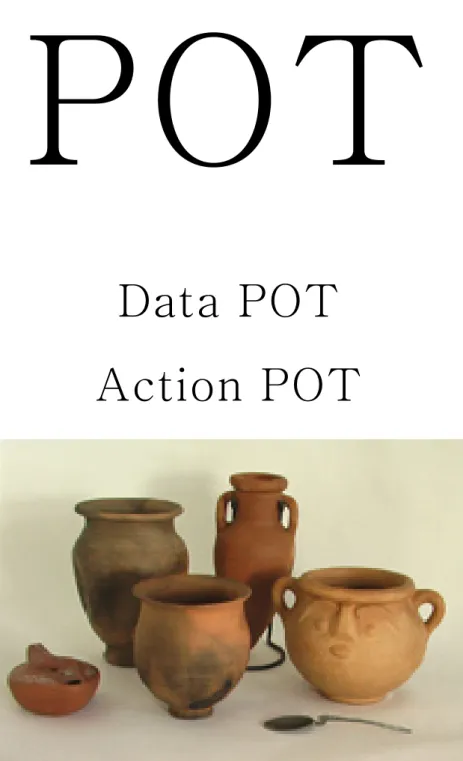
POT
Data POT
Action POT
Figure 2 - Clay Pots from ancient times
iv
Resumo
Desenvolver software continua a ser uma atividade económica de risco. Mesmo com 60
anos de experiência, a nossa comunidade continua a não ser capaz de construir sistemas
de informação para organizações de forma consistente, com qualidade previsível, dentro
dos orçamentos e dos calendários acordados.
O principal objetivo deste trabalho é criar uma nova forma de desenvolver sistemas de
informação para organizações, com tecnologia internet, de uma forma mais rápida,
melhor, mais barata e que seja mais adequada para lidar com a mudança organizacional.
Para o fazer propomos um método de crescente formalização com oito degraus. Para
cada área de atividade as organizações podem adotar um nível de formalismo e ao longo
do tempo evoluir em cada área do sistema de informação, tornando-o mais ou menos
formal consoante a evolução do negócio.
Propomos uma arquitetura global, prevendo que utilizador fará uso de múltiplas
interfaces em simultâneo, para lidar com várias organizações numa mesma interface
lógica. A arquitetura inclui um agente agregador da informação por utilizador a quem se
pode delegar atividades de coordenação. No núcleo da arquitetura estão as aplicações
com os seus dados e ações, alguns privados outros partilhados.
Propomos um modelo de objetos adaptativo que utilize uma nova ontologia para dados
e ações com regras estritas de normalização. Estas regras restringem os efeitos das
mudanças tornando-as mais testáveis e mais facilmente corrigíveis e adaptáveis.
Propomos uma evolução no padrão universal de transações da Engenharia
Organizacional, que acrescenta aos atos de coordenação e produção, os atos de
conhecimento e de significado. Propomos ainda uma transformação nos atos de
coordenação, tornando-os mais flexíveis e adaptados aos processos negociais que visam
o alcançar de acordos entre as partes.
Este trabalho implementa um protótipo com parte do sistema proposto de forma a ter
uma avaliação preliminar da sua possibilidade de construção e limitações.
v
Abstract
To develop software is still a risky business. After 60 years of experience, these
community is still not able to consistently build information systems (IS) for
organizations with predictable quality, within previously agreed budget and time
constraints.
The main goal of this work is to create a new way to develop flexible IS for
organizations, using web technologies, in a faster, better and cheaper way that is more
suited to handle organizational change.
To do so we propose a formalization ladder with eight steps. Each organizational area
can adopt a specific formalization level and, over time, evolve its information system
making it more formal or less formal according to the business current needs.
We propose a global architecture, allowing the user to use several interfaces
simultaneously to deal with IS of several organizations in the same logic interface. The
architecture includes an agent per user that aggregates the information and performs
coordination acts by delegation. At the core of the architecture are the applications with
their data and actions, some private, others shared.
We propose an adaptive object model that uses a new ontology for data and action with
strict normalizing rules. These rules bound the effects of changes so that they can be
better tested, corrected and evolved.
We propose an evolution to the universal pattern for transactions from Organizational
Engineering that adds knowledge and meaning acts to the already existing production
and coordination acts. We propose a transformation to the coordination acts, making
them more flexible and adapted to negotiation processes in which parts aim to reach an
agreement.
This work implements a prototype with part of the proposed system in order to have a
preliminary assessment of its feasibility and limitations.
vi
List of Figures
Figure 1 - Otho Denarios - roman coin from the emperor Otho ... ii
Figure 2 - Clay Pots from ancient times ... iii
Figure 3 – Mesh of related topics... xi
Figure 4 - Roman Empire at maximum extent in 150 CE ... 2
Figure 5 - The cycle in “The Structure of Scientific Revolutions” (1962) by Thomas Kuhn [12] ... 4
Figure 6 – Foundational Theories for Organizational Engineering [4] ... 17
Figure 7 - Arity of operations in Universal Algebra ... 18
Figure 8 - Venn diagram illustrating some set operations ... 19
Figure 9 - Elements of a graph ... 20
Figure 10 - Examples of Assiciative Maps ... 23
Figure 11 - B-Tree [63] ... 24
Figure 12 - Elements of a System ... 24
Figure 13 – PSI theory - Social Interaction Pattern [65] ... 25
Figure 14 - 3 fundamental questions to determine the nature of relations, based on [66] ... 27
Figure 15 - Neuron Model ... 28
Figure 16 - TOPO global architecture ... 33
Figure 17 - Communication state chart ... 40
Figure 18 - Structural elements of Zachmann Framework ... 43
Figure 19 - Usual sets of numbers in mathematics ... 51
Figure 20 - Indexing structure for infinite size identifiers ... 56
Figure 21 - Construction to hold Universal Data Structures ... 61
Figure 22 and 23 – Instantiation of simple list and ring structures ... 62
Figure 24 - Binary tree representation ... 63
Figure 25 – Instantiation of a binary tree structure ... 63
Figure 26 - Adapted MOESI shared memory state transition diagram (Used in AMD Opteron) 64 Figure 27 - Visual representation of a Turing Machine ... 72
Figure 28 – Prototype for message handling and association of Zachmann Dimensions ... 76
Figure 29 - Distribution of Dots according to prime numbers ... 77
Figure 30 - Prototype for the handling of concepts (Person) ... 78
Figure 31 - Prototype for the visualization of complex structures (Clusters of Persons) ... 79
vii
List of Acronyms
• API – Application Programming Interface
• CPU – Central Processing Unit
• DEMO – Design and Engineering Methodology for Organizations
• IS – Information Systems
• LOC – Lines Of Code
• MMX - Multiple Math eXtension
• MOF – Meta Object Facility
• NASA – National Aeronautics and Space Administration
• PHP – PHP Hypertext Preprocessor
• POSET – Partially Ordered Set
• PSI Theory – Performance in Social Interactions Theory
• SATA – Serial ATA International Organization
• SIMD – Single Instruction Multiple Data
• SMS – Short Message Service
• TOPO - Transparent Open Platform for Ontologies
• UML – Unified Modeling Language
viii
Index
1. Introduction ... 1
1.1 Organizations ... 1
1.2 State of Information Systems field ... 2
1.2.1 An analogy with the Roman Empire ... 2
1.2.2 Fragmentation and crisis ... 3
1.2.3 A new paradigm – Organizational Engineering ... 3
1.3 The structure of this thesis ... 5
2. Motivation, Goals and Axioms ... 7
2.1 Motivation ... 7
2.2 Goals ... 7
2.3 Axioms ... 8
3. Problem Statement ... 10
3.1 Change in IS for organizations ... 10
3.2 Other problems in IS ... 12
3.2.1 Complexity ... 12
3.2.2 Conformity... 13
3.2.3 Invisibility... 14
3.2.4 Performance ... 14
3.2.5 Correction ... 16
3.3 Existing approaches to handle change in IS ... 16
3.3.1 Agile ... 16
3.3.2 Frameworks ... 16
4. Review of Literature ... 17
4.1 Theoretical Framing ... 17
4.2 Philosophical Theories... 18
4.2.1 Universal Algebra ... 18
4.2.2 Set Theory ... 19
4.2.3 Map Theory ... 20
4.2.4 Graph Theory ... 20
4.2.5 State Machines ... 21
4.2.6 State Charts ... 21
ix
4.2.8 Basic Data Types ... 22
4.2.9 Common Complex Data Structures ... 23
4.2.10 Automata ... 24
4.2.11 Systems... 24
4.3 Ontological Theories ... 25
4.3.1 Performance in Social Interactions Theory ... 25
4.3.2 Foundations Ontologies ... 26
4.3.3 Relations Nature ... 26
4.3.4 Neuron Model ... 28
4.4 Ideological Theories ... 28
4.4.1 Business Motivation Model ... 28
4.4.2 Values ... 28
4.5 Technological Theories ... 29
4.5.1 Normalized Systems ... 29
4.5.2 Functions ... 29
5. Options ... 31
5.1 Scope and Technology ... 31
5.2 Performance ... 31
5.3 Correction and Robustness ... 31
5.4 Control, Security and Reliability ... 32
5.5 Usability ... 32
6. Vision ... 33
6.1 TOPO Architecture ... 33
6.1.1 Persons ... 34
6.1.2 Interfaces ... 35
6.1.3 Agents ... 36
6.1.4 Applications ... 37
6.1.5 Data Cells ... 37
6.2 Asynchronous Message Model ... 38
6.3 Memory System ... 38
6.4 Transaction Protocol ... 38
6.5 Neuron model with Zachman Framework Dimensions ... 42
6.6 Future Programming ... 43
x
7.1 Bottom-Up approach ... 48
7.1.1 Basic Data Types ... 48
7.1.2 Concepts, Objects and Types ... 54
7.1.3 Identifiers ... 55
7.1.4 Basic Data Pot ... 57
7.1.5 Structured Data Pot ... 60
7.1.6 Universal Data Structure ... 60
7.1.7 Shared Data Pots ... 64
7.1.8 Visual Programming ... 65
7.1.9 Index Data Pot ... 65
7.1.10 Basic Action Pot ... 66
7.1.11 Mapping Action Pot ... 71
7.1.12 Strategy Action Pot ... 71
7.1.13 Visual Action Pot ... 72
7.1.14 Grammar Action Pot ... 72
7.1.15 Turing Machine Pot ... 72
7.2 Method: Formalization Ladder... 73
7.2.1 Step 1 - No Formalization (big ball of mud) ... 73
7.2.2 Step 2 - Adding Dimensions with neurons ... 74
7.2.3 Step 3 – Adding Attributes ... 74
7.2.4 Step 4 – Adding Concepts ... 74
7.2.5 Step 5 – Adding Constraints ... 74
7.2.6 Step 6 – Adding Structural Relationships between concepts ... 75
7.2.7 Step 7 – Adding Transactions ... 75
7.2.8 Step 8 – Delegating tasks ... 75
7.3 Analysis of Ladder Formalization ... 75
7.4 Prototype - Interface ... 76
7.5 Prototype – Inner Structure of Data ... 80
8. Functionalities and Requirements Analysis ... 85
9. Analysis using Design Science Research Guidelines ... 89
Guideline 1: Design as an Artifact ... 89
Guideline 2: Problem Relevance ... 89
Guideline 3: Design Evaluation... 89
xi
Guideline 5: Research Rigor ... 89
Guideline 6: Design as a Search Process ... 90
Guideline 7: Communication of Research ... 90
10. Conclusions ... 91
11. Time and Other Constraints ... 93
12. Ongoing and future work ... 93
13. References ... 94
1
1.
Introduction
The title of this work has an embedded game of words.
Producing Applications with XHTML
Organizations Redesign and Building of Information Systems
Templated Extendable Resources for Rapid Application Reuse, Update and Maintenance
On a first glimpse it’s just a long sequence of technical terms that says “what” this work is all
about – an engineering layer that addresses the building of information systems (IS) for organizations.
With the first letter of each word, we get the Latin expression “Pax Orbis Terrarum” that leads to the “why” question through the analogy presented below – a meaning layer with the deeper
purpose of this work.
P
AX
O
RBIS
T
ERRARUM
Repeating the first letter simplification again we get a single word “POT” of a real world artifact and again an analogy to “how” we will try to solve the main problem addressed – the need to
handle change in IS for organizations.
POT
This introduction section addresses the following topics: 1) The subject of study: organizations
2) The state of IS field of study: analogy; fragmentation and crisis; new paradigm 3) The structure of this thesis: IMPROVE FACTOR
1.1
Organizations
Organizations are social structures whose members communicate and coordinate their behavior in order to accomplish shared goals or to put out valuable goods (ideas, environmental conditions, products or services). Organizations can produce goods for external entities or for their own consumption – becoming “prosumers” [1].
A few years ago, the concept of organizations was restricted to relatively big, rational, formal and structured entities with a predefined set of people, fixed roles, procedures and rules like schools, hospitals, factories, governments and businesses. Richard Scott extended this concept to a much broader sense, including what he called natural systems and open systems [2][3]. Natural systems are organizations “whose participants pursue multiple interests, forged in conflict and consensus, but who recognize the value of perpetuating the organization as an important resource” [3].
In open systems, “organizations are congeries of interdependent flows and activities linking shifting coalitions of participants embedded in wider material-resource and institutional environments” [3]. Structures like families, social groups, movements, friendship cliques, and other dynamic structures can also be seen as organizations – even a single person can be seen as an organization.
2
1.2
State of Information Systems field
1.2.1 An analogy with the Roman Empire
The Latin sentence “Pax Orbis Terrarum”, also derived from the title of this work, is an expression that means “universal peace” or literally, peace (pax) for all the land (terrarum) that surrounds us (orbis).
The reason for this reference to the Roman Empire is a useful analogy between what happened in the lands around the Mediterranean (“mare nostrum” – “our sea”) before and during the Roman Empire, and the current state of the information systems field.
Before the Roman Empire, people lived in small communities in subsistence economy with little commerce, inefficient and small markets, and minute interaction with other communities besides nearby neighbors. Each community had its own ruler and lived according to their own rules. Roads between communities were bad or inexistent. War was the recurring state, as pillage was an easier way to get better lands and goods.
Figure 4 - Roman Empire at maximum extent in 150 CE
The Roman Empire lasted 5 centuries. The first 2 centuries were called “Pax Romana” (“Roman peace”) due to the relative stability that the Roman Empire was able to bring without precedent until that time.
Although we have a clear image from the roman armies built around copper, coal, leather and organization, it was the Lex Romana across the empire (“Roman rule of law”) based on the Latin language, and the ability to enforce it with the legions, that brought the stability to that empire.
3 organizations based on efficient networks of trade. It is reported that the transportation of grain from Hispania (“Spain”) to Rome would only increase 16% to the product cost [5].
Roman engineering artifacts still stand as a proof of their advances with aqueducts, mills, dams, bridges, roads, theaters, coliseums, pantheons, baths, mines and water systems.
1.2.2 Fragmentation and crisis
As an analogy, the current state in the field of Information Systems is the world before the existence of the Roman Empire. According to Klein [6], the IS field suffers from two problematic structural patterns:
• A state of fragmentation
• Significant communication gaps
The author argues that fragmentation is different from diversity, as the last one presumes the existence of a common base that currently does not exist in IS field.
Avison [7] argues about the lack of discipline in IS field as there is no agreed general area for teaching, research and practice. This leads to a perceived lack of coherence in the discipline and a low status as a consequence. The theoretical foundations of IS come from a diversity of theories from many “reference disciplines, including economics, mathematics, linguistics, semiotics, ethics, political science, psychology, sociology and statistics”. These multiple theories may be “mutually inconsistent” and generate many unconnected “schools of thought with their own metatheoretic assumptions, research methodologies and adherents”.
Benbasat [8] claims that in order to have identity in the IS field there must be: central character; claimed distinctiveness and temporal continuity. Galliers [9] points toward the need of a trans-disciplinary view of IS in order to set boundaries, define the scope, focus on the central artifact and its properties.
Klein [6] argues that a common language is needed for overcoming the communication gaps, and based on that solid ground develop a common body of knowledge for IS.
Orlikowski [10] regrets the “blind spot” in the IS field of ignoring, or taking for granted, the conceptualization or theorizing of the artifact. On the other hand, Lyytinen [11] argues that not having a core theory at the center of the IS field is not a reason for concern, as long as relevant results are produced. We share the view that current results are not solid enough to argue in favor of no reason to concern…
The visions about the path to be followed are not fully consistent, as you would expect of a fragmented world. But in one thing they all agree: the IS field is in crisis and actions should be taken in order to get to a better ground. But how can we do that?
1.2.3 A new paradigm – Organizational Engineering
Kuhn in “The Structure of Scientific Revolutions” [12] presents a cyclic model for how science works.
According to Kuhn, “normal science” follows Karl Poper’s “moralistic methodology” [12] toward truth that states that “science proceeds by conjectures and refutations”.
This method consists of:
4 Kuhn proposes a different model:
Puzzle Solving
Crisis Normal
Science
Paradigm
Anomaly
Revolution
The Structucture of Scientific Revolutions Thomas Kuhn
Figure 5 - The cycle in “The Structure of Scientific Revolutions” (1962) by Thomas Kuhn [12]
Kuhn though that the usual way science progresses is just like solving puzzles that are left open within the current field of knowledge – that is, within the current set of theories that establish a paradigm and dominant strategies to solve those puzzles he called “normal science”. "The most striking feature of normal research problems we have just encountered is how little they aim to produce major novelties, conceptual or phenomenal." According to Kuhn, normal science addresses 3 types of problems:
• Determination of significant facts
Measure phenomena to better describe and predict according to current theories.
• Matching of facts with current theory
Adjust current theory to match the observed facts when discrepancies occur.
• Articulation of theory
Elaborate on the implicit consequences of current theories and applications.
There can co-exist many competing theories in the same field event when huge anomalies are detected due to mismatch between existing theories and observed phenomena. That is certainly the current situation in the construction and maintenance of IS for organizations, as stated above.
Kuhn says that scientists won’t leave their current theories until a new, sufficiently better paradigm is able to replace it. That is the revolution moment: "The decision to reject one paradigm is always simultaneously the decision to accept another, and the judgment leading to that decision involves the comparison of both paradigms with nature and with each other." Organizational Engineering hopes to be a paradigm shift with a new, holistic and systemic approach to address change in organization of all sizes [4]. In this work we use the term “organizations” instead of the also common term “enterprise”, as we believe that the principles hereby described have broader appliance than just to organizations oriented to business.
These principles for organizational engineering have been established in a manifesto [13], that, in my perspective, aims to the following goals:
1. Holistic view of organizations
5 2. Organizations as social systems
People are at the core of organizations being their owners, users, workers and beneficiaries. People coordinate their acts through messages and establish commitments in universal patterns called transactions.
3. Black-box and white-box perspectives
Black-box perspective is the functional (or teleological) perspective that each user establishes with artifacts in use (which can be different from what they were designed for).
White-box perspective is the construction (or ontological) perspective that artifacts have based on their objective reality.
4. Information system ontology
Information system ontology is the meta model for designing organizations using atomic elements in its construction. This ontological model should come prior to any functional model that describes its usage.
5. People with authority and responsibility
People, as intelligent beings, should take control of their organizations as they get authorized to perform roles and assume responsibility for their actions. They are in better position to act in the best interest of the organization than the initial conceptual designers of the organizations IS that are not able to embrace the full complexity of everyday environment that organizations operate in.
6. Organizations architecture
Organizations should be driven by strategic concerns and values that in time are transformed into normative principles – the culture and the way things work in each organization.
7. Organizations governance
In order to manage change as an integrated unity, organizations have to establish and apply measures of control.
1.3
The structure of this thesis
This thesis is structured into 13 sections following the acronym: IMPROVE FACTOR. We hereby describe the content and contribution that each section brings to this work.
1.
I
ntroductionThe current section introduces: the subject of study: organizations; analysis of current state of the field; and the structure of this thesis.
2.
M
otivation, Goals and AxiomsExplains the motivation for this work and its main goals, leading to a research question and a list the axioms – the assumptions being made as starting points for reasoning.
3.
P
roblem Statement6 4.
R
eview of LiteratureSuccinct description of the support theories used for this work, analyzing separately the philosophical, ontological, ideological and technological theories.
5.
O
ptionsDefines the options for this architecture, by defining the non-functional requirements in terms of scope, technology, performance, correction, robustness. control, security, reliability and usability.
6.
V
isionTop-down approach for the proposed solution, including all the core structural decisions like the global system architecture, called TOPO with its components (persons, interfaces, agents, applications and data cells); the asynchronous message model; the memory system; the transaction protocol; the neuron model with Zachman framework dimensions; future visual programming.
7.
E
xisting and Proposed SolutionsBottom-up approach with comparison between existing and proposed solutions to implement the architecture, from the most basic data types to the most complex data and action structures. Also an eight-step method to allow organizations to gradually move up the formalization ladder in order to improve their information system and adapt it to their needs.
8.
F
unctionalities and requirements analysisAnalytical evaluation of how each requirement proposed in section 5 is addressed by the solutions proposed in sections 6 and 7, and its level of success in complying with those requirements.
9.
A
nalysis using Design Science Research GuidelinesAnalysis of current work using Design Science Research Guidelines.
10.
C
onclusionsThe lessons learned from this work.
11.
T
ime constraints This work limitations.12.
O
ngoing and future workPossible alternatives as future work.
13.
R
eferences7
2.
Motivation, Goals and Axioms
This section contribution:
Explain the motivation for this work and its main goals, leading to a research question and a list the axioms – the assumptions being made as starting points for reasoning.
2.1
Motivation
This work motivations is the belief that it is possible to create a information system ontology, as defined in [14], that is generic enough to be used to model the world, but at the same time concrete enough to enable its automatic transformation into working prototypes, or even full software applications. This belief is stemmed from the author's professional experience in developing code generation tools that produce fully working database applications from simple entity-relationship models.
This work aims to create a paradigm shift [12] on software development by taking the initial steps into the creation of a theory, a information system ontology and a method for developing IS for organizations, one order of magnitude better in the aggregate of all improvement factors defined in chapter 5. This is an imprecise measurement, because paradigm shifts are usually subject to incommensurability [12] – that is, the impossibility of accurately compare with solutions in the previous paradigm. Our hope is that the benefits are so clear that the fulfillment of these goals become self evident to the users and stakeholders.
Aiming one order of magnitude improvement means that we are aiming to create a “Silver Bullet”, as defined in 1956 by Frederick Brooks in the classic paper “No Silver Bullet: Essence and Accidents of Software Engineering” [15], with the interpretation given by the same author in the preface of [16].
2.2
Goals
The ultimate goal of building software for organizations is to help users to be better by deciding, producing, consuming and remembering better. Being humans we have flaws in our judgments. Science has studied many cases of our biased decisions [17][18][19].
Most of our daily decisions are based on simple rules that are really just simple models. Probably the most common model of them all is to copy what others are choosing as decision criteria – there is safety in big numbers. But in the future, people will rely more on software tools to better model the world, be able to make informed and rational decisions (unbiased) and, in time, become better than our nature.
Building software, big or small, is about creating models of reality. Every model is a simplification, so a lot is lost in the modeling process. Accumulating knowledge is not the purpose of an IS. The real purpose is to make things more manageable by making things simpler through conceptualization.
A software model is useful for analyzing the current state of the world by querying or viewing synthetic reports, for predicting the future or retrodicting – predicting the past and learn from experience.
Models represent world that can be continuous or discrete. Actions performed can be deterministic or stochastic, that is, unpredictable – especially if the model does not take account with all possible actions that are happening in the world. Information about the world might not even be available (or with required precision). The roles of the several persons in the world can differ and change over time from collaborative mode to adversarial or even irrelevant interaction.
8 that are mostly natural systems or open systems, as defined by Richard Scott [2]. As Niccolo Maquiavel (1949-1527) puts it: “Nothing is more difficult than to change the order of things.” This work aims to mitigate the lack of flexibility of software applications felt by persons and organizations when faced with unforeseen situations or change. Therefore, the research question for this work is: can an IS artifact be built satisfying these goals?
2.3
Axioms
Axioms are the premises or starting points for reasoning. Axioms are supposed to be self evident that can be accepted as true without controversy, although that can be a hard assumption in a fragmented field of study like IS.
Theories are the best explanations to a certain phenomena. Theories are built over sets of axioms. This work assumes as true the following axioms:
Axiom 1.
People are the core element of any information system.
The core element is not the data or the events but the people that make sense of that information. Information is teleological usage that people get from world facts. Information is “the difference that makes a difference” [3] to people. Each person can have a level of authority and responsibility in the information system allowing them to take responsible decisions.
Axiom 2.
Change is inevitable.
Long gone are the times of Parmenides (515BCE – 460BCE) that argued that change is not possible. Since Heraclites (535BCE – 475BCE) that change is assumed to be ever-present as stated “No man ever steps in the same river twice”. Not only the water in the river is not the same, but also the person is not exactly the same as biology changed and the person gained experience from the previous steps.
Axiom 3.
The world is more complex that what can be modeled by any IS.
António Damásio has argued [21] that the reason why our brains are so complex is because we need to handle ambiguity. Simply combining the elements in several dimensions (who, what, when, where, how) is a model simple enough to map the brain with its neuron like structures, but without the enough power to model it’s use.Axiom 4.
The world is continuous. Perception of the world is discrete.
There are two types of changes [22]: the continuous change in the world and the change in the perception that is discontinuous and always received as an inconsistency with the previous mental model of the world.
Axiom 5.
The world is stochastic (non deterministic).
No person action can determine the future state of the world because there are many other uncontrolled actions in the world. The information system model may be deterministic, leading to inconsistencies between the world and its model.
Axiom 6.
Persons can collaborate, oppose or be neutral to your goals.
9
Axiom 7.
Communication between persons is enough to manage any IS
People were able to build up complex organizations for centuries. Even before writing, the only mean they had was interpersonal communication. These means that communication between agents with memory alone is enough to manage any IS.
Axiom 8.
Communication is asynchronous.
Even in face to face communication the messages are sent and perceived asynchronously. Synchronizations is a simplification that is not supported by the real world.
Axiom 9.
IS for organizations must be holistic and live long lives.
10
3.
Problem Statement
This section contribution:
Deepen the analysis of the problems posed by change in IS for organizations - the main problem addressed with this work. Define the scope by stating what will be handled and other challenging problems in the subject of study not addressed by this work. Identify the existing approaches to handle the change in building IS.
3.1
Change in IS for organizations
Change creates major difficulties to organizations in order to cope with the renewed operational environment. According to Dietz [4], the success perspectives of enterprise strategic initiatives are not favorable because organizations usually do not achieve the expected results. Several sources [24][25] show rates of success lower than 10% or 30%, arguably because of gaps between those initiatives and the way people and organizations learn and take decisions.
Organizations face increasing challenges in data demand and data supply. In terms of data demand, the increase of traffic had an inflection point in 2007 with the launch of iPhone and the start of a new phase in data access from mobile devices with demand for traffic doubling every year [26].
In terms of data supply, today’s organizations can generate big amounts of internal data in very little time – much faster than what can be understand without the proper tools. Companies like Google and Facebook have reported a substantial increase on the amount of data being produced every year, but those number are hard to compare to the pre-computer age as they are built from so different paradigms [12].
On the storage side Kryder’s law [27] state that “magnetic disk areal storage density is increasing very quickly at a pace much faster than doubling in every 18 months in Moore’s law”. Although disk capacities are growing fast, disk latencies and data transfer rate are not keeping the pace. Currently, a computer can only get 300Mb/s from one disk with 3.0 SATA. Organizations need Information Systems (IS) that can enable Data Science, that is, [3] “the ability to take data – to be able to understand it, process it, to extract value from it, to visualize it, to communicate it”. Organizations need tools that allow them to manage their business models, their data and metadata and cope with their changing environment.
In order to cope with increased organization complexities the amount of lines of code (LOC) in software is increasing at an impressive rate [28] – doubling every ten months [29] – which is almost double of Moore’s law. So many millions LOC will inevitable have errors because there is still no economic way to perform formal verifications automatically and testing. As Dijkstra [30] said it, tests “shows the presence, not the absence of bugs”. The biggest effort of formal verification had less than 10 000 LOC for a operating system kernel and its cost was $500/LOC[31][32]. As a reference point, software for NASA typically costs $80/LOC.
Lehman’s eight laws of software evolution [33] emphasize the inevitability of change in IS and their effects:
•
Law of continuing change (I)
“A software that is used must be continually adapted else it becomes progressively less satisfactory.”
•
Law of increasing complexity (II)
11
•
Law of continuing growth (VI)
“Functional content of a program must be continually increased to maintain user satisfaction over its lifetime.”
•
Law of declining quality (VII)
“Software will be perceived as of declining quality unless rigorously maintained and adapted to a changing operational environment.”
•
Law of feedback system (VIII)
“Programming processes constitute multi-loop, multi-level feedback systems and must be treated as such to be successfully modified or improved”
In order to check the impact of change we looked at change logs for PHP version 4 and 5 that are freely available online [34][35]. PHP is one of the most popular programming languages with constant support and monthly updates.
For the 9 years lifetime of PHP4 (Jul99-Aug08) there were 2484 bugs fixed/improvements made with an average of 23 items per month. For the current version PHP5, that is already 10 years old (Jun03 - Sep2013), there have been 5648 bugs fixed/improvements made, with an average of 46 items per month. We might think that the number of bugs diminish as time passes by, but that is not the case for this case where the numbers remain stable. In the last 3 years there where on average 47 items changed in new releases per month.
On the day of this analysis (3Sep2013), if we look at stats [36] we will find out that there were 65257 issues reported. Only 4% of the reported issues are requests for new features, 9% are about problems in the documentation and the remaining 87% are bugs in the code of the several modules.
Around 47% of issues reported are now closed, 33% were not considered a bug, for 3% the decision was made not to fix them, 6% are still open for analysis, and the remaining 11% are in the maintenance pipeline.
These numbers are absolutely astonishing, especially since they come from PHP, with a huge open source community, and considered as one of the most stable and reliable programming language/tools available. Although we only use a fraction of the available functionality, statistically it is very likely that overtime we will use function that have bugs, either solved or unsolved.
My conclusion about this study on PHP is that maintenance is a huge factor even in big, well supported communities. In order to keep IS in production for decades, as we do, we need to improve the way we program computers.
After 60 years of software engineering, almost no software version passes the teenage years, independently of the amount of money, expertise or effort that was put into creating them. Any software project sponsor still faces a new project with a high associated risk of success.
In “Peopleware” [37] the authors of this classic book from 1999 state that “about 15% of all projects studied (…) were canceled or aborted or postponed or they delivered products were never used. For bigger projects the odds are even worse. Fully 25% of projects that lasted 25 work-years or more failed to complete.”
The current reference source of success analysis of software projects is the CHAOS Manifest from the Standish Group. The 2012 and 2013 [38][39] reports states that, although it was their best result ever, only 37% and 39% of software projects could be considered a success; 21% and 18% and were clear failures and the remaining 42% and 43% were challenged. The fundamental problem didn’t change – building software is still hard and challenging.
12 development are fine for small projects, but we still lack the knowledge about how to scale up to huge projects, because of problems that arise in such highly complex assembles.
As time passes by we are getting better at building software, but we are still far from respectful project success numbers when compared to other areas of engineering.
3.2
Other problems in IS
Handling “change” is not the only problem posed to IS. In order to limit the scope of this thesis, without losing track of the holistic approach required to design IS, we will quickly approach other pressing problems of IS design that will not be addressed by this thesis, therefore limiting this work scope.
According to Frederick Brooks [15], “the essence of a software entity is a construct of interlocking concepts: datasets, relations among data items, algorithms, and invocations of functions.” This author also states that the essential attributes of software that make them so challenging are: complexity, conformity, changeability and invisibility.
Changeability is the main problem addressed by this work, but we would like to add two other problems that we believe are core to IS: performance and correction.
3.2.1 Complexity
Allen Downey [40] states that “classical models of science tend to be law-based, expressed in the form of equations and solved by mathematical derivation. Models that fall under the umbrella of complexity are often rule-based, expressed as computations, and simulated rather than analyzed.”
According to that author, with the usage of computational modeling there has been a shift along the following axis from:
• continuous to discrete
• linear to non-linear
• determinism to stochastic (random, non-deterministic)
• abstract to detailed
• one, two (few) elements to many elements
• homogeneous to composite (heterogeneous)
This new kind of model is often appropriate for different purposes and interpretations of the world.
• From predictive to explanatory
Many social phenomena’s can be explained by simple models like the Schelling’s model of segregation, the standing ovation model by Miller and Page’s or the threshold models of collective behavior by Mark Granovetter [23].
• From realism to instrumentalism
Modeling can be a good enough solution for understanding the world and make predictions about it. As George Box said it: “All models are wrong, but some models are useful.” [23]
• From reductionism to holism
13 ontological perspective that focus on the elements that constitute the system, their interconnections, relations, groups, similarities and differences.
According to Downey [40], these changes may lead to a new kind of engineering and organization of social systems from:
• centralized to decentralized
• isolation to interaction
• one-to-many to many-to-many
• top-down to bottom-up
• analysis to computation
• design to search
And finally, to a new kind of thinking, from:
• Aristotelean logic (only true or false) to multivalent, fuzzy logic
• frequentist probability to Bayesianism
• objective (objectivists – only a single truth exists) to subjective (subjectivists – each person can hold a different truth - or constructivists – truths are established trough social interaction)
• physical law to theory to model
• determinism to indeterminism (breaking the cause-effect link through randomness, probabilistic causation and fundamental uncertainty)
A complex model is not necessarily a better one; actually it is usually the opposite. Albert Einstein said: “Things should be as simple as possible, but not simpler.”
3.2.2 Conformity
The problem of conformity arises from the need to interact with other existing systems, and usually not very organized ones.
Systems are used throughout science extensively and by definition systems interact with each other. Systems are normally conceived as something that has an input, an internal structure and an output. According to the ontological approach for systems, as defined by Mario Bunge [41] and Jan Dietz [14], a system has:
• Ambient – a set of elements that live on the border of the system communicating with the exterior (either input or output).
• Composition – a set of elements that live inside the system and only communicate between themselves and the elements in the ambient.
• Structure – links of mutual influence between elements of the ambient and the composition.
• Production – things that are produced by the elements of the composition and delivered to the outside through the elements of the ambient. The production of a system can be a product (material), a result (immaterial) or a service (a mix of material and immaterial goods provided instantly or over time).
14 typical usages of known patterns to address typical concerns with typical results in terms of non functional characteristics.
3.2.3 Invisibility
The challenge of invisibility comes from the fact that software is an abstraction that is not tangible. The issue of invisibility can be addressed in two perspectives: code view and results view.
On code view, the lines of code expressed in any language does not visually match its execution, therefore it is difficult for the programmer to “see” if the code is working as intended, if it has unexpected unreachable sections of the code, handling all input as expected and where are the bottle necks that prevent it to run faster. When a programmer writes code he does not have a clear relation to any physical objects. Lines of code could be mapped to a visual representation of code in order to make it more understandable and therefore result in software with fewer bugs.
On results view there is the field of information visualization. The process of data encoding consists of classifying data types and choosing the most appropriate visual attributes to represent them.
The first problem is data types. Computer’s hardware and usual programming languages typically represent data as booleans, integers (signed or unsigned) or floating points (with a specific precision and range set). This is quite different from the way mathematicians usually classify data (Natural, Integer, Rational, Real, Complex, etc).
On the other hand, statisticians and data scientists typically use only three basic data types [42]: nominal (categorical), ordinal (when we can establish an order between categories) and quantitative. Quantitative can be split in interval and ratio
According to the French cartographer Jacques Bertin [43] there are 7 visual attributes that can be used for visualizing data, for 0, 1 or 2 dimensions: position, size, value (or lightness), texture, color, orientation and shape. Later, these attribute list was extended to 3 dimensions by Card [44].
3.2.4 Performance
The topic of performance in IS can be addressed as the time required to design and implement a solution – the design performance; but it can also be addressed as the execution performance problem, that is – the time a specific computer architecture will take to execute a certain code over a certain data.
Design performance
Programming languages haven’t changed much over the last two decades. Adopting new languages is not an easy task because the learning curve is quite steep and the change would only justify if the increase in performance was huge.
There are hundreds or even thousands of programming languages, but most of them are quite similar, and only a few of them are really popular [45] like C, C++, C#, Java, PHP, Javascript, Python, Perl, SQL, Ruby. Even so, there are niche programming languages, for instance for high performance scientific computation the preferred language and the benchmark reference is still Fortran.
A paradigm is an approach to solve a specific kind of problems. Most popular languages support more than one paradigm, typically object-oriented and imperative, or sometimes functional. But very few, and none of the most popular languages, support the four main paradigms.
15
• Imperative – a program is a state machine and procedures change from current state to a new one.
• Declarative – programs that state what we wish the result to be, not how to get it (HTML, SQL). There are fixed inference rules to get to the stated goals.
• Functional – a program is a set of functions that do not hold any state. Each function returns always the same result based on the same input.
• Object-oriented – objects are closures that hold attributes and associated procedures, typically called methods. Objects are typed to classes and classes have hierarchies that allow sharing properties and methods across those semantic links.
• Logic programming – logic programming is based on statements that establish facts and rules between types of facts. Based on that knowledge it is possible to use inference rules and query for values that are supported by the current fact/rules database. Logic programming is a very elegant way of solving some kind of programming problems.
• Constraint – Relations between variables constraint the set of possible results. The language tries to find out solutions that match those constraints.
• Event-driven – The control flow is determined by a sequence of events, typically human interactions.
The main difficulty in adopting a new programming paradigm is adapting to a new way of thinking in programming logical terms.
Execution performance
Software runs on specific hardware environments. For many years, software guaranteed increased performance just by the increase of processor speed, even without any relevant maintenance over it.
In 2005 a new era started: multicore processors. Processors were not getting faster anymore, but there was still more processing power in the new CPU. Now, increase performance required parallel programming. In 2009, manycore processors (over 16 cores) were introduced, and the production of single core processors ceased at Intel.
The road ahead become clear, but still most programmers don't have a clue how to program in parallel, because they never tried it and were never taught that way. Programmers may know basic synchronization techniques for accessing shared resources (mutexes, semaphores) and communicating through asynchronous queues of messages, but that is not enough to take full advantage of current many core architecture.
Some programmers might have eared about CUDA programming model or the OpenMP standard, but very few ever heard about the Intel Threading Building Blocks (Intel TBB), which has become the best and simplest way to program parallelism in C++ since 2009 when it was launched.
State of the art on programming in parallel is in balancing the core usage for the critical sections of the program and preventing the need for synchronization, instead of handling critical access to shared resources. James Reinders, lead evangelist and director of software development products at Intel says "I am still confident that software development in 2016 will not be kind to programmers who have not learned to «Think Parallel»." [48]
Most algorithms in computer science were not thought to be run in parallel and a lot of work is still needed to optimize them to this new requirement.
16 compilers, by the same reason, although they were introduced in the processor architecture with the MMX package in 1997.
3.2.5 Correction
A mathematical alternative approach for generation IS is to start with an abstract model of the intended system and then through a sequence of refinement steps deduce the creation of the intended solution. As long as each refinement step is done with the level of assurance of a mathematical proof, the resulting system would guarantee correction. The B method [49] is the most well known strategy that follows this approach.
3.3
Existing approaches to handle change in IS
3.3.1 Agile
For many years software engineering has followed the path of building software as a well organized structure. Due to is complexity, unsatisfactory results and stakeholder pressure to change, software development has been shifting toward agile methods that favor gradual growth instead of the “big design up front” approach.
For most organizations, the development effort is still divided into two phases: development and operation. Even with an agile development phase, the IS is not created to be changed during operation phase, therefore making adaptations more difficult.
Organizations that are natural systems [2] and open systems are more prone to rapid and radical changes and they still don’t have the software applications that allow them to better handle their natural ambiguity and in time gradually become better organizations. On the other hand, structured organizations that are based on rational systems, typically have rigid IS which creates difficulties in rapidly adaptation to change and evolution.
3.3.2 Frameworks
Frameworks are software infrastructures that set a stage for the development of applications. They increase productivity but constrain the flexibility of possible solutions by setting a standard way of work for all applications by providing the usual means to quickly solve those common problems.
17
4.
Review of Literature
This section contribution:
Succinct description of the support theories used for this work, analyzing separately the philosophical, ontological, ideological and technological theories.
4.1
Theoretical Framing
Jan Dietz proposed [13] a classification scheme for the set of theories on the field of study of organizational engineering. The arrows among the classes in Figure 6 signify the support they typically provide to each other in order to assure soundness or rigor by being well supported in theoretical terms.
Philosophical
Theories
Ontological
Theories
Ideological
Theories
Technological
Theories
Modeling thingsTheoretical foundations
Choosing vision, mission, values
and goals
Design artifacts that perform
Figure 6 – Foundational Theories for Organizational Engineering [4]
• Philosophical theories concern is the more basic foundational building blocks.
• Ontological theories focus on the nature of things, how to model them, how to explain then, how things relate to each other and use them to predict outcomes.
• Ideological theories are focused on the why we choose to do things in certain ways, based on our vision, mission, values and goals.
18
4.2
Philosophical Theories
4.2.1 Universal Algebra
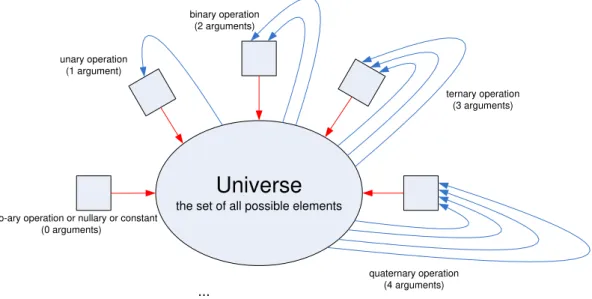
One of the most abstract approaches to generic ontologies is universal algebra – a recent
field in mathematics that only started in 1933 by Garret Birkhoff [50]. In universal
algebra a world can be described with algebras [51]. An algebra is a set of elements of a
universe and a set of operations that take some elements in the universe (arity is the
number of elements) and map them to an element in the universe, as the operation
result.
Universe
the set of all possible elements
zero-ary operation or nullary or constant (0 arguments)
unary operation (1 argument)
binary operation (2 arguments)
ternary operation (3 arguments)
quaternary operation (4 arguments)
...
Figure 7 - Arity of operations in Universal Algebra
Each operation can take zero (nullary or constant), one (unary), two (binary) or more elements (n-ary) in the universe and transform them into elements that also belong to the universe. Although there can be any number of input arguments, the output of each operation is always a single element of the universe.
Although these are simple definitions, the elements and the operations can be mapped to anything. The most simple and well known example of algebras are:
a) the universe of natural numbers and the binary operations “plus” and “times” that take two natural numbers and connect to a natural number.
b) the universe with only two members {true,false}, with the unary operation “not”, and the binary operations: “and”, “or”, “imply”.
Elements and operations in a algebra can:
a) Satisfy common features like the arity of the universe or the arguments in the operations;
b) Satisfy properties in operations like associativity, distributivity, commutativity, neutral element, absorption element, and many others. All these properties can be expressed unequivocally in mathematical terms and can be verified over real data.
19 Mathematicians underwent significant efforts in characterizing these structures and establishing rules between then, namely: isomorphism, congruence and homomorphism.
Using this tools it is possible to find out relevant properties of the global structure just by knowing which features are supported by each of them. It is also possible to establish a connections between different ways we represent problems, in the same or in very different domains. Knowing these structures that can be treated as the same problem as long as there is a isomorphism between elements, operations and their properties. Using Birkhoff own words: "In achieving this, one discovers general concepts, constructions, and results which not only generalize and unify the known special situations, thus leading to an economy of presentation, but, being at a higher level of abstraction, can also be applied to entirely new situations, yielding significant information and giving rise to new directions." [50]
4.2.2 Set Theory
Set Theory was first established by Georg Cantor in 1874 and has been used since them in nearly all mathematical fields [52].
Set theory uses sets of elements as its core. There are elements of a universe and each set can include that element or not, but there can only be one instance of each element in the set. It is also possible to have empty sets, that is a set that doesn’t contain any element.
Figure 8 - Venn diagram illustrating some set operations
The usual operations in set theory are:
• Union
Joining all the elements of A and B.
•
IntersectionKeeping only the common elements in A and B.
20 Removing from the A set all elements in the B set.
•
Symmetric DifferenceKeeping the elements that only belong to one of the operand sets, but not in both.
•
Cartesian ProductPairs with all the possible combinations from elements from set A with elements from set B. For example:
A={1,2} B={3,4} AxB={ {1,3}, {1,4}, {2,3}, {2,4} }
•
Power Set (unary operation)The result set is all the possible subsets that can be obtained from a set. We can identify a subset by being a set that only differs from a super set by one element. Therefor, the powerset can be obtained by incrementally removing a single element at a time in all possible subset operations from an initial set. For example:
A={1,2,3} powerset A = { {1,2}, {1,3}, {2,3}, {1}, {2}, {3}, {} }
4.2.3
Map TheoryMap theory [53] is a rigorously defined formal mathematical theory that extends the Set theory without losing support to any feature of that theory. Map theory includes abstractions for algorithms and metalogic, adequate to support computer science as well as well as being suited to support all classical mathematics.
Classical theories follow the rule “tertium non datur” [53] that a formula is either true or false without any other possibility. Following Kurt Gödel incompleteness theorem, map theory introduces a third and final option: nontermination (or undecidability).
Map theory uses as basic concepts: negation, implication, equivalence (bi-implication). Functions can be treated as black boxes (hiding its content) or white boxes (given more information about its construction). This theory uses ordinal functions to establish order relations between elements as well as other relations between elements; tuples to group related items, rank to assess similar cardinality.
4.2.4 Graph Theory
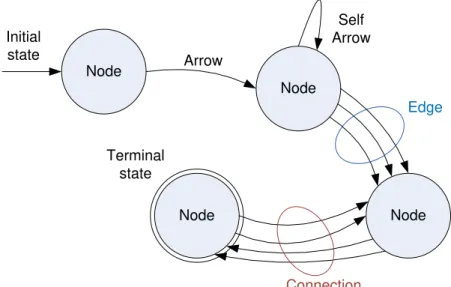
A graph, in mathematical terms [54], is a data structure that can be represented with four types of elements:
Node
Node
Node
Node Arrow
Edge
Initial state
Terminal state
Connection
Self Arrow
21
• Node
Node is the core element of a graph.
• Arrow
Arrow is a directed link from a node A to a node B.
• Edge
An edge is a group of directed arrows between the same two nodes (A and B) with the same direction (from A to B).
• Connection
A connection is a group of edges between two specific nodes in any direction (from A to B and from B to A).
Graph theory is a huge field in mathematics that started in 1736 with Leonhard Euler with the famous study on the “Seven Bridges of Königsberg”.
Graph theory can use different names to identify its components. In this work we will use these names previously identified. We will call vertices when we refer to arrow, edges or connections without considering directionality or quantity. Sometimes graphs with only directed arrows are called Di-graphs.
It is usual to assign names either to the nodes, to edges or even to each connection from an edge to a node. This is the case of networks of computers with TCP/IP, where each connection gets a unique address, but neither the nodes (router) not the connections (cable) get any identification. It is also common to assign weights or cost and usage/capacity to each node or vertices. Many algorithms use this information to discover central elements in the graph, paths, circularities, minimum cut to divide the graph in two parts (bipartite). Depending on the rules used to add nodes and arrows to a graph, for example: random or preferential attachment, there can be properties assigned to those properties derived from theory.
4.2.5 State Machines
Graphs can be used to model many things, for example, nodes can represent states, and arrows transitions between states, therefore representing a state machine. Some transitions might be epsilon transitions that can happen without any condition. In this case the state machine becomes a non-deterministic state machine, that is, the current state (node) can be more than one at the same time.
A non-deterministic state machine can be transformed into a deterministic state machine through a predefined algorithm, but in some circumstances that can lead to a deterministic state machine with infinite nodes, which is not possible to be handled by a computer.
Non-deterministic state machines are always more compact than their deterministic counterpart, therefore more comprehensive, even with the uncertainty associated to the current state.
4.2.6 State Charts
A State Chart [55] is an extension of the concepts of state machines and state diagrams for discrete-event systems by adding hierarchy, concurrency and communication.
Although state systems are a natural way of describing the dynamic behavior of a complex system, the combination of all possible states into one “flat” super state model generates an “unmanageable, exponentially growing multitude of states” [55].
22
4.2.7 Data and Metadata
Metadata [56] is usualy described as data about data, but what is metadata for some people might be raw data on which others will build upon to create new data.
There are 3 types of metadata:
• descriptive (that tells features about a “thing”)
• structural (that says how “things” are connected to other “things”)
• administrative (that tells who has rights about each piece of data and how that data was formed (provenance) and how it should be kept – for how long, how and by whom. The predicates to be used should, as far as possible, be one of the 15 basic types of Dublin Core [57] (contributor; coverage; creator; date; description; format; identifier; language; publisher; relation; rights; source; subject; title; type) or one of its extensions, in order to facilitate future semantic integration between ontologies.
4.2.8
Basic DataTypes
The usual types of data commonly used in statistics are: nominal, ordinal, interval and ratio (fixed interval with meaningful zero).
Nominal types are the kind of data that do not have numerical properties, even if a number is associated to each category. Categories are human constructions that are created in the intersubjective world of communities. For example, we can have sex: “male” or ”female”; or gender: “man”, “woman”, “undefined” [58]. The only operations that make sense to perform over nominal data are checking for equality and counting occurrences. These allow the calculation of mode – as central tendency measure – and the variation ratio, giving some notion of dispersion. In order to manage many nominal types, tools should be provided to handle controlled vocabularies, that is, to allow establishing relationships like broader term, narrower term, use for, use instead and preferred term, as is usual in Information Science.
Ordinal types are constructed over nominal types, adding the condition that they have a function that can specify a total order for all members of a set. However the “distance” between those elements is not a measure, since it only specifies the order for any pair of elements, but not the distance between two elements in the group. Examples of ordinal types are Likert scales in questionnaires. Ordinal types can add median to the available central tendency measures and range, inter-quartile ranges to the dispersion variables. Over ordinal types it is possible to construct ranges (with open or closed boundaries) and operations over ranges and it is also possible to perform sorting operations.
Interval types are constructed over ordinal types, adding the condition that all intervals in the scale are equal. For example, the measurement of temperature in Celsius or Fahrenheit is an interval type, but not ratio (as shown below) because zero degrees does not mean absence of temperature. Intervals allows the usage of meaningful differences, but not the application of ratios between those measures. For interval types it is possible to add Mean as a central tendency measure and standard deviation (and variance) as dispersion measures.
Ratio types are constructed over interval types, adding the condition that there is a absolute zero that is meaningful in the scale and that represents the absence of the phenomenon. Examples are measurements of height, weight and time intervals.
For any variables of a certain type, it is always possible to go downwards in the types of variables following the line: ration > interval > ordinal > nominal, but not the other way around. In order to manage many nominal types, tools should be provided to handle controlled vocabularies, that is, to allow establishing relationships like broader term, narrower term, use for, use instead and prefered term, as is usual in information science.


![Figure 5 - The cycle in “The Structure of Scientific Revolutions” (1962) by Thomas Kuhn [12]](https://thumb-eu.123doks.com/thumbv2/123dok_br/15672395.624173/17.892.146.747.120.392/figure-cycle-structure-scientific-revolutions-thomas-kuhn.webp)
![Figure 6 – Foundational Theories for Organizational Engineering [4]](https://thumb-eu.123doks.com/thumbv2/123dok_br/15672395.624173/30.892.145.724.355.910/figure-foundational-theories-organizational-engineering.webp)

![Figure 11 - B-Tree [63]](https://thumb-eu.123doks.com/thumbv2/123dok_br/15672395.624173/37.892.127.771.525.721/figure-b-tree.webp)
