ARTICLE
Translation and validation of Autism
Diagnostic Interview-Revised (ADI-R) for
autism diagnosis in Brazil
Tradução e validação da ADI-R (Autism Diagnostic Interview-Revised) para diagnóstico de
autismo no Brasil
Michele M. Becker1, Mário B. Wagner2, Cleonice A. Bosa3, Carlo Schmidt4, Danae Longo5,
Clarissa Papaleo1, Rudimar S. Riesgo6
he landmark paper in autism came in 1942, when Kanner described a behavioral syndrome in eleven children1.
Autism is characterized by three core behavioral manifes-tations: qualitative deicits in social interaction and commu-nication; repetitive and stereotyped behavior patterns; and restricted interests2.
In the 1980s, questionnaires and scales were created in an attempt to standardize the diagnosis and evaluation of chil-dren with autism. he Autism Diagnostic Interview-Revised (ADI-R)3 is one of the most detailed instrument. Today, it
is considered the gold standard for the diagnosis of autism worldwide4,5. he ADI-R is one of the most frequently used
1 MD, Child Neurologist, Hospital de Clínicas de Porto Alegre (HCPA), Universidade Federal do Rio Grande do Sul (UFRGS), Porto Alegre RS, Brazil; 2 MD, PhD, Epidemiologist, Professor of Medicine, UFRGS, Porto Alegre RS, Brazil;
3 PhD, Psychologist, Professor of Psychology, UFRGS, Porto Alegre RS, Brazil;
4PhD, Psychologist, Professor of Education, Universidade Federal de Santa Maria (UFSM), Santa Maria RS, Brazil; 5 PhD, Psychologist, Professor of Education, UFSM, Santa Maria RS, Brazil;
6 MD, PhD, Child Neurologist, Professor of Medicine, UFRGS, Porto Alegre RS, Brazil.
Correspondence: Rudimar S. Riesgo; Avenida Juca Batista 8.000 / 415; 91780-070 Porto Alegre RS - Brasil; E-mail: [email protected] Support: FIPE (Fundo de Incentivo à Pesquisa) – HCPA.
Conflict of interest: There is no conflict of interest to declare.
Received 09 August 2011; Received in final form 01 November 2011; Accepted 09 November 2011
ABSTRACT
Objective: To translate into Brazilian Portuguese the Autism Diagnostic Interview-Revised (ADI-R), an extremely useful diagnostic tool in
autism. Methods: A case-control study was done to validate the ADI-R. After being translated, the interview was applied in a sample of 20
patients with autism and 20 patients with intellectual disability without autism, in order to obtain the initial psychometric properties.
Re-sults: The internal consistency was high, with α of Crombach of 0.967. The validity of criterion had sensitivity and specificity of 100%, having as a gold standard the DSM–IV diagnostic criteria. The interview had high discriminant validity, with higher scores in the group of patients
with autism, as well as high interobserver consistency, with median kappa of 0.824. Conclusion: The final version of ADI-R had satisfactory
psychometric characteristics, indicating good preliminary validation properties. The instrument needs to be applied in bigger samples in other areas of the country.
Key words: neurology, pediatrics, autistic disorder, child, adolescent, diagnosis, translating, validation studies.
RESUMO
Objetivo: Traduzir para o português do Brasil a ADI-R (Autism Diagnostic Interview–Revised), uma ferramenta diagnóstica extremamente útil
em casos de autismo. Métodos: Foi realizado um estudo caso-controle para validar a ADI-R. A fim de se obter as propriedades psicométricas
iniciais da entrevista, após a tradução, a ADI-R foi aplicada em uma amostra de 20 pacientes com autismo e 20 controles com retardo mental
sem autismo. Resultados: A consistência interna foi alta, com um α de Crombach de 0,976. A validade de critério mostrou uma sensibilidade
e uma especificidade de 100%, tendo os critérios diagnósticos do DSM-IV como padrão ouro. A entrevista teve uma alta validade discrimi-nante, com maiores escores no grupo de pacientes com autismo, bem como uma alta consistência entre observadores, com um Kappa médio
de 0,824. Conclusão: A versão final da ADI-R teve características psicométricas satisfatórias, indicando boas propriedades preliminares de
validação. O instrumento necessita ser aplicado em amostras maiores em outras áreas do país.
instrument in research and publications in the autism ield6,7.
Its diagnostic properties and validity are well document-ed4. he ADI-R is a useful diagnostic tool in distinguishing
between children with autism and children with receptive language disorders8. he ADI-R diagnostic classiication
re-mains relatively stable over time in prospective studies9,
al-though it does not rank the syndrome as mild, moderate or severe forms10.
In this study, the authors translated the ADI-R into the Brazilian Portuguese language and validate it as a diagnos-tic instrument of autism in Brazil. he preliminary validation properties are described.
METHODS
A case-control study was done in a convenience sample of children from the Hospital de Clínicas de Porto Alegre (HCPA). he inclusion criteria were: 7-18 years of age, diag-nosis through the DSM-IV criteria for patients with autism and through the Weschler Intelligence Scale for the group of patients with moderate intellectual disability and no au-tism. he patients with autism were diagnosed by one of the authors (R.S.R). In the group of patients with intellectu-al disability, autism was ruled out by the Autism Screening Questionaire11. he study excluded patients with sensorial or
physical impairment, as well as patients with syndrome-as-sociated diseases. he groups were paired by age.
An informed consent was obtained. his study was ap-proved by the Ethics and Research Committee (no 06-539).
Study tool
he ADI-R is a standard semi-structured interview, ap-plied to parents and/or caregivers of individuals with possi-bility of autism12.
he ADI-R produces a scoring algorithm that is similar to the diagnostic criteria of CID-10 (World Health Organization, 1992) and DSM-IV3,4.
It is comprised of 93 items, 42 of which are able to be ranked into the following four scores with the respective cut-of values for diagnostic purposes. Score A: 10; Score B: verbal 8, non verbal 7; Score C: 3; and Score D: 112. he answers are
transcribed into the interview protocol3,10,12.
he instrument provides only three diagnoses: patient with autism, autistic signs without the classic form of the dis-ease, patient without autism.
Statistical analysis
Cronbach’s α reliability coeicient was calculated to eval-uate the internal consistency. he interobserver consistency was evaluated using Kappa statistics, and, for this purpose, the possible answers to the questions were grouped into two groups: 0 and 1 (no symptoms and mild symptoms); 2 and
3 (moderate symptoms and severe symptoms). For discrimi-nant validity, the Student’s t-test was utilized for the
inter-view and Fisher’s exact test for the interinter-view items. he valid-ity of criterion was evaluated with sensitivvalid-ity and speciicvalid-ity measurements, having the DSM–IV diagnostic criteria as the gold standard.
he signiicance level established for this study was p<0.05.
LOGISTICS
First, the project was evaluated and authorized by the Western Psychological Services (WPS), the publisher that owns the copyrights of the ADI-R. hen, the purchase of the kit for the instrument translation, the royalty payment and the training to interviewers were arranged. It is important to note that the ADI-R is a diagnostic scale belonging to WPS and that its use requires prior training in a recognized Center by the copyright holder. Its use in Brazil is still restricted to research ield.
he ADI-R was translated as earlier proposed13,14. Two
investigators with luent English made independent trans-lations of the instrument into Portuguese. After that, a inal version was produced, which was translated into English by a translator specialized in translation and retro-translation processes, and later sent for analysis of the interview authors. hen, the inal version of the interview was applied to parents and/or caregivers.
he interview was made by one of the other three inves-tigators who had been previously trained, blindfolded to the patient’s diagnosis. hey illed out the interview protocol and handed it to two of the investigators without the initial part of the protocol containing the identiication and information that could afect the study blindness. hen, these two inves-tigators, based on the behavior descriptions, gave the scoring algorithm to each patient. Half of the interviews were sub-mitted to the scoring algorithm illed by the two investigators for the interobserver consistency evaluation.
RESULTS
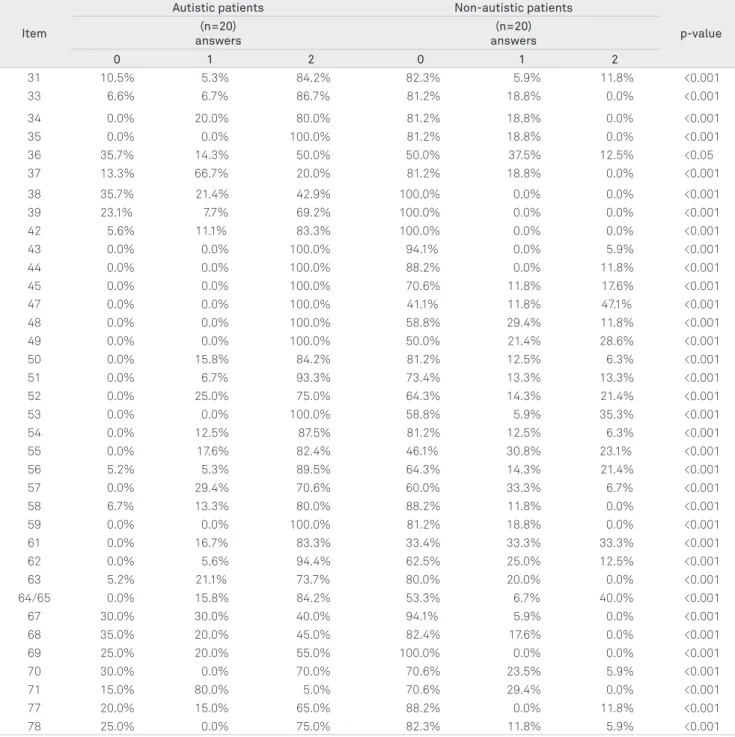
he Cronbach’s α reliability coeicient was 0.967 (95%CI 0.952–0.982). In the evaluation for the validity of criterion, the ADI-R correctly identiied all autism cases diagnosed through the DSM-IV criteria, with sensitivity of 100% (95%CI 83.2–100.0) and speciicity of 100% (95%CI 80.5–100.0). In the discriminant validity evaluation, mean scores obtained in each of the three diagnostic domains of the instrument were signiicantly high-er in the group of patients with autism, showing that this in-strument can discriminate both groups (Table 1).he discrimi-nant validity of each of the 42 scoring items of the interview was also evaluated. A signiicantly higher number of score 2 in the group with autism and scores 0 and 1 in the group without autism was obtained, showing that the items are valid as they
Table 1. Assessment of discriminant validity of the Autism Diagnostic Interview-Revised Brazilian Adaptation.
Autistic patients (n=20)
Non-autistic
patients (n=20) Diff 95%CI
x SD x SD
Domain 1 24.45 3.18 6.12 4.97 18.33 15.59-21.08
Domain 2 19.4 4.24 4.47 3.28 14.93 12.36-17.50
Domain 3 7.9 2.65 0.94 1.24 6.96 5.59–8.32
Domain 1: Qualitative impairment in social interaction; Domain 2: Qualitative impairment in communication; Domain 3: Restricted, repetitive and stereotyped behavior patterns; x: median; SD: standard deviation; CI: confidence interval; Diff: difference.
Table 2. Assessment of discriminant validity for each item of the Autism Diagnostic Interview-Revised Brazilian Adaptation.
Item
Autistic patients Non-autistic patients
p-value (n=20)
answers
(n=20) answers
0 1 2 0 1 2
31 10.5% 5.3% 84.2% 82.3% 5.9% 11.8% <0.001
33 6.6% 6.7% 86.7% 81.2% 18.8% 0.0% <0.001
34 0.0% 20.0% 80.0% 81.2% 18.8% 0.0% <0.001
35 0.0% 0.0% 100.0% 81.2% 18.8% 0.0% <0.001
36 35.7% 14.3% 50.0% 50.0% 37.5% 12.5% <0.05
37 13.3% 66.7% 20.0% 81.2% 18.8% 0.0% <0.001
38 35.7% 21.4% 42.9% 100.0% 0.0% 0.0% <0.001
39 23.1% 7.7% 69.2% 100.0% 0.0% 0.0% <0.001
42 5.6% 11.1% 83.3% 100.0% 0.0% 0.0% <0.001
43 0.0% 0.0% 100.0% 94.1% 0.0% 5.9% <0.001
44 0.0% 0.0% 100.0% 88.2% 0.0% 11.8% <0.001
45 0.0% 0.0% 100.0% 70.6% 11.8% 17.6% <0.001
47 0.0% 0.0% 100.0% 41.1% 11.8% 47.1% <0.001
48 0.0% 0.0% 100.0% 58.8% 29.4% 11.8% <0.001
49 0.0% 0.0% 100.0% 50.0% 21.4% 28.6% <0.001
50 0.0% 15.8% 84.2% 81.2% 12.5% 6.3% <0.001
51 0.0% 6.7% 93.3% 73.4% 13.3% 13.3% <0.001
52 0.0% 25.0% 75.0% 64.3% 14.3% 21.4% <0.001
53 0.0% 0.0% 100.0% 58.8% 5.9% 35.3% <0.001
54 0.0% 12.5% 87.5% 81.2% 12.5% 6.3% <0.001
55 0.0% 17.6% 82.4% 46.1% 30.8% 23.1% <0.001
56 5.2% 5.3% 89.5% 64.3% 14.3% 21.4% <0.001
57 0.0% 29.4% 70.6% 60.0% 33.3% 6.7% <0.001
58 6.7% 13.3% 80.0% 88.2% 11.8% 0.0% <0.001
59 0.0% 0.0% 100.0% 81.2% 18.8% 0.0% <0.001
61 0.0% 16.7% 83.3% 33.4% 33.3% 33.3% <0.001
62 0.0% 5.6% 94.4% 62.5% 25.0% 12.5% <0.001
63 5.2% 21.1% 73.7% 80.0% 20.0% 0.0% <0.001
64/65 0.0% 15.8% 84.2% 53.3% 6.7% 40.0% <0.001
67 30.0% 30.0% 40.0% 94.1% 5.9% 0.0% <0.001
68 35.0% 20.0% 45.0% 82.4% 17.6% 0.0% <0.001
69 25.0% 20.0% 55.0% 100.0% 0.0% 0.0% <0.001
70 30.0% 0.0% 70.0% 70.6% 23.5% 5.9% <0.001
71 15.0% 80.0% 5.0% 70.6% 29.4% 0.0% <0.001
77 20.0% 15.0% 65.0% 88.2% 0.0% 11.8% <0.001
discriminate patients with autism from those with intellectual disability without autism (Table 2). Questions 2, 86, 87, 9 and 10, although part of the scoring algorithm, were not consid-ered in the discriminant validity evaluation because they are not able to be discriminant.
In the group of children with intellectual disability with-out autism, 5 (29.4%) of them reached scoring values in 1 or 2 of the three autism diagnostic domains.
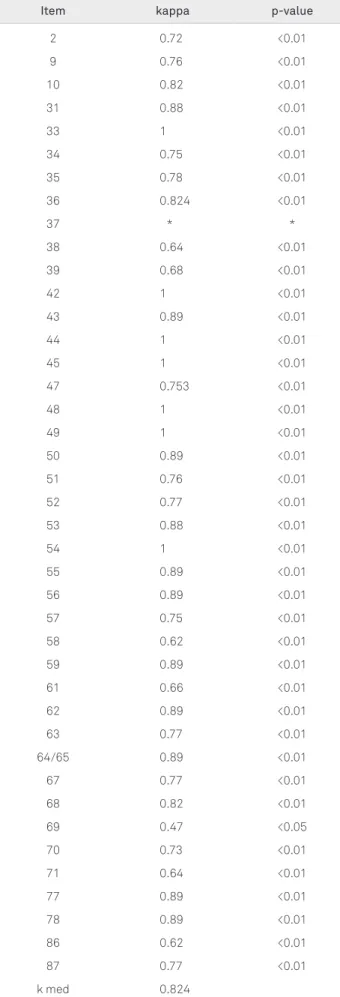
he external consistency was satisfactory in all scoring algorithm items, except for item 37, which did not allow the application of Kappa statistics (Table 3). he median Kappa value was 0.824.
DISCUSSION
In Brazil, in the last years, three autism assessment in-struments have been translated into Portuguese and validat-ed. he Scale for the Assessment of Autistic Behavior15, the
Childhood Autism Rating Scale16 and the Autism Screening
Questionaire11.
he ADI-R is considered as one of the “gold stan-dard” methods for autism diagnosis by the international literature4,5 and is the most frequently used clinical
instru-ment in studies and publications. Given its importance, it has been translated in several countries, such as Germany, Island, Japan, China, Italy and Spain, and is in translation process in others, as Holland, Norway, Hungary, Sweden, Korea and France.
Our study adopted the model of translation and transcul-tural validation process described by Sperber14, which is one
of the most frequently utilized in the literature6,17.
he predominance of male patients in the group with au-tism was not unexpected. According to some authors, the mean reported proportions varies from 3.5 to 4 boys to one girl, sometimes reaching 6 or more18,19.
he ADI-R Brazilian Adaptation obtained from our sam-ple showed initial validation properties. hese results were similar to those of the original interview and its revised edi-tion, as well as the methodology utilized in the instrument validation, with interview application to two groups of patients3,10.
he reliability, also known as consistency, refers to the reproducibility of a measurement and it can be evaluated through several forms. his study evaluated the interobserver consistency, which is the measurement of agreement between two or more observers assessing the same individuals20,21. It
was measured in the original interview and in its revision by means of the video recorded interviews.
In this study, the investigators made the evaluation in written records, a more practical and cheaper method. According to Menezes and Nascimento20, these records
im-mediately show whether the appraisers know the adopted criteria and interpret the records the same way. he Kappa
Table 3. Interobserver consistency of the Autism Diagnostic Interview-Revised Brazilian Adaptation.
Item kappa p-value
2 0.72 <0.01
9 0.76 <0.01
10 0.82 <0.01
31 0.88 <0.01
33 1 <0.01
34 0.75 <0.01
35 0.78 <0.01
36 0.824 <0.01
37 * *
38 0.64 <0.01
39 0.68 <0.01
42 1 <0.01
43 0.89 <0.01
44 1 <0.01
45 1 <0.01
47 0.753 <0.01
48 1 <0.01
49 1 <0.01
50 0.89 <0.01
51 0.76 <0.01
52 0.77 <0.01
53 0.88 <0.01
54 1 <0.01
55 0.89 <0.01
56 0.89 <0.01
57 0.75 <0.01
58 0.62 <0.01
59 0.89 <0.01
61 0.66 <0.01
62 0.89 <0.01
63 0.77 <0.01
64/65 0.89 <0.01
67 0.77 <0.01
68 0.82 <0.01
69 0.47 <0.05
70 0.73 <0.01
71 0.64 <0.01
77 0.89 <0.01
78 0.89 <0.01
86 0.62 <0.01
87 0.77 <0.01
k med 0.824
statistics is the most frequently method utilized to assess the external consistency; it is a measurement of interobserver agreement, corrected to chance agreement. Kappa values over 0.61 are considered substantial, according to Menezes and Nascimento20. In our study, high Kappa values were
ob-tained in 40 of the 42 assessed items. In item 37, which as-sessed the presence of pronoun reversal, it was not possible to apply the statistic test, as it is an orthogonal matrix and not all cells were illed out. Only item 69 presented a non-satisfactory value of external consistency (k=0.471). his item assesses the stereotyped use of objects and interest in parts of objects. he authors did not ind problems in the ret-ro-translation process of this speciic item and suggest that the training on concepts and codes involved in the question might have been insuicient.
he internal consistency of the ADI-R Brazilian Adaptation was fully satisfactory. According to Streiner and Norman22, the minimum value of 0.70 for Cronback’s α
coef-icient is recommended to ensure that the items consistently assess the same construct.
his study assessed not o nly the discriminant validity of the instrument, but also each instrument item, as per-formed in the validation studies of the original ADI10 and
its subsequent revision3, with satisfactory results, similar to
those of the abovementioned studies. hus, the instrument showed to be able to diferentiate patients with autism from patients without autism, although they presented mani-festations of the autism spectrum, a phenomenon already known in the clinical practice and that makes the diferential
diagnosis easier between patients with autism and patients with intellectual disability without autism3,10,23.
Our study detected that approximately 30% of the pa-tients with moderate intellectual disability fulilled the au-tism diagnosis criteria in at least one of the three diagnostic domains, a percentage that is very similar to that found by Le Couteur et al.10, when creating the ADI.
his study also showed that the Brazilian adaptation of the ADI-R presents validity of criterion as it identiied all chil-dren with autism diagnosed through the DSM-IV criteria. Such criteria were chosen because it is the most frequently utilized in the clinical practice and considered accurate, as suggested by Blacker and Endicott24.
he purpose of this study was to translate and validate the ADI-R into Brazilian Portuguese. Although the initial indings have been positive, precaution should be considered. his study was made with a small sample, using a case-control study de-sign that knowingly can overestimate the psychometric prop-erties of behavioral scales. Finally, the sample was obtained in a restricted area of the country. Regional, social and cultural variations should be assessed in a broader way.
ACKNOWLEDGEMENTS
We would like to thank the Department of Psychology of the HCPA, especially psychologists Natália Soncini and Letícia Rocha, for their help in the identiication of patients in this study with moderate intellectual disability.
1. Kanner L. Autistic Disturbances of Affective Contact. The Nervous Child 1942;2:217-251.
2. DSM-IV-TR, Transtornos Globais do Desenvolvimento. In: Manual Diagnóstico e Estatístico de Transtornos Mentais. 4th ed. Texto Revisado 2002. Porto Alegre: Artmed; 2002:99-103.
3. Le Couteur A, Lord C, Rutter M. Autism Diagnostic Interview-Revised: a revised version of a diagnostic interview for caregivers of individuals with possible pervasive developmental disorders. J Autism Dev Disord 1994;24:659-685.
4. Gray KM, Tonge BJ, Sweeney DJ. Using the autism Diagnostic Interview-Revised and the Autism Diagnostic Observation Schedule with young children with developmental delay: evaluating diagnostic validity. J Autism Dev Disord 2008;38:657-667.
5. Moss J, Magiati I, Charman T, Howlin P. Stability of the autism diagnostic interview-revised from pre-school to elementary school age in children with autism spectrum disorders. J Autism Dev Disord 2008;38:1081-1091.
6. Spence SJ, Sharifi P, Wiznitzer M. Autism spectrum disorder: screening, diagnosis, and medical evaluation. Semin Pediatr Neurol 2004;11:186-195.
7. Gadia CA, Tuchman R, Rotta NT. Autismo e doenças invasivas de desenvolvimento. J Pediatr 2004;80(Suppl 2):S83-S94.
8. Mildenberger K, Sitter S, Noterdaeme M, Amorosa H. The use of the ADI-R as a diagnostic tool in the differential diagnosis of children with infantile autism and children with a receptive language disorder. Eur Child Adolesc Psychiatry 2001;10:248-255.
9. Soke GN, Philofsky A, Diguiseppi C, Lezotte D, Rogers S, Hepburn S. Longitudinal changes in Scores on the Autism Diagnostic Interview-Revised (ADI-R) in pre-school children with autism: Implications for diagnostic classification and symptom stability. Autism 2011;15:545-562.
10. Le Couteur A, Rutter M, Lord C, et al. Autism Diagnostic interview: a standardized investigator-based instrument. J Autism Dev Disord 1989;19:363-387.
11. Sato FP, Paula CS, Lowenthal R, et al. Instrument to screen cases of pervasive developmental disorder: a preliminary indication of validity. Rev Bras Psiquiatr 2009;31:30-33.
12. Rutter MA, Le Couteur A, Lord C. Autism diagnostic interview revised manual. Los Angeles: Western Psychological Services; 2003.
13. Guillemin F, Bombardier C, Beaton D. Cross-cultural adaptation of health-related quality of life measures: literature review and proposed guidelines. J Clin Epidemiol 1993;46:1417-1432.
15. Assumpção Júnior FB, Kuczinski E, Gabriel MR, Rocca CC. Escala de avaliação de traços autísticos (ATA): validade e confiabilidade de uma escala para a detecção de condutas autísticas. Arq Neuropsiquiatr 1999;57:23-29.
16. Pereira A, Riesgo RS, Wagner MB. Autismo infantil: tradução e validação da Childhood Autism Rating Scale para uso no Brasil. J Pediatr (Rio J) 2008;84:487-494.
17. Mattos P, Segenreich D, Saboia E, Louzã M, Dias G, Romano M. Adaptação transcultural para o português da escala Adult Self-Report Scale para avaliação do transtorno de déficit de atenção/hiperatividade (TDAH) em adultos. Rev Psiquiatr Clin 2006;33:188-194.
18. Klin A. Autismo e síndrome de Asperger: uma visão geral. Rev Bras Psiquiatr 2006;28(Suppl 1):S3-S11.
19. Johnson CP, Myers SM. Identification and evaluation of children with autism spectrum disorders. Pediatrics 2007;120:1183-1215.
20. Menezes PR, Nascimento AF. Validade e confiabilidade das escalas de avaliação em psiquiatria. In: Gorenstein C, Andrade LHSG, Zuardi AW (Eds). Escalas de avaliação clínica em psiquiatria e psicofarmacologia. São Paulo: Lemos; 2000:23-28.
21. Duhn LJ, Medves JM. A systematic integrative review of infant pain assessment tools. Adv Neonatal Care 2004;4:126-140.
22. Streiner DL, Norman GR. Health measurement scales. A pratical guide to their development and use. Second Edition. New York: Oxford Medical Publications; 1995.
23. Waterhouse L, Wing L, Fein D. Re-evaluating the syndrome of autism in the light of empirical research. In: Dawson G (Ed). Autism: nature, diagnosis and treatment. São Paulo: Lemos; 1989263-281.