582
DOI: 10.1590/0004-282X20150064 ARTICLE
Epidemiology of chronic pain in the office of a
pain specialist neurologist
Epidemiologia da dor crônica no consultório de um neurologista especialista em dor
Karen dos Santos Ferreira, José Geraldo Speciali
he world prevalence of chronic pain is approximately 40%, generating enormous inancial and social damage1,2,3,4,5. here still is a severe shortage of professionals working in this area. hus, over the last few years, the training of health professionals in the pain area has been gaining space in Brazil1.Among the new specialties acting in this area, Neurology was approved by the Brazilian Federal Council of Medicine in 2002 (resolution no. 1634) as an area of activ
-ity in pain6. Over the last few years, the medical residency
program for Neurologists working with Pain has been im
-plemented at some institutions,resulting in the irst group of neurologists completing this program with this type of training. he objectives of qualifying neurologists for work in the Pain area were based on their theoretical knowledge
of the mechanisms of chronic pain, headaches, neuropathic pain, low back pain, rheumatological pain, palliative care, as well as their work with invasive procedures (peripheral nerve blockade) and anesthesiology procedures of medium complexity. Since then, some questions have arisen: what kind of working experience have these neurologists had? Who are the patients who efectively look for a neurologist for treatment and how are they approached?
Within this context, in an attempt to answer these ques
-tions, the objective of the present study was to describe the one-year prevalence of chronic pain in the oice of a Pain Specialist Neurologist who concluded a medical residency program at the University Hospital, Faculty of Medicine at Ribeirão Preto, University of São Paulo (FMRP-USP).
Universidade de São Paulo, Faculdade de Medicina de Ribeirão Preto, Divisão de Neurologia, Departamento de Neurociências e Ciências do Comportamento, Sao Paulo SP, Brazil.
Correspondence: Karen dos Santos Ferreira; Avenida Bandeirantes, 3900; 14048-900 Ribeirão Preto SP, Brasil; E-mail: [email protected]
Conflict of interest: There is no conlict of interest to declare.
Received 10 May 2014; Received in inal form 16 January 2015; Accepted 05 February 2015.
ABSTRACT
Objective: The objective of the present report was to describe the working experience of a pain specialist neurologist after concluding a medical residency program on neurology, area of concentration pain. Method: A retrospective study was conducted for one year in the ofice of a pain specialist neurologist. Patients older than 18 years with chronic pain according to the criteria of the International Association for the Study of Pain, were included. Demographic data, chronic pain data and the treatments instituted were investigated. Results: A total of 241 medical records were reviewed, mean patient age was 52.4 years and 79 (66.9%) were women, and the mean score on a numeric pain scale was 8.69. The diagnoses were headaches (74.6%), neuropathic pain (17%) and ostheomuscular pain (8.2%). We did not detect cancer pain. Patients received medication and procedures of anesthetic blockade. Conclusion: This data can guide new medical residency programs on Neurology, area of concentration pain, to plan activities and studies.
Keywords: chronic pain, neurology, medical residency.
RESUMO
Objetivo: O objetivo do presente estudo foi descrever a experiência de trabalho de um neurologista especialista em dor, após concluir um programa de residência médica em neurologia, área de concentração: dor. Método: Um estudo retrospectivo foi realizado por 1 ano no consultório de um neurologista especialista em dor. Pacientes com mais de 18 anos, com dor crônica de acordo com os critérios da Associação Internacional para o Estudo da Dor, foram incluídos. Dados demográicos, da dor crônica e tratamentos instituídos foram investigados. Resultados: Um total de 241 prontuários médicos foram revisados, a média de idade dos pacientes foi de 52,4 anos, 79 (66,9%) eram mulheres, e o escore médio em uma escala numérica de dor foi de 8,69. Os diagnósticos foram cefaleias (74,6%), dores neuropáticas (17%) e dores osteomusculares (8,2%). Não detectamos dor do câncer. Os pacientes receberam medicações e procedimentos de bloqueios anestésicos. Conclusão: Estes dados podem orientar novos programas de residência médica em neurologia, sub-área da Dor, para planejar as atividades e estudos.
583 Karen dos Santos Ferreira et al. Chronic pain in the ofice of a neurologist
METHOD
he study was conducted in the oice of a Pain Specialist Neurologist who had concluded a medical residency program at the University Hospital, Faculty of Medicine at Ribeirão Preto, University of São Paulo, in 2008. his is an outpatient clinic, that attends a speciic population from health insur
-ance companies or private patients. All the records of vis
-its held in 2012, involving patients older than 18 years with chronic pain according to the criteria of the International Association for the Study of Pain (IASP)7, were reviewed. Demographic data (age, gender), the characteristics of chron
-ic pain (location, intensity, diagnoses) and the treatments in
-stituted (medication, nerve blocks) were investigated. he Ethics Committee of School of Medicine of Ribeirão Preto, University of São Paulo, approved the study (CAAE: 22649914.4.0000.5440).
Data were processed in the Department of Statistics of FMRP-USP using the SPSS software.
RESULTS
he medical records of 241 patientwith chronic pain were reviewed. Of the patients evaluated, 79 (66.9%) were women and 39 (33.1%) were men; mean patient age was 52.4 years (Table 1).
On the occasion of the irst visit, the mean score of the nu
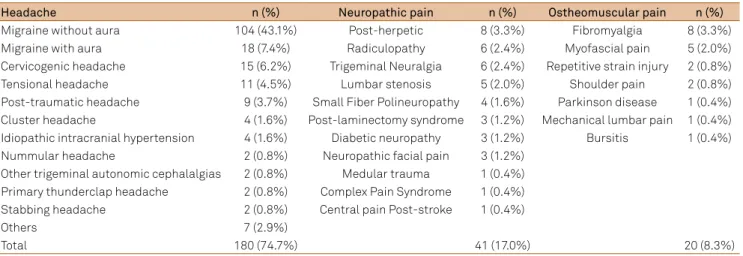
-meric pain rating scale was 8.69. he most frequent type of pain was headache. he diagnoses were divided into 3 major groups: 180 patients (74.6%) had headaches, 41 (17%) had neuropathic pain, and 20 (8.2%) had ostheomuscular pain. No patient had oncologic pain. he sub-diagnoses are described in Table 2. he medications most frequently used for treatment were tricyclic
antidepressants (78, 32.3%), followed by topiramate (53, 21.9%) and pregabalin (29, 12%) (Table 3). Opioids were used by 15 pa
-tients (6.2%). Sixty-four pa-tients (26.5%) received procedures of anesthetic blockade, the most frequent being blockade of the occipital nerves (16, 6.6%), followed by facet (6, 24%), epidural (5, 2.0%) and intercostal (5, 2.0%) blockade (Table 4).
DISCUSSION
In 1997, the Executive Council of the American Academy of Neurology (AAN) approved an initiative for the promotion of the participation of neurologists in the diagnosis and treat
-ment of pain. In the United States of America (USA), the assess
-ment and manage-ment of pain and patient education are crite
-ria for good hospital care. he AAN encourages neurologists to participate in an increasing and efective manner in the assess
-ment and treat-ment of pain, which require learning about this topic. he training opportunities for professionals dealing with pain include learning during the medical residency, one-year fel
-lowships from the American Board of Psychiatry and Neurology, and a growing evidence-based literature. Other specialties also deal with chronic pain in the USA, such as anesthesiology, psy
-chiatry, physical medicine and rehabilitation, with the profes
-sionals acquiring qualiication by entering one-year fellowship programs supported by the American Board of Anesthesiology. hese fellowships are based on a multidisciplinary program in
-volving several areas, and provide experience in interventional procedures, rehabilitation, oncologic pain, palliative care, pedi
-atric pain, neurologic pain, and clinical research8.
In Western European countries, candidates from difer
-ent specialties are selected for fellowships for the Treatm-ent of Pain at Excellence Centers in various countries, sponsored by the European Federation of IASP Chapters9.
In Brazil,a medical residency program for neurologists dealing with Pain has been implemented at several institu
-tions over the last few years, with very preliminary results having been obtained regarding the irst neurologists who have received this training.
Table 1. Chronic pain patients treated in 2012 (n: 241).
Mean age 41.27
Gender Female 185 (76.7%) Male 56 (23.3%) Numeric pain scale (mean) 8.69
Table 2. Pain diagnoses in chronic pain patients treated in 2012 (n: 241).
Headache n (%) Neuropathic pain n (%) Ostheomuscular pain n (%)
Migraine without aura 104 (43.1%) Post-herpetic 8 (3.3%) Fibromyalgia 8 (3.3%)
Migraine with aura 18 (7.4%) Radiculopathy 6 (2.4%) Myofascial pain 5 (2.0%)
Cervicogenic headache 15 (6.2%) Trigeminal Neuralgia 6 (2.4%) Repetitive strain injury 2 (0.8%)
Tensional headache 11 (4.5%) Lumbar stenosis 5 (2.0%) Shoulder pain 2 (0.8%)
Post-traumatic headache 9 (3.7%) Small Fiber Polineuropathy 4 (1.6%) Parkinson disease 1 (0.4%) Cluster headache 4 (1.6%) Post-laminectomy syndrome 3 (1.2%) Mechanical lumbar pain 1 (0.4%) Idiopathic intracranial hypertension 4 (1.6%) Diabetic neuropathy 3 (1.2%) Bursitis 1 (0.4%)
Nummular headache 2 (0.8%) Neuropathic facial pain 3 (1.2%)
Other trigeminal autonomic cephalalgias 2 (0.8%) Medular trauma 1 (0.4%) Primary thunderclap headache 2 (0.8%) Complex Pain Syndrome 1 (0.4%)
Stabbing headache 2 (0.8%) Central pain Post-stroke 1 (0.4%)
Others 7 (2.9%)
584 Arq Neuropsiquiatr 2015;73(7):582-585
Regarding the patients with chronic pain who seek these neurologists, the epidemiological demographic data ob
-tained in the present study are similar to literature data ob
-tained in previous studies about patients with chronic pain, aged on average 45 to 65 years and more frequent in women.
Gureje et al., published the irst large-scale cross-national study of persistent pain among primary care patients, con
-ducted by the World Health Organization (WHO), estimating its prevalence and impacts in a wide range of countries. Across all centers (including two centers in South America, Rio de Janeiro and Santiago), 22% of primary care patients reported persistent pain (25% of women and 16% of men). Lumbar pain were found in 47.8% of 5468 patients interviewed, headache in 45%, joint pain in 41%, and limb pain in 34.3%5.
he prevalence of chronic pain deined for the gen
-eral population, by a multicenter research conducted in 17 countries, is about 37% in developed countries and 41% in developing countries. hey detected lumbar pain in 40% of 42249 patients interviewed and headache in 14.4%10.
In general, lumbar pain is the most prevalence pain site in the world. In a population study, Elliott et al. detected 1817 patients with chronic pain, 576 of whom reported lum
-bar pain as the main cause of pain3.
he literature about chronic pain is scarce in developing countries, and there is a lack of studies conducted at Pain Clinics. In South Africa, using face-to-face interviews, Walker reported a 42.9% prevalence of chronic pain, with lumbar pain in 49.2% of this people11. In Brazil, Jacobsen interviewed 485 patients in a Pain Unit at the University of Sao Paulo,and reported that the most prevalent diagnosis was ibromyalgia (21.9%)12. Ferreira et al., de -scribed patients with chronic pain treated at the Pain Unit of the Central Hospital of Maputo, Mozambique. Of 118 patients inter
-viewed, 79 (66.9%) were women and mean patient age was 52.4 years. Lumbar pain was the most frequent site of pain (36.4%)13.
In the present study, headache was the main site of pain, whereas most world studies have detected low back pain as
the main pain topography. We believe that patients with oth
-er causes of chronic pain are not being ref-erred yet to neu
-rologists, since pain area of concentration on Neurology is recent. Patients with headache are believed to seek more fre
-quently a neurologist rather than a specialist in another area. On the other hand, patients with low back pain usually move between various professionals such as orthopedists, neuro
-surgeons, anesthesiologists specializing in pain, or rheuma
-tologists before solving their problem. Headache is the cause of sufering, disability and loss of quality of life and is one of the most important causes of chronic pain in the population. According to an article published in Lancet Neurology in 2008, the prevalence of headache in the general adult popula
-tion is 47%, with 10% involving migraine, 38% tension head
-ache, and 3% chronic headaches lasting more than 15 days14. he social costs related to headache in general, including lost work days and treatment costs, are considerable15.
Neuropathic pain, as deined by the Neuropathic Pain Special Interest Group – IASP, corresponds to pain occur
-ring as a direct consequence of injury or disease, afecting the neurosensory system16.Its world prevalence is about 3 to
8% of the population17,18. In the present study, the most fre
-quent causes among patients with neuropathic pain were post-herpetic neuralgia and radiculopathy. Most published studies have reported the lower limbs as the most frequently afected site17.he care of patients with neuropathic pain is a diferential item for neurologists who are pain specialists.
Ostheomuscular or musculoskeletal pain is a condi
-tion that includes a variety of disorders which cause pain in bones, joints, or surrounding structures. Musculoskeletal pain due to excessive use afects 33% of adults and is respon
-sible for 29% of work absenteeism19. Table 3. Medications most frequently used by chronic pain
patients treated in 2012.
Medication n (%)
Tricyclic antidepressants 78 (32.3%)
Topiramate 53 (21.9%)
Pregabalin 29 (12.0%)
Dual antidepressants 18 (7.4%)
Valproate 13 (5.3%)
Clorpromazine 10 (4.1%)
Gabapentine 8 (3.3%)
Propranolol 8 (3.3%)
Flunarizine 8 (3.3%)
Verapamil 4 (1.6%)
Indometacine 4 (1.6%)
Opioids 15 (6.2%)
Capsaicine 1 (0.4%)
Table 4. Procedures received by chronic pain patients treated in 2012.
Procedure n (%)
Anesthetic blockade
Occipital nerve block 16 (6.6%)
Facet joint block 6 (2.4%)
Epidural block 5 (2.0%)
Intercostal nerve block 5 (2.0%)
Suprascapular nerve block 5 (2.0%)
Surgical scars 3 (1.2%)
Gasser ganglia block 2 (0.8%)
Supratrochlear nerve block 2 (0.8%)
Maxillary e mandibular 2 (0.8%)
Numular points 2 (0.8%)
Auriculotemporal nerve block 2 (0.8%)
Sympathetic ganglia 1 (0.4%)
Supraorbital nerve block 1 (0.4%)
Others (femoral nerve, joint blocks) 3 (1.2%) Myofascial
Trigger point injection 6 (2.4%)
Radiofrequency 3 (1.2%)
585 Karen dos Santos Ferreira et al. Chronic pain in the ofice of a neurologist
About 18 million people in the world sufer oncologic pain, which is usually incapacitating, being very intense in 30% of patients. It should be pointed out that cancer pain is still un
-dertreated even in more socioculturally advanced countries due to poor information on the part of health professionals in the area of palliative care and pain relief and to resistance of the patients themselves due to cultural factors20. In the present study we did not detect cancer pain among our patients. We believe oncologic pain patients are being treated by their on
-cologists and they do not reach the neurologic clinic.
Regarding thetreatments instituted, the medications most frequently used were amitriptyline, topiramate and pregaba
-lin. he use of amitriptyline and topiramate was justiied by the large number of patients with headache, with amitripty
-line and pregabalin being the medications of choice for neu
-ropathic pain21.he choice of the drugs was not inluenced by socio-economic status of the patient, the price of the drug or the availability of the drug at the public health system. Opioids were seldom used, perhaps because of the absence of cancer pain in the present sample. A still controversial question is the use of opioids for non-oncologic chronic pain in disorders such as headache, neuropathy, post-laminectomy syndrome, ibro
-myalgia and other pain syndromes8. Invasive procedures (an
-esthetic blockade) were performed in 64 (26.5%) patients. We should emphasize that neurologists who are qualiied for the
treatment of chronic pain must be prepared to provide special
-ized care and procedures.
Over the last few years, the presence of neurologists in the area of treatment of cronic pain has become a world trend. he programs of medical residency for neurologists working with pain encourage neurologists to participate in an increasing and efective manner in the evaluation and treatment of pain. he training opportunities for the professionals working with this treatment are an important step for the improvement of the ef
-fectiveness of the treatment instituted. Since this specialty is new, it would be desirable to be made public information campaigns to medical and lay people, so patients can be properly referral.
In conclusion, chronic pain is a serious health problem all over the world, generating physical disability and social, emo
-tional an economic damage. A irst step for a more efective approach to the problem is to know it prevalence and pecu
-liarities. he present study shows that the training of neurolo
-gists working in the pain area should give priority to the fol
-lowing causes of pain: primary headaches, neuropathic pain and musculoskeletal pain, with emphasis on Fibromyalgia and Miofascial pain in these last area. Next, more profession
-als should be habilitated for providing care, establishing treat
-ment strategies, and inally, the performance of these profes
-sionals should be evaluated. Only in this way will it be possible to improve the way we deal with such relevant problem.
References
1. Teixeira MJ. Dor: manual para o clínico. Rio de Janeiro: Atheneu; 2006.
2. Croft P, Blyth FM, Windt D, editors. Chronic pain epidemiology from aetiology to public health. Oxford: Oxford University Press; 2010. 3. Elliott AM, Smith BH, Penny KI, Smith WC, Chambers WA. The epidemiology
of chronic pain in the community. Lancet. 1999;354(9186):1248-52.
4. Gaskin DJ, Richard P. The economic costs of pain in the United States. J Pain. 2012;13(8):715-24. http://dx.doi.org/10.1016/j.jpain.2012.03.009 5. Gureje O, Von Korff M, Smion GE, Gater R. Persistent pain and
well-being: a World Health Organization study in primary care. JAMA. 1998;280(2):147-51. http://dx.doi.org/10.1001/jama.280.2.147 6. Conselho Federal de Medicina. Resolução CFM nº 1634/2002. Dispõe
sobre convênio de reconhecimento de especialidades médicas irmado entre o Conselho Federal de Medicina CFM, a Associação Médica Brasileira – AMB e a Comissão Nacional de Residência Médica – CNRM. Diário Oicial União. 29 abr 2002;seção1:81.
7. International Association for the Study of Pain – IASP. Classiication of chronic pain. 2nd ed rev. Washingoton, DC: International Association for the Study of Pain; 2011 [cited 2001 July 10]. Available from: http://www. iasp-pain.org/PublicationsNews/Content.aspx?ItemNumber=1673 8. American Academy of Neurology Ethics, Law and Humanities
Committee. Ethical considerations for neurologists in the management of chronic pain. Neurology. 2001;57(12):2166-7.
9. European Pain Federation – EFIC. EFIC chapters. Belgium: European Pain Federation; 2012 [cited 2014 Nov]. Available from: http://www.eic.org/index.asp?sub=3joJQ8061FVMeR
10. Tsang A, Von Korff M, Lee S, Alonso J, Karam E, Angemeyer MC et al. Common chronic pain conditions in developed and developing countries: gender and age differences and comorbidity with depression-anxiety disorders. J Pain. 2008;9(10):883-91. http://dx.doi.org/10.1016/j.jpain.2008.05.005
11. Walker SP, Odendaal CL, Esterhuyse KGF. Biographical, pain and psychosocial data for a South African sample of chronic
pain patients. South Afr J Anaesth Analg. 2006;12(2):62-6. http://dx.doi.org/10.1080/22201173.2006.10872440
12. Teixeira MJ, Teixeira WGJ, Santos FPS, et al. Clinical epidemiology of musculoskeletal pain. Rev Med. 2001;80(1):1-21.
13. Ferreira KS, Schwalbach MT, Schwalbach J, Speciali JG. A pain unit in a developing country: epidemiology of chronic pain in Maputo, Mozambique. Pain Med. 2014;15(11):1986-8. http://dx.doi.org/10.1111/pme.12544
14. Jensen R, Stovner LJ. Epidemiology and comorbidity of headache. Lancet Neurol. 2008;7(4):354-61. http://dx.doi.org/10.1016/S1474-4422(08)70062-0
15. Bigal ME, Lipton RB, Stewart WF. The epidemiology and impact of migraine. Curr Neurol Neurosci Rep. 2004;4(2):98-104. http://dx.doi.org/10.1007/s11910-004-0022-8
16. Haanpää M, Attal N, Backonja M, Baron R, Bennett M, Bouhassira D et al. NeuPSIG guidelines on neuropathic pain assessment. Pain. 2011;152(1):14-27. http://dx.doi.org/10.1016/j.pain.2010.07.031 17. Bouhassira D, Lantéri-Minet M, Attal N, Laurent B, Touboul C. Prevalence
of chronic pain with neuropathic characteristics in the general population. Pain. 2008;136(3):380-7. http://dx.doi.org/10.1016/j.pain.2007.08.013 18. Torrance N, Smith BH, Bennett MI, Lee AJ. The epidemiology of
chronic pain of predominantly neuropathic origin: results from a general population survey. J Pain. 2006;7(4):281-9. http://dx.doi.org/
19. Merskey H, Bogduk N, editors. Classiication of chronic pain: description of chronic pain syndromes and deinition of pain terms. Seattle: IASP Press; 1994.
20. Ministério da Saúde (BR), Instituto Nacional de Câncer. Cuidados paliativos oncológicos: controle da dor. Rio de Janeiro: Instituto Nacional de Câncer; 2001.