Numerical Generation of Optimized
Discrete Variable Representations
J. J. SoaresNeto and L. S.Costa Universidade de Braslia, Departamento de Fsica
70.910-900 Braslia- DF, Brazil
Received January 17, 1997. Revised November 3, 1997.
We develop a procedure for calculating an optimized Discrete Variable Representation (DVR) optimized for a given potential. The method leads to an ecient and compact way to obtain numerical solutions of quantum mechanical problems. The procedure is ap-plied to several physical problems. To illustrate the strength of the algorithm in dealing with multidimensional calculations, we obtain accurate levels up to 19;000 cm,1 for the
vibrational energies of the water molecule.
The eciency of quantum mechanical numerical cal-culations rely in great part on the right choice of basis functions. The solution of multidimensional problems requires the manipulation of large matrices and a bad choice of basis functions could easily turn the problem unfeasible. We should also be concerned with the ma-trix structure and the computer time for the computa-tion of the matrix elements. The calculacomputa-tion of the el-ements of a matrix makes use of Gaussian quadratures and an excessive number of points may lead to hibitive time consuming codes. This paper shows a pro-cedure for optimizing all these aspects. The strength of the approach is easily seen when we deal with three-dimensional problems.
There are several ways of expanding the quantum mechanical wave function. The more traditional proce-dure is the expansion in terms of global basis functions [1-3]. Generally, we choose the functions that diago-nalize the kinetic energy operator and integrate numer-ically the potential using Gaussian quadratures. An-other family of procedures are the nite element meth-ods [4-12]. The basis functions are local and we have to discretize the space in many elements to implement the calculation [6]. Finally, we may choose a set of ba-sis functions that have the feature of diagonalizing the potential. The great advantage in this case is that the kinetic energy operator may be integrated analytically, leading to a great eciency during the evaluation of the matrix elements. The last procedure is called the \Discrete Variable Representation" (DVR) [13-23].
The Discrete Variable Representation has been used extensively by Light and collaborators [13-16] who
per-formed accurate calculations of the ro-vibrational en-ergies of several triatomic molecules. Choi and Light [24] also used this procedure to study Van der Waals molecules. Le Quere and Leforestier [25] used a time dependent approach and a DVR implementation for studying the photodissociation of Ozone. More re-cently, the method for expanding the multidimensional quantum mechanical wave function [26-32] has ap-peared in other calculations.
This paper develops a procedure for obtaining a Nu-merically Generated Discrete Variable Representation (NG-DVR). All publications mentioned before, except the work of Echave and Clary [26], do not use a nu-merically optimized Discrete Variable Representation for the potential of the system under consideration. In this way, the number of basis functions is not optimized for the particular problem to be solved. The proce-dure proposed by Echave and Clary [26] does not cal-culate explicitly the weight of the optimized Gaussian quadrature while the method developed here obtain both points and weights. This feature gives more ex-ibility for using the NG-DVR. To show its features we apply the NG-DVR for some standard one-dimensional problems. However, the strength of this methodology appears when we treat multidimensional calculations. A three-dimensional code is developed and applied to the calculation of the vibrational modes of H2O.
prob-lems. Section IV is concerned with the application of the methodology for a multidimensional problem and the calculation of the vibrational energies of the H2O
molecule. Finally, in the Conclusion we present several remarks.
I The discrete variable
repre-sentation
Most methodologies for dealing with multidimen-sional problems are based on direct products of one-dimensional sets of basis functions. In view of this, we will treat all basic concepts of DVR using a one-dimensional terminology. Section IV shows an appli-cation for a multidimensional problem. We stress that the use of N basis functions in each direction of the space will lead to a matrix with dimensionNd where d is the dimension of the space. It is essential to spend as few as possible basis functions for each direction of the space in order to keep the matrix problem treatable.
The Hamiltonian operator, H =,
1 2m d
2
dx2 + V (x);
is composed of the kinetic energy and potential opera-tors. Let us expand the wave function in a set of basis functions fi(x);i = 1;::;N belonging to a L2-space,
(x) =XN
i=1
fi(x)ai; (1)
where ai;i = 1;:::;N are the coecients of the
expan-sion. We will require that
fi(xl) = il;i;l = 1;::;N; (2)
where xl;l = 1;::;N are points of a Gaussian
quadra-ture rule. Later, we will develop an algorithm to obtain an optimized Gaussian quadrature.
We call a set of functions obeying Eq. (2) a Discrete Variable Representation (DVR). In order to generate a numerically optimized DVR we start with another set of L2 functions g
j(x);j = 1;::;N: The wave function
(x) may also be expanded in terms of this set,
(x) =XN
j=1
gj(x)bj: (3)
The nite set of functions gj(x);j = 1;::;N obey the
relation N
X
j=1
jgjhigjj= 1: (4)
We will call gj(x);j = 1;:::;N the primitive functions,
and the set fi(x);i = 1;::;N is called the
Numeri-cally Generated Discrete Variable Representation (NG-DVR). The gjare given functions and the NG-DVR will
be obtained, for any potential V (x), by the proposed algorithm.
We use Eq.(4) to obtain fi(x) =XN
j=1
hxjgjihgjjfii: (5)
The integralhgjjfiimay be evaluated applying a
Gaus-sian quadrature rule of points and weights xl;wl;l =
1;::;N: This quadrature will also be numerically opti-mized for the potential of the system in question. At this stage, we assume that the optimized quadrature rule has been done and we obtain
fi(x) =XN
j=1
N
X
l=1
g
j(x)wlgj(xl)fi(xl) : (6)
Finally, using Eq. 2, we have fi(x) = wi N
X
j=1
g
j(x)gj(xi): (7)
We can see that Eq. 2 is automatically veried for the functions fi(x);i = 1;::;N generated by Eq. 7. It is
straightforward to obtain an optimized quadrature rule using Eq. 2 and Eq. 7. For a given quadrature point xl, we have
wl=XN
j=1
1 g
j(xl)gj(xl): (8)
From the theory of Gaussian quadrature rules, we know that the points xlare the eigenvalues of the matrix with
elements
Xjj0=
hgjjxjgj
0i; (9)
where x is the position operator. As it will be shown in the applications in the next two sections, an ecient NG-DVR is obtained when we use as primitive func-tions, gj(x);j = 1;::;N; the eigenfunctions of the
one-dimensional Hamiltonian H = , 1 2m d
2
dx2 + V (x). For
many real systems, there is no analytical solution for the Schrodinger equation H = E , so our procedure is all done numerically.
II Simple examples
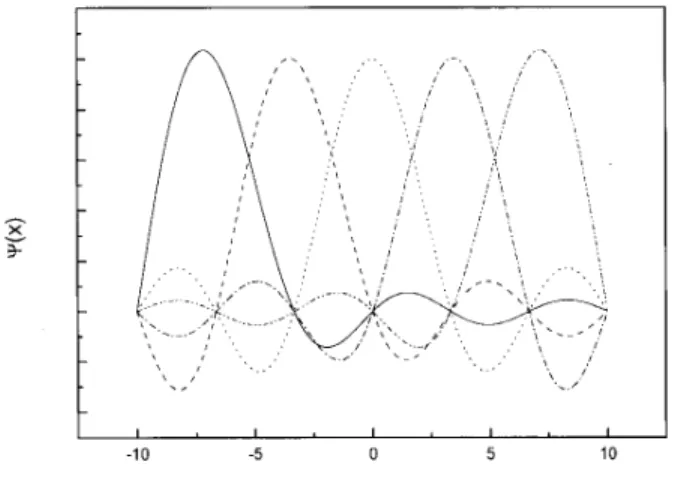
The simplest problem one could treat is the particle in a box. We may solve Eqs. 7- 9 analytically and obtain the quadrature points and weights as well as the DVR's. Muckerman [23] and Colbert and Miller [22] have done that and generated the Discrete Variable Representa-tion associated with the particle in a box. We show in Fig. 1-A one of these functions and in Fig. 1-B ve of them. The quadrature points associated with this DVR are equally spaced. From now on we will use this set of DVR to expand the primitiveg
j(
x);j= 1;::;Ndened
in Eq. 3.
Figure 1A. Particle in a box DVR. The system is dened for a box ranging from - 10 to 10 bohr.
Figure 1B. A set of 5 particle in a box DVR's. The quadra-ture points are equaly spaced in this case.
In order to have a clear idea of the accuracy of the method we treat now the harmonic oscillator. As the Gaussian quadrature points can be analytically calcu-lated for this problem, we can see how well we are able to reproduce them. The numerical procedure is as follows. First, we use 100 particles in a box DVR's to generate 5 eigenfunctions of the Hamiltonian
H = , 1 2 d 2 dx 2 + 1 2 x
2. These eigenfunctions constitute
the set g j(
x);j= 1;::;5:Eq. 9 is applied to obtain the
quadrature points. Table 1 compares the exact 5 Gauss-Hermite quadrature points with the numerically calcu-lated ones. We also provide a 9 point Gauss-Hermite quadrature rule in Table 1. As we notice, the method-ology is able to oer highly accurate numbers, and they are accurate up to the tenth gure. Finally, Eq. 7 gives us the NG-DVR optimized for the harmonic oscillator. Fig. 2A shows one NG-DVR associated with the har-monic oscillator and Fig. 2B pictures the full set of ve. One may generate as many quadrature points and NG-DVR as necessary to deal with the problem in hand. We also point out that the property expressed in Eq. 2 is accurately satised.
Figure 2A. A Numerically Generated DVR (NG-DVR) for the harmonic oscillator.
Figure 2B. A set of 5 NG-DVR for the harmonic oscillator.
Finally, we treat the H
2 molecule and also use
100 particle in a box DVR's to calculate 5 eigenfunc-tions ofH
2. These eigenfunctions are our primitive set g
j(
x);j = 1;::;5: Applying the same procedure used
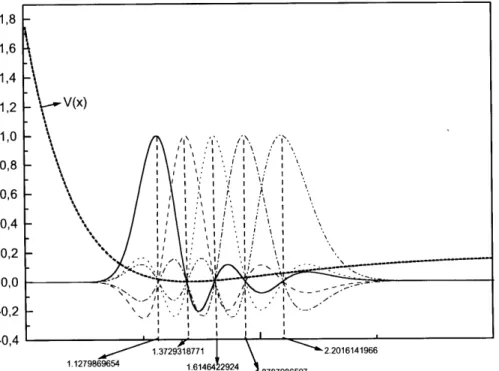
for the harmonic oscillator, we obtain the quadrature points optimized for this potential and the NG-DVR. Fig. 3 shows the 5 NG-DVR's as well as the potential forH
Figure 3. Five NG-DVR for the H2 molecule. The Figure also shows the H2potential energy surface and the ve quadrature
points used to generate the DVR's.
III The
H2Omolecule. A
three-dimensional example
Now the concepts developed in the previous Sections will be applied to a multidimensional problem. The generalization of the algorithm is straightforward and easy to perform. The ability of the algorithm to gener-ate high accurgener-ate quadratures points and NG-DVR will allow us to use the minimum number of basis functions and integration points for solving the multidimensional problem.
The potential energy surface of a triatomic system depends on the three internuclear distances and ro-vibrational calculations have to deal with the expansion of the wave function in these directions. The choice of coordinates and basis functions are crucial for the success of any algorithm. The most commonly used are the hyperspherical coordinates, Jacobi coordinates and mass weighted Jacobi coordinates. We are using a particular set of hyperspherical coordinates that de-scribe the full space by means of a hyper-radius and ve hyper-angles. The hyper-radius range goes from zero to innity while the hyper-angles have nite ranges. Other details about the coordinates we are using are given in previous publications and we refer the reader to them [5,31-35].
Accurate calculations of ro-vibrational levels of tri-atomic molecules are now feasible due to the speed and memory of the modern computers. Eorts have been done by several groups to obtain the accurate spectrum of tetra-atomic molecules. For this purpose, we should run a full six-dimensional calculation and pay atten-tion in each step of the calculaatten-tion in order to keep the dimension of the matrix and the number of oper-ations within the limits of the computers. Even for three-atomic systems, the optimization of basis func-tions is essential in order to calculate high vibrational modes with high accuracy. The wave functions associ-ated with excited states may sample a large region of the three-dimensional conguration space and the ba-sis functions being used should be able to accurately represent such states. Moreover, the number of basis functions must be small in order to keep the matrix dimension manageable.
pro-cedure described in Sections II and III are them applied to generate a NG-DVR for the hyper-radial direction. We point out that this set of basis functions brings in-formation about the potential and they are ecient for expanding the total wave function.
The numerically optimized basis functions for the hyper-angular space is obtained applying a two-dimensional nite element method approach. The two-dimensional hyper-angular space is discretized by means of triangles and the Hamiltonian matrix is diag-onalized. The eigenvectors are utilized as two- dimen-sional basis functions for the hyper-angular space. This contraction method has been used before and we refer the reader to the Ref. 5. We keep a number of 110 hyper-angular eigenvectors in the present calculation.
We used the same potential of Miller and Tennyson, Wei and Carrington and Choi and Light. This is an empirical potential energy surface obtained by Jensen [36] who collected a large amount of experimental data to t it. Table 2 shows states of the water molecule up to 19;000cm,1. We also compare the calculated
numbers with experimental values and calculations by Fernley, Miller and Tennyson (FMT) [27], Wei and Car-rington (WC) [30], Choi and Light (CL) [29] and J. J. Soares Neto and F. V. Prudente (NP) [5] in Table 2 and conclude that our calculated numbers agree well with other calculations. We also notice that this calculation improves considerably our previous attempt [5], in spe-cial, for highly excited states, where the present basis set describes the wave function more accurately. There are three key parameters that are responsible for the convergence of the calculation and we use the following values for them: 22 hyper-radial basis functions, 3095 triangular nite elements describing the hyper-angular space and the maximum number of 150 hyper-angular contraction basis functions. The dimension of the ma-trices associated with these parameters is the maximum we can manage with our present computer resources.
The nal contracted matrix for this calculations is of dimension 15001500 and the complete run takes 5
hours of a CPU of a Alpha 3000 (Digital) workstation.
IV Concluding remarks
We developed a numerical procedure to optimize a DVR for a given system. The methodology has been applied to the calculation of the ro-vibrational states of the wa-ter molecule. We obtained high vibrational levels of this molecule with good accuracy compared to other three-dimensional calculations. The results of this publica-tion are considerably better than those that we have published [5] using another approach for making the expansions along the hyper{radial direction. The ap-plication to other three-atomic systems is straightfor-ward and does not require any change in the program since the optimization procedure is automatic. The al-gorithm deals with both the generation of basis func-tions and the calculation of quadratures points for the problem.
Ohrn and Linderberg [37] developed a set of hyperspherical coordinates for tetra-atomic systems. Presently, we are makingeorts to develop an algorithm to calculate bound states of tetra-atomic molecules us-ing these coordinates and the Numerically Generated DVR described in this paper. We are also developing a contraction scheme similar to the one used for the water molecule.
Acknowledgments
References
1. P. L. Goodfriend, Chem. Phys. Lett. 186, 509
(1991).
2. T. D. Crawford and W. Yang, Chem. Phys. Lett.
192, 45 (1992).
3. A. Preiskorn, D. Frye and E. Clementi, J. Chem. Phys. 94, 7204 (1991).
4. J.J. Soares Neto and J. Linderberg, Comp. Phys. Comm.66, 55 (1991).
5. J. J. Soares Neto and F. V. Prudente, Theor. Chim. Acta89, 415 (1994).
6. P. G. Ciarlet,The Finite Element Method for El-liptic Problem,North- Holland, Amsterdam, 1978. 7. D. H. Norrie and G. de Vries,The Finite Element
Method,Academic Press, NewYork, 1973. 8. K. W. Morton, Comp. Phys. Rep. 6, 1 (1987).
9. R. Jaquet, Theor. Chim. Acta71, 425 (1987).
10. R. Jaquet, Chem. Phys. 118, 17 (1987).
11. N. Sato and S. Iwata, J. Comp. Chem. 9, 222
(1988).
12. L. Yang, D. Heinemann and D. Kolb, Chem. Phys. Lett. 192, 499 (1992).
13. Z. Bacic and J. C. Light, J. Chem. Phys., J. Chem. Phys. 85, 4594 (1986).
14. Z. Bacic, R. M. Whitnell, D. Brown and J. C. Light, Comp. Phys. Comm.51, 35 (1988).
15. Z. Bacic and J. C. Light, J. Chem. Phys. 86, 3065
(1987).
16. J. C. Light and Z. Bacic, J. Chem. Phys. 87, 4008
(1987).
17. M. Mladenovic and Z. Bacic, J. Chem. Phys.93,
3039 (1990).
18. Z. Bacic and J. Z. Zhang, Chem. Phys. Lett. 184,
513 (1991).
19. Z. Bacic and J. Z. Zhang, J. Chem. Phys. 96,
3707 (1992).
20. V. Szalay, J. Chem. Phys. 99, 1978 (1993).
21. C. Leforestier, 4th Topse Summer School on
Time Dependent Methods in Quantum Mechanics,
Copenhagen, 1991.
22. D. T. Colbert anq W. H. Miller, J. Chem. Phys.
96, 1982 (1992).
23. J. T. Muckerman, Chem. Phys. Lett. 173, 200
(1990).
92, 2129 (1990).
25. F. Le Quere and C. Leforestier, J. Chem. Phys.
94, 1118 (1991).
26. D. Wang and J. M. Bowman, J. Chem. Phys.
100, 1021 (1994).
27. J. A. Fernley, S. Miller and J. Tennyson, J. Mol. Spectr. 150, 597 (1991).
28. J. Tennyson, J. Chem. Phys. 98, 9658 (1993).
29. S. E. Choi and J. C. Light, J. Chem. Phys. 97,
7031 (1992).
30. H. Wei and T. Carrington, Jr., J. Chem. Phys.
97, 3029 (1992).
31. J. J. Soares Neto and J. Linderberg, J. Comp.
Chem. 12, 1237 (1991).
32. J. J. Soares, S. B. Padkjaer and J. Linderberg, Int. J. Quantum Chem. S23, 127 (1989).
33. J. Linderberg and B. Vessal, Int. J. Quantum Chem. 31, 65 (1987).
34. M. Mishra, J. Linderberg and Y. Ohrn, Chem. Phys. Lett. 111, 439 (1984).
35. J. J. Soares Neto and J. Linderberg, J. Chem. Phys. 95, 8022 (1991).
36. P. Jensen, J. Mol. Spectrosc. 133, 438 (1989).
37. Y. Ohrn and J. Linderberg, Mol. Phys. 49, 53