Abstract: This article is a theoretical proposal about the expressive dimension of inner speech, a phenomenon that emphasizes the Karl Buhler’s proposal in relation to the expressiveness of the language; the Heinz Werner´s studies about a physiognomic-organismic dimension of human language and the theoretical and empirical approach of Lev Vygotsky about the phenomenon of inner speech in human experience. It is concluded that some passages of Vygotsky’s work are the keys to the comprehension of the expressive inner speech, specifically the influence of affective-volitional sphere in the development of thought and language. Finally, is proposed an integration of Vygotsky’s monological conception of the inner speech, the Wernerian notion of physio-organismic language and the Bühlerian proposal of the expressive dimension of human language, for an integrative comprehension of the expressiveness of the inner speech.
Keywords: inner speech, expressiveness, physiognomic language.
The expressive dimension of inner speech
Pablo Fossa*
Pontiicia Universidad Católica de Chile, Escuela de Psicología. Santiago, Chile
Introduction
The inner speech has been an object of interest from very early on in the history of philosophy. There are mentions regarding this phenomenon in various relevant works, such as Plato’s Theaetetus (2006), which establish a direct relationship between this phenomenon and thought. It is also possible to see references to inner speech in the works of Stoic philosopher Marco Aurelio (Hadot, 2001), and in the Christian philosophy exemplified in the Confessions of St. Augustine (2010). Wittgenstein (1953) also dedicates some passages of his philosophical investigations to reflection regarding the existence of a private language.
In modern psychology Piaget (1922) and Vygotsky (1934) conducted the first empirical approaches to the phenomenon. Piaget conducted studies on the child egocentric language and Vygotsky deepened and made reformulations to the Piagetian postulations. Subsequent studies of inner speech in contemporary psychology have a Vygotskian influence on the development of language and other higher cognitive processes (Heery, 1989; Kinsbourne, 2000; Ridgway, 2009; Roberts, 2008; Villagrán, Navarro, López & Alcalde, 2002; Damianova, Lucas & Sullivan, 2012; Silveira & Gomes, 2012; among others). In this study on inner speech experience, there is no evidence of an expressive dimension that had already been presented, though not directly, in philosophical works about the experience of speaking to oneself.
Karl Bühler is the leading author in psychology who refloats the ancient dimension of the experience, forgotten or sub-dimensioned in contemporary psychology. Bühler (1934/1965) makes a systematization of language functions and adds a different dimension to the representational
function, classically studied in psychology of the language
* Corresponding address: [email protected]
and linguistics, and which refers to the function of language related to the communication of a referent, meaning anything outside the act of communicating. It is the most obvious function of language, since it is found in every communicative act. It is clearly observed when the message can be checked and it is possible to observe the relationship between the message and the external referent it designates. Realize the denotative meaning of the message (Bühler, 1934/1965). It has also been called denotative function, cognitive or referential.
Bühler (1934/1965) adds, on the one hand, the subjectivity of the sender in the communicative act and, on the other hand, the language’s ability to interpellate the interlocutor with the representational function of the linguistic sign. Bühler denominates the appellative
function of the language to this last phenomenon, and the
expressive function of language to the first.
Bühler (1934/1965) revisits an old dimension –
expressive – of human language that has not been the object of interest in contemporary research. Vygotsky (1934) carries out a finished study regarding inner speech in psychology managing to explore and describe its main characteristics and its development in the ontogeny, without realizing explicitly, an expressive dimension – in the sense of Buhler – in the inner speech.
phenomenon and obtain a more holistic understanding of an experience inherent to the human being.
The inner speech
Vygotsky (1934) is one of the main authors in psychology concerned with the development of cognitive processes. For Vygotsky, inner speech is the experience of speaking to oneself in silence. Internal speech is a language with no sound, a sub-vocalized speech or, how he declares in his last work Thought and Language, a verbal thought. With the concept of verbal thinking, the author establishes a clear relationship between inner speech and thought, a fundamental interaction at the moment of understanding the phenomenon of inner speech. In his words:
Inner speech is a special formation in its psychological nature, a special form of verbal activity, with its own characteristics, and which maintains a complex relationship with other forms of verbal activity. We believe that it is not indifferent if one speaks to oneself or others. Internal language is language for oneself and external language is language for others. It cannot be admitted that this radical and fundamental difference between the functions of these kinds of languages has no consequences on the structural nature of both verbal functions. . . . This is not just about vocalization. The presence or absence of vocalization does not explain the psychological nature of internal language but the consequence that follows from this nature. Inner speech not only precedes external language, but quite the contrary. external language is the process of transforming thought into word, its materialization and objectivation. Inner speech is a process in the opposite direction that goes from the outside to the inside, a process of evaporation of language in thought. (Vygotsky, 1934, pp. 306-307)
Vygotsky (1934), based on his observations with children and on the review of language development studies in chimpanzees, theorizes that thought and language have independent genetic origins in phylogenetic development. However, it is in our species – and due to the influence of culture – that thought and languages intersect their development during the early stages of ontogenetic development, a moment in which thought becomes verbal and intellectual language. For Vygotsky, culture offers challenges that require superior cognitive skills to be faced. In this permanent challenge that takes place in the exchange with the environment, cognitive processes intersect their functions to achieve increasing cognitive achievements, so that the human being manages to be adapted to culture. In this way, Vygotsky understands psychological development as the result of the permanent interaction between cognition and the environment. Based on studies regarding the development of cognitive
processes in childhood – language and thought – and specifically the study on the relationship between these elements, Vygotsky (1934) discovers one of his main findings: the inter-functional relationship between thought and language differs in quality and quantity in the different moments of ontogenetic and microgenetic development. It is in this context that Vygotsky explains his referenced idea regarding the development of cognitive functions:
In the ontogenetic development of the human kind, its growth curves meet and separate again and again, they also cross and, during certain periods, are aligned in parallel even merging at some point, and then forking again.(Vygotsky, 1934, p. 91)
From here Vygotsky proposed that thought is mediated – mainly by words – which is a fundamental aspect in the study of the phenomenon of inner speech.
Based on the works of Piaget (1922) on children’s egocentric language, Vygotsky, up to this point, had developed more systematic understanding of inner speech. Previously, Piaget (1922) had observed the presence of a language form characteristic of pre-school children, which he called egocentric language, since it has as function a communication “to oneself” as a function, with little interest in being understood by the interlocutor. Piaget (1922) also deduced the existence of an egocentric thought in children through a vocalized language with similar characteristics. Piaget’s studies revealed the emergence of this form of language and thought during children’s play. Because of this, Piaget concluded that the main function of egocentric language should be problem solving. This kind of language, according to Piaget’s perspective, would be very close to the action and is accompanied by concrete behaviors such as, for example, those in children’s play. According to this idea, egocentric language would lack social function and its main function would be problem solving, specifically during children’s games, and control of thought. For Piaget (1922), the egocentric language – and therefore, egocentric thinking – begin to decrease gradually with the emergence of a socialized language, meaning that language is directed towards another.
resort to expressing a vocalized language – egocentric – accompanied by actions to solve everyday situations, but from the school age it is possible to resort to the internalized function.
Vygotsky’s effort to understand this phenomenon of experience continued to the linguistic structure of inner speech. On this occasion the author, through his experimental observations, manages to describe characteristics of this type of language, a tendency for predication and another one for abbreviation. The tendency to predication orientates from inner speech to the expression of only predicating and omitting the subject in the syntactic structure. In inner speech we only express predicates since the receivers, who are ourselves, know the subject of the sentence. On the other hand, the tendency abbreviate promotes the capacity of inner speech to express great ideas condensed in small concepts. These characteristics, described by Vygotsky, support the argument that inner speech would be an internalization of childlike egocentric speech, because both – inner speech and egocentric language – share the same characteristics: the tendency to predicate and abbreviate.
The final one completes the Vygotsky’s analysis. Adult inner speech and childlike egocentric speech maintain the same characteristics not only with respect to their function (fulfilling the same intellectual function) and genetic development (the disappearance of egocentric speech is consistent with school age, period in which the internal speech appears), but also to maintaining similarity in terms of their syntactic structure (tendency to abbreviate and predicate).
Vygotsky (1934), while attempting to achieve a genetic understanding of inner speech, described the forms as being the phenomenon taking microgenaetically form from the birth of a new thought to vocalized speech. At the beginning it is possible to consider the existence of clusters of diffuse thoughts or sensations that come from the motivational sphere of consciousness. The mediation of inner speech makes it possible to create a line of thought or a specific thought; the initial thought or proto-thought takes form as inner speech. Then, inner speech is mediated by the meaning of external words. These meanings are closer to the syntactic structure of the word, that is to say, these are words that constitute unique meanings that are shared by everybody. At this stage inner speech shows similarities to vocalized speech. Finally, inner speech is shredded into multiple words which compose phrases and complex discursive expressions that are externalized in the form of vocalized speech. Vygotsky (1934) contended that this process is neither linear nor sequential, but dynamic and dialectical while experience advances. In relation to the final and definitive step in the analysis of the internal levels of language, Vygotsky (1934, p. 342) says:
Thought is not the last instance in this process. Thought is not born of itself or of other thoughts, but from the motivational sphere of our consciousness,
which embraces our inclinations and our needs, our interests and impulses, our affections and emotions. Behind every thought there is an affective tendency – volitional. Only it has the last answer in the analysis of the process of thinking. If we have previously compared thought with the cloud that throws a shower of words, we should compare the motivation of thought – following the metaphor – with the wind that sets the clouds in motion.
In this significant passage from Vygotsky’s work there is evidence of a close relationship between inner speech and the affective-volitional sphere of consciousness. Inner speech would emerge from deep states of subjectivity and express them. This is consistent with Vygotsky’s proposal of the link between inner language and what he calls meaning, which is a central aspect of the expressive dimension of the phenomenon.
For Vygotsky, the meaning of the word is what its content represents. That is, the meaning of the word would be invariable and only constitutes a part of the meaning. The meaning constitutes the connections made between the word and the referential object during the ontogenetic development of the subject. The meaning, unlike the significance, has a greater command in internal language and is related to all elements of consciousness that emerge or are evoked with the presence of the word. That is, the meaning evokes an individual and subjective meaning (not universal) of the concept; is a connection with the situated experience which is referred to with language. In this sense, meaning implies an affective involvement with the given experience, a product of the emergence of lived experiences and deep motivations that are alluded to by the present experience and that conform to it. In internal speech, the word is charged with a meaning that varies from one context to another and from one subject to another. This phenomenon is what makes the experience of inner speech a private and personal phenomenon. In Vygotsky’s words: “in inner language, the word is so charged with different meanings that even if we translate it into external language, it would be necessary to use all the words condensed within it” (p. 336). This shows a relationship between inner language and the deeper aspects of consciousness, which every word through its meaning manages to remove. Likewise, the deeper aspects of consciousness seek expression in the internal language, being a complex process while inner speech is more than a simple discursive form.
The expressive dimension of the language
In 1934, the same year that Vygotsky wrote Thought and Language, Karl Bühler presents his work Theory of language. In this work Bühler emphasizes the existence of a dimension that at that time had not been considered by research in linguistics and in language psychology, and called this dimension the expressive dimension of language.
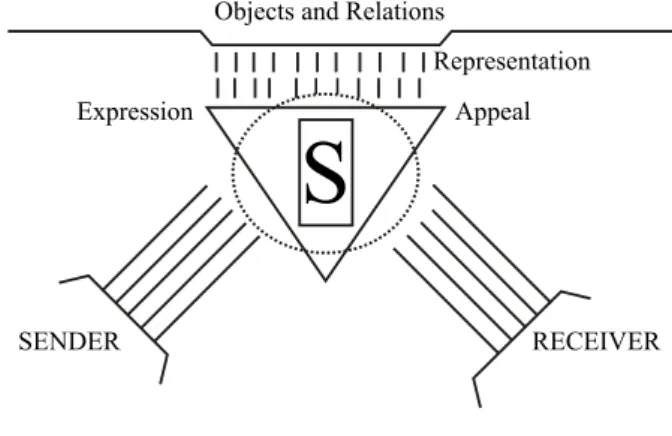
While gathering all the research conducted up to that time, Bühler (1934/1965) considers that, in addition to a representational and appealing dimension of language, there would be a function of language that refers to aspects of the subjectivity of the sender, those that are not totally conscious to the subject. According to Bühler’s description (1934/1965), the representational function covers the ability of language to refer to objects and things of the sensible world (a denotative function). The representational function alludes to the meaning of the word and the association between the concept and the object named by it. It is the reflection of the world out there that can also be perceived by the receiver. The appealing function, on the other hand, alludes to the aspect of the language that seeks to challenge the receiver, namely, to persuade, to move, to demand, to implore, to inform, etc. That is, the appellative function of language makes it possible to have an impact on the receiver. Finally, the expressive function refers to the possibility of a subjective understanding of the sender; his interiority being a constituent part of the message and which is manifested through him.
Objects and Relations
Representation
Appeal Expression
SENDER RECEIVER
Figure 1. Model of the instrument Source: Bühler, 1934/1965.
In the Figure 1, “S” represents the equidistant linguistic sign of the sender and receiver. This S sign is the one that fulfills the triple function of representation, appeal and expression in the interaction between the interlocutors.
In addition to his theory of language, Bühler made a historical journey through the philosophical and psychological literature on gestural expressiveness, namely the one that he presented in his Theory of the expression
(1933/1980). For the author, the expressive nature of the human being transcends the limits of language by finding
expression in gesture. The theory of expression refers to an old understanding in philosophy that proposes that physical variations are direct manifestations of the states of the soul, thereby forming a single system. For him, the expressiveness of language and its gestural manifestation allows us to understand the mental and spiritual world of the human being. Language, as an instrument of communication, would not be enough to perceive this whole experience, so that the human being would resort to his gestural expression to build meaning based on his the contact with the environment. According to Bühler (1933/1980), expression, in the broad sense of the word, makes it possible to exteriorize intimacies. Both the gesture and the word enable an observation of the subjectivity of the sender. However, between the outer phenomenon and the intimacy revealed there is a long distance between them. In other words, body expression presents the internal states as they are expressed, but which have nothing to do with the idea of a table with the word “table”. In this way he proposes that the study of gestural expression is a challenge compared with its counterpart, language, even to make it explicit: “this difference obliges a limitation of the word ‘expression’ mainly due to the way it manifests the intimacy with which we are presented with maximum purity in gestures” (Bühler, 1933/1980, p. 10).
Through this dimension, expressed in both language and gesture, the human being tries to convey the complexity of the experience, the expression of incarnated linguistic meanings charged with meaning is accompanied by a physiognomic manifestation. In relation to this, Werner (1955) – who develops the expressive dimension of the experience in depth – denominates this complex interaction between language and physiognomy as “the indissoluble unity of form and content” (p. 20). The expressive dimension manifested in gestuality corresponds to residues of the most primitive forms of language (Cornejo, Olivares & Rojas, 2013) in phylogenetic development, when the human being was only gesture, or the gesture and the word were totally united in its expression. Bühler (1933/1980, p. 58), referencing Engel, writes:
The language of gestures so far seems to have so many possibilities, a little more or a little less, than the language of words; but there is a more important circumstance, referring to the representation of the object and the familiarity that it brings with it that are intimately merged in the soul, forming a single thing, that the person wants to see united with the same precision, and fused with equal intimacy even in their denominations.
of human language is evidenced in the perception of linguistic forms associated with texture, color, weight, smell and figures. Various studies conducted by these individuals (check Werner & Kaplan, 1963), specifically through the use of the tachistoscope1
, have demonstrated how human language is perceived in the first instance with an organismic involvement – namely, the spheres of meaning that involve bodily sensations – before the only cognitive-intellectual. These studies observed organismic involvement in the early stages of linguistic understanding, for example when participants refer to the tachistoscope “it gives me the feel of something warm”, or when unknown concepts are presented to them (invented) and refer “it seems hard to me”, when they say that sad words are less light than happy words, or that words that refer to actions “up” (for example, climb) are positioned in height and words that refer to actions “down” (for example, descend) are positioned in lower places, etc.
This is how the physiognomy in Werner is one of the ways in which human expression manifests itself. In this sense, the physiognomic dimension of experience, or the physiognomic language (Werner, 1955), is a form of a manifestation of the theory of the expression from Bühler (1934/1965). The first emphasizes the organismic aspects and the second the gestural aspects, which have to be considered for a complete theory of expression. However, the integration of both is fundamental to understanding a true theory of human expression, as a dimension of the experience expressed in language and that transcends it by deploying its manifestation of thoughts and gestures.
The expressive dimension of inner speech
Hereunder, it is necessary to prove the theoretical consistency of the expressive dimension of inner speech, reflecting and integrating the approaches made by the aforementioned authors. Firstly, it is necessary to mention that Vygotsky (1934) realizes the most finished description of inner speech known in contemporary psychology. Bühler (1934/1965), for his part, completes the theory of human language including a new dimension – albeit old and forgotten – which is called the expressive dimension, due to the attribute of being able to reflect on the subjectivity of the sender. Vygotsky (1934) systematizes the phenomenon of inner language while Bühler (1934/1965) systematizes and completes a model on the external or vocalized language.
If inner speech constitutes – according to Vygotsky (1934) – the ontogenetic evolution of egocentric language; that is, if its emergence is the product of the internalization of a language that was previously audible (external), it is plausible to think that inner language must also maintain
1 The tachistoscopic technique was an instrument used by Werner in which he studied the perception of words in thousandths of a second. Each concept or brief phrase appears in the tachistoscope at a rate of 50 milliseconds, almost imperceptible to the human being, and by its different syllables. Then the concept appears completely until its total clarity. The subject must report his experience after each application while trying to decipher the meaning of the concept.
the same functions of vocalized language as described by Bühler (1934/1965), namely, as being representational, appealing and expressive. In the case of inner speech, language is representational because it is about different referents; it is appellative – or, in this case, self-appellative – since the speaker himself has the capacity to question himself, because he is both emitter and receiver. Finally, inner speech is also expressive as it gives signs of deep aspects of the psychic life of the subject.
While accepting the hypothesis that the dimensions of vocalized language are the same functions that maintain inner language, it is necessary to understand the possible relationship between them during experience. Bühler (1934/1965) proposes that each linguistic sign has the three functions described above, however, he does not explain the way in which each of them manifests themselves or the power over the other dimensions that each of them unfolds in each moment of the experience.
If we take the approaches of Vigotsky, in regards to between the different psychological processes during the development, and their assertion that these processes are related to qualitative and quantitative fluctuations in each moment of ontogenetic development, it is not possible to have a homogeneous relationship between the three dimensions of language and even less in regards to its stability over time. In other words, in Bühler’s model the relation between the three dimensions of language would be constant and equitable at every moment of development.
Bühler’s model (1934/1965), represented in the Figure 1, lacks hierarchical organization. All the components of the Buhlerian model of language are equidistant from the linguistic sign – or at least Bühler does not express the opposite in any part of his work – which does not occur in the human communicative experience. The distance of the sender, receiver and the sign with respect to the explicit referent varies permanently over time during the communication process. This sign may be further away or nearer to the meaning attributed by each interlocutor, and this distance suffers constant fluctuations through the temporal dimension. The same could be possible in terms of the dimensions of the linguistic sign: expressiveness, representation and appeal do not emerge with the same intensity in each linguistic sign over time.
moments. In this way, it is possible to think that each word in inner language presents different levels of expressiveness.
On the other hand, Buhler’s model is static and does not incorporate the ongoing experience of the communicative process. During the sender and receiver’s experience they exchange roles by deploying the three dimensions of language in a dynamic and dialectical way, recursively moving towards higher levels of generalization. Werner and Kaplan (1963) emphasize that communication is a process that moves from ambiguity towards generalization, in a permanent process of construction of meanings that are being generalized until reaching greater meaning in order to give significance to experience. This process occurs over time, moving towards an immediate and unknown future. In the words of the authors: “the psychological development of organisms advances towards states of relative maturation. Under the widest range of conditions, the development of organisms is transformed from states of relative undifferentiation to differentiated and integrated adult forms” (Werner & Kaplan, 1963, p. 5). This dynamic is not observed in the model from Bühler, which does not perceive the mobility of the communicative process. In this permanent exchange of roles in time – between the sender and receiver – language functions are expanded – namely, as being representational, appellative and expressive – and relationships are generated between them at each moment in a different way. Language, through its representation, appeal and expression, is what dyes the communicative process of a given emotional “atmosphere”. According to this idea, it is possible to think that the linguistic sign of the model from Bühler (1934/1965) is therefore not static, but rather progresses towards generalization at higher levels of abstraction by manifesting different proportions of each of its functional components each time. At other times, the sign progresses until it is destroyed by new emergencies loaded with the same functional dimensions of language. Thus, by integrating the perspective of the authors developed in this work it is plausible to maintain that the Bühlerian linguistic sign maintains, both in internal and external language, different levels of expressivity, as the course of experience advances, and different communicative expressions of inner language. In addition, the expressiveness of inner language has different manifestations in the different stages of the microgenetic development of inner language, as proposed by Vygotsky (namely, thought motivations, clusters of thought, inner language mediated by internal words, inner language mediated by external words, vocalized language). In this sense, inner language is expressive in its different phases of development, or in some phases it may present higher levels of expressiveness, since, as posed by Vigotsky (1934), the development of inner language can take place in all possible directions, in addition to the possibility of being interrupted at any of its stages.
By accepting this idea – that inner language is expressive in its different phases of microgenetic development – it is possible to stress the functions of internal language as classically described by Piaget and
Vygotsky: problem solving and thought control. The daily experience of the interior language and the theoretical development, that in this work he tries to present, makes it possible to introduce the expressive dimension as a new function of interior language. This means that inner language fluctuates between a controlled, voluntary, cognitive and intellectual form – which makes it possible to solve problems and to be concentrated on the task – and another involuntary, uncontrolled, dominated by affection, a total experience of images, language, affection, and cognition. While recalling Bühler’s (1933/1980) approach to human expression in language and corporeality, this author emphasizes that the phenomenon of expression constitutes a holistic totality; its access becomes more evident based on the corporality rather than from language. This is due to the direct relationship of the body to human consciousness, while in language the internal aspects are further from the surface of consciousness and are more difficult to access. By applying this idea to the phenomenon of the inner language, it is possible to affirm that it is expressive in all its forms: in each of its manifestations it covers the deepest aspects of human consciousness, however, the direct relationship with the primitive nature of the human being, of the human cognition and development of language, for its manifest expressiveness that corresponds to the residues of the most primitive forms of human language – in the sense of Cornejo, Olivares and Rojas (2013) – is that the concept of expression captures the meaning of the second form of manifestation of interior language better, namely, an involuntary inner language, organismic, with a sensory and affective domain.
Based on this point of view, inner language would not only fulfill the function of problem solving and control of thought, but it would also serve as an expressive function. This function involves simple downloading and contemplation, sometimes as a play space, and others as complex clusters of thought that involuntarily invade psychological experience, which is probably related to the early stages of Vygotskian microgenetic development, and express the deep thought motifs. It is important to mention that if expression is a dimension of total human experience, it is through using Bühler’s conceptualization to understand this dimension in inner language that we can speak now of the expressive dimension as a function of the internal language, which is in permanent interrelation with the other functions as described by Bühler, namely, the representational and appellative functions. This is how the expressiveness of experience is also a function of inner language.
when we try to apply the model of the instrument in inner language, we find the difficulty that, in inner speech, the emitter and receiver both are the same subject.
Bühler (1934/1965) recognizes that the expressiveness of language is a manifestation of the deepest subjectivity of the sender, nevertheless, in inner speech, the receiver is the same subject. Because of this, Buhler’s model is developed in theory of language, constitutes an optimal model for vocalized speech, since in internal speech the referent, the appellative and expressive function of the communicative act begins and ends in the same subject.
At this point it is necessary to return to Vygotsky to defend the argument that the expressive dimension of language is also found in inner speech, and it is the same subject that is the sender and receiver of his own message, the phenomenon maintains a monological character. Vygotsky (1934) emphasizes that inner language is more charged with meaning. In this way, inner language removes all aspects of consciousness associated with that idea and that states that experience is not dialogic (sender and receiver as two separate entities) but holistic and total. This is related to one of the characteristics of inner language as described by Vygotsky, the one that mentions the absence of subject and maintenance of the predicates. As the sender and receiver are the same subject in inner language, the subject is eliminated and the predicates are maintained, since the person knows the subject of his predicate.
With the concept of meaning developed in Thought and language, and the criticism of the modern theory of emotions, Vygotsky (1934) recognizes that human experience exceeds the limits of language, maintaining a more genuine expressiveness in gesture as an expression of the relationship between consciousness and soul. In this sense, the expressiveness of inner language is manifested in corporality beyond a simple affective phenomenon, but it is the totality of the psyche and the permanent flow of consciousness that is expressed in physiognomy as a single complex whole. This is the point of connection between the physiognomy of Werner, Buhler’s expressiveness and the phenomenon of inner language explored by Vygotsky.
Werner and Kaplan (1963) propose that it is within the process of symbol formation in the human experience that the forms of internal and external symbols appear undifferentiated in the early stages of development. Throughout human development there is a progressive differentiation or distance between the internal forms of the symbol (connotative dynamics) and the external forms of the symbol (the phonic or written vehicle). This differentiation or separation is never a total break; but the internal and external forms of the symbol always maintain a connection, albeit an increasingly distant one.
With the progression of the development, the internal forms of the symbol become more and more disguised through inner gestures, images, postural-affective states, feelings, etc. That is, the internal forms of the symbol – increasingly differentiated from external
forms – are condensed covertly in the “internal gestures”, feelings, images, etc. The authors point out:
Our answer then to the question regarding the relevance of studies about physiognomy to understand the formation of symbols in everyday life, is that such studies bring to the fore the tendencies by which symbols are typically carried in covert ways, in several domains of the total organismic matrix, from which some symbolic vehicles emerge and in which remain embedded. These tendencies, which are covered over by inner gestures, postural-affective sets etc., in everyday speech can be “translated” in visual or auditory properties, because the connotative dynamics transcend the particular psychological modalities, and can be equivalently manifested in material forms different from organismic activity. (Werner & Kaplan, 1963, p. 239)
This maintains a direct relationship with expressive internal language. The internal forms of linguistic symbols are physiognomized, based on Werner’s perspective, and “translated” in other forms of inner activity belonging to the orgnismic matrix of human experience, which provides evidence for the expressive nature of inner forms of language, constituting a kinetic-postural-affective-imagistic experience, which are characteristic of the cognitive-organismic fusion of the early stages in the development of human language.
Thus, based on these arguments, it becomes possible to understand a new function of inner language. The expressiveness observed by Bühler (1934/1965) with respect to vocalized language can be articulated with the vygotskyan postulates. The guidelines for Vygotsky’s notion of expressiveness of inner language are found in his critique of the theory of passions in modern psychology and in the final passages of his work Thought and Language.
Final considerations
Bühler (1934/1965) in his classic works on language and expression revisits an old tradition that is omitted from the study of language and gesture in modern psychology: the theory of human expressiveness. This is observed in ordinary language and in the physiognomic manifestation that accompanies it, being also directly related to the denominated physiognomic language developed in the works of Werner. Although Bühler and Werner did not develop a model regarding the inner language, Vygotsky did in his work on this phenomenon it is possible to observe in action the Buhlerian expressive dimension and the notion of Wernerian physiognomy. It is in the motivational sphere of consciousness – as the initial stage on which inner speech emerges – that the key to understanding the expressiveness and physiognomy of language exists in the vygotskyan postulates and, therefore, of inner speech.
The expressive dimension of inner speech is a manifestation of the deeper states of consciousness, that
is, the expressiveness of the volitional sphere – motivation that resonates in our interior in the form of a condensed experience of images, thoughts and affections. Here, this makes sense the approach from Shanon (2008) when he affirms that the subjectivity of conscience is the starting point of human communication and the constructed message its result, thereby constituting the speaking experience – to himself and others – a presentation and not just representational act.
Based on the perspective of the human experience developed in these works, inner speech would then correspond to an undifferentiated process between cognition and emotion, which in its entirety expresses the total complexity of the experience, of the flow of consciousness and its animated nature. We can therefore accept the monological conception of internal speech in Vygotsky, the organismic-physiognomic understanding in Werner and the expressive dimension in Bühler – the last two, only partially manifested, in the work of Vygotsky – which seems fundamental to understanding the expressive dimension of inner language.
La dimensión expresiva del habla interna
Resumen: Este texto constituye una propuesta teórica sobre la dimensión expresiva del habla interna. Se describe el fenómeno de interés enfatizando la propuesta de Karl Bühler respecto a la expresividad del lenguaje, los estudios de Heinz Werner sobre una dimensión isionómica-organísmica del lenguaje humano y la aproximación teórico-empírico de Lev Vygotsky respecto al fenómeno del habla interior en la experiencia humana. Se concluye que en algunos pasajes de la obra de Vygotsky están las claves para una comprensión del habla interna expresiva, especíicamente en la inluencia de la esfera afectivo-volitiva en el desarrollo del pensamiento y de la palabra. Finalmente, se propone una integración de la concepción monológica vygotskyana del lenguaje interior, la noción werneriana del lenguaje isionómico-organísmico y la propuesta bühleriana de la dimensión expresiva del lenguaje humano, para una comprensión integradora de la expresividad del lenguaje interior.
Palabras clave: habla interna, expresividad, lenguaje isionómico.
Dimension expressive du discours intérieur
Résumé:Cet article est une proposition théorique sur la dimension expressive de la discours intérieur. Le phénomène d‘intérêt est décrit à partir de la proposition de Karl Bühler en ce qui concerne l’expressivité du langage ; des études de Heinz Werner sur la dimension physionomique-organiciste du langage humain ; et de l‘approche théorique et empirique de Lev Vygotski sur le phénomène du discours intérieur dans l‘expérience humaine. On conclut que, dans certains passages de l’œuvre de Vygotsky, plus précisément l’inluence de la sphère afective-volitive dans le développement de la pensée et de la langue sont essentiels à la compréhension du discours intérieur expressive. Enin, on propose une intégration de la conception monologique du discours intérieur de Vygotski, de la notion physionomique-organiciste de Werner du langage, et de la dimension expressive du langage humain de Bühler, pour une compréhension globale de l’expressivité du discours intérieur.
Mots-clés: discours intérieur, expressivité, langage physionomique.
A dimensão expressiva do discurso interior
Bühler, K. (1965). Theory of language: the representational function of language. Amsterdam, Holanda: John Benjamins Publishing Company. (Trabalho original publicado em 1934) Bühler, K. (1980). Teoría de la expresión. Madrid, España:
Alianza. (Trabalho original publicado em 1933)
Cornejo, C., Olivares, H. & Rojas P. (2013). The physiognomic and the geometrical apprehensions of metaphor. Culture & Psychology, 19(4), 484-505. Damianova, M. K., Lucas, M. & Sullivan, G. B. (2012).
Verbal mediation of problem solving in Pre-primary and Junior Primary school children. South African Journal of Psychology, 42(3), 445-455.
Ekman, P., & Friesen, W. V. (1971). Constants across cultures in the face and emotion. Journal of personality and social psychology, 17(2), 124-129.
Hadot, P. (2001). The inner citadel: meditations of Marcus Aurelius. Cambridge, EUA: Harvard University Press. Heery, M. W. (1989). Inner voice experiences: an exploratory
study of thirty cases. The Journal of Transpersonal Psychology, 21(1), 73-82.
Kinsbourne, M. (2000). Inner speech and the inner life. Brain and Language, 71(1), 120-123.
McNeill, D. (1992). Hand and mind: what gestures reveal about thought. Chicago, EUA: Chicago University Press. Piaget, J. (1922). The language and thought of the child. New
York, NY: Routledge Classics.
Platón (2006). Teeteto. Buenos Aires, Argentina: Losada. Ridgway, A. J. (2009). The inner voice. International Journal
of English Studies, 9(2), 45-58.
Roberts, J. (2008). Expressive free speech, the state and the public sphere: a Bakhtinian-Deleuzian analysis of ‘public address’ at Hyde Park. Social Movement Studies,
7(2), 101-119.
San Agustín (2010). Confesiones. Madrid: Gredos.
Shanon, B. (2008) The representational and presentational: an essay on cognition and the study of mind.
Charlottesville, EUA: Imprint Academic.
Silveira, A.C. & Gomes, W. B. (2012). Experiential perspective of inner speech in a problem-solving context.
Paideia, 22(51), 43-52.
Vygotsky, L. S. (1934). Pensamiento y lenguaje. Madrid, España: Paidos.
Vygotsky, L. (2004). Teoría de las emociones. Madrid, España: Akal.
Villagrán, M., Navarro, J., López, J., & Alcalde, C. (2002). Pensamiento formal y resolución de problemas matemáticos. Psicothema, 14(2), 382-386.
Werner, H. (1955). A psychological analysis of expressive language. In On expressive language. Worcester, EUA: Clark University Press.
Werner, H. & Kaplan, B. (1963). Symbol formation. New Jersey, EUA: Lawrence Associates Publishers.
Wittgenstein, L. (1953). Investigaciones filosóficas. Chichester, Inglaterra: Wiley-Blackwell.
Recibido: 16/08/2016 Aceptado: 24/01/2017
discurso interior. Conclui-se que em algumas passagens da obra de Vygotsky são fundamentais para compreender o discurso interior expressivo especiicamente a inluência da esfera afetiva-volitiva no desenvolvimento do pensamento e da palavra. Por último, propõe-se uma integração da concepção monológica do discurso interior vygotskiano, da noção werneriana sobre a dimensão isionômico-organicista da linguagem e da proposta bühleriana da dimensão expressiva da linguagem humana, para uma compreensão abrangente da expressividade do discurso interior.
Palavras-chave: discurso interior, expressividade, linguagem isionômica.