Technical
Discussions
Washington,. D.C. September 1963
Draft Agenda Item 22 CD14/DT/2
30 August ORIGINAL:
(Eng.) 19.63
ENGLISH
* ;
IDEAS FOR THE FORMULATION OF A PLAN FOR THE CONTROL OF GASTRO-INTESTINAL DISEASES, INCLUDING ENVIRONMENTAL SA-NITATION MEASURES, EPIDEMIOLOGY, HEALTH EDUCATION, AND
EARLY DIAGNOSIS AND TREATMENT
AN EPIDEMIOLOGIC BASIS FOR THE CONTROL OF ACUTE DIARRHEAL DISEASE
by
John E. Gordon, Ph. D.,. M. D., Moises Behar, M.: D., M. P. H.,
and
Nevin S. Scrimshaw, Ph. D, M. D.
From the Department of Demography and Human Ecology, Harvard. University School of Public Health, Boston, Massachusetts;the Institute of Nutrition of Central America and Panama, Guatemala, C.A.; and the Department of Nutrition and Food Science, Massachusetts Institute of Technology, Cambridge, Massachusetts.
CD14/DT/2 (Eng.)
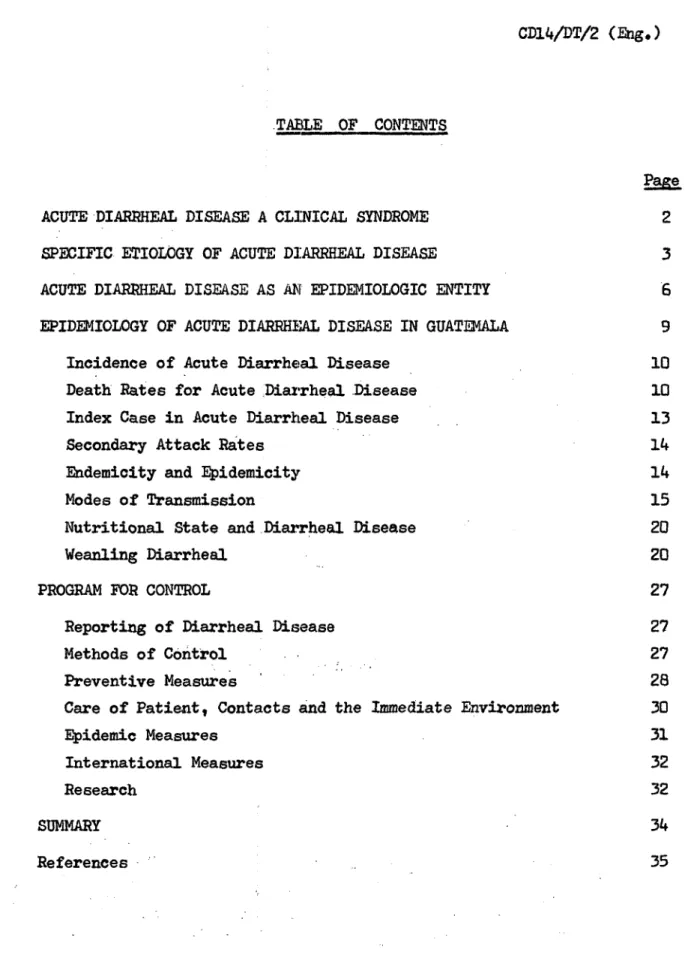
TABLE OF CONTENTS
Page
ACUTE DIARRHEAL DISEASE A CLINICAL SYNDROME 2
SPECIFIC ETIOLOGY OF ACUTE DIARRHEAL DISEASE 3
ACUTE DIARRHEAL DISEASE AS AN EPIDEMIOLOGIC ENTITY 6 EPIDEMIOLOGY OF ACUTE DIARRHEAL DISEASE IN GUATEMALA 9
Incidence of Acute Diarrheal Disease
10
Death Rates for Acute Diarrheal..Disease
10
Index Case in Acute Diarrheal Disease
13
Secondary Attack Rates
14
Endemicity and Epidemicity
14
Modes of Transmission
15
Nutritional State
and Diarrheal
Disease
20
Weanling Diarrheal
20
PROGRAM FOR CONTROL
27
Reporting of Diarrheal Disease
27
Methods of Control
27
Preventive Measures
28
Care of Patient, Contacts and the Immediate Environment
30
Epidemic Measures
31
International Measures
32
Research
32
SUMMARY 34
CD14/DT/2 (Eng.)
AN EPIDEMIOLOGIC BASIS FOR THE CONTROL OF ACUTE DIARRHEAL DISEASE
John E. Gordon, Ph.D., M. D., Moisfs B6har, M. D., M.P.H.,
and
Nevin S. Scrimshaw, Ph.D., M. D.
Aside from contributions to field research, epidemiology has a major practical usefulness as an instrument for action in the control of community disease. To this end, pieces of knowledge from clinic, laboratory and field are fitted together to give a pattern of disease behavior within populations. A considered program for control then evolves through identifying various features in a complex of causality which is multifactorial, with variables individually related to an agent of disease, to the human host and to the environment which encompasses both. A recent analysis of chickenpox (1) is in illustration. Epidemiology, so employed, serves as the diagnostic discipline of public health (2) through operational as contrasted to inves-tigative activities (3).
The purpose now is to present the diarrheas and the dysenteries of man, especially those of infants and young children, from this viewpoint.
The intent is to assemble recorded knowledge, to make free use of opinion and interpretations of many colleagues, and to supplement these findings where appropriate with personal observations that have extended from arctic' (4) to tropics (5), and over many years (6). Research interests will be touched upon only to indicate gaps in knowledge pertinent to control. In simple terms, the aim will be to state what to do now with the information at hand: to examine the behavior of diarrheal disease in nature an the application of that knowledge to prevention and control in human populations.
CD14/DT/2 (Eng.)
Page 2
ACUTE DIARRHEAL DISEASE
A CLINICAL SYNDROME.
Whether prevailing
at high or low'incidence, the endemic diarrheas everywhere are mainly of
acute evolution. Chronic diarrheal disease is minimal, in lesser developed
regions an inconsequential part of the whole, and not included in this
discussion. Like most acute infections, rabies in man being one of the few
exceptions, diarrheal disease follows a biological gradient from clinically
undetectable, inapparent infection to severe manifestations with an
appre-ciable
fatality. By arbitrary definition, crude clinical separations are
possible into mild, moderate and severe forms of the disease.
Acute diarrheal disease includes a proportion of specific enteric
infections, such
:as
shigellosis, salmonellosis and enteropathogenic coliform
disease, but
it consists mainly of undifferentiated disease with no
demon-strable specific infectious agent.
The significant feature is that the same
divisions in clinical effect. occur with all endemic diarrheas, whether of
demonstrated specific etiology or otherwise.
No characteristic clinical
pattern distinguishes one etioLogic'entity from another, as with measles
among the acute exanthemata, nor the total of specific entities from cases
without a
known
infectious agent.
It is true in Guatemala that severe cases are more likely to be
related to
Shigella
than to any other infectious agent and that cases with
a demonstrated agent include more than a proportionate share of severe
in-fections. However, a severe case has nothing to mark it as shigellosis,
other than the greater probability of isolating an organism; and greater
-numbers of severe cases are of indeterminant microbial origin than of
de-fined
etiology.-Epidemics in a general population ordinarily are superimposed on an
endemic base. Consequently, various-pathogens are isolated in the course
of an outbreak.
-
In our experience no epidemics have been
encountered without
predominance of some particular infectious agent among those identified,
although by no means in a majority of cases; which is to say that no
epi-demics of purely non-bacterial disease have been seen other than food
poi-soning of toxicogenic origin. Again, from a practical standpoint, diarrheal
disease in epidemic form as seen in lesser developed countries has-not been
distinguishable clinically from endemic cases.
This is not to discount recognition by Hardy (8) and most others who
have worked in the two
situations that the diarrheas in preindustrial countries
CD14/DT/2 (Eng.) Page 3
Among malnourished children of retarded development, the disease is not ordinarily an isolated episode of acute evolution. Systemic manifesta-tions often seem less pronounced than in the well nourished child, but the attack tends to persist. Instead of the prompt rebound characteristic of the well nourished child, a low-grade indisposition often continues for a mohth or more, sometimes for as long as 3 months, with irregularly recur-ring loose stools, a progressively depleted nutritional state and occasional recurrent acute episodes. Dehydration and electrolyte imbalance are more frequent and more difficult to correct. Two or 3 such events during a year are frequent in young children and some have as many as 8 or 10. Because of this, the usually deficient diet is further restricted, which contributes to maintaining the situation. A bloody or mucopurulent exudate in stools is commoner than in the mild undifferentiated diarrheas of developed areas.
Clinically considered, acute diarrheal. disease is a syndrome, occurring universally and in different degrees of severity, with essential differences characterizing specific areas and different environmental conditions. In any single situation, clinical entities cannot be distinguished, although etiologically distinct diseases exist. This circumstances is neither unique among infectious diseases nor does it necessarily limit specific action. In acute sore throat or typhoid fever, for example, laboratory means compensate-for the clinical deficiency. As will become evident, that is not the case with the acute diarrheal diseases.
SPECIFIC ETIOLOGY OF ACUTE DIARRHEAL DISEASE. The designation of acute diarrheal disease as a clinical syndrome in no way precludes the exist-ence of exactly determined disease entities within the group. Aseptic
meningitis is an illustration of a common clinical reaction induced by many different infectious agents, some one of which is demonstrable in most instances.
On the other hand, the common cold is also a clinical syndrome, a collection of diseases. It includes several recognizable specific infectious disease entities, those due to the syncytial viruses, parainfluenza viruses, rhinoviruses and reoviruses and a number of others, each irregularly
repre-sented in the totality of common colds at a particular time or a particular place. However, the syndrome includes a much greater aggregate of cases,
with good reason judged infectious and communicable, and yet with no demon-strable infectious agent. No inconsiderable number are suggestively non-infectious, or at least scarcely communicable, notably those of allergic origin.
CD14/DT/2 (Eng.)
Page 4
The recognized specific infectious diseases, shigellosis, salmonellosis,
Esch. col
idiarrhea and amebiasis ordinarily constitute a minor part of the
whole. Under endemic conditions in preindustrial regions with prevailing
high rates.of incidence, the 3 bacterial agents with their multiple serotypes
often are demonstrated in less than 20 per cent of cases. The usual
fre-quency is slightly in excess of that level; a proportion of 40 per cent is
occasional; and to find'60 per cent of diarrheas associated with any one
of the specific bacterial pathogen is exceptional.
AkIn a Guatemalan Indian village one or another of the 3 pathogens was
present in 24 per cent of 578 cases (Table 1), as observed in children under
5
years of age during a period of 17 months. A single specimen of feces,
usually obtained by rectal swab, was cultured on 3 different mediums. An
additional 115 cases were subjected to intensive examination, by methods
beyond any practical field application. Both rectal swabs and stools were
used, as many as 5 serial specimens were collected and two augmented lines
of'culture mediums employed. The result was isolation of a pathogen in
35.6 per cent of cases, the gain being mainly in numbers of Salmonella and
Esch. coli, the less frequent members of the group. The demonstration of
Shigella was not significantly increased.
Isolation of a.pathogen from stools of a patient does not, of course,
establish an etiologic relationship. Diarrhea of other-cause can occur in
a bacterial carrier. Furthermore, in no less than 12 per cent of cases of
diarrhea in the Guatemalan experience, where a recognized pathogent was
.demonstrated, had 2 or-more present concurrently, with the open question
of which, if either,.was the responsible agent. Enteroviruses were
fre-quently associated with bacterial agents; and indeed more often. than not
a pathogenic bacterium when present was accompanied by a protozoan or other
intestinal parasite. High or low incidence of diarrhea was not adetermining
factor.
In addition to this varying proportion of commonly reconized intestinal
pathogens, the intestinal flora of man in health as well as.in acute diarrheal
disease, contains.a presumably major fraction of commensal organisms, normal
inhabitants of the intestinal tract and without accepted pathogenicity,
mainly coliform organisms. Between these extremes is a group of infectious
agents of indeterminate and irregular pathogenic power, poorly evaluated as
to numbers and of diverse kinds. They include certain serologically
dis-tinct Esch. coli, other bacilli, enteroviruses in profusion,
CD14/DT/2 (Eng.) Page 5
Table 1. Bacterial pathogens present in 578 cases of acute diarrheal disease in a rural Guatemalan village February 1961 - June 1962.
Bacterium Acute diarrheal disease
Number of Percent of
cases all cases
Sh. dysenteriae I 10 1.7
Sh. dysenteriae II 4 0.7
Sh. sonnei 9 1.6
Sh. boydi 5 0.9
Sh. flexneri I 2 0.3
Sh. flexneri 2 23 3.8
Sh. flexneri 3 32 5.5
Sh. flexneri 6 36 6.2
Salmonella 1 0.2
Esch. coli 17 2.9
CD14/DT/2 (Eng.) Page 6
Remote infections of other systems, principally of the respiratory tract and its appendages, conceivably have the capacity to light up in-testinal disorders, Measles has a prominent place among such parenteral infections.
Foods, of themselves and through their contained nutrients, have the capacity to induce acute diarrhea other than through infection. Excess of a nutrient is rarely involved, a deficiency being more usual as in pel-lagra, beriberi and especially kwashiorkor. Some foods induce diarrhea through content of roughage and a few are themselves poisonous, as some varieties of mushrooms and, fishes.
Toxins formed in 'foods by growth of staphylococci and other bacteria are a common source of epidemic diarrhea and to an ill-defined degree of endemic disease. The diarrheas of emotional origin are others of nonin-fectious origin.
The inability to distinguish, among acute diarrheal diseases, clin-ical entities sufficiently distinct to permit and individualized program for control has been noted. Acute diarrheal disease can be delineated satisfactorily but not its elements, which other evidence shows to exist. The recourse is to interpret the group as a clinical syndrome.
The summary of etiologic agents just given likewise discounts the possibility that laboratory procedures of today are able to compensante for clinical deficiencies as happens with some other infectious processes. Although research has been largely microbiologic, an impressive effort has had the practical result that only a relatively small part of the acute diarrheas of the world can be distinguished as disease entities. Still more important, those which are identified lack other characteristics sep-arating them from the bulk of undifferentiated diarrheal disease. To center control activities on specific entities is to ignore the main problem. The possibility remains that the group has enough common epidemiologic charac-teristics by which to establish principles for general control, and that recognizable epidemiologic patterns exist within the complex, of sufficient importance and magnitude to warrant individualized measures in their control.
ACUTE DIARRHEAL DISEASE AS AN EPIDEMIOLOGIC ENTITY. The universal occurrence of acute diarrheal disease in all populations of the world suggests as much as anything innate host characteristics, physiological and biological, conducive to the disease and common to all mankind. For the same reasons, the expectation also is of fundamental features in human behavior, aside from the artificial variations introduced by time and place, in cultural practices and in the social environment of aggregates of man, all with a bearing on propagation and presence of the condition.
CD14/DT/2 (Eng.)
Page 7
and under favoring circumstances of external environment and nutrition they prevail at hyperendemic levels in much of the universe.
Not all acute diarrheal diseases are of infectious origin, but most of them are. Considered as a group, and despite indefinite and diverse infectious agents, the reservoir of infection is almost wholly man. Some few cases are of animal origin, notably salmonellosis, but this disease also comes from the infected person. In all recognized specific diarrheal disease, carriers have a significant place along with cases in the community reservoir of infection. In Guatemalan villages carrier rates in the general population of children without diarrhea under 5 years of age were 7.8percent for Shigella, 0.1 for Salmonella and 3.4 per cent for enteropathogenic Esch. coli (Table 2). Epidemiologic evidence gives strong support that the situa-tion holds generally for diarrheas of indeterminant infectious etiology. The immediate source'of infection, the materials by which infection is transferred, is of common nature in all infectious diarrhea, namely feces, and whatever the method of transfer.
All infectious diarrheas, whether etiologically distintc or an un-differentiated enteritis, have common modes of transmission. Only food poi-soning has an individual means of spread. Noteworthy differences occur, however, according to patterns of distribution. Endemic and sporadic diar-rheal disease is transferred predominantly by direct contact, hand to mouth infection. Indirect contact through objects freshly contaminated with feces has minor significance. The agency of flies is scarcely to be compared with direct contact.
Epidemic diarrheal disease is classically of common source origin, through water, milk or solid foods, with the outbreak rising "and 'alling abruptly. By contrast, numerous epidemics in lesser developed areas are due to contact spread. Characteristically they are of slow evolution, fail to reach the high peak of common source outbreaks, and follow a protracted course, occasionally over a period of 3 or 4 years.
The incubation period is among the more regular epid4emiologic charac-teristics. In epidemics, Salmonella infections may have atm interval no longer than 12 hours, but sporadic cases occur after 2 or 3 days, which is usual for the undifferentiated group and most others specifically identified. For example, the usual incubation period in shigellosis is less than 4 years. The duration of communicability in acute diarrheal disease is not too well known. Most of the evidence relates to shigellosis, where infectiousness is essentially for the duration of symptoms and briefly thereafter. Chronic convalescent carriers are stated to be few and the carrier state to end within days or weeks. However, existing observations relate mainly to adults and to patients in good nutritional state. The longer clinical course among malnourished children, and the tendency of the disease to relapse, suggest that communicability may be appreciably longer under such conditions, a possibility supported by the high carrier rates in many communities, of the
CD14/DT/2
(Eng.)
Page 8
Table
2..
Carrers
of
enteric bacterial pathogens, children
without diazrrhea, by age,
three
Guatemalan highland
villages,
1959
- 1962.Number
Age
in
ofr.
.
Shieie
1L
Salmonella:
Ech. coli
Total
years'
No.
%
No.
%
No.
%
No.
%
Under 1
647
10
1,5
1
0.2
31
4.8
42
6.5
.
1.
690;
61
8.8
O
_--
38
5.5
96
13.9.
*
2 678 71110.5
1 0.1 25. 3.7 93 13.73
676
69
10
0.
0
24
3.6
90
13.3
.4
459
35
7.6
2
0,4
14.
3.0.
47 10.2
Total
3,150 -246
7.8
4
0.1 132
4.2
368 11.7
CD14/DT/2 (Eng.) Page 9
suggest that carrier rates for Esch. coli may be greater than indicated by the infrequent cases. Salmonella carriers in acute diarrheal disease have had minor attention. Serial studies of families, as in the INCAP observa-tions, should provide information on communicability of the undifferentiated diarrheas.
The known facts about resistance and susceptibility to acute diarrheal disease are also limited. In lesser developed regions, relatively fewcases occur during the first 6 months of life. During the second 6 months, few persons escape. Thereafter, incidence decreases with age so that attack rates in late childhood are much lower and incidence in the adult population still less.
Repeated attacks in the course of the first and second year are the rule in underdeveloped countries. Almost every child can be certain of a bout of diarrhea during each of the first 3 years of life; and the time may extend through the 5th year. About one-half will have repeated, numerous attacks, during the second year, and one child out of 3 in any of the pre-school years. It is evident that one attack gives no general immunity and yet it is equally certain that resistance increases with age; older children and adults have far less diarrhea. The suggestion is of a pattern of resist-ance comparable to that in influenza, where a matrix of resistresist-ance is filled out with age, the elements to a degree specific and enduring, and effective because it eventually accounts for most of the prevailing agents. A particular pattern holds for a particular place. Transfer to another area and contact
with a new set of infectious agents results in fresh need to accomodate, as evidenced by the well known "traveler's diarrhea."
The reaction of populations to the complex included withing the acute diarrheal syndrome exhibits in most features a common behavior fitting with accepted ecologic principle and sufficient to justify interpretation as an epidemiologic entity. Epidemiologic characteristics, as evidenced in a representative developing area of Latin America, with a prevailing high level of malnutrition are provided by the long-term prospective incidence studies of recent years under auspices of the Institute of Nutrition of Central America and Panama.
CD14/DT/2
(Eng.)
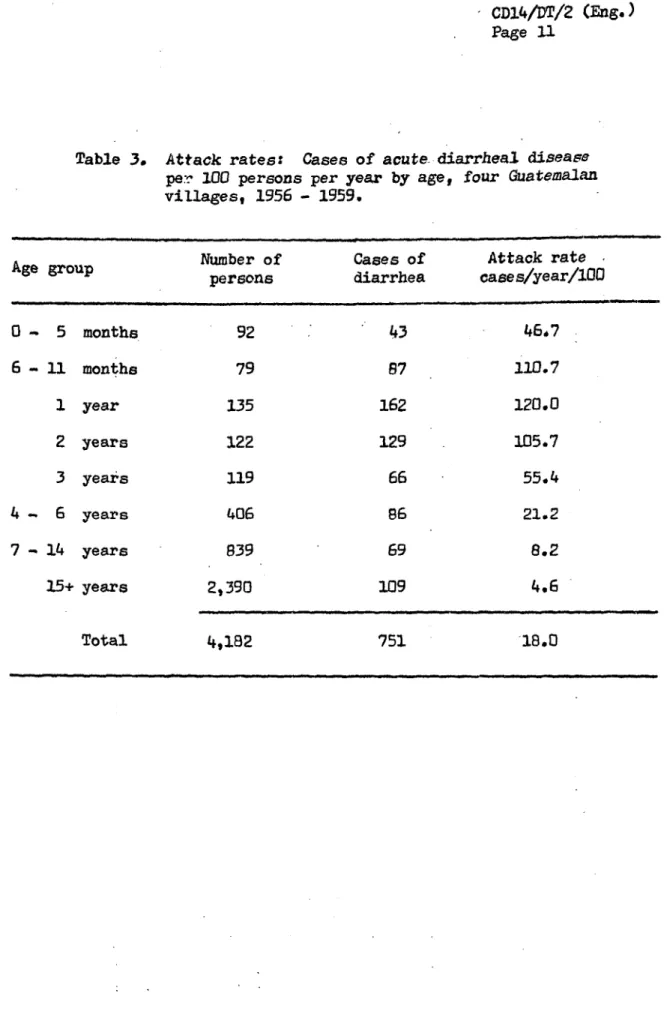
Page 10-. .Incidence of Acute Diarrheal Disease. The outstanding feature of attack rates in these communities, as present ed in Table 3, is the extent to which the disease centered at ages 6 months through the 2nd year of life. This'is the period of weaning (5). Acute diarrheal disease was relatively infrequent during the first 6 months when these children were almost wholly breast fed. After weaning was completed, usually early in the 3rd year, incidence declined'sharply, so that atl age 6 years, the year of entering school, the attack rate was orly 21.2 per 100 children of that age per year. School children of 7 to 14 years had only a fraction of the rates charac-teristic of early childhood, while for adolescents and adults- past 15 years incidence was essentially halfl that of school children. This progressive decline with age is well authenticated for many parts of the world. What is not so well recognized is the concentration of cases during the period of weaning. This comes about because of the common statistical practice of grouping results of the 2nd to 5th'years as a unit. The dangerous 2nd year of life is -thus'obscured. .
Death Rates for.Acute Diarrheal Disease. Disease-specific mortality rates from acute diarrheas disease followed the same trend as case incidence.
In 3 other villages for which information is'available over.'a 10-year period, death rates were greatest in the 2nd year of life, Table 4. Indeed, they
were more than twice..ithose of the 1st year 'and were maintained at a -high 'level in the 3rd year. Thereafter a sharp drop occurred to a level of 9.63 :per 19000 population deaths during the 5th'year. For school children and
adults the rates were only fractionally those-of the earlier years of life. The significance of deaths from acute diarrheal' disease in the general health of these communities is brought out in different fashion bydetermining
the proportion of deaths from this cause to deaths from all causes. For the general village population, 27 per cent of'deaths were'due-to diarrheal disease', a finding in agreement with the frequently cited national rate for
Guatemala where diarrheal disorders are the first cause of death and the highest. for any Latin American country. Despite a high attack rate in
infan-cy, fatalities from this cause accounted for only 14 per cent of total deaths, less than the average for the general population, 27 per cent.' For the
critical period of ages one to 4 years, the proportion was 46 per cent and in two of the years, the 3rd and 5th, it was more than a half. These data are especially meaningful. Although death rates from acute diarrheal disease were greatest in the 2nd year of life, in.the subsequent preschool years the proportion of deaths due to that cause to all deaths was even greater. The .situation during school age, 5 to 14 years, demands special attention. The age-specific death rate was highly favorable compared to earlier years, and yet the proportion of diarrheal deaths to all deaths was exactly the same,
CD14/DT/2
(Eng.)
Page
11
Table 3.
Attack
rates:
C
per 100 persons
villages, 1956-Cases
of
acute diarrheal disease
per year
by
age,
four Guatemalan
1959.
Number of
Cases
of
Attack rate
Age group
persons
diarrhea
cases/year/100
0-
5
months
92
43
46.7
6 - 11 months 79 87 110.7
1 year
135
162
120.0
2 years
122
129
105.7
3
years
119
66
55.4
4 - 6 years 406 86 21.2
7
-
14 years
839
69
8.2
15+ years
2,390
109
4.6
Table 4. Deaths from acute: diarrheal disease per 1000 population per year, by age, 3 Guatemalan villages, 1950 - 1959, inclusive. Cumulative population, 106, 456.
De ?t s Diorrheal Percent Ratio
f-rcm acute deaths diarrheal Diarrheal death rates,
Age in
yea di.arheal per 1000 deaths of Guatemalan villages
years
i ;.&ease population per year all deaths and U. S. A., 1960
Under 1 year 87 16.98 . 14 25
1 year
123
35.63
41
2 years
102
27.97
53
3
years
44
12.17
43
4 years
34
9.63
55
1
-
4
years
303
21.27
46
519
5 -
14 years
70
2.55 -
41
15+ years
117
1.95
16
Total
577
5.42
27
115
Oq
_
.~~~~~~~~~~~~~~~~~~~~~~~~~~~~~~~~~~~~~~~~~~~~~~~~~~~~~~~~~~~~
; .
CD14/DT/2
(Eng.)
Page 13
societies. For infants under one year, the death rate in this experience was 25 times that for infants in the United States. For the preschool group it was 519 times greater; and for the general population, the excess in Gdatemala was 115 times.
To stress further the magnitude of this health problem in terms of death and disability in Guatemala and in comparable countries seems pur-poseless. Its concentration in the early preschool years is evident and should be the guide in developing an effective program for control. To this end, other characteristics of behavior as a community disease are now examined.
Index Case in Acute Diarrheal Disease. Knowledge of the manner in which an infectious disease progresses through a community is one of the decisive factors in formulating a program for control. The usual sequence of events in family outbreaks of the common communicable diseases of childhood is an initial illness contracted by a school child, less com-monly by an adult, and then secondary cases, frequently among preschool
children and proportionately among older members of the family according
to immunity state. Acute diarrheal disease in the villages shows a
stri-king departure from this behavior.The usual index or primary case was not an older child or adult.
In
71
per cent of
390
family outbreaks during 12 months (11), the disease
first appeared in a preschool child, aged 0 to 5 years. School children
introduced the disease into the family less frequently than did adults, but
the differences were inconsequential, 12 per cent for school children and 17 per cent for adults. These frequencies were out of all proportion to numbers within a family. Adults and school children together made up 80 per
cent of members of households; they provided the index case in only 29 per cent of family outbreaks.
No less than 1/3 of total index cases were infants less than one year old. More than 1/2 were children in the first three years of life. Because of the system of expanded families, where several closely related units were represented within one household, there were few families with only preschool children. In 27 such familes there were 22 family epidemics of diarrheal disease and a preschool child was the index case in 19 of them. Diarrhea appeared 12 times in the 28 familes with only adult members.
Multiple index cases, the appearance of the disease in more than one member of a family within a period of 24 hours, occurred in only 5 of 390 family outbreaks, Multiple index cases are characteristic of common source epidemics, as from water or milk. The scant frequency in this experience supports a conclusion that contact spread was the major means of transmission.
CD14/DT/2 (Eng.)
Page 14
agent favored 'by a deficient environmental sanitation. The necessary '
facts are not at hand; a detailed study of family outbreaks experienced by
children- frqm birth 'to school age is a suggested approach. .
,
Secondary Attack Rates. Secondary cases are those occurring in
sus-ceptible members.;of a family within an accepted incubation period following
a primary or index case. Secondary attack rates for acute diarrheal disease
are necessarily computed frdm tctal family members excluding the index case,
because of inability to identify susceptibles. The incubation period was'*
taken as 1 to 7 days. On this basis, the overall secondary attack rate for
the 390 family outbreaks was only 1.4 per cent, suggesting either that most
family members were immune or a low communicability of the agent. A more
reliable datum is based on children of preschool age who may be judged as
more regularly susceptible. The! secondary-attack rate for that age group
was 4.1 per cent. Similar age specific secondary attack rates were 1.3 per
cent for school. children and 0.3 per cent for adults 15 years or older. Of
450 cases in families 86.7 per cent were primary cases, only 7.5 per cent
were secondaryinfections anid 5.8 per cent were tertiary or subsequentcases.
A case was recognized as a new-or primary case when'the interval between- '
cases was more than 7 days, the maximum incubation period.
-The spread of infection within the family was no greater when
pre-school children ·were *the index case than when an older person introduced
the disease. The secondary attack rate when the primary case was a child
under 6,years.i was 1.2 per cent, a school child 1.6 per cent and after an :
adult index case, l.8 per cent. There is suggestion that most
·older 'family
members were immune -to-the prevailing agents of diarrheal diseasei;at least,
in these communities diarrheal disease does not usually spread within families
to adults regardless of the age of index case·.
These observations departed so much from anticipated-
results that
-the study was repeated over a period of 17 months in ano-ther community where
attention was primarily to diarrheal disease in child&en under 5 years ofage.
Among 504 invaded families the preschool child was found to be the first
or-primary family
·case in 94.5 per cent of instances, influenced evidently by
the bias incident to the manner of selection but in'accord with the preceding
series.
-
The concentration of index cases again was high among children of
the first 3 years of·life; no multiple index case was noted; and the
second-ary attack rate was 8.4 per cent., as before -predominantly preschool children.
'Endemicity and Epidemicitxv. Interest in manner of spread extends
naturally from family unit to community. Acute diarrheal disease in Guatemala
commonly is described-as endemic or more precisely as hyperendemic. Actually,
it is neither. .If communicable diseases of-this general class are recognized
as fluctuating endemic processes, continuously 'present but with occasional
and irregularly interspersed epidemics, then acute diarrheal disease is not
that either.
-
'
.
-
-.
ClL4/DT/2 (Eng.)
Page 15
village registers in consultation with the official recording the
information.
Analysis showed that what happens is a succession of epidemics of fairly
regular periodicity, commonly 3 outbreaks every 10 years, each of relatively
long duration with deaths occurring throughout a year or more, and often over
a 2- or even 3-year period. In no epidemic examined, even those essentially
restricted to a single year did the outbreak develop sharply, last a few
months and end about as abruptly as it began, which is characteristic
behavior
of common source outbreaks related to water or other vehicle. Rather, the
epidemic evolved slowly, and continued active through many consecutive months.
The experience of 4 villages, including both small and larger communities is
illustrated in Figure 1. The broad behaviour is better characterized as
fluc-tuating epidemicity rather than flucfluc-tuating endemicity.
The behavior
of
acute diarrheal disease was comparable to that of
measles which in the same region has a similar periodicity, about 3 outbreaks
in 10 years. The behavior of measles is usually attributed to development of
a new crop of susceptibles by birth. The predominance of toddlers of the 2nd
and 3rd year of life in diarrheal as well as measles outbreaks suggests a
similar mechanism in the
2
diseases. The experience of the village of San
Andres Itzapa
is
indicative.
This
community in 1952 had a measles outbreak
of exceptional size and severity (12). About 2 months later, indeed as the
measles epidemic was subsiding, the outbreak of acute diarrheal disease shown
in Figure
1
made its appearance, and epidemic of greater magnitude than any
other in this study, although the associated events suggest that a part of the
diarrheas were incident to kwashiorkor. A minor outbreak of measles occurred
in 1955 and one of moderate size in 1957-58, an experience closely paralleled
by acute diarrheal disease.
Modes of Transmission. The INCAP studies on acute diarrheal disease
have had as a principal aim an improved definition of causality, viewed in
its broad sense. With good reason, modes of transmission have had a
promi-nent place in that effort, with the direct relation they have to practical
control measures an added incentive. For present purposes, a summary of
fam-ily and community observations must suffice.
Numerous epidemiological facts point to direct contact as the chief
method of spread. The general course and behavior of observed epidemics is
best explained by contact dissemination. The extreme prevalence of index
cases among young children suggests an origin of infection within the family,
rather than from outside sources, in that infants of this age have relatively
few general contacts. Carriers of known pathogens are at a high level and
numerous among older children and adults. The paucity of multiple index cases
is decidedly against a common source origin. Perhaps most important of all,
the hygienic habits of siblings as well as family adults are compatible with
spread by personal contact, a feature abetted by the limited amounts of water
usually available.
CD14/DT/2 (Eng.)
. Page- 16 .
',* .- - . .
;ure 1. Death rates from acute' diarrheal disease, as
compiled .from local.registers of 4 Guatemalan
...communities, 1950 - 1962. Populations:... :
Chimaltenango, 1.4,838; San. Andres Itzapa,'
5,277; E1,Tejar, ]L,923, Santa: Maria Cauqu,; 923.
-,: .. . ' l ': ...
·. ...
~ ~
. . .I : ·..
· · ·.. · . ,·~~~~~~~~~~~~~~~~~~~.:*
..
1 I
I .£
3 , 1. . ,
r
- -FiE
' ! .
. ..I .. , ', ..
::··-CD14/DT/2
(Eng.)
Page 17largely eliminated because little
is
available, and when it
is,
the source
is usually the family cow. Common eating establishments
scarcely exist
in
the villages, and such food-borne infection as occurs is thereby restricted
in large part to the family group. Water is the chief consideration. Common
sources are usual in the villages and known to be frequently contaminated.
The commonly observed age of attack
is
heavily weighted within the 1st 3
years of life, and is not the broad age of distribution characteristc of
water-borne infection. Children of this age are not the heavy water drinkers
of the population, but rather the working adult where cases were few.
Epi-demics as observed are not of the common source type. In one village, Santa.
Maria Cauqu6 of Figure
1,
with a proven contamited water supply, forceful
and successful effort was made in 1960-1961 to provide a safe water supply
which did not, however, prevent the development of the 1962 epidemic,
pri-marily due to the Shiga type of dysentery bacillus.
These observations are not intended to imply that water, food'and
milk have no part in the genesis of diarrheal disease in these village
communities. What does appear certain is that the consistently high rates
for diarrheal disease cannot be attributed to appreciable epidemics of common
source origin.
The part of flies in mechanical transmission of acute diarrheal disease
under conditions of the usual Guatemalan village is as yet ill-defined. It
would appear to be a secondary consideration, ranking below contact spread
and the agency of food, water and milk. The seasonal peak of the disease
occurs in May and June (Table 5) before flies are prevalent. Flies appear
in late June and attain their greatest numbers in September, a'time when the
monthly incidence of diarrhea is declining.
Obviously, the significance of all modes of transmission relates to
care and efficiency in disposal of human feces. Many features of environmental
hygiene and sanitation have an influence on the frequency of acute diarrheal
disease, among them disposal of wastes other than feces, food storage and
preparation, housing and rodent control in addition to water and flies already
mentioned. Feces disposal i's singled out for consideration because in the
final analysis, it is basic to all.
Table 5. New cases of diarrhea by month in 3 Guatemalan highland villages, as determined by home visits, May, 1959 - April, 1963
Santa santa Santa
Maria Cauque Catarina Barahona Cruz Balanya Total 3 villages
Month Cases- Percent Cases Percent Cases Percent Cases Percent
of acute annual of acute annual of acute annual of acute annual
diarrheal total diarrheal total diarrheal total diarrheal total
disease disease disease disease
January 148 7.3 32 5.8 76 7.1 256 7.0
February 181 8.9 44 .8.0 117 10.9 342 9.4
March 192 9.5 77 14.0 80 7.4 349 9.5
April 137 6.8 49 8.9 78 7,2 264 7.2
May 248 12.2 63 11.5 97 9.0 408 ' 11.2
June 164 8.1 51 9.3 114 10.6 329 9.0
July 164 8.1 50 9.1 90 8.4 304 8.3
August 196 9.6 61 11.1 100 9.3 357 9.8
September 185 9.1 48 8.7 76 7.1 309 8.5
October 160 7.9 26 4.7 70 6.5 256 7.0
November 145 7.1 33 6.0 123 11.4 301 . 8.2
December 109 5.4 16 2.9 55 5.1 180 4.9
Total 2,029 100.0 550 100.0 .1,076 100.0 3,655 100.0
"3
07
I
i
Table 6. Acute diarrheal disease, annual case rates per 100 persons at risk, by age, in households with and without privies, 4 villages of rural
Guatemala, 1956 - 1959
09 j (D r
r-With privies Without privies
Age Persons at risk No. of Rate per Persons No. of Rate per
cases 100 persons at risk cases 100 persons
Under 1 year 136 123 80.7 35 21 52.8
1 - 5 years 524 365 60.3 122 107 80.3
6 - 14 years 795 81 8.3 180 24 11.7
15+ years 2109 113 4.6 410 35 7.3
CD14/DT/2 (Ehg.) Page 20
Food has been considered-briefly as a mechanism in common source epidemics of acute diarrheal disease and as such judged unimportant in the village populations. Two other relations are significant; first the part of food in spread of the ordinary sporadic disease, especially among infants and youn children; and second, the place of inadequate nutrition in favoring clinical disease after infection.
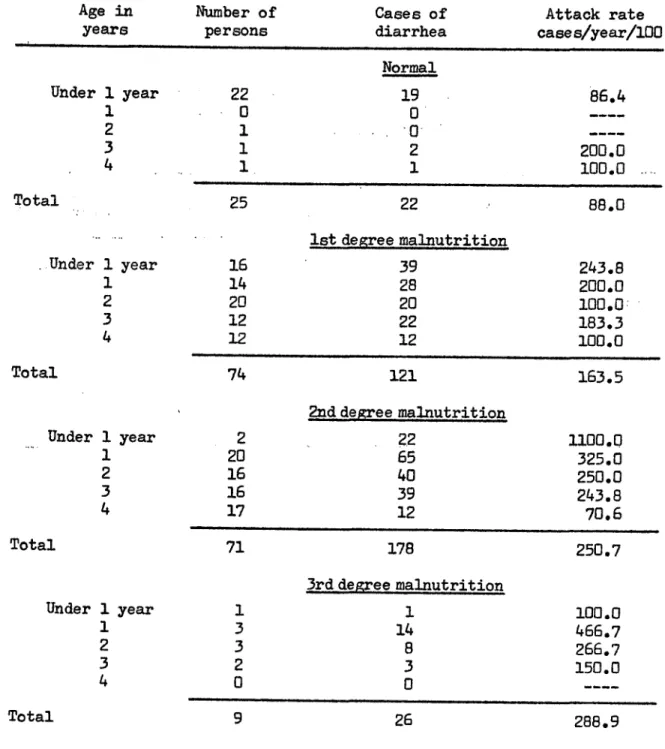
Nutritional State and Diarrheal Disease. Perhaps no clinical impres-sion is more firmly fixed among physicians working in preindustrial popu-lations than the belief that acute diarrheal disease is a more frequent and a more serious disease among the malnourished than in persons of normal nu-tritional state. Few quantitative data have been advanced in support of that hypothesis. Using a standard classification based on weight (13), the frequency of acute diarrheal disease in children was determined on the basis of 3 degrees of malnutrition, where weight deficiency was more than 10 per cent and less than 25 per centy by the accepted standard; where the deficiency was between 25 per cent and 40 per cent and where it exceeded 40 per cent.
By the standards used, most of the children in the group suffered an appreciable degree of malnutrition. This is in accord with numerous other and extensive investigations (14) of nutritional state in this area whereby
it becomes evident that infants'do well nutritionally during the first 6 months of life, in general conforming to the standard, but thereafter and especially during the weaning period, they depart broadly and consistently from the accepted scale. Table 7 shows that diarrheal disease occurred with signifi-cantly greater frequency in the malnourished than the normal, that attack rates increased progressively the greater the degree of malnutrition, and that these relationships held at all;preschool ages.
The related question of greater severity of diseases among the mal-nourished is considered through-data of Table 8. Diarrheas were recognized as mild or moderate according to duration of less or more than 4 days, mucus and blood in the stools being absent. Patients.with either of these findings were classed as severe, irrespective of days of duration. A difference was established between frequency of a severe form of diarrhea in the malnourished as compared with normal children; it increased regulary with advancing age, nutritional deficiency presumably being longer continued. The significance is discounted by the small numbers of persons in the normal group and aheavy loading with those in the first year of life. Also, serious diarrhea was numerically less frequent in persons with moderate nutritional deterioration than in the group with the beginning condition.
CD14/DT/2 (Eng.) Page 21
Table 7. Attack rates: Cases of acute diarrheal disease per 100 persons per year, by age and by degree of malnutrition. Santa Maria Cauqu6, 1961.
Age in Number of Cases of Attack rate
years persons diarrhea cases/year/100
Normal Under 1 year
1 2 3 4 22 0 1 1 1 19 0 0-2 1 86.4 200.0
1nnn
25 22 88.0
lst degree malnutrition
16 39 243.8
14 28 200.0
20 20 100l.0
12 22 183.3
12 12 100.0
74 121 163.5
2nd degree malnutrition
2
2.2
1100.0
20 65 325.0
16 40 250.0
16 39 243.8
17 12 70,6
71 178 250.7
3rd degree malnutrition
1 1 100.0
3 14 466.7
3 8 266.7
2 3 150.0
0 ...----0
Total
.Under 1 year 1 2 3 4 Total
Under 1 year 1 2 3 4 Total
Under 1 year 1 2 3
4
CD14/DT/2 (Eng.)
Page 22
N?
Distribution of cases
of
severe diarrheal
disease
by
degree
of
malnutrition. Santa
Maria Cauqu6,
February,
1961
-
June, 1962.
Total number
Number of
Percent
Degree of malnutrition:-
of cases
severe cases severe cases
Normal.
35
8
.
2.9
lst degree
.
172
65
37.8
2nd.degree
.
254
74
29.1
3rd degree
35
14
40.0
1st degree - 3rd degree .. . 461 153 33.2
-Table 8.
CD14/DT/2 (Eng.) Page 23
of difficulty. The second is through substitution of food of poorer qual-ity and commonly insufficient to meet currente requirements.
Infants and young children fed wholly on breast milk had relatively low attack rates for acute diarrheal disease, as shown in Table 9, including those continuing at an older age, with due allowance for the small numbers and the probability, despite history to the contrary, that they received some foreing foods. The frequency with which supplementary feeding is in-stituted at about the 6th month is indicated by the decided decline during 6 to 9 months in the numbers stated to be wholly breast fed during that period. No child was wholly breast fed past the 14th month.
Initiation of the weaning process, the addition of other foods beside breast milk, was associated.with a greatly increased frequency of diarrheal disease whether weaning began at an early age or relatively late, Table 10
shows that in general the rates more than doubled. Few children in this experience received milk as a supplementary food. Other liquids in the form of gruels or semisolid pastes were common but various solid foods were the main addition and almost without exception.
The highest rates for acute diarrheal disease prevailed during the time that weaning was being completed ;namely, when breast feeding ended and the child was transferred to a completely independent diet. The rates shown in Table 11 are measurably-greater than those for corresponding ages when weaning was in process and the' child still partially breast fed. The 3-month period immediately following that in which weaning was completedalso was as-sociated with high rates, numerically less than during the more stressful period when the transfer was made, but still statistically the same.
The results just presented on: the relation of breast feeding and the weaning process to incidence of acute diarrheal disease agree closely in principle with a similar comprehensive field study in the rural Punjab area
of India (5), although attack rates were regularly greater in Guatemala and death rates less. In relation to total deaths, diarrheal deaths were in much the same proportion in the 2 areas, if anything the proportion greater in Guatemala for the 2nd and 3rd years, where weaning was completed later, the mode in India being 19.5 months.
Table 9. Cases of acute diarrheal disease among wholly breast-fed children, by quarter years, 3 Guatemalan highland villages, 1959 - 1962.
Ages in All Cases of acute Incidence:
months children Breast milk only diarrheal disease cases per 100,
inclusive breast fed Number Percent among breast-fed wholly breast-fed
children only
children per year
0 - 2 294 284 96.6 51 71.8
3 - 5 290 239 32.4 100 167.4
6 -
8
288
95
33.0
45
189.5
9 - 11 280 13 4.6 7 215.4
12 - 14 261 3 1.1 3 400.0
15 -17 221 0
Total 634 206 130.0
ro
.
CD4
- N $~~~~~~~~~~~~"
I I
Table 10. Cases of acute diarrheal disease and incidence per 100 children per year, among breast-fed children in course of weaning, 3 Guatemalan highland
villages, 1959 - 1962
Age in All Breast milk supplemented with other foods
months children Number of Cases of acute Incidence:
inclusive breast fed children diarrheal disease cases per 100 per year
0- 2 3- 5 6- 8
9 - 11
12 - 14 15 - 17 18 - 20 21 - 23
24 - 26 27 - 29 30 - 32 33,- 35 36 - 38 39 - 41 42 - 44. 45 - 47 48 - 50
Total 294 290 288 280 261 221 169 124 72 44 23 9 5 2 9 48 190 264 254 220 168 123 72 44 23 9 5 2 1 17 103 187 178 164 124 79 36 31 15 10 3
0
44.4 141.7 216.8 283.3 280.3 298.2 295.2 256.9 200.0 281.8 260.9 444.4 240.0 0.0 0 0 2,082 1,431(D pi Co
Nr
N
265 ,>
V1
948
-
--16
Table 11, Cases of acute diarrheal disease, incidence per 100 per year, originally breast-fed children at age weaned from breast, and subsequent quarter year, 3 Guatemalan highland villages, 1959
among during - 1962
Weaned from breast this period Weaned in preceding 3 months
Age in All Cases of Incidence: Cases of Incidence:
months Children acute diarrheal cases per acute diarrheal cases per
inclusive breast fed Number disease 100 per year Number disease 100 per year
0-- 2 294 0
3 - 5 290 0
6 - B 288 0
9 -11 : 280 1 1 400.0
12 -14 261 3 4 533.3 1 1 400.0
15 -17 221 8 5 250.0 2 4 - 800.0
18 -20 169 13 14 430.8 4 1 100.0
21 .-23 124 20 13 260.0 13 11 338.5
24 -26 72 24 19 316,7 15 6 160.0
27 -29 44 18 . 7 155.6 20 16 320.0
30 -32 23 13 6 184.6 16 7 175,0
33--35 9 6 6 400.0 12 5 166.7
36 -38 5 2 1 200.0 6 0 0,0
39 -41 . 2 2 1 200,0 2 0 0.0
42 -44 . 2 0 o0.o0 2. 0 . . .0
45 -47 .. . -. . . -2 o 0 0.0
Total i 2 77 275.0 95 . 51 214.5 .
(9
D O
oN
N
CD14/DT/2
(Ehg.)
Page 27PROGRAM FOR CONTROL . A common error in the control of community disease is to attempt in areas without well organized health services procedures which have been demostrated as successful but under muchbetter circumstances. Equally, effort in highly developed health agencies some-times extrapolates scientific fervor beyond practical promise of accom-plishment. The recommendations now made are directed primarily to the 7/8 of the world where acute diarrheal disease prevails at high levels and ex-isting facilities are limited. The collection at the local level of basic data on frequency of occurrence is the first step toward control.
Reporting of Diarrheal Disease. The aim fostered by many goodhealth departments of requiring individual case report of acute diarrheal disease by etiological agent has the common result of discouraging notification. Even under optimal conditions, as in the military services, this has not proved possible or practicable (15). A better idea of the prevailing sit-uation is ordinarily to be had through report as undifferentiated diarrheal disease, but for this to be informative a change needs to be made in the
Standard List of diseases (16) whereby the several conditions to be regarded as acute diarrheal disease are grouped under diseases of the gastrointestinal tract or under the acute infections. The former is preferred because, as has been brought out, all are not of infectious origin.
Individual case report in communities without local health services or with the limited facilities of so many technically underdeveloped coun-tries is likely to prove little more than a gesture. The better reliance is on report of epidemics rather than cases, by the procedure outlined in Control of Communicable Diseases in Man of the American Public Health Association(17). Although epidemic report is just as impractical as individual case report without some organized responsibility for health, the concept can be accom-plished by judgement based on deaths rahter than cases. Most countries have a designated registrar of births and deaths, even in the smaller communities. Based on accumulated experience of sufficient years for the particular area, an arbitrary number of deaths from acute diarrheal disease, according to population and within a specified time, can be established as constituting an epidemic and report made to the next higher jurisdiction by the most un-informed official.
Methods of Control. Control resolves into measures for limiting num-bers of cases and thereby deaths; and secondly a direct attack on mortality through medical care. It is well to appreciate that no disease has everbeen
controlled by treating all patients, no matter how effective the available measures; and prevention has yet to attain eradication although successful for some few diseases in limited areas for indefinite times. The question of priority, one over the other, in a general approach should not intrude;
CDl4/DT/2 (Eng.)
Page 28Preventive.Measures. We choose to depart from tradition-in placing health education of the public first in rank among preventive measures. The reason is two-fold. In the first place, many of the important preventive measures relate directly to personal hygiene and personal health practices, applicable onily through initiative of the individual, The second reason is that control measures originating as a community effort and instituted through official agencies of society, frequently fail of their potential usefulness because. the individual person is deficient in knowledge of their proper use or unconvinced of their value. Illustrations have been given earlier.
This opinion of the primary importance of health education traces .back to an axiom originating with Haven Emerson, who said that "the first
thing. to do in public health is to persuade people to get up out of their own dirt." The implication is. clear, that this depends upon the individual himself, that his incentive is from imparted knowledge and acceptance of the worthwhilnessof the idea, and that provision of sanitary facilities is the means to an end, not the basic consideration. Health education finds its place in all of the measures to follow, from prevention to epidemic control, with reason to believe that it is not excluded from the high level of inter-national protective measures.
The principal age of attack in the first years of life, the high fa-tality at that time, and the association with the weaning process, make ma-ternal and child health practices a main feature of control programs. Spread by contact predominates and thus involves a clear relation to hygienic prac-tices by mother and other attendants. Breast feeding presently is close to universal in most of the lesser developed countries, but cultural changes in many areas lead to substitution of artificial feeding with disastrous results before an improved personal hygiene and sanitary practice are able to keep pace with the change. Breast feeding through 12 months is important, but
as the main reliance not to be continued beyond a point where the amount of breast milk provides an adequate nutrition. Cleanliness in preparation of food supplements has more than usual importance in this first contact of the infant with enteric pathogens, solid foods being generally recognized as
more hazardous than substituted milk. Areas are known where the milk is always boiled but not the water with which it is diluted.
The traditional acceptance of environmental sanitation as the funda-mental feature-in long term control of acute diarrheal disease in totalpop-ulations is wholly justified. Its short term effect on that part of the population most affected, the weanling diarrhea of infants and youngchildren, is not so definite. The value of improved sanitary facilities hasrepeatedly been dissipated by lack of coordination with health education to assure prop-er use.
CD14/DT/2 (Eng.) Page 29
readily water is available. Personal hygiene has been stressed as a prominent control measure. It requires adequate amounts of water. When supplies have to be transported several kilometers in small earthen jars, carried on the head, quantity is necessarily limited and detracts from practice of ordinary cleanliness.
Disposal of human feces is a critical concern and yet the construc-tion of privies often results in acquiring an edifice instead of an insti-tution, a monument to Hygea, but not something that the people understand, use and appreciate. Evidence has been introduced of a minimal effect of privieS in restricting the frequency of diarrhea among infants and young children where the disease exerts its major effect.
Disposal of wastes other than feces enters into sanitary control as a means of controlling fly breeding. Other fly control has significancein many localities.
Improved housing can be expected to influence favorably incidence rates of diarrheal disease. Dirt floors and creeping children are a bad
combination.
Food and nutrition necessarily attain greater prominence among con-trol measures as the place of weanling diarrhea within the total problem becomes better appreciated. The greater incidence and severity of acute
diarrheal disease among malnourished children than among well nourished in-fants and toddlers puts emphasis in attempted control on a diet adequate in nutrients and in amount. The addition to the infant diet of foods other than breast milk also increases the likelihood of infection. Supplementary
feeding during the weaning stage needs to depart from the haphazard process so common in underprivileged populations, with substitution of an orderly regimen accomplished through health education and the guidance of workersin maternal and child health. The critical period is when breast feeding ends and the child transfers to a general diet. In lesser developed regions, nutritional state usually has deteriorated measurably by that time from the normal growth curve. An appreciable risk of diarrheal disease continuesin the months that follow, and is still a factor in later preschool years.
Preventive methods are directed toward both mother and child. Mothers benefit from instruction in how properly to prepare foods which provide the supplement to breast feeding and equally after weaning; in protecting food
from flies, rodents and other sources of contamination; in the storage and preservation of food; and the management of leftovers. In many cultures,
CD14/DT/Z (Eng.)
Page
30
Children require training at an early age in food habits', from
- hand washing before.-eating to such elementary matters as prohibition of
'food dropped on-the floor.'
Care of Patient, Contacts and the Immediate Environment. As fun-damental a principle as any, is to appreciate that the problem of control in-the lesser developed countries, relates primarily to the community and -not to the patient, nor to the family contacts and the household environ-ment, which constitute the basic population unit. The period of communi-cability of the sick individual is short, the other sources of infection 'are multiple, and the secondary attack rate has been demonstrated to be
small.
Insolation and quarantine are difficult to impose under the condi-tions of village life, even the elementary prohibition of food handling, but happily, for reasons just stated, they are of ·lesser consequence. No specific immunization of contacts is known, and attempts to institute chemoprophylaxis in the.protection of contacts, while occasionally re-ported favorably it -shigellosi.s,have failed to demostrate its worth when tested under controlled conditions. A principle proved useful in numerous other diseases where specific preventive measure are lacking, is close observation of contacts and prompt institution of full therapy at the first evidence of illness.' Concurrent or terminal disinfection, other than ordinary cleaning has little value, again because of multiple sources of infection.
The part of a control program relating to the patient resolves essentially into clinical treatmen of the acute illness with the major an-ticipated result being fewer deaths, and a minor contribution to control from a somewhat shortened:period of communicability, Modern methods of management, especially' rehydriation, contribute notably, although less so in the diarrheas of malnourished children who respond slowly to usual measure.
Recommended procedures on clinical management fail many times to recognize that the great bulk of patients with diarrheal disease in lesser developed countries lack access to hospital facilities, an organizedclinic or'the medical care characteristic of metropolitan centers. Those areas with high rates for diarrheal disease, taking the world as a whole are ru-ral rather than urban, 85 per cent in India and 70 per cent in Guatemala. Medical care in many such situations is mainly with the practitioner of folk medicine, the local midwife, or the village wiseman. A conviction arising from experience in marty such areas suggests the need to develop and test'a simple program of management applicable to the particular local conditions, capable of use in the absence of a physician, and disseminated through health education to mothers of young children.