Offi cial Publication of the Brazilian Society of Anesthesiology www.sba.com.br
REVISTA
BRASILEIRA DE
ANESTESIOLOGIA
Abstract
Background and objective: Postoperative nausea and vomiting (PONV) occur frequently after laparoscopic bariatric surgery. The combination of haloperidol, dexamethasone, and ondansetron may reduce these undesirable events. The aim of this study was to evaluate the intensity of nausea and pain, the number of vomiting episodes, and morphine consumption in postoperative (PO) obese patients undergoing laparoscopic sleeve gastrectomy (LSG).
Method: A clinical, randomized, controlled, double-blind study conducted with 90 patients with body mass index ≥ 35 kg.cm-2. Patients were divided into three groups of 30 individuals
to receive ondansetron 8 mg (Group O); ondansetron 8 mg and dexamethasone 8 mg (Group OD); and ondansetron 8 mg, dexamethasone 8 mg, and haloperidol 2 mg (Group HDO). We evaluated the intensity of nausea and pain using the verbal numeric scale, cumulative number of vomiting episodes, and morphine consumption in the period of 0-2, 2-12, 12-24, and 24-36 hours postoperatively.
Results: Nausea intensity was lower in Group HDO compared to Group O (p = 0.001), pain intensity was lower in Group HDO compared to Group O (p = 0.046), and morphine consumption was lower in Group HDO compared to Group O (p = 0.037). There was no difference between groups regarding the number of vomiting episodes (p = 0.052).
Conclusion: The combination of haloperidol, ondansetron, and dexamethasone reduced nausea and pain intensity and morphine consumption in postoperative obese patients undergoing LSG. © 2013 Sociedade Brasileira de Anestesiologia. Published by Elsevier Editora Ltda.
All rights reserved.
Combination of Haloperidol, Dexamethasone, and
Ondansetron Reduces Nausea and Pain Intensity and Morphine
Consumption after Laparoscopic Sleeve Gastrectomy
Márcio Luiz Benevides
a,*, Sérgio de Souza Oliveira
a,b,
José Eduardo Aguilar-Nascimento
ba Center for Teaching and Training, Sociedade Brasileira de Anestesiologia, Cuiabá, MT, Brazil
bDepartment of Surgery, Hospital Universitário Júlio Müller, Universidade Federal de Mato Grosso, Cuiabá, MT, Brazil
Study conducted at Hospital Jardim Cuiabá, Cuiabá, MT, Brazil.
Submitted on April 15, 2012; accepted on July 30, 2012
KEYWORDS Antiemetics; Haloperidol; Dexamethasone; Ondansetron; Bariatric Surgery; Postoperative Nausea and Vomiting.
SCIENTIFIC ARTICLE
*Corresponding author: Universidade Federal de Mato Grosso, Avenida Fernando Corrêa da Costa s/n, Boa Esperança, Cuiabá, MT, Brasil. CEP: 78 068-600.
E-mail: [email protected] (M.L. Benevides).
405 Consumption after Laparoscopic Sleeve Gastrectomy
Introduction
Postoperative nausea and vomiting (PONV) usually occur after laparoscopic bariatric surgery. In previous studies, the incidence of PONV in patients who did not receive
antieme-tic prophylaxis was as high as 70-80%.1,2 The combination of
antiemetic drugs has been used as a strategy for reducing PONV. Thus, the combination of three antiemetic drugs with different mechanisms of action may be an option to prevent these undesirable events.
Haloperidol, a prolonged action butyrophenone (18 hours)
with high affi nity for dopamine D2-receptors, has been used
to control agitation and delirium in medical and surgical patients and in palliative care of cancer patients for nausea
and vomiting management.3 It is used in much lower doses
(1.2 mg) than drugs used for treating psychiatric disorders, administered by intravenous (IV) route for prevention and treatment of PONV with minimal toxicity. Extrapyramidal symptoms are rare and cardiac arrhythmias have not been
reported.4,5
Intravenous dexamethasone (8-10 mg) reduces the incidence of PONV by a central mechanism that reduces the production of prostaglandin and controls the release
of endorphins.6,7 Moreover, it may decrease postoperative
pain by modulating the systemic physiological response of
anti-infl ammatory mediators.6 Despite the various potential
side effects, such as infection and delayed wound healing or adrenal gland suppression, Henzi and colleagues did not observe these effects after a single bolus injection of
dexa-methasone in their systematic review.7
Ondansetron, one of the 5-HT3 receptor antagonists, is
the most studied drug. Used intravenously at doses of 4-8 mg, it has few side effects and appears to be particularly useful for PONV in patients undergoing gastrointestinal surgery with
stimulation of enterochromaffi n cells.8
Headaches may occur after its IV administration, and transient elevation of liver enzymes occurred in a small
numbers of patients.9
Among the various types of surgical approaches to obesity,
laparoscopic sleeve gastrectomy (LSG) is emerging.10
The aim of this study was to evaluate the intensity of nau-sea, cumulative number of vomiting episodes, pain severity, and morphine consumption in postoperative obese patients undergoing LSG who received one of the three antiemetic prophylactic regimens.
Method
We conducted this study according to the Declaration of Helsinki Ethical principles and had it approved by the Medical Ethics Committee of the Universidade Federal de Mato Grosso (Protocol 932/CEP-HUJM/2010). We obtained written infor-med consent from all patients. Between January and October 2011, patients with age ≥ 18 years, physical status ASA I-III,
body mass index (BMI) ≥ 35 kg.cm-2, and candidates for LSG
were invited to participate in this randomized, controlled, double-blind, clinical trial. Exclusion criteria were patients with known hypersensitivity or contraindication to the study drugs; who had experienced serious complications during pe-rioperative period; who have psychiatric disorder; history of migraine; and those who had used opioids, anti-infl ammatory hormone, and antiemetic drugs 24 hours before surgery.
Patients, anesthesiologists, and investigators who collec-ted the postoperative data were blinded to the randomization process and types of drugs used.
We used a list of random numbers generated by computer (www.graphpad.com) and the sealed envelope technique. Independent personnel not associated with the study prepa-red the randomization. Thus, patients were assigned to recei-ve one of three IV treatments. Group O (control): ondansetron (8 mg); Group DO: dexamethasone (8 mg) and ondansetron (8 mg); Group HDO: haloperidol (2 mg), dexamethasone (8 mg) and ondansetron (8 mg). The nurse unit prepared the drugs in volumes of 10 mL with the same color (colorless) and delivered them to the assistant anesthesiologist who administered the volumes. Therefore, two syringes contai-ning 0.9% saline solution (SS) or one contaicontai-ning SS and the other dexamethasone or one containing dexamethasone and the other haloperidol were administered immediately after induction of anesthesia. All patients received ondansetron 20-30 minutes before the end of procedure.
Anesthetic technique
Anesthetic technique was standardized: we calculated the doses of anesthetic drugs for induction and maintenance of anesthesia based on the ideal weight (IW) and corrected weight (CW) of patients, in which IW = height in cm (-100 for men and -105 for women) and CW = IW + [0.4 x (current weight - ideal weight)]. Thus, anesthesia was induced with IV
propofol (2 mg.kg-1 CW), fentanyl (3 μg.kg-1 CW), and
cisatra-curium (0.1 mg.kg-1 IW) for tracheal intubation. Remifentanil
(0.1-0.3 μg.kg-1.min-1 IW), isofl urane (1%) in a mixture of 1:1
oxygen and air, and additional dose of cisatracurium were given for maintenance if required. Neuromuscular block was
reversed with IV neostigmine up to 0.04 mg.kg-1 and atropine
up to 0.015 mg.kg-1.
Surgical technique
LSG was standardized. We insterted fi ve or six trocars after establishing the pneumoperitoneum. Initially, partial release of the stomach’s greater curvature was done using the ultra-sonic device Ligasure®, preserving the antral region. Then, we positioned an orogastric tube (Fouchet 32 French) into the lesser curvature to delimit gastric resection, which we performed with linear staplers 2 to 5 cm from the pylorus, advancing it to the angle of Hiss. After gastric tube insertion, we did a staple line reinforcement using non-absorbable mo-nofi lament sutures with continuous invaginating seromuscular stitches. At the end of surgery, Fouchet tube was aspirated and removed after a leak test using methylene blue.
Postoperative diet
We introduced fractionated oral liquid diet, initially with water and later with broth without residue, on the fi rst pos-toperative (PO) day, according to patient’s acceptance.
Verbal numeric scale of nausea (VNSN) and verbal
numeric scale of pain (VNSP)
Analgesia
We administered intravenous ketorolac (30 mg) and dipyrone
(20-30 mg.kg-1 IW) immediately after induction of
anesthe-sia and maintained it every 8 and 4 hours, respectively. We used intravenous bolus doses of morphine (2-3 mg) in post-anesthesia care unit (PACU), if VNSP > 3. If VNSP > 3, we administered subcutaneous morphine (5 mg) after discharge to ward.
Data collection
We recorded nausea and pain intensity at the end of 0-2, 2-12, 12-24, and 24-36 hours postoperatively, in addition to the cumulative number of vomiting episodes and morphine consumption at 36 hours postoperatively. We also recorded the demographic variables: ASA physical status, non-smoker status, history of PONV, history of kinetosis, preoperative fasting time, duration of anesthesia, amount of fl uids admi-nistered during operation, and length of PACU stay.
Statistical analysis
We determined that the sample size of 28 patients per group was adequate to meet the decrease in mean nausea intensity from fi ve to three in VNSN and standard deviation of three (pilot study showed a mean nausea intensity of three with the use of a prophylactic antiemetic drug), assuming a 20% β-error and 5% α-error.
We assessed continuous data with normal distribution using the analysis of variance test (ANOVA) followed by Tukey’s test for post-hoc analysis when necessary.
We assessed continuous or discrete data without nor-mal distribution and ordinal data using Kruskal-Wallis test, followed by Mann-Whitney test for post-hoc analysis, if necessary.
We used a Chi-square test for categorical data. We used repeated measures ANOVA test for comparative analysis of the evolution of variables: VNSN, VNSP, and morphine
consumption over time between groups. In this analysis, we considered two factors of interest (time and group), in addition to the possible interaction between them.
To reject the null hypothesis, we established a level of sig-nifi cance at 5% (p value < 0.05). We performed analyses using the Statistical Package for Social Sciences for Windows 17.0.
Results
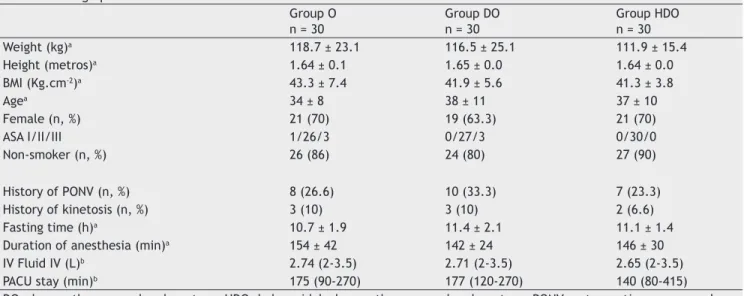
Of the 96 randomized patients, six were excluded (one un-derwent laparotomy, one had surgery postponed, two had surgical complications, one had angioneurotic edema, and one received rescue antiemetic outside the protocol). Thus, 90 patients were included (30 per group). Demographic va-riables, physical status, non-smoker status, history of PONV, history of kinetosis, preoperative fasting time, duration of anesthesia, amount of fl uid administered during operation, and time of PACU stay had homogeneous distribution between the groups (Table l).
Nausea intensity
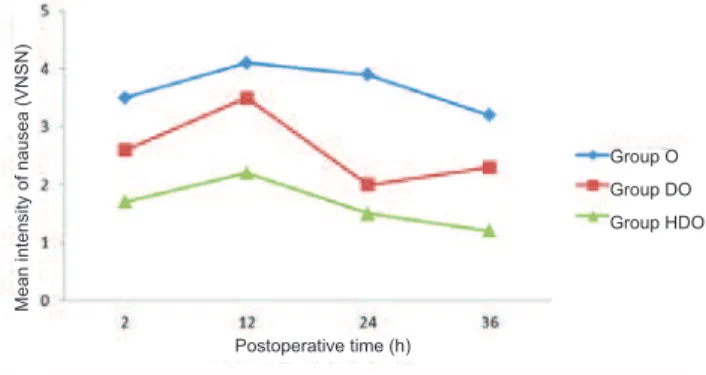
Nausea intensity was lower in Group HDO than in Group O (p = 0.001). Nausea intensity remained constant over time in all three groups (time variable, p = 0.17). There was no interaction between group and time (time variable x group, p = 0.96) (Fig. 1).
Number of vomiting episodes
Kruskal-Wallis test showed a trend towards a statistical diffe-rence between groups (p = 0.052). The number of vomiting episodes tended to be lower in Group HDO, followed by DO and O groups (Table 2).
Pain intensity
Pain intensity was lower in Group HDO than in Group O (p = 0.046). There was also a decrease in pain intensity over time (p = 0.000). There was no interaction between group and time (time variable x group, p = 0.52) (Fig. 2).
Table 1 Demographic and Other Clinical Variables. Group O n = 30
Group DO n = 30
Group HDO n = 30
Weight (kg)a 118.7 ± 23.1 116.5 ± 25.1 111.9 ± 15.4
Height (metros)a 1.64 ± 0.1 1.65 ± 0.0 1.64 ± 0.0
BMI (Kg.cm-2)a 43.3 ± 7.4 41.9 ± 5.6 41.3 ± 3.8
Agea 34 ± 8 38 ± 11 37 ± 10
Female (n, %) 21 (70) 19 (63.3) 21 (70)
ASA I/II/III 1/26/3 0/27/3 0/30/0
Non-smoker (n, %) 26 (86) 24 (80) 27 (90)
History of PONV (n, %) 8 (26.6) 10 (33.3) 7 (23.3)
History of kinetosis (n, %) 3 (10) 3 (10) 2 (6.6)
Fasting time (h)a 10.7 ± 1.9 11.4 ± 2.1 11.1 ± 1.4
Duration of anesthesia (min)a 154 ± 42 142 ± 24 146 ± 30
IV Fluid IV (L)b 2.74 (2-3.5) 2.71 (2-3.5) 2.65 (2-3.5)
PACU stay (min)b 175 (90-270) 177 (120-270) 140 (80-415)
DO, dexamethasone and ondansetron; HDO, haloperidol, dexamethasone, and ondansetron; PONV,postoperative nausea and vomiting; O, ondansetron.
aMean ± standard deviation.
407 Consumption after Laparoscopic Sleeve Gastrectomy
Morphine consumption
Morphine consumption was lower in Group HDO than in Group O (p = 0.037). There was also a decrease in morphine consumption over time (p = 0.000). There was no interaction between group and time (time variable x group, p = 0.74) (Fig. 3).
Discussion
We chose haloperidol, dexamethasone, and ondansetron because they have different mechanisms of antiemetic activity, are inexpensive and have proven effi cacy when
used alone or in combination.11-14 We used haloperidol, in
particular, because it is an interesting option to droperidol,
as it provides less sedation.15
The selection of doses was based on previous studies
re-porting they were safe and effective.2,16 The study design did
not include a control group without prophylactic medication. In fact, there is a higher incidence of PONV after laparoscopic
surgeries and the use of balanced anesthesia.16 which in itself
may justify the use of at least one prophylactic antiemetic drug; thus, we believe that it was not ethical to include a placebo group in this study.
In this study, patients received the same type of anes-thesia and underwent the same type of surgery. Moreover, the variables age, gender, weight, height, physical status, BMI, non-smoker status, history of PONV and kinetosis, pre-operative fasting time, duration of anesthesia, amount of fl uid infused during surgery, and time of PACU stay (possible confounding biases) had homogeneous distribution between groups. This is important because the differences between groups could be attributed to the different antiemetic com-binations administered.
The study showed that the combination of antiemetics reduced the intensity of nausea, proportionally to the number of drugs used. However, nausea intensity remained constant over time in all three groups. This may be explai-ned by the additive effect of the antiemetic combination,
Figure 1 Nausea intensity variation in verbal numerical scale of nausea (VNSN), according to group and time (hour).
Mean intensity of nausea (VNSN)
Postoperative time (h)
Group O
Group DO
Group HDO
Figura 2 Variación de la intensidad del dolor por la escala numérica verbal de dolor (ENVD), segundo grupo y tiempo, en horas.
Mean intensity of pain (VNSP)
Postoperative time (h)
Group O
Group DO
Group HDO
Figura 3 Variación del consumo de morfi na, segundo grupo y tiempo, en horas.
Mean consumption of morphine (mg)
Postoperative time (h)
Group O
Group DO
Group HDO Table 2 Number of Vomiting Episodes 36 Hours after Surgery, According to Group.
Group O n = 30
Group DO n = 30
Group HDO n=30
p
Number of episodes 1.10 ± 1.2 0.83 ± 2 0.63 ± 1.2 0.052
as suggested by Apfel.17 and the fact that haloperidol and
dexamethasone elimination half-lives are greater than that of ondansetron.
The number of vomiting episodes was not different be-tween groups (p = 0.052), possibly because of the greater anti-vomiting than anti-nausea effect in antiemetics studied or the need for a larger sample size in order to fi nd a statis-tically signifi cant difference.
Pain is a frequent cause of discomfort during the posto-perative period. Pain intensity was lower in groups receiving dexamethasone, but statistically different in Group HDO compared to Group O. Pain relief effect may be attributed to the use of dexamethasone (decrease in proinfl ammatory cytokines release, such as tumor necrosis factor, interleukin-1
and interleukin-6), similar to results of other studies.18-20
Morphine (IV and SC bolus) used as rescue analgesic was adequate, safe, and a good option compared to the use of IV morphine via patient-controlled analgesia. We found increased morphine consumption in the fi rst 2 hours in all groups, with signifi cant decline in subsequent periods. The
use of dipyrone 21 and ketorolac 22 at fi xed times may have
contributed decisively to this result. There was less mor-phine consumption in Group HDO than in Group O, which may be attributed to the anti-infl ammatory and analgesic opioid-sparing action of dexamethasone, as seen in other
studies.23-26
The combination of haloperidol, dexamethasone, and on-dansetron decreased nausea and pain intensity and morphine consumption in obese patients undergoing LSG.
Confl icts of interest
The authors declare no confl icts of interest.
References
1. Moussa AA, Oregan PJ - Prevetion of postoperative nausea and vomiting in patients undergoing laparoscopic bariatric surgery - Granisetron alone vs granisetron combined with dexamethasone/droperidol. M.E.J. Anesth. 2007;19(2):367-368.
2. Mendes MN, Monteiro RS, Cruz Martins FAN - Profi laxia de náuseas e vômitos pós-operatórios em obesos mórbidos submetidos a gastroplastias por laparoscopias. Estudo comparativo entre três métodos. Rev Bras Anestesiol. 2009;59(5):570-576.
3. Perkins P, Dorman S - Haloperidol for the treatment of nausea and vomiting in palliative care patient. Cochrane Database of Systematic Reviews. 2009;(2):CD006271.
4. Chu CC, Shieh JP, Tzeng JI et al. - The prophylactic effect of haloperidol plus dexamethasone on postoperative nausea and vomiting in patients undergoing laparoscopically assisted vaginal hysterectomy. Anesth Analg. 2008;106:1402-1406.
5. Wang TF, Liu YH, Chu CC et al. - Low-dose haloperidol prevents post-operative nausea and vomiting after ambulatory laparoscopic surgery. Acta Anaesthesiol Scand. 2008;52:280-284.
6. Karanicolas PJ, Smith SE, Kanbur B et al. - The impact of prophylactic dexamethasone on nausea and vomiting after laparoscopic cholecystectomy: a systematic review and meta-analysis. Ann Surg.2008;248:751-762.
7. Henzi I, Walder B, Tramer MR - Dexamethasone for the prevention of postoperative nausea and vomiting: a quantitative systematic review. Anesth Analg. 2000;90:186-194.
8. Laer S, Scholz J, Ritterbach C et al. – Association between increased 5-HIAA plasma concentrations and postoperative nausea and vomiting in patients undergoing general anaesthesia for surgery. Eur J Anaesth. 2001;18(12):833-835.
9. Tramer MR, Reynolds DJ, Moore RA et al. - Effi cacy, dose-response, and safety of ondansetron in prevention of postoperative nausea and vomiting: a qualitative systematic review of randomized placebo-controlled trials. Anesthesiology. 1997;87:1277-1289.
10. O’Brein PE - Bariatric surgery: mechanisms, indications, and outcomes. J Gastroenterol Hepatol. 2010;25:1358-1365. 11. Chu CC, Shieh JP, Tzeng JI et al. - The prophylactic effect of
haloperidol plus dexamethasone on postoperative nausea and vomiting in patients undergoing laparoscopically assisted vaginal hysterectomy. Anesth Analg. 2008;106:1402-1406.
12. Rosow CE, Haspel KL, Smith SE et al. - Haloperidol versus ondansetron for prophylaxis of postoperative nausea and vomiting. Anesth Analg. 2008;106:1407-1409.
13. White PF, O’Hara JF, Roberson CR - The impact of current antiemetic practices on patient outcomes: a prospective study on high-risk patients. Anesth Analg. 2008;107:452-458. 14. Voigt M, Fröhlich CW, Waschke KF - Prophylaxis of postoperative
nausea and vomiting in elective breast surgery. Journal of Clinical Anesthesia. 2011;23:461-468.
15. Carlise JB, Stevenson CA - Drugs for preventing postoperative nausea and vomiting. Cochrane Database Syst Rev. 2006;(3):CD004125.
16. Le TP, Gan TJ - Update on the management of postoperative nausea and vomiting and postdischarge nausea and vomiting in ambulatory surgery. Anesthesiology Clin. 2010;28:225-249. 17. Apfel CC, Laara E, Koivuranta M et al. - A simplifi ed risk score
for predicting postoperative nausea and vomiting: conclusions from cross-validations between two centers. Anesthesiology. 1999;91:693-700.
18. Sánchez-Rodríguez PE, Fuentes-Orozco C, González-Ojeda A - Effect of dexamethasone on postoperative symptoms in patients undergoing elective laparoscopic cholecystectomy: randomized clinical trial. World J Surg. 2010;34:895-900.
19. Zhou H, Xu H, Zhang J et al. - Combination of dexamethasone and tropisetron before thyroidectomy to alleviate postoperative nausea, vomiting, and pain: randomized controlled trial. World J Surg. 2012;7:1217-1224.
20. Feroci F, Rettori M, Borrelli A et al. - Dexamethasone prophylaxis before thyroidectomy to reduce postoperative nausea, pain, and vocal dysfunction: a randomized clinical controlled trial. Head Neck. 2011;33(6):840-846.
21. Edwards J, Meseguer F, Faura C et al. - Single dose dipyrone for acute postoperative pain. Cochrane Database Syst Rev. 2010;(9):CD003227.
409 Consumption after Laparoscopic Sleeve Gastrectomy
23. De Oliveira Jr GS, Almeida MD, Benzon HT - Perioperative single dose systemic dexamethasone for postoperative pain:a meta-analysis of randomized controlledtrials. Anesthesiology. 2011;115:575-588.
24. Fujii Y, Itakura M - Reduction of postoperative nausea, vomiting, and analgesic requirement with dexamethasone for patients undergoing laparoscopic cholecystectomy. Surg Endosc. 2010;24:692-696.
25. Jokela RM, Ahonen JV, Tallgren M - The effective analgesic dose of dexamethasone after laparoscopic hysterectomy. Anesth Analg. 2009;109:607-615.