Article
ISSN 0102-695X
http://dx.doi.org/10.1590/S0102-695X2012005000005 Received 14 Jun 2011 Accepted 3 Aug 2011 Available online 6 Jan 2012
reducing intracellular calcium concentration
in vascular smooth muscle cells of rats
Aurylene C. Oliveira,
1José G. Sena-Filho,
2Leônidas G.
Mendes-Júnior,
1Raline M. Anjos,
1Thaís P. Ribeiro,
1José M.
Barbosa-Filho,
1Valdir A. Braga,
1Isac A. Medeiros
*,11Laboratório de Tecnologia Farmacêutica, Universidade Federal da Paraíba,
Brazil,
2Empresa Brasileira de Pesquisa Agropecuária, Coastal Tablelands, AracajuSE,
Brazil.
Abstract: The cardiovascular effects elicited by the ethanolic extract obtained from the roots of Erythroxylum pungens O.E. Schulz, Erythroxylaceae (EEEP) and the vasorelaxant effect induced by its main tropane alkaloid (pungencine) were investigated. In normotensive rats, administration of EEEP (1, 10, 30 and 60 mg/kg i.v., randomly)
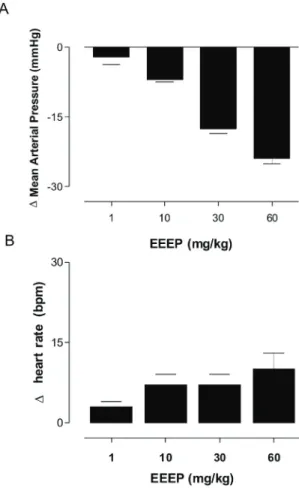
produced dose-dependent hypotension (-2±1, -7±0.5 -17.6±1, -24±1 ∆ mmHg, n=5) followed by tachycardia (3±0.5, 7±2, 7.1±1, 10±5 ∆ bpm, n=5). In intact phenylephrine (Phe, 10 μM)-pre-contracted rings, EEEP (0.01-500 μg/mL) induced concentration-dependent vasorelaxation (EC50 13.7±5.5 μg/mL, Maximal Response= 92±2.6%), and
this effect was unchanged after the removal of the vascular endothelium (EC50 27.2±4.7
μg/ml, Maximal Response= 88.3±3.3 %). In KCl (80 mM)-pre-contracted-endothelium-denuded rings, EEEP elicited concentration-dependent relaxation (EC50= 128.2±11.2 μg/mL, Maximal Response 76.8±3.4%). Vasorelaxation has also been achieved with tonic contractions evoked by the L-type Ca2+ channel agonist Bay K 8644 (EC50
80.2±9.1 μg/mL, Maximal Response 86.3±8.3%). In addition, in a depolarizing medium,
EEEP inhibited CaCl2 (30-500 μg/mL) induced contractions and caused a
concentration-dependent rightward shift of the relaxation curves. Lastly, the tropane alkaloid pungencine
caused vasorelaxation in mesenteric arteries resembling to the EEEP responses. These results suggests that EEEP induces hypotension and vasorelaxation, at least in part, due to the reduction in [Ca2+]i in vascular smooth muscle cells.
Keywords:
Ca2+ channels
Erythroxylum pungens
hypotension mesenteric artery tropane alkaloid vasorelaxant effect
Introduction
Medicinal plants contain several classes of bioactive compounds such as polyphenols, alkaloids and terpenes (Oliveira et al., 1996; Barbosa-Filho et al., 2000; Adaramoye et al., 2009). Among the pharmacological activities of compounds isolated from medicinal drugs on the cardiovascular system are calcium antagonism, NO release, antioxidant and others (Guedes et al., 2004; Ribeiro et al., 2010).
The Erythroxylaceae is an important family that produces active secondary metabolites on biological systems. Erythoxylum species are known for the production of the tropane diester alkaloid, cocaine, but only a few members of this genus accumulate this alkaloid in quantity (Chin et al., 2006; Queiroz et al., 2009). This family has four genera, with approximately 250 species, being the genus Erythroxylum P. Browne, which is the largest one, found widely distributed in tropical regions
of South America, Africa, Southeast Asia, and Madagascar
(Plowman & Hensold, 2004; Brock et al., 2005). In South
America, Brazil is one of the main centers of diversity and endemism for Erythroxylum sp., where around 114
are found from a total of 187 species catalogued (Brock
et al., 2005). Erythrxoxylum pungens, popularly known as “rompe-gibão” is found in the Northeast region of Brazil.
Among their constituents with biological activity, tropane alkaloids demonstrated analgesic effects, anesthetic, anticholinergic, antiemetic, antihypertensive, parasympatholytic, and many others pharmacological
actions (Grynkiewicz & Gadzikowska, 2008). In modern
medicine, three tropane alkaloids, atropine, hyoscyamine, and scopolamine, are among the major drugs obtained from plants. Although synthetic approaches have been developed for the basic tropane alkaloids, most of the pharmaceutically important alkaloids of this series are still
To our knowledge, there is no information about the effects of Erythroxylum pugens ethanolic extract (EEEP) or tropane alkaloid pungencine on the cardiovascular system. Therefore, the present study was designed to determine whether EEEP and its isolated tropane alkaloid (pungencine, 1) has a pharmacological effect on isolated rat superior mesenteric arterial rings, and if so, to unravel the mechanisms by which EEEP exerts its cardiovascular effects.
N H3C
O
O
OCH3
OH
OCH3
1
Material and Methods
Animals
Male Wistar rats (250-300 g) were used for all experiments. Animals were housed under controlled
temperature (21±1 ºC) and light cycle (lights on 6-18 h). Animals had free access to food (Labina®, PURINA, Brazil) and tap water. Experimental protocols and procedures were approved by the Institutional Animal
Care and Use Committee of the LTF, Federal University of
Paraiba (Protocol number 0305/07).
Plant material and extraction
Erythroxylum pungens O.E. Schulz,
Erythroxylaceae (EEEP), were collected near the São José de Espinharas town in Paraiba State, Brazil, in March
2007. The voucher specimen (IPA-81029) was deposited in the Herbarium Dárdano de Andrade Lima, Empresa Pernambucana de Pesquisa Agropecuária, Pernambuco
State, Brazil.
Roots were air-dried at room temperature and then powdered. The powdered samples (1 kg) were de-fatted
with n-hexane (2.5 L) and extracted with 75% ethanol (2.5 L) overnight in a soxhlet extractor. Part of the EtOH
extract (200 g) was submitted to alkaloid extraction. The whole fraction of tertiary alkaloids (50 g) was subjected to column chromatography (CC, basic Al2O3).
The isolation and identiication of pungencine (1) have been described in details elsewhere (Sena-Filho et al, 2010). EEEP or pungencine stock solution were prepared in distilled water and kept at -4 °C. EEEP or pungencine were solubilized in cremophor and diluted to the desired
concentrations with distilled water just before the use.
The inal concentration of cremophor in the bath never exceeded 0.01% and had no effect when tested in control
preparations.
Measurement of arterial pressure and heart rate in conscious rats
For blood pressure and heart rate recordings, procedures were similar to those previously described
(Braga, 2010; Nunes et al., 2010). Briely, under sodium
thiopental anaesthesia (45 mg/kg, i.p.), rats were itted with
polyethylene catheters inserted into the lower abdominal aorta and lower vena cava through left femoral artery
and vein, respectively. Both catheters were illed with
heparinized saline, tunnelled subcutaneously, exteriorized and sutured at the dorsal surface of the neck. Twenty-four hours after surgical procedures, experiments were performed in conscious rats. The arterial catheter was connected to a pre-calibrated pressure transducer (Statham
P23 ID; Gould, Cleveland, OH, USA). The transducer was connected to an ampliier-recorder (Model TBM-4M, WPI, Sarasota, FL, USA) and feed to a computer equipped with an analogic-to-digital converter board (CIO-DAS16/ JR, Computer Boards, Inc., Mansield, MA, USA). Using CVMS acquisition software (WPI, Sarasota, FL, USA), data were sampled every 500 Hz and stored on a
CD-ROM. Beat-to-beat time waveforms were generated and processed off-line. For each cardiac cycle, the software calculated mean arterial pressure (MAP) and pulse interval (used to derive heart rate).
Cardiovascular effects of ethanolic extract from the roots of Erythroxylum pungens (EEEP)
After cardiovascular parameters had stabilized (30 min of baseline recordings), different doses of EEEP (1, 10, 30 and 60 mg/kg, i.v.) were randomly administered.
Vascular reactivity studies in isolated rat superior mesenteric artery rings
Rats were euthanized by stunning and bleeding. The superior mesenteric artery was removed and cleaned from connective tissue and fat. Whenever appropriated, the endothelium was removed by gently rubbing the intimal surface of the vessels. Rings (1-2 mm) were obtained and placed in physiological Tyrode’s solution, maintained
to 37 °C, gassed with carbogenic mixture (95% O2 and
5% CO2), and maintained at pH 7.4. All preparations were stabilized under a resting tension of 0.75 g for 1 h. The solution was replaced every 15 min to prevent the
accumulation of metabolites (Ribeiro et al., 2010; Luciano
FL, USA) coupled to an ampliier-recorder (Miobath-4, WPI, Sarasota, FL, USA) and to a computer equipped with
an analogic-to-digital converter board.
The presence of functional endothelium was assessed by the ability of acetylcholine (10 µM) to induce
more than 90% relaxation of vessels pre-contracted with phenylephrine (10 µM). Less than 10% of relaxation
to acetylcholine was taken as evidence that the vessel segments were functionally denuded of endothelium as described earlier (Ribeiro et al., 2010). In the tonic phase of the second contraction, EEEP (0.01, 0.03, 0.1, 0.3, 1,
3, 10, 30, 100, 300 and 500 μg/mL) was cumulatively
added to preparations until a Maximal Response for the drug administration was observed as indicated by a plateau response (approximately 10 min). The same procedure was used to observe the effects induced by pungencine (10-12 M to 3x10⁻⁴ M).
The possible effects of EEEP on KCl (80 mM) Bay k 8644-induced sustained contraction in denuded rings
were also examined. To further investigate the mechanism of vasorelaxation induced by EEEP, concentration-response curves to CaCl2 were constructed using
endothelium-denuded rings. Briely, the rings were pre-contracted with KCl (60 mM) to conirm tissue viability. The Tyrode’s
solution was replaced with depolarizing Tyrode’s solution
(KCl 60 mM) nominally without Ca2+ (for 15 min). Thereafter, concentration-response curves to CaCl2 (1 µM-10 mM) were constructed in the absence or presence of EEEP. To determine whether EEEP could interfere with Ca2+ release from intracellular stores, the denuded rings
were pre-contracted with KCl, washed and exposed to
Ca2+-free Tyrode’s solution containing EGTA (1 mM). The rings were then stimulated with phenylephrine (10 µM). The contractions of both agonists were obtained in the absence (control) or after incubation with EEEP.
Drugs and solutions
The drugs used were: acetylcholine chloride
(ACh), L-phenylephrine (Phe), S-(-)1,4-dihydro-2,6- dimethyl-5-nitro-4-(2-[triluoromethyl]phenyl)pyridine-3-carboxylic acid methyl ester (Bay K 8644), cremophor EL (Sigma Chemical Co., St Louis, MO, USA). Heparin sodium
salt (Roche, Rio de Janeiro, RJ Brazil), sodium thiopental
(Cristália, São Paulo, SP, Brazil). The other compounds
were dissolved in distilled water. The composition of the
Tyrode’s solution used was (mM): NaCl, 158.3; KCl, 4.0;
CaCl2, 2.0; MgCl2, 1.05; NaH2PO4, 0.42; NaHCO3, 10.0 and glucose, 5.6.
Statistical analysis
Data are presented as mean±SEM. Statistical analyses were performed using “one-way” ANOVA
followed by Tukey’s post hoc test or unpaired Student’s
t-test when appropriate. Non-linear regressions were done by the least square method, using Graph Pad Prism TM software, version 5.0 (Graph Pad Software, Inc.).
Results
The cardiovascular responses elicited by the EEEP were evaluated in normotensive conscious rats.
In ive rats, baseline values for mean arterial pressure and heart rate were 109±1 mmHg and 365±5 bpm,
respectively. EEEP administration (1, 10, 30 and 60 mg/kg
i.v., randomly) induced hypotension (-2±1, -7±0.5 -17.6±1,
-24±1 ∆mmHg, n=5) followed by tachycardia (3±0.5, 7±2, 7.1±1, 10±5 ∆ bpm, n=6) (Figure 1).
Figure 1. Changes in mean arterial pressure (MAP, A) and
heart rate (HR, B) induced by the acute administration of
increasing doses of EEEP (mg/kg, i.v.) in conscious unrestrained
normotensive rats. Values are expressed as mean±SEM (n=6).
In phenylephrine-precontracted mesenteric artery
rings with functional endothelium, EEEP (0.01-500 μg/ mL) induced a concentration-dependent relaxation (Figure 2A) with (EC50 13.7±5.5 μg/mL, Maximal Response 92±2.6%), without any appreciable effects on maximal
responses when compared to preparations lacking the
88.3±3.3%). The time required for reaching the maximal
effect at each concentration was around 10 min.
In order to further investigate the mechanisms underlying the effects of EEEP, such effects were evaluated in the presence of a high extracellular potassium
concentration solution (KCl 80 mM) (Figure 2B). Under
this experimental condition, the vasorelaxant maximum effect for the EEEP was unchanged after the removal of the vascular endothelium when compared to those data obtained in mesenteric artery rings pre-contracted
with phenylephrine (EC50 27.2±4.7 μg/mL, Maximal Response 88.3±3.3%, n=8 for phenylephrine 10 µM; EC50 128.2±11.2 μg/mL, Maximal Response 76.8±3.4% for KCl (80mM).
The contractions elicited by S(-)Bay K 8644 (10 μM) were very stable, making it easy to analyze the
relaxing effects induced by EEEP under that experimental condition. Under those controlled conditions, EEEP produced a concentration-dependent vasorelaxation
[Maximal Response= 86.4±13.6 % and an EC50 of 80.2±17.1 μg/mL (n=8)] as shown in Figure 2B.
The vasorelaxant response induced by higher
concentrations of EEEP (30; 100; 300; 500 μg/mL)
may be suggestive of a possible blockade of Ca2+ inl ux through the interference with both voltage- and receptor-operated channels. As shown in Figure 3, pretreatment with EEEP attenuated CaCl2-induced contraction of denuded mesenteric rings exposed to Ca2+-free medium
containing KCl (60 mM). CaCl2 induced a concentration-dependent contraction of rat mesenteric artery rings
(EC50 27.2±4.7 μg/mL, Maximal Response 88.3±3.3%, n=8 for preparations without the endothelium [control]). Pre-incubation of rings with EEEP at 100-500 μg/mL, signii cantly reduced the Maximal Response values for
CaCl2 (73.2±5.1%, 53.0±11.3%, 31.7±6.3%, respectively;
n = 6 for each group).
We further investigated whether EEEP could exert its vasorelaxant effects by interfering with the release of intracellular calcium via the phosphoinositide-dependent or inphosphoinositide-dependent pathway following receptors activation. The results presented in Figure 3 show that EEEP significantly (p<0.05) reduced the transient contractions induced by phenylephrine in endothelium-denuded rings in Ca2+-free media containing EGTA (1 mM).
To evaluate the contribution of tropane alkaloids in the EEEP-induced vasorelaxation, we also studied the effect of pungencine (1) on contractions elicited by the
Phe (10 μM). In isolated rat superior mesenteric rings with
intact endothelium pre-contracted with phenylephrine
(10 μM), increasing concentrations of pungencine (10-12 to 3x10⁻⁴ M) induced vasorelaxation in a concentration-dependent manner [(EC50 2.4 x 10⁻⁸ M, Maximal
Response 94±4.9%, n=8)]. After removal of vascular
endothelium, the relaxant response induced by pungencine
was signii cantly attenuated [(EC50 1.3 x 10⁻⁴ M, Maximal
Response 65.7±4.1%] as illustrated in Figure 4.
Figure 2. Responses to EEEP (μg/mL) in endothelium-intact
mesenteric artery rings pre-contracted with 10 μM phenylephrine
(Phe). Tracings are representative of eight similar experiments. A. Concentration-response curves showing the relaxant effect
of EEEP (0.01 to 500 μg/mL) and vehicle (♦). The response
is expressed as a percentage relaxation of the
phenylephrine-induced contraction (100% represented relax completely). Each
data point and vertical bar represents the mean and the SEM from eight experiments. *p< 0.05 indicate signii cant differences
between EC50 values of the endothelium-intact () and the endothelium-denuded (■). B. Endothelium-denuded – Phe 10μM (▼) or denuded - KCl 80 mM or Endothelium-denuded – Bay K 8644 (■). MR=Maximal Response.
Discussion
The major i ndings of this work were that
the EEEP induced dose-dependent hypotension and tachycardia in conscious rats and vasorelaxation in mesenteric artery ring preparations in vitro. The changes in blood pressure seem to be due to a decrease in the vascular resistance as discussed in details below. On the other hand, the tachycardia seems to be mediated by the
barorel ex in response to the fall in blood pressure.
In order to investigate the direct effect of EEEP on the vasculature, independent of neurohumoral
(Lee et al., 2001) and voltage-sensitive channels (Eckert
et al., 2000). An increase in free cytoplasmic Ca2+ levels is required for excitation-contraction coupling of vascular
smooth muscle (Gollasch et al., 1998). The increase in
cytosolic calcium is due to activation of Ca2+ permeable ion channels on the plasma membrane and release of calcium from the sarcoplasmic reticulum (Catterall, 2010).
One possibility for increasing the intracellular calcium concentration is via activation of L-type calcium channels in the membrane. Our results demonstrate that the vasorelaxation induced by EEEP in mesenteric artery rings lacking the endothelium was unaffected by the activation of L-type calcium channels using Bay K 8644.
We further investigated the possible link between EEEP-induced vasorelaxation and the inhibition of Ca2+
inl ux from the extracellular medium. We observed that
the CaCl2-induced contractions in depolarizing medium nominally without Ca+2 were inhibited by EEEP (30-500
μg/mL) in a concentration dependent manner (Figure
3A). In addition, in Ca+2-free medium, EEEP (30, 100,
300, 500μg/ml) signii cantly inhibited the transient
contraction induced by phenylephrine (10 µM) (Figure 3).
Taken together, these results support the notion that EEEP can block Ca2+ inl ux through Ca2+ channels present in the vascular smooth muscle cells and suggest that the endothelium-independent vasorelaxant effect induced by EEEP is probably due to the blockade of the Ca+2 inl ux through voltage-dependent calcium channels as well as inhibition of calcium release from intracellular stores sensitive to IP3. This interpretation is in agreement superior mesenteric artery rings using different contracting
agents. In intact rings pre-contracted with Phe (10 μM),
an alpha-1 receptor agonist, EEEP induced a remarkable relaxant effect in a concentration-dependent manner. After endothelium removal, this effect was unchanged (Figure 2A). The mechanism by which these effects occur seems to be independent of endothelium-derivative relaxant factors
(EDRF).
We also evaluated the effects induced by EEEP
in an experimental condition where extracellular K+ was
raised from 4 to 80 mM, showing that EEEP induced a
concentration-dependent and endothelium-independent
relaxant activity on Phe- or KCl-pre-contracted mesenteric
artery rings, suggesting that vasodilatations in both case were produced by interfering with a common pathway, which seems to involve calcium. Contractions of vascular
smooth muscle cells induced by KCl (80 mM) rely
almost exclusively on Ca2+ inl ux through activation of
voltage-sensitive channels, (Hirata et al., 1998), whereas
contractions induced by Phe are mediated by an increase in Ca2+ inl ux through both receptor-operated channels Figure 3. Effects of EEEP on CaCl2-induced contraction in endothelium-denuded mesenteric artery rings. Concentration-response curves for CaCl2 were determined in Ca2+-free solution
containing KCl (60 mM). A. The curves were determined in the absence (control) (■) and after incubation with EEEP 30 μg/ mL (); 100 μg/mL (▼); 300 μg/mL (◘); 500 μg/mL (●). B. Effect of EEEP (30, 100, 300, 500 μg/mL) on phenylephrine
(10 µM) induced transient contractions in endothelium-denuded mesenteric artery rings in Ca2+-free medium containing
EGTA (1 mM). *Signii cantly different from control (p<0.05).
MR=Maximal Response.
Figure 4. Responses to pungencine (M) in endothelium-intact
mesenteric artery rings pre-contracted with 10 μM phenylephrine
(Phe). Tracings are representative of eight similar experiments. Concentration-response curves showing the relaxant effect of pungencine (10-12 to 10-4 M) and vehicle (♦). The response is expressed as a percentage relaxation of the
phenylephrine-induced contraction (100% represented relax completely). Each
data point and vertical bar represents the mean and the SEM from eight experiments. *p<0.05 indicate signii cant differences
with indings reported by others (Medeiros et al., 2009; Bastos et al., 2010; Cavalcante et al., 2011). However, this
result does not rule out the possibility that EEEP interferes with the sarco-endoplasmatic reticulum Ca2+-ATPases. This interesting possibility is still matter for further investigation.
EEEP contains many constituents, being the tropane alkaloid (pungencine (1)) its major component (Sena-Filho et al., 2010). For comparison, after isolation
and identiication, we tested the effects elicited by the
administration of pungencine on mesenteric artery rings. Our results demonstrated that pungencine (10-12 a 3x10⁻⁴ M) induced a marked relaxant effect in a concentration
manner in intact rings pre-contracted with Phe (10 μM),
which was attenuated after the removal of the functional endothelium (Figure 4). Therefore, the vasorelaxant response induced by the EEEP is due, at least in part,
to pungencine. However, there is no information in the
literature about the effects of this compound on vascular smooth muscle cells. In light of this new evidence, further studies aiming to identify the mechanisms underlying the vasorelaxant effects of this compound are needed.
In conclusion, using combined in vivo and in vitro
approaches we demonstrated that EEEP lowers arterial blood pressure in normotensive rats, probably secondary to a decrease in the peripheral vascular resistances. Furthermore, the vasorelaxant action of EEEP is partly mediated by the blockade of extracellular Ca2+ inlux by interfering with both voltage-dependent and receptor-operated channels and by inhibition of Ca2+ release from inositol-1,4,5-triphosphate (IP3) sensitive stores in vascular smooth muscle cells. In addition, pungencine was found to elicit vasorelaxation, requiring further studies to unravel its potential mechanisms on the cardiovascular system.
Acknowledgements
The authors would like to thank José Crispim
Duarte and colleagues for technical assistance. This work
was funded by CAPES and CNPq in Brazil.
References
Adaramoye OA, Anjos RM, Almeida MM, Veras RC, Silvia DF, Oliveira FA, Cavalcante KV, Araújo IG, Oliveira AP, Medeiros IA 2009. Hypotensive and
endothelium-independent vasorelaxant effects of methanolic extract from Curcuma longa L. in rats. J Ethnopharmacol 124: 457-462.
Barbosa-Filho JM, Da Cunha EVL, Gray AI 2000. Alkaloids of
the Menispermaceae. The Alkaloids 54: 1-190.
Bastos JF, Moreira IJ, Ribeiro TP, Medeiros IA, Antoniolli
AR, De Sousa DP, Santos MR 2010. Hypotensive and
vasorelaxant effects of citronellol, a monoterpene alcohol,
in rats. Basic Clin Pharmacol Toxicol 106: 331-337.
Braga VA 2010. Dietary salt enhances angiotensin-II-induced
superoxide formation in the rostral ventrolateral medulla.
Auton Neurosci 155:14-18.
Brock A, Bieri S, Christen P, Drager B 2005. Calystegines in wild
and cultivated Erythroxylum species. Phytochemistry 66: 1231-1240.
Chin YW, Jones WP, Waybright TJ, McCloud TG, Rasoanaivo
P, Cragg GM Cassady JM, Kinghorn AD 2006. Tropane
aromatic ester alkaloids from a large-scale re-collection of Erythroxylum pervillei stem bark obtained in Madagascar. J Nat Prod 69: 414-417.
Catterall WA 2010. Signaling complexes of voltage-gated sodium and calcium channels. Neurosci Lett 486: 107-116.
Cavalcante HM, Ribeiro TP, Silva DF, Nunes XP, Barbosa-Filho JM, Diniz MF, Correia NA, Braga VA, Medeiros
IA 2011. Cardiovascular effects elicited by milonine, a
new 8,14-dihydromorphinandienone alkaloid. Basic Clin Pharmacol Toxicol 108: 123-130.
Eckert RE, Karsten AJ, Utz J, Ziegler M 2000. Regulation
of renal artery smooth muscle tone by alpha1-adrenoceptors: role of voltage-gated calcium channels and intracellular calcium stores. Urol Res 28: 122-127.
Gollasch M, Haase H, Ried C, Lindschau C, Morano I, Luft FC, Haller H 1998. L-type calcium channel expression
depends on the differentiated state of vascular smooth muscle cells. FASEB J 12: 593-601.
Grynkiewicz G, Gadzikowska M 2008. Tropane alkaloids as
medicinally useful natural products and their synthetic derivatives as new drugs. Pharmacol Rep 60: 439-463.
Guedes DN, Silva DF, Barbosa-Filho JM, Medeiros IA 2004.
Calcium antagonism and the vasorelaxation of the rat aorta induced by rotundifolone. Braz J Med Biol Res 37:
1881-1787.
Hirata S, Enoki T, Kitamura R, Vinh VH, Nakamura K, Mori K 1998. Effects of isolurane on receptor-operated Ca2+ channels in rat aortic smooth muscle. Br J Anaesth 81:
578-583.
Khattak KF, Atta-ur-Rahman, Choudhary MI, Hemalal KD, Tillekeratne LM 2002. New tropane alkaloids from
Erythroxylum moonii. J Nat Prod 65: 929-931.
Lee CH, Poburko D, Sahota P, Sandhu J, Ruehlmann DO, van
Breemen C 2001. The mechanism of phenylephrine-mediated [Ca2+]I oscillations underlying tonic contraction in the rabbit inferior vena cava. J Physiol 534: 641-650
Lounasmaa M, Tamminen T 1993. In The Alkaloids; Cordell GA
(Ed.). Academic Press: San Diego 44: 1113.
Luciano MN, Ribeiro TP, de França-Silva MD, do Nascimento RJ, de Jesus Oliveira E, França KC, Antunes AA, Nakao LS, Aita CA, Braga VA, de Medeiros IA 2011. Uncovering the vasorelaxant effect induced by Vale do São Francisco
red wine: A role for nitric oxide. J Cardiovasc Pharmacol 57: 696-701.
JF, Roman-Campos D, de Medeiros IA, Araújo DA, Cruz
JS 2009. (S)-reticuline induces vasorelaxation through
the blockade of L-type Ca2+ channels. Naunyn-Schm
Arch Pharmacol 379: 115-125.
Nunes FC, Ribeiro TP, França-Silva MS, Medeiros IA, Braga VA
2010. Superoxide scavenging in the rostral ventrolateral medulla blunts the pressor response to peripheral
chemorelex activation. Brain Res 1351: 141-149.
Oliveira EJ, Medeiros IA, Mukherjee R 1996. Hypotensive and
spasmolytic effects of normacusine B from Strychnos atlantica roots. Phytomedicine 3: 45-49.
Oliveira SL, da Silva MS, Tavares JF, Sena-Filho JG, Lucena HF,
Romero MA Barbosa-Filho JM 2010. Tropane alkaloids from Erythroxylum genus: distribution and compilation of 13C-NMR spectral data. Chem Biodivers 7: 302-226.
Plowman TC, Hensold N 2004. Names, types and distribution of
neotropical species of Erythroxylum (Erythroxylaceae).
Brittonia 56: 1-53.
Queiroz EF, Zanolari B, Marston A, Guilet D, Burgener L, Paulo Mde Q, Hostettmann K 2009. Two new tropane alkaloids
from the bark of Erythroxylum vacciniifolium Mart. (Erythroxylaceae). Nat Prod Commun 4: 1337-1340.
Ribeiro TP, Porto DL, Menezes CP, Antunes AA, Silva DF, De Sousa DP, Nakao LS, Braga VA, Medeiros IA 2010.
Unraveling the cardiovascular effects induced by alpha-terpineol: a role for the NO-cGMP pathway. Clin Exp Pharmacol Physiol 37: 811-816.
Sena-Filho JG, Sobral da Silva M, Tavares JF, Oliveira SL, Romero MAV, Xavier HS, Barbosa-Filho JM,
Braz-Filho R 2010. Cytotoxic evaluation of pungencine: a new tropane alkaloid from the Roots of Erythroxylum
pungens O. E. Schulz. Helvetica Chim Acta 93: 1742-1744.
*Correspondence
Isac Almeida de Medeiros Universidade Federal da Paraíba
Laboratório de Tecnologia Farmacêutica
B.O. Box 5009, 58051-970 João Pessoa-PB, Brazil