w w w . j c o l . o r g . b r
Journal
of
Coloproctology
Technical
Note
A
necktie
fashion
vascular
loop
seton
tie
may
simplify
the
treatment
of
perianal
fistula
Nidal
Issa
a,b,∗,
Ruben
Weil
a,
Eldad
Powsner
a,
Wisam
Khoury
caRabinMedicalCenter,PetahTikva,Israel
bTel-AvivUniversity,SacklerSchoolofMedicine,PetahTikva,Israel
cRambamHealthCareCampus,Haifa,Israel
a
r
t
i
c
l
e
i
n
f
o
Articlehistory:
Received2September2016 Accepted5September2016 Availableonline16September2016
Keywords: Perianalfistula Seton Vascularloop Necktie
a
b
s
t
r
a
c
t
Setonfortreatmentofperianalfistulacanbeofthecuttingoraloosetype.Weadopteda simpletechniquefortightenthesetonbyapplyinganecktieshapetieonthevascularloop, henceitcanbeusedfordrainageonthebeginning,andforcuttingpurposelateron.Inthis retrospectivestudywereportourexperienceonthissetontiemethod.
Materialandmethods:Patientsoperatedforperianalfistulabetween2012and2014were reviewed.
Results:Of63patientsoperated,23(35%)hadanecktie-tieseton.Therewere15(65%)men. Age34.1±10.6.Six(26%)hadarecurrentfistula,2(9%)withloosesetoninplace.Theexternal opening:anteriorfour(17%),lateralfifteen(65%),posteriorthree(13%),onepatient(4%)had twoopening.Theinternalopeningwasidentified:posteriorseventeen(74%),anteriorfour (17%)andrightposteriortwo(8%).Nineteen(82%)hadatrans-sphenterictract,four(17%) femaleshadananteriorlocation.Operativetimewas32min(range22–55).Thesetonwas tightened4times(range2–5)with2weeksinterval.Healingwasachievedin7weeks(range 5–11).In24months(range12–35)follow-up,noreportedanalincontinence.Recurrencewas observedinonepatient(4%).
Conclusion:Thenecktietighteningofthevascularloopsetonisasimple,safe,easily per-formedandmaysimplifythesetonmanagementofperianalfistulae.
©2016SociedadeBrasileiradeColoproctologia.PublishedbyElsevierEditoraLtda.This isanopenaccessarticleundertheCCBY-NC-NDlicense(http://creativecommons.org/ licenses/by-nc-nd/4.0/).
O
seton
para
alc¸a
vascular
com
lac¸ada
em
forma
de
nó
de
gravata
pode
simplificar
o
tratamento
da
fístula
perianal
Palavras-chave: Fístulaperianal Seton
r
e
s
u
m
o
Setonsparaotratamentodefístulaperianalpodemserdotipodecorteoudotipofrouxo. Adotamosumatécnicasimplesparaapertaroseton,pelaaplicac¸ão,naalc¸avascular,deuma lac¸adaemformadenódegravata.Dessemodo,inicialmentealac¸adapodeserutilizadapara
∗ Correspondingauthor.
E-mails:[email protected],[email protected](N.Issa). http://dx.doi.org/10.1016/j.jcol.2016.09.001
Alc¸avascular Gravata
drenageme,subsequentemente,paraasfinalidadesdecorte.Nesteestudoretrospectivo, relatamosnossaexperiênciacomestemétododeaplicac¸ãodalac¸adadoSetonemnóde gravata.
Material e métodos: Foram revisados pacientes operados para fístula perianal entre 2012–2014.
Resultados:Dos63pacientesoperados,23(35%)receberamumSetonemnódegravata.Desse total,15(65%)eramhomens,commédiadeidadede34,1±10,6anos.Seis(26%)tiveram fístularecorrente,edois(9%)tiveramafrouxamentodosetoninloco.Foramidentificadas aberturasexternas:anteriores,quatro(17%);laterais,15(65%);posteriores,três(13%);eduas aberturasemumpaciente(4%).Tambémforamidentificadasaberturasinternas: posteri-ores,17(74%);anteriores,quatro(17%);eposterioresdireitas,duas(8%).Em19(82%)havia umtratotrans-esfinctérico,equatropacientesmulheres(17%)tiveramlocalizac¸ão ante-rior.Otempodecirurgiafoide32minutos(variac¸ão,22–55).Osetonfoiapertado4vezes (variac¸ão,2–5)aintervalosde2semanas.Acicatrizac¸ãoocorreuemsetesemanas(variac¸ão, 5–11).Aolongodos24meses(variac¸ão,12–35)deseguimentodospacientes,nãohouverelato deincontinênciaanal.Houverecorrênciaemumpaciente(4%).
Conclusão: OapertodoSetonem alc¸avascularpelatécnicadonódegravataémétodo simples,seguro,defácilrealizac¸ãoequepodesimplificarotratamentodefístulasperianais comSeton.
©2016SociedadeBrasileiradeColoproctologia.PublicadoporElsevierEditoraLtda.Este ´eumartigoOpenAccesssobumalicenc¸aCCBY-NC-ND(http://creativecommons.org/ licenses/by-nc-nd/4.0/).
Introduction
Perianalfistulaisacommonproctologicaldiseasewith
preva-lence that reaches 2.8/10,000 in some western countries.1
Theclassificationofperianalfistulaisbasedonthelocation
of its tract in relation to anal sphincter muscle:
submu-cosal,intersphincteric,transsphincteric,suprasphincteric,or extrasphincteric.2 Whenthefistulatract crossesmorethan
30%oftheexternalsphincter,hasananteriorlocationina
woman,ortherearemultipletractsthefistulaisthen
consid-eredcomplex.
Usuallythetreatmentofcomplexfistulaposesahighrisk forimpairmentofcontinence.3
Surgical treatment ofperianal fistulais dictated bythe
amountofsphincterinvolvement,forthisreasonthereisno singleappropriatetechniqueforthetreatmentoffistulas,and
thetreatment mustbalance betweentheextentof
sphinc-terdivision,postoperativehealingrate,andfunctionalloss.3
Whateverthetypeandtheextentoffistulaare,the princi-plesofanalfistulasurgeryaretoeradicatethefistuloustract
preservesphincterfunction, and preventrecurrence.There
areseveralalternativeforfistulatreatment,butmostofthe
superficial or minimal sphincter involvementfistulas have
been traditionallytreated byeitherfistulotomy, or fistulec-tomy,whichhavebeenproventobeeffective.4Setonhasbeen
usedfortreatmentofperianalfistulaformanyyears;however,
itwascommonlyusedonlyforcomplexandhighanalfistula
inordertoavoidfecalincontinence.5
Theseton ispassedthroughthe fistulatract toconvert
aninflammatoryprocess toaforeign bodyreactioncausing
perisphinctericfibrosis.Setonsmaybeofthecuttingtype,for
whichaslowdivisionofthemuscleallowsforfibrosisand
scarringwithminimalseparationofthecutends,hencethe
integrityofthesphinctercomplexismaintained.The
tech-niqueinvolvessequentialtighteningofthesetonthroughthe
fistulatractandthisallowsforfastercuttingandinductionof scarringoverthecourseofweeks.Alternatively,alooseseton
maybeplacedtopromotedrainageandavoidanceofrecurrent
perinealsepsis,andmaybeleftinplacelong-termorremoved withultimatecure.6
Different typesofsetons are used forthis purpose like
silastictube,silk,braidedsilk,rubberband,braidedpolyester, vascular loop,nylon,cable tie, andso forth.7 Thereported
incontinenceandrecurrenceraterangesfrom0%to62%7and
from0%to16%,8respectively,withdifferentmaterialsusedas
seton.
Thevascularloopsetonhasseveraladvantages:itiseasy tohandle,easytoinserttothefistulatract,canbeusedfor drainageofabscesseswithinthefistula,canbeusedalsofor
cuttingpurpose,anditcanmaintainthetensionwhen
tight-ened.Vascularloopcanbeusedforseveralactions:drainage
atthebeginning,and lateroncanbetightened aroundthe
sphincterandadvancedthrough.
Tightenthesetonsincaseofcuttingsetoncanbepainful andtroublesomeforthepatients,anditmaynecessitate anal-gesiaandevenanesthesia.
Weadoptedasimpleandapracticaltighteningtechnique
fortightenthesetonbyapplyinganecktieshapetieonthe vas-cularloop,henceitcanbeusedfordrainageonthebeginning,
and forcuttingpurposelateron, itcanbeadvancedeasily,
andprovidesconvenienttighteninginaclinicsettingwithout needofanalgesia.
Inthisretrospectivestudyweaimedtoreportour experi-enceonnecktievascularloopsetontiemethodoncomplicated perianalfistula.
Patients
and
methods
Allpatientswithperianalfistulatreatedinthedepartmentof
Fig.1–Necktiefashionofsetontie.
January 2012 and December 2014were reviewed. Included
were patients managed with necktie vascular loop seton.
Patientswithexistingpreoperativeincontinenceand
inflam-matoryboweldiseasewereexcluded.
The fullmedical records ofthe patients were obtained
andcollectivelyreviewedandrecorded.Patientsundergoing
surgeryforanalfistulawereevaluatedaccordingtoastandard protocolthatincludeddetailedmedicalandsurgicalhistory withregardtopreviousanorectalprocedures,clinical
exami-nationwithdigitalrectalexaminationandrigidproctoscopy
for obtaining the localization of the external and internal
openings,presenceoflocalized tendernessor abscess,and
previousscars.Noeffortwasmadetodefinethefistulatractby probingtheopeningsonclinicalexamination.Endoanal
ultra-sound(EAS)ormagneticresonanceimaging(MRI)wasused
forthetractinvestigationandsphincterinvolvementinsome patients.
The procedure was performed under general or spinal
anesthesia.Thepatientswereplacedinlithotomyorinaprone jackknifepositiondependingonthelocationofthefistula.
Theanusandtherectumwerereexamined,theexternal
openingofthefistulatractwasgentlyprobedusingastandard
blunt-tippedprobetilltheinternalopening,andsometimes
ahydrogenperoxideinjectionthrowtheexternalopeningis
usedforbettervisualizationoftheinternalopening.The exter-nalfistulaopeningisusuallywidenedanddebridedofchronic granulationtissue.Ifthefistulatractisfoundtobedeepand
transphentericlocationwithinvolvementoflargeportionof
thesphincter,thentheanalmucosaandskinfromtheinternal openingtothelateralportionofthetractwasincisedtoallow thesetontosettleontothesphincterAsutureisthenattached
totheprobeandpulledthrough.Theotherendisthentied
tothevesselloopandthenpulledthrough.Thevesselloop
circling the sphincter complex is tiedin anecktie fashion
(Fig.1)andtightenedwithitslongendtomakeitsitloosely
over the sphincter. A Vaseline gauze dressing was usedto
coverthewound.
Postoperativepainmanagementforallpatientsincluded
oraldipyroneorparacetamolandoralnarcotics(tramadol)on
demand.CareathomeconsistedofhotsoaksorSitzbathand
drygauzecovering.
Patients were seen in the clinicafter 10 days to
evalu-ate woundandtoreinforcepostoperativeinstructions.The
patientswereseeneveryotherweekandvascularloopwas
tightened simply by pulling the long end. On each visit,
patientswereaskedaboutsecretion,painsandincontinence.
Alsopatientsweretaughthowtopullthesetonend.Complete
advancementandspontaneousdropoftightenedsetonwas
considered ashealingsignofthefistula.Thepatientswere
followedata3monthsintervalforre-evaluation.
Results
Weoperatedon63patientswithperianalfistulabetween
Jan-uary 2012andDecember 2014.Twentythree(35%)patients
underwenttheinterventionwithanecktietievascularloop
seton.Therewere 15(65%)menand 8(35%)women. Their
meanagewas34.1±10.6years.
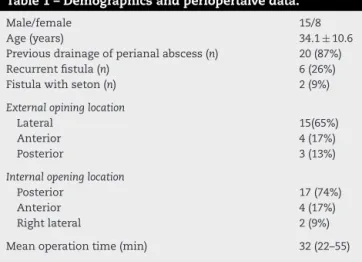
Twenty(87%)patientshadahistoryofprevious perianal
abscessincision.Six(26%)patientshad alsoaprevious fis-tulasurgeryandpresentedwitharecurrentfistula,two(9%) ofthemhadaloosesetoninplace.Preoperativeevaluationby EASwasperformedin6patientsandMRIin3patients.Table1
Table1–Demographicsandperiopertaivedata.
Male/female 15/8
Age(years) 34.1±10.6
Previousdrainageofperianalabscess(n) 20(87%)
Recurrentfistula(n) 6(26%)
Fistulawithseton(n) 2(9%)
Externalopininglocation
Lateral 15(65%)
Anterior 4(17%)
Posterior 3(13%)
Internalopeninglocation
Posterior 17(74%)
Anterior 4(17%)
Rightlateral 2(9%)
Meanoperationtime(min) 32(22–55)
Theprocedurewasperformedundergeneralanesthesiain 18(78%)patientsandspinalanesthesiain5(22%)patients. Thelocationoftheexternalfistulaopeningwasinthe ante-riorperianalregionin4(17%)patients, alaterallocation in 15(65%)patients,posteriorlyin3(13%)patients,andanother patient(4%)hadtwoexternalopenings;leftlateraland pos-terior location. The internal fistulaopening was identified inall the cases, however, in14 (61%)patients the identifi-cationwaspermitted afterthehydrogenperoxide injection throughtheexternalopening.Theinternalopeningwas iden-tifiedtobeinposteriorlocationin17(74%)patients,anterior location in 4 (17%) and right posterior location in 2 (8%) patients.
In 19 (82%) patients a trans-sphenteric fistulous tract involvingalargeportionoftheexternalsphincterwasfound, six(26%)ofthemhadarecurrentfistulawhiletwopatients hadaloosesetoninplace.Four(17%)femalepatientshadan anteriorlocationoffistuloustract.In5(22%)patientsa cav-itywithresidualabscesswasfoundwithinthe fistulatract beneaththeperianalskin.
Thevascularloopsetonwhichwasinsertedinthefistula tractinallthecases,circlingthesphinctercomplexloosely, wastiedinanecktiefashion.
The mean operative time was 32min (with a range of 22–55min).Allthepatientsweredischargedthedayafterthe intervention.
Thevascularloopsetonwastightenedwithamedianof4 times(range2–5times)with2weeksinterval,4patients per-formedaself-tighteningbypullingthelongendofthevascular looptie.Allpatientstoleratedverywellwithnoorminimal analgesia.Completehealingwasachievedin7weeks(5–11). Patientswerefollowedupforamedianof24months(12–35).
Seven patients (20%) had a soiling or frequent secre-tionduringthe first4weeksofthehealingprocess,which decreasedgradually.None ofthepatients reportedfecalor flatalincontinence.
Noneofthepatientshadbleeding,woundinfection, pre-maturedislodgement,orslippageoftheseton.
Recurrencewasobservedinonemale patient(4%) three monthsafterthehealing.Atthere-operationasuperficial fis-tulawithoutsphincterinvolvement(alongskinbridge),was found,andalyingopenfistulotomywasdone.
Discussion
Whilethediagnosticandsurgicaltechniquesadvancerapidly, theroleofsetonsinthetreatmentofperianalfistulasseems tobekeptupoverthetime.Differentsetonmaterialshasbeen usedwithdifferentratesofrecurrenceandincontinence.But whateverthematerialis,recurrenceandincontinencerateis mainlydependentontheexperienceandsurgicalprecision andcapabilityofthesurgeon.7
Theseton materialusedforfistulatreatmentshouldbe
durable, non-allergic, technically easy totie evenin clinic
setting,andallowstotightrepeatedlywithoutcausingpain
andwithoutanesthesia.9Withtheseproperties,vascularloop
seemstobetheappropriateseton.Itiseasytohandle,non
toxicandcaneasilytighten;hence,whenanecktietieis
per-formed, the tighteningcan be gradual and controlled.The
necktietieisverywellknowntie,easilyperformedbymostof thesurgeons,canmaintainthetensionpropriety.Therefore, tighteningthevascularloopsetoncanbeeasilyperformedin clinicsettingbypulling onthe longendofthe loop,unlike othersetons,forwhichthepatientistakentooperatingroom
repeatedlywiththe associatedmorbidityandcosts. Alsoit
canbeself-tightenedbythepatientwithouteventheneedfor surgicalvisit.
Forsubcutaneous,lowinter-sphinctericfistulasorfistula
withminimalinvolvementonlyofthesubcutaneouspartof
externalsphincter, a fistulotomycan beusuallyperformed
safely.Andinouropinionalltheotherfistulas,thefistulotmy shouldbeavoidedandothersurgicaltechniqueassetonwould
be moreappropriate.Theutility ofsetonshave been
well-establishedbutinsomelargecaseserieshavebeenreported
tousethisprocedurein10%ofthecases.10
Inourstudy,wefound0%incontinenceand4.3%
recur-renceratein23patientstreatedwiththevascularloopseton fortransphentericandcomplicatedfistulas.
Adifferent publisheddataonthe use ofsetons in
peri-analfistulareporteda4–5%rateofrecurrence8,11anda0–5%
ratesofincontinence8,11thatareinaccordanceofourpresent
results.
Theincontinencereportedindifferentstudiesisusuallyof
minornature.The0%incontinencerateinourstudycanbe
attributedtometiculoussurgicaltechniquewhereby
sphinc-terremainsintact.Lowrecurrencerateinourstudyisdueto
properidentificationofinternalopeningandtheextensions
offistulatract.
Loose seton or draining seton for complicated
peri-analfistula,usuallyrequiressecondprocedure.12,13 Forhigh
transsphinctericwithabscessandlocalsepsis,alooseseton
actsasdrainageseton.Oncetheabscesshasbeen resolved
foracryptoglandularfistulathetreatmentdecisioninvolves theuseofsphincter-sparingversussphincter-cuttingoptions. Setonsforsuchtreatmentcanbeconsideredeitherasacutting orlooseseton.Acuttingsetoncanbeusedasasingle-or multi-stageprocedure,butinourstudy,in5(18%)patientstheloose vascularloopwasusedinitiallyfordrainageoftheresidual
abscessandlateronforcompletionthedefinitivetreatment
Currently, the cutting setons are associated with pain, uncontrolledcuttingofsphinctermusclesandahigherrateof incontinence.Ifthepatientiswillingtotryaprolonged treat-mentoptionthenhecanbeofferedthelong-termlooseseton withprogressivemigrationbutusingthevascularloop
tight-enedwithanecktiefashioncanpermitthesame setonfor
drainagewhenlooseandforcuttingpurposeinonestageby
simpletightening.
Oncetightenedbyanecktiefashiontie,thevascularloop doesnotlosetensionasinsimpletie,6andhasnobulkyand
imprecisetighteningasfacedinbunchofsilkties,orsecond
procedureasindrainingsetons.Thevascularloopdoesnot
absorbliquidsandsecretionshence,permitsrepeatedlyand
easilymanageabletightening
Aftertightening,noneofthepatientshadasignificantpain
formorethanfewminutes
Thecontrolledandgradualtighteningdecreasedthe
inci-denceofincontinenceandrecurrence;however,atthecostof relativelylongertimeofsetoninplace(5–11weeks).
Noneofthepatientsreportedanydifficultyincarryingout routineactivities.Thevascularloop,onceengaged,isretained inplacewithoutanyirritationofthesurroundingtissue.
Ourresultsareprobablyalsorelatedtotheintensive ambu-latoryfollow-upthatweofferedtoourpatients.Infactthey
werefollowedevery2weeksandsetontighteninghasbeen
doneateachvisit,andthisaccuratepostoperative
manage-mentrequiredagoodcooperationofthepatients.
Awide rangeofincontinence rateswas reportedinthe
literatureafter cuttingseton treatment, and Ritchie et al.7
haveconcludedthattherewasnorelationshipbetween
incon-tinence and the frequency oftightening, type of seton,or
classificationoffistula.Hence,wefurtherreinforcethe
impor-tanceofsurgeon’sexperienceandtheuseofasetonhaving
additivequalitiesasstatedabove.
Othertechniquesoftreatmenthavebeenreported
includ-ingfibringlue,ligationofintersphinctericfistulatract(LIFT)
and collagen plug. Metanalysis of trials on fibrin glue did
notreportany statisticallysignificant differenceover other
techniques for recurrence or incontinence.14 Accumulated
experience of LIFT is also promising and sounds good
alternative15;however,besidesasteeplearningcurve,itneeds
technicalexpertiseespeciallyforcomplexfistulae.
Thelowincontinence rateinpatients can beattributed
toacarefuldissectionofthefistulatractwithaminimalor
nodamagetotheanalsphinctermusclecomplex.Alsothe
gradual cutting through of the sphincter caused by direct
compression of the vascular loop allows fibrosis to occur
withtheresultantadvancementoftheloopwithinintactor
non+distractedmuscle.
Thefactors implicated infistula recurrence includethe
complexityandlevelofthefistula,thepresenceorabsenceof ahorseshoeextension,thedegreeoflateralityoftheexternal opening,failurebythesurgeontoidentifytheinternal open-ingatinitialsurgery,andtheoverallsurgicalexperienceofthe operatorincomplicatedproctologicpractice.16
Inourstudy,wewereabletoidentifytheinternalopening inallthepatients,whichmightcontributetothehighsuccess rateoftreatment.
Allthe proceduresweredone byasinglesurgeon,
elim-inating the bias which could have occurred with multiple
surgeons.However,itisasingle-armstudywithno
compari-songroupandlackingofrandomization,sowethinkalarger
andarandomizedstudymaybeneeded.
Conclusion
Thenecktietighteningofthevascularloopsetonisasimple,
safe,easilyperformedandmaysimplifytheseton
manage-ment ofperianal fistulae. Thistechniquemay broaden the
optionsandmayaddapracticaltiptosurgicalrepertoireof complexfistulasurgery.Itdoesnotcarrythedisadvantageof
repeatedanesthesiaandvisitstotheoperatingroom,hasa
lowmorbidityandmaybeveryconveniencetothepatient.
Conflicts
of
interest
Theauthorsdeclarenoconflictsofinterest.
r
e
f
e
r
e
n
c
e
s
1.ZanottiC,Martinez-PuenteC,PascualI,PascualM,Herreros D,Garcia-OlmoD.Anassessmentoftheincidenceof fistula-in-anoinfourcountriesoftheEuropeanUnion.IntJ ColorectalDis.2007;22:1459–62.
2.ParksAG,GordonPH,HardcastleJD.Aclassificationoffistula inano.BrJSurg.1976;63:1–12.
3.KodnerIJ,MazorA,ShemeshEI,FryRD,FleshmanJW, BirnbaumEH.Endorectaladvancementflaprepairof rectovaginalandothercomplicatedanorectalfistulas. Surgery.1993;114:682–90.
4.Seow-ChoenF,NichollsRJ.Analfistula.BrJSurg. 1992;79:197–205.
5.PearlRK,AndrewsJR,OrsayCP,WeismanRI,PrasadML, NelsonRL,etal.Roleofthesetoninthemanagementof anorectalfistulas.DisColonRectum.1993;36:573–9.
6.MentesBB,OktemerS,TezcanerT,AzihC,LeventogluS,Oguz M.Elasticone-stagecuttingsetonforthetreatmentofhigh analfistulas:preliminaryresults.TechColoproctol. 2004;8:159–62.
7.RitchieRD,SackierJM,HoddeJP.Incontinenceratesafter cuttingsetontreatmentforanalfistula.ColorectalDis. 2009;11:564–71.
8.VialM,ParésD,PeraM,GrandeL.Faecalincontinenceafter setontreatmentforanalfistulaewithandwithoutsurgical divisionofinternalanalsphincter:asystematicreview. ColorectalDis.2010;12:172–8.
9.GurerA,OzlemN,GokakinAK,OzdoganM,KulacogluH, AydinR.Anovelmaterialinsetontreatmentoffistula-in-ano. AmJSurg.2007;193:794–6.
10.Chuang-WeiC,Chang-ChiehW,Cheng-WenH,Tsai-YuL, Chun-CheF,Shu-WenJ.Cuttingsetonforcomplexanal fistulas.Surgeon.2008;6:185–8.
11.McCourtneyJS,FinlayIG.Cuttingsetonwithoutpreliminary internalsphincterotomyinmanagementofcomplexhigh fistula-in-ano.DisColonRectum.1996:55–8.
12.PearlRK,AndrewsJR,OrsayCP,WeismanRL,PrasadML, NelsonRL,etal.Roleofthesetoninthemanagementof anorectalfistulas.DisColonRectum.1993;36:573–7.
14.CirocchiR,SantoroA,TrastulliS,FarunellaE,DiRocooG, VendettualiD,etal.Meta-analysisoffibringlueversus surgeryfortreatmentoffistula-in-ano.AnnItalChir. 2010;81:349–56.
15.ShanwaniA,NorAM,AmriN.Ligationoftheintersphincteric fistulatract(lift):asphincter-savingtechniquefor
fistula-in-ano.DisColonRectum.2010;53:39–42.