*Correspondence: M. R.Bhalekar. Department of Pharmaceutics, AISSMS. College of Pharmacy, Kennedy Road, Pune - 411001, India. E-mail: [email protected]
A
rti
Pharmaceutical Sciences vol. 46, n. 2, abr./jun., 2010
Novel ion exchange resin-based combination drug-delivery system
for treatment of gastro esophageal relux diseases
Mangesh Ramesh Bhalekar
*, Nitin Madhukar Kadam, Nilam Hindurao Patil,
Nitin Somnath Gawale, Ashwini Madgulkar
Department of Pharmaceutics, AISSMS College of Pharmacy, India
The present study involves preparation and characterization of a combination tablet of ranitidine in immediate release form and domperidone in sustained release form, using ion exchange resins. Ranitidine lowers acid secretion, while domperidone release over a prolonged period improves gastric motility thus justifying this combination in gastro esophageal relux diseases (GERD) and ensuring patient compliance. Drug loading was carried out by batch method & resinates were characterized using FTIR, XRPD. Resinates were formulated as a combination tablet and evaluated for tablet properties & in vitro
drug release. Resinates provided sustained release of domperidone and immediate release of ranitidine. IR and X-ray studies indicate complexation of drug and resin along with monomolecular distribution of drugs in amorphous form in the resin matrix. The tablets of resinate combination showed good tablet properties. In-vitro drug release gave desired release proiles and ex-vivo drug absorption studies carried out by placing everted rat intestine in dissolution medium indicated statistically signiicant similarity in absorption from test and marketed formulation. The novelty of this study is that the retardation in release of domperidone from resinates is achieved by presence of weak resin in the formulation.
Uniterms: Drugs/delivery system. Ranitidine/tablets/immediate release. Domperidone/tablets/sustained release. Tablets/delivery system. Ion exchange resins/use/ drugs delivery system.
O presente estudo envolve a preparação e a caracterização de associação do comprimido de ranitidina de liberação imediata e domperidona de liberação prolongada, utilizando resinas de troca iônica. A ranitidina diminui a secreção ácida, enquanto a liberação prolongada de domperidona melhora a motilidade gástica, justiicando, dessa forma, a associação em doenças de reluxo gastroesofágico (DRGE) e garantindo a adesão do paciente. A carga de fármaco foi efetuada pelo método em batelada e os resinatos, caracterizados utilizando-se FTIR e XRPD. Os resinatos foram formulados como comprimido da associação e avaliados com relação às propriedades dos comprimidos e liberação do fármaco in vitro. Os resinatos proporcionaram a liberação prolongada da domperidona e a liberação imediata da ranitidina. IV e estudos de difração de raios X indicaram a complexação do fármaco e da resina junto com a distribuição monomolecular dos fármacos, em estado amorfo, na matriz da resina. Os comprimidos da associação do resinato apresentaram boas propriedades. Obtiveram-se os peris de liberação in vitro e os estudos de absorção dos fármacos
ex vivo realizados com intestino de rato em meio de dissolução indicaram semelhança signiicativa na absorção entre as formulações teste e comercializada. A inovação do trabalho é que o retardamento da liberação da domperidona dos resinatos é atingido pela presença de resina fraca na formulação.
INTRODUCTION
Research over the past few years has revealed that ion exchange resins are equally suitable for drug delivery technologies, including controlled release, site-speciic fast dissolving, iontophoretically-assisted transdermal, nasal, topical, and taste masked systems. (Borodkin et al.,1971). Literature review (Anand et al.,2001) A litera-ture review (Anand et al.,2001) revealed that ion exchange resins have versatile properties as a drug delivery vehicle. Moreover, resin characteristics such as acid or base strength, porosity, degree of cross linkage and particle size can be chosen from among the many available ion exchange resins to achieve the intended purpose (Vimaladevi et al.,2001). Combination products have the advantages of combina-tion therapy besides reducing the complexity of the dosage regimen. Thus, combination therapy, if used optimally, has the advantages of increased eficacy and improved clinical effectiveness, broadening the array of therapeutic options, offering customization of the treatment to suit speciic patient needs, enhanced patient adherence and reduction in cost of administration. (Wetheimer et al.,2002). Gastro esophageal relux disease (GERD), relux esophagitis, Peptic ulcer, gastric ulcer and other gastric acid-related disorders have pathogenesis related to reduced gastric motility and release of excessive gastric acid. GERD and gastric ulcer have been successfully treated with a range of gastric acid inhibitors, such as ranitidine, which are acid suppressing agents. Stimulation of gastric motility has been proposed to accelerate the healing of gastric ulcer and prokinetic agents such as domperidone are known to enhance gastrointestinal motility and prevent duodenogas-tric relux. The aim of combining two or more drugs with complementary modes of action using ion exchange resins is to produce the desired release pattern and therapeutic beneits along with theadvantage of reducing the complex-ity of the dosage regimen thus leading to patient compli-ance (Norris et al., 2005). In the present study, sustained release of domperidone was achieved by complexing with Indion 244 while the immediate release form of ranitidine hydrochloride was prepared by complexing with Indion 294. In vitro drug release from resinates was studied. Res-inates were formulated into combination tablets and tablets were evaluated for hardness, thickness, friability, weight
variation & in-vitro drug release. An everted rat intestine model was employed for studying ex-vivo absorption and was compared with marketed preparation.
EXPERIMENTAL
Material
Ranitidine HCl was a gift from Wockhardt Pharma Ltd. Domperidone was from BURGEON Pharmaceuticals Pvt. Ltd.. Indion 244, Indion 294 were provided by Ion exchange India Ltd. Ranitidine HCL and domperidone were analyzed by Jasco V-530 UV/ VIS spectrophotome-ter. Resinates were evaluated by Jasco FT/IR-460.
Methods
The ranitidine & domperidone were simultaneously estimated by simultaneous equation method spectropho-tometricaly at 326 nm & 287 nm using Jasco V-530 UV/ VIS Spectrophotometer.
Drug loading was carried out by batch method des-cribed elsewhere in the literature. (Vimaladevi et al., 2001; Plaizier et al., 1992).
The weak cation exchange resin Indion 234 was selected for binding ranitidine as ranitidine is a basic drug and is needed in immediate release form, whereas Indion 244, a strong cation exchange resin, was chosen to produce sustained release resinates of domperidone, again a basic drug. Both the drugs ranitidine hydrochloride & domperidone (100 mg each) were separately added to 100 mL of deionised water, and Indion 294 & Indion 244 (100 mg each), respectively was placed into the solutions and stirred for four hours on a mechanical stirrer. The so-lutions were iltered and the amount of drug remaining in the iltrate was determined spectrophotometrically.
The amount of drug adsorbed was determined by the difference between the amount of drug present in stock solution and amount remaining in iltrate at the end of stirring.
Evaluation of physical properties of resins and resonates (Lordi et al., 1991)
Different physical parameters of resinates including
TABLE I - Properties of Indion 244 and Indion 294
Resin Functionality Matrix Form Ion exchange capacity
Indion 244 -SO3H Cross linked polystyrene H+ 4.5 meq/grygm
shape, low properties, bulk density, tap density and pa-cking ability were determined.
Characterization of resin and resinates
The FT-IR studies were carried out using a Jasco FT/ IR-460. The X- ray diffraction studies were carried on a Phillips analytical X-ray BV(PW 1710) device using cu anode 40 kv voltage and 30 ma current.
In-vitro drug release from resinates:
Resinates of ranitidine hydrochloride with Indion 294, and domperidone with Indion 244, were subjected to
in-vitro dissolution studies using an USP type II apparatus at 100 rpm. The dissolution medium was 900 ml 0.1 N HCl at 37 ± 0.5 ºC.
In-vitro drug release from combination of resinates:
Resinates of ranitidine hydrochloride and domperi-done, equivalent to their doses, were combined together. The combination of resinates were then subjected to in- vitro dissolution studies using an USP type II apparatus at 100 rpm. The dissolution medium was 900 ml 0.1 N HCl at 37 ± 0.5 ºC.
Formulation of combination tablets
Resinates of ranitidine HCl (441.17 mg) and dom-peridone (32.25 mg) equivalent to the therapeutic dose of free drug, were blended with mannitol (71.38 mg) and granulated with gelatin solution (10%). The granules were dried and blended with sodium starch glycolate (6 mg), talc(12 mg), magnesium stearate (6 mg), methyl paraben (1.08), and propyl paraben (0.12 mg) as excipients. Total weight of each tablet was kept at 600 mg. The tablets were compressed on a Karnavati Rimek press, using D tooling and a 12.5 mm lat punch with pressure adjusted to achieve hardness of 5 kg/cm2 .
Evaluation of prepared tablets (Banker, Anderson, 1991)
The physical properties of tablets such as general appearance, hardness, thickness, friability and weight variation, were determined as described elsewhere in the literature.
In-vitro drug release proile of combination tablet and marketed tablets
Prepared tablets and marketed tablets were subjected to in-vitro dissolution studies using an USP type II appa-ratus at 100 rpm. Dissolution medium was 900 ml 0.1 N HCl at 37 ± 0.5 ºC.
Ex-vivo study for absorption through everted rat
intestine (Dixon et al., 1977; Chowhan, 1977)
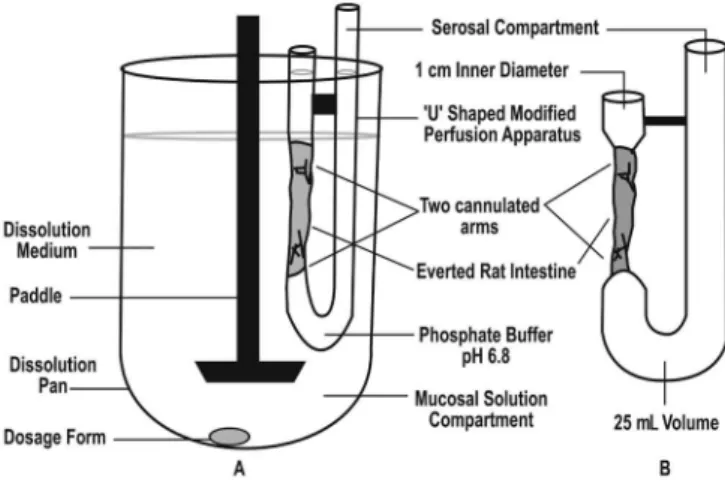
Ex-vivo study for absorption of drugs by the everted rat intestine technique was carried out using a modiied perfusion apparatus.
The apparatus consist of ‘U’ shaped glass tubing having 1 cm inner diameter with cannulated cut on one arm of the ‘U’ tube. The volume capacity of apparatus was 25 mL. The distance between two cannulated arms was 8 cm where the intestine was tied. After placement of intestine on the perfusion apparatus, the apparatus were dipped into the dissolution media in the dissolution pan and the dissolution study was performed under the above-mentioned conditions.
From the prepared tablet, absorption of drugs through rat intestine was compared with marketed formu-lations of domperidone and ranitidine HCl.
RESULT AND DISCUSSION
The batch process was used for drug loading. From preliminary experiments, 4 hours was found to be the optimum period for attainment of loading equilibrium of domperidone & ranitidine. The drug loading was carried out at 1:1 drug resin ratio for both drug resin combinations. Indion 244 domperidone showed 48.44% & Indion 294 - ranitidine showed 40.44% of drug content.
Table II summarizes the physical properties of resins and resinates. The shape of resinate affects the low and packing properties & was found to be irregular for Indion 244 resin and resinate. Angle of repose was found to lie between 20-30 °C thus exhibiting good low properties. Bulk density less than 1.2 gm/cm3 exhibited good packing
ability. Thus the results showed that resin and resinate
FIGURE 1 - [A] Modiied perfusion apparatus in dissolution
exhibit good low properties. Carr’s compressibility in-dex i.e. % compressibility, and Hausner ratio indicate the packing ability of powders.
When compressibility index ranges from 5 to 16 and the Hausner ratio approaches 1 the material has good low property and packing ability.
X-ray diffraction
The X–ray diffraction pattern (Figure 2) for drugs [A & D] contained a number of sharp peaks, while the
resins [B & E] showed a diffused peak or halo pattern, where as only a diffused peak was observed in X–ray powder diffraction patterns for the resinates regardless of drug loading.
According to this data, the molecular state of drugs [A&D] was crystalline, but that of resins [B&E] was amorphous. The molecular state of drugs prepared as drug resin complexes was changed from crystalline state to amorphous state. This shows that entrapped drug molecules are monomolecularly dispersed in resin beads (Pisal et al. 2004).
TABLE II - Physical properties of resins and resinates
Parameter Indion 244 Resin Domperidone Resinate Indion 294 Resin Ranitidine Resinate
Shape Irregular Irregular Irregular Irregular
Angle of repose 26.56 24.22 25.34 27.21
Bulk density 0.681 0.550 0.625 0.584
Tap density 0.789 0.610 0.731 0.652
Carr’s index 15.85 13.27 16.96 11.64
Housner ratio 1.15 0.98 1.16 0.98
FIGURE 2 - X- ray powder diffraction pattern for A. Domperidone, B. Indion 244, C. Domperidone resinate, D. Ranitidine HCl,
FT-IR STUDIES
The IR spectra for the drugs (Figure 3) [A&D] sho-he IR spectra for the drugs (Figure 3) [A&D] sho-ws peak at 3349 cm-1 corresponding to N-H stretching in
a secondary amine. The absence of a peak at 3349 cm-1 in
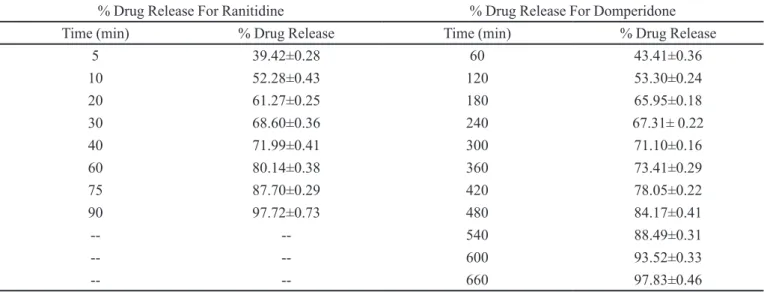
resinates [C&F] conirms the complexation of the secon-dary amine group in the drugs [A&D] with resins [B&E]. The in-vitro dissolution proile (Table III) shows that about 43.41% of domperidone was released in 60 min from resinate, and about 97.83% of domperidone was released
FIGURE 3 - Infrared spectra for A. Domperidone, B. Indion 244, C. Domperidone resinate, D. Ranitidine HCl, E. Indion 294, F.
Ranitidine resinate.
TABLE III -In-vitro drug release proiles of ranitidine HCl and domperidone from resinates
% Drug Release For Ranitidine % Drug Release For Domperidone
Time (min) % Drug Release Time (min) % Drug Release
5 39.42±0.28 60 43.41±0.36
10 52.28±0.43 120 53.30±0.24
20 61.27±0.25 180 65.95±0.18
30 68.60±0.36 240 67.31± 0.22
40 71.99±0.41 300 71.10±0.16
60 80.14±0.38 360 73.41±0.29
75 87.70±0.29 420 78.05±0.22
90 97.72±0.73 480 84.17±0.41
-- -- 540 88.49±0.31
-- -- 600 93.52±0.33
-- -- 660 97.83±0.46
at the end of 660 min from resinate. The resinate showed initial high release but could retard the drug release beyond 480 min, therefore resinate of a 1:1 ratio showed potential to sustain the release of domperidone. The initial burst release may be attributed to lower particle size of resinate. (Borodkin et al., 1991).The ranitidine release from raniti-dine resinate was found to be 97.72% in 90 min.
A difference was observed between domperidone release from individual domperidone resinate & combina-tion with ranitidine resinate (Figure 4), where the release was retarded from combination. Similar observations are reported in the literature (Hughes, 2002)
This can be explained as follows, after complete release of ranitidine from resinate, the weak resin was available as unloaded resin as it is experimentally demons-trated that the drug release is retarded in the presence of unloaded resin.
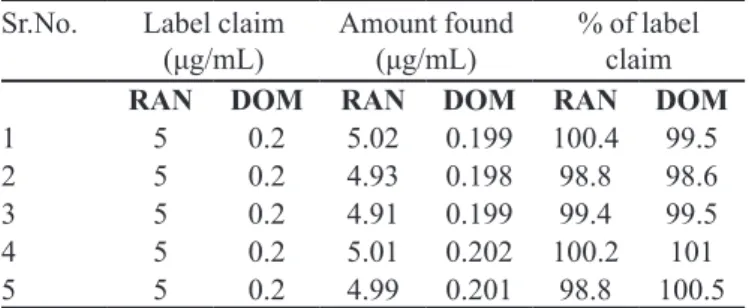
Assay of prepared tablets
FIGURE 4- In-vitro ranitidine & domperidone release from
combination of resinates. % release of ranitidine; % release
of domperidone.
TABLE IV - Evaluation of prepared tablets
Hardness
kg/cm2 Thickness (mm) uniformity+ Weight
(mg)
% Friability
5±0.25 4.49 600±0.5 0.7±0.43
(Mean ± SD, n=3)
In-vitro drug release proile of combination tablet
and marketed tablet
The results show that the formulated tablet released 94.05 % domperidone in 11 hours while the marketed tablet showed 98.24 % domperidone release in 10 hours (Figure 5). Thus, the formulated tablet showed better sustained release of domperidone than the marketed tablet. The f2 value of the domperidone release from the combination tablet was found to be 83, comparable to the marketed tablet, showing that the formulated tablet had a similar release proile as that of the marketed tablet.
In the case of ranitidine hydrochloride formulated tablets, the release was 99.45 % drug in 90 min while the marketed tablet showed 94.43 % ranitidine hydrochlo-ride release in 90 min. Thus, there was no signiicant difference in release of ranitidine hydrochloride from formulated & marketed tablets. The f2 value of the rani-tidine release from the combination tablet was found to be 58.5, compared to the marketed tablet, showing that formulated tablet had a similar release proile as that of the marketed tablet.
FIGURE 5 - In-vitro dissolution for domperidone from
formulated and marketed tablet. Formulated tablet;
Marketed tablet
TABLE V - Assay analysis of prepared tablets
Sr.No. Label claim
(μg/mL) Amount found (μg/mL) % of label claim
RAN DOM RAN DOM RAN DOM
1 5 0.2 5.02 0.199 100.4 99.5
2 5 0.2 4.93 0.198 98.8 98.6
3 5 0.2 4.91 0.199 99.4 99.5
4 5 0.2 5.01 0.202 100.2 101
5 5 0.2 4.99 0.201 98.8 100.5
FIGURE 6 -In-vitro dissolution for ranitidine HCl from
formulated and marketed tablet. Formulated tablet;
Ex-vivo study for absorption through everted rat
intestine
Data presented in Table VI represents the amount of domperidone & ranitidine transported across everted rat intestine, expressed as percent of amount of drugs released
in-vitro over the time interval. Data suggest that there is no difference in ex-vivo drug absorption from marketed and prepared combination tablet.
The data was subjected to paired t test using Instat3.0 software. The mean of the differences between column A and column B was found not to differ signiicantly from zero. The one-tailed P value was 0.3041, considered non-signiicant at a 95% conidence interval.
By applying statistical treatment to the above data it was concluded that absorption of ranitidine hydrochloride and domperidone from formulated & marketed tablets did not differ signiicantly from each other.
CONCLUSION
Gastric acid inhibitors such as ranitidine HCl, and prokinetic agents such as domperidone, are known to enhance gastrointestinal motility and prevent duodenogas-tric relux, and are widely used to treat gastro esophageal relux diseases (GERDs). Hence, a combination of imme-diate release ranitidine and sustained release domperidone in a unit dosage form will be a useful therapeutic option, enhancing patient compatibility and therapeutic beneit.
Formulated tablet provided pH independent sus-tained release of domperidone, and fast release of rani-tidine. Ex-vivo studies suggest that there is no difference
TABLE VI - Ex-vivo study for absorption through everted rat intestine
Time (h) % Drug Absorbed
From formulated tablet From marketed tablet
Ranitidine
hydrochloride Domperidone hydrochlorideRanitidine Domperidone
0.5 67.23±1.23 24.56±0.68 72.64±0.25 15.20±0.49
1 73.44±0.67 25.68±0.29 77.50±0.65 18.27±0.69
2 81.63±0.72 26.36±0.89 79.71±0.81 27.34±0.83
3 -- 32.04±0.78 -- 33.46±0.79
4 -- 36.83±0.64 -- 36.66±0.91
5 -- 37.41±0.69 -- 38.53±0.48
6 -- 37.88±0.73 -- 41.16±0.77
7 -- 43.45±0.75 -- 44.38±0.59
8 -- 49.37±0.71 -- 49.58±0.82
(Mean ± SD, n=3)
in ex-vivo drug absorption from marketed and prepared combination tablet.
REFERENCES
ANAND, V.; KANDARAPU, R.; GARG, S. Ion-exchange
resins: carrying drug delivery forward. Drug Discov. Today,
v.6, n.17, p.905-913, 2001.
BANKER, G.; ANDERSON, N. Tablets. In : LACHMAN,
L.; LIBERMAN, H. A.; KANIG, J. L. (Eds.). The theory
and practice of industrial pharmacy. Bombay: Varghese Publishing House, 1991. p.293-303.
BORODKIN, S.; SUNDERBERG, D. P. Polycarboxylic acid ion exchange resin adsorbates for taste coverage in chewable
tablets. J. Pharm. Sci., v.60, n.10, p.1523-1527, 1971.
BORODKIN, S. Ion exchange resin delivery systems. In:
TARCHA, P. J. (Ed.). Polymers for drug delivery. Boca
Raton: CRC Press, 1991. p.215-230.
CHOWHAN, Z. T.; AMRO, A. A. Everted rat intestinal sacs as an in vitro model for assessing absorptivity of new drugs.
J. Pharm. Sci., v.66 n.9, p.1249-1253, 1977.
DIXON, C.; MIZEN, L. W. Absorption of amino penicillin
from everted rat intestine. J. Physiol., v.269, n.3,
p.549-559, 1977.
HUGHES, L. Controlled dissolution of active ingredients. US
LORDI, N. G. Sustained release dosage forms. In: LACHMAN,
L.; LIBERMAN, H. A.; KANIG, J. L. (Eds.). The theory
and practice of industrial pharmacy. Bombay: Varghese Publishing House, 1991. p.67-68.
NORRIS, D. A. Mechanisms of action of topical therapies
and the rationale for combination therapy. J. Am. Acad.
Dermatol., v.53, n.1, p.17-25, 2005.
PISAL, S.; ZAINNUDDIN, R.; NALAWADE, P.; MAHADIK, K.; KADAM, S. Molecular properties of
ciprofloxacin-indion 234 complexes. AAPS PharmSciTech., v.5, n.4,
p.1-8, 2004.
PLAIZIER- VERCAMMEN, J. A. Investigation of the bioavailability of codeine from a cation exchange sulphonic
acid 1. Effect of parameters. Int. J. Pharm., v.85, n.1-3,
p.45-50, 1992.
VIMALADEVI, M.; KRISHNABABU, P. S. S. Ion exchange resinates as controlled release drug delivery systems. In:
JAIN, N. K. (Eds.). Advances in controlled and novel drug
delivery. 1.ed. New Delhi: CBS publishers and Distributors, 2001. p.290-305.
WETHEIMER, A. I.; MORRISON, A. Combination drugs:
innovation in pharmacotherapy. P&T, v.27, n.1, p.44-49,
2002.
Received for publication on 06th August 2008