Correspondence: E. L. de Sousa. Departamento de Antibióticos, Universidade Federal de Pernambuco. Av. Prof. Moraes do Rêgo S/N - 50690-900 - Recife - PE, Brasil. E-mail: [email protected]
A
rti
Pharmaceutical Sciences vol. 46, n. 2, abr./jun., 2010
Antitumor activity of leaves of
Himatanthus drasticus
(Mart.)
Plumel-Apocynaceae (Janaguba) in the treatment of Sarcoma
180 tumor
Eliane Leite de Sousa
1,*, Ana Ruth Sampaio Grangeiro
1, Isla Vanessa Gomes Alves Bastos
1,
Guilherme Carvalho Ribeiro Rodrigues
1, Maria Joselice e Silva
2, Falba Bernadete Ramos dos
Anjos
3, Ivone Antonia de Souza
1, Cicero Ernandes Leite de Sousa
41Department of Antibiotics, Laboratory of Pharmacology and Experimental Oncology, Federal University of Pernambuco, 2Department of Pharmaceutical Sciences, Federal University of Pernambuco, 3Department of Histology, Federal University of
Pernambuco, 4Department of Biological Sciences, Regional University of Cariri.
Himatanthus drasticus, also known as janaguba, is used popularly in Brazil’s Northeastern region in the treatment of cancer. However, no scientiic reports are available. The present study is the irst investigation on the antitumor activity of crude methanolic extract from Himatanthus drasticus leaves against Sarcoma 180 tumor and on its side effects including acute oral toxicity. The OECD 423 methodology was used to study acute oral toxicity, and the STOCK methodology to assess antitumor activity. The crude extract showed low toxicity at the tested doses (50, 300 and 2000 mg/kg) administered orally. The histopathological analyses demonstrated alterations in liver lung, spleen and kidney. It also showed activity against Sarcoma 180 tumor in male Swiss albino mice, evidencing tumor growth inhibition of 67.7% and 68% at 300 mg/kg and 400 mg/kg doses, respectively.
Uniterms: Himatanthus drasticus/antitumor activity. Himatanthus drasticus/acute oral toxicity. Janaguba/ antitumor activity. Sarcoma 180/experimental study.
Himatanthus drasticus, conhecida popularmente como janaguba, tem uma longa história de emprego na cura do câncer no nordeste brasileiro, porém quase sem registro na literatura. O objetivo desse trabalho foi investigar a atividade antitumoral do extrato bruto metanólico das folhas de Himatanthus drasticus
frente ao modelo experimental Sarcoma 180 e avaliar sua toxicidade aguda. A determinação da toxicidade aguda foi realizada segundo a metodologia da OECD 423 e o transplante do tumor sólido de sarcoma 180 foi realizado seguindo a metodologia de Stock. O extrato apresentou baixa toxicidade nas doses testadas (50, 300 e 2000 mg/kg) por via oral. A análise histopatológica apresentou alterações em nível hepático, pulmonar, baço e renal. A atividade antineoplásica apresentou inibição tumoral signiicativa em relação ao grupo controle nas doses de 300 mg/kg e 400 mg/kg de peso do animal com um percentual de inibição de 67.7% e 68% respectivamente. Na menor dose analisada, 200 mg/kg, o percentual de inibição tumoral foi apenas de 32.8%.
Unitermos: Himatanthus drasticus/atividade antitumoral. Himatanthus drasticus/toxicidade aguda. Janaguba/atividade antitumoral. Sarcoma 180/estudo experimental.
INTRODUCTION
Plants contain a wide variety of compounds that have important biological activity including anticancer activity (Ramakrishna et al., 1984). Several drugs used
The toxicity determination of plant extracts is rele-vant because there is no single beneicial effect whereas biotransformation occurs, and these products can have toxic side effects which are harmful to human health (Hi-lary et al., 2004).
The plant of the Himatanthus (Apocynaceae) genus is a medium-sized tree, growing on irm ground in South America from Southeastern regions of Brazil to the French Guiana (Plumel, 1991). In the Araripe National Forest, south of the State of Ceará, the species found is H. drasti-cus, known as Janaguba. Its wood stem latex is popularly used in the treatment of cancer in Brazil’s Northeastern Region (Amaro et al., 2006a).
To our knowledge, only three papers have been repor-ted in the literature on H. drasticus. However, there are no studies describing its leaves or anti-tumoral activity (Amaro
et al., 2006a; Colares et al., 2008).
In 2008, Colares et al. isolated and identified an ethanolic extract from H. drasticus stem bark, namely, triterpene lupeol cinnamate which is probably a subs-tance with potential for anti-tumor activity. The active ingredient of H. sucuuba was also isolated (an iridoid fulvoplumierin) and this also showed activity against the human epidermoid carcinoma of the nasopharynx (Perdue, Blomster, 1978).
In this study, the acute oral toxicity and antitumor activity against Sarcoma 180 tumor of the crude metha-nolic extract from Himatanthus drasticus leaves was described.
EXPERIMENTAL
Plant material
Leaves of Himatanthus drasticus were collected in December of 2007 at Araripe National Forest, Jardim, Ceará, Brazil, and identiied by Marlene Barbosa, PhD. A sample specimen (n° 48.961) was deposited at the herbarium Geraldo Mariz of the Federal University of Pernambuco (UFPE).
Extract preparation
The leaves were dried at room temperature in fresh air for seven days, and then cut into small fragments. The sample material (500g) was macerated with metha-nol at room temperature (30 ± 2 ºC). Three extractions were made allowing 48h for each macerated extraction. Solvent was evaporated at 60 °C under reduced pressure and dried in a high vacuum for 10 h affording the crude extract (100.6 g).
Animals
60 day-old male Swiss albino mice weighing betwe-en 25 and 35 g were housed under controlled temperature conditions (22 ± 2 ºC) and 12h light/dark cycles. Food and water were available ad libitum before and throughout the experiments. All studies were approved by the Research Ethics Committee (CEEA) of the Federal University of Pernambuco (n° 23076.03566/2008-71) in accordance with the National Institute of Health “Guide for the Care and Use of Laboratory Animals” (NIH publication no. 86-23, 1985).
Acute oral toxicity
The acute toxicity of the methanolic extract from the leaves of Himatanthus drasticus was evaluated in mice using the up-and-down procedure (OECD, 423). Male mice, (weighing from 25-35 g, aged from 6-8 weeks) re-ceived a single initial gavage containing a 50 mg/kg dose of Himatanthus drasticus leaf methanolic extract. Three animals were used for each step. The dose level used as the starting dose was selected from one of the four ixed levels: 50, 300 and 2000 mg per kg of body weight. The animals were continuously observed for toxicity development during the irst 4 hours of administration of each dose. Finally, the number of survivors was noted after 24 hours, and these animals were then kept alive for a further 14 days while observations were made on a daily basis. The experiment was then repeated after the end of the irst trial.
Histopathological studies
Macroscopic analysis and histopathological examina-tion of the bodies of those animals subjected to acute toxici-ty at higher doses were performed. The liver, kidneys, spleen and lung tissues were excised and rinsed with an ice-cold normal saline solution in order to remove blood and debris adhering to the tissues. These tissues were then ixed in a 10% formalin solution for 24 h. The ixative was removed by washing specimens thoroughly with running tap water overnight. After dehydration through a graded series of alcohols, the tissues were cleaned in methyl-benzoate, and embedded in parafin wax. Sections were cut 7 μm-thick and stained with hematoxylin and eosin (Michelany, 1980). After dehydration and cleaning, the slides were mounted and observed under light microscope for details.
Antitumor activity
et al. (1955). The treatment was initiated 48 hours post-tumor transplant. The animals were divided into groups (n = 5): standard group (Cyclophosphamide, CTX, 10 mg/kg), control group (NaCl 0.9%) and treated groups I, II and III, which received the methanolic extract from janaguba, at 200, 300 and 400 mg/kg doses, respectively. All substances had been managed by oral administration during the previous seven days. On the eighth day, the animals were sacrificed and their tumors removed and weighed. Subsequently, the difference between the treated groups and control group was calculated to give the index of tumor inhibition in accordance with the formula below.
TWI% = C - T x 100/C
Where:
TWI% = Tumor weight inhibition (%)
C = Mean tumor weight in control group animals T = Mean tumor weight in treated group animals
Statistical analysis
The results are presented as mean ± S.E.M. and statistical signiicance between the groups was analyzed by mean of variance analysis followed by Student’s t test. P values < 0.05 were considered signiicant.
RESULTS AND DISCUSSION
Acute oral toxicity
In the study for acute toxicity, the animals were treated with a single dose of the extract in question for a period of approximately 24 h (Simões, 2003). The oral administration of the methanolic extract from H. drasticus
leaves at doses of 50 and 300 mg presented no alteration in the animals during the irst 30 minutes of observation. The animals remained without changes after 14 days. Within the irst 15 minutes of 2000 mg/kg dose administration, the animals presented excitability and agitation including exophthalmia, agitation, vibrissa, stereotyped and circle movements. They also presented increased respiratory rate, position in claw, snout edema, lack of lee attempt. After this period, depressive reactions such as lowering of the posterior train and prostration became evident. After 14 days, no mortality or changes in behavior were observed. The excitability followed by depressive behaviors suggests a reduction in the amount of stimulant neurotransmitters during the excitation phase (Fai et al., 2005). During the observation period, animals displayed no variation in their general appearance. These results obtained for methanolic
extract from H. drasticus leaves were in accordance with the norms established for OECD 423, and presented low toxicity for oral administration at 2000 mg/kg. The general results for acute oral toxicity are shown in Table I.
Histopathological studies
Animal bodies were macroscopically preserved. Histopathological examination of the livers presented hepatic congestion at sinusoids and the portal vessel, pe-ricentre globular micro-steatosis, Kuffe cell proliferation, hepatocyte diffuse necrosis and mononuclear iniltrate. In the kidneys, the indings were glomerular atrophy, capsule thickening, renal cortico-medullary congestion, hemor-rhage and mononuclear iniltrate. The pulmonary indings were alveolar interstitial thickening, intense pulmonary congestion, mononuclear iniltrate, pneumocyte-type II proliferation, pulmonary emphysema, edema and vessel thickening. In the spleen, the authors noted red pulp con-gestion, white pulp hyperplasia and apoptotic cells at the germinal center.
Antitumor activity
Laboratory animals represent a valuable experi-mental system for the understanding of the mechanism of cancer in humans. The majority of the currently accepted concepts of tumorigenesis are strongly influenced by cancer development models in mice. Mice organisms are accessible models and possess similar systems to humans (Kamb, 2005). Sarcoma 180 is an original mouse tumor and one of the most frequently used cell lineages in the research of antitumor activity (Lee et al., 2003; Magalhães
et al., 2006).
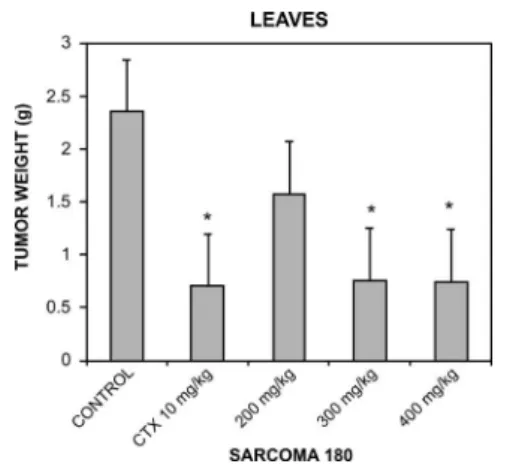
The antitumor activity of the methanolic extract from H. drasticus leaves was tested by oral administration against the Sarcoma 180 experimental model. Figure 1 shows the mean weight of the tumors in the control group (NaCl 0.9% Solution), standard group (cyclophosphamide, CTX, 10mg/kg), treated I (200 mg/kg), treated II (300 mg/kg) and treated III (400 mg/kg) groups. The standard group presented signiicant tumor growth inhibition of 70.4% in comparison to the control group. The treated groups also presented a reduction in tumor growth in relation to the control group; however, the doses of 300 mg/kg and 400 mg/kg also demonstrated marked tumor growth inhibition activity of 67.7% and 68%, respectively. At the 200 mg/kg dose, tumor growth inhibition was 32.8%.
However, in the treated groups, only the Treated I group (200 mg/kg) presented ascites, solid and invasive tumor, adhered to epidermis and well vascularized. The Treated II (300 mg/kg) and Treated III (400 mg/kg) groups presented well described solid tumors which were less vascularized than control group tumors.
The mechanism underlying janaguba antitumor activity has not yet been elucidated. It is known that the
Himatanthus genus has iridoid and triterpene in its chemi-cal constitution, and one of these substances is likely res-ponsible for the activity. Detailed studies are being carried
TABLE I – Toxic effects for methanolic extract from H. drasticus
leaves in male Swiss albino mice (Mus musculus)
EFFECTS DOSES (mg/kg)
STIMULANT 50 300 2000
Tachycardia - -
-Tachypnea - - +
Piloerection - - + +
Agitation - - +
Exophthalmia - - +
Stereotyped Movements - - + + +
Circle Movements - - + +
Vibrissa Movements - - +
Tail Curl - - +
Fine/Coarse Tremors - -
-Position in Claw - - +
Flee Reaction - - + + +
DEPRESSIVE
Lowering of the posterior member - - +
Apnea - -
-Alteration in gait - -
-Sleepiness - -
-Prostration - - + +
OTHERS
Fecal Elimination - - +
Diuresis - - +
Abdominal Movements - -
-Petechiae - - +
Snout Edema - - + +
Cyanosis - -
-Photophobia - -
-Relux - -
-Data obtained within irst 30 minutes of oral administration. (-) No Effect; (+) Mild Effect; (++) Moderate Effect; (+++) Severe Effect.
FIGURE 1 –Mean tumor weight. *p < 0.05 comparing treated
groups with control group ( normal saline solution). Student’s
t test (n = 5/group).
to clarify the antitumor activity of leaves of H. drasticus
as well as to determine new routes of drug administration. Based on these results, we can conclude that the methanolic extract from H. drasticus leaves possesses low toxicity and signiicant antitumor activity at the tested do-ses administered orally. The results for antitumor activity were very good in relation to control cyclophosphamide, the synthetic drug widely used in chemotherapy protocols. The extract was also found to be safe in terms of acute toxicity in experimental animal models whereas further studies are necessary on its chronic toxicity, mutagenicity and carcinogenicity to ascertain the safety and beneits of the plant.
ACKNOWLEDGEMENTS
The authors would like to thank the Conselho Nacional de Desenvolvimento Cientíico e Tecnológico (CNPq-Brazil) for financial support and scholarships. Authors also extend their thanks to Dr. Marlene Barbosa for botanical identiication.
REFERENCES
ALMEIDA, V. L.; LEITÃO, A.; REINA, L. C. B.; MONTANARI, C. A.; DONNICI, C. L.; LOPES, M. T. P. Câncer e agentes antineoplásicos ciclo-celular especíicos e ciclo-celular não especíicos que interagem com o DNA:
uma introdução. Quim. Nova, v.28, n.1, p.118-129, 2005.
AMARO, M. S.; FILHO, S. M.; GUIMARÃES, R. M.; TEÓFILO, E. M. Inluência da temperatura e regime de
luz na germinação de sementes de Janaguba (Himatanthus
AMARO, M. S.; FILHO, S. M.; GUIMARÃES, R. M; TEÓFILO, E. M. Morfologia de frutos, sementes e de
plântulas de Janaguba Himatanthus drasticus (MART.)
Plumel.-Apocynaceae.Rev. Bras. Sementes, v.28, n.1,
p.63-71, 2006b.
COLARES, A. V.; CORDEIRO, L. N.; COSTA, J. G. M.; SILVEIRA, E. R.; CAMPOS, A. R.; CARDOSO, A. H. Phytochemical and biological preliminary study of Himatanthus drasticus (Mart.) Plumel (Janaguba).
Pharmacog. Mag., v.4, n.14, p.73-77, 2008.
FAI, P. B. A.; FAGANDE, S. O. Acute toxicity of Euphorbia
Kamerunia on Oreochrmis niloticus. Ecotoxicol. Environ.
Saf., v.62, n.1, p.123-131, 2005.
HILARY, J. E.; ISRAILI, Z. H.; LYOUSSI, B. Acute and chronic
toxicological studies of Ajuga ivain experimental animals.
J. Ethnopharmacol.,v.91, n.1, p.43-50, 2004.
LEE, Y. L.; KIM, H. J.; LEE, M. S.; KIM, J. M.; HAN, J. S.; HONG, E. K.; KWON, M. S.; LEE, M. J. Oral
administration of Agaricus blazei (H1 strain) inhibited
tumor growth in a sarcoma 180 inoculation model. Exp.
Anim., v.52, n.5, p.371-375, 2003.
KAMB, A. What’s wrong with our cancer models? Nature Rev.
Drug Discov., v.4, n.2, p.161-165, 2005.
MAGALHÃES, H. I. F.; VERAS, M. L.; TORRES, M. R.; ALVES, A. P. N. N.; PESSOA, O. D. L.; SILVEIRA, E. R.; COSTA-LOTUFO, L. V.; MORAES, M. O.; PESSOA, C.
In vitro and in vivo antitumor activity of physalins B and D
from Physalis angulata. J. Pharm. Pharmacol., v.58, n.2,
p.235-241, 2006.
MICHALANY, J. Técnica histológica em anatomia patológica.
São Paulo: Editora Pedagógica e Universitária Ltda, 1980. p.277.
ORGANIZATION FOR ECONOMIC COOPERATION AND DEVELOPMENT. OECD. Guideline for Testing
of Chemicals. Guideline 423. Acute Oral Toxicity-Acute
Class Method. Adopted 17th December 2001. Available at:
<http://iccvam.niehs.nih.gov/SuppDocs/FedDocs/OECD/ OECD_GL423.pdf>.Accessed on: 10 dec. 2007.
PERDUE, G. P.; BLOMSTER, R. N. South American plants III:
Isolation of fulvoplumierin from Himatanthus sucuuba (M.
Arg.) Woodson (Apocynaceae). J. Pharm. Sci.,v.67, n.9,
p.1322-1323, 1978.
PLUMEL, M. M. Le genre Himatanthus(Apocinaceae).
Revisión taxonomique: brandea. Bol. Herb. Bradeanu, v.5,
p.1-20, 1991.
RAMAKRISHNA, Y.; MAHONOR, A. I.; MAMATA, P.; SHREEKANT, K. G. Plants and novel antitumour agents:
A review. Indian Drugs, v.21, n.1, p.173-185, 1984.
SILVA, M. N.; FERREIRA, V. F.; SOUZA, M. C. B. Um panorama atual da química e da farmacologia de naftoquinonas, com ênfase na β-lapachona e derivados.
Quim. Nova, v.26, n.3, p.407-416, 2003.
SIMÕES, C. M. O. Farmacognosia: da planta ao medicamento.
5.ed. Porto Alegre: UFRGS/UFCS, 2004. p.256.
SOUZA, M. V. N. Novos produtos naturais capazes de atuar na estabilização de microtúbulos, um importante alvo no
combate ao câncer. Quim. Nova, v.27, n.2, p.308-312, 2004.
STOCK, C. C.; CLARCK, D. A.; PHILIPS, F. S. Sarcoma 180 –
inhibitor screening date. Cancer Res., v.15, n.2, p.2-3, 1955.
Received for publication on 22nd January 2009