F
ACULDADE DEE
NGENHARIA DAU
NIVERSIDADE DOP
ORTOCommunication Patterns in
Project-Oriented Organizations
João André Nogueira Ferreira
Master in Electrical and Computers Engineering
Supervisor: Professor Doutor José António Rodrigues Pereira de Faria
c
Resumo
A comunicação representa uma vertente absolutamente fulcral dentro das organizações orientadas a projeto, seja na gestão diária do trabalho ou nas relações existentes entre os indivíduos que a constituem, existindo um conjunto alargado de ferramentas disponíveis que facilitam esta colabo-ração. Porém, tamanha variedade pode representar um obstáculo a uma comunicação mais eficaz e eficiente dentro das próprias organizações.
Se por um lado, um bom uso da comunicação interpessoal numa organização pode conduzir a melhorias significativas na produtividade e na obtenção de resultados por parte dos seus colabo-radores, uma aplicação inapropriada das ferramentas de comunicação, nomeadamente do e-mail, poderá também levar a uma perda de eficiência e disrupção constante no fluxo de trabalho.
Assim, torna-se essencial criar ferramentas pensadas e estruturadas para este tipo de organi-zações, que suportem todo o fluxo de comunicação entre níveis hierárquicos distintos ou equiva-lentes, procurando ao máximo padronizar os diferentes tipos de interação existentes.
Nesse sentido, a presente Dissertação aborda esta temática com dois objetivos principais. O primeiro foca-se na identificação de padrões de comunicação existentes entre os colaboradores numa organização orientada a projeto. Tendo por base a análise efetuada a estes fluxos de infor-mação, o segundo objetivo principal centra-se na implementação de um módulo de comunicação que permita suportar os diferentes padrões identificados.
Numa fase inicial da Dissertação foi feita uma familiarização com as ferramentas de desen-volvimento necessárias à elaboração do projeto, assim como uma análise dos requisitos para todo o sistema. Após esta fase, foi elaborado um modelo do domínio que identifica as relações exis-tentes entre diferentes entidades presentes no sistema. Posteriormente a implementação da solução desenvolvida foi realizada utilizando SQL Server 2014 e Visual Studio 2015.
Para a elaboração da solução, foram tidos em consideração conceitos relacionados com a pro-dutividade pessoal e comportamentos no trabalho. Estes, por sua vez, estão intimamente ligados a algumas metodologias como o Getting Things Done e Behavior Design.
O sistema desenvolvido permite uma troca de mensagens ágil e intuitiva, à semelhança do que acontece com as aplicações de messaging, garantindo em simultâneo uma organização equiva-lente ao e-mail, o que permite um armazenamento de dados mais estruturado para posterior uso. Constata-se então que este se trata de um sistema híbrido que permitirá ao utilizador final uma comunicação expedita com os outros. Além deste mecanismo de troca de mensagens, é ainda identificado e explicado um conjunto de padrões de comunicação que definem modelos de inter-ação entre os utilizadores. Estes são claramente orientados a determinada inter-ação, seja ela validinter-ação, aceitação, colocação de questão, entre outros. De uma forma geral, é expectável que o fluxo de comunicação existente numa organização seja simplificado e simultaneamente mais conciso, evitando redundâncias e perdas de informação ao longo do tempo, com a utilização deste sistema. Além de comprovar a validade de conceitos explorados na Dissertação, nomeadamente da gestão do trabalho, o módulo de gestão da comunicação desenvolvido permitiu testar e validar as
ii
funcionalidades principais, através da sua integração na plataforma de gestão de trabalho empre-sarial uONE, desenvolvida pela empresa Dreamo.
Abstract
Communication represents an essential component of an organization way of work, whether it is in the daily work management or in the existent interactions among individuals that are part of it. A vast range of tools are available for this purpose. However, it can represent a disturbance inside an organization, as its diversity leads to discordant means of communication.
In one hand, a proper handling of interpersonal communication inside an Organization can improve significantly its productivity and the results of its employees. On the other hand, an unsuitable application of communication tools, namely e-mail, can lead to inefficiency and to a continuous disruption in the workflow.
Thus, the development of structured and planned tools for this purpose is essential, as it will support all the communication flow between distinct or alike hierarchical levels, standardizing different kinds of existent interactions.
With this purpose, the present Dissertation approaches the problem with two main objectives. The first concerns the identification of common communication patterns between collaborators, in a Project-Oriented Organization (POO). Based on this analysis, the second objective focus on the implementation of a module that is able to support the distinct communication patterns identified. In an initial stage of the project, a familiarization with the development technology was needed, as well as the specification of the system requirements. After that, a domain model com-prehending all the fundamental relationships between entities was elaborated. This stage was followed by the implementation of the solution using SQL Server 2014 and Visual Studio 2015.
Several concepts regarding personal productivity and behavior at work were taken into con-sideration to elaborate the final solution. These are closely related to methodologies as Getting Things Done(GTD) and Persuasive Behavior Design (PBD).
The developed system allows an agile and intuitive message exchanging, similar to messaging applications, assuring simultaneously a structure comparable to e-mail, which permits a more organized data storage, and in consequence an easier traceability of information. Therefore, this system might be considered a hybrid between those two channels of communication, providing an expeditious communication with others. Moreover, a set of communication patterns, which define interaction models among users, is identified and explained. These patterns are undoubtedly oriented to explicit actions, like validation, confirmation, asking and others. Thus, it is expected that, in general, the communication flow inside an organization is simplified and at the same time more concise, avoiding redundancies and information losses over time.
Besides proving the validity of the explored concepts, regarding the work management, during this Dissertation, the module developed for communication management allowed the test and vali-dation of its main functionalities, already as an integrated part of the enterprise work management platform uONE, developed by Dreamo.
Acknowledgments
Em primeiro lugar queria agradecer ao Professor José António Faria pelo apoio e disponibilidade demonstrados ao longo de todo este período. Sem dúvida que o seu enorme entusiasmo pelo tema fez com que eu me sentisse muito mais motivado para este projeto.
Também é de realçar a preciosa colaboração prestada tanto pelo Helder Marques, como pelo João Silva, membros da Dreamo. Por isso e pela amizade que criei com eles, estou-lhes bastante grato.
Em todo este processo, muitas outras pessoas tiveram um papel fundamental e, portanto, não será demais mencionar algumas delas. Ao João Almeida, ao Ruben Dias e ao Manuel Silva, gostava de deixar uma mensagem de profundo agradecimento pelo apoio prestado em diversos momentos, mas mais que isso pela excelente amizade que temos e que espero conservar por muitos e bons anos. Deixo também um agradecimento especial à Catarina Costa por me ter apoiado constantemente durante esta jornada.
Gostava ainda de deixar uma palavra de apreço aos meus familiares mais próximos, que sem-pre me proporcionaram as condições necessárias para o meu desenvolvimento pessoal e académico. Aos meus pais, também agradeço por serem um exemplo perfeito de perseverança, humildade e dedicação, incutindo em mim esses mesmos valores ao longo de toda a minha vida.
João André Ferreira
“The man who moves a mountain begins by carrying away small stones.”
Confucius
Contents
Resumo i Abstract iii 1 Introduction 1 1.1 Context . . . 1 1.2 Motivation . . . 2 1.3 Objectives . . . 3 1.4 Development Methodology . . . 3 1.5 Document Structure . . . 42 State of the Art 5 2.1 Context . . . 5
2.2 Patterns and Behaviors in Communication . . . 7
2.2.1 Dependency on E-mail . . . 8
2.2.2 Getting Things Done . . . 8
2.3 Commercial Solutions . . . 9
2.3.1 Enterprise Project Management Software . . . 9
2.3.2 Collaboration Tools . . . 11
3 System Requirements and Conceptual Model 13 3.1 Requirements . . . 13 3.2 Conceptual Model . . . 15 4 Proposed Solution 17 4.1 Overall Analysis . . . 17 4.2 Communication Patterns . . . 18 4.3 Communication Organizer . . . 26
4.4 Use Cases Matrix . . . 28
5 Communication Organizer Implementation 31 5.1 Development Technology and Tools . . . 31
5.2 Application Architecture . . . 32
5.3 Database Architecture . . . 32
5.3.1 Relational Model . . . 33
5.3.2 Communication Organizer Entities . . . 33
5.4 Inbox . . . 34
5.4.1 Talk . . . 36
5.4.2 Quick Reply . . . 37 ix
x CONTENTS
5.4.3 Nudge . . . 38
5.5 Search . . . 38
5.5.1 Talks Overview . . . 38
5.5.2 Integration with Work Items . . . 39
6 System Testing and Validation 41 6.1 Talk Flow Testing . . . 41
6.2 Technical Integration . . . 46
6.3 uONE Team Validation . . . 46
6.4 Independent End-User Validation . . . 47
7 Conclusions and Future Work 49 7.1 Future Work . . . 50
List of Figures
2.1 The three main management dimensions inside an organization . . . 6
2.2 The three main dimensions for communication activities . . . 7
2.3 Wrike’s communication module . . . 9
2.4 Share comments on any item in EPM Live [1] . . . 10
2.5 Slack’s communication module . . . 11
2.6 Share files and collaborate with people in Yammer [2] . . . 12
3.1 System conceptual model . . . 15
4.1 Message properties . . . 17
4.2 Communication patterns . . . 18
4.3 Messaging Pattern from Sender’s View . . . 19
4.4 Messaging Pattern from Recipient’s View . . . 20
4.5 Nudge Pattern . . . 21 4.6 Assignment Pattern . . . 22 4.7 Invitation Pattern . . . 23 4.8 Validation Pattern . . . 23 4.9 Notification Pattern . . . 24 4.10 Reporting Pattern . . . 25
4.11 Schema of inbox page . . . 26
4.12 Archiving Mechanism Modelling . . . 27
4.13 Talk properties . . . 28
5.1 Application architecture schema . . . 32
5.2 Relational Model . . . 33
5.3 Personal Organizer . . . 35
5.4 Controls used to implement the drag and drop functionality . . . 36
5.5 Form that starts a new talk . . . 36
5.6 Presentation of messages associated to a talk inside a popup . . . 37
5.7 Dropdown button to select a project and the remaining form details . . . 37
5.8 Form for quick reply . . . 37
5.9 Nudge action . . . 38
5.10 Presentation of Search page . . . 39
5.11 Generic function that allows to expand or collapse the rows . . . 39
5.12 Presentation of messages associated to a talk inside a project’s page . . . 40
6.1 Starting a new talk named “Talk Test” . . . 41
6.2 Message sent in the sender Pending’s box . . . 42
6.3 Message shown in the recipient’s inbox page . . . 42 xi
xii LIST OF FIGURES
6.4 Creating a new message in the Talk form . . . 42
6.5 Message sent updated in the sender Pending’s section . . . 43
6.6 Creating a new message in the Quick Reply form . . . 43
6.7 Sending an instantaneous message . . . 43
6.8 Receiving a new message . . . 44
6.9 Message read in Later’s box . . . 44
6.10 Drag and Drop between the two central containers . . . 44
6.11 Replying to the message received . . . 45
6.12 Archiving action triggered . . . 45
6.13 Searching for a conversation . . . 45
6.14 Nudging other user . . . 46
List of Tables
4.1 Talk Management Use Cases . . . 29 5.1 Programming Tools used in implementation . . . 32
Abbreviations
CSS Cascading Style Sheets GTD Getting Things Done
HTML HyperText Markup Language JS Javascript
PBD Persuasive Behavior Design POO Project-Oriented Organization SQL Structured Query Language WBA Web-Based Application WI Work Item
Chapter 1
Introduction
This chapter presents and explains the context, the motivation and the objectives defined for this Master Dissertation. It is also presented the methodology used for its accomplishment, as well as the structure defined for the present document.
1.1
Context
One of information technology’s purpose is simplifying the production and distribution of infor-mation, but most of the times it is inappropriately used, or somehow its potential is limited.
To achieve this objective, organizations tend to significantly invest in complex platforms to support the daily work of their teams, many times without relevant success. Multiple factors can explain the negative results of the implementation of such tools in project management, such as the excess of complexity according to the level of knowledge of the users and the inherent inertia from workers to change [3] and adapt to new tools.
In the past, project management was essentially used to accomplish requirements presented by a customer. Teams, typically gathered in a single location [4], would develop a solution specifically for that client, allocating all the resources available to the project development. Due to business globalization and technology advancements, new styles of projects have arisen where people and organizations have to work and cooperate all over the world [5].
Therefore, the organizations have been seeking for new technologies and software to help them evolve and be more efficient in their everyday work. Achieving this is not a straightforward task, taking into consideration the multiple pressures and motives that can lead to a poor or inefficient handling of the tasks and all the information associated.
Typically, in POOs concerning engineering, consulting, or others, operations derive from projects in the form of tasks that presumably will ensure that specific objectives for each project are reached.
Inside an organization, communication is a key factor in the relations established within the departments, teams and with clients. Regarding the different types of interactions, it is clear
2 Introduction
that most of them use communication channels such as e-mail, instant messaging, web-based applications and telephone [6].
Concerning the use of e-mail, is clear that it has become a main way of communication and information exchange, and this occurs in almost every organization.
However, the excess of e-mail exchange and the diversity of the communication channels leads to losses of relevant information details, as users cannot filter and give equal importance to all data. The efficiency is also affected significantly by the recurrent search for information through the multiple conversations established. Throughout time, this lack of information traceability [7] will end up being noticed in most commonly used collaboration tools .
In response, many companies’ and researchers’ efforts are involved in a continuous improve-ment of the communication process, which hopefully will lead to new tools and solutions able to improve the daily work in POO.
1.2
Motivation
In this context, a spin-off from FEUP entitled as Dreamo – Balanced Work Systems has been developing solutions for several organizations with the purpose of improving the quality of the work accomplished, knowledge sharing and the collaboration inside these companies.
As referred in section1.1, organizations have been using different tools to manage work. Of-ten, these applications do not cover all the dimensions associated to the work management, leading to systems that are not fully integrated, in both vertical and horizontal flows of information. Be-sides, these platforms usually focus on planning tasks, generating Gantt Charts, in the assignment of tasks and documents management. The collaborative component, regarding the interactions among team members, is frequently ignored, or just basic modules are implemented where instant and isolated messages can be exchanged.
Using these systems might be enough for small companies or ones with limited resources, where the users are closer to each other and there is not a considerable number of projects ongo-ing. However, in organizations with a considerable size and multiple projects running simultane-ously, this type of software solution may not be enough. In fact, these mechanisms cause a high level of inefficiency to the whole organization and create delays along the workflow, planning and reporting process.
In the matter of communication process, the majority of organizations tend to use individual and independent tools such as Microsoft Outlook or browsers to have access to e-mail, instead of using an application that is fully integrated in their platforms.
Thus, Dreamo pretends to offer its clients an integrated system with tools that allows users to keep information permanently trackable even after projects, tickets, tasks and others are finished, reducing the amount of time spent searching for e-mails and logs of communication.
In a POO, due to the quantity of stages that must be accomplished, the information produced and developed, and later reported to project managers, should be available at any time during the development phase, but especially for future work development.
1.3 Objectives 3
Moreover, generating a constant rhythm in the process of communication is important to as-sure better results from team members. Achieving this means to create mechanisms capable of avoiding constant interruptions, that otherwise would certainly lead to a decreasing focus and con-secutively a lower efficiency [8]. Thus, the development of patterns capable of establishing rules in communication is necessary for increasing the productivity inside the organizations.
1.3
Objectives
This Master Dissertation project contemplates two main objectives, the analysis and the identifica-tion of interacidentifica-tion patterns that can be used to standardize the communicaidentifica-tion flows existing within a POO, and the development of a module for communication management purposes, providing the necessary tools to accomplish a productive and simple system to the end-user.
The communication module should cover several aspects regarding work management, archiv-ing system, permissions management and information traceability.
As this solution will be developed in partnership with Dreamo, it is expected that the module can be implemented in the platform for enterprise work management already being developed, uONE.
Finally, the system should be prepared for future changes, regarding new features and en-hancements needed to assure the best user experience as well as continuous improvement.
1.4
Development Methodology
This dissertation project follows a system engineering approach, contemplating a reliable guide-line for analysis and development in this kind of processes. The employed methodology estab-lishes distinct stages that should be followed sequentially:
• Analyze the state of the art concerning the areas of interest to the project; • Analyze and specify the final system requirements;
• Formulate the system conceptual model; • Propose a solution for the identified problem; • Implement and integrate the developed system; • Test and validate the employed solution; • Document the implemented solution.
Taking this development model approach into consideration, it is manifest that this disserta-tion project contemplates several tasks regarding the proper development and achievement of the expected outcomes. The obtained results, throughout the distinct stages, will be fully integrated as a system to be implemented in the platform (uONE) already existent.
4 Introduction
The first step focus essentially on the requirements analysis followed by the specifications for the system to be implemented. This has a particular relevance, as the specifications represent the base for designing and implementing the whole system. Also, the conceptual model will establish the relationships present in the system, being later transposed to the final database.
Then, the simulation of interfaces, based on mockups, is developed for representation of the final appearance of the application module.
Having the architecture of the system fully designed, implementation takes a relevant role in the development of this dissertation. During this stage, regarding the priorities defined and the usability expected, specific features from the overall solution will be developed. There are several features implemented such as messaging, archiving and management mechanisms, and overall information searching, allowing the testing and validation of the main objectives previously defined for this dissertation.
All these iterative steps of implementation, testing and consequent validation will be recurrent and extensive, to ensure a successful integration of the developed modules. Using this approach, the communication module integration with the existing work planning and management platform will be more coherent and least prone to errors.
In the final stage of implementation process, the developed solution was tested with one Dreamo’s client in order to validate the module of communication management and its utility to the target client.
1.5
Document Structure
This document is composed by seven chapters. In the present chapter1, the scope and motivation for this dissertation are fully described, as well as the expected final result and the methodology used during the development process. Chapter2contemplates the State of the Art. In chapter3, the requirements for this dissertation are specified, and the model and concepts associated to the system developed are presented and explained. Then, in chapter4, the aim is to outline and justify the main choices regarding the application module development, describing and fully detailing the proposed solution regarding the identified and categorized communication patterns, and the communication module that will support them as the engine of the whole system. Chapter 5 provides information related to implementation matters, regarding the communication organizer, archiving and management mechanisms, as well as organization of the database, by presenting illustrative parts of the system implemented. After that, in chapter6, typical situations to test and validate the system settled are demonstrated.
Finally, in chapter 7, the conclusions taken from this dissertation project development are exhibited, as well as possible future enhancements to enrich this communication module.
Chapter 2
State of the Art
This chapter presents a panorama on the subject discussed in this dissertation. Section2.1will in-troduce the application scope of this research. After that, an introduction to patterns and behaviors in communication, as well as some techniques to be more productive are presented in section2.2. Ultimately, a set of commercial solutions available in the market are identified, regarding the communication management perspective, in section2.3.
2.1
Context
Encouraged by the technological advances during the past decades, the environment in organiza-tions has become more globalized, with people communicating constantly using different means and not necessarily on the same place [4]. Also, the information shared may have different desti-nations, inside or outside the organizations, such as team members, clients and suppliers.
In POOs, the relationships between those entities are tight, since the purpose of these com-panies is to develop products and services that fit distinct requirements, in strict cooperation with clients [9].
As Raymond and Bergeron stated [10], the management of these projects and its success is highly correlated with the resources and the project management tools available for the teams.
Project management is a field in constant evolution and continuous improvement, promot-ing the best results within organizations, departments, and specially in teams. The United States Project Management Institute states that the purpose of project management is nothing more than meeting project requirements previously established, using the knowledge, skills and tools neces-sary to achieve it. Also, it defines project as a temporary effort, by one or more individuals, to create a product or service, tangible or not, within a deadline [11].
Nowadays, multidisciplinary teams are a reality present in a vast majority of POOs, such as consulting and engineering firms. The engagement between different fields of knowledge is neces-sary for a proper achievement of established requirements [12]. This led to change the traditional perspective on project management.
6 State of the Art
By the year of 1995, Helbrough [13] stated that computer-assisted collaboration could reduce the amount of time spent in meetings, with more accurate data and easier to interpret and analyze. The capacity of immediate distribution and availability of produced documentation for further editing or processing could also be reinforced.
Schwalbe [14] presents the concept of enterprise project management software as a tool that is capable of integrating information across an organization, from multiple projects within the past, present and future.
Associated with this type of software, three distinct dimensions must be considered as shown in Figure2.1.
Figure 2.1: The three main management dimensions inside an organization
Improving the features of software concerning communication management is important to aid and enhance communications within the teams. However, the most difficult and challenging part in an organization is to motivate and prepare people to change habits and learn new techniques for communicating. Only with a good plan for communication management this can be assured [6].
Gareis [15] stated that the use of appropriate information and communications technology in-frastructures is absolutely relevant to guarantee the project management on a professional level. Being so, assuring a proper plan and collaboration software, capable of sustaining all communi-cations, represents a challenge for every organization.
Communication among team members and stakeholders has a major role in the development of the projects, as referred in [16]. Regarding the project communications management, there are three main processes to consider. One refers to the communications management planning that intends to develop an approach to obtain a plan to meet needs and requirements according to the resources available. The other two are communications management and control that contemplates the mechanisms used for management of the information produced and collected, and ensures that communications throughout the entire project life cycle are correctly used, respectively.
As Qian and Zhen-hua [17] affirm, that an effective communication is the base of a project, since it is the basis for information exchange.
The actors involved in this system have specific functions such as project managers, team members and stakeholders. Based on the communication processes already mentioned, distinct
2.2 Patterns and Behaviors in Communication 7
dimensions for communication activities are established by the Project Management Institute [16], such as:
• Internal interactions associated to projects, and external relationships with other projects, organizations or stakeholders;
• Formal and informal communications such as reports and discussions, respectively; • Vertical interactions regarding communications between different management levels inside
the organization. Horizontal collaboration for operational purposes; • Written and oral information.
Badiru [18] also presents several dimensions for communication activities within organiza-tions, as presented in Figure2.2.
Figure 2.2: The three main dimensions for communication activities
2.2
Patterns and Behaviors in Communication
About the design of cooperative work, Winograd [19] illustrated an action oriented conversation in a state transition network, and presented a solution for computer-based systems using patterns of interaction that could be found inside organizations, as a request or an offer for example, and other kinds of action that automatically match as an answer to the template used. Those action oriented patterns and highly connected to the context of the conversations, intended to provide a set of templates capable of standardizing and facilitating the communication in work groups.
Fogg [20] presents his behavior model for persuasive design in technology, using three main factors as basis of this study. Supposing a behavior is expected for a specific situation, triggers must be used to instigate the person to behave on that same way it was intended. But a trigger is completely useless if there is lack of motivation or capability. These are both highly important to
8 State of the Art
assure so that the right stimulation leads to the expected behavior. The motivation will affect the availability of people to do something, while the ability is directly related with the design of the application and its simplicity. An application that does not force the users to learn too much things or that avoids an excessive number of steps to do something will most certainly help them to be capable and susceptible to use it. Obviously, that is the real and complex challenge in technologies development.
2.2.1 Dependency on E-mail
The use of e-mail is a primary necessity in all kinds of organizations, but frequently the overload of information arriving can trigger several hidden issues that teams tend to have difficulty dealing with. Constant desktop notifications are sent to provide quick and relevant information to people, but the disruption of focus caused in the receiver isn’t, in most cases, not taken into account by the software applications developers [21].
In the study developed by Jackson et al. in [22], regarding the price to pay for e-mail interrup-tion, it is demonstrated that the majority of employees tend to check incoming e-mail notifications as they arrive instead of focusing on the work in hands.
The authors of this study research, propose a few advices to handle these interruptions, such as:
• adjust the level of intrusion in the e-mail application by changing the style of notification for alerting when a new e-mail is received;
• reduce the amount of e-mails sent as reply-to-all messages within the company. This re-quires some training to better understand in which situations should be applied or not; • display the first three lines of each message to monitor the activity;
• extend the time for updating the mailbox to assure longer times for task focus;
• establish rules to aid the categorization and prioritization for incoming e-mails without re-quiring immediate attention.
2.2.2 Getting Things Done
The proposed methodology by David Allen [8] in his book, Getting Things Done, intends to pro-vide people a set of mechanisms that help managing their everyday work using several techniques. From those methods, four key ideas have special interest for the topics approached on this master dissertation.
Keeping the inbox empty, with an agile management of the incoming messages, and defining a specific folder for messages that still not have a suitable reply are highly recommended, since it allows people to have full control of what is on their hands. Besides those two ideas, Allen also foments the necessity of defining priorities in every task that must be accomplished. By
2.3 Commercial Solutions 9
doing this, people will be more likely to accept the fact that they cannot do everything, and some prioritization has to be done to guarantee that major goals are achieved. Another key idea is that whatever system is used, it should fit and be easily handled by a person, so that he can be efficient in solving his issues.
2.3
Commercial Solutions
Currently, there are several available commercial solutions in the market for Project Management with collaboration support. Most of these are WBAs, with device and desktop applications also available, used for teams of distinct fields and contexts, such as education, engineering, consulting, manufacturing, construction or design. These systems intend to provide different and capable solutions that can be applied in different contexts regarding work, information and communication management.
Within enterprise project management software and collaboration tools, several solutions could be presented. However, most of them do not have a differentiator aspect that highlights them.
2.3.1 Enterprise Project Management Software
Wrike [23], presented in Figure2.3, is an application for real-time work management that contem-plates the three dimensions of project management software, already referred in the section2.1.
Figure 2.3: Wrike’s communication module
This solution is a cloud-based tool that empowers teams to achieve high efficiency even if people are in different places. Regarding collaboration management, this tool presents a dashboard with distinct information for users. Taking in consideration the different projects in progress, it presents the tasks’ states for current or archived ones, as well as a live activity stream, where the
10 State of the Art
communication between team members is done. This is the main communication channel in this application, and it guarantees that everyone is able to share documents as well.
EPM Live [24], shown in Figure2.4, describes its solution as a fully integrated enterprise work engine that allows teams to manage and collaborate on projects across the organization.
Figure 2.4: Share comments on any item in EPM Live [1]
This software promotes knowledge sharing and better collaboration within the teams to in-crease productivity through distinct modes of communication. Based on Microsoft SharePoint, this tool establishes the connections with applications such as Microsoft Outlook, to simplify con-versations.
Discussion boards related to projects are contemplated in this solution to share information and discuss topics in real-time. These boards are integrated with Microsoft Outlook, allowing the user to reply and post information as preferred.
Automatic reminders based on shared calendars are also proposed, as well as notifications for both individuals and teams regarding project updates and changes [25].
uONE is a WBA offered by Dreamo with a considerable set of functionalities regarding com-munication, work and information management. This enterprise present its product as their flag-ship and an innovative tool capable of increasing significantly the efficiency and effectiveness in their clients’ work routines.
This platform not only supports projects management, but also another kind of work types as tickets or work orders, being adaptable to several scenarios. By doing this, the system can deal unusual situations that are particular of each client.
Regarding the different dimensions of management already mentioned, uONE platform has been developed, since the new generation of this platform is currently an ongoing project. By the
2.3 Commercial Solutions 11
end of this master dissertation, the communication module in uONE was capable of supporting communication mechanisms in the clients using the new generation of the platform.
2.3.2 Collaboration Tools
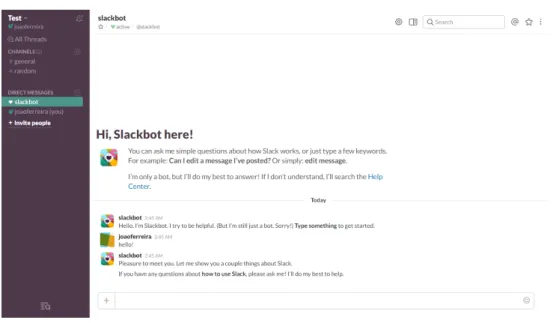
Slack [26], displayed in Figure2.5, presents a quite effective cloud-based solution specifically regarding communication management, based on a new kind of messaging for teams. Claiming a 48.6% reduction in internal e-mail, this application bases its offer in "channels" for organization of team conversations, that can be related to groups, projects or departments.
Figure 2.5: Slack’s communication module
Communications within the application are divided in two categories:
• Public channels — open to anyone, within the team, to see what is going on and join the conversation;
• Private channels — only people invited are able to join the conversation and access to confidential information.
Direct messaging is one feature available, where private conversations from one person to another or to multiple receivers (groups) are possible.
This application offers a mechanism of knowledge sharing, using a drag and drop feature, where distinct types of files can be shared within the team. The user is also free to make comments on documents.
System notifications, associated to new messages, are also included in the platforms used by Slack, as well as the search feature that allows users to find information on talks and inside the contents shared, by indexation.
Slack’s aim is to bring all the communications together in one place, looking for more produc-tive, transparent and efficient way of working, with no added e-mail.
12 State of the Art
Microsoft rivals in this market with a comparable tool called Yammer [27], exhibited in Fig-ure2.6. It follows similar principles as social networks, but within the perspective of the organi-zations.
Figure 2.6: Share files and collaborate with people in Yammer [2]
The concept of group is applied as the base of this application, promoting internal and external interactions concerning daily routines of work. The groups allow the users to discuss the projects on going, knowledge sharing with Office 365 fully integrated [28].
Both internal and external collaboration can be assured using this WBA, establishing deeper relationships through group conversations with partners, customers, vendors and members of the organization.
Searching for topics along the information shared is also a feature contemplated in this soft-ware, as well as an Inbox, where the user may find all existent conversations. This system, as many others, has integrated notifications.
Chapter 3
System Requirements and Conceptual
Model
This chapter contemplates an identification of the system requirements, followed by a conceptual-ization of the system proposed and with the described implementation in the following chapters.
3.1
Requirements
Dreamo has been developing software with the strong purpose of increasing the added value of characteristic processes in POOs. Considering organizations with a substantial number of employ-ees, the focus is essentially in creating an integrated system that contemplates all the dimensions of project management, mentioned before in chapter2, in order to obtain a standard platform, en-titled as uONE. An important aspect of this solution, that was considered, is the balance between the use of custom options, such as the communication standards, and the flexibility and easy cus-tomization according to the client’s will or needs. The system developed should be conceived as an extension of the organization in cause, reducing to the minimum possible situations where the client’s necessities are limited by this technology.
As the system should have a robust database structure that supports the necessary parametriza-tion to turn this customizaparametriza-tion from end-user possible, it is expected that different aspects and scenarios are prepared, generalizing as much as possible the proposed system.
Based on multiple received inputs from Dreamo members, it was possible to settle down spe-cific requirements. Thus, the system should provide the following functionalities:
• Messaging System
– Create new conversations;
– Associate one or multiple users to a new conversation; – Specify a subject in a new conversation;
– Apply a normal or high priority to new created messages; 13
14 System Requirements and Conceptual Model
– Define to new messages a deadline date as a limit to reply; – Attribute one work item to a conversation, maximum;
– Add new recipients to the conversation, even after a conversation is created;
– Answer quickly to a received message without requiring to access the integral conver-sation;
– Inform if a sent message is read by the recipients or not;
– Provide to the recipient information about the deadline aimed by the sender;
– Separate messages in three distinct areas: new ones, messages already read but still needing to reply and the messages sent.
• Archiving System
– Archive messages without restrictions, at any time;
– Allow the creator of a conversation to archive it whenever he feels that no more rele-vant informant will come from it;
– Reopen an archived conversation when a new associated message is sent; • Information Traceability
– Keep all the records of created conversations;
– Link a conversation to an existing work item, at any moment; – Find messages concerning a specific work item;
– Search conversations associated to a user;
– Have access to archived and active conversations, at any instant; • Permissions Management
– Allow users to follow or unfollow conversations from multiple work items; – Be able to define the privacy of a conversation as public or private;
– Have access to previous messages when added to a private conversation already exis-tent;
– Provide an open system that grants access to all messages exchanged if a user is mem-ber inside a specific conversation or the it is public.
In addition to these specific requirements, the model is also expected to be entirely compatible with uONE platform along with providing great usability for the users, performing accurately and successfully the required activities for their communication management.
3.2 Conceptual Model 15
3.2
Conceptual Model
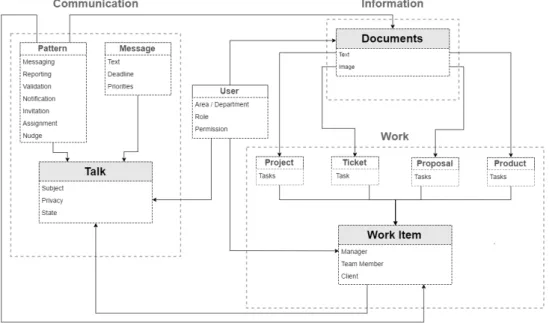
The conceptual model represented in Figure3.1provides an embracing view of how the developed system will be interrelated, as it establishes the main entities present in the system and the objects that they contain.
Figure 3.1: System conceptual model
All dimensions regarding an application for project management are present in the same model, grouped in three modules: communication, work and information. As mentioned, this master dissertation focus essentially on the communication module, and for that reason, it is par-ticularly more detailed than the remaining ones.
In order to clarify some expressions used during the present document, a few ideas must be explained for a better understanding of the concepts here presented. Exploring the work’s module, the term Work Item (WI) pops out as a main element. A WI is considered to be any element regarding the work module. Thus, the WI is a generalization of different types of work within an organization. In the conceptual model shown, four types of work are identified. However, their purpose is only to exemplify and for that reason, others could be considered. The project represents a process with different stages contemplating a set of tasks to accomplish the established objectives. Tickets may be considered a major task that should be handled and solved as an independent item. The proposal typically refers to commercial affairs that contemplate multiple tasks associated to the elaboration of a proposed solution to a specific client. Product represents the process of development, with a group of tasks that result in a final output. Tasks are considered internal WIs within the previously referred elements.
Regarding the information’s module, documents represent resources with distinct types such as images or textual information mostly related to WIs existent in the system.
16 System Requirements and Conceptual Model
The last main exhibited entity regards the whole communication management system designed to suit the requirements and the objectives of this master dissertation. Naturally, the solution pro-posed to support this module is entirely compatible with the remaining management blocks of the platform, establishing direct relationships with them. Talk is the term used to characterize existent conversations between users, with the purpose of creating a dominant entity that aggregates and links every object associated to the communication dimension. From now on, the concept talk will be always used as reference to the presented entity.
The communication pattern concept regards common activities that may be considered as nor-mal and quite standard between individuals, in their interactions. Analyzing these activities, sev-eral patterns are distinguishable in a POO.
The messaging pattern represents a situation where two or more individuals exchange ad hoc messages about a specific affair, starting a new talk. Within this pattern, a particular behavior was identified, concerning the usual alerts from someone expecting an answer of the other part. To standardize these type of ad hoc messages, a new pattern was created and named as nudge.
Reporting is another very common activity inside POOs that usually aggregates information about a set of WIs running or completed. Typically, this kind of interaction occurs between two levels of the hierarchical structure, as a member of a team should report to his supervisor, while the latter informs directly the administration.
Approving produced or updated documentation, is another highly normal interaction that may be designated as the validation pattern.
In this context, a notification may also be considered as a pattern. An example of this would be a situation where a specific sender intends to broadcast information to one or multiple recipients, not necessarily expecting an answer from them. This kind of situation is employed regularly to inform members of an organization about multiple affairs such as a new seminar coming, an official announcement and information likely to be relevant for a WI.
Another common pattern identified in POOs, for example, is the invitation for meetings or events. For instance, if a new seminar is being prepared, it is highly recommended that every person likely to be interested is invited. This is of major importance when an organization has a significant number of employees.
Assigning WIs and tasks to collaborators may also be considered as a quite usual and easily standardized procedure in the organization’ routines since it requires very specific answers, like accepting or declining an assignment.
As a fundamental part in the entire system, users are an independent entity that link and sus-tain all the others with continuous stimulus and contents, using the connections provided by the platform. Irrevocably, the projected resultant system is molded to facilitate the end-user’s life and keep him stimulated and motivated to use it in his routines. However, the relationships above exhibited will certainly become more evident throughout the document.
Chapter 4
Proposed Solution
This chapter presents the proposed solution for the problem underlying this master dissertation project. Firstly, a context for the solution is exposed, followed by an integral description of how the messaging system is projected.
Finally, specific use cases are presented for a better understanding of the main expected func-tionalities.
4.1
Overall Analysis
Taking into consideration the project requirements, mentioned in Chapter3, the proposed solution includes a module for communication management that integrates with Dreamo’s uONE platform, and assures the necessary mechanisms to achieve an easy and agile handling of requests, with a structured and complex data background, reflecting techniques for boosting productivity and traceability of information, while increasing the end-user’s motivation to collaborate, as much as possible, on the developed platform.
As demonstrated in the conceptual model, presented in section3.1, the message derives from the Talk entity, representing a sequential but independent item originated by an action of a user as a stimulus to other(s). This object consists of two key attributes with a specific purpose, regarding priority and expectation of a limit date to reply, as shown in Figure4.1.
Figure 4.1: Message properties
Prioritizing a message has a single purpose which is to define if it should be categorized as something important to do quickly or if it has an importance considered normal. However, this categorization might be applied from the sender’s or recipient’s perspective.
18 Proposed Solution
The priority can be divided in two exclusive levels, normal or high importance. Besides this, the priority can also be applied in two different contexts, as the sender will assign a level of importance that makes sense to him, as well as the recipient will decide whether to keep that attribute to the received message. This dual attribution of importance to messages will be detailed in section 4.3. Defining a target date to accomplish tasks can also be applied to the message developed system, using it as a reminder of something that should be handled within the proposed time. The idea is to create some sort of pressure on the recipient’s side without forcing him to actually settle the response within the stipulated time.
Talks are an integrated component within a system with several WIs that might be in progress, suspended or complete. There may exist established relationships between talks and these items or not, but the association is always possible. This kind of association will be explored later.
4.2
Communication Patterns
Achieving the expected integrated system, that reliably supports the communication flow inside a POO, requires an in-depth view of how the system should be adapted to people and their func-tions. The purpose of each person within an organization delineate the kind of expected activities for that function. Thus, having tools designed specifically to accomplish those tasks requires an identification of interaction patterns for each type of user.
Thereafter, in the projected patterns, displayed in Figure4.2, a division between sender and recipient was used to facilitate their comprehension. By doing this, it is intended a clear and objective view of each perspective within the interaction flow.
Figure 4.2: Communication patterns
• Messaging Pattern
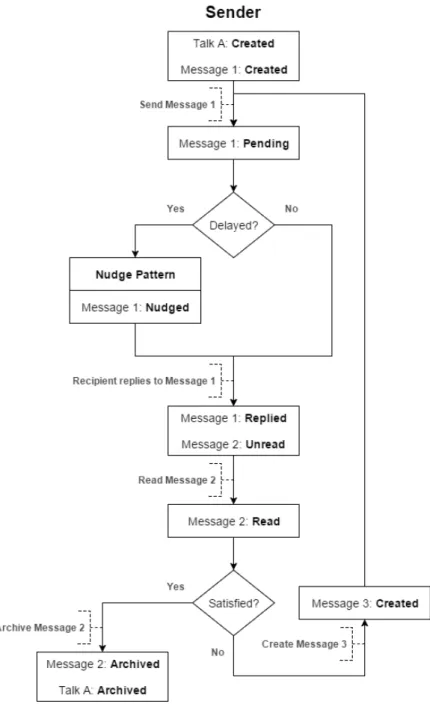
The pattern exhibited below, in Figure4.3 and Figure4.4, describes the distinct stages of a talk, considering a common situation of conversation between users using the proposed system. Messaging is undoubtedly the most pertinent projected pattern, as it characterizes a typical sce-nario that can be applied within other patterns, extending its use to a wide-ranging application across the system.
4.2 Communication Patterns 19
Although a conversation is a finite activity, people persistently tend to unconsciously, or not, ignore this and keep it as an active subject in their inbox, when that is not the case anymore. This may become a critical problem to solve as an organization grows and so the number of solicitations to its employees. The messaging pattern pursuits to finish that problem by imposing automatic rules that keep the talks flowing through the expected stages, ending as an archived subject. The goal is that users will define talk’s course throughout an iterative path, recognizing it as an activity that has beginning, middle and an end.
Figure 4.3: Messaging Pattern from Sender’s View
20 Proposed Solution
message that is sent to one or more recipients transiting to a new state designated as pending. Taking into consideration the obligation of choosing a limit date to wait for a reply, the user may adopt one of two possible behaviors: either are nudging the recipient(s) as an alert for delay, or keep waiting for a reply in situations that are still on time. After that, and assuming the recipient replies to the first message, it is expected that the initial sender reads it and determines if the answer is suitable or not. If that is the case, then he is ready to archive not only the message but also the talk itself. More details about this functionality are provided ahead in section 4.3 regarding the archiving mechanism. In case the user is not satisfied with the received answer, he is able to continue the conversation with a new message, restarting the sequence.
Figure 4.4: Messaging Pattern from Recipient’s View
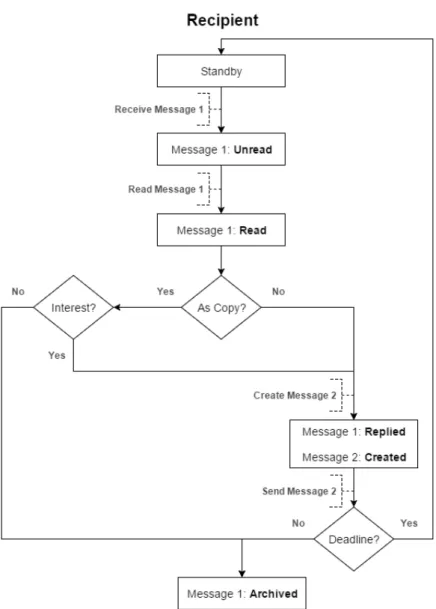
The recipient follows a straightforward and natural succession of steps, covering reception, reading and later replying the received message. However, the recipient may be receiving the message as a copy, equivalent to Cc or Bcc from e-mail, and here the possibilities are a
consider-4.2 Communication Patterns 21
ably different. Naturally, when as a main recipient (not in copy), the recipient must reply to the sender. The user receiving message as a copy has not that responsibility and may interfere only if he finds his input to be helpful or necessary. If no interest is shown by a secondary recipient (as copy), then the message received is automatically archived after reading.
Returning to the sequence, the recipient must pick a date as deadline, assuming he has some interest in keeping the conversation active. When that is not the case, the person may not select any date, considering that the answer provided concludes the conversation. In this case, the previous received messages are automatically archived. This action is also fully detailed in the next section.
• Nudge Pattern
In the course of a conversation there is a standard functionality that may produce a stimulus to keep the talk activity moving forward. The nudge pattern was projected with that purpose, and should be used as a surgical measure, avoiding its excessive use, since this may become ineffective in the long term.
The expected result, from this kind of interaction, is as simple and basic as highlighting, in some way, a message that still does not have reply after its deadline is exceeded.
Figure 4.5: Nudge Pattern
This interaction is presented in Figure4.5, considering a sender, the one who nudges, and a recipient that is nudged in order to get the necessary push to answer the received message.
• Assignment Pattern
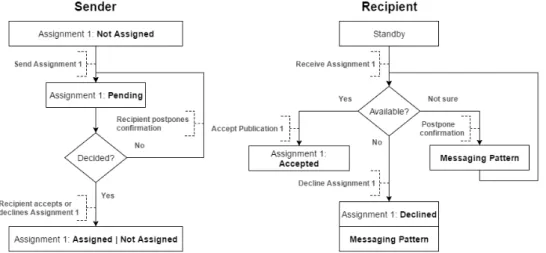
As presented in Figure 4.6, the WIs have an associated implicit state to the assignment of a sender, for example an administrator or responsible for a department. This action requires an adequate and specific channel for communication purposes, as it will follow a pattern of interaction between the administrator and the member assigned to manage the WI. In this kind of scenario, it is evident that there are only two adequate options of final answer.
Accepting or declining an assignment is indeed one of the most critical situations inside an organization, since it represents the transference of responsibility. Being so, the system should
22 Proposed Solution
be prepared to facilitate this assignment management, imputing new responsibilities to the user assigned.
The assignment is associated to a specific WI, and the assigned state or not refers to that WI. Therefore, “Assignment 1” will be considered as a WI for a better schematics interpretation. As shown in Figure4.6, the WI starts unassigned. This state passes to pending when a new person is selected to assume the responsibility of accomplish the respective WI. Once pending, it is ex-pected an answer from the recipient, accepting, declining or postponing the decision. Postponing maintains the state as pending, while a definite answer pushes the interaction toward its end. those three options already mentioned will certainly lead to distinct situations and consequent actions.
Deciding whether accept or reject the assignment requires an insight on the pending situations that are still on recipient’s hands. This person has always the possibility of postponing the choice, using the messaging pattern to explain the decision, but a final one must come up, at some point.
Figure 4.6: Assignment Pattern
When rejected, an explanation must be given to the sender, initializing again the messaging pattern. If accepted, no more actions are required or expected.
• Invitation Pattern
The objective of standardizing this pattern is essentially related to the massive message ex-changing that will be generated from an invitation using a traditional method, expecting standalone replies from each recipient. It is intended to avoid that excessive amount of non-valuable informa-tion resulting from the multiple answers, taking advantage of simple responses as accept, decline or postpone.
As the previous pattern, the diagram presented in Figure4.7, follows a similar sequence struc-ture. Following the same idea, an invitation with one or multiple targeted persons is created at first. Then, the state of each invitation stays as pending. At this point, the sender will start having confirmations on people’s availability to join the event. On the other side, the recipient receives the invitation and provides a definite answer or delays the decision, following the same principles presented before in other equivalent patterns.
4.2 Communication Patterns 23
Figure 4.7: Invitation Pattern
The action of accepting or rejecting an invitation automatically affects the event’s associated data, not requesting any further effort by the initial sender in updating the state of each invitation sent.
• Validation Pattern
Publication pattern comprehends the same logic as the assignment, since it has an equiva-lent set of actions and results. However, the context is slightly different and, for that reason, is understood as a typified interaction between users.
Figure 4.8: Validation Pattern
Initially, in Figure 4.8, a person creates a publication where a specific document is chosen as the target to be evaluated by the recipient(s). When sent, the publication’s state is changed to pending, waiting for a decision on the validation of the proposed document. On the other side, the recipient must reach a conclusion and, depending on that, provide a justification for rejecting or postponing scenarios.
24 Proposed Solution
• Notification Pattern
This type of interaction often requires an acknowledgment of the notification reception. This is something that is intended to be an implicit action when reading the notification. The pattern here presented covers an internal perspective of the system. In posterior integration with e-mail, the referred acknowledgment is assured by a reading report.
Figure 4.9: Notification Pattern
Observing the diagram above shown in Figure4.9, two related paths are again described, re-garding the sender’s and recipient’s view. The first one is a three-state diagram where a notification is created and sent before remaining in standby waiting for further advances. After this, and de-pending on the recipients’ activity on this subject, the notification reaches its final stage, being archived.
On the recipient’s side, the notification follows a natural sequence until it is read. Then, the recipient has a decision to make, pondering if he has interest in generating a new talk based on the received notification. This action contemplates the messaging pattern practice, previously
4.2 Communication Patterns 25
explained. Whether the user initiates a talk based on the notification or not it is expected that the notification culminates as archived.
• Reporting Pattern
The relations existent in different POOs may not be exactly the same, but the associated be-havior remains intact, and for that reason, a pattern is proposed for this situation, reporting to a superior hierarchical level.
Figure 4.10: Reporting Pattern
As represented in Figure4.10, the person reporting first provides information about the state of the projects, tasks and others on his hand, with the possibility of checking an option that informs the recipient that some kind of help is needed before finally submitting the report. If help was not requested, the report will, probably, be read and then archived. Now, considering help was demanded, the sender will be expecting that recipient reads his report and provides the necessary help by initializing a new talk with the adequate people for this purpose. A new conversation may be started whenever the recipient finds important his contribution in some of the matter reported. Dissatisfaction regarding the content of the report will be more likely the main motive to start a talk, even when not asked by the sender.
26 Proposed Solution
4.3
Communication Organizer
To support each pattern, presented in the previous section, several mechanisms and functionalities are developed. Beyond the messaging system itself, there are also a few concepts from GTD and PBD that will complement and make the system even more capable and powerful, boosting the productivity and objectives achievement.
Undoubtedly, the GTD methodology approaches topics with major importance on this matter, and the final solution built to manage the inbox includes those same principles intrinsically. Be-sides, the idea of one page shows all is applied in the inbox page, since it stands as a personal organizer that must facilitate the user’s platform usage.
Figure 4.11: Schema of inbox page
As represented in Figure4.11, there are four main containers allowing the management of the active talks. At the upper section of the page, there is an area identified as Unread, where new arriving messages are shown. The following functionalities are proposed to be applied in this section:
— open the complete talk in a popup in a single click; — read the received message without having to open it; — open a popup for a quick reply;
— mark messages as read in a single click; — archive messages in a single click.
At the central section, one core block representing Running items may be divided in two separate areas identified as Later and Now, where messages already read will be displayed. The classification process for the messages depends only on the priority given to a specific subject by the recipient user. The following functionalities are implemented:
— drag and drop messages from one container to another;
— access to the WI associated, if that is the case, in one single click;
— all the functionalities mentioned in Unread’s section, except mark messages as read, since they are already in that state.
As GTD defends, the idea of empty inbox is highly stimulated by the proposed system in both areas, Unread and Running, as well as prioritization of running items, providing a clearer vision of what is one user hands.
4.3 Communication Organizer 27
At the lower section, titled as Pending, messages sent and expecting new ones in return are presented. The following functionalities are proposed:
— read the message sent without having to open it;
— nudge other user(s), when a message has not been replied within the time interval previously defined;
— archive in one single click.
Figure 4.12: Archiving Mechanism Modelling
In Figure4.11, the archiving mechanism is illustrated on the right side, representing a funda-mental part of the proposed system. This mechanism is better described in Figure4.12. As result of this instrument, the end-user will be capable of archiving talks with great agility in one single click.
Nevertheless, even providing simple tools that facilitate archiving, there will be always several users ignoring this functionality and keeping all the conversations in their inbox page. Thereafter, these people tend to represent a bottleneck in the processes where they take part, since their lack of organization may lead to low productivity and delays on responses to solicitations. The proposed mechanism prevents the possibility of this kind of situations happening with simplicity, usability and special attention to design aspects. The button for archiving is always displayed on the right side of the message, allowing the recipient to read the content, and then archiving it immediately, if that message closes the subject. Furthermore, the system has a built-in mechanism for automatic archiving when a user send a message without limit date to expect a reply.
This functionality is associated to each talk, and the result of executing this action is not only archiving the selected message, but also all other attached messages to the corresponding talk. Another scenario is also considered when a user, creator of a specific talk, archives his messages within this talk. In this cases, besides archiving his own messages, the user will be also archiving the talk itself, which means that conversation as reached its end and the obtained answers suit the initial problem or the user is not expecting any more replies. This leads to another topic, the continuity of a talk. For a better understanding of the concepts now explored, the properties of a talk are once more presented in Figure4.13.
The conversation has three different stages. The first corresponds to the trigger that starts the talk itself, like a question or an information. After that, it is expected some sort of answer that fits the initial trigger. The final stage is the talk closure, where each user archives messages associated to the mentioned talk, assuming that no more relevant information is required or expected from talk’s participants. Nevertheless, a talk conclusion does not represent inevitably that it cannot be
28 Proposed Solution
reopened again. If someone intends to add new information, the talk state will be changed to non-archived, and all the participants will receive related notifications again.
Figure 4.13: Talk properties
Integrating talks with other entities present in the system, like projects or users, opens an enor-mous range of relationships that allow to extract and track more complete and accurate information from the data source.
However, the permissions associated to each user will limit their access to data records re-garding talks. As a standard procedure, talks are intended to be public whenever possible, what does not mean they have necessarily to be public. If the end user chooses private permission, then he will be limiting the ability from others, outside that talk, to view the contents shared. This possibility is probably more likely to be used in superior levels in the hierarchical structure of the organization.
4.4
Use Cases Matrix
A talk is constituted by three types of users which are a creator, an active and a passive member. The first one, is the one who triggered the conversation by sending the initial message. Active members are the ones who were added to the conversation as main (“To”) or secondary (“Cc”) recipients at some point of the talk’s timeline. Passive members are members that have some interest in a specific subject and started to follow the talk for that reason. These should never participate in a talk, unless they have special permissions for doing so.
To represent the main use cases, a matrix was prepared for each type of member, regarding the talk management, containing in green and blank colors the scenarios that are possible or not, respectively. The matrix is below represented in Table4.1.
• Use Case 1 — The user is able to send a new message inside the talk;
• Use Case 2 — The user can archive all the talk received messages until that moment; • Use Case 3 — The user has permissions to archive the whole talk. This does not limit the
possibility of sending new messages again, reopening the conversation;
• Use Case 4 — The user is capable of receiving the messages associated to a talk where he is involved;
4.4 Use Cases Matrix 29
• Use Case 6 — The user may alert a recipient that he is late regarding a previous sent mes-sage.
Table 4.1: Talk Management Use Cases Talk Management
Member
Creator Active Passive Non-Member Public Talk
1. Send new message
2. Archive previous messages 3. Archive talk
4. Receive messages in inbox 5. Read messages
6. Nudge a member Private Talk
1. Send new message
2. Archive previous messages 3. Archive talk
4. Receive messages in inbox 5. Read messages
Chapter 5
Communication Organizer
Implementation
This chapter contemplates the information regarding the implementation process. Initially, a brief introduction to the tools and libraries used in the implementation process and the application architecture is presented. After that, the database architecture is exhibited and explained, followed by the presentation of the developed webpages based on the communication organizer previously proposed.
5.1
Development Technology and Tools
During this Dissertation project, a set of tools were used to accomplish the established objectives. The technology selection, as foreseeable, was conditioned by the context were the final module was applied. Thus, the proposed solution was implemented using the same technologies employed by Dreamo in uONE platform development.
The software for development chosen was Microsoft Visual Studio Enterprise 2015, as it vides the necessary Integrated Development Environment (IDE) to develop a WBA like the pro-posed one, and Microsoft SQL Server 2014, as the database server necessary to store and provide information associated to the whole system.
On the subject of programming tools used, several were necessary for development purposes, and therefore are presented next. Primarily, it is important to clarify that the system implemented is a WBA, and both .NET framework and SharePoint platform from Microsoft were used to support developments. Furthermore, a set of programming tools were used and presented below.
A library offered by Telerik [29], designated as Kendo UI, was largely employed, since it provides a collection of controls, like grids, multiselect fields and many others, reducing the time needed for development. These controls will be presented throughout the next sections, as well as the final interfaces. The jQuery [30] library was mostly used to make Ajax calls, manipulate elements and for event handling.


![Figure 2.4: Share comments on any item in EPM Live [1]](https://thumb-eu.123doks.com/thumbv2/123dok_br/15203381.1018408/28.892.149.701.264.600/figure-share-comments-item-epm-live.webp)
![Figure 2.6: Share files and collaborate with people in Yammer [2]](https://thumb-eu.123doks.com/thumbv2/123dok_br/15203381.1018408/30.892.152.700.226.596/figure-share-files-collaborate-people-yammer.webp)