Musculoskeletal disorders in adolescents: a study
on prevalence and determining factors
Perturbações músculo-esqueléticas em adolescentes: estudo da prevalência e dos fatores determinantes Trastornos musculoesqueléticos en adolescentes: estudio de prevalencia y factores determinantes
Rosa Lopes Martins https://orcid.org/0000-0001-9850-98221
Nélia Carvalho https://orcid.org/0000-0002-7065-53661
Carlos Albuquerque https://orcid.org/0000-0002-2297-06361
Ana Andrade https://orcid.org/0000-0003-1070-85071
Conceição Martins https://orcid.org/0000-0002-6598-822X1
Sofi a Campos https://orcid.org/0000-0002-4696-35371
Susana Batista https://orcid.org/0000-0003-0256-60271
Alexandra Isabel Dinis https://orcid.org/0000-0002-4102-53221
1Instituto Politécnico de Viseu, Escola Superior de Saúde, Viseu, Portugal.
Confl icts of interest: none to report.
Abstract
Objective: To identify the prevalence of musculoskeletal disorders in adolescents, and to analyze this prevalence relationship with sociodemographic, anthropometric and contextual variables.
Methods: An observational, cross-sectional, descriptive/relational study with quantitative approach was conceptualized, involving 632 adolescents with mean age of 13.36 from six school groups from Central and North Portugal. Data collection protocol included questions of sociodemographic, anthropometric and contextual nature, and also the “Nordic Musculoskeletal Questionnaire” to assess musculoskeletal disorders. Results: Data showed that 47.4% of adolescents mentioned musculoskeletal disorders within the last 3 months, located in the shoulders (27.8%), dorsal region (25.3%), thigh/hips (26.1%), neck (23.4%), lumbar region (22.8%), and knees (19.6%). We found that musculoskeletal disorders are more prevalent in female adolescents, and among those who spend longer time watching television per day, and also those who go to school by foot or bicycle.
Conclusion: The prevalence of musculoskeletal disorders in adolescents is high and has multicausal origin, turning imperative the implementation of preventive and readapted actions to promote a better musculoskeletal function.
Resumo
Objetivo: Identifi car a prevalência das perturbações músculo-esqueléticas em adolescentes e analisar a sua relação com variáveis sociodemográfi cas, antropométricas e contextuais.
Métodos: Conceptualizou-se um estudo observacional, transversal, descritivo/relacional de cariz quantitativo, que envolveu 632 adolescentes de seis agrupamentos de escolas das zonas centro e norte de Portugal, com média de idades de 13,36 anos. O protocolo de colheita de dados integrava questões de cariz sociodemográfi co, antropométrico, contextual e ainda o “Questionário Nórdico Músculo-Esquelético” para avaliar as perturbações músculo-esqueléticas.
Resultados: Os dados mostraram que 47,4% dos adolescentes referem perturbação músculo-esqueléticas nos últimos 3 meses, localizando-se estas aos níveis dos ombros (27,8%), região dorsal (25,3%), coxa/anca (26,1%), pescoço (23,4%), zona lombar (22,8%) e joelhos (19,6%). Verifi cou-se ainda, que as perturbações músculo-esqueléticas são mais prevalentes nos adolescentes do género feminino, naqueles que gastam mais tempo por dia a ver televisão e ainda nos que se deslocam para a escola a pé ou de bicicleta.
Conclusão: A prevalência das perturbações músculo-esqueléticas nos adolescentes é elevada, tem origem multicausal, tornando-se imperativa a implementação de intervenções de prevenção e readaptação promotoras de um funcionamento músculo-esquelético otimizado.
Keywords
Adolescent; Musculoskeletal pain/epidemiology; Prevalence; School health
Descritores
Adolescente; Dor músculoesquelética/ epidemiologia; Prevalência; Saúde escolar
Descriptores
Adolescente; Dolor musculoesquelético/ epidemiología; Prevalencia; Salud escolar
Submitted
July 15, 2019
Accepted
July 22, 2019
Corresponding author Rosa Lopes Martins https://orcid.org/0000-0001-9850-9822
E-mail: [email protected] How to cite:
Martins RL, Carvalho N, Albuquerque C, Andrade A, Martins C, Campos S, et al. Musculoskeletal disorders in adolescents: a study on prevalence and determining factors. Acta Paul Enferm. 2020;33:e-APE20190173
DOI http://dx.doi.org/10.37689/
acta-ape/2020AO0173
Resumen
Objetivos: Identificar la prevalencia de trastornos musculoesqueléticos en adolescentes y analizar su relación con variables sociodemográficas, antropométricas y contextuales.
Métodos: Se conceptualizó un estudio observacional, transversal, descriptivo/relacional de aspecto cuantitativo, que incluyó 632 adolescentes de seis agrupamientos de escuelas de la zona centro y norte de Portugal, con promedio de edad de 13,36 años. El protocolo de recolección de datos incluyó cuestiones de aspecto sociodemográfico, antropométrico, contextual e, inclusive, el “Cuestionario Nórdico Musculoesquelético” para evaluar los trastornos musculoesqueléticos.
Resultados: Los datos mostraron que el 47,4% de los adolescentes señalan trastornos musculoesqueléticos en los últimos 3 meses, localizados en el nivel de los hombros (27,8%), región dorsal (25,3%), muslo/cadera (26,1%), cuello (23,4%), zona lumbar (22,8%) y rodillas (19,6%). Además, se verificó que los trastornos musculoesqueléticos tienen mayor prevalencia en adolescentes de género femenino, en los que pasan más tiempo por día viendo televisión y en los que van a la escuela caminando o en bicicleta.
Conclusión La prevalencia de los trastornos musculoesqueléticos en adolescentes es elevada, tiene origen multicausal, por lo que se torna imperativa la implementación de intervenciones de prevención y readaptación que promuevan un funcionamiento musculoesquelético optimizado.
they usually have a rounded back posture that may lead to lesions.(4)
Musculoskeletal Disorder (MSD) in adolescents is characterized by the presence of pain or discom-fort.(5) This is a nosological entity that affects
mus-cles, nerves, intervertebral discs, joints, cartilages, tendons, and ligaments, and may occur on specific occasions, systematically or chronically. This entity etiology can be genetic or acquired, and affects – to a greater or lesser extent, daily tasks and the individ-uals’ quality of life.(6)
Epidemiological studies including adolescents suggest that prevalence and incidence has substan-tially increased worldwide during the last few years, including Portugal, and this increase may even progress into chronic situations that may continue until the adulthood.(7) The consensus that emerges
from many studies conducted by different research-ers is that MSDs cannot only be explained through physical factors, but also through social, psycholog-ical, environmental and behavioral factors that may precipitate the appearance of this problem.(2,3,8,9)
Therefore, considering the complexity of above-described and the increasing scale of the problem, the research of the prevalence of these disorders in childhood and adolescence, the ac-knowledgment of the factors that contribute to their appearance, and the assessment of the impact of measures to promote quality of life are current major challenges both for health professionals and for general population. In fact, the negative impact that these disorders cause – not only in this adoles-cence, but also in adulthood, constitutes today a real public health problem.(5,8)
Introduction
The World Health Organization (WHO)(1) defines
adolescence as a period of life between ages 10 and 19, a transitional phase between childhood and adulthood. This period is characterized by physical, mental and emotional development, in which ef-forts are made to meet different goals, according to each person’s culture. This constitutes a phase of life that begins with puberty, changes in the body, and ends with the consolidation of the individual’s de-velopment in terms of personality, and who gradu-ally obtains economic independence and integrates into social group.(2)
Therefore, this is a period marked by intense physical, psychological, behavioral and social changes. This phase is composed by the transition from childhood to adult life, in which many char-acteristics and habits related to adult lifestyle are acquired and/or consolidated. At this time, this is also a period that individuals present an increase in rate growth of height and weight, which justifies the increase of nutritional needs.(3)
Studies of the human body biomechanics show that there are postural behaviors that cause imbal-ance in the body system, leading to compensations that may result in changes of structure and func-tion. During puberty there is asymmetry in the development, since bones grow faster than mus-cles and tendons, and this fact is particularly no-ticeable at the level of the spine. Adolescents take some time to adapt to their new body, and they often passing through a phase of introspection, sensitivity and even shame of the body, that is why
The need to improve individual, biomechanical, organizational and psychosocial MSDs preventive strategies in which the action of health professionals along with multidisciplinary teams, must be pro-moted and implemented.
Considering the above-described premises and the scale of the problem, the objective of this study is to identify musculoskeletal disorders in adoles-cents and to establish existing relationships between MSDs and sociodemographic, anthropometric and contextual variables.
Methods
This was an observational, cross-sectional, descrip-tive/relational study with quantitative approach. A non-probabilistic convenience sample was used including 632 adolescents from six school clusters from Central and North Portugal. We included par-ticipants based on the following inclusion criteria: adolescents aged between 10 to 19, and attending from Grade 5 to 12 of school. We excluded ado-lescents with secondary musculoskeletal disorders, collagen vascular and infectious diseases, onco-he-matological diseases, genetic diseases, endocrine disorders (such as thyroid disorders or diabetes
mel-litus), or recent traumatic injuries.
The instrument for data collection (DCI) was a questionnaire made up of four sections. The first section contained sociodemographic data (age, gen-der, residency, and socioeconomic status). The sec-ond section collected anthropometric data (weight, height and BMI based on International Obesity
Task Force). The third section assessed
contextu-al variables (backpack wearing – its characteristics and weight; time spent per week watching televi-sion, computer use and time spent with comput-er games; type of transportation until the school; type and intensity of physical exercise). Finally, the fourth section included the Nordic Musculoskeletal Questionnaire, validated and culturally and linguis-tically adapted for Portugal, by Mesquita, Ribeiro & Moreira in 2010.(10) The DCI consisted of 25
di-chotomous questions (yes/no) and three questions associated with nine anatomical regions, identified
with the help of a posterior human body figure. The questions related to each anatomical region aimed to assess whether respondents felt any disorder in the last three months (time period chosen to obtain recent and more accurate memories) and whether, during this period, there were any consequences to these individuals daily life. There was also a numer-ical pain scale for each anatomnumer-ical region, classified using a continuum scale from 0 (no pain) to 10 (worst possible pain) for pain measurement. Data was collected in March, April and May 2017; days when physical education classes took place.
Before beginning the data collection, parents were invited to participate for voluntary and informed co-operation for the study, and those who agreed signed the informed consent. Participants were informed about the objectives of the study. The confidential-ity of the participants’ responses was guaranteed, as well as their clinical data. Development of this study followed national and international ethical and legal aspects of research on human subjects. The study was approved by the Ethics and Research Committee. The Statistical Package for the Social Sciences (SPSS) version 22.0 was used for statistical analyses. Student’s t-tests and Mann–Whitney U test (MWU) was used to study the relationship between variables, and to compare the means of a quantitative variable of the two groups including different individuals. Kruskall Wallis test was adopted to compare the means of a quantitative variable in three or more groups of dif-ferent individuals. The equality of more than two means was tested. In addition, we used post-hoc tests to determine in what extent every mean differed from each other. A p value of 5% was considered statistical significance.
Results
The adolescents that comprised the sample were aged between 11 (younger) and 17 (older), with a mean of 13.36 years old, and standard deviation of 2.08. Of participants, 58.2% were girls and 41.8% boys. The majority of adolescents (75.3%) lived in rural areas and were considered to be of intermedi-ate socioeconomic status (53.9%).
In relation to weight state, we observed that ado-lescents weighed, on average, 53.89 kg (SD=11.44), were 1.59 meter high (SD=0.08), and most of them (71.5%) were eutrophic. In addition, 12.0% of adolescents were overweight, a fact that was more associated to boys (x2 = 6.341; p = 0.023) with
sta-tistically significant differences.
The vast majority of adolescents (97.5%) wore a backpack to carry their school material with adjustable (82.3%) and padding (78.5%) straps, but with no waist belt, sternum strap or metal support. We observed that 79.8% of the par-ticipants used bus/car to go to school, and only 20.2% go to school by foot or by bicycle. They wear the backpack on average 20 min/day, 80.0% on both shoulders and 20.0% (especially girls) on one shoulder only. Furthermore, we confirmed that, besides wear a backpack, 87.3% of the par-ticipants carry other equipment, mainly sports, visual education and technological support ma-terials. The common backpack weight ranged be-tween 12% and 19% of the body weight of the majority of the participants.
Most of the adolescents (56.8%) exercise on a regular basis. Soccer/futsal (33.7%) and basket-ball (22.1%) were the most commonly mentioned sports, both practice at a moderate rate. A total of 72.8% of participants dedicated, on average, 2 hours per day to watch television, and this practice was higher among girls; however, statistical differ-ences were not significant (t = 1.087; p = 0.342). The posture adopted by 38.6% of the respondents was lying down on the couch. The time spent us-ing technological devices (audio/video devices and computer) by adolescents varied between 0 and 32 hours/week, which corresponded to a mean of 13.92 hours. Despite mean values differed between girls and boys, no significant statistical differences (p=0.681) were found.
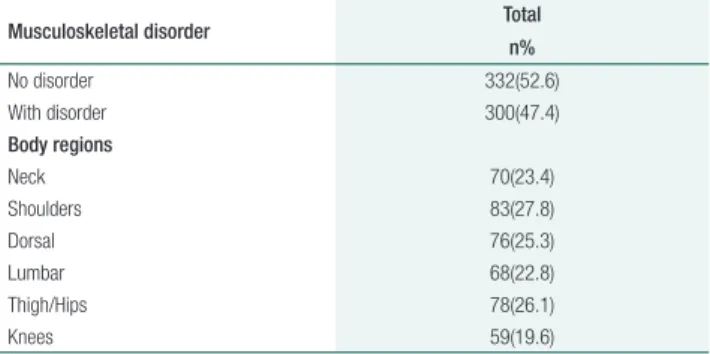
The prevalence of MSDs mentioned by ad-olescents in the last three months (Table 1) was (n=300) 47.4%, and they were located at different levels (multiple answers), but had greater focus on the neck (23.4%), shoulders (27.8%), dorsal re-gion (25.3%), lumbar rere-gion (22.8%), thigh/hips (26.1%), and knees (19.6%).
The intensity of pain mentioned by adolescents with MSDs (Table 2) is showed mainly as mild (34.7%) and moderate (41.3%) pain, however, we verified that 16.0% of them reported severe pain and 8.0% very severe pain.
Table 1. Prevalence of MSDs and anatomical regions affected
Musculoskeletal disorder Total n% No disorder 332(52.6) With disorder 300(47.4) Body regions Neck 70(23.4) Shoulders 83(27.8) Dorsal 76(25.3) Lumbar 68(22.8) Thigh/Hips 78(26.1) Knees 59(19.6)
Table 2. Intensity of pain felt by adolescents with MSD
Intensity of pain Total
n(%)
Mild pain 104(34.7)
Moderate pain 124(41.3)
Severe pain 48(16.0)
Very severe pain 24(8.0)
Total 300(100)
To analyze the existing relationship between independent variables and MSD (dependent vari-able) among adolescents, we used parametric and non-parametric tests. By considering the large number of variables, we decided to present only those that were statistical significance. Therefore, we confirmed that MSDs were more prevalent among adolescents of female gender (t=-3.358; p=0.001), and for those who spend more time watching tele-vision per day (χ²= 6.532; p=0.038), and among those who went to school by foot or by bicycle (U= 1531.500; p=0.018). No statistical significance (p>0.05) found in the other variables such as age, residency, weight, backpack wearing, and physical exercise.
Discussion
Sociodemographic characteristics of the adolescents of this research agree with other studies conduct-ed recently in the Portugal context with the same target population.(7,11,12) This sample is mainly
com-prised of adolescents of female gender (58.2%), with a mean age of 13.36 years, living in rural areas (75.3%), and belonging to intermediate socioeco-nomic classes (53.9%), confirming the expected correlation of the living conditions in country side areas of the country.(13)
From an anthropometric perspective, adoles-cents weighed, on average, 53.89 kg, and they were 1.59 meters high, and mainly eutrophic (71.5%). However, 12.0% of them were overweight (mainly boys) a condition that promotes the appearance of MSDs according to other study(13), which states that
adolescents with BMI above the ideal often present higher rates of postural changes in different body regions.(14,15)
Many authors have highlighted that adolescents often wear backpacks incorrectly, carry excessive load inefficiently, and expose themselves to serious and great postural deviations. As a solution, they advise adolescents, to carry on a safe load limit, and for not carrying loads weighting over 10% of their body weight.(16,17) In fact, the majority of adolescents
(97.5%) carried their school material in a backpack with adjustable and padding straps, but with no waist belt, sternum strap or metallic support, which contributed to a greater tension at the musculo-skeletal level. Adolescents wore a backpack, on av-erage, 20 min/day, and 20.0% of them (especially girls) wore it on one shoulder only. Furthermore, 87.3% of the respondents carried other equipment for sports and visual education support and tech-nology materials, which contributed to the fact that the majority of the participants carried loads that represented from 12% to 19% of their body weight. This data contradicts the recommendations of WHO and Portuguese Directorate-General for Health, since these organizations recommend that the weight that should be carry to not exceed 10% of their body weight as a safe limit.(16,18,19)
It was also revealed that most of the adolescents of the study (56.8%) practice physical exercise on a regular basis, (soccer/futsal and basketball) at a moderate rate. The evidence of the impact of phys-ical activities on MSDs in adolescents has generat-ed much controversy among authors and it is far from reaching consensus. Many researchers defend
that the lack of physical activities is responsible for the appearance of disorders in an early stage of life; but the practice to excess is also harmful, since once pushed to certain limits – pushing hard muscles, tendons, bones and joints, physical activity that may act as a pathological agent on the locomotive system.(20,21)
Exposure of adolescents to informational technologies has increased in the educational set-ting, leisure and family environments, and this is a growing phenomenon among all socioeconomic classes worldwide.(3,8,22) We observed that 72.8% of
the participants spent, on average, 2 hours per day watching television, and the position adopted is ly-ing on the couch. The average time spent usly-ing new technologies (audio and video devices, and comput-er) is 13.92 hours/week, adopting static, repetitive and continuous postures that cause consequential damages. We agree that the benefits of using these technologies are evident: greater access to quality information, possibility of exchanging information with other persons and with distant communities, improvement of cognitive abilities, and even the availability of leisure activities. However, the unreg-ulated and abusive use of technological devices is a factor that contributes to sedentarism and posture changes (with ergonomic disturbances, inadequate proportion of furniture at schools and at home) and structural changes in the skeleton, with overload in joints, tendons, ligaments and muscles, that may cause musculoskeletal deformities.(23,24)
The results concerning the prevalence of MSDs in adolescents may not be dissociated from the above-mentioned aspects, and this confirm the ten-dency demonstrated in epidemiological studies of being high.(3,8,22) In fact, 47.4% of the participants
had MSD located in diverse (and simultaneous) body regions. A national study(12) about adolescents’
health demonstrated that 35% of adolescents men-tioned they feel pain in the neck/shoulder area, and 38.6% at the lumbar level. The results of other re-searchers identify scenarios with characteristics that are very similar to our study.(3,7,8,12)
For most adolescents, the pain felt in the body regions above-mentioned are of moderate (41.3%) and mild (34.7%) intensity. However, we could not
ignore the fact that 16.0% of adolescents report-ed that they feel severe pain and 8.0% very severe pain. The International Association for the Study of Pain (IASP) defines pain as an unpleasant sensory and emotional experience associated with actual or potential tissue damage, and when associated with adolescents, pain does not only affect the current health status, but also may cause the development of chronic pain in adulthood, with severe conse-quences in the quality of life.(25,26) In fact, pain may
not be understood as an isolated and occasional manifestation, but as an event with some dramatic consequences in the person’s development of health and well-being throughout life and in the sustain-ability of the countries’ own health care systems.
The analyses of the relationship between vari-ables have revealed that MSDs are more prevalent in female adolescents. This difference between genders can be explained because of different threshold in the perception of musculoskeletal symptomatology, greater muscle flexibility in female gender, or even hormonal changes during puberty.(27) Participants
that spend more time per day watching television and using new technologies for longer periods also have more prevalence of MSDs. This data strength-ens the idea of other researchers stating that the fre-quent use of informational technologies becomes a high risk factor to develop MSDs.(23,24) Likewise,
commuting to school by foot or by bicycle is also a risk factor for disorders to appear, since the load of backpack associated with balance in motion generates posterior movements of the body’s cen-ter of gravity, and this imbalance is compensated by moving the body forwards, which can lead to spine deviation.(12,14,28) The results of this study lead
to the need of greater investments in preventing these disorders in adolescence, as one of the pillars of the National Service for Health, on the basis of promotion and continuity of care, and it can be a powerful resource for individuals, families and the whole society.
The limitations found in this study were: the use of a convenience non-probabilistic sample, which does not allow us to generalize results with statisti-cal accuracy; data collection made through a ques-tionnaire self-complete by adolescents, which may
present some interpretation biases, due to underes-timating or overvaluing MSDs problem and, there-fore, may interfere in the validity of data; the use of simple questions to assess physical activity practice, instead of using a scale to evaluate physical activi-ty and sedentarism, such as WHO HBSC (World Health Organization, Health Behavior in School-aged Children), which would allow us to classify adolescents in “active”, “inadequately active” or “inactive”, thus, it was not possible to obtain more accurate and reliable data regarding this variable.
In spite of the limitations mentioned, we con-sider that the research addresses a very relevant topic at the time, contributing with its important results to nursing scientific knowledge. We suggest the development of further studies to compare the evolution of people’s health potential throughout their lifecycle in the same time period and in a lon-gitudinal perspective.
Conclusion
Adolescents who were part of this study’s sample revealed a high prevalence of MSDs. The discom-fort they mentioned is located mainly in the fol-lowing anatomical regions: neck, shoulders, dorsal region, lumbar region, thigh/hips and knees. Even though the pain intensity pattern was between moderate and mild for the majority of the adoles-cents, this is important to consider different results with growing severity as they reported severe and even very severe pain. As expected, considering the determiners mentioned in similar studies, within this group of adolescents, MSDs are more prev-alent in girls, and among those who spend more time per day using new technologies and in the type of transportation used to go to school, since going by foot or by bicycle becomes more harmful. We conclude that the origin of musculoskeletal disorders in adolescents is dynamic, multifaceted and multidimensional, because, if in one hand, there are factors that are of particular importance as they influence directly on the appearance of these manifestations – such as those of mechanical origin, on the other hand, there are other factors
that influence indirectly, mainly those related with social, cultural and organizational origin.
Acknowledgments
We thank the European Social Fund, the Operational Program “CENTRO 2020” and the Foundation for Science and Technology of the Portuguese Government for funding the Research Program MAISaúde Mental (More Mental Health) “Monitoring and assessing mental health indicators of children and adolescents: from research to prac-tice” (identification number: CENTRO-01-0145-FEDER-023293), in which this study was included.
Collaborations
Martins RL, Carvalho N, Albuquerque C, Andrade A, Martins C, Campos S, Batista S and Dinis AI contributed to the design of the study, analysis and interpretation of data, drafting the manuscript, rel-evant critical review of the content and approval of the final version to be published.
References
1. World Health Organization. Evaluation of the national health plan of Portugal: 2004–2010. Geneva: WHO; 2010.
2. Kamper SJ, Henschke N, Hestbaek L, Dunn KM, Williams CM. Musculoskeletal pain in adolescence. Braz J Phys Ther. 2016;16;20(3):275-84.
3. Martins R, Almeida A, Andrade Moreira H, Campos S. Prevalência e determinantes das perturbações músculo-esqueléticas em adolescentes. Psicol Criança Adolesc. 2016;7(1-2):73–82.
4. Meziat Filho N, Coutinho ES, Azevedo e Silva G. Association between home posture habits and low back pain in high school adolescents. Eur Spine J. 2015;24(3):425–33.
5. Martins R, Albuquerque C, Andrade A, Martins C, Campos S. Subjective health associated with the quality of life of adolescents. In: 4th International Conference on Health and Health Psychology. The European Proceedings of Social & Behavioural Sciences; 2018 Jul 4-6; Viseu: Escola Superior de Saúde de Viseu; 2018. p. 149– 57.
6. Pinho ME, Vaz MA, Arezes PM, Campos JC, Magalhães AP. Lesões músculo-esqueléticas relacionadas com as atividades desportivas em crianças e adolescentes: uma revisão das questões emergentes. Motricidade. 2013;9(1):31–49.
7. Fonseca CD, Candotti CT, Noll M, Luz AM, Santos AC, Corso CO. Prevalence of back pain among high school students in a municipality in southern Brazil. Fisioter Mov. 2016;29(1):137–46.
8. Albuquerque C, Santos C, Martins R, Cunha M. Strategies for the prevention of work-related musculoskeletal injuries: Systematic review of literature. In: 3rd International Conference on Health and Health Psychology, The European Proceedings of Social & Behavioural Sciences; 2017 jul 5-7. Porto: Faculdade de Medicina, Universidade do Porto. p. 79-89
9. Noll M, Candotti CT, Rosa BN, Loss JF. Back pain prevalence and associated factors in children and adolescents: an epidemiological population study. Rev Saude Publica. 2016;50. pii: S0034-89102016000100219.
10. Mesquita CC, Ribeiro JC, Moreira P. Portuguese version of the Standardize Musculoskeletal Questionnaire: cross cultural and reability. J Public Health. 2010;18(5):461–6.
11. Trigueiro MJ, Massada L, Garganta R. Back pain in Portuguese school children: prevalence and risk factors. Eur J Public Health. 2013 Jun;23(3):499–503.
12. Health Behaviour in School. A saúde dos adolescentes portugueses em tempos de recessão: Dados nacionais do estudo HBSC de 2014 [Internet]. Lisboa: Aventura Social & Saúde; 2014. [citado 2019 Jul 21]. Disponível em: http://aventurasocial.com/arquivo/1437158618_ RELATORIO%20HBSC%202014e.pdf
13. Instituto Nacional de Estatística (INE). Crianças e Adolescentes em Portugal. Rev Estud Demográficos; 2015;55:53-101.
14. Sedrez JA, da Rosa MI, Noll M, Medeiros FS, Candotti CT. Fatores de risco associados a alterações posturais estruturais da coluna vertebral em crianças e adolescentes. Rev Paul Pediatr. 2015;33(1):72–81. 15. Tsekoura M, Dimitriadis Z. Kastrinis Al, Katsoulaki M, Nomikou El.
Association of musculoskeletal pain with schoolbags. Interscientific Health Care. 2017;9(3):86–91.
16. World Health Organization (WHO). Global recommendations on physical activity for health. Geneva: WHO; 2016.
17. Kunzler M, Noll M, Antoniolli A, Candotti CT. Associação entre postura sentada e alterações posturais da coluna vertebral no plano sagital de escolares da cidade de Lajeado, RS. Rev Baiana Saúde Pública. 2014;38(1):197–212. 18. Portugal. Ministério da Saúde Direção Geral de Saúde. Plano Nacional
de Saúde Escolar [Internet]. Lisboa: DGS; 2015. [citado 2019 Jul 21]. Disponível em: http://pns.dgs.pt
19. Natasha AA, Syukria AA, Kamaruddin M, Diana SN. Ima-NirwanaS, Chin KY. The association between backpack use and low back pain among pre-university students: A pilot study. J Taibah University Med Sci. 2018;13(2):205–9.
20. Calvo-Muñoz I, Gómez-Conesa A, Sánchez-Meca J. Physical therapy treatments for low back pain in children and adolescents: a meta-analysis [Internet]. BMC Musculoskelet Disord. 2013;14(1):55. 21. O’Keeffe M, O’Sullivan K, Kamper SJ. Schoolbags and back pain: opinions
strongest where the evidence is weakest. Physiotherapy. 2018;104(1):e1. 22. Minghelli B, Oliveira R, Nunes C. Postural habits and weight of
backpacks of Portuguese adolescents: are they associated with scoliosis and low back pain? Work. 2016;54(1):197–208.
23. Yamato TP, Maher CG, Traeger AC, Wiliams CM, Kamper SJ. Do schoolbags cause back pain in children and adolescents? A systematic review. Br J Sports Med. 2018;52(19):1241–5.
24. Batista IT, Melo-Marins D, Carvalho RG, Gomes LE. Weight and mode of carrying schoolbags at elementary school: effect of the school grades and sex. Fisioter Pesqui. 2016;23(2):210–5.
25. Bilik O, Karayurt O, Savci A, Turhan Damar A. Experiências de adolescentes e suas famílias a curto prazo após cirurgia para correção de escoliose. Acta Paul Enferm. 2018;31(4):342–50.
26. International Association for the Study of Pain. Classification of chronic pain. Seattle, Washington: IASP Press; 2002.
27. Manchikanti L, Hirsch JA. What can be done about the increasing prevalence of low back pain and associated comorbid factors? Pain Manag. 2015;5(3):149–52.
28. Tsekoura M, Dimitriadis Z. Kastrinis Al, Katsoulaki M, Nomikou El. Association of musculoskeletal pain with schoolbags. Interscientific Health Care. 2017;9(3):86–91.