EUROPEAN ORGANISATION FOR NUCLEAR RESEARCH (CERN)
CERN-PH-EP-2015-094
Submitted to: PRD
Search for type-III Seesaw heavy leptons in
√
pp
collisions at
s = 8 TeV
with the ATLAS Detector
The ATLAS Collaboration
Abstract
A search for the pair-production of heavy leptons (N
0, L
±) predicted by the type-III seesaw theory
formulated to explain the origin of small neutrino masses is presented. The decay channels N
0→
W
±l
∓(` = e, µ, τ ) and L
±→ W
±ν
(ν = ν
e, ν
µ, ν
τ) are considered. The analysis is performed using
the final state that contains two leptons (electrons or muons), two jets from a hadronically decaying
W
boson, and large missing transverse momentum. The data used in the measurement correspond
to an integrated luminosity of 20.3 fb
−1of pp collisions at
√
s = 8 TeV
collected by the ATLAS detector
at the LHC. No evidence of heavy lepton pair-production is observed. Heavy leptons with masses
below 325–540 GeV are excluded at the 95% confidence level, depending on the theoretical scenario
considered.
c
2015 CERN for the benefit of the ATLAS Collaboration.
Reproduction of this article or parts of it is allowed as specified in the CC-BY-3.0 license.
Search for type-III Seesaw heavy leptons in pp collisions at
√
s = 8 TeV with the
ATLAS Detector
ATLAS Collaboration
A search for the pair-production of heavy leptons (N0, L±) predicted by the type-III seesaw theory formulated to explain the origin of small neutrino masses is presented. The decay channels N0→ W±
l∓(` = e, µ, τ ) and L±→ W±
ν (ν = νe, νµ, ντ) are considered. The analysis is performed
using the final state that contains two leptons (electrons or muons), two jets from a hadronically decaying W boson and large missing transverse momentum. The data used in the measurement correspond to an integrated luminosity of 20.3 fb−1 of pp collisions at √s = 8 TeV collected by the ATLAS detector at the LHC. No evidence of heavy lepton pair-production is observed. Heavy leptons with masses below 325–540 GeV are excluded at the 95% confidence level, depending on the theoretical scenario considered.
PACS numbers: 14.60.Hi,13.35.Hb
INTRODUCTION
Experiments show that neutrinos have much smaller
masses than charged leptons (see Ref. [1], and
refer-ences therein). While in the Standard Model (SM) the charged fermions acquire masses by coupling to the Higgs (H) boson, the neutrinos may become massive via new physics beyond the SM, e.g. via the introduction of Ma-jorana mass terms [2]. These masses could be small due to the seesaw mechanism [3, 4], which relies on new mas-sive states that couple to a charged lepton and the Higgs field. Among different models for the seesaw mechanism, the type-III model [2, 5] introduces at least two extra triplets of fermionic fields with zero hypercharge in the
adjoint representation of SU(2)L that generate neutrino
masses and couple to gauge bosons. This model predicts new charged and neutral heavy leptons that could be pro-duced in proton-proton collisions at the Large Hadron Collider (LHC).
A search by the CMS experiment [6] excluded the type-III seesaw heavy leptons with masses in the range of 100-210 GeV, depending on theoretical assumptions. A re-cent search by ATLAS [7] also sets complementary limits on heavy leptons using the three-lepton final state. Sim-ilar searches have also been done by L3 experiment [8] ruling out charged heavy leptons with masses below 100 GeV.
In this paper, a search for heavy leptons predicted by the type-III seesaw mechanism is presented. The search explores the mass region above 100 GeV. A minimal type-III seesaw model [9] is used to optimize the anal-ysis strategy and interpret the search results. The model introduces a triplet with one neutral and two
oppositely-charged leptons denoted by N0 and L±, respectively.
The heavy leptons decay into a SM lepton and a W , Z or Higgs boson. The heavy leptons are assumed to be degen-erate in mass. This assumption does not affect the result because in the case of a small mass splitting due to radia-tive corrections, the decays within the heavy leptons are
highly suppressed [10]. The dominant production mech-anism for type-III seesaw heavy leptons in pp collisions is pair-production through the weak coupling to the W
boson propagator: pp → W∗ → N0L±, and the largest
branching fraction is the one with two W bosons in the
final state: N0 → W±l∓ (` = e, µ, τ ) and L± → W±ν
(ν = νe, νµ, ντ). The production cross-section does not
depend on the mixing angles between the SM leptons and
the new heavy lepton states Vα, (α = e, µ, τ ), which
en-ter only in the expressions for the L and N decay widths. The fraction of L and N decays to lepton flavor α is
pro-portional to bα= |Vα|2/(|Ve|2+ |Vµ|2+ |Vτ|2). The
lim-its obtained may be interpreted in terms of a range of mixing angles and Yukawa couplings [9], allowing tests of a range of models with different couplings to gauge bosons and cross-section predictions [11, 12]. In the type-III seesaw model considered here, a benchmark point is
defined by setting Vτ to zero, so that beand bµ are
deter-mined only by the ratio Ve/Vµ, taken to be 0.87 based on
the separately-allowed maximum values of Ve and Vµ in
Refs. [13–15]. This choice results in values of be= 0.53,
bµ = 0.43 and bτ = 0. The search is performed for the
process pp → N0L± → W±`∓W±ν, where one W
bo-son decays leptonically and the other W bobo-son decays hadronically, resulting in a lepton pair in the final state with either the same charge (same-sign, SS) or with the opposite charge (opposite-sign, OS).
DATA SAMPLE AND MONTE CARLO SIMULATION
The analysis uses data from √s = 8 TeV pp
colli-sions at the LHC that were recorded by the ATLAS detector using single-electron and single-muon triggers. A detailed description of the ATLAS detector can be found elsewhere [16]. The data sample corresponds to
20.3 ± 0.6 fb−1[17] of integrated luminosity. Data quality
criteria are applied to ensure that events were recorded with stable beam conditions and with all relevant
sub-detector systems operational. The triggers [18] are fully
efficient for leptons with pT> 25 GeV, where transverse
momentum pTis defined as the magnitude of the
momen-tum component orthogonal to the beam axis. Events are required to have a reconstructed collision vertex with at
least three associated tracks, each with pT> 400 MeV.
In events with multiple vertices, the vertex with the
largestP p2
Tof associated tracks is taken as the primary
event vertex.
Monte Carlo (MC) samples are used to optimize the event selection and to model the kinematics and nor-malization of most background processes. Signal sam-ples are generated for heavy lepton masses in the range
100–600 GeV. MadGraph 5 [19] is used to
calcu-late the matrix elements for each process, while MadE-vent [20] with the MSTW2008 parton distribution func-tions (PDF) set [21] simulates the initial hard scatter-ing and the N and L decay. Pythia 8.153 [22] is used to simulate the decays of W bosons and the underlying physics by providing parton showers and hadronization, as well as adding initial- and final-state radiation (ISR and FSR) to the events simulated in MadEvent. The main background sources arise from the production of a Z boson in association with jets (Z+jets), single and pair-production of top quarks, and diboson production (W W, W Z, ZZ). The Z+jets and diboson processes are simulated with Sherpa 1.4.1 [23], a generator based on a multileg matrix element calculation matched to the par-ton shower using the CKKW prescription [24], and using the CT10 [25] PDF set. For diboson production, both the electroweak and strong production processes are sim-ulated [26]. Top-quark pair events and single-top-quark events in the W t-channel and s-channel are simulated using MC@NLO 4.03 [27], which is interfaced to Her-wig 6.520 [28] and Jimmy 4.31 [29] with the CT10 PDF set. Top pair production in association with a vector
bo-son, t¯t + W/Z, is simulated using MadGraph with the
CTEQ6L1 PDF set [30], interfaced to Pythia 8.153 for parton showering and hadronisation. Single top quark production in the t-channel is simulated using AcerMC v3.8 [31] with Pythia 6.426 [32] and the CTEQ6L1 PDF set.
All samples of simulated events include the effect of multiple pp interactions in the same and neighbor-ing bunch crossneighbor-ings (pileup) by overlayneighbor-ing simulated minimum-bias events on each generated signal and back-ground event. The number of overlaid events is chosen to match the average number of interactions per pp bunch crossing observed in the data as it evolved throughout the data-taking period (giving an average of 21 interactions per crossing for the whole data-taking period). The gen-erated samples are processed through the Geant4-based detector simulation [33, 34] or a fast simulation using a parameterization of the performance of the calorimetry and Geant4 for the other parts of the detector [35]. The standard ATLAS reconstruction software is used for both
simulated and collision data.
OBJECT DEFINITIONS
The reconstructed objects used in this analysis are electrons, muons, jets, and missing transverse momen-tum. Electrons are reconstructed from clusters of energy depositions in the calorimeter that match a track recon-structed in the inner detector (ID) and satisfy the “tight” criteria defined in Ref. [36]. The electrons are required to
have pT> 25 GeV and pseudorapidity |η| < 2.47 [37],
ex-cluding the transition region between the barrel and end-caps in the liquid argon calorimeter (1.37 < |η| < 1.52). Muons are reconstructed by combining ID and and muon spectrometer tracks that are spatially matched and have consistent curvatures. The muon tracks are required to
have pT> 25 GeV and |η| < 2.5. In addition, leptons are
required to be isolated from other tracks and calorimet-ric activity [38]. To ensure that leptons originate from
the interaction point, requirements of |d0|/σd0 < 3 and
|z0sin θ| < 0.5 mm are imposed on the electrons and
muons, where d0(z0) is the transverse (longitudinal)
im-pact parameter of the lepton, and σd0 is the uncertainty
on the measured d0. The lepton impact parameters are
measured with respect to the event primary vertex. Jets are reconstructed from three-dimensional topolog-ical clusters of energy depositions in the calorimeter
us-ing the anti-kt algorithm [39] with a radius parameter
of R = 0.4. The energies of jets are calibrated to the hadronic energy scale by correcting for energy losses in passive material, the non-compensating response of the calorimeter, and extra energy due to multiple pp
inter-actions [40]. The jets are required to have pT> 30 GeV
and |η| < 2.8. For jets with pT< 50 GeV and |η| < 2.4,
the summed scalar pT of associated tracks from the
re-constructed primary vertex is required to be at least 25%
of the summed scalar pTof all tracks associated with the
jet. In the pseudorapidity range |η| < 2.5, jets containing b-hadrons are identified using a b-tagging algorithm [41] with an efficiency of 70% and with a misidentification rate for selecting light-quark or gluon jets of less than
1%. The identification efficiency of the algorithm for
jets containing c-hadrons is 20%. The efficiencies and
misidentification rates are determined from t¯t MC events.
The missing transverse momentum vector (with its
magnitude Emiss
T ) is derived using the calorimeter cell
energies within |η| < 4.9 and corrected on the basis of dedicated calibrations of the associated physics objects including muons [42]. Calorimeter cells containing energy
depositions above noise and not associated with high-pT
EVENT SELECTION
Events that contain exactly two reconstructed leptons (electrons or muons), at least two jets, and no b-tagged
jets are selected. One of these leptons is required to
match the object upon which the event was triggered. Different sets of optimized selection criteria are used for the events in the OS and SS final states. The optimiza-tion is done using simulated heavy lepton pair-producoptimiza-tion events at a benchmark mass of 300 GeV. For the OS (SS) final state, the leading and next-to-leading lepton
candi-dates are required to have pTgreater than 100 (70) GeV
and 25 (40) GeV, respectively. The invariant mass of the two lepton candidates is required to be larger than 130 (90) GeV in order to suppress background from the pro-duction of Z+jets. The hadronically decaying W can-didate is formed by combining the two jets with
high-est pT, and the pT of the first and second leading jets
are respectively required to be larger than 60 (40) and
30 (25) GeV, for the OS (SS) final state. The
invari-ant mass of the W candidate, mjj, is required to be
between 60 and 100 GeV. Events selected in the OS
(SS) final state are required to have a Emiss
T of at least
110 (100) GeV and, for OS events, an angular separation
∆Rjj =p(∆η)2+ (∆φ)2< 2 between the two jets with
highest pT, where ∆η and ∆φ are defined as the
differ-ences in pseudorapidity and azimuthal angle between the jets.
BACKGROUND ESTIMATE
The background in this search can be classified into two categories based on the origin of the charged lepton candidates. The first category of backgrounds consists of events in which two leptons are produced via the de-cays of W or Z bosons and are correctly reconstructed. This category of backgrounds includes the production
of Z+jets, t¯t, W t single-top-quark and diboson events.
Smaller contributions originate from t¯t + W/Z events.
Contributions from triboson events, such as W W W , and
events containing a Higgs boson, are negligible. The
number of events from this background category is esti-mated using the simulated samples described previously. The second category corresponds to all other sources, such as events containing at least one particle that is incorrectly identified as a lepton, or a lepton which origi-nates from secondary interactions and decays, which are together denoted as fakes, and events with a lepton whose charge is incorrectly determined. Fake electrons originate primarily from jets that have a large electromagnetic en-ergy fraction passing the electron selection requirements, photon conversions, and electrons from semileptonic de-cays of charm or bottom hadrons. Fake muons include muons arising from semileptonic decays of charm or bot-tom hadrons, in-flight decays of pions or kaons, or
ener-getic particles that reach the muon spectrometer. For the OS final state, the background contribution is dominated by events from the first category. For the SS final state, the expected background is very small and is also primarily from the first category. Events from Z+jets production can mimic the SS signal if the charge of one of the electrons is incorrectly determined. The background events from this contribution are modeled by simulation, with correction factors derived using Z → ee events in data. The probability of misidentifying the muon charge is negligible.
The background contribution in the second category
(i.e. fake leptons) is estimated using an in situ
tech-nique [38] that relies minimally on simulation. This is done by reweighting a complementary set of events, se-lected by changing the electron identification criterion from “tight” to “loose” [43] and by loosening the muon
|d0|/σd0 and the electron and muon isolation
require-ments, while keeping the event selection otherwise iden-tical. The reweighting factors are defined as the ratio of the number of events containing a lepton that satisfies the nominal criteria to the number of events containing a lepton that only fulfill the relaxed criteria. These
fac-tors are measured as a function of the candidate pTand
η in data samples that are enriched in fake leptons [38]. Corrections to the factors due to true leptons from vec-tor boson decay in the background-enriched samples are taken from MC simulation.
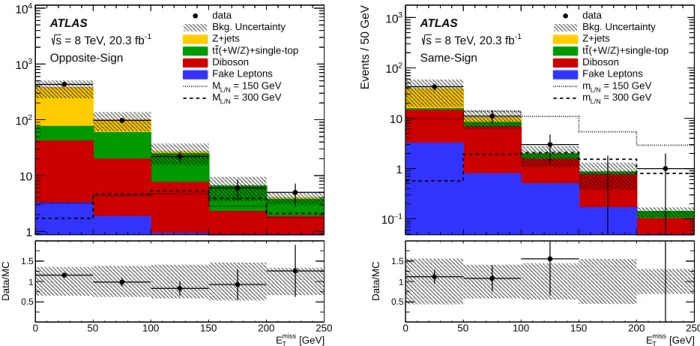
Figure 1 shows a comparison of the missing transverse momentum distribution of data, expected backgrounds and signal predictions when all the selection requiments, except for the missing transverse momentum re-quirement, are applied. The shape and the rate of the background estimate is in good agreement with the data. The background estimates are validated by comparing the predicted numbers of events in simulation to those observed in data in several control regions that have event selection criteria similar to those for the signal region.
The control region for top quark pairs is defined by
TABLE I. Event yields for opposite-sign (OS) and same-sign (SS) selection for predicted backgrounds, data, and type-III seesaw lepton pair-production with masses of 150 and 300 GeV. The reported errors include both the statistical and sys-tematic uncertainties.
OS SS
Fake Leptons 1.4 ± 0.9 0.67 ± 0.42 Z+jets 2.4 ± 1.2 0.06 ± 0.23 W W/W Z/ZZ 9.2 ± 2.9 1.95 ± 0.58 t¯t (+W/Z) and single top 17.9 ± 6.9 0.47 ± 0.25 Total 31.0 ± 7.7 3.15 ± 0.80
Data 25 4
Signal mL/N = 150 GeV 9.5 ± 1.6 20.3 ± 2.3
Events / 50 GeV 1 10 2 10 3 10 4 10 ATLAS -1 = 8 TeV, 20.3 fb s Opposite-Sign data Bkg. Uncertainty Z+jets (+W/Z)+single-top t t Diboson Fake Leptons = 150 GeV L/N M = 300 GeV L/N M [GeV] miss T E 0 50 100 150 200 250 Data/MC 0.5 1 1.5 Events / 50 GeV 1 − 10 1 10 2 10 3 10 ATLAS -1 = 8 TeV, 20.3 fb s Same-Sign data Bkg. Uncertainty Z+jets (+W/Z)+single-top t t Diboson Fake Leptons = 150 GeV L/N m = 300 GeV L/N m [GeV] miss T E 0 50 100 150 200 250 Data/MC 0.5 1 1.5
FIG. 1. The missing transverse momentum distribution of opposite-sign (left) and same-sign (right) events for data and predictions. The dotted and dashed lines show the expected distribution of type-III seesaw lepton pair-production with masses of 150 and 300 GeV, respectively. The events shown here are required to pass all selection requirements except that on the missing transverse momentum. The uncertainties shown include both statistical and systematic uncertainties.
selecting events with two b-tagged jets. In this region,
OS ee SS ee OS µµ SS µµ OS eµ SS eµ
Events
1
10
210
310
410
data Bkg. Uncertainty Z+jets (+W/Z)+single-top t t Diboson Fake Leptons = 150 GeV L/N M = 300 GeV L/N MATLAS
-1= 8 TeV, 20.3 fb
s
FIG. 2. Event yields for opposite-sign (OS) and same-sign (SS) selection for ee, µµ, and eµ predicted backgrounds, data, and signal events featuring type-III seesaw lepton pair-production with masses 150 and 300 GeV. The reported un-certainties include both the statistical and systematic uncer-tainties.
according to MC simulation, all the events are from top quark pair and single top quark production with a neg-ligible contribution from other sources. MC simulation
predicts 26 ± 3 (stat.) events and in data 32 events
are observed. The scale factor, the ratio of the observed and predicted event yields, is found to be consistent with unity.
The diboson control region is obtained using a W Z-enriched sample of events containing three leptons with-out a requirement on the missing transverse momentum. In this control region, according to MC simulation all the events are from diboson production with a negligible contribution from other sources. MC simulation predicts 11 ± 1 events and in data 9 events are observed. The scale factor is found to be consistent with unity.
SYSTEMATIC UNCERTAINTIES
The uncertainties on the rate of top quark and diboson backgrounds due to potential differences between data and MC simulation are evaluated using the statistical uncertainties of the measured scale factors in the control samples. They are the dominant systematic uncertain-ties (∼ 35%) on the background estimates. For top quark production, an additional systematic uncertainty is con-sidered to account for a potential difference between scale factors in the control region and the signal region. This
[GeV] L/N m 100 200 300 400 500 600 Wl) [pb] ν W → 0 N ± L → (pp σ -3 10 -2 10 -1 10 1 10 2 10
Observed 95% C.L. upper limit Expected 95% C.L. upper limit 1 std. dev. ± Expected limit 2 std. dev. ± Expected limit Wl) → 0 BR(N × ) ν W → ± BR(L × ) 0 N ± L → (pp σ Wl)=1 → 0 BR(N × ) ν W → ± ), BR(L 0 N ± L → (pp σ ATLAS -1 = 8 TeV, 20.3 fb s =0.43 e b =0.57 µ b =0 τ b [GeV] L/N m 100 200 300 400 500 600 Wl) → 0 BR(N × ) ν W → ± BR(L 0 0.1 0.2 0.3 0.4 0.5 0.6 0.7 0.8 0.9 1 Expected 95% C.L. limit 1 std. dev. ± Expected limit Observed 95% C.L. limit Type III seesaw BR
ATLAS -1 = 8 TeV, 20.3 fb s =0.43 e b =0.57 µ b =0 τ b
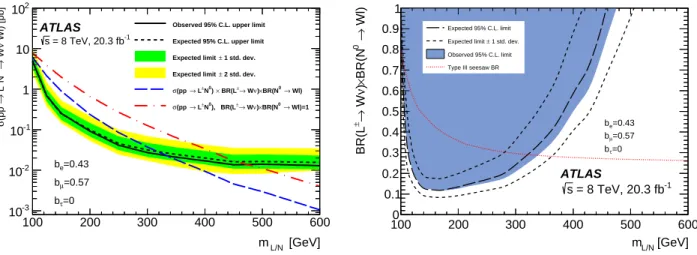
FIG. 3. Left: Observed (solid line) and expected (dashed line) 95% C.L. upper limits on the type-III seesaw heavy lepton cross-section as a function of the heavy lepton L or N mass assuming be= 0.43, bµ= 0.57, and bτ = 0. The bands surrounding the
expected limit correspond to one and two standard deviations on the expected limit. The large-dashed (dot-dashed) line shows the theoretical prediction for mL/N-dependent (maximal) branching fraction for decays to a W boson. Right: The expected
(large-dashed line) and observed (shaded region) upper limits at the 95% C.L. on the BR(L± → W ν) × BR(N0 → W±
l∓) versus mL/N. The dashed line corresponds to one standard deviation around the expected limit. The dotted line shows the
nominal mass-dependent branching ratio of the type-III seesaw model.
[GeV] L/N m 100 200 300 400 500 600 We) [pb] ν W → 0 N ± L → (pp σ -3 10 -2 10 -1 10 1 10 2 10
Observed 95% C.L. upper limit Expected 95% C.L. upper limit 1 std. dev. ± Expected limit 2 std. dev. ± Expected limit We) → 0 BR(N × ) ν W → ± BR(L × ) 0 N ± L → (pp σ We)=1 → 0 BR(N × ) ν W → ± ), BR(L 0 N ± L → (pp σ =1 e b =0 µ b =0 τ b ATLAS -1 = 8 TeV, 20.3 fb s [GeV] L/N m 100 200 300 400 500 600 ) [pb] µ W ν W → 0 N ± L → (pp σ 3 − 10 2 − 10 1 − 10 1 10 2 10
Observed 95% C.L. upper limit Expected 95% C.L. upper limit 1 std. dev. ± Expected limit 2 std. dev. ± Expected limit ) µ W → 0 BR(N × ) ν W → ± BR(L × ) 0 N ± L → (pp σ )=1 µ W → 0 BR(N × ) ν W → ± ), BR(L 0 N ± L → (pp σ ATLAS -1 = 8 TeV, 20.3 fb s =0 e b =1 µ b =0 τ b
FIG. 4. Observed (solid line) and expected (dashed line) 95% C.L. upper limits on the type-III seesaw heavy lepton cross-section as a function of the heavy lepton L or N mass for exclusive coupling to electrons (left) and exclusive coupling to muons (right). In the left plot, the dashed line is covered by the solid line. The large-dashed (dot-dashed) line shows the theoretical prediction for mL/N dependent (maximal) branching fraction for decays to a W boson.
tive t¯t MC samples. These samples include events that
are generated using Powheg-Box 1.0 (patch 4)[44–46] and the leading-order, multileg generator Alpgen v2.13 [47]. The Powheg-Box generator is interfaced to the Pythia 6.426 showering routines with either CT10 or
HeraPDF [48] PDF sets and with the Powheg hdamp
parameter set to either the mass of the top quark or in-finity [49]. Alpgen is interfaced to Herwig 6.520, and used to simulate top pair events with up to four
addi-tional partons in the matrix element. The
uncertain-ties due to QCD ISR and FSR modeling are estimated with samples generated with AcerMC v3.8 interfaced
to Pythia 6.426 in which the parton shower parameters are varied in a range consistent with a measurement of
additional hadronic activity in t¯t events [50]. The
differ-ences observed in the signal region by using different MC simulations are about 35%.
For the Z+n-jets (n ≥ 2) background estimate, the dominant systematic uncertainty in the OS final state is from the uncertainty on its production cross-section (∼ 50%) [51]. For the SS final state, the systematic un-certainty is dominated by the statistical unun-certainty on the measured electron charge misidentification rate.
leptons are determined in dedicated studies using a com-bination of simulation and data. They account for poten-tial biases in the method used to extract the reweighting factors, and for the dependency of the reweighting factors on the event topology.
For both the predicted signal and background event yields, uncertainties resulting from detector effects from jet energy scale and resolution [40], lepton reconstruction and identification efficiencies [36, 52], lepton momentum scales and resolutions [52, 53], and missing transverse momentum [42] are considered. They are typically small (1–5%). The theoretical uncertainties on the signal pro-duction cross-section and acceptance, such as PDF choice and ISR and FSR modeling, are found to be negligible.
The background estimates and their uncertainties are tested in two other regions: a Z+jets control region and the hadronic W sidebands. The Z+jets control region is selected by requiring the invariant mass of the oppositely-charged lepton pair to be consistent with the Z boson mass. In this region, approximately 70% of the events are from a Z boson produced in association with jets. The predicted number of events is 34 ± 4, where the error includes both the statistical and systematic
uncer-tainties, and 32 events are observed in data. For the
hadronic W sidebands, the analysis was repeated using the same event selection, but requiring the invariant mass of the hadronically decaying W candidate to be 35 <
mjj < 60 GeV or 100 < mjj < 125 GeV. This selection
provides samples dominated by background events with kinematic properties similar to those of the signal candi-dates. In this region the predicted number of events is 34 ± 7 events, where the error includes both the statistical and systematic uncertainties, and in data 18 events are observed. The data are in agreement with the predictions within 1.9 standard deviations.
RESULTS AND INTERPRETATION
Table I shows the predicted numbers of signal and background events and the observed data events in the signal region. The data agree with the background-only
hypothesis. Figure 2 shows the flavor composition of
the simulated signal and background events, and of the observed events in data. In the absence of any signif-icant data excess, upper limits on the production rate
of pp → N0L± → W±`∓W±ν at the 95% confidence
level (C.L.) are derived as a function of the heavy lepton
mass using the CLS method [54]. The results of limit
calculations combining the observations in the OS and SS final states are shown in Figs. 3 and 4. With the de-fault mixing angles considered here, heavy leptons with masses less than 335 GeV are excluded by the analysis, while masses less than 475 GeV are excluded in the sce-nario in which heavy leptons can only decay to the W ` or W ν final states. For comparison, upper limits are also
calculated for different theoretical assumptions, such as exclusive coupling between the heavy leptons and muons
(be = 0, bµ = 1) or electrons (be = 1, bµ = 0 ). In the
limit calculations for exclusive couplings, events in the two-muon (two-electron) final state are excluded for ex-clusive electron (muon) coupling. Heavy leptons with a mass below 400 (325) GeV can be ruled out by the data in the case of exclusive coupling to muons (electrons). Masses less than 540 (470) GeV are excluded in the sce-nario in which heavy leptons can only decay to the W ` or W ν final state.
CONCLUSIONS
A search for the pair-production of heavy leptons pre-dicted by the type-III seesaw model is presented. The analysis is performed using a final state that contains two leptons, two jets from a hadronically decaying W boson, and large missing transverse momentum. The data used in the search correspond to an integrated luminosity of
20.3 fb−1 of pp collisions at√s = 8 TeV collected by the
ATLAS detector at the LHC. No evidence of heavy lep-ton production is observed. Heavy leplep-tons with masses below 325–540 GeV are excluded at the 95% confidence level, depending on the considered theoretical scenarios.
ACKNOWLEDGMENTS
We thank CERN for the very successful operation of the LHC, as well as the support staff from our institutions without whom ATLAS could not be operated efficiently. We acknowledge the support of ANPCyT, Argentina; YerPhI, Armenia; ARC, Australia; BMWFW and FWF, Austria; ANAS, Azerbaijan; SSTC, Belarus; CNPq and FAPESP, Brazil; NSERC, NRC and CFI, Canada; CERN; CONICYT, Chile; CAS, MOST and NSFC, China; COLCIENCIAS, Colombia; MSMT CR, MPO CR and VSC CR, Czech Republic; DNRF, DNSRC and Lundbeck Foundation, Denmark; EPLANET, ERC
and NSRF, European Union; IN2P3-CNRS,
CEA-DSM/IRFU, France; GNSF, Georgia; BMBF, DFG, HGF, MPG and AvH Foundation, Germany; GSRT and NSRF, Greece; RGC, Hong Kong SAR, China; ISF, MINERVA, GIF, I-CORE and Benoziyo Center, Israel; INFN, Italy; MEXT and JSPS, Japan; CNRST, Mo-rocco; FOM and NWO, Netherlands; BRF and RCN, Norway; MNiSW and NCN, Poland; GRICES and FCT, Portugal; MNE/IFA, Romania; MES of Russia and NRC KI, Russian Federation; JINR; MSTD, Serbia; MSSR,
Slovakia; ARRS and MIZˇS, Slovenia; DST/NRF, South
Africa; MINECO, Spain; SRC and Wallenberg Foun-dation, Sweden; SER, SNSF and Cantons of Bern and Geneva, Switzerland; NSC, Taiwan; TAEK, Turkey;
STFC, the Royal Society and Leverhulme Trust, United Kingdom; DOE and NSF, United States of America.
The crucial computing support from all WLCG part-ners is acknowledged gratefully, in particular from CERN and the ATLAS Tier-1 facilities at TRIUMF (Canada), NDGF (Denmark, Norway, Sweden), CC-IN2P3 (France), KIT/GridKA (Germany), INFN-CNAF (Italy), NL-T1 (Netherlands), PIC (Spain), ASGC (Tai-wan), RAL (UK) and BNL (USA) and in the Tier-2 fa-cilities worldwide.
[1] K. Olive et al. (Particle Data Group), Chin. Phys. C38, 090001 (2014).
[2] E. Ma, Phys. Rev. Lett. 81, 1171 (1998), arXiv:hep-ph/9805219 [hep-ph].
[3] P. Minkowski, Phys. Lett. B67, 421 (1977).
[4] R. N. Mohapatra and G. Senjanovic, Phys. Rev. Lett. 44, 912 (1980).
[5] R. Foot, H. Lew, X. He, and G. C. Joshi, Z. Phys. C44, 441 (1989).
[6] CMS Collaboration, Phys. Lett. B718, 348 (2012), arXiv:1210.1797 [hep-ex].
[7] ATLAS Collaboration, Submitted to J. High Energy Phys. (2015), arXiv:1506.01291 [hep-ex].
[8] P. Achard et al. (L3 Collaboration), Phys. Lett. B517, 75 (2001), arXiv:hep-ex/0107015 [hep-ex].
[9] C. Biggio and F. Bonnet, Eur. Phys. J. C72, 1899 (2012), arXiv:1107.3463 [hep-ph].
[10] R. Franceschini, T. Hambye, and A. Strumia, Phys. Rev. D78, 033002 (2008), arXiv:0805.1613 [hep-ph].
[11] J. Aguilar-Saavedra, Nucl. Phys. B828, 289 (2010), arXiv:0905.2221 [hep-ph].
[12] K. Kumericki, I. Picek, and B. Radovcic, Phys. Rev. D86, 013006 (2012), arXiv:1204.6599 [hep-ph].
[13] A. Abada, C. Biggio, F. Bonnet, M. Gavela, and T. Ham-bye, Phys. Rev. D78, 033007 (2008), arXiv:0803.0481 [hep-ph].
[14] A. Abada, C. Biggio, F. Bonnet, M. Gavela, and T. Hambye, J. High Energy Phys. 0712, 061 (2007), arXiv:0707.4058 [hep-ph].
[15] F. del Aguila, J. de Blas, and M. Perez-Victoria, Phys. Rev. D78, 013010 (2008), arXiv:0803.4008 [hep-ph]. [16] ATLAS Collaboration, JINST 3, S08003 (2008). [17] ATLAS Collaboration, Eur. Phys. J. C 73, 2518 (2013),
arXiv:1302.4393 [hep-ex].
[18] ATLAS Collaboration, Eur. Phys. J. C72, 1849 (2012), arXiv:1110.1530 [hep-ex].
[19] J. Alwall, M. Herquet, F. Maltoni, O. Mattelaer, and T. Stelzer, J. High Energy Phys. 1106, 128 (2011), arXiv:1106.0522 [hep-ph].
[20] F. Maltoni and T. Stelzer, J. High Energy Phys. 0302, 027 (2003), arXiv:hep-ph/0208156 [hep-ph].
[21] A. Martin, W. Stirling, R. Thorne, and G. Watt, Eur. Phys. J. C63, 189 (2009), arXiv:0901.0002 [hep-ph]. [22] T. Sj¨ostrand, S. Mrenna and P. Skands, Comput. Phys.
Commun. 178, 852 (2008), arXiv:0710.3820 [hep-ph]. [23] T. Gleisberg et al., J. High Energy Phys. 0902, 007
(2009), arXiv:0811.4622 [hep-ph].
[24] S. Catani, F. Krauss, R. Kuhn, and B. Webber, J. High Energy Phys. 0111, 063 (2001), arXiv:hep-ph/0109231 [hep-ph].
[25] H.-L. Lai et al., Phys. Rev. D 82, 074024 (2010), arXiv:1007.2241 [hep-ph].
[26] Production mechanisms involving weak interactions at Born level (of order α4EW without considering the boson
decay, where αEW is the electroweak coupling constant)
are referred to as electroweak production [55]. Production mechanisms involving both the strong and electroweak interactions at Born level (of order α2Sα2EW, where αS is
the strong coupling constant) are referred to as strong production.
[27] S. Frixione and B. R. Webber, J. High Energy Phys. 0206, 029 (2002), arXiv:hep-ph/0204244 [hep-ph]. [28] G. Corcella et al., J. High Energy Phys. 0101, 010 (2001),
arXiv:hep-ph/0011363 [hep-ph].
[29] J. Butterworth, J. R. Forshaw, and M. Seymour, Z. Phys. C 72, 637 (1996), arXiv:hep-ph/9601371 [hep-ph]. [30] J. Pumplin et al., J. High Energy Phys. 0207, 012 (2002),
arXiv:hep-ph/0201195 [hep-ph].
[31] B. P. Kersevan and E. Richter-Was, Comput. Phys. Com-mun. 184, 919 (2013), arXiv:hep-ph/0405247 [hep-ph]. [32] T. Sj¨ostrand, S. Mrenna and P. Skands, J. High Energy
Phys. 0605, 026 (2006), arXiv:hep-ph/0603175 [hep-ph]. [33] S. Agostinelli et al. (GEANT4 Collaboration), Nucl.
In-strum. Meth. A506, 250 (2003).
[34] ATLAS Collaboration, Eur. Phys. J. C 70, 823 (2010), arXiv:1005.4568 [physics.ins-det].
[35] ATLAS Collaboration, ATL-PHYS-PUB-2010-013 (2010), http://cdsweb.cern.ch/record/1300517.
[36] ATLAS Collaboration, Eur. Phys. J. C74, 2941 (2014), arXiv:1404.2240 [hep-ex].
[37] ATLAS uses a right-handed coordinate system with its origin at the nominal interaction point (IP) in the center of the detector and the z-axis along the beam pipe. The x-axis points from the IP to the center of the LHC ring, and the y-axis points upward. Cylindrical coordinates (r, φ) are used in the transverse plane, φ being the azimuthal angle around the beam pipe. The pseudorapidity is de-fined in terms of the polar angle θ as η = − ln tan(θ/2). [38] ATLAS Collaboration, Submitted to J. High Energy
Phys. arXiv:1411.2921 [hep-ex].
[39] M. Cacciari, G. P. Salam, and G. Soyez, J. High Energy Phys. 0804, 063 (2008), arXiv:0802.1189 [hep-ph]. [40] ATLAS Collaboration, Eur. Phys. J. C 73, 2304 (2013),
arXiv:1112.6426 [hep-ex].
[41] ATLAS Collaboration, ATLAS-CONF-2011-102 (2011), http://cdsweb.cern.ch/record/1369219.
[42] ATLAS Collaboration, Eur. Phys. J. C 72, 1844 (2012), arXiv:1108.5602 [hep-ex].
[43] ATLAS Collaboration, Eur. Phys. J. C 72, 1909 (2012), arXiv:1110.3174 [hep-ex].
[44] P. Nason, J. High Energy Phys. 0411, 040 (2004), arXiv:hep-ph/0409146 [hep-ph].
[45] S. Frixione, P. Nason, and C. Oleari, J. High Energy Phys. 11, 070 (2007), arXiv:0709.2092 [hep-ph].
[46] S. Alioli, P. Nason, C. Oleari, and E. Re, J. High Energy Phys. 1006, 043 (2010), arXiv:1002.2581 [hep-ph]. [47] M. L. Mangano, M. Moretti, F. Piccinini, R. Pittau, and
A. D. Polosa, J. High Energy Phys. 0307, 001 (2003), arXiv:hep-ph/0206293 [hep-ph].
[48] F. Aaron et al. (H1 and ZEUS Collaborations), J. High Energy Phys. 1001, 109 (2010), arXiv:0911.0884
[hep-ex].
[49] ATLAS Collaboration, ATL-PHYS-PUB-2013-005 (2013), https://cds.cern.ch/record/1532067.
[50] ATLAS Collaboration, Eur. Phys. J. C72, 2043 (2012), arXiv:1203.5015 [hep-ex].
[51] J. Alwall et al., Eur. Phys. J. C53, 473 (2008), arXiv:0706.2569 [hep-ph].
[52] ATLAS Collaboration, Eur. Phys. J. C74, 3130 (2014), arXiv:1407.3935 [hep-ex].
[53] ATLAS Collaboration, Eur. Phys. J. C74, 3071 (2014), arXiv:1407.5063 [hep-ex].
[54] T. Junk, Nucl. Instrum. Meth. A434, 435 (1999), arXiv:hep-ex/9902006 [hep-ex].
[55] ATLAS Collaboration, Phys. Rev. Lett. 113, 141803 (2014), arXiv:1405.6241 [hep-ex].
The ATLAS Collaboration
G. Aad85, B. Abbott113, J. Abdallah151, O. Abdinov11, R. Aben107, M. Abolins90, O.S. AbouZeid158,
H. Abramowicz153, H. Abreu152, R. Abreu30, Y. Abulaiti146a,146b, B.S. Acharya164a,164b,a, L. Adamczyk38a,
D.L. Adams25, J. Adelman108, S. Adomeit100, T. Adye131, A.A. Affolder74, T. Agatonovic-Jovin13,
J.A. Aguilar-Saavedra126a,126f, S.P. Ahlen22, F. Ahmadov65,b, G. Aielli133a,133b, H. Akerstedt146a,146b,
T.P.A. ˚Akesson81, G. Akimoto155, A.V. Akimov96, G.L. Alberghi20a,20b, J. Albert169, S. Albrand55,
M.J. Alconada Verzini71, M. Aleksa30, I.N. Aleksandrov65, C. Alexa26a, G. Alexander153, T. Alexopoulos10,
M. Alhroob113, G. Alimonti91a, L. Alio85, J. Alison31, S.P. Alkire35, B.M.M. Allbrooke18, P.P. Allport74,
A. Aloisio104a,104b, A. Alonso36, F. Alonso71, C. Alpigiani76, A. Altheimer35, B. Alvarez Gonzalez30,
D. ´Alvarez Piqueras167, M.G. Alviggi104a,104b, B.T. Amadio15, K. Amako66, Y. Amaral Coutinho24a, C. Amelung23,
D. Amidei89, S.P. Amor Dos Santos126a,126c, A. Amorim126a,126b, S. Amoroso48, N. Amram153, G. Amundsen23,
C. Anastopoulos139, L.S. Ancu49, N. Andari30, T. Andeen35, C.F. Anders58b, G. Anders30, J.K. Anders74,
K.J. Anderson31, A. Andreazza91a,91b, V. Andrei58a, S. Angelidakis9, I. Angelozzi107, P. Anger44, A. Angerami35,
F. Anghinolfi30, A.V. Anisenkov109,c, N. Anjos12, A. Annovi124a,124b, M. Antonelli47, A. Antonov98, J. Antos144b,
F. Anulli132a, M. Aoki66, L. Aperio Bella18, G. Arabidze90, Y. Arai66, J.P. Araque126a, A.T.H. Arce45,
F.A. Arduh71, J-F. Arguin95, S. Argyropoulos42, M. Arik19a, A.J. Armbruster30, O. Arnaez30, V. Arnal82,
H. Arnold48, M. Arratia28, O. Arslan21, A. Artamonov97, G. Artoni23, S. Asai155, N. Asbah42, A. Ashkenazi153,
B. ˚Asman146a,146b, L. Asquith149, K. Assamagan25, R. Astalos144a, M. Atkinson165, N.B. Atlay141, B. Auerbach6,
K. Augsten128, M. Aurousseau145b, G. Avolio30, B. Axen15, M.K. Ayoub117, G. Azuelos95,d, M.A. Baak30,
A.E. Baas58a, C. Bacci134a,134b, H. Bachacou136, K. Bachas154, M. Backes30, M. Backhaus30, P. Bagiacchi132a,132b,
P. Bagnaia132a,132b, Y. Bai33a, T. Bain35, J.T. Baines131, O.K. Baker176, P. Balek129, T. Balestri148, F. Balli84,
E. Banas39, Sw. Banerjee173, A.A.E. Bannoura175, H.S. Bansil18, L. Barak30, E.L. Barberio88, D. Barberis50a,50b,
M. Barbero85, T. Barillari101, M. Barisonzi164a,164b, T. Barklow143, N. Barlow28, S.L. Barnes84, B.M. Barnett131,
R.M. Barnett15, Z. Barnovska5, A. Baroncelli134a, G. Barone49, A.J. Barr120, F. Barreiro82,
J. Barreiro Guimar˜aes da Costa57, R. Bartoldus143, A.E. Barton72, P. Bartos144a, A. Basalaev123, A. Bassalat117,
A. Basye165, R.L. Bates53, S.J. Batista158, J.R. Batley28, M. Battaglia137, M. Bauce132a,132b, F. Bauer136,
H.S. Bawa143,e, J.B. Beacham111, M.D. Beattie72, T. Beau80, P.H. Beauchemin161, R. Beccherle124a,124b,
P. Bechtle21, H.P. Beck17,f, K. Becker120, M. Becker83, S. Becker100, M. Beckingham170, C. Becot117,
A.J. Beddall19b, A. Beddall19b, V.A. Bednyakov65, C.P. Bee148, L.J. Beemster107, T.A. Beermann175, M. Begel25,
J.K. Behr120, C. Belanger-Champagne87, W.H. Bell49, G. Bella153, L. Bellagamba20a, A. Bellerive29, M. Bellomo86,
K. Belotskiy98, O. Beltramello30, O. Benary153, D. Benchekroun135a, M. Bender100, K. Bendtz146a,146b,
N. Benekos10, Y. Benhammou153, E. Benhar Noccioli49, J.A. Benitez Garcia159b, D.P. Benjamin45, J.R. Bensinger23,
S. Bentvelsen107, L. Beresford120, M. Beretta47, D. Berge107, E. Bergeaas Kuutmann166, N. Berger5, F. Berghaus169,
J. Beringer15, C. Bernard22, N.R. Bernard86, C. Bernius110, F.U. Bernlochner21, T. Berry77, P. Berta129,
C. Bertella83, G. Bertoli146a,146b, F. Bertolucci124a,124b, C. Bertsche113, D. Bertsche113, M.I. Besana91a,
G.J. Besjes106, O. Bessidskaia Bylund146a,146b, M. Bessner42, N. Besson136, C. Betancourt48, S. Bethke101,
A.J. Bevan76, W. Bhimji46, R.M. Bianchi125, L. Bianchini23, M. Bianco30, O. Biebel100, S.P. Bieniek78,
M. Biglietti134a, J. Bilbao De Mendizabal49, H. Bilokon47, M. Bindi54, S. Binet117, A. Bingul19b, C. Bini132a,132b,
C.W. Black150, J.E. Black143, K.M. Black22, D. Blackburn138, R.E. Blair6, J.-B. Blanchard136, J.E. Blanco77,
T. Blazek144a, I. Bloch42, C. Blocker23, W. Blum83,∗, U. Blumenschein54, G.J. Bobbink107, V.S. Bobrovnikov109,c,
S.S. Bocchetta81, A. Bocci45, C. Bock100, M. Boehler48, J.A. Bogaerts30, D. Bogavac13, A.G. Bogdanchikov109,
C. Bohm146a, V. Boisvert77, T. Bold38a, V. Boldea26a, A.S. Boldyrev99, M. Bomben80, M. Bona76,
M. Boonekamp136, A. Borisov130, G. Borissov72, S. Borroni42, J. Bortfeldt100, V. Bortolotto60a,60b,60c, K. Bos107,
D. Boscherini20a, M. Bosman12, J. Boudreau125, J. Bouffard2, E.V. Bouhova-Thacker72, D. Boumediene34,
C. Bourdarios117, N. Bousson114, A. Boveia30, J. Boyd30, I.R. Boyko65, I. Bozic13, J. Bracinik18, A. Brandt8,
G. Brandt54, O. Brandt58a, U. Bratzler156, B. Brau86, J.E. Brau116, H.M. Braun175,∗, S.F. Brazzale164a,164c,
W.D. Breaden Madden53, K. Brendlinger122, A.J. Brennan88, L. Brenner107, R. Brenner166, S. Bressler172,
K. Bristow145c, T.M. Bristow46, D. Britton53, D. Britzger42, F.M. Brochu28, I. Brock21, R. Brock90, J. Bronner101,
G. Brooijmans35, T. Brooks77, W.K. Brooks32b, J. Brosamer15, E. Brost116, J. Brown55,
P.A. Bruckman de Renstrom39, D. Bruncko144b, R. Bruneliere48, A. Bruni20a, G. Bruni20a, M. Bruschi20a,
N. Bruscino21, L. Bryngemark81, T. Buanes14, Q. Buat142, P. Buchholz141, A.G. Buckley53, S.I. Buda26a,
I.A. Budagov65, F. Buehrer48, L. Bugge119, M.K. Bugge119, O. Bulekov98, D. Bullock8, H. Burckhart30, S. Burdin74,
B. Burghgrave108, S. Burke131, I. Burmeister43, E. Busato34, D. B¨uscher48, V. B¨uscher83, P. Bussey53, J.M. Butler22,
A.I. Butt3, C.M. Buttar53, J.M. Butterworth78, P. Butti107, W. Buttinger25, A. Buzatu53, A.R. Buzykaev109,c,
P. Calfayan100, L.P. Caloba24a, D. Calvet34, S. Calvet34, R. Camacho Toro31, S. Camarda42, P. Camarri133a,133b,
D. Cameron119, L.M. Caminada15, R. Caminal Armadans165, S. Campana30, M. Campanelli78, A. Campoverde148,
V. Canale104a,104b, A. Canepa159a, M. Cano Bret76, J. Cantero82, R. Cantrill126a, T. Cao40,
M.D.M. Capeans Garrido30, I. Caprini26a, M. Caprini26a, M. Capua37a,37b, R. Caputo83, R. Cardarelli133a,
F. Cardillo48, T. Carli30, G. Carlino104a, L. Carminati91a,91b, S. Caron106, E. Carquin32a, G.D. Carrillo-Montoya8,
J.R. Carter28, J. Carvalho126a,126c, D. Casadei78, M.P. Casado12, M. Casolino12, E. Castaneda-Miranda145b,
A. Castelli107, V. Castillo Gimenez167, N.F. Castro126a,g, P. Catastini57, A. Catinaccio30, J.R. Catmore119,
A. Cattai30, J. Caudron83, V. Cavaliere165, D. Cavalli91a, M. Cavalli-Sforza12, V. Cavasinni124a,124b,
F. Ceradini134a,134b, B.C. Cerio45, K. Cerny129, A.S. Cerqueira24b, A. Cerri149, L. Cerrito76, F. Cerutti15,
M. Cerv30, A. Cervelli17, S.A. Cetin19c, A. Chafaq135a, D. Chakraborty108, I. Chalupkova129, P. Chang165,
B. Chapleau87, J.D. Chapman28, D.G. Charlton18, C.C. Chau158, C.A. Chavez Barajas149, S. Cheatham152,
A. Chegwidden90, S. Chekanov6, S.V. Chekulaev159a, G.A. Chelkov65,h, M.A. Chelstowska89, C. Chen64, H. Chen25,
K. Chen148, L. Chen33d,i, S. Chen33c, X. Chen33f, Y. Chen67, H.C. Cheng89, Y. Cheng31, A. Cheplakov65,
E. Cheremushkina130, R. Cherkaoui El Moursli135e, V. Chernyatin25,∗, E. Cheu7, L. Chevalier136, V. Chiarella47,
J.T. Childers6, G. Chiodini73a, A.S. Chisholm18, R.T. Chislett78, A. Chitan26a, M.V. Chizhov65, K. Choi61,
S. Chouridou9, B.K.B. Chow100, V. Christodoulou78, D. Chromek-Burckhart30, J. Chudoba127, A.J. Chuinard87,
J.J. Chwastowski39, L. Chytka115, G. Ciapetti132a,132b, A.K. Ciftci4a, D. Cinca53, V. Cindro75, I.A. Cioara21,
A. Ciocio15, Z.H. Citron172, M. Ciubancan26a, A. Clark49, B.L. Clark57, P.J. Clark46, R.N. Clarke15, W. Cleland125,
C. Clement146a,146b, Y. Coadou85, M. Cobal164a,164c, A. Coccaro138, J. Cochran64, L. Coffey23, J.G. Cogan143,
B. Cole35, S. Cole108, A.P. Colijn107, J. Collot55, T. Colombo58c, G. Compostella101, P. Conde Mui˜no126a,126b,
E. Coniavitis48, S.H. Connell145b, I.A. Connelly77, S.M. Consonni91a,91b, V. Consorti48, S. Constantinescu26a,
C. Conta121a,121b, G. Conti30, F. Conventi104a,j, M. Cooke15, B.D. Cooper78, A.M. Cooper-Sarkar120,
T. Cornelissen175, M. Corradi20a, F. Corriveau87,k, A. Corso-Radu163, A. Cortes-Gonzalez12, G. Cortiana101,
G. Costa91a, M.J. Costa167, D. Costanzo139, D. Cˆot´e8, G. Cottin28, G. Cowan77, B.E. Cox84, K. Cranmer110,
G. Cree29, S. Cr´ep´e-Renaudin55, F. Crescioli80, W.A. Cribbs146a,146b, M. Crispin Ortuzar120, M. Cristinziani21,
V. Croft106, G. Crosetti37a,37b, T. Cuhadar Donszelmann139, J. Cummings176, M. Curatolo47, C. Cuthbert150,
H. Czirr141, P. Czodrowski3, S. D’Auria53, M. D’Onofrio74, M.J. Da Cunha Sargedas De Sousa126a,126b, C. Da Via84,
W. Dabrowski38a, A. Dafinca120, T. Dai89, O. Dale14, F. Dallaire95, C. Dallapiccola86, M. Dam36, J.R. Dandoy31,
N.P. Dang48, A.C. Daniells18, M. Danninger168, M. Dano Hoffmann136, V. Dao48, G. Darbo50a, S. Darmora8,
J. Dassoulas3, A. Dattagupta61, W. Davey21, C. David169, T. Davidek129, E. Davies120,l, M. Davies153, P. Davison78,
Y. Davygora58a, E. Dawe88, I. Dawson139, R.K. Daya-Ishmukhametova86, K. De8, R. de Asmundis104a,
S. De Castro20a,20b, S. De Cecco80, N. De Groot106, P. de Jong107, H. De la Torre82, F. De Lorenzi64, L. De Nooij107,
D. De Pedis132a, A. De Salvo132a, U. De Sanctis149, A. De Santo149, J.B. De Vivie De Regie117, W.J. Dearnaley72,
R. Debbe25, C. Debenedetti137, D.V. Dedovich65, I. Deigaard107, J. Del Peso82, T. Del Prete124a,124b, D. Delgove117,
F. Deliot136, C.M. Delitzsch49, M. Deliyergiyev75, A. Dell’Acqua30, L. Dell’Asta22, M. Dell’Orso124a,124b,
M. Della Pietra104a,j, D. della Volpe49, M. Delmastro5, P.A. Delsart55, C. Deluca107, D.A. DeMarco158,
S. Demers176, M. Demichev65, A. Demilly80, S.P. Denisov130, D. Derendarz39, J.E. Derkaoui135d, F. Derue80,
P. Dervan74, K. Desch21, C. Deterre42, P.O. Deviveiros30, A. Dewhurst131, S. Dhaliwal23, A. Di Ciaccio133a,133b,
L. Di Ciaccio5, A. Di Domenico132a,132b, C. Di Donato104a,104b, A. Di Girolamo30, B. Di Girolamo30,
A. Di Mattia152, B. Di Micco134a,134b, R. Di Nardo47, A. Di Simone48, R. Di Sipio158, D. Di Valentino29,
C. Diaconu85, M. Diamond158, F.A. Dias46, M.A. Diaz32a, E.B. Diehl89, J. Dietrich16, S. Diglio85, A. Dimitrievska13,
J. Dingfelder21, P. Dita26a, S. Dita26a, F. Dittus30, F. Djama85, T. Djobava51b, J.I. Djuvsland58a,
M.A.B. do Vale24c, D. Dobos30, M. Dobre26a, C. Doglioni49, T. Dohmae155, J. Dolejsi129, Z. Dolezal129,
B.A. Dolgoshein98,∗, M. Donadelli24d, S. Donati124a,124b, P. Dondero121a,121b, J. Donini34, J. Dopke131, A. Doria104a,
M.T. Dova71, A.T. Doyle53, E. Drechsler54, M. Dris10, E. Dubreuil34, E. Duchovni172, G. Duckeck100,
O.A. Ducu26a,85, D. Duda175, A. Dudarev30, L. Duflot117, L. Duguid77, M. D¨uhrssen30, M. Dunford58a,
H. Duran Yildiz4a, M. D¨uren52, A. Durglishvili51b, D. Duschinger44, M. Dyndal38a, C. Eckardt42, K.M. Ecker101,
R.C. Edgar89, W. Edson2, N.C. Edwards46, W. Ehrenfeld21, T. Eifert30, G. Eigen14, K. Einsweiler15, T. Ekelof166,
M. El Kacimi135c, M. Ellert166, S. Elles5, F. Ellinghaus83, A.A. Elliot169, N. Ellis30, J. Elmsheuser100, M. Elsing30,
D. Emeliyanov131, Y. Enari155, O.C. Endner83, M. Endo118, J. Erdmann43, A. Ereditato17, G. Ernis175, J. Ernst2,
M. Ernst25, S. Errede165, E. Ertel83, M. Escalier117, H. Esch43, C. Escobar125, B. Esposito47, A.I. Etienvre136,
E. Etzion153, H. Evans61, A. Ezhilov123, L. Fabbri20a,20b, G. Facini31, R.M. Fakhrutdinov130, S. Falciano132a,
R.J. Falla78, J. Faltova129, Y. Fang33a, M. Fanti91a,91b, A. Farbin8, A. Farilla134a, T. Farooque12, S. Farrell15,
S.M. Farrington170, P. Farthouat30, F. Fassi135e, P. Fassnacht30, D. Fassouliotis9, M. Faucci Giannelli77,
A. Favareto50a,50b, L. Fayard117, P. Federic144a, O.L. Fedin123,m, W. Fedorko168, S. Feigl30, L. Feligioni85,
J. Ferrando53, A. Ferrari166, P. Ferrari107, R. Ferrari121a, D.E. Ferreira de Lima53, A. Ferrer167, D. Ferrere49,
C. Ferretti89, A. Ferretto Parodi50a,50b, M. Fiascaris31, F. Fiedler83, A. Filipˇciˇc75, M. Filipuzzi42, F. Filthaut106,
M. Fincke-Keeler169, K.D. Finelli150, M.C.N. Fiolhais126a,126c, L. Fiorini167, A. Firan40, A. Fischer2, C. Fischer12,
J. Fischer175, W.C. Fisher90, E.A. Fitzgerald23, I. Fleck141, P. Fleischmann89, S. Fleischmann175, G.T. Fletcher139,
G. Fletcher76, R.R.M. Fletcher122, T. Flick175, A. Floderus81, L.R. Flores Castillo60a, M.J. Flowerdew101,
A. Formica136, A. Forti84, D. Fournier117, H. Fox72, S. Fracchia12, P. Francavilla80, M. Franchini20a,20b,
D. Francis30, L. Franconi119, M. Franklin57, M. Frate163, M. Fraternali121a,121b, D. Freeborn78, S.T. French28,
F. Friedrich44, D. Froidevaux30, J.A. Frost120, C. Fukunaga156, E. Fullana Torregrosa83, B.G. Fulsom143,
J. Fuster167, C. Gabaldon55, O. Gabizon175, A. Gabrielli20a,20b, A. Gabrielli132a,132b, S. Gadatsch107, S. Gadomski49,
G. Gagliardi50a,50b, P. Gagnon61, C. Galea106, B. Galhardo126a,126c, E.J. Gallas120, B.J. Gallop131, P. Gallus128,
G. Galster36, K.K. Gan111, J. Gao33b,85, Y. Gao46, Y.S. Gao143,e, F.M. Garay Walls46, F. Garberson176,
C. Garc´ıa167, J.E. Garc´ıa Navarro167, M. Garcia-Sciveres15, R.W. Gardner31, N. Garelli143, V. Garonne119,
C. Gatti47, A. Gaudiello50a,50b, G. Gaudio121a, B. Gaur141, L. Gauthier95, P. Gauzzi132a,132b, I.L. Gavrilenko96,
C. Gay168, G. Gaycken21, E.N. Gazis10, P. Ge33d, Z. Gecse168, C.N.P. Gee131, D.A.A. Geerts107,
Ch. Geich-Gimbel21, M.P. Geisler58a, C. Gemme50a, M.H. Genest55, S. Gentile132a,132b, M. George54, S. George77,
D. Gerbaudo163, A. Gershon153, H. Ghazlane135b, B. Giacobbe20a, S. Giagu132a,132b, V. Giangiobbe12,
P. Giannetti124a,124b, B. Gibbard25, S.M. Gibson77, M. Gilchriese15, T.P.S. Gillam28, D. Gillberg30, G. Gilles34,
D.M. Gingrich3,d, N. Giokaris9, M.P. Giordani164a,164c, F.M. Giorgi20a, F.M. Giorgi16, P.F. Giraud136,
P. Giromini47, D. Giugni91a, C. Giuliani48, M. Giulini58b, B.K. Gjelsten119, S. Gkaitatzis154, I. Gkialas154,
E.L. Gkougkousis117, L.K. Gladilin99, C. Glasman82, J. Glatzer30, P.C.F. Glaysher46, A. Glazov42,
M. Goblirsch-Kolb101, J.R. Goddard76, J. Godlewski39, S. Goldfarb89, T. Golling49, D. Golubkov130,
A. Gomes126a,126b,126d, R. Gon¸calo126a, J. Goncalves Pinto Firmino Da Costa136, L. Gonella21,
S. Gonz´alez de la Hoz167, G. Gonzalez Parra12, S. Gonzalez-Sevilla49, L. Goossens30, P.A. Gorbounov97,
H.A. Gordon25, I. Gorelov105, B. Gorini30, E. Gorini73a,73b, A. Goriˇsek75, E. Gornicki39, A.T. Goshaw45,
C. G¨ossling43, M.I. Gostkin65, D. Goujdami135c, A.G. Goussiou138, N. Govender145b, E. Gozani152,
H.M.X. Grabas137, L. Graber54, I. Grabowska-Bold38a, P. Grafstr¨om20a,20b, K-J. Grahn42, J. Gramling49,
E. Gramstad119, S. Grancagnolo16, V. Grassi148, V. Gratchev123, H.M. Gray30, E. Graziani134a, Z.D. Greenwood79,n,
K. Gregersen78, I.M. Gregor42, P. Grenier143, J. Griffiths8, A.A. Grillo137, K. Grimm72, S. Grinstein12,o, Ph. Gris34,
J.-F. Grivaz117, J.P. Grohs44, A. Grohsjean42, E. Gross172, J. Grosse-Knetter54, G.C. Grossi79, Z.J. Grout149,
L. Guan33b, J. Guenther128, F. Guescini49, D. Guest176, O. Gueta153, E. Guido50a,50b, T. Guillemin117, S. Guindon2,
U. Gul53, C. Gumpert44, J. Guo33e, S. Gupta120, G. Gustavino132a,132b, P. Gutierrez113, N.G. Gutierrez Ortiz53,
C. Gutschow44, C. Guyot136, C. Gwenlan120, C.B. Gwilliam74, A. Haas110, C. Haber15, H.K. Hadavand8,
N. Haddad135e, P. Haefner21, S. Hageb¨ock21, Z. Hajduk39, H. Hakobyan177, M. Haleem42, J. Haley114, D. Hall120,
G. Halladjian90, G.D. Hallewell85, K. Hamacher175, P. Hamal115, K. Hamano169, M. Hamer54, A. Hamilton145a,
G.N. Hamity145c, P.G. Hamnett42, L. Han33b, K. Hanagaki118, K. Hanawa155, M. Hance15, P. Hanke58a,
R. Hanna136, J.B. Hansen36, J.D. Hansen36, M.C. Hansen21, P.H. Hansen36, K. Hara160, A.S. Hard173,
T. Harenberg175, F. Hariri117, S. Harkusha92, R.D. Harrington46, P.F. Harrison170, F. Hartjes107, M. Hasegawa67,
S. Hasegawa103, Y. Hasegawa140, A. Hasib113, S. Hassani136, S. Haug17, R. Hauser90, L. Hauswald44,
M. Havranek127, C.M. Hawkes18, R.J. Hawkings30, A.D. Hawkins81, T. Hayashi160, D. Hayden90, C.P. Hays120,
J.M. Hays76, H.S. Hayward74, S.J. Haywood131, S.J. Head18, T. Heck83, V. Hedberg81, L. Heelan8, S. Heim122,
T. Heim175, B. Heinemann15, L. Heinrich110, J. Hejbal127, L. Helary22, S. Hellman146a,146b, D. Hellmich21,
C. Helsens30, J. Henderson120, R.C.W. Henderson72, Y. Heng173, C. Hengler42, A. Henrichs176,
A.M. Henriques Correia30, S. Henrot-Versille117, G.H. Herbert16, Y. Hern´andez Jim´enez167, R. Herrberg-Schubert16,
G. Herten48, R. Hertenberger100, L. Hervas30, G.G. Hesketh78, N.P. Hessey107, J.W. Hetherly40, R. Hickling76,
E. Hig´on-Rodriguez167, E. Hill169, J.C. Hill28, K.H. Hiller42, S.J. Hillier18, I. Hinchliffe15, E. Hines122,
R.R. Hinman15, M. Hirose157, D. Hirschbuehl175, J. Hobbs148, N. Hod107, M.C. Hodgkinson139, P. Hodgson139,
A. Hoecker30, M.R. Hoeferkamp105, F. Hoenig100, M. Hohlfeld83, D. Hohn21, T.R. Holmes15, M. Homann43,
T.M. Hong125, L. Hooft van Huysduynen110, W.H. Hopkins116, Y. Horii103, A.J. Horton142, J-Y. Hostachy55,
S. Hou151, A. Hoummada135a, J. Howard120, J. Howarth42, M. Hrabovsky115, I. Hristova16, J. Hrivnac117,
T. Hryn’ova5, A. Hrynevich93, C. Hsu145c, P.J. Hsu151,p, S.-C. Hsu138, D. Hu35, Q. Hu33b, X. Hu89, Y. Huang42,
Z. Hubacek30, F. Hubaut85, F. Huegging21, T.B. Huffman120, E.W. Hughes35, G. Hughes72, M. Huhtinen30,
T.A. H¨ulsing83, N. Huseynov65,b, J. Huston90, J. Huth57, G. Iacobucci49, G. Iakovidis25, I. Ibragimov141,
L. Iconomidou-Fayard117, E. Ideal176, Z. Idrissi135e, P. Iengo30, O. Igonkina107, T. Iizawa171, Y. Ikegami66,
K. Ikematsu141, M. Ikeno66, Y. Ilchenko31,q, D. Iliadis154, N. Ilic143, Y. Inamaru67, T. Ince101, P. Ioannou9,
M. Iodice134a, K. Iordanidou35, V. Ippolito57, A. Irles Quiles167, C. Isaksson166, M. Ishino68, M. Ishitsuka157,
H. Iwasaki66, J.M. Izen41, V. Izzo104a, S. Jabbar3, B. Jackson122, M. Jackson74, P. Jackson1, M.R. Jaekel30,
V. Jain2, K. Jakobs48, S. Jakobsen30, T. Jakoubek127, J. Jakubek128, D.O. Jamin151, D.K. Jana79, E. Jansen78,
R. Jansky62, J. Janssen21, M. Janus170, G. Jarlskog81, N. Javadov65,b, T. Jav˚urek48, L. Jeanty15, J. Jejelava51a,r,
G.-Y. Jeng150, D. Jennens88, P. Jenni48,s, J. Jentzsch43, C. Jeske170, S. J´ez´equel5, H. Ji173, J. Jia148, Y. Jiang33b,
S. Jiggins78, J. Jimenez Pena167, S. Jin33a, A. Jinaru26a, O. Jinnouchi157, M.D. Joergensen36, P. Johansson139,
K.A. Johns7, K. Jon-And146a,146b, G. Jones170, R.W.L. Jones72, T.J. Jones74, J. Jongmanns58a, P.M. Jorge126a,126b,
K.D. Joshi84, J. Jovicevic159a, X. Ju173, C.A. Jung43, P. Jussel62, A. Juste Rozas12,o, M. Kaci167, A. Kaczmarska39,
M. Kado117, H. Kagan111, M. Kagan143, S.J. Kahn85, E. Kajomovitz45, C.W. Kalderon120, S. Kama40,
A. Kamenshchikov130, N. Kanaya155, M. Kaneda30, S. Kaneti28, V.A. Kantserov98, J. Kanzaki66, B. Kaplan110,
A. Kapliy31, D. Kar53, K. Karakostas10, A. Karamaoun3, N. Karastathis10,107, M.J. Kareem54, M. Karnevskiy83,
S.N. Karpov65, Z.M. Karpova65, K. Karthik110, V. Kartvelishvili72, A.N. Karyukhin130, L. Kashif173, R.D. Kass111,
A. Kastanas14, Y. Kataoka155, A. Katre49, J. Katzy42, K. Kawagoe70, T. Kawamoto155, G. Kawamura54,
S. Kazama155, V.F. Kazanin109,c, M.Y. Kazarinov65, R. Keeler169, R. Kehoe40, J.S. Keller42, J.J. Kempster77,
H. Keoshkerian84, O. Kepka127, B.P. Kerˇsevan75, S. Kersten175, R.A. Keyes87, F. Khalil-zada11,
H. Khandanyan146a,146b, A. Khanov114, A.G. Kharlamov109,c, T.J. Khoo28, V. Khovanskiy97, E. Khramov65,
J. Khubua51b,t, H.Y. Kim8, H. Kim146a,146b, S.H. Kim160, Y. Kim31, N. Kimura154, O.M. Kind16, B.T. King74,
M. King167, S.B. King168, J. Kirk131, A.E. Kiryunin101, T. Kishimoto67, D. Kisielewska38a, F. Kiss48, K. Kiuchi160,
O. Kivernyk136, E. Kladiva144b, M.H. Klein35, M. Klein74, U. Klein74, K. Kleinknecht83, P. Klimek146a,146b,
A. Klimentov25, R. Klingenberg43, J.A. Klinger139, T. Klioutchnikova30, E.-E. Kluge58a, P. Kluit107, S. Kluth101,
E. Kneringer62, E.B.F.G. Knoops85, A. Knue53, A. Kobayashi155, D. Kobayashi157, T. Kobayashi155, M. Kobel44,
M. Kocian143, P. Kodys129, T. Koffas29, E. Koffeman107, L.A. Kogan120, S. Kohlmann175, Z. Kohout128,
T. Kohriki66, T. Koi143, H. Kolanoski16, I. Koletsou5, A.A. Komar96,∗, Y. Komori155, T. Kondo66,
N. Kondrashova42, K. K¨oneke48, A.C. K¨onig106, S. K¨onig83, T. Kono66,u, R. Konoplich110,v, N. Konstantinidis78,
R. Kopeliansky152, S. Koperny38a, L. K¨opke83, A.K. Kopp48, K. Korcyl39, K. Kordas154, A. Korn78,
A.A. Korol109,c, I. Korolkov12, E.V. Korolkova139, O. Kortner101, S. Kortner101, T. Kosek129, V.V. Kostyukhin21,
V.M. Kotov65, A. Kotwal45, A. Kourkoumeli-Charalampidi154, C. Kourkoumelis9, V. Kouskoura25,
A. Koutsman159a, R. Kowalewski169, T.Z. Kowalski38a, W. Kozanecki136, A.S. Kozhin130, V.A. Kramarenko99,
G. Kramberger75, D. Krasnopevtsev98, M.W. Krasny80, A. Krasznahorkay30, J.K. Kraus21, A. Kravchenko25,
S. Kreiss110, M. Kretz58c, J. Kretzschmar74, K. Kreutzfeldt52, P. Krieger158, K. Krizka31, K. Kroeninger43,
H. Kroha101, J. Kroll122, J. Kroseberg21, J. Krstic13, U. Kruchonak65, H. Kr¨uger21, N. Krumnack64,
Z.V. Krumshteyn65, A. Kruse173, M.C. Kruse45, M. Kruskal22, T. Kubota88, H. Kucuk78, S. Kuday4b, S. Kuehn48,
A. Kugel58c, F. Kuger174, A. Kuhl137, T. Kuhl42, V. Kukhtin65, Y. Kulchitsky92, S. Kuleshov32b, M. Kuna132a,132b,
T. Kunigo68, A. Kupco127, H. Kurashige67, Y.A. Kurochkin92, R. Kurumida67, V. Kus127, E.S. Kuwertz169,
M. Kuze157, J. Kvita115, T. Kwan169, D. Kyriazopoulos139, A. La Rosa49, J.L. La Rosa Navarro24d,
L. La Rotonda37a,37b, C. Lacasta167, F. Lacava132a,132b, J. Lacey29, H. Lacker16, D. Lacour80, V.R. Lacuesta167,
E. Ladygin65, R. Lafaye5, B. Laforge80, T. Lagouri176, S. Lai48, L. Lambourne78, S. Lammers61, C.L. Lampen7,
W. Lampl7, E. Lan¸con136, U. Landgraf48, M.P.J. Landon76, V.S. Lang58a, J.C. Lange12, A.J. Lankford163,
F. Lanni25, K. Lantzsch30, S. Laplace80, C. Lapoire30, J.F. Laporte136, T. Lari91a, F. Lasagni Manghi20a,20b,
M. Lassnig30, P. Laurelli47, W. Lavrijsen15, A.T. Law137, P. Laycock74, T. Lazovich57, O. Le Dortz80,
E. Le Guirriec85, E. Le Menedeu12, M. LeBlanc169, T. LeCompte6, F. Ledroit-Guillon55, C.A. Lee145b, S.C. Lee151,
L. Lee1, G. Lefebvre80, M. Lefebvre169, F. Legger100, C. Leggett15, A. Lehan74, G. Lehmann Miotto30, X. Lei7,
W.A. Leight29, A. Leisos154,w, A.G. Leister176, M.A.L. Leite24d, R. Leitner129, D. Lellouch172, B. Lemmer54,
K.J.C. Leney78, T. Lenz21, B. Lenzi30, R. Leone7, S. Leone124a,124b, C. Leonidopoulos46, S. Leontsinis10, C. Leroy95,
C.G. Lester28, M. Levchenko123, J. Levˆeque5, D. Levin89, L.J. Levinson172, M. Levy18, A. Lewis120, A.M. Leyko21,
M. Leyton41, B. Li33b,x, H. Li148, H.L. Li31, L. Li45, L. Li33e, S. Li45, Y. Li33c,y, Z. Liang137, H. Liao34,
B. Liberti133a, A. Liblong158, P. Lichard30, K. Lie165, J. Liebal21, W. Liebig14, C. Limbach21, A. Limosani150,
S.C. Lin151,z, T.H. Lin83, F. Linde107, B.E. Lindquist148, J.T. Linnemann90, E. Lipeles122, A. Lipniacka14,
M. Lisovyi58b, T.M. Liss165, D. Lissauer25, A. Lister168, A.M. Litke137, B. Liu151,aa, D. Liu151, H. Liu89, J. Liu85,
J.B. Liu33b, K. Liu85, L. Liu165, M. Liu45, M. Liu33b, Y. Liu33b, M. Livan121a,121b, A. Lleres55, J. Llorente Merino82,
S.L. Lloyd76, F. Lo Sterzo151, E. Lobodzinska42, P. Loch7, W.S. Lockman137, F.K. Loebinger84,
A.E. Loevschall-Jensen36, A. Loginov176, T. Lohse16, K. Lohwasser42, M. Lokajicek127, B.A. Long22, J.D. Long89,
R.E. Long72, K.A. Looper111, L. Lopes126a, D. Lopez Mateos57, B. Lopez Paredes139, I. Lopez Paz12, J. Lorenz100,
N. Lorenzo Martinez61, M. Losada162, P. Loscutoff15, P.J. L¨osel100, X. Lou33a, A. Lounis117, J. Love6, P.A. Love72,
N. Lu89, H.J. Lubatti138, C. Luci132a,132b, A. Lucotte55, F. Luehring61, W. Lukas62, L. Luminari132a,
O. Lundberg146a,146b, B. Lund-Jensen147, D. Lynn25, R. Lysak127, E. Lytken81, H. Ma25, L.L. Ma33d,