EUROPEAN ORGANIZATION FOR NUCLEAR RESEARCH (CERN)
CERN-PH-EP/2013-037 2015/04/15
CMS-EXO-12-036
Search for decays of stopped long-lived particles produced
in proton-proton collisions at
√
s
=
8 TeV
The CMS Collaboration
∗Abstract
A search has been performed for long-lived particles that could have come to rest within the CMS detector, using the time intervals between LHC beam crossings. The existence of such particles could be deduced from observation of their decays via energy deposits in the CMS calorimeter appearing at times that are well separated from any proton-proton collisions. Using a data set corresponding to an integrated luminosity of 18.6 fb−1of 8 TeV proton-proton collisions, and a search interval corre-sponding to 281 hours of trigger livetime, 10 events are observed, with a background prediction of 13.2+−3.62.5events. Limits are presented at 95% confidence level on gluino and top squark production, for over 13 orders of magnitude in the mean proper life-time of the stopped particle. Assuming a cloud model of R-hadron interactions, a gluino with mass.1000 GeV and a top squark with mass.525 GeV are excluded, for lifetimes between 1 µs and 1000 s. These results are the most stringent constraints on stopped particles to date.
Published in the European Physical Journal C as doi:10.1140/epjc/s10052-015-3367-z.
c
2015 CERN for the benefit of the CMS Collaboration. CC-BY-3.0 license ∗See Appendix A for the list of collaboration members
1
1
Introduction
Many extensions of the standard model (SM) predict the existence of new heavy long-lived particles [1–6]. At the CERN LHC the two general-purpose detectors, ATLAS and CMS, have already set stringent limits on the existence of such particles with searches that exploit the anomalously large ionization and/or long time-of-flight that they would exhibit as they tra-verse the detectors [7, 8]. These searches are complemented by those that target the fraction of such particles produced with sufficiently low kinetic energy (KE) that they come to rest in the detectors. In this approach, the subsequent decay is directly observed, allowing (in principle) the reconstruction of the “stopped” particle and the study of its characteristics [9].
New long-lived heavy particles, such as heavy gluinos (eg) and top squarks (et), could be pair-produced in proton-proton (pp) collisions and combine with SM particles to form R-hadrons [10– 12]. These R-hadrons would then traverse the volume of the detector, interacting with detec-tor materials via nuclear interactions and, if charged, by ionization. Below a critical velocity
.0.45c, the KE of the R-hadron is small enough and the energy loss per unit length (dE/dx) large enough that the particle can come to rest within the body of the detector. At some later time, the stopped R-hadron would then decay. Assuming at least one daughter particle is a SM particle and the R-hadron has stopped in an instrumented region of the detector, the de-cay could be observable. If this stopping location is in the calorimeter, as is most likely given its density, the experimental signature would be a randomly-timed, relatively large energy re-sponse spread over a few channels. Since these depositions might be difficult to differentiate from those of SM particles produced in pp collisions, they would be most easily observed at times between pp collisions. During these times the detector should be quiet with the excep-tion of cosmic rays, some beam-related backgrounds, and instrumental noise. The results of such searches have previously been reported by the D0 collaboration at the Tevatron [13], and by the CMS [14, 15] and ATLAS collaborations [16, 17].
This paper provides an update to the CMS search for stopped particles. The new analysis benefits from a four-fold integrated luminosity increase and uses data resulting from higher energy pp collisions compared to the previous CMS publication [14].
2
The CMS detector and jet reconstruction
The central feature of the CMS apparatus is a superconducting solenoid of 6 m internal diam-eter, providing a magnetic field of 3.8 T. Within the superconducting solenoid volume are a silicon pixel and strip tracker, a lead tungstate crystal electromagnetic calorimeter (ECAL), and a brass/scintillator hadron calorimeter (HCAL), each composed of a central (barrel) and two forward (endcap) sections. In the region|η| < 1.74, the HCAL cells have widths of 0.087 in pseudorapidity and 0.087 in azimuth (φ). In the η-φ plane, and for|η| < 1.48, the HCAL cells map onto 5×5 ECAL crystals arrays to form calorimeter towers projecting radially outwards from close to the nominal interaction point. At larger values of|η|, the size of the towers in-creases and the matching ECAL arrays contain fewer crystals. Within each tower, the energy deposits in ECAL and HCAL cells are summed to define the calorimeter tower energies, sub-sequently used to provide the energies and directions of hadronic jets. Muons are measured in gas-ionization detectors embedded in the steel flux-return yoke outside the solenoid; drift tubes and resistive-plate chambers (RPC) provide coverage in the barrel, while cathode strip chambers (CSC) and RPC provide coverage in the endcaps. Extensive forward calorimetry complements the coverage provided by the barrel and endcap detectors. The first level (L1) of the CMS trigger system, composed of custom hardware processors, uses information from the
2 3 Data set and Monte Carlo simulation samples
calorimeters and muon detectors to select the most interesting events in a fixed time interval of less than 4 µs. The high-level trigger (HLT) processor farm further decreases the event rate from around 100 kHz to around 400 Hz, before data storage. A more detailed description of the CMS detector, together with a definition of the coordinate system used and the relevant kinematic variables, can be found in Ref. [18].
Because a stopped particle is by definition at rest, the energy deposits in the calorimeter that result from its decay would not generally be oriented in towers radially towards the pp inter-action point of CMS. Nevertheless, such depositions are sufficiently jet-like that they may be reconstructed offline using the anti-kTclustering algorithm [19, 20] with a distance parameter
of 0.5.
3
Data set and Monte Carlo simulation samples
The search is performed using √s = 8 TeV pp collision data collected between May and De-cember 2012, corresponding to an integrated luminosity of 18.6 fb−1and to 281 hours when the dedicated trigger used in this analysis was active (“livetime”). The maximum instantaneous luminosity achieved during this period was 7.5×1033cm−2s−1. As a control sample, this anal-ysis uses √s = 7 TeV pp collision data corresponding to an integrated luminosity of 3.6 pb−1 collected at the beginning of LHC operations in 2010. The control sample includes 253 hours of trigger livetime. Though the integrated luminosity for this period is much smaller than that in 2012, the trigger livetime is comparable because of the longer time interval between collisions in 2010.
Simulated signal Monte Carlo (MC) events for this analysis are generated in three stages. In the first stage we usePYTHIA8.153 [21] to generate pp→egeg and pp →etet events. The colored sparticles are hadronized with the default parameters in the RHADRONSpackage included in PYTHIA 8.153. These parameters influence technical aspects of the hadronization process, e.g.
the fraction of produced R-hadrons that contain a gluino and a valence gluon, which is set to 10%. Because of the nature of the stopped-particle technique, these parameters do not have a significant effect on the phenomenology. The passage of the R-hadrons through the detector is simulated with GEANT4 9.4.p03 [22]. A phase-space driven “cloud model” of R-hadron interactions with the material of the CMS detector [23, 24], referred to as the “generic” model in Ref. [16], is used to simulate the interaction of these R-hadrons with the CMS detector. In this model, which has emerged as the standard benchmark for these searches, R-hadrons are treated as supersymmetric particles surrounded by a cloud of loosely bound quarks or gluons. The KE of these simulated R-hadrons is diminished though nuclear interactions and ionization, and they can thus come to rest within the body of the CMS detector. If this occurs, the position in the CMS coordinate system of the stopped R-hadron is recorded. The second stage of the simulation generates an R-hadron, translates it to the stopping position recorded in the first stage, and causes it to decay at rest via a second GEANT4 step. The gluino decay is simulated as eg → gχe
0 and the top squark decay is simulated as
et → tχe
0, where
e
χ0 is the lightest neu-tralino in both instances. The first stage allows estimation of the stopping probability εstopping,
and the second stage allows estimation of the reconstruction efficiency εreco. While any spin
correlation of the decaying gluino with its pair produced partner is lost in this approach, no observable effects of this omission are expected [25]. The probability for the subsequent decay of a stopped particle to occur at a time when the trigger is live is estimated with a custom third stage pseudo-experiment MC simulation. We randomly generate decay times according to the exponential distribution expected for a given lifetime hypothesis and compare these to the
de-3
livered luminosity profile and actual bunch structure of each LHC fill, and all relevant CMS trigger rules, in order to determine an effective luminosity (Leff) for each lifetime hypothesis.
4
Event selection
We perform the search with a dedicated trigger used to select events out-of-time with respect to collisions. A series of offline selection criteria are then applied to exclude events likely due to background processes.
The LHC beams are composed of circulating bunches of protons. At the experiments, bunch crossings (BX) nominally occur at intervals of 25 ns. In 2012, however, the LHC operated with a 50 ns minimum interval between proton bunches and the most often used LHC filling scheme had 1377 of such intervals containing colliding bunches of protons. This search looks for events in a suitable subset of the other 802 BXs i.e. during intervals that are “out-of-time” with respect to normal collisions. Such events are recorded using an updated version of the calorimeter trigger employed in the earlier CMS study [14, 15] that uses the two beam position and timing monitors (BPTX) that are positioned along the beam axis, at either end of the CMS detector close to the beams. These BPTX are sensitive electrostatic instruments that are able to detect the passage of an LHC proton bunch. Consequently, in order to search for out-of-time events, we employ a dedicated trigger that requires an energy deposit in the calorimeter trigger together with the condition that neither BPTX detects a bunch in that BX. We also require that at most one BPTX produces a signal in a window±1 BX around the triggered event. This rejects triggers due to out of time “satellite” bunches that occasionally accompany the colliding protons. The energy deposition in the calorimeter of a jet from the R-hadron decay is sufficiently similar to those of jets originating directly from pp collisions that a calorimeter jet trigger can be used. At L1 the jet transverse energy, which is calculated assuming the jet was produced at the nominal interaction point, is required to be greater than 32 GeV, while in the HLT jet energy is required to be greater than 50 GeV. At both L1 and HLT|ηjet|is required to be less than 3.0. Finally, the
trigger rejects any event within a±1 BX window that is identified as beam halo at L1 by the presence of a pair of CSC hits geometrically consistent with the expected trajectory of a halo muon.
We select events more than±1 BX away from an in-time pp collision. Additionally, to remove rare events in which an out-of-time pp collision occurred, usually caused by residual protons found in between proton bunches, we veto events that include a primary vertex reconstructed by an adaptive vertex fit [26] with greater than or equal to 4 degrees of freedom as expected from a pp collision. Finally, we require that a jet is reconstructed with an energy of at least 70 GeV. This threshold is set just above the turn-on plateau for the 50 GeV trigger.
Halo muons are a source of background for this analysis. Halo muons are produced when off-orbit protons in the LHC beam strike material in some limiting aperture of the LHC upstream of the CMS detector. The resulting collision produces a shower of particles, most of which decay before reaching CMS. Muons are produced in these decays and, given their long lifetimes and the fact that they undergo only electroweak interactions, can survive long enough to traverse the detector. When they pass through the denser regions, they can emit a bremsstrahlung photon that strikes the calorimeter and can be reconstructed with large enough energy to be included in the search sample. We remove these events by vetoing any event in which there are hits recorded within the CSC forward muon chambers. The low-noise rate of the CSC detectors allows the requirement to be set at the single-hit level, which enables the maximal exclusion of this background.
4 5 Signal efficiency
Muons from cosmic rays incident on the CMS detector can also mimic the signal characteristics. Similar to the halo background, cosmic ray muons may emit a photon that strikes the calori-meter, leaving a large energy deposit. To remove such events, we consider the distribution of reconstructed hits within the barrel muon system. Compared to the expected signal, there are key differences with cosmic ray muons that can be exploited. It is possible that heavy R-hadron decay products have a large enough energy to “punch through” the outer region of the calori-meter and the first layers of the iron yoke of the solenoid, leaving energy deposits in the muon system. This phenomenon is easily distinguished from cosmic ray muons by considering the distribution of reconstructed hits. In the case of cosmic ray muons, we expect hits evenly dis-tributed throughout the barrel of the muon system, whereas for signal events, we expect the hits to be restricted to the innermost layers of the muon system. Additionally, in the case of punch-through, the muon hits should be localized near the reconstructed jet. Unlike signal events, hits from cosmic ray muons may also appear opposite in φ to that of the reconstructed jet. Exploiting these properties, we are able to substantially reduce the cosmic ray background contaminating the signal region by removing events with hits in the outer layers of the muon system (r>560 cm), events with hits recorded in both the top and bottom of the muon system, and events with hits in the muon system separated from the leading jet in φ by greater than 1.0 radians.
The final source of background stems from instrumental noise in the calorimetry system, pri-marily within the HCAL. Noise in the HCAL can give rise to events in which an errant spike in energy is recorded, unrelated to any physical interaction with particles produced inside the de-tector. These occurrences are rare, but the calorimeter response resembles the anticipated signal and must be removed. The HCAL electronics has a well-defined time response to charge de-posits generated by showering particles. Analog signal pulses produced by the electronics are sampled at 40 MHz, synchronized with the LHC clock. These pulses are readout over ten BX samples centered around the pulse maximum. A physical signal exhibits a clear peak followed by an exponential decay over the next few BXs. Moreover, energy deposits from physical par-ticles tend to have a large fraction of the pulse energy in the peak BX. We use a series of offline criteria that exploit these timing and topological characteristics to remove spurious events due to noise, which do not exhibit these properties. These criteria are detailed in Ref. [15] and are applied as in that analysis with the exception of the requirement that the leading jet has at least 60% of its energy contained in fewer than 6 towers.
5
Signal efficiency
Using the first stage of the MC simulation described in Section 3, we estimate the probability of an R-hadron to stop within the instrumented regions of the detector. In particular, we are inter-ested in R-hadrons that stop in the barrel region of the calorimeter, since these are the regions where we can observe the subsequent jet-like energy deposits from the decay products. We exclude the endcap calorimeters since the signal-to-background ratio is less favorable in this region. R-hadrons could also stop within the iron yokes interleaved with the muon detector system, but we expect a negligible efficiency to detect the corresponding decays. The simula-tion demonstrates that the stopping probability is approximately constant over the range of R-hadron masses considered in this search. The probability that at least one R-R-hadron is stopped within the barrel region of the calorimeter is found to be 8% for gluinos with meg = 800 GeV
and 6% for top squarks with met =400 GeV. The slighter larger εstoppingobtained for gluinos is
because of their greater propensity to form doubly charged states.
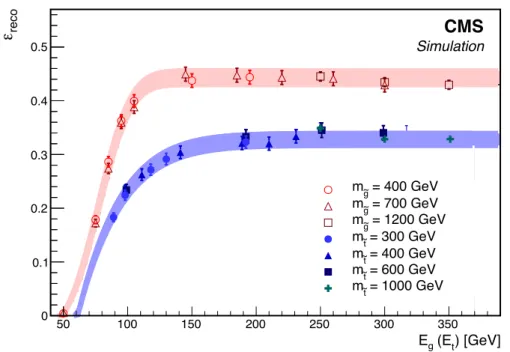
5 ) [GeV] t (E g E 50 100 150 200 250 300 350 reco ε 0 0.1 0.2 0.3 0.4 0.5 = 400 GeV g ~ m = 700 GeV g ~ m = 1200 GeV g ~ m = 300 GeV t ~ m = 400 GeV t ~ m = 600 GeV t ~ m = 1000 GeV t ~ m CMS Simulation
Figure 1: The reconstruction efficiency εrecoforeg andet R-hadrons that stop in the barrel region of the calorimeter as a function of the energy of the produced SM daughter particle. The shaded bands indicate the systematic uncertainty in εreco.
an approximate trigger efficiency of 70%. We define εreco as the number of signal events that
pass all selection criteria (including the trigger requirement) divided by the number of signal events that stop within the barrel region of the calorimeter. The reconstruction efficiency de-pends principally on the energy of the visible daughter particle of the R-hadron decay, which we denote by Eg (Et) if the daughter is a gluon (top quark). The reconstruction efficiencies
obtained for gluinos and top squarks are plotted as a function of this energy in Fig. 1. Above the minimum energy threshold for the SM decay products, where εrecobecomes approximately
constant, Eg > 120 GeV (Et > 150 GeV), we obtain εreco ≈ 45% (32%) foreg(et) decays. The top squark efficiency is lower than the gluino efficiency primarily because of t→ bµν decays that yield less visible energy in the calorimeter and are rejected by the muon vetoes. When Et is
below mt, which can happen in cases when the mass splitting between theet andχe
0is small, the
top quark is off the mass-shell.
The signal efficiency is given by the product of εstoppingand εreco.
6
Backgrounds
It is possible for halo muons to escape detection in the endcap muon system. Escaping detec-tion is uncommon, but owing to the high rate of halo producdetec-tion in the 2012 data collecdetec-tion period, the expected halo background is non-negligible. We estimate the halo veto inefficiency using a “tag-and-probe” method [27] that analyzes a high-purity sample of halo muons to de-termine the rates at which we record hits on both ends of the endcap muon detectors, compared to the rate at which we see only the “incoming” or “outgoing” portions of the halo muon track. Because of timing and trigger effects, we may only observe the outgoing leg of the halo muon, with the incoming leg recorded in a previous BX. When the reverse occurs, we see only the
6 7 Sources of systematic uncertainties
incoming leg. Additionally, it is possible for the muon to lose all of its energy within the CMS detector before reaching the opposite side CSC chambers, which also results in an incoming-only event. We classify these events as to whether the halo originates from the clockwise or counterclockwise beam, and bin them by their geometric location in the endcap muon system. After integrating these distributions, we measure a halo veto inefficiency of 1×10⁻⁵. This in-efficiency is multiplied by the number of halo events vetoed from the search sample yielding an average halo background estimate of 8.0±0.4 events, where the uncertainty in the estimate is owing to the limited size of the data samples used.
To determine the rate at which cosmic ray muons escape detection by the cosmic muon veto, we generate a sample of 300 million simulated cosmic events using CMSCGEN [28], which is
based on the air shower program CORSIKA[29], and has been validated in [30]. After requiring
a substantial energy deposit in the calorimeter and the absence of any hits in the muon endcap system that would cause the event to be classified as a halo muon, we estimate the inefficiency of the cosmic muon veto by dividing the number of events that escape this veto by the total number of events. The inefficiency obtained in this manner is roughly 0.5%. After multiplica-tion by the number of cosmic ray muon events vetoed from the search sample, this corresponds to a predicted cosmic background of 5.2±2.5 events, where the uncertainty in the estimate is owing to the limited size of the data samples used.
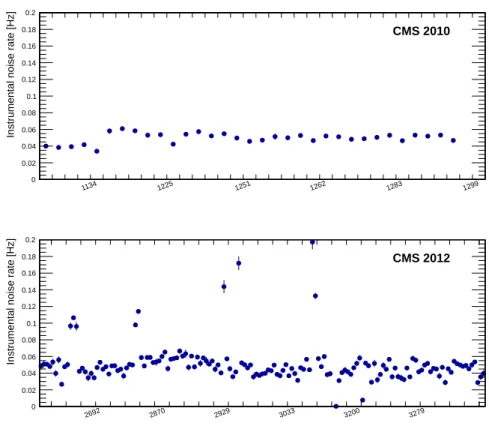
Finally, the background owing to instrumental noise is estimated by considering data recorded in 2010. Figure 2 shows the measured noise rates in both periods. In these plots all selection criteria except those that are designed to reject noise are applied. Additionally, only events at least 5 BX from a bunch are considered. This is done to reduce halo contamination in the distributions, which is abundant directly after a bunch crossing. There is a greater variation in the 2012 noise rate because of increased halo background, which can mimic HCAL noise if no CSC hits are present. The small variation seen in the 2012 data, while larger than that seen in 2010, is nevertheless small compared to the systematic uncertainty in the noise event count. The larger variations observed in the 2012 data are attributed to residual halo contamination arising from non-standard LHC beam conditions.
Because the rate of instrumental noise is approximately constant between the two periods, and the data recorded in early 2010 were delivered with very low instantaneous luminosity, this sample is unlikely to contain either halo events or signal events. After applying the same se-lection criteria to the 2010 data sample as used in this analysis, two events remain. We estimate the cosmic ray muon contribution to this sample to be 4.8±3.6 events. Because the cosmic ray background estimate exceeds the number of observed events, we assume a central value of zero events for the instrumental noise contribution to the 2010 sample, and allowing for Pois-son fluctuations in both the noise and cosmic ray muon contributions, set a 68% confidence level (CL) upper limit on this contribution of 2.3 events. This estimate is then scaled by the ra-tio of the 2012 and 2010 livetimes, resulting in an expected noise contribura-tion of 0.0+−2.60.0events in the 2012 data set.
7
Sources of systematic uncertainties
The model-independent results of the counting experiment described in this paper have rel-atively few systematic uncertainties. There is a 2.5% uncertainty in the integrated luminos-ity [31]. There is a 13% uncertainty in the reconstruction efficiency resulting from the possibil-ity that even above the minimum value of Eg(Et), this efficiency is not completely independent
of the energy of the daughter particle as is assumed. This uncertainty is determined by con-sidering the difference between the individual values of εreco in Fig. 1 and the average value
7
1134 1225 1251 1262 1283 1299
Instrumental noise rate [Hz]
0 0.02 0.04 0.06 0.08 0.1 0.12 0.14 0.16 0.18 0.2 CMS 2010 2692 2870 2929 3033 3200 3279
Instrumental noise rate [Hz]
0 0.02 0.04 0.06 0.08 0.1 0.12 0.14 0.16 0.18 0.2 CMS 2012
Figure 2: The noise rates from 2010 data (top) and 2012 data (bottom).
for all points above the minimum value of Eg(Et). The shaded bands in the figure depict this
uncertainty. Because the energy deposits resulting in reconstructed jets are not the result of jets originating from the center of the detector (as is the case for jets originating from pp collisions), they are not necessarily directed radially, and standard uncertainties in the jet energy scale (JES) do not apply. Instead, we determine the JES uncertainty by referencing a study performed on the HCAL during cosmic ray data taking in 2008 [32]. This study compares the reconstructed energy deposits in the HCAL for simulated cosmic ray events and cosmic ray events in 2008 data. These comparisons lead to an estimated uncertainty of∼2% on the simulation. A similar study comparing data and simulation for dijets originating at the interaction point conducted with 2012 data yielded an uncertainty of <2% for jets striking the HCAL barrel with angles of incidence from 0 to 60 degrees [33]. While the study demonstrates that the HCAL response is well simulated with an uncertainty of about 1%, we take a conservative JES uncertainty of 3% to compensate for any effects of stopped particle decays that these studies cannot test be-cause of the potentially large angles that could sometimes be expected in the signal decays. This value for the JES uncertainty leads to an uncertainty in the search results of about 2% at the minimum value of Eg. The value of 3% is somewhat pessimistic since the uncertainty falls
rapidly as Eg increases. Variations in the reconstructed jet energy are only important for
de-posits with energies close to the jet energy threshold, which typically correspond to events in which Egis small.
In obtaining constraints on a particular model, however, more substantial uncertainties arise since the signal yield is sensitive to the stopping probability. While the GEANT4 simulation
used to derive the stopping probability very accurately models both the electromagnetic and nuclear interaction energy-loss mechanisms, the relative contributions of these energy-loss mechanisms to the stopping probability depends significantly on unknown R-hadron
spec-8 8 Results
troscopy. We do not consider this dependence to be a source of error, however, since given a particular model for the spectrum the resultant uncertainty in the stopping probability is small. In addition to these uncertainties in the signal efficiency, there is also a systematic uncertainty in the background estimate described in Section 6. This systematic uncertainty arises from the limited size of the data control samples that were used to estimate the contribution of each of the background processes to the search sample.
The systematic uncertainties are summarized in Table 1.
Table 1: Summary of systematic uncertainties. Systematic uncertainty Fractional uncertainty
JES uncertainty ±3%
Luminosity uncertainty ±2.5%
εrecouncertainty ±13%
Background uncertainty +27%,−19%
8
Results
The total and individual background estimates for both the 2012 search period and the 2010 control period used to determine the background from instrumental noise, are summarized in Table 2, together with the number of observed events.
Table 2: Background predictions and observed events for the 2010 control and 2012 search samples.
Period Trigger livetime (h) Nnoisebkg Ncosmicbkg Nhalobkg Ntotalbkg Nobs 2010 253 0.0+−2.30.0 4.8±3.6 — 4.8+−4.33.6 2 2012 281 0.0+−2.60.0 5.2±2.5 8.0±0.4 13.2+−3.62.5 10
With the assumption that the backgrounds listed in Table 2 are uniformly distributed in time, which is valid even for the halo background for times at least one BX away from the collision as our selection requires, we perform a counting experiment in equally spaced log(time) bins of gluino (top squark) lifetime hypotheses, τeg(τet), from 10−7to 106seconds. For lifetime hypothe-ses shorter than one orbit (89 µs), we count only candidates within a sensitivity-optimized time window of 1.3τ
e
g(τet)from any pp collision. This restriction avoids the addition of backgrounds
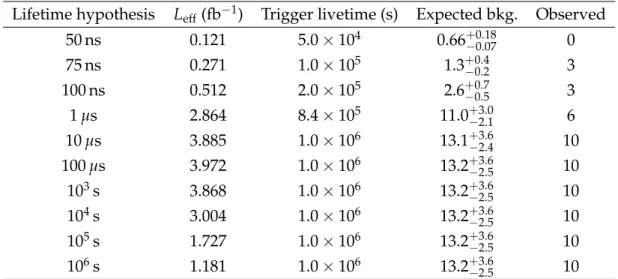
for time intervals during which the signal has a high probability to have already decayed. In order to resolve any time structure in the data within a single orbit, we test two additional life-time hypotheses for each observed event for these counting experiments: the largest lifelife-time hypothesis for which the event lies outside 1.3τeg(τet), and the smallest lifetime hypothesis for which the event is contained within 1.3τeg(τet). Table 3 shows the results of the counting exper-iments for selected lifetime hypotheses. The observed number of events is consistent with the background expectation for all lifetime hypotheses tested.
8.1 Limits on gluino and top squark production
We obtain upper limits on the signal production cross section using a hybrid CLS method [34,
35] to incorporate the systematic uncertainties [36]. These limits are presented in Fig. 3 as a function of particle lifetime τ. The two left-hand axes of Fig. 3 are production cross section times branching fraction (σ× B) for top squarks and gluinos, assuming the total visible en-ergy in the decay satisfies either Eg > 120 GeV or Et > 150 GeV for the gluino and top squark
8.2 Limits on gluino and top squark mass 9
Table 3: Results of counting experiments for selected lifetime hypotheses. Lifetime hypothesis Leff(fb−1) Trigger livetime (s) Expected bkg. Observed
50 ns 0.121 5.0×10⁴ 0.66+−0.180.07 0 75 ns 0.271 1.0×10⁵ 1.3+−0.40.2 3 100 ns 0.512 2.0×10⁵ 2.6+0.7 −0.5 3 1 µs 2.864 8.4×10⁵ 11.0+−3.02.1 6 10 µs 3.885 1.0×10⁶ 13.1+−3.62.4 10 100 µs 3.972 1.0×10⁶ 13.2+−3.62.5 10 103s 3.868 1.0×10⁶ 13.2+−3.62.5 10 104s 3.004 1.0×10⁶ 13.2+−3.62.5 10 105s 1.727 1.0×10⁶ 13.2+3.6 −2.5 10 106s 1.181 1.0×10⁶ 13.2+3.6 −2.5 10
analyses, respectively. The minimum energy of the SM particle is set by considering the re-construction efficiency shown in Fig. 1. Below this energy, the rere-construction efficiency drops off rapidly and we are significantly less sensitive toeg andet decays. By not making a specific neutralino mass hypothesis, we are able to constrain a larger phase space of top squark decays, including the region where the top squarks are off mass-shell. The right-hand axis of Fig. 3 shows the quantity σ× B ×εstopping×εreco, which is more model independent.
8.2 Limits on gluino and top squark mass
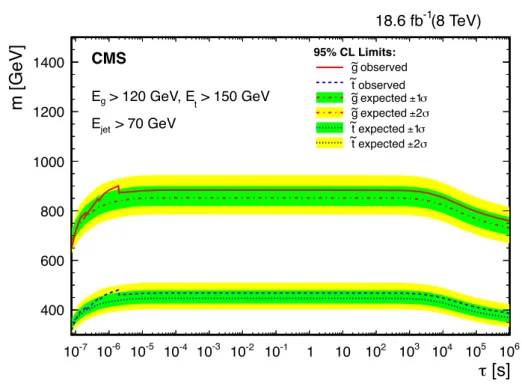
Figure 4 shows the limits on gluino and top squark mass as a function of the particle lifetime. The production cross sections at√s = 8 TeV were obtained at next-to-leading order in αswith
next-to-leading-logarithmic soft gluon summation (NLO+NLL) using NLL-FAST[37], with the assumption that any other sparticles are decoupled. Assuming B(eg → gχe
0) = 100% and
B(et → tχe
0) = 100%, we are able to exclude m e
g < 880 GeV and met < 470 GeV at 95% CL for
1 µs < τ < 1000 s with Eg > 120 GeV and Et > 150 GeV. Because of the requirements on
the minimum energies for the gluon (top quark), these limits do not apply for all neutralino masses, as discussed in the next section.
8.3 Results for higher energy thresholds
With the selection criteria described previously, we are able to reduce background contami-nation to acceptable levels. We can, however, be more aggressive with the removal of back-grounds by increasing the offline jet energy threshold (Ethresh). Since εreco is essentially flat
above the minimum energy of Egor Et, and the background falls steeply with energy, we
po-tentially obtain stronger limits on the production cross section by running the analysis with an increased jet energy threshold. This more aggressive method of reducing background was per-formed for Ethresh = 100, 150, 200, and 300 GeV. However, as Ethresh increases, the sensitivity
to heavyχe
0 degrades. If there is a smaller mass splitting between
e
g(et)andχe0, the amount of energy available for the visible decay product is small.
To perform the analysis at the higher jet energy thresholds, the threshold is applied to the simulated signal to calculate the minimum energy of Eg or Et and εreco for each Ethresh. We
repeat the analysis of the 2010 data to estimate the instrumental noise rate at the increased threshold, and then the cosmic and beam halo rates are determined as for the analysis with the 70 GeV jet energy threshold. The resultant contributions of each background source to each
10 8 Results [s] τ -7 10 10-6 10-5 10-4 10-3 10-2 10-1 1 10 102 103 104 105 106 [pb] reco ε × stopping ε × B × σ -4 10 -3 10 -2 10 -1 10 1 CMS > 150 GeV t > 120 GeV, E g E > 70 GeV jet E = 600 GeV) g~ (m theory σ = 600 GeV) t~ (m theory σ 95% CL Limits: Observed σ 1 ± Expected σ 2 ± Expected ) [pb] 0 χ ∼ g →g~ B ( ×) g~g~ → (ppσ -2 10 -1 10 1 10 2 10 ) [pb] 0 χ ∼ t →t~ B ( ×)t~t~ → (ppσ -2 10 -1 10 1 10 2 10 (8 TeV) -1 18.6 fb
Figure 3: The left-hand axes present expected and observed 95% CL upper limits on top squark and gluino pair production cross sections using the cloud model of R-hadron interactions, as a function of particle lifetime. The NLO+NLL cross sections shown were obtained with NLL-FAST[37]. The right-hand axis shows the quantity σ× B ×εstopping×εreco, which is more model
independent. The structure observed between 10−7and 10−5s is due to the number of observed events incrementing when crossing boundaries between lifetime bins. When Et < mt, the top
quark is off the mass shell.
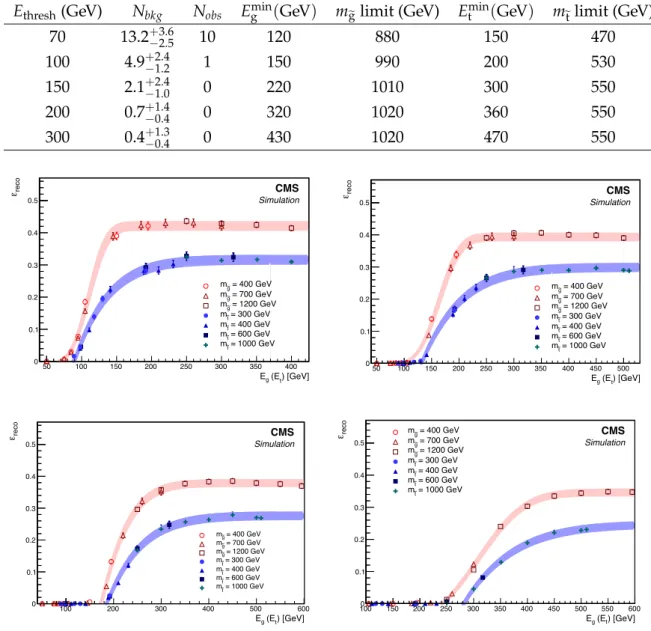
signal region are presented in Table 4. Limits on gluino and squark masses for each threshold are presented in Table 5. These limits are valid for the minimum value of Eg and Et that we
calculate from the turn-on curves shown in Fig. 5. These minimum values are listed in Table 5 for each threshold; they increase with increased Ethresh because the turn on plateau for εreco
moves in response to the higher thresholds as seen in Fig. 5.
The systematic uncertainties in εreco and integrated luminosity are unaffected by the increase
in the jet energy threshold. However, the systematic uncertainty resulting from the JES does vary somewhat with different Ethresh. The final JES uncertainty is calculated by measuring the change in εreco when the jet energy threshold requirement is varied according to the JES
systematic uncertainty. Variations in the jet energy requirement have the largest impact for gluon (top) energies close to the threshold, so we perform this calculation on simulated signal samples corresponding to the minimum values of Eg(Et).
As mentioned previously, increasing Ethresh affects the masses of χe
0 that are accessible to the
analysis. Figure 6 summarizes how these different jet energy thresholds exclude different re-gions of the(m
e
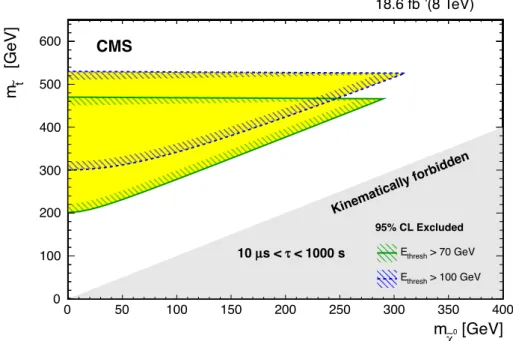
g, mχe0)phase space. Figure 7 does the same for the(met, mχe0)phase space, though
it only applies to on-shell top quark decays because m
e
χ0 is unknown when the top goes off
mass-shell. It should be noted that the minimum lifetime for the higher threshold limits in-creases from 1 µs to 10 µs. This decrease in sensitivity to smaller lifetimes is due to the smaller sample size associated with the increased energy requirement.
11 [s] τ -7 10 10-6 10-5 10-4 10-3 10-2 10-1 1 10 102 103 104 105 106 m [GeV] 400 600 800 1000 1200 1400 CMS > 150 GeV t > 120 GeV, E g E > 70 GeV jet E 95% CL Limits: observed g ~ observed t ~ σ 1 ± expected g ~ σ 2 ± expected g ~ σ 1 ± expected t ~ σ 2 ± expected t ~ (8 TeV) -1 18.6 fb
Figure 4: Lower limits at 95% CL on gluino and top squark mass as a function of particle lifetime, assuming the cloud model of R-hadron interactions and NLO+NLL production cross sections given in Ref. [38]. When Et< mt, the top quark is allowed to go off the mass shell.
Table 4: Background estimates for various energy thresholds. Ethresh(GeV) Nnoisebkg Ncosmicbkg Nhalobkg Ntotalbkg
70 0.0+−2.60.0 5.2±2.5 8.0±0.4 13.2+−3.62.5 100 0.0+−2.00.0 3.1±1.2 1.7±0.4 4.9+−2.41.2 150 0.0+−2.20.0 1.6±1.0 0.6±0.1 2.1+−2.41.0 200 0.0+−1.30.0 0.5±0.4 0.5±0.1 0.7+−1.40.4 300 0.0+−1.30.0 0.4±0.4 0.04±0.02 0.4+−1.30.4
9
Summary
A search has been made for long-lived particles that have stopped in the CMS detector af-ter being produced in 8 TeV pp collisions at the CERN LHC. The subsequent decay of these particles was looked for during gaps between proton bunches in the LHC beams. In a data set with a peak instantaneous luminosity of 7.5×1033cm−2s−1, an integrated luminosity of 18.6 fb−1, and a search interval corresponding to 281 hours of trigger livetime, no excess above background is observed. Limits are presented at 95% CL on gluino and top squark production over 13 orders of magnitude in the mean proper lifetime of the stopped particle. Assuming a cloud model of R-hadron interactions, for Eg > 120 GeV, andB(eg → gχe
0) = 100%, gluinos
with lifetimes from 1 µs to 1000 s and m
e
g<880 GeV are excluded. Under similar assumptions,
Et >150 GeV, andB(et→tχe
0) =100%, long-lived top squarks with lifetimes from 1 µs to 1000 s
and met < 470 GeV are excluded. By increasing the jet energy requirement, these mass exclu-sions increase to meg . 1000 GeV and met . 525 GeV in a more restricted region of parameter
space. In all cases, these exclusions require that m
e
χ0 is kinematically consistent with the
12 9 Summary
Table 5: Lower limits on gluino and top squark masses obtained from the analyses with varied jet energy thresholds.
Ethresh(GeV) Nbkg Nobs Emin
g (GeV) meglimit (GeV) E min
t (GeV) metlimit (GeV)
70 13.2+−3.62.5 10 120 880 150 470 100 4.9+−2.41.2 1 150 990 200 530 150 2.1+−2.41.0 0 220 1010 300 550 200 0.7+−1.40.4 0 320 1020 360 550 300 0.4+−1.30.4 0 430 1020 470 550 ) [GeV] t (E g E 50 100 150 200 250 300 350 400 reco ε 0 0.1 0.2 0.3 0.4 0.5 = 400 GeV g ~ m = 700 GeV g ~ m = 1200 GeV g ~ m = 300 GeV t ~ m = 400 GeV t ~ m = 600 GeV t ~ m = 1000 GeV t ~ m CMS Simulation ) [GeV] (E g E 50 100 150 200 250 300 350 400 450 500 reco ε 0 0.1 0.2 0.3 0.4 0.5 = 400 GeV g ~ m = 700 GeV g ~ m = 1200 GeV g ~ m = 300 GeV t ~ m = 400 GeV t ~ m = 600 GeV t ~ m = 1000 GeV t ~ m CMS Simulation t ) [GeV] t (E g E 100 200 300 400 500 600 reco ε 0 0.1 0.2 0.3 0.4 0.5 = 400 GeV g ~ m = 700 GeV g ~ m = 1200 GeV g ~ m = 300 GeV t ~ m = 400 GeV t ~ m = 600 GeV t ~ m = 1000 GeV t ~ m CMS Simulation ) [GeV] (E g E 100 150 200 250 300 350 400 450 500 550 600 reco ε 0 0.1 0.2 0.3 0.4 0.5 = 400 GeV g ~ m = 700 GeV g ~ m = 1200 GeV g ~ m = 300 GeV t ~ m = 400 GeV t ~ m = 600 GeV t ~ m = 1000 GeV t ~ m CMS Simulation t
Figure 5: The reconstruction efficiency εreco for eg andet R-hadrons that stopped in the barrel region of the calorimeter as a function of the energy of the SM daughter particle for jet energy thresholds of 100, 150, 200, and 300 GeV.
to date.
Acknowledgments
We congratulate our colleagues in the CERN accelerator departments for the excellent perfor-mance of the LHC and thank the technical and administrative staffs at CERN and at other CMS institutes for their contributions to the success of the CMS effort. In addition, we gratefully acknowledge the computing centers and personnel of the Worldwide LHC Computing Grid for delivering so effectively the computing infrastructure essential to our analyses. Finally, we acknowledge the enduring support for the construction and operation of the LHC and the CMS detector provided by the following funding agencies: BMWFW and FWF (Austria); FNRS and
References 13 [GeV] 0 χ ∼ m 0 100 200 300 400 500 600 700 800 900 1000 [GeV] g~ m 0 200 400 600 800 1000 1200 CMS Kinematically forbidden
CMS
10 µs < τ < 1000 s 95% CL Excluded > 70 GeV thresh E > 100 GeV thresh E > 150 GeV thresh E > 200 GeV thresh E (8 TeV) -1 18.6 fbFigure 6: Regions of the meg−mχe
0 plane excluded by the analysis, valid for 10−5s <τ < 103s using thresholds as indicated in the legend.
FWO (Belgium); CNPq, CAPES, FAPERJ, and FAPESP (Brazil); MES (Bulgaria); CERN; CAS, MoST, and NSFC (China); COLCIENCIAS (Colombia); MSES and CSF (Croatia); RPF (Cyprus); MoER, ERC IUT and ERDF (Estonia); Academy of Finland, MEC, and HIP (Finland); CEA and CNRS/IN2P3 (France); BMBF, DFG, and HGF (Germany); GSRT (Greece); OTKA and NIH (Hungary); DAE and DST (India); IPM (Iran); SFI (Ireland); INFN (Italy); MSIP and NRF (Re-public of Korea); LAS (Lithuania); MOE and UM (Malaysia); CINVESTAV, CONACYT, SEP, and UASLP-FAI (Mexico); MBIE (New Zealand); PAEC (Pakistan); MSHE and NSC (Poland); FCT (Portugal); JINR (Dubna); MON, RosAtom, RAS and RFBR (Russia); MESTD (Serbia); SEIDI and CPAN (Spain); Swiss Funding Agencies (Switzerland); MST (Taipei); ThEPCenter, IPST, STAR and NSTDA (Thailand); TUBITAK and TAEK (Turkey); NASU and SFFR (Ukraine); STFC (United Kingdom); DOE and NSF (USA).
Individuals have received support from the Marie-Curie program and the European Research Council and EPLANET (European Union); the Leventis Foundation; the A. P. Sloan Founda-tion; the Alexander von Humboldt FoundaFounda-tion; the Belgian Federal Science Policy Office; the Fonds pour la Formation `a la Recherche dans l’Industrie et dans l’Agriculture (FRIA-Belgium); the Agentschap voor Innovatie door Wetenschap en Technologie (IWT-Belgium); the Ministry of Education, Youth and Sports (MEYS) of the Czech Republic; the Council of Science and Industrial Research, India; the HOMING PLUS program of Foundation for Polish Science, co-financed from European Union, Regional Development Fund; the Compagnia di San Paolo (Torino); the Consorzio per la Fisica (Trieste); MIUR project 20108T4XTM (Italy); the Thalis and Aristeia programs cofinanced by EU-ESF and the Greek NSRF; and the National Priorities Research Program by Qatar National Research Fund.
References
[1] S. Dimopoulos, M. Dine, S. Raby, and S. Thomas, “Experimental Signatures of Low Energy Gauge-Mediated Supersymmetry Breaking”, Phys. Rev. Lett. 76 (1996) 3494,
14 References [GeV] 0 χ ∼ m 0 50 100 150 200 250 300 350 400 [GeV]~ t m 0 100 200 300 400 500 600 Kinematically forbidden 10 µs < τ < 1000 s 95% CL Excluded > 70 GeV thresh E > 100 GeV thresh E CMS (8 TeV) -1 18.6 fb
Figure 7: Regions of the met−m
e
χ0 plane excluded by the analysis, valid for 10
−5s <
τ < 103s using two energy thresholds as indicated in the legend. The excluded regions only apply to on-shell top quarks.
doi:10.1103/PhysRevLett.76.3494, arXiv:hep-ph/9601367. [Erratum: doi:10.1103/PhysRevD.87.019901].
[2] H. Baer, K. Cheung, and J. F. Gunion, “A heavy gluino as the lightest supersymmetric particle”, Phys. Rev. D 59 (1999) 075002, doi:10.1103/PhysRevD.59.075002, arXiv:hep-ph/9806361.
[3] T. Jittoh, J. Sato, T. Shimomura, and M. Yamanaka, “Long life stau in the minimal supersymmetric standard model”, Phys. Rev. D 73 (2006) 055009,
doi:10.1103/PhysRevD.73.055009, arXiv:hep-ph/0512197.
[4] M. J. Strassler and K. M. Zurek, “Echoes of a hidden valley at hadron colliders”, Phys. Lett. B 651 (2007) 374, doi:10.1016/j.physletb.2007.06.055,
arXiv:hep-ph/0604261.
[5] A. Arvanitaki et al., “Astrophysical probes of unification”, Phys. Rev. D 79 (2009) 105022, doi:10.1103/PhysRevD.79.105022, arXiv:0812.2075.
[6] N. Arkani-Hamed and S. Dimopoulos, “Supersymmetric unification without low energy supersymmetry and signatures for fine-tuning at the LHC”, JHEP 06 (2005) 073,
doi:10.1088/1126-6708/2005/06/073, arXiv:hep-th/0405159.
[7] CMS Collaboration, “Searches for long-lived charged particles in pp collisions at√s=7 and 8 TeV”, JHEP 07 (2013) 122, doi:10.1007/JHEP07(2013)122,
arXiv:1305.0491.
[8] ATLAS Collaboration, “Searches for heavy long-lived sleptons and R-hadrons with the ATLAS detector in pp collisions at√s=7 TeV”, Phys. Lett. B 720 (2013) 277,
References 15
[9] P. W. Graham, K. Howe, S. Rajendran, and D. Stolarski, “New measurements with stopped particles at the LHC”, Phys. Rev. D 86 (2012) 034020,
doi:10.1103/PhysRevD.86.034020, arXiv:1111.4176.
[10] P. Fayet, “Spontaneously broken supersymmetric theories of weak, electromagnetic and strong interactions”, Phys. Lett. B 69 (1977) 489,
doi:10.1016/0370-2693(77)90852-8.
[11] P. Fayet, “Massive gluinos”, Phys. Lett. B 78 (1978) 417, doi:10.1016/0370-2693(78)90474-4.
[12] G. R. Farrar and P. Fayet, “Phenomenology of the production, decay, and detection of new hadronic states associated with supersymmetry”, Phys. Lett. B 76 (1978) 575, doi:10.1016/0370-2693(78)90858-4.
[13] D0 Collaboration, “Search for Stopped Gluinos from p ¯p Collisions at√s=1.96 TeV”, Phys. Rev. Lett. 99 (2007) 131801, doi:10.1103/PhysRevLett.99.131801,
arXiv:0705.0306.
[14] CMS Collaboration, “Search for stopped long-lived particles produced in pp collisions at√ s =7 TeV”, JHEP 08 (2012) 026, doi:10.1007/JHEP08(2012)026,
arXiv:1207.0106.
[15] CMS Collaboration, “Search for Stopped Gluinos in pp collisions at√s=7 TeV”, Phys. Rev. Lett. 106 (2011) 011801, doi:10.1103/PhysRevLett.106.011801,
arXiv:1011.5861.
[16] ATLAS Collaboration, “Search for decays of stopped, long-lived particles from 7 TeV pp collisions with the ATLAS detector”, Eur. Phys. J. C 72 (2012) 1965,
doi:10.1140/epjc/s10052-012-1965-6, arXiv:1201.5595.
[17] ATLAS Collaboration, “Search for long-lived stopped R-hadrons decaying out-of-time with pp collisions using the ATLAS detector”, Phys. Rev. D 88 (2013) 112003,
doi:10.1103/PhysRevD.88.112003, arXiv:1310.6584.
[18] CMS Collaboration, “The CMS experiment at the CERN LHC”, JINST 03 (2008) S08004, doi:10.1088/1748-0221/3/08/S08004.
[19] M. Cacciari, G. P. Salam, and G. Soyez, “The anti-kT jet clustering algorithm”, JHEP 04
(2008) 063, doi:10.1088/1126-6708/2008/04/063, arXiv:0802.1189.
[20] M. Cacciari, G. P. Salam, and G. Soyez, “FastJet User Manual”, Eur. Phys. J. C 72 (2012) 1896, doi:10.1140/epjc/s10052-012-1896-2, arXiv:1111.6097.
[21] T. Sj ¨ostrand, S. Mrenna, and P. Z. Skands, “A brief introduction to PYTHIA 8.1”, Comput. Phys. Commun. 178 (2008) 852, doi:10.1016/j.cpc.2008.01.036,
arXiv:0710.3820.
[22] GEANT4 Collaboration, “GEANT4—a simulation toolkit”, Nucl. Instrum. Meth. A 506 (2003) 250, doi:10.1016/S0168-9002(03)01368-8.
[23] A. C. Kraan, “Interactions of heavy stable hadronizing particles”, Eur. Phys. J. C 37 (2004) 91, doi:10.1140/epjc/s2004-01997-7, arXiv:hep-ex/0404001.
16 References
[24] R. Mackeprang and A. Rizzi, “Interactions of coloured heavy stable particles in matter”, Eur. Phys. J. C 50 (2007) 353, doi:10.1140/epjc/s10052-007-0252-4,
arXiv:hep-ph/0612161.
[25] M. Kr¨amer, E. Popenda, M. Spira, and P. M. Zerwas, “Gluino polarization at the LHC”, Phys. Rev. D 80 (2009) 055002, doi:10.1103/PhysRevD.80.055002,
arXiv:0902.3795.
[26] CMS Collaboration, “Description and performance of track and primary-vertex reconstruction with the CMS tracker”, JINST 9 (2014) P10009,
doi:10.1088/1748-0221/9/10/P10009, arXiv:1405.6569.
[27] CMS Collaboration, “Measurements of Inclusive W and Z Cross Sections in pp Collisions at√s=7 TeV”, JHEP 01 (2011) 080, doi:10.1007/JHEP01(2011)080,
arXiv:1012.2466.
[28] P. Biallass and T. Hebbeker, “Parametrization of the Cosmic Muon Flux for the Generator CMSCGEN”, (2009). arXiv:0907.5514.
[29] D. Heck et al., “CORSIKA: A Monte Carlo code to simulate extensive air showers”, Technical Report FZKA-6019, 1998.
[30] CMS Collaboration, “Measurement of the charge ratio of atmospheric muons with the CMS detector”, Phys. Lett. B 692 (2010) 83,
doi:10.1016/j.physletb.2010.07.033, arXiv:1005.5332.
[31] CMS Collaboration, “CMS luminosity based on pixel cluster counting - summer 2013 update”, CMS Physics Analysis Summary CMS-PAS-LUM-13-001, 2013.
[32] CMS Collaboration, “Performance of the CMS Hadron Calorimeter with Cosmic Ray Muons and LHC Beam Data”, JINST 05 (2010) T03012,
doi:10.1088/1748-0221/5/03/T03012, arXiv:0911.4991.
[33] M. Fitzgerald Schroeder, “Performance of Jets in CMS”, in 16thInternational Conference on Calorimetry in High Energy Physics (CALOR 2014). 2014. CMS-CR-2014-065.
[34] T. Junk, “Confidence level computation for combining searches with small statistics”, Nucl. Instrum. Meth. A 434 (1999) 435, doi:10.1016/S0168-9002(99)00498-2, arXiv:hep-ex/9902006.
[35] A. L. Read, “Presentation of search results: The CLstechnique”, J. Phys. G 28 (2002) 2693,
doi:10.1088/0954-3899/28/10/313.
[36] R. D. Cousins and V. L. Highland, “Incorporating systematic uncertainties into an upper limit”, Nucl. Instrum. Meth. A 320 (1992) 331,
doi:10.1016/0168-9002(92)90794-5.
[37] W. Beenakker et al., “Squark and gluino hadroproduction”, Int. J. Mod. Phys. A 26 (2011) 2637, doi:10.1142/S0217751X11053560, arXiv:1105.1110.
[38] M. Kr¨amer et al., “Supersymmetry production cross sections in pp collisions at√s=7 TeV”, (2012). arXiv:1206.2892.
17
A
The CMS Collaboration
Yerevan Physics Institute, Yerevan, Armenia
V. Khachatryan, A.M. Sirunyan, A. Tumasyan
Institut f ¨ur Hochenergiephysik der OeAW, Wien, Austria
W. Adam, T. Bergauer, M. Dragicevic, J. Er ¨o, M. Friedl, R. Fr ¨uhwirth1, V.M. Ghete, C. Hartl, N. H ¨ormann, J. Hrubec, M. Jeitler1, W. Kiesenhofer, V. Kn ¨unz, M. Krammer1, I. Kr¨atschmer, D. Liko, I. Mikulec, D. Rabady2, B. Rahbaran, H. Rohringer, R. Sch ¨ofbeck, J. Strauss,
W. Treberer-Treberspurg, W. Waltenberger, C.-E. Wulz1
National Centre for Particle and High Energy Physics, Minsk, Belarus
V. Mossolov, N. Shumeiko, J. Suarez Gonzalez
Universiteit Antwerpen, Antwerpen, Belgium
S. Alderweireldt, S. Bansal, T. Cornelis, E.A. De Wolf, X. Janssen, A. Knutsson, J. Lauwers, S. Luyckx, S. Ochesanu, R. Rougny, M. Van De Klundert, H. Van Haevermaet, P. Van Mechelen, N. Van Remortel, A. Van Spilbeeck
Vrije Universiteit Brussel, Brussel, Belgium
F. Blekman, S. Blyweert, J. D’Hondt, N. Daci, N. Heracleous, J. Keaveney, S. Lowette, M. Maes, A. Olbrechts, Q. Python, D. Strom, S. Tavernier, W. Van Doninck, P. Van Mulders, G.P. Van Onsem, I. Villella
Universit´e Libre de Bruxelles, Bruxelles, Belgium
C. Caillol, B. Clerbaux, G. De Lentdecker, D. Dobur, L. Favart, A.P.R. Gay, A. Grebenyuk, A. L´eonard, A. Mohammadi, L. Perni`e2, A. Randle-conde, T. Reis, T. Seva, L. Thomas, C. Vander Velde, P. Vanlaer, J. Wang, F. Zenoni
Ghent University, Ghent, Belgium
V. Adler, K. Beernaert, L. Benucci, A. Cimmino, S. Costantini, S. Crucy, S. Dildick, A. Fagot, G. Garcia, J. Mccartin, A.A. Ocampo Rios, D. Ryckbosch, S. Salva Diblen, M. Sigamani, N. Strobbe, F. Thyssen, M. Tytgat, E. Yazgan, N. Zaganidis
Universit´e Catholique de Louvain, Louvain-la-Neuve, Belgium
S. Basegmez, C. Beluffi3, G. Bruno, R. Castello, A. Caudron, L. Ceard, G.G. Da Silveira, C. Delaere, T. du Pree, D. Favart, L. Forthomme, A. Giammanco4, J. Hollar, A. Jafari, P. Jez, M. Komm, V. Lemaitre, C. Nuttens, D. Pagano, L. Perrini, A. Pin, K. Piotrzkowski, A. Popov5, L. Quertenmont, M. Selvaggi, M. Vidal Marono, J.M. Vizan Garcia
Universit´e de Mons, Mons, Belgium
N. Beliy, T. Caebergs, E. Daubie, G.H. Hammad
Centro Brasileiro de Pesquisas Fisicas, Rio de Janeiro, Brazil
W.L. Ald´a J ´unior, G.A. Alves, L. Brito, M. Correa Martins Junior, T. Dos Reis Martins, J. Molina, C. Mora Herrera, M.E. Pol, P. Rebello Teles
Universidade do Estado do Rio de Janeiro, Rio de Janeiro, Brazil
W. Carvalho, J. Chinellato6, A. Cust ´odio, E.M. Da Costa, D. De Jesus Damiao, C. De Oliveira Martins, S. Fonseca De Souza, H. Malbouisson, D. Matos Figueiredo, L. Mundim, H. Nogima, W.L. Prado Da Silva, J. Santaolalla, A. Santoro, A. Sznajder, E.J. Tonelli Manganote6, A. Vilela Pereira
18 A The CMS Collaboration
Universidade Estadual Paulistaa, Universidade Federal do ABCb, S˜ao Paulo, Brazil
C.A. Bernardesb, S. Dograa, T.R. Fernandez Perez Tomeia, E.M. Gregoresb, P.G. Mercadanteb, S.F. Novaesa, Sandra S. Padulaa
Institute for Nuclear Research and Nuclear Energy, Sofia, Bulgaria
A. Aleksandrov, V. Genchev2, R. Hadjiiska, P. Iaydjiev, A. Marinov, S. Piperov, M. Rodozov, G. Sultanov, M. Vutova
University of Sofia, Sofia, Bulgaria
A. Dimitrov, I. Glushkov, L. Litov, B. Pavlov, P. Petkov
Institute of High Energy Physics, Beijing, China
J.G. Bian, G.M. Chen, H.S. Chen, M. Chen, T. Cheng, R. Du, C.H. Jiang, R. Plestina7, F. Romeo, J. Tao, Z. Wang
State Key Laboratory of Nuclear Physics and Technology, Peking University, Beijing, China
C. Asawatangtrakuldee, Y. Ban, Q. Li, S. Liu, Y. Mao, S.J. Qian, D. Wang, Z. Xu, W. Zou
Universidad de Los Andes, Bogota, Colombia
C. Avila, A. Cabrera, L.F. Chaparro Sierra, C. Florez, J.P. Gomez, B. Gomez Moreno, J.C. Sanabria
University of Split, Faculty of Electrical Engineering, Mechanical Engineering and Naval Architecture, Split, Croatia
N. Godinovic, D. Lelas, D. Polic, I. Puljak
University of Split, Faculty of Science, Split, Croatia
Z. Antunovic, M. Kovac
Institute Rudjer Boskovic, Zagreb, Croatia
V. Brigljevic, K. Kadija, J. Luetic, D. Mekterovic, L. Sudic
University of Cyprus, Nicosia, Cyprus
A. Attikis, G. Mavromanolakis, J. Mousa, C. Nicolaou, F. Ptochos, P.A. Razis
Charles University, Prague, Czech Republic
M. Bodlak, M. Finger, M. Finger Jr.8
Academy of Scientific Research and Technology of the Arab Republic of Egypt, Egyptian Network of High Energy Physics, Cairo, Egypt
Y. Assran9, S. Elgammal10, M.A. Mahmoud11, A. Radi12,13
National Institute of Chemical Physics and Biophysics, Tallinn, Estonia
M. Kadastik, M. Murumaa, M. Raidal, A. Tiko
Department of Physics, University of Helsinki, Helsinki, Finland
P. Eerola, G. Fedi, M. Voutilainen
Helsinki Institute of Physics, Helsinki, Finland
J. H¨ark ¨onen, V. Karim¨aki, R. Kinnunen, M.J. Kortelainen, T. Lamp´en, K. Lassila-Perini, S. Lehti, T. Lind´en, P. Luukka, T. M¨aenp¨a¨a, T. Peltola, E. Tuominen, J. Tuominiemi, E. Tuovinen, L. Wendland
Lappeenranta University of Technology, Lappeenranta, Finland
19
DSM/IRFU, CEA/Saclay, Gif-sur-Yvette, France
M. Besancon, F. Couderc, M. Dejardin, D. Denegri, B. Fabbro, J.L. Faure, C. Favaro, F. Ferri, S. Ganjour, A. Givernaud, P. Gras, G. Hamel de Monchenault, P. Jarry, E. Locci, J. Malcles, J. Rander, A. Rosowsky, M. Titov
Laboratoire Leprince-Ringuet, Ecole Polytechnique, IN2P3-CNRS, Palaiseau, France
S. Baffioni, F. Beaudette, P. Busson, C. Charlot, T. Dahms, M. Dalchenko, L. Dobrzynski, N. Filipovic, A. Florent, R. Granier de Cassagnac, L. Mastrolorenzo, P. Min´e, C. Mironov, I.N. Naranjo, M. Nguyen, C. Ochando, G. Ortona, P. Paganini, S. Regnard, R. Salerno, J.B. Sauvan, Y. Sirois, C. Veelken, Y. Yilmaz, A. Zabi
Institut Pluridisciplinaire Hubert Curien, Universit´e de Strasbourg, Universit´e de Haute Alsace Mulhouse, CNRS/IN2P3, Strasbourg, France
J.-L. Agram14, J. Andrea, A. Aubin, D. Bloch, J.-M. Brom, E.C. Chabert, C. Collard, E. Conte14, J.-C. Fontaine14, D. Gel´e, U. Goerlach, C. Goetzmann, A.-C. Le Bihan, K. Skovpen, P. Van Hove
Centre de Calcul de l’Institut National de Physique Nucleaire et de Physique des Particules, CNRS/IN2P3, Villeurbanne, France
S. Gadrat
Universit´e de Lyon, Universit´e Claude Bernard Lyon 1, CNRS-IN2P3, Institut de Physique Nucl´eaire de Lyon, Villeurbanne, France
S. Beauceron, N. Beaupere, C. Bernet7, G. Boudoul2, E. Bouvier, S. Brochet, C.A. Carrillo Montoya, J. Chasserat, R. Chierici, D. Contardo2, P. Depasse, H. El Mamouni, J. Fan, J. Fay, S. Gascon, M. Gouzevitch, B. Ille, T. Kurca, M. Lethuillier, L. Mirabito, S. Perries, J.D. Ruiz Alvarez, D. Sabes, L. Sgandurra, V. Sordini, M. Vander Donckt, P. Verdier, S. Viret, H. Xiao
Institute of High Energy Physics and Informatization, Tbilisi State University, Tbilisi, Georgia
Z. Tsamalaidze8
RWTH Aachen University, I. Physikalisches Institut, Aachen, Germany
C. Autermann, S. Beranek, M. Bontenackels, M. Edelhoff, L. Feld, A. Heister, O. Hindrichs, K. Klein, A. Ostapchuk, M. Preuten, F. Raupach, J. Sammet, S. Schael, J.F. Schulte, H. Weber, B. Wittmer, V. Zhukov5
RWTH Aachen University, III. Physikalisches Institut A, Aachen, Germany
M. Ata, M. Brodski, E. Dietz-Laursonn, D. Duchardt, M. Erdmann, R. Fischer, A. G ¨uth, T. Hebbeker, C. Heidemann, K. Hoepfner, D. Klingebiel, S. Knutzen, P. Kreuzer, M. Merschmeyer, A. Meyer, P. Millet, M. Olschewski, K. Padeken, P. Papacz, H. Reithler, S.A. Schmitz, L. Sonnenschein, D. Teyssier, S. Th ¨uer, M. Weber
RWTH Aachen University, III. Physikalisches Institut B, Aachen, Germany
V. Cherepanov, Y. Erdogan, G. Fl ¨ugge, H. Geenen, M. Geisler, W. Haj Ahmad, F. Hoehle, B. Kargoll, T. Kress, Y. Kuessel, A. K ¨unsken, J. Lingemann2, A. Nowack, I.M. Nugent, O. Pooth, A. Stahl
Deutsches Elektronen-Synchrotron, Hamburg, Germany
M. Aldaya Martin, I. Asin, N. Bartosik, J. Behr, U. Behrens, A.J. Bell, A. Bethani, K. Borras, A. Burgmeier, A. Cakir, L. Calligaris, A. Campbell, S. Choudhury, F. Costanza, C. Diez Pardos, G. Dolinska, S. Dooling, T. Dorland, G. Eckerlin, D. Eckstein, T. Eichhorn, G. Flucke, J. Garay Garcia, A. Geiser, P. Gunnellini, J. Hauk, M. Hempel15, H. Jung, A. Kalogeropoulos, M. Kasemann, P. Katsas, J. Kieseler, C. Kleinwort, I. Korol, D. Kr ¨ucker, W. Lange, J. Leonard, K. Lipka, A. Lobanov, W. Lohmann15, B. Lutz, R. Mankel, I. Marfin15, I.-A. Melzer-Pellmann,
20 A The CMS Collaboration
A.B. Meyer, G. Mittag, J. Mnich, A. Mussgiller, S. Naumann-Emme, A. Nayak, E. Ntomari, H. Perrey, D. Pitzl, R. Placakyte, A. Raspereza, P.M. Ribeiro Cipriano, B. Roland, E. Ron, M. ¨O. Sahin, J. Salfeld-Nebgen, P. Saxena, T. Schoerner-Sadenius, M. Schr ¨oder, C. Seitz, S. Spannagel, A.D.R. Vargas Trevino, R. Walsh, C. Wissing
University of Hamburg, Hamburg, Germany
V. Blobel, M. Centis Vignali, A.R. Draeger, J. Erfle, E. Garutti, K. Goebel, M. G ¨orner, J. Haller, M. Hoffmann, R.S. H ¨oing, A. Junkes, H. Kirschenmann, R. Klanner, R. Kogler, J. Lange, T. Lapsien, T. Lenz, I. Marchesini, J. Ott, T. Peiffer, A. Perieanu, N. Pietsch, J. Poehlsen, T. Poehlsen, D. Rathjens, C. Sander, H. Schettler, P. Schleper, E. Schlieckau, A. Schmidt, M. Seidel, V. Sola, H. Stadie, G. Steinbr ¨uck, D. Troendle, E. Usai, L. Vanelderen, A. Vanhoefer
Institut f ¨ur Experimentelle Kernphysik, Karlsruhe, Germany
C. Barth, C. Baus, J. Berger, C. B ¨oser, E. Butz, T. Chwalek, W. De Boer, A. Descroix, A. Dierlamm, M. Feindt, F. Frensch, M. Giffels, A. Gilbert, F. Hartmann2, T. Hauth, U. Husemann, I. Katkov5, A. Kornmayer2, E. Kuznetsova, P. Lobelle Pardo, M.U. Mozer, T. M ¨uller, Th. M ¨uller, A. N ¨urnberg, G. Quast, K. Rabbertz, S. R ¨ocker, H.J. Simonis, F.M. Stober, R. Ulrich, J. Wagner-Kuhr, S. Wayand, T. Weiler, R. Wolf
Institute of Nuclear and Particle Physics (INPP), NCSR Demokritos, Aghia Paraskevi, Greece
G. Anagnostou, G. Daskalakis, T. Geralis, V.A. Giakoumopoulou, A. Kyriakis, D. Loukas, A. Markou, C. Markou, A. Psallidas, I. Topsis-Giotis
University of Athens, Athens, Greece
A. Agapitos, S. Kesisoglou, A. Panagiotou, N. Saoulidou, E. Stiliaris
University of Io´annina, Io´annina, Greece
X. Aslanoglou, I. Evangelou, G. Flouris, C. Foudas, P. Kokkas, N. Manthos, I. Papadopoulos, E. Paradas, J. Strologas
Wigner Research Centre for Physics, Budapest, Hungary
G. Bencze, C. Hajdu, P. Hidas, D. Horvath16, F. Sikler, V. Veszpremi, G. Vesztergombi17, A.J. Zsigmond
Institute of Nuclear Research ATOMKI, Debrecen, Hungary
N. Beni, S. Czellar, J. Karancsi18, J. Molnar, J. Palinkas, Z. Szillasi
University of Debrecen, Debrecen, Hungary
A. Makovec, P. Raics, Z.L. Trocsanyi, B. Ujvari
National Institute of Science Education and Research, Bhubaneswar, India
S.K. Swain
Panjab University, Chandigarh, India
S.B. Beri, V. Bhatnagar, R. Gupta, U.Bhawandeep, A.K. Kalsi, M. Kaur, R. Kumar, M. Mittal, N. Nishu, J.B. Singh
University of Delhi, Delhi, India
Ashok Kumar, Arun Kumar, S. Ahuja, A. Bhardwaj, B.C. Choudhary, A. Kumar, S. Malhotra, M. Naimuddin, K. Ranjan, V. Sharma
Saha Institute of Nuclear Physics, Kolkata, India
S. Banerjee, S. Bhattacharya, K. Chatterjee, S. Dutta, B. Gomber, Sa. Jain, Sh. Jain, R. Khurana, A. Modak, S. Mukherjee, D. Roy, S. Sarkar, M. Sharan
21
Bhabha Atomic Research Centre, Mumbai, India
A. Abdulsalam, D. Dutta, V. Kumar, A.K. Mohanty2, L.M. Pant, P. Shukla, A. Topkar
Tata Institute of Fundamental Research, Mumbai, India
T. Aziz, S. Banerjee, S. Bhowmik19, R.M. Chatterjee, R.K. Dewanjee, S. Dugad, S. Ganguly, S. Ghosh, M. Guchait, A. Gurtu20, G. Kole, S. Kumar, M. Maity19, G. Majumder, K. Mazumdar, G.B. Mohanty, B. Parida, K. Sudhakar, N. Wickramage21
Institute for Research in Fundamental Sciences (IPM), Tehran, Iran
H. Bakhshiansohi, H. Behnamian, S.M. Etesami22, A. Fahim23, R. Goldouzian, M. Khakzad, M. Mohammadi Najafabadi, M. Naseri, S. Paktinat Mehdiabadi, F. Rezaei Hosseinabadi, B. Safarzadeh24, M. Zeinali
University College Dublin, Dublin, Ireland
M. Felcini, M. Grunewald
INFN Sezione di Baria, Universit`a di Barib, Politecnico di Baric, Bari, Italy
M. Abbresciaa,b, C. Calabriaa,b, S.S. Chhibraa,b, A. Colaleoa, D. Creanzaa,c, N. De Filippisa,c, M. De Palmaa,b, L. Fiorea, G. Iasellia,c, G. Maggia,c, M. Maggia, S. Mya,c, S. Nuzzoa,b, A. Pompilia,b, G. Pugliesea,c, R. Radognaa,b,2, G. Selvaggia,b, A. Sharmaa, L. Silvestrisa,2,
R. Vendittia,b, P. Verwilligena
INFN Sezione di Bolognaa, Universit`a di Bolognab, Bologna, Italy
G. Abbiendia, A.C. Benvenutia, D. Bonacorsia,b, S. Braibant-Giacomellia,b, L. Brigliadoria,b, R. Campaninia,b, P. Capiluppia,b, A. Castroa,b, F.R. Cavalloa, G. Codispotia,b, M. Cuffiania,b, G.M. Dallavallea, F. Fabbria, A. Fanfania,b, D. Fasanellaa,b, P. Giacomellia, C. Grandia, L. Guiduccia,b, S. Marcellinia, G. Masettia, A. Montanaria, F.L. Navarriaa,b, A. Perrottaa,
F. Primaveraa,b, A.M. Rossia,b, T. Rovellia,b, G.P. Sirolia,b, N. Tosia,b, R. Travaglinia,b
INFN Sezione di Cataniaa, Universit`a di Cataniab, CSFNSMc, Catania, Italy
S. Albergoa,b, G. Cappelloa, M. Chiorbolia,b, S. Costaa,b, F. Giordanoa,c,2, R. Potenzaa,b, A. Tricomia,b, C. Tuvea,b
INFN Sezione di Firenzea, Universit`a di Firenzeb, Firenze, Italy
G. Barbaglia, V. Ciullia,b, C. Civininia, R. D’Alessandroa,b, E. Focardia,b, E. Galloa, S. Gonzia,b,
V. Goria,b, P. Lenzia,b, M. Meschinia, S. Paolettia, G. Sguazzonia, A. Tropianoa,b
INFN Laboratori Nazionali di Frascati, Frascati, Italy
L. Benussi, S. Bianco, F. Fabbri, D. Piccolo
INFN Sezione di Genovaa, Universit`a di Genovab, Genova, Italy
R. Ferrettia,b, F. Ferroa, M. Lo Veterea,b, E. Robuttia, S. Tosia,b
INFN Sezione di Milano-Bicoccaa, Universit`a di Milano-Bicoccab, Milano, Italy
M.E. Dinardoa,b, S. Fiorendia,b, S. Gennaia,2, R. Gerosaa,b,2, A. Ghezzia,b, P. Govonia,b, M.T. Lucchinia,b,2, S. Malvezzia, R.A. Manzonia,b, A. Martellia,b, B. Marzocchia,b,2, D. Menascea, L. Moronia, M. Paganonia,b, D. Pedrinia, S. Ragazzia,b, N. Redaellia, T. Tabarelli de Fatisa,b
INFN Sezione di Napoli a, Universit`a di Napoli ’Federico II’ b, Universit`a della
Basilicata (Potenza)c, Universit`a G. Marconi (Roma)d, Napoli, Italy
S. Buontempoa, N. Cavalloa,c, S. Di Guidaa,d,2, F. Fabozzia,c, A.O.M. Iorioa,b, L. Listaa, S. Meolaa,d,2, M. Merolaa, P. Paoluccia,2
22 A The CMS Collaboration
INFN Sezione di Padovaa, Universit`a di Padovab, Universit`a di Trento (Trento)c, Padova,
Italy
P. Azzia, N. Bacchettaa, D. Biselloa,b, R. Carlina,b, P. Checchiaa, M. Dall’Ossoa,b, T. Dorigoa, U. Dossellia, M. Galantia,b, F. Gasparinia,b, U. Gasparinia,b, A. Gozzelinoa, K. Kanishcheva,c,
S. Lacapraraa, A.T. Meneguzzoa,b, F. Montecassianoa, M. Passaseoa, J. Pazzinia,b, M. Pegoraroa, N. Pozzobona,b, F. Simonettoa,b, E. Torassaa, M. Tosia,b, P. Zottoa,b, A. Zucchettaa,b, G. Zumerlea,b
INFN Sezione di Paviaa, Universit`a di Paviab, Pavia, Italy
M. Gabusia,b, S.P. Rattia,b, V. Rea, C. Riccardia,b, P. Salvinia, P. Vituloa,b
INFN Sezione di Perugiaa, Universit`a di Perugiab, Perugia, Italy
M. Biasinia,b, G.M. Bileia, D. Ciangottinia,b,2, L. Fan `oa,b, P. Laricciaa,b, G. Mantovania,b, M. Menichellia, A. Sahaa, A. Santocchiaa,b, A. Spieziaa,b,2
INFN Sezione di Pisaa, Universit`a di Pisab, Scuola Normale Superiore di Pisac, Pisa, Italy
K. Androsova,25, P. Azzurria, G. Bagliesia, J. Bernardinia, T. Boccalia, G. Broccoloa,c, R. Castaldia, M.A. Cioccia,25, R. Dell’Orsoa, S. Donatoa,c,2, F. Fioria,c, L. Fo`aa,c, A. Giassia, M.T. Grippoa,25, F. Ligabuea,c, T. Lomtadzea, L. Martinia,b, A. Messineoa,b, C.S. Moona,26, F. Pallaa,2, A. Rizzia,b, A. Savoy-Navarroa,27, A.T. Serbana, P. Spagnoloa, P. Squillaciotia,25, R. Tenchinia, G. Tonellia,b,
A. Venturia, P.G. Verdinia, C. Vernieria,c
INFN Sezione di Romaa, Universit`a di Romab, Roma, Italy
L. Baronea,b, F. Cavallaria, G. D’imperioa,b, D. Del Rea,b, M. Diemoza, C. Jordaa, E. Longoa,b, F. Margarolia,b, P. Meridiania, F. Michelia,b,2, G. Organtinia,b, R. Paramattia, S. Rahatloua,b, C. Rovellia, F. Santanastasioa,b, L. Soffia,b, P. Traczyka,b,2
INFN Sezione di Torino a, Universit`a di Torino b, Universit`a del Piemonte Orientale
(No-vara)c, Torino, Italy
N. Amapanea,b, R. Arcidiaconoa,c, S. Argiroa,b, M. Arneodoa,c, R. Bellana,b, C. Biinoa, N. Cartigliaa, S. Casassoa,b,2, M. Costaa,b, A. Deganoa,b, N. Demariaa, L. Fincoa,b,2, C. Mariottia, S. Masellia, E. Migliorea,b, V. Monacoa,b, M. Musicha, M.M. Obertinoa,c, L. Pachera,b, N. Pastronea, M. Pelliccionia, G.L. Pinna Angionia,b, A. Potenzaa,b, A. Romeroa,b, M. Ruspaa,c, R. Sacchia,b, A. Solanoa,b, A. Staianoa, U. Tamponia
INFN Sezione di Triestea, Universit`a di Triesteb, Trieste, Italy
S. Belfortea, V. Candelisea,b,2, M. Casarsaa, F. Cossuttia, G. Della Riccaa,b, B. Gobboa, C. La Licataa,b, M. Maronea,b, A. Schizzia,b, T. Umera,b, A. Zanettia
Kangwon National University, Chunchon, Korea
S. Chang, A. Kropivnitskaya, S.K. Nam
Kyungpook National University, Daegu, Korea
D.H. Kim, G.N. Kim, M.S. Kim, D.J. Kong, S. Lee, Y.D. Oh, H. Park, A. Sakharov, D.C. Son
Chonbuk National University, Jeonju, Korea
T.J. Kim
Chonnam National University, Institute for Universe and Elementary Particles, Kwangju, Korea
J.Y. Kim, D.H. Moon, S. Song
Korea University, Seoul, Korea
23
Seoul National University, Seoul, Korea
H.D. Yoo
University of Seoul, Seoul, Korea
M. Choi, J.H. Kim, I.C. Park, G. Ryu, M.S. Ryu
Sungkyunkwan University, Suwon, Korea
Y. Choi, Y.K. Choi, J. Goh, D. Kim, E. Kwon, J. Lee, I. Yu
Vilnius University, Vilnius, Lithuania
A. Juodagalvis
National Centre for Particle Physics, Universiti Malaya, Kuala Lumpur, Malaysia
J.R. Komaragiri, M.A.B. Md Ali
Centro de Investigacion y de Estudios Avanzados del IPN, Mexico City, Mexico
E. Casimiro Linares, H. Castilla-Valdez, E. De La Cruz-Burelo, I. Heredia-de La Cruz, A. Hernandez-Almada, R. Lopez-Fernandez, A. Sanchez-Hernandez
Universidad Iberoamericana, Mexico City, Mexico
S. Carrillo Moreno, F. Vazquez Valencia
Benemerita Universidad Autonoma de Puebla, Puebla, Mexico
I. Pedraza, H.A. Salazar Ibarguen
Universidad Aut ´onoma de San Luis Potos´ı, San Luis Potos´ı, Mexico
A. Morelos Pineda
University of Auckland, Auckland, New Zealand
D. Krofcheck
University of Canterbury, Christchurch, New Zealand
P.H. Butler, S. Reucroft
National Centre for Physics, Quaid-I-Azam University, Islamabad, Pakistan
A. Ahmad, M. Ahmad, Q. Hassan, H.R. Hoorani, W.A. Khan, T. Khurshid, M. Shoaib
National Centre for Nuclear Research, Swierk, Poland
H. Bialkowska, M. Bluj, B. Boimska, T. Frueboes, M. G ´orski, M. Kazana, K. Nawrocki, K. Romanowska-Rybinska, M. Szleper, P. Zalewski
Institute of Experimental Physics, Faculty of Physics, University of Warsaw, Warsaw, Poland
G. Brona, K. Bunkowski, M. Cwiok, W. Dominik, K. Doroba, A. Kalinowski, M. Konecki, J. Krolikowski, M. Misiura, M. Olszewski
Laborat ´orio de Instrumenta¸c˜ao e F´ısica Experimental de Part´ıculas, Lisboa, Portugal
P. Bargassa, C. Beir˜ao Da Cruz E Silva, P. Faccioli, P.G. Ferreira Parracho, M. Gallinaro, L. Lloret Iglesias, F. Nguyen, J. Rodrigues Antunes, J. Seixas, J. Varela, P. Vischia
Joint Institute for Nuclear Research, Dubna, Russia
S. Afanasiev, P. Bunin, M. Gavrilenko, I. Golutvin, V. Karjavin, V. Konoplyanikov, G. Kozlov, A. Lanev, A. Malakhov, V. Matveev28, P. Moisenz, V. Palichik, V. Perelygin, M. Savina, S. Shmatov, S. Shulha, V. Smirnov, A. Zarubin
Petersburg Nuclear Physics Institute, Gatchina (St. Petersburg), Russia
V. Golovtsov, Y. Ivanov, V. Kim29, P. Levchenko, V. Murzin, V. Oreshkin, I. Smirnov, V. Sulimov,