CERN-PH-EP/2012-175 2013/03/21
CMS-TOP-11-030
Inclusive and differential measurements of the tt charge
asymmetry in proton-proton collisions at
√
s
=
7 TeV
The CMS Collaboration
∗Abstract
The tt charge asymmetry is measured in events containing a charged lepton (elec-tron or muon) and at least four jets, one of which is identified as originating from b-quark hadronization. The analyzed dataset corresponds to an integrated
luminos-ity of 5.0 fb−1 collected with the CMS detector at the LHC. An inclusive and three
differential measurements of the tt charge asymmetry as a function of rapidity, trans-verse momentum, and invariant mass of the tt system are presented. The measured
inclusive tt charge asymmetry is AC =0.004±0.010 (stat.)±0.011 (syst.). This result
and the three differential measurements are consistent with zero asymmetry as well as with the predictions of the standard model.
Submitted to Physics Letters B
c
2013 CERN for the benefit of the CMS Collaboration. CC-BY-3.0 license
∗See Appendix A for the list of collaboration members
1
Introduction
The top quark offers an excellent opportunity to search for departures from the standard model (SM) as its large mass makes it unique among all quarks. A possible hint for new physics con-tributions showing up in the top-quark sector is the discrepancy of the measured tt forward-backward asymmetry with SM expectations, reported by the CDF [1] and D0 [2] Collaborations at the Tevatron. These discrepancies are of the order of two standard deviations and even more in certain phase space regions. They have generated a large number of theoretical explana-tions that attribute them to contribuexplana-tions from physics beyond the standard model (BSM). An overview of the variety of theoretical explanations can be found, e.g., in Ref. [3] and references therein.
The production of tt pairs at leading order (LO) is symmetric with respect to the exchange of the
top quark and antiquark. At higher-order calculations, QCD radiative corrections to the qq→
tt process induce an asymmetry in the differential distributions of top quarks and antiquarks. The interference between initial-state and final-state radiation (ISR and FSR) processes as well as the interference between the Born and box diagrams generate a correlation between the direction of the top-quark momentum and that of the incoming quark, while the direction of the top-antiquark momentum is related to that of the incoming antiquark [4]. While these
processes induce a forward-backward asymmetry (AFB) at the Tevatron pp collider, the
charge-symmetric pp collisions at the Large Hadron Collider (LHC) result in a different effect. At the LHC, the larger average momentum fraction of the valence quarks leads to an excess of top quarks produced in the forward and backward directions, while the top antiquarks are produced more centrally. This makes the difference of the absolute values of the rapidities of
top quark and antiquark, ∆|y| = |yt| − |yt|, a suitable observable to measure this tt charge
asymmetry. The rapidity is defined as y = 12ln(E+pz
E−pz), where E denotes the particle energy
and pzits momentum component along the beam direction. For a given sensitive variable, the
charge asymmetry is defined as:
AC =
N+−N−
N++N− , (1)
where N+ and N− represent the number of events with positive and negative values in the
sensitive variable, respectively.
In pp collisions at the LHC, tt production is dominated by gg fusion processes, while at the
Tevatron, tt pairs are dominantly produced via qq → tt. As described above, only the
lat-ter process results in different angular distributions of top quarks and antiquarks and thus the charge asymmetry at the LHC is expected to be considerably smaller than the forward-backward asymmetry at the Tevatron. The SM prediction at next-to-leading order (NLO)
pre-cision is AtheoryC =0.0115±0.0006 [5].
Recently, the Compact Muon Solenoid (CMS) and ATLAS Collaborations have published first
measurements of the charge asymmetry at the LHC and found respectively AC = −0.013±
0.028(stat.)+−0.0290.031(syst.)[6] and AC= −0.019±0.028(stat.) ±0.024(syst.)[7], consistent with
the SM prediction. Although these results do not have the precision to establish a non-zero asymmetry at the LHC, they seem to disfavor large positive deviations from the SM prediction
as seen for AFB at the Tevatron. The potential disagreement between the Tevatron and LHC
results might be due to BSM contributions having different effects on the Tevatron forward-backward asymmetry and the LHC charge asymmetry [8, 9]. On the other hand it is possible
2 2 The CMS detector
theoretical predictions or unaccounted for systematic uncertainties.
To shed light on this question, it is crucial to not only measure the inclusive asymmetry but
to also measure AC as a function of suitable variables enhancing the tt charge asymmetry in
certain regions.
In this Letter, we report on updated and further developed measurements of AC, adopting
the event selection, background estimation, and reconstruction of the tt system from Ref. [6]. We present an inclusive measurement and three differential measurements of the tt charge asymmetry as a function of the rapidity, transverse momentum, and invariant mass of the tt system, using the full 2011 dataset. Each of these three variables is sensitive to a certain aspect of the tt charge asymmetry.
The rapidity of the tt system in the laboratory frame,|ytt|, is sensitive to the ratio of the
contri-butions from the qq and gg initial states to tt production. The charge-symmetric gluon fusion process is dominant in the central region, while tt production through q ¯q annihilation mostly produces events with the tt pair at larger rapidities, which implies an enhancement of the
charge asymmetry with increasing|ytt|[5].
The transverse momentum of the tt pair in the laboratory frame, pttT, is sensitive to the ratio of
the positive and negative contributions to the overall asymmetry. The interference between the Born and the box diagrams leads to a positive contribution, while the interference between ISR and FSR results in a negative contribution. The presence of additional hard radiation implies on average a higher transverse momentum of the tt system. Consequently, in events with large
values of pttT, the negative contribution from the ISR-FSR interference is enhanced [5].
The charge asymmetry is expected to depend on the invariant mass of the tt system, mtt, since
the contribution of the qq initial state processes is enhanced for larger values of mtt. This
ob-servable is also sensitive to new physics contributions; potential new heavy particles could be exchanged between initial quarks and antiquarks and contribute to the tt production (see e.g., Ref. [10] and references therein). The amplitudes associated with these new contributions would interfere with those of the SM processes, leading to an effect on the tt charge asymmetry, which increases as a function of the invariant mass of the tt system.
2
The CMS detector
The central feature of the CMS apparatus is a superconducting solenoid, of 6 m internal diam-eter, providing a magnetic field of 3.8 T. Within the field volume are a silicon pixel and strip tracker, a crystal electromagnetic calorimeter (ECAL) and a brass/scintillator hadron calorime-ter. CMS uses a right-handed coordinate system, with the origin at the nominal interaction point, the x axis pointing to the centre of the LHC ring, the y axis pointing up (perpendicular to the LHC plane), and the z axis along the counterclockwise beam direction. The polar an-gle θ is measured from the positive z axis and the azimuthal anan-gle φ is measured in the x-y
plane. The pseudorapidity is defined as η = −ln(tan θ/2). The inner tracker measures
trajec-tories of charged particles within the pseudorapidity range|η| < 2.5, while the calorimeters
provide coverage up to|η| = 3.0. The ECAL has an energy resolution of 3 % or better for the
range of electron energies relevant for this analysis. Muons are measured in the
pseudorapid-ity range|η| <2.4, with gas-ionization detectors embedded in the steel return yoke. Matching
the muons to the tracks measured in the silicon tracker results in a transverse momentum
res-olution between 1 and 5 %, for pTvalues up to 1 TeV/c. Extensive forward calorimetry
of CMS can be found in Ref. [11].
3
Data and simulation
The measurements reported in this Letter are based on data taken with the CMS detector at
a centre-of-mass energy of 7 TeV, corresponding to an integrated luminosity of 5.0 fb−1. To
translate the distributions measured with reconstructed objects to distributions for the under-lying quarks, samples of simulated events are used. Top-quark pair events are generated with
two different generators, either with MADGRAPH version 5.1.1 [12] or with the NLO
gener-ator POWHEG [13]. For both samples the parton shower is simulated using PYTHIA version
6.4.24 [14], and the MLM parton shower/matrix element matching [15] in case of MADGRAPH.
Also the t and tW channels of electroweak production of single top quarks are simulated us-ing POWHEG. The production of electroweak vector bosons in association with jets (W+jets
and Z+jets) is simulated using the same combination of MADGRAPH and PYTHIA as for the
tt signal. All samples are generated using thePYTHIAZ2 Monte Carlo tune [16] to model the
underlying event. The simulations include additional proton-proton interactions (pileup) with the same frequency of occurrence as observed in the analyzed data.
4
Event selection and estimation of background
The analysis uses tt events where one of the W bosons from the decay of a top-quark pair subsequently decays into a muon or electron and the corresponding neutrino, and the other W boson decays into a pair of quarks originating jets. We therefore select events containing one electron or muon and four or more jets, at least one of which is identified as originating from b-quark hadronization. For the reconstruction of electrons, muons, jets, and any imbalance
in transverse momentum due to the undetected neutrino, EmissT , we use a particle-flow (PF)
algorithm [17]. Electron (muon) candidates are required to have pT > 30(20) GeV/c and be
within|η| <2.5(2.1), while jets are required to have pT >30 GeV/c and|η| <2.4. More details
on the selection criteria applied to the events can be found in Ref. [6].
In total, 57 697 events are selected, 24 705 events in the electron+jets channel and 32 992 events
in the muon+jets channel. About 20% of these events are expected to come from background
processes like W+jets and Z+jets production, the production of single top quarks, and multijet
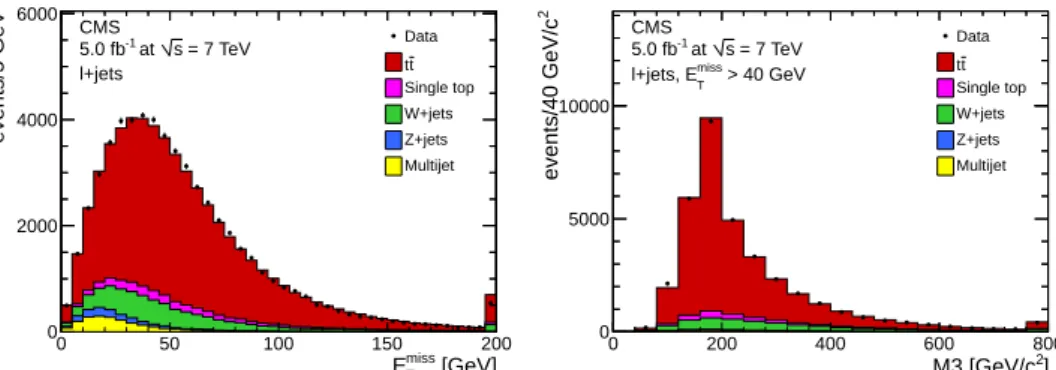
production. For the estimation of the background contributions we make use of the
discrimi-nating power of EmissT and of M3, the invariant mass of the three jets with the largest vectorially
summed transverse momentum. For each of the two lepton channels, these two distributions
are fitted with a binned maximum-likelihood fit. For the tt signal and the W+jets, Z+jets, and
single-top-quark background processes, the respective simulated samples are used to model
the shapes of the Emiss
T and M3 distributions, while an approach based on data from sideband
regions featuring non-isolated leptons is used for the multijet background. Gaussian rate
con-straints are introduced into the likelihood function for the Z+jets and single-top-quark
pro-cesses according to the respective NLO cross sections, while the rates of all other propro-cesses are free parameters of the fit. A more detailed description of the fitting procedure can be found in Ref. [6].
The resulting rates for the different processes can be correlated with each other, which has to be propagated to the calculation of the statistical uncertainty of the measured tt charge asymmetry.
The largest correlations are found between the rates of the Z+jets and multijet backgrounds
(−20%) and between the rates for the W++jets and W−+jets backgrounds (+12%). All other
4 5 Measurement of the tt charge asymmetry
the fits, along with their uncertainties. Figure 1 shows the measured ETmissand M3 distributions,
with the individual simulated contributions normalized to the results from the fit.
[GeV] miss T E 0 50 100 150 200 events/5 GeV 0 2000 4000 6000 Data t t Single top W+jets Z+jets Multijet = 7 TeV s at -1 5.0 fb l+jets CMS ] 2 M3 [GeV/c 0 200 400 600 800 2 events/40 GeV/c 0 5000 10000 Data t t Single top W+jets Z+jets Multijet = 7 TeV s at -1 5.0 fb > 40 GeV miss T l+jets, E CMS
Figure 1: Comparison of the combined lepton+jets data with simulated contributions for the
distributions in Emiss
T (left) and M3 (right). The simulated signal and background contributions
are normalized to the results of the fits given in Table 1.
Table 1: Results for the numbers of events for background (BG) and tt contributions from fits to data, along with their uncertainties. The quoted uncertainties are of statistical nature with
the exception of the uncertainties on the numbers for the single top and Z+jets backgrounds,
which reflect the widths of the Gaussian rate constraints used in the likelihood fit (see text).
Process Electron+jets Muon+jets Total
Single top (t+tW) 1113±338 1418±505 2532±608 W++jets 1818±227 1807±290 3625±369 W−+jets 1454±224 1320±275 2773±355 Z+jets 535±153 600±170 1135±229 Multijet 1142±227 863±209 2005±308 Total BG 6062±540 6008±698 12070±882 tt 18634±390 26976±468 45610±609 Observed data 24705 32992 57697
5
Measurement of the tt charge asymmetry
The measurement of the tt charge asymmetry is based on the fully reconstructed four-momenta of the top quarks and antiquarks in each event. We reconstruct the leptonically decaying W
bo-son from the measured charged lepton and EmissT , and associate the measured jets in the event
with the quarks in the tt decay chain. The reconstruction procedure is described in detail in Ref. [6].
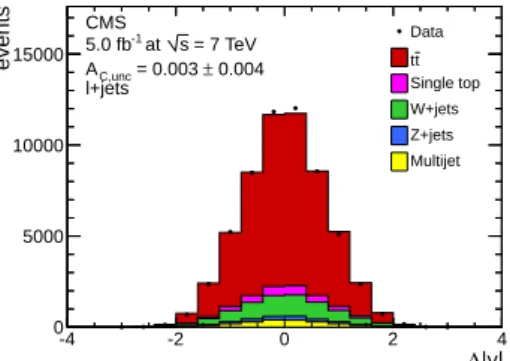
The reconstructed top quark and antiquark four-momenta are used to obtain the inclusive (see
Fig. 2) and differential distributions of∆|y|and the charge asymmetry is calculated from the
number of entries with∆|y| > 0 and ∆|y| < 0. In case of the differential measurements, the
asymmetries are calculated separately for the different bins in the kinematic variable Vi, where
Vi is either |ytt|, pttT, or mtt. To allow for a comparison of the resulting asymmetry and the
predictions from theory, the reconstructed distributions of∆|y|and the three kinematic
vari-ables have to be corrected for background contributions, reconstruction effects, and selection efficiencies.
|y| ∆ -4 -2 0 2 4 events 0 5000 10000 15000 Data t t Single top W+jets Z+jets Multijet = 7 TeV s at -1 5.0 fb CMS 0.004 ± = 0.003 C,unc A l+jets
Figure 2: Comparison of the combined lepton+jets data with simulated contributions for the
distributions in∆|y|. The simulated signal and background contributions are normalized to
the results of the fits given in Table 1.
In the first correction step, the distributions of background processes are normalized to the estimated rates (see Table 1) and subtracted from the data, assuming Gaussian uncertainties on the background rates as well as on statistical fluctuations in the background templates. The correlations among the individual background rates are taken into account.
The background-subtracted distributions are transformed from the reconstruction level to the particle level after event selection, and from there to the particle level before event selection. The corrections are achieved by applying a regularized unfolding procedure to the data [18] through a generalized matrix-inversion method. In this method, the perturbing effects are
de-scribed by a smearing matrix S that translates the true spectrum~x into the measured spectrum
~
w = S~x. As reconstruction and selection effects factorize, the smearing matrix S can be
con-structed as the product of a migration matrix and a diagonal matrix with the efficiencies for each of the bins on the diagonal, and all other elements set to zero. The unfolding procedure used for the inclusive measurement — described in detail in Ref. [6] — can be generalized to deal also with two-dimensional distributions.
The binning choice for a two-dimensional unfolding procedure has to fulfill some requirements in order to stabilize the unfolding procedure and to avoid a loss of resolution. For the applied unfolding procedure it is advised to use twice as many bins for the reconstructed spectra as for
the unfolded spectra [18]. We use 16 (8) bins for the reconstructed (unfolded)∆|y|distribution
and 6 (3) bins in the reconstructed (unfolded) Vi distributions. Furthermore it is desirable that
the number of entries in each bin of the reconstructed distributions as well as in the unfolded distributions be approximately equal. The ranges for the bins in the unfolded kinematic
vari-ables are [0 – 0.41; 0.41 – 0.90; 0.90 –∞] for|ytt|, [ 0 – 23; 23 – 58; 58 –∞] for pttTin GeV/c, and [0 –
420; 420 – 512; 512 –∞] for mttin GeV/c2. The binning choice for∆|y|is different in each bin of
Vi, resulting in different amounts of vertical overlap between horizontally neighbouring bins
in the two-dimensional distributions (for illustration see the binning in Fig. 3, lower right). For the regularization of these distributions used in the differential measurements all combinations of neighbouring bins are considered. Due to the partial vertical overlap of horizontally neigh-bouring bins for a given central bin there are up to four possible combinations, each weighted with a factor considering the amount of vertical overlap.
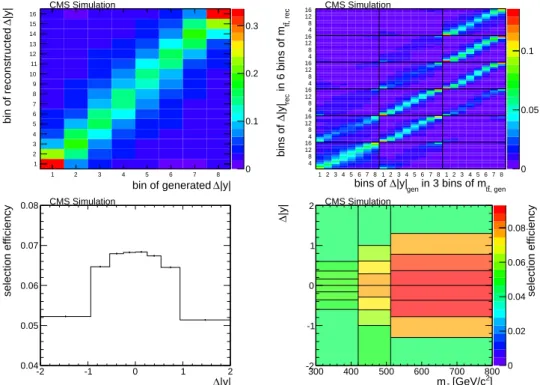
We use separate migration matrices and selection efficiencies for the inclusive measurement
and the three differential measurements, obtained from tt events simulated with POWHEG.
Figure 3 shows the migration matrices for the inclusive measurement and for the differential
mea-6 5 Measurement of the tt charge asymmetry
surements. While for the inclusive measurement the migration matrix describes the migration
of selected events from true values of∆|y|to different reconstructed values, for the migration
matrices of the differential measurements not only the migration between bins of∆|y|has to be
taken into account, but also the migration between bins of Vi. The migration matrices for the
differential measurements feature on large scale a grid of 6×3 bins in Viwith each of these bins
hosting a 16×8 migration matrix describing the migration between different∆|y|values. The
values of∆|y|and Vi affect the probability for an event to survive the event selection criteria.
The selection efficiencies as a function of∆|y|for the inclusive measurement and as a function
of∆|y|and mtt for the differential measurement in mttare depicted in Fig. 3. The nearly
sym-metric shapes of the efficiency distributions imply that the effect of the event selection criteria on the tt charge asymmetry is small.
0 0.1 0.2 0.3 |y| ∆ bin of generated 1 2 3 4 5 6 7 8 |y| ∆ bin of reconstructed 1 2 3 4 5 6 7 8 9 10 11 12 13 14 15 16 CMS Simulation 0 0.05 0.1 , gen t t in 3 bins of m gen |y| ∆ bins of 1 2 3 4 5 6 7 8 1 2 3 4 5 6 7 8 1 2 3 4 5 6 7 8 , rectt in 6 bins of m rec |y| ∆ bins of 4 8 12 164 8 12 16 4 8 12 16 4 8 12 16 4 8 12 16 4 8 12 16 CMS Simulation |y| ∆ -2 -1 0 1 2 s e le c ti o n e ff ic ie n c y 0.04 0.05 0.06 0.07 0.08 CMS Simulation s e le c ti o n e ff ic ie n c y 0 0.02 0.04 0.06 0.08 ] 2 [GeV/c t t m 300 400 500 600 700 800 |y| ∆ -2 -1 0 1 2 CMS Simulation
Figure 3: Migration matrix (upper row) between the generated and the reconstructed values
after the event selection for∆|y|(left) and for the measurement differential in mtt(right).
Selec-tion efficiency (lower row) as a funcSelec-tion of generated∆|y|, defined with respect to inclusive tt
production (left) and for the measurement differential in mtt(right).
The performance of the unfolding algorithm is tested in sets of pseudoexperiments, each of which provides a randomly generated sample distribution. For each pseudoexperiment the number of events from each contributing process is determined from a Poisson distribution around the mean of a Gaussian distribution centred around the measured event rate given in Table 1, with a width corresponding to the respective uncertainty. We randomly draw the resulting number of events for each process from the respective simulated sample to generate distributions for each pseudoexperiment. Each distribution is then subjected to the background subtraction and unfolding procedure described above.
The average asymmetries from 50 000 pseudoexperiments for the inclusive as well as for the differential measurements agree well with the true asymmetries in the sample used to model the signal component and the pull distributions agree with expectations, indicating that the treatment of uncertainties is consistent with Gaussian behavior. To test the unfolding procedure
for different asymmetries, we reweight the events of the default tt sample according to their
∆|y| value with a factor w = k·∆|y| +1, to artificially introduce asymmetries between−0.2
and+0.2, and then perform pseudoexperiments for each of the reweighted distributions. For
the differential measurements this test is performed in each of the three bins of Vi separately.
In all cases we find only negligible, if any deviations of the ensemble means from the input values for the asymmetry. In addition to this global reweighting of events, one can define the
reweighting factor w as a function of one of the kinematic variables, w =k(Vi) ·∆|y| +1. Four
scenarios with k rising or falling linearly with Viand one scenario in which k rises quadratically
are tested, generating asymmetries between −0.1 and +0.1. The effect of this reweighting
dependent on Vi is tested in all three possibilities to measure AC as a function of Vj. These
scenarios serve as tests of the model-independence of the unfolding procedure, and observed deviations from the expectations are considered for the estimate of the systematic uncertainties of the measurement.
6
Estimation of systematic uncertainties
Systematic uncertainties with an impact on the differential selection efficiency, on the recon-structed top-quark momenta, or on the background rates can bias the results. To evaluate each source of systematic uncertainty, we repeat the background estimation and the measurement
of ACusing modified simulated samples. The expected systematic uncertainty for each source
is taken to be the shift in the values of the corrected asymmetry between the default measure-ment and the one using the modified templates. The systematic uncertainties can be divided into three different categories: experimental sources, uncertainties in the modeling of the signal and background processes, and uncertainties due to the applied unfolding procedure.
The following experimental sources of systematic uncertainties are evaluated: variations in the jet energy scale (JES), jet energy resolution (JER), b-tagging efficiency, and the lepton selection efficiency. In order to derive the modified templates the corrections on JES and JER for
simu-lated events are changed by±1 standard deviations of their η- and pT-dependent uncertainties.
The overall scaling factor of the b-tagging efficiency does not affect the measurement, only η-dependent variations could in principle change the results. We therefore reweight events with tagged jets in the central region and in the forward regions maximally different within the
b-tagging efficiency uncertainty. The effect on the ACmeasurement is found to be negligible. In a
similar manner, we vary the scale factor for the lepton selection efficiency within its
uncertain-ties (±1% for muons;±2% for electrons), this time with maximally different weighting factors
for positively and negatively charged leptons, as a possible difference could lead to artificial asymmetries. This conservative treatment covers possible detector asymmetries as well as the probability of mismeasuring the lepton charge.
Regarding the simulation of signal and background processes, several sources of systematic uncertainties are evaluated. The uncertainty associated with the choice of the event generator
used for modeling the tt signal is estimated by using simulated events generated with MAD
-GRAPHinstead ofPOWHEGfor the determination of the smearing matrix. In addition, a signal
sample with a different hadronization and shower modeling has been used ([email protected] [19]
interfaced toHERWIG[20]) to estimate the systematic uncertainty due to this part of the event
generation. The effects of variations in the factorization and renormalization scales (Q2) are
estimated for W+jets and tt events. For this purpose the strong coupling constant αsand the
parton distribution functions (PDF) are recalculated for each event for the varied Q2 scale —
either multiplied with a factor of 4 or 0.25. The Q2scale is varied independently for W+jets and
result-8 6 Estimation of systematic uncertainties
ing systematic uncertainty on the measurement. The systematic uncertainties on the measured asymmetry from the choice of PDFs for the colliding protons used in the simulated events are estimated using the CTEQ6.6 [21] PDF set and the LHAPDF [22] package. In addition, the effect of variations in the frequency of occurrence of pileup events, overlaid on the simulated signal and background events, is estimated.
As the first step of the correction of the measured distributions is the subtraction of the back-ground, the measurement is sensitive to the asymmetries present in the background model and we therefore evaluate the influence of possible mismodeling of the two backgrounds which are most sensitive to mismodeling. The rates for positively charged and negatively charged W bosons are asymmetric and since the distributions of the two processes are slightly different, a mismodeling could artificially produce asymmetries. To estimate the effects from possible
mismodeling of the W+jets background component, the templates for W+and W− processes
are interchanged. Further studies are performed using a control sample enriched in W+jets
events by selecting only events without b-tagged jets. The small observed differences between simulation and data in the inclusive distributions, as well as in the differential ones, are well
encapsulated by the applied method to vary the W+jets template. The other background
pro-cess that can show artificial asymmetries is the multijet background. This is the case if the rates for positively and negatively charged leptons differ in this sample. The multijet background is modeled using events from a sideband region, defined by inverting the requirements on the isolation of the charged lepton candidates. In these events the lepton rapidity is on average larger than the jet rapidities. As a result, the reconstructed leptonically decaying top quark can-didates have on average a larger absolute value of the rapidity than the hadronically decaying
top quark candidates, which in the end leads to different mean values of∆|y|for events with
positively and negatively charged leptons, respectively. To account for this effect, we invert the
sign of∆|y|for each event and use this altered template to model the multijet background.
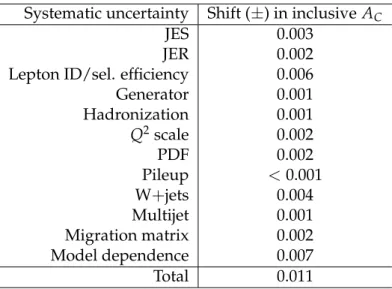
Table 2: Systematic uncertainties for the inclusive measurement of AC.
Systematic uncertainty Shift (±) in inclusive AC
JES 0.003
JER 0.002
Lepton ID/sel. efficiency 0.006
Generator 0.001 Hadronization 0.001 Q2scale 0.002 PDF 0.002 Pileup <0.001 W+jets 0.004 Multijet 0.001 Migration matrix 0.002 Model dependence 0.007 Total 0.011
The third category of systematic uncertainties deals with the impact of the limited number of simulated events and possible violations of the assumption that the applied unfolding pro-cedure is model-independent. The impact of statistical uncertainties of the entries in the mi-gration matrices is evaluated by repeating the measurement with altered mimi-gration matrices, where each element is varied within its statistical uncertainties. In addition to these uncer-tainties, we estimate the influence of possible dependencies of the asymmetry on one of the
reweighted simulated signal samples and evaluate the differences between true and measured asymmetries in various reweighting scenarios, as described above. We take the average of the absolute values of the observed deviations and assign it as systematic uncertainty.
The contributions of the different sources of systematic uncertainties to the total uncertainty of the inclusive measurement are summarized in Table 2. The total systematic uncertainty is smaller than the one obtained in Ref. [6]. The two main changes in the evaluation of systematic uncertainties with respect to Ref. [6], which account for this difference, are discussed below. Variations in the threshold for the matching of matrix elements and parton shower evolution for the simulation of the tt signal [15], causing the largest contribution to the total systematic uncertainty in the previous measurement, have no impact on the present measurement due to
the usage of the NLO event generatorPOWHEGfor modeling the tt signal. Furthermore, we do
not quote a separate uncertainty due to variations in the amount of ISR and FSR on the
mea-surement, as this contribution is covered by the uncertainties due to the choice of the Q2scale
and the model-dependence systematic. The probability for additional radiation increases with
decreasing Q2and vice versa. Due to the strong correlation between the amount of additional
radiation and the transverse momentum of the tt system, the variation of the generated
asym-metry as a function of pttT, as done in the estimation of the model dependence uncertainty, is
also suited to estimate the effects of variations in the amount of ISR/FSR on the measurement. The systematic uncertainties on the differential measurements are included in the error bars
of the corrected differential distributions (see Fig. 4). Depending on Vi and the actual bin, the
contributions from the different sources vary. The largest contributions arise from variations in the JES and the conservatively estimated uncertainties due to lepton selection efficiency and model-dependence as well as the statistical fluctuations of the migration matrix. The generator
and hadronization uncertainty play a significant role for the measurements differential in mtt
and pttT. The modeling of the major background, the W+jets process, is significant in the third
bin of mttand|ytt|.
7
Results
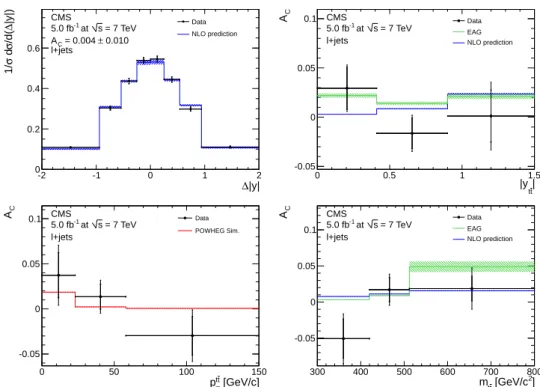
The unfolded ∆|y| distribution, shown in Fig. 4, is used to calculate the corrected inclusive
asymmetry:
AC =0.004±0.010(stat.) ±0.011(syst.). (2)
Table 3 gives the values of the measured inclusive asymmetry at the different stages of the analysis.
Table 3: The measured inclusive asymmetry at the different stages of the analysis and the corresponding theoretical prediction from the SM.
Uncorrected 0.003±0.004(stat.)
BG-subtracted 0.002±0.005(stat.) ±0.003(syst.)
Final corrected 0.004±0.010(stat.) ±0.011(syst.)
Theoretical prediction (SM) 0.0115±0.0006
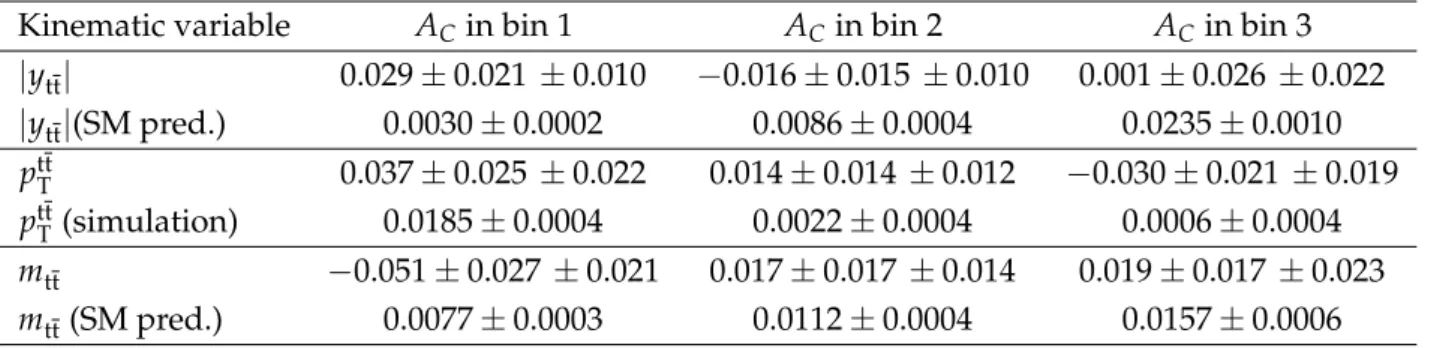
The results of the three differential measurements can be found in Table 4 and Fig. 4. The measured values are compared to the SM predictions — based on the calculation of Ref. [5] —
10 8 Conclusion
and as an illustrative example to the predictions from a BSM model that introduces an anoma-lous effective axial-vector coupling to the gluon at the one-loop level [23, 24]. The gluon-quark vertex is treated in the approximation of an effective field theory with an order of 1 TeV scale for new physics contributions. This is a model that can explain the strong dependence of the
forward-backward asymmetry on mtt as seen by CDF. As the theoretical predictions are
nor-malized to the leading-order cross section and ptt
T is zero at LO, no theoretical predictions are
available for this differential measurement. Instead, we compare the measured asymmetries
with the predictions obtained fromPOWHEGsimulation. Within the uncertainties the data do
not show any significant asymmetry and all measured values are consistent with a null asym-metry as well as with the SM predicted values. The current level of precision is not yet sufficient to discriminate the explored BSM model either.
Table 4: The corrected asymmetry values in three bins of the kinematic variables|yt¯t|, pT,t¯t, and
mt¯t with statistical and systematic uncertainties, along with the SM predictions (in case of pttT
we compare to the values obtained fromPOWHEGsimulation).
Kinematic variable ACin bin 1 ACin bin 2 ACin bin 3
|ytt| 0.029±0.021 ±0.010 −0.016±0.015 ±0.010 0.001±0.026 ±0.022 |ytt|(SM pred.) 0.0030±0.0002 0.0086±0.0004 0.0235±0.0010 ptt T 0.037±0.025 ±0.022 0.014±0.014 ±0.012 −0.030±0.021 ±0.019 ptt T (simulation) 0.0185±0.0004 0.0022±0.0004 0.0006±0.0004 mtt −0.051±0.027 ±0.021 0.017±0.017 ±0.014 0.019±0.017 ±0.023 mtt(SM pred.) 0.0077±0.0003 0.0112±0.0004 0.0157±0.0006
8
Conclusion
An inclusive and three differential measurements of the charge asymmetry in tt production
at the LHC have been presented. Events with top-quark pairs decaying in the electron+jets
and muon+jets channels were selected and a full tt event reconstruction was performed to
determine the four-momenta of the top quarks and antiquarks. The observed distributions were then corrected for acceptance and reconstruction effects. Although the measured values constitute the most precise determination of the tt charge asymmetry at the LHC to date, the current precision does not yet allow distinguishing a zero asymmetry from the values predicted in the standard model or in BSM theories. The reported results nonetheless indicate that LHC data disfavor large deviations from the SM predictions. To get a quantitative picture and to
answer the question whether or not the observed slight difference between AFBat the Tevatron
and ACat the LHC is due to BSM physics, it is essential to further explore AC. This is especially
true in kinematic regions where the qq → tt contribution, and thus the charge asymmetry, is
enhanced.
Acknowledgments
We thank G. Rodrigo, and J.H. K ¨uhn for fruitful discussions and congratulate our colleagues in the CERN accelerator departments for the excellent performance of the LHC machine. We thank the technical and administrative staff at CERN and other CMS institutes, and acknowl-edge support from: FMSR (Austria); FNRS and FWO (Belgium); CNPq, CAPES, FAPERJ,
|y| ∆ -2 -1 0 1 2 |y|) ∆ /d( σ d σ 1/ 0 0.2 0.4 0.6 Data NLO prediction CMS = 7 TeV s at -1 5.0 fb 0.010 ± = 0.004 C A l+jets | t t |y 0 0.5 1 1.5 C A -0.05 0 0.05 0.1 Data EAG NLO prediction CMS = 7 TeV s at -1 5.0 fb l+jets [GeV/c] t t T p 0 50 100 150 C A -0.05 0 0.05 0.1 Data POWHEG Sim. CMS = 7 TeV s at -1 5.0 fb l+jets ] 2 [GeV/c t t m 300 400 500 600 700 800 C A -0.05 0 0.05 0.1 Data EAG NLO prediction CMS = 7 TeV s at -1 5.0 fb l+jets
Figure 4: Unfolded inclusive∆|y|distribution (upper left), corrected asymmetry as a function
of|ytt|(upper right), pttT (lower left), and mtt(lower right). The measured values are compared
to NLO calculations for the SM — based on the calculations of Ref. [5] — and to the predictions of a model featuring an effective axial-vector coupling of the gluon (EAG) [24]. The error bars on the differential asymmetry values indicate the statistical and total uncertainties, determined by adding statistical and systematic uncertainties in quadrature. The shaded areas indicate the theoretical uncertainties on the NLO calculations.
and FAPESP (Brazil); MES (Bulgaria); CERN; CAS, MoST, and NSFC (China); COLCIEN-CIAS (Colombia); MSES (Croatia); RPF (Cyprus); MoER, SF0690030s09 and ERDF (Estonia); Academy of Finland, MEC, and HIP (Finland); CEA and CNRS/IN2P3 (France); BMBF, DFG, and HGF (Germany); GSRT (Greece); OTKA and NKTH (Hungary); DAE and DST (India); IPM (Iran); SFI (Ireland); INFN (Italy); NRF and WCU (Korea); LAS (Lithuania); CINVESTAV, CONACYT, SEP, and UASLP-FAI (Mexico); MSI (New Zealand); PAEC (Pakistan); MSHE and NSC (Poland); FCT (Portugal); JINR (Armenia, Belarus, Georgia, Ukraine, Uzbekistan); MON, RosAtom, RAS and RFBR (Russia); MSTD (Serbia); MICINN and CPAN (Spain); Swiss Funding Agencies (Switzerland); NSC (Taipei); TUBITAK and TAEK (Turkey); STFC (United Kingdom); DOE and NSF (USA).
Individuals have received support from the Marie-Curie programme and the European Re-search Council (European Union); the Leventis Foundation; the A. P. Sloan Foundation; the Alexander von Humboldt Foundation; the Belgian Federal Science Policy Office; the Fonds pour la Formation `a la Recherche dans l’Industrie et dans l’Agriculture (FRIA-Belgium); the Agentschap voor Innovatie door Wetenschap en Technologie (IWT-Belgium); the Council of Science and Industrial Research, India; and the HOMING PLUS programme of Foundation for Polish Science, cofinanced from European Union, Regional Development Fund.
12 References
References
[1] CDF Collaboration, “Evidence for a mass dependent forward-backward asymmetry in top quark pair production”, Phys. Rev. D 83 (2011) 112003,
doi:10.1103/PhysRevD.83.112003, arXiv:1101.0034.
[2] D0 Collaboration, “Forward-backward asymmetry in top quark-antiquark production”, Phys. Rev. D 84 (2011) 112005, doi:10.1103/PhysRevD.84.112005.
[3] J. A. Aguilar-Saavedra and M. Perez-Victoria, “Asymmetries in tt production: LHC versus Tevatron”, Phys. Rev. D 84 (2011) 115013,
doi:10.1103/PhysRevD.84.115013, arXiv:1105.4606.
[4] J. H. K ¨uhn and G. Rodrigo, “Charge Asymmetry in Hadroproduction of Heavy Quarks”, Phys. Rev. Lett. 81 (1998) 49, doi:10.1103/PhysRevLett.81.49,
arXiv:hep-ph/9802268.
[5] J. H. K ¨uhn and G. Rodrigo, “Charge asymmetries of top quarks at hadron colliders revisited”, JHEP 01 (2012) 063, doi:10.1007/JHEP01(2012)063,
arXiv:1109.6830.
[6] CMS Collaboration, “Measurement of the charge asymmetry in top-quark pair
production in proton-proton collisions at√s = 7 TeV”, Phys. Lett. B 709 (2012) 28,
doi:10.1016/j.physletb.2012.01.078, arXiv:1112.5100.
[7] ATLAS Collaboration, “Measurement of the charge asymmetry in top quark pair
production in pp collisions at√s = 7 TeV using the ATLAS detector”, (2012).
arXiv:1203.4211. Submitted to Eur. Phys. J. C.
[8] J. Drobnak, J. F. Kamenik, and J. Zupan, “Flipping tt asymmetries at the Tevatron and the LHC”, (2012). arXiv:1205.4721.
[9] J. A. Aguilar-Saavedra and A. Juste, “Collider-independent tt forward-backward asymmetries”, (2012). arXiv:1205.1898.
[10] G. Rodrigo and P. Ferrario, “Charge asymmetry: A theory appraisal”, Nuovo Cim. C 33 (2010) 221, doi:10.1393/ncc/i2010-10646-5, arXiv:1007.4328.
[11] CMS Collaboration, “The CMS experiment at the CERN LHC”, JINST 03 (2008) S08004, doi:10.1088/1748-0221/3/08/S08004.
[12] J. Alwall et al., “MadGraph 5: going beyond”, JHEP 06 (2011) 128, doi:10.1007/JHEP06(2011)128, arXiv:1106.0522.
[13] S. Alioli et al., “A general framework for implementing NLO calculations in shower Monte Carlo programs: the POWHEG BOX”, JHEP 06 (2010) 043,
doi:10.1007/JHEP06(2010)043, arXiv:1002.2581.
[14] T. Sj ¨ostrand, S. Mrenna, and P. Z. Skands, “PYTHIA 6.4 physics and manual”, JHEP 05 (2006) 026, doi:10.1088/1126-6708/2006/05/026, arXiv:hep-ph/0603175. [15] M. L. Mangano et al., “Matching matrix elements and shower evolution for top-quark
production in hadronic collisions”, JHEP 01 (2007) 013,
[16] R. Field, “Min-bias and the underlying event at the LHC”, Acta Physica Polonica B 42 (2011) 2631, doi:10.5506/APhysPolB.42.2631.
[17] CMS Collaboration, “Particle–Flow Event Reconstruction in CMS and Performance for
Jets, Taus, and EmissT ”, CMS Physics Analysis Summary CMS-PAS-PFT-09-001, (2009).
[18] V. Blobel, “An unfolding method for high energy physics experiments”, (2002).
arXiv:hep-ex/0208022.
[19] S. Frixione and B. R. Webber, “Matching NLO QCD computations and parton shower simulations”, JHEP 06 (2002) 029, doi:10.1088/1126-6708/2002/06/029, arXiv:hep-ph/0204244.
[20] G. Corcella et al., “HERWIG 6.5 Release Note”, (2002). arXiv:hep-ph/0210213. [21] P. M. Nadolsky et al., “Implications of CTEQ global analysis for collider observables”,
Phys. Rev. D 78 (2008) 013004, doi:10.1103/PhysRevD.78.013004,
arXiv:0802.0007.
[22] WBG Collaboration, “The Les Houches Accord PDFs (LHAPDF) and LHAGLUE”, (2005). arXiv:hep-ph/0508110.
[23] E. Gabrielli, A. Racioppi, and M. Raidal, “Implications of the effective axial-vector coupling of the gluon on top-quark charge asymmetry at the LHC”, Phys. Rev. D 85 (2012) 074021, doi:10.1103/PhysRevD.85.074021, arXiv:1112.5885v1. [24] G. Brooijmans et al., “Les Houches 2011: Physics at TeV Colliders New Physics Working
A
The CMS Collaboration
Yerevan Physics Institute, Yerevan, Armenia
S. Chatrchyan, V. Khachatryan, A.M. Sirunyan, A. Tumasyan
Institut f ¨ur Hochenergiephysik der OeAW, Wien, Austria
W. Adam, E. Aguilo, T. Bergauer, M. Dragicevic, J. Er ¨o, C. Fabjan1, M. Friedl, R. Fr ¨uhwirth1,
V.M. Ghete, J. Hammer, N. H ¨ormann, J. Hrubec, M. Jeitler1, W. Kiesenhofer, V. Kn ¨unz,
M. Krammer1, D. Liko, I. Mikulec, M. Pernicka†, B. Rahbaran, C. Rohringer, H. Rohringer,
R. Sch ¨ofbeck, J. Strauss, A. Taurok, P. Wagner, W. Waltenberger, G. Walzel, E. Widl, C.-E. Wulz1
National Centre for Particle and High Energy Physics, Minsk, Belarus
V. Mossolov, N. Shumeiko, J. Suarez Gonzalez
Universiteit Antwerpen, Antwerpen, Belgium
S. Bansal, T. Cornelis, E.A. De Wolf, X. Janssen, S. Luyckx, L. Mucibello, S. Ochesanu, B. Roland, R. Rougny, M. Selvaggi, Z. Staykova, H. Van Haevermaet, P. Van Mechelen, N. Van Remortel, A. Van Spilbeeck
Vrije Universiteit Brussel, Brussel, Belgium
F. Blekman, S. Blyweert, J. D’Hondt, R. Gonzalez Suarez, A. Kalogeropoulos, M. Maes, A. Olbrechts, W. Van Doninck, P. Van Mulders, G.P. Van Onsem, I. Villella
Universit´e Libre de Bruxelles, Bruxelles, Belgium
B. Clerbaux, G. De Lentdecker, V. Dero, A.P.R. Gay, T. Hreus, A. L´eonard, P.E. Marage, T. Reis, L. Thomas, C. Vander Velde, P. Vanlaer, J. Wang
Ghent University, Ghent, Belgium
V. Adler, K. Beernaert, A. Cimmino, S. Costantini, G. Garcia, M. Grunewald, B. Klein, J. Lellouch, A. Marinov, J. Mccartin, A.A. Ocampo Rios, D. Ryckbosch, N. Strobbe, F. Thyssen, M. Tytgat, P. Verwilligen, S. Walsh, E. Yazgan, N. Zaganidis
Universit´e Catholique de Louvain, Louvain-la-Neuve, Belgium
S. Basegmez, G. Bruno, R. Castello, L. Ceard, C. Delaere, T. du Pree, D. Favart, L. Forthomme,
A. Giammanco2, J. Hollar, V. Lemaitre, J. Liao, O. Militaru, C. Nuttens, D. Pagano, A. Pin,
K. Piotrzkowski, N. Schul, J.M. Vizan Garcia
Universit´e de Mons, Mons, Belgium
N. Beliy, T. Caebergs, E. Daubie, G.H. Hammad
Centro Brasileiro de Pesquisas Fisicas, Rio de Janeiro, Brazil
G.A. Alves, M. Correa Martins Junior, D. De Jesus Damiao, T. Martins, M.E. Pol, M.H.G. Souza
Universidade do Estado do Rio de Janeiro, Rio de Janeiro, Brazil
W.L. Ald´a J ´unior, W. Carvalho, A. Cust ´odio, E.M. Da Costa, C. De Oliveira Martins, S. Fonseca De Souza, D. Matos Figueiredo, L. Mundim, H. Nogima, V. Oguri, W.L. Prado Da Silva, A. Santoro, L. Soares Jorge, A. Sznajder
Instituto de Fisica Teorica, Universidade Estadual Paulista, Sao Paulo, Brazil
C.A. Bernardes3, F.A. Dias4, T.R. Fernandez Perez Tomei, E. M. Gregores3, C. Lagana,
F. Marinho, P.G. Mercadante3, S.F. Novaes, Sandra S. Padula
Institute for Nuclear Research and Nuclear Energy, Sofia, Bulgaria
V. Genchev5, P. Iaydjiev5, S. Piperov, M. Rodozov, S. Stoykova, G. Sultanov, V. Tcholakov,
16 A The CMS Collaboration
University of Sofia, Sofia, Bulgaria
A. Dimitrov, R. Hadjiiska, V. Kozhuharov, L. Litov, B. Pavlov, P. Petkov
Institute of High Energy Physics, Beijing, China
J.G. Bian, G.M. Chen, H.S. Chen, C.H. Jiang, D. Liang, S. Liang, X. Meng, J. Tao, J. Wang, X. Wang, Z. Wang, H. Xiao, M. Xu, J. Zang, Z. Zhang
State Key Lab. of Nucl. Phys. and Tech., Peking University, Beijing, China
C. Asawatangtrakuldee, Y. Ban, S. Guo, Y. Guo, W. Li, S. Liu, Y. Mao, S.J. Qian, H. Teng, D. Wang, L. Zhang, B. Zhu, W. Zou
Universidad de Los Andes, Bogota, Colombia
C. Avila, J.P. Gomez, B. Gomez Moreno, A.F. Osorio Oliveros, J.C. Sanabria
Technical University of Split, Split, Croatia
N. Godinovic, D. Lelas, R. Plestina6, D. Polic, I. Puljak5
University of Split, Split, Croatia
Z. Antunovic, M. Kovac
Institute Rudjer Boskovic, Zagreb, Croatia
V. Brigljevic, S. Duric, K. Kadija, J. Luetic, S. Morovic
University of Cyprus, Nicosia, Cyprus
A. Attikis, M. Galanti, G. Mavromanolakis, J. Mousa, C. Nicolaou, F. Ptochos, P.A. Razis
Charles University, Prague, Czech Republic
M. Finger, M. Finger Jr.
Academy of Scientific Research and Technology of the Arab Republic of Egypt, Egyptian Network of High Energy Physics, Cairo, Egypt
Y. Assran7, S. Elgammal8, A. Ellithi Kamel9, S. Khalil8, M.A. Mahmoud10, A. Radi11,12
National Institute of Chemical Physics and Biophysics, Tallinn, Estonia
M. Kadastik, M. M ¨untel, M. Raidal, L. Rebane, A. Tiko
Department of Physics, University of Helsinki, Helsinki, Finland
P. Eerola, G. Fedi, M. Voutilainen
Helsinki Institute of Physics, Helsinki, Finland
J. H¨ark ¨onen, A. Heikkinen, V. Karim¨aki, R. Kinnunen, M.J. Kortelainen, T. Lamp´en, K. Lassila-Perini, S. Lehti, T. Lind´en, P. Luukka, T. M¨aenp¨a¨a, T. Peltola, E. Tuominen, J. Tuominiemi, E. Tuovinen, D. Ungaro, L. Wendland
Lappeenranta University of Technology, Lappeenranta, Finland
K. Banzuzi, A. Karjalainen, A. Korpela, T. Tuuva
DSM/IRFU, CEA/Saclay, Gif-sur-Yvette, France
M. Besancon, S. Choudhury, M. Dejardin, D. Denegri, B. Fabbro, J.L. Faure, F. Ferri, S. Ganjour, A. Givernaud, P. Gras, G. Hamel de Monchenault, P. Jarry, E. Locci, J. Malcles, L. Millischer, A. Nayak, J. Rander, A. Rosowsky, I. Shreyber, M. Titov
Laboratoire Leprince-Ringuet, Ecole Polytechnique, IN2P3-CNRS, Palaiseau, France
S. Baffioni, F. Beaudette, L. Benhabib, L. Bianchini, M. Bluj13, C. Broutin, P. Busson, C. Charlot,
N. Daci, T. Dahms, L. Dobrzynski, R. Granier de Cassagnac, M. Haguenauer, P. Min´e, C. Mironov, M. Nguyen, C. Ochando, P. Paganini, D. Sabes, R. Salerno, Y. Sirois, C. Veelken, A. Zabi
Institut Pluridisciplinaire Hubert Curien, Universit´e de Strasbourg, Universit´e de Haute Alsace Mulhouse, CNRS/IN2P3, Strasbourg, France
J.-L. Agram14, J. Andrea, D. Bloch, D. Bodin, J.-M. Brom, M. Cardaci, E.C. Chabert, C. Collard,
E. Conte14, F. Drouhin14, C. Ferro, J.-C. Fontaine14, D. Gel´e, U. Goerlach, P. Juillot, A.-C. Le
Bihan, P. Van Hove
Centre de Calcul de l’Institut National de Physique Nucleaire et de Physique des Particules (IN2P3), Villeurbanne, France
F. Fassi, D. Mercier
Universit´e de Lyon, Universit´e Claude Bernard Lyon 1, CNRS-IN2P3, Institut de Physique Nucl´eaire de Lyon, Villeurbanne, France
S. Beauceron, N. Beaupere, O. Bondu, G. Boudoul, J. Chasserat, R. Chierici5, D. Contardo,
P. Depasse, H. El Mamouni, J. Fay, S. Gascon, M. Gouzevitch, B. Ille, T. Kurca, M. Lethuillier, L. Mirabito, S. Perries, V. Sordini, S. Tosi, Y. Tschudi, P. Verdier, S. Viret
E. Andronikashvili Institute of Physics, Academy of Science, Tbilisi, Georgia
V. Roinishvili
RWTH Aachen University, I. Physikalisches Institut, Aachen, Germany
G. Anagnostou, S. Beranek, M. Edelhoff, L. Feld, N. Heracleous, O. Hindrichs, R. Jussen, K. Klein, J. Merz, A. Ostapchuk, A. Perieanu, F. Raupach, J. Sammet, S. Schael, D. Sprenger,
H. Weber, B. Wittmer, V. Zhukov15
RWTH Aachen University, III. Physikalisches Institut A, Aachen, Germany
M. Ata, J. Caudron, E. Dietz-Laursonn, D. Duchardt, M. Erdmann, R. Fischer, A. G ¨uth, T. Hebbeker, C. Heidemann, K. Hoepfner, D. Klingebiel, P. Kreuzer, J. Lingemann, C. Magass, M. Merschmeyer, A. Meyer, M. Olschewski, P. Papacz, H. Pieta, H. Reithler, S.A. Schmitz, L. Sonnenschein, J. Steggemann, D. Teyssier, M. Weber
RWTH Aachen University, III. Physikalisches Institut B, Aachen, Germany
M. Bontenackels, V. Cherepanov, G. Fl ¨ugge, H. Geenen, M. Geisler, W. Haj Ahmad, F. Hoehle, B. Kargoll, T. Kress, Y. Kuessel, A. Nowack, L. Perchalla, O. Pooth, J. Rennefeld, P. Sauerland, A. Stahl
Deutsches Elektronen-Synchrotron, Hamburg, Germany
M. Aldaya Martin, J. Behr, W. Behrenhoff, U. Behrens, M. Bergholz16, A. Bethani, K. Borras,
A. Burgmeier, A. Cakir, L. Calligaris, A. Campbell, E. Castro, F. Costanza, D. Dammann, C. Diez Pardos, G. Eckerlin, D. Eckstein, G. Flucke, A. Geiser, I. Glushkov, P. Gunnellini, S. Habib, J. Hauk, G. Hellwig, H. Jung, M. Kasemann, P. Katsas, C. Kleinwort, H. Kluge, A. Knutsson,
M. Kr¨amer, D. Kr ¨ucker, E. Kuznetsova, W. Lange, W. Lohmann16, B. Lutz, R. Mankel, I. Marfin,
M. Marienfeld, I.-A. Melzer-Pellmann, A.B. Meyer, J. Mnich, A. Mussgiller, S. Naumann-Emme, J. Olzem, H. Perrey, A. Petrukhin, D. Pitzl, A. Raspereza, P.M. Ribeiro Cipriano, C. Riedl,
E. Ron, M. Rosin, J. Salfeld-Nebgen, R. Schmidt16, T. Schoerner-Sadenius, N. Sen, A. Spiridonov,
M. Stein, R. Walsh, C. Wissing
University of Hamburg, Hamburg, Germany
C. Autermann, V. Blobel, J. Draeger, H. Enderle, J. Erfle, U. Gebbert, M. G ¨orner, T. Hermanns, R.S. H ¨oing, K. Kaschube, G. Kaussen, H. Kirschenmann, R. Klanner, J. Lange, B. Mura, F. Nowak, T. Peiffer, N. Pietsch, D. Rathjens, C. Sander, H. Schettler, P. Schleper, E. Schlieckau, A. Schmidt, M. Schr ¨oder, T. Schum, M. Seidel, V. Sola, H. Stadie, G. Steinbr ¨uck, J. Thomsen, L. Vanelderen
18 A The CMS Collaboration
Institut f ¨ur Experimentelle Kernphysik, Karlsruhe, Germany
C. Barth, J. Berger, C. B ¨oser, T. Chwalek, W. De Boer, A. Descroix, A. Dierlamm, M. Feindt,
M. Guthoff5, C. Hackstein, F. Hartmann, T. Hauth5, M. Heinrich, H. Held, K.H. Hoffmann,
S. Honc, I. Katkov15, J.R. Komaragiri, P. Lobelle Pardo, D. Martschei, S. Mueller, Th. M ¨uller,
M. Niegel, A. N ¨urnberg, O. Oberst, A. Oehler, J. Ott, G. Quast, K. Rabbertz, F. Ratnikov, N. Ratnikova, S. R ¨ocker, F. Roscher, A. Scheurer, F.-P. Schilling, G. Schott, H.J. Simonis, F.M. Stober, D. Troendle, R. Ulrich, J. Wagner-Kuhr, S. Wayand, T. Weiler, M. Zeise
Institute of Nuclear Physics ”Demokritos”, Aghia Paraskevi, Greece
G. Daskalakis, T. Geralis, S. Kesisoglou, A. Kyriakis, D. Loukas, I. Manolakos, A. Markou, C. Markou, C. Mavrommatis, E. Ntomari
University of Athens, Athens, Greece
L. Gouskos, T.J. Mertzimekis, A. Panagiotou, N. Saoulidou
University of Io´annina, Io´annina, Greece
I. Evangelou, C. Foudas5, P. Kokkas, N. Manthos, I. Papadopoulos, V. Patras
KFKI Research Institute for Particle and Nuclear Physics, Budapest, Hungary
G. Bencze, C. Hajdu5, P. Hidas, D. Horvath17, F. Sikler, V. Veszpremi, G. Vesztergombi18
Institute of Nuclear Research ATOMKI, Debrecen, Hungary
N. Beni, S. Czellar, J. Molnar, J. Palinkas, Z. Szillasi
University of Debrecen, Debrecen, Hungary
J. Karancsi, P. Raics, Z.L. Trocsanyi, B. Ujvari
Panjab University, Chandigarh, India
S.B. Beri, V. Bhatnagar, N. Dhingra, R. Gupta, M. Jindal, M. Kaur, M.Z. Mehta, N. Nishu, L.K. Saini, A. Sharma, J. Singh
University of Delhi, Delhi, India
Ashok Kumar, Arun Kumar, S. Ahuja, A. Bhardwaj, B.C. Choudhary, S. Malhotra, M. Naimuddin, K. Ranjan, V. Sharma, R.K. Shivpuri
Saha Institute of Nuclear Physics, Kolkata, India
S. Banerjee, S. Bhattacharya, S. Dutta, B. Gomber, Sa. Jain, Sh. Jain, R. Khurana, S. Sarkar, M. Sharan
Bhabha Atomic Research Centre, Mumbai, India
A. Abdulsalam, R.K. Choudhury, D. Dutta, S. Kailas, V. Kumar, P. Mehta, A.K. Mohanty5,
L.M. Pant, P. Shukla
Tata Institute of Fundamental Research - EHEP, Mumbai, India
T. Aziz, S. Ganguly, M. Guchait19, M. Maity20, G. Majumder, K. Mazumdar, G.B. Mohanty,
B. Parida, K. Sudhakar, N. Wickramage
Tata Institute of Fundamental Research - HECR, Mumbai, India
S. Banerjee, S. Dugad
Institute for Research in Fundamental Sciences (IPM), Tehran, Iran
H. Arfaei, H. Bakhshiansohi21, S.M. Etesami22, A. Fahim21, M. Hashemi, H. Hesari, A. Jafari21,
M. Khakzad, M. Mohammadi Najafabadi, S. Paktinat Mehdiabadi, B. Safarzadeh23, M. Zeinali22
INFN Sezione di Baria, Universit`a di Barib, Politecnico di Baric, Bari, Italy
N. De Filippisa,c,5, M. De Palmaa,b, L. Fiorea, G. Iasellia,c, L. Lusitoa,b, G. Maggia,c,
M. Maggia, B. Marangellia,b, S. Mya,c, S. Nuzzoa,b, N. Pacificoa,b, A. Pompilia,b, G. Pugliesea,c,
G. Selvaggia,b, L. Silvestrisa, G. Singha,b, R. Venditti, G. Zitoa
INFN Sezione di Bolognaa, Universit`a di Bolognab, Bologna, Italy
G. Abbiendia, A.C. Benvenutia, D. Bonacorsia,b, S. Braibant-Giacomellia,b, L. Brigliadoria,b,
P. Capiluppia,b, A. Castroa,b, F.R. Cavalloa, M. Cuffiania,b, G.M. Dallavallea, F. Fabbria,
A. Fanfania,b, D. Fasanellaa,b,5, P. Giacomellia, C. Grandia, L. Guiduccia,b, S. Marcellinia,
G. Masettia, M. Meneghellia,b,5, A. Montanaria, F.L. Navarriaa,b, F. Odoricia, A. Perrottaa,
F. Primaveraa,b, A.M. Rossia,b, T. Rovellia,b, G. Sirolia,b, R. Travaglinia,b
INFN Sezione di Cataniaa, Universit`a di Cataniab, Catania, Italy
S. Albergoa,b, G. Cappelloa,b, M. Chiorbolia,b, S. Costaa,b, R. Potenzaa,b, A. Tricomia,b, C. Tuvea,b
INFN Sezione di Firenzea, Universit`a di Firenzeb, Firenze, Italy
G. Barbaglia, V. Ciullia,b, C. Civininia, R. D’Alessandroa,b, E. Focardia,b, S. Frosalia,b, E. Galloa,
S. Gonzia,b, M. Meschinia, S. Paolettia, G. Sguazzonia, A. Tropianoa,5
INFN Laboratori Nazionali di Frascati, Frascati, Italy
L. Benussi, S. Bianco, S. Colafranceschi24, F. Fabbri, D. Piccolo
INFN Sezione di Genova, Genova, Italy
P. Fabbricatore, R. Musenich
INFN Sezione di Milano-Bicoccaa, Universit`a di Milano-Bicoccab, Milano, Italy
A. Benagliaa,b,5, F. De Guioa,b, L. Di Matteoa,b,5, S. Fiorendia,b, S. Gennaia,5, A. Ghezzia,b,
S. Malvezzia, R.A. Manzonia,b, A. Martellia,b, A. Massironia,b,5, D. Menascea, L. Moronia,
M. Paganonia,b, D. Pedrinia, S. Ragazzia,b, N. Redaellia, S. Salaa, T. Tabarelli de Fatisa,b
INFN Sezione di Napolia, Universit`a di Napoli ”Federico II”b, Napoli, Italy
S. Buontempoa, C.A. Carrillo Montoyaa,5, N. Cavalloa,25, A. De Cosaa,b,5, O. Doganguna,b,
F. Fabozzia,25, A.O.M. Iorioa, L. Listaa, S. Meolaa,26, M. Merolaa,b, P. Paoluccia,5
INFN Sezione di Padovaa, Universit`a di Padovab, Universit`a di Trento (Trento)c, Padova, Italy
P. Azzia, N. Bacchettaa,5, D. Biselloa,b, A. Brancaa,5, R. Carlina,b, P. Checchiaa, T. Dorigoa,
U. Dossellia, F. Gasparinia,b, U. Gasparinia,b, A. Gozzelinoa, K. Kanishcheva,c, S. Lacapraraa,
I. Lazzizzeraa,c, M. Margonia,b, A.T. Meneguzzoa,b, J. Pazzinia, N. Pozzobona,b, P. Ronchesea,b,
F. Simonettoa,b, E. Torassaa, M. Tosia,b,5, S. Vaninia,b, P. Zottoa,b, G. Zumerlea,b
INFN Sezione di Paviaa, Universit`a di Paviab, Pavia, Italy
M. Gabusia,b, S.P. Rattia,b, C. Riccardia,b, P. Torrea,b, P. Vituloa,b
INFN Sezione di Perugiaa, Universit`a di Perugiab, Perugia, Italy
M. Biasinia,b, G.M. Bileia, L. Fan `oa,b, P. Laricciaa,b, A. Lucaronia,b,5, G. Mantovania,b,
M. Menichellia, A. Nappia,b, F. Romeoa,b, A. Sahaa, A. Santocchiaa,b, A. Spieziaa,b, S. Taronia,b,5
INFN Sezione di Pisaa, Universit`a di Pisab, Scuola Normale Superiore di Pisac, Pisa, Italy
P. Azzurria,c, G. Bagliesia, T. Boccalia, G. Broccoloa,c, R. Castaldia, R.T. D’Agnoloa,c,
R. Dell’Orsoa, F. Fioria,b,5, L. Fo`aa,c, A. Giassia, A. Kraana, F. Ligabuea,c, T. Lomtadzea,
L. Martinia,27, A. Messineoa,b, F. Pallaa, A. Rizzia,b, A.T. Serbana,28, P. Spagnoloa,
P. Squillaciotia,5, R. Tenchinia, G. Tonellia,b,5, A. Venturia,5, P.G. Verdinia
INFN Sezione di Romaa, Universit`a di Roma ”La Sapienza”b, Roma, Italy
20 A The CMS Collaboration
P. Meridiania,5, F. Michelia,b, S. Nourbakhsha,b, G. Organtinia,b, R. Paramattia, S. Rahatloua,b,
M. Sigamania, L. Soffia,b
INFN Sezione di Torino a, Universit`a di Torino b, Universit`a del Piemonte Orientale (No-vara)c, Torino, Italy
N. Amapanea,b, R. Arcidiaconoa,c, S. Argiroa,b, M. Arneodoa,c, C. Biinoa, N. Cartigliaa,
M. Costaa,b, N. Demariaa, C. Mariottia,5, S. Masellia, E. Migliorea,b, V. Monacoa,b, M. Musicha,5,
M.M. Obertinoa,c, N. Pastronea, M. Pelliccionia, A. Potenzaa,b, A. Romeroa,b, M. Ruspaa,c,
R. Sacchia,b, A. Solanoa,b, A. Staianoa, A. Vilela Pereiraa
INFN Sezione di Triestea, Universit`a di Triesteb, Trieste, Italy
S. Belfortea, V. Candelisea,b, F. Cossuttia, G. Della Riccaa,b, B. Gobboa, M. Maronea,b,5,
D. Montaninoa,b,5, A. Penzoa, A. Schizzia,b
Kangwon National University, Chunchon, Korea
S.G. Heo, T.Y. Kim, S.K. Nam
Kyungpook National University, Daegu, Korea
S. Chang, D.H. Kim, G.N. Kim, D.J. Kong, H. Park, S.R. Ro, D.C. Son, T. Son
Chonnam National University, Institute for Universe and Elementary Particles, Kwangju, Korea
J.Y. Kim, Zero J. Kim, S. Song
Korea University, Seoul, Korea
S. Choi, D. Gyun, B. Hong, M. Jo, H. Kim, T.J. Kim, K.S. Lee, D.H. Moon, S.K. Park
University of Seoul, Seoul, Korea
M. Choi, J.H. Kim, C. Park, I.C. Park, S. Park, G. Ryu
Sungkyunkwan University, Suwon, Korea
Y. Cho, Y. Choi, Y.K. Choi, J. Goh, M.S. Kim, E. Kwon, B. Lee, J. Lee, S. Lee, H. Seo, I. Yu
Vilnius University, Vilnius, Lithuania
M.J. Bilinskas, I. Grigelionis, M. Janulis, A. Juodagalvis
Centro de Investigacion y de Estudios Avanzados del IPN, Mexico City, Mexico
H. Castilla-Valdez, E. De La Cruz-Burelo, I. Heredia-de La Cruz, R. Lopez-Fernandez, R. Maga ˜na Villalba, J. Mart´ınez-Ortega, A. S´anchez-Hern´andez, L.M. Villasenor-Cendejas
Universidad Iberoamericana, Mexico City, Mexico
S. Carrillo Moreno, F. Vazquez Valencia
Benemerita Universidad Autonoma de Puebla, Puebla, Mexico
H.A. Salazar Ibarguen
Universidad Aut ´onoma de San Luis Potos´ı, San Luis Potos´ı, Mexico
E. Casimiro Linares, A. Morelos Pineda, M.A. Reyes-Santos
University of Auckland, Auckland, New Zealand
D. Krofcheck
University of Canterbury, Christchurch, New Zealand
National Centre for Physics, Quaid-I-Azam University, Islamabad, Pakistan
M. Ahmad, M.I. Asghar, H.R. Hoorani, S. Khalid, W.A. Khan, T. Khurshid, S. Qazi, M.A. Shah, M. Shoaib
Institute of Experimental Physics, Faculty of Physics, University of Warsaw, Warsaw, Poland
G. Brona, K. Bunkowski, M. Cwiok, W. Dominik, K. Doroba, A. Kalinowski, M. Konecki, J. Krolikowski
Soltan Institute for Nuclear Studies, Warsaw, Poland
H. Bialkowska, B. Boimska, T. Frueboes, R. Gokieli, M. G ´orski, M. Kazana, K. Nawrocki, K. Romanowska-Rybinska, M. Szleper, G. Wrochna, P. Zalewski
Laborat ´orio de Instrumenta¸c˜ao e F´ısica Experimental de Part´ıculas, Lisboa, Portugal
N. Almeida, P. Bargassa, A. David, P. Faccioli, P.G. Ferreira Parracho, M. Gallinaro, J. Seixas, J. Varela, P. Vischia
Joint Institute for Nuclear Research, Dubna, Russia
I. Belotelov, P. Bunin, M. Gavrilenko, I. Golutvin, I. Gorbunov, A. Kamenev, V. Karjavin, G. Kozlov, A. Lanev, A. Malakhov, P. Moisenz, V. Palichik, V. Perelygin, S. Shmatov, V. Smirnov, A. Volodko, A. Zarubin
Petersburg Nuclear Physics Institute, Gatchina (St Petersburg), Russia
S. Evstyukhin, V. Golovtsov, Y. Ivanov, V. Kim, P. Levchenko, V. Murzin, V. Oreshkin, I. Smirnov, V. Sulimov, L. Uvarov, S. Vavilov, A. Vorobyev, An. Vorobyev
Institute for Nuclear Research, Moscow, Russia
Yu. Andreev, A. Dermenev, S. Gninenko, N. Golubev, M. Kirsanov, N. Krasnikov, V. Matveev, A. Pashenkov, D. Tlisov, A. Toropin
Institute for Theoretical and Experimental Physics, Moscow, Russia
V. Epshteyn, M. Erofeeva, V. Gavrilov, M. Kossov5, N. Lychkovskaya, V. Popov, G. Safronov,
S. Semenov, V. Stolin, E. Vlasov, A. Zhokin
Moscow State University, Moscow, Russia
A. Belyaev, E. Boos, V. Bunichev, M. Dubinin4, L. Dudko, A. Ershov, V. Klyukhin, O. Kodolova,
I. Lokhtin, A. Markina, S. Obraztsov, M. Perfilov, S. Petrushanko, A. Popov, L. Sarycheva†,
V. Savrin, A. Snigirev
P.N. Lebedev Physical Institute, Moscow, Russia
V. Andreev, M. Azarkin, I. Dremin, M. Kirakosyan, A. Leonidov, G. Mesyats, S.V. Rusakov, A. Vinogradov
State Research Center of Russian Federation, Institute for High Energy Physics, Protvino, Russia
I. Azhgirey, I. Bayshev, S. Bitioukov, V. Grishin5, V. Kachanov, D. Konstantinov, A. Korablev,
V. Krychkine, V. Petrov, R. Ryutin, A. Sobol, L. Tourtchanovitch, S. Troshin, N. Tyurin, A. Uzunian, A. Volkov
University of Belgrade, Faculty of Physics and Vinca Institute of Nuclear Sciences, Belgrade, Serbia
P. Adzic29, M. Djordjevic, M. Ekmedzic, D. Krpic29, J. Milosevic
Centro de Investigaciones Energ´eticas Medioambientales y Tecnol ´ogicas (CIEMAT), Madrid, Spain
22 A The CMS Collaboration
Llatas, N. Colino, B. De La Cruz, A. Delgado Peris, D. Dom´ınguez V´azquez, C. Fernandez Bedoya, J.P. Fern´andez Ramos, A. Ferrando, J. Flix, M.C. Fouz, P. Garcia-Abia, O. Gonzalez Lopez, S. Goy Lopez, J.M. Hernandez, M.I. Josa, G. Merino, J. Puerta Pelayo, A. Quintario Olmeda, I. Redondo, L. Romero, J. Santaolalla, M.S. Soares, C. Willmott
Universidad Aut ´onoma de Madrid, Madrid, Spain
C. Albajar, G. Codispoti, J.F. de Troc ´oniz
Universidad de Oviedo, Oviedo, Spain
H. Brun, J. Cuevas, J. Fernandez Menendez, S. Folgueras, I. Gonzalez Caballero, L. Lloret
Iglesias, J. Piedra Gomez30
Instituto de F´ısica de Cantabria (IFCA), CSIC-Universidad de Cantabria, Santander, Spain
J.A. Brochero Cifuentes, I.J. Cabrillo, A. Calderon, S.H. Chuang, J. Duarte Campderros,
M. Felcini31, M. Fernandez, G. Gomez, J. Gonzalez Sanchez, A. Graziano, C. Jorda, A. Lopez
Virto, J. Marco, R. Marco, C. Martinez Rivero, F. Matorras, F.J. Munoz Sanchez, T. Rodrigo, A.Y. Rodr´ıguez-Marrero, A. Ruiz-Jimeno, L. Scodellaro, M. Sobron Sanudo, I. Vila, R. Vilar Cortabitarte
CERN, European Organization for Nuclear Research, Geneva, Switzerland
D. Abbaneo, E. Auffray, G. Auzinger, P. Baillon, A.H. Ball, D. Barney, J.F. Benitez, C. Bernet6,
G. Bianchi, P. Bloch, A. Bocci, A. Bonato, C. Botta, H. Breuker, T. Camporesi, G. Cerminara, T. Christiansen, J.A. Coarasa Perez, D. D’Enterria, A. Dabrowski, A. De Roeck, S. Di Guida, M. Dobson, N. Dupont-Sagorin, A. Elliott-Peisert, B. Frisch, W. Funk, G. Georgiou, M. Giffels, D. Gigi, K. Gill, D. Giordano, M. Giunta, F. Glege, R. Gomez-Reino Garrido, P. Govoni, S. Gowdy, R. Guida, M. Hansen, P. Harris, C. Hartl, J. Harvey, B. Hegner, A. Hinzmann, V. Innocente, P. Janot, K. Kaadze, E. Karavakis, K. Kousouris, P. Lecoq, Y.-J. Lee, P. Lenzi, C. Lourenc¸o, T. M¨aki, M. Malberti, L. Malgeri, M. Mannelli, L. Masetti, F. Meijers, S. Mersi, E. Meschi, R. Moser, M.U. Mozer, M. Mulders, P. Musella, E. Nesvold, T. Orimoto, L. Orsini, E. Palencia Cortezon, E. Perez, L. Perrozzi, A. Petrilli, A. Pfeiffer, M. Pierini, M. Pimi¨a,
D. Piparo, G. Polese, L. Quertenmont, A. Racz, W. Reece, J. Rodrigues Antunes, G. Rolandi32,
T. Rommerskirchen, C. Rovelli33, M. Rovere, H. Sakulin, F. Santanastasio, C. Sch¨afer,
C. Schwick, I. Segoni, S. Sekmen, A. Sharma, P. Siegrist, P. Silva, M. Simon, P. Sphicas34,
D. Spiga, A. Tsirou, G.I. Veres18, J.R. Vlimant, H.K. W ¨ohri, S.D. Worm35, W.D. Zeuner
Paul Scherrer Institut, Villigen, Switzerland
W. Bertl, K. Deiters, W. Erdmann, K. Gabathuler, R. Horisberger, Q. Ingram, H.C. Kaestli,
S. K ¨onig, D. Kotlinski, U. Langenegger, F. Meier, D. Renker, T. Rohe, J. Sibille36
Institute for Particle Physics, ETH Zurich, Zurich, Switzerland
L. B¨ani, P. Bortignon, M.A. Buchmann, B. Casal, N. Chanon, A. Deisher, G. Dissertori, M. Dittmar, M. D ¨unser, J. Eugster, K. Freudenreich, C. Grab, D. Hits, P. Lecomte,
W. Lustermann, A.C. Marini, P. Martinez Ruiz del Arbol, N. Mohr, F. Moortgat, C. N¨ageli37,
P. Nef, F. Nessi-Tedaldi, F. Pandolfi, L. Pape, F. Pauss, M. Peruzzi, F.J. Ronga, M. Rossini, L. Sala,
A.K. Sanchez, A. Starodumov38, B. Stieger, M. Takahashi, L. Tauscher†, A. Thea, K. Theofilatos,
D. Treille, C. Urscheler, R. Wallny, H.A. Weber, L. Wehrli
Universit¨at Z ¨urich, Zurich, Switzerland
C. Amsler, V. Chiochia, S. De Visscher, C. Favaro, M. Ivova Rikova, B. Millan Mejias, P. Otiougova, P. Robmann, H. Snoek, S. Tupputi, M. Verzetti
Y.H. Chang, K.H. Chen, C.M. Kuo, S.W. Li, W. Lin, Z.K. Liu, Y.J. Lu, D. Mekterovic, A.P. Singh, R. Volpe, S.S. Yu
National Taiwan University (NTU), Taipei, Taiwan
P. Bartalini, P. Chang, Y.H. Chang, Y.W. Chang, Y. Chao, K.F. Chen, C. Dietz, U. Grundler, W.-S. Hou, Y. Hsiung, K.Y. Kao, Y.J. Lei, R.-W.-S. Lu, D. Majumder, E. Petrakou, X. Shi, J.G. Shiu, Y.M. Tzeng, X. Wan, M. Wang
Cukurova University, Adana, Turkey
A. Adiguzel, M.N. Bakirci39, S. Cerci40, C. Dozen, I. Dumanoglu, E. Eskut, S. Girgis,
G. Gokbulut, E. Gurpinar, I. Hos, E.E. Kangal, T. Karaman, G. Karapinar41, A. Kayis Topaksu,
G. Onengut, K. Ozdemir, S. Ozturk42, A. Polatoz, K. Sogut43, D. Sunar Cerci40, B. Tali40,
H. Topakli39, L.N. Vergili, M. Vergili
Middle East Technical University, Physics Department, Ankara, Turkey
I.V. Akin, T. Aliev, B. Bilin, S. Bilmis, M. Deniz, H. Gamsizkan, A.M. Guler, K. Ocalan, A. Ozpineci, M. Serin, R. Sever, U.E. Surat, M. Yalvac, E. Yildirim, M. Zeyrek
Bogazici University, Istanbul, Turkey
E. G ¨ulmez, B. Isildak44, M. Kaya45, O. Kaya45, S. Ozkorucuklu46, N. Sonmez47
Istanbul Technical University, Istanbul, Turkey
K. Cankocak
National Scientific Center, Kharkov Institute of Physics and Technology, Kharkov, Ukraine
L. Levchuk
University of Bristol, Bristol, United Kingdom
F. Bostock, J.J. Brooke, E. Clement, D. Cussans, H. Flacher, R. Frazier, J. Goldstein, M. Grimes,
G.P. Heath, H.F. Heath, L. Kreczko, S. Metson, D.M. Newbold35, K. Nirunpong, A. Poll,
S. Senkin, V.J. Smith, T. Williams
Rutherford Appleton Laboratory, Didcot, United Kingdom
L. Basso48, K.W. Bell, A. Belyaev48, C. Brew, R.M. Brown, D.J.A. Cockerill, J.A. Coughlan,
K. Harder, S. Harper, J. Jackson, B.W. Kennedy, E. Olaiya, D. Petyt, B.C. Radburn-Smith, C.H. Shepherd-Themistocleous, I.R. Tomalin, W.J. Womersley
Imperial College, London, United Kingdom
R. Bainbridge, G. Ball, R. Beuselinck, O. Buchmuller, D. Colling, N. Cripps, M. Cutajar, P. Dauncey, G. Davies, M. Della Negra, W. Ferguson, J. Fulcher, D. Futyan, A. Gilbert, A. Guneratne Bryer, G. Hall, Z. Hatherell, J. Hays, G. Iles, M. Jarvis, G. Karapostoli, L. Lyons,
A.-M. Magnan, J. Marrouche, B. Mathias, R. Nandi, J. Nash, A. Nikitenko38, A. Papageorgiou,
J. Pela5, M. Pesaresi, K. Petridis, M. Pioppi49, D.M. Raymond, S. Rogerson, A. Rose, M.J. Ryan,
C. Seez, P. Sharp†, A. Sparrow, M. Stoye, A. Tapper, M. Vazquez Acosta, T. Virdee, S. Wakefield,
N. Wardle, T. Whyntie
Brunel University, Uxbridge, United Kingdom
M. Chadwick, J.E. Cole, P.R. Hobson, A. Khan, P. Kyberd, D. Leggat, D. Leslie, W. Martin, I.D. Reid, P. Symonds, L. Teodorescu, M. Turner
Baylor University, Waco, USA
K. Hatakeyama, H. Liu, T. Scarborough
The University of Alabama, Tuscaloosa, USA