UNIVERSIDADE DE LISBOA UNIVERSIDADE NOVA DE LISBOA
GEOENGINEERING: THE ETHICAL AND SOCIAL ISSUES
Paula Curvelo da Silva Campos Alves
Doutoramento no ramo de Filosofia, especialidade de Filosofia da Natureza e do Ambiente
UNIVERSIDADE DE LISBOA UNIVERSIDADE NOVA DE LISBOA
GEOENGINEERING: THE ETHICAL AND SOCIAL ISSUES
Paula Curvelo da Silva Campos Alves
Doutoramento no ramo de Filosofia, especialidade de Filosofia da Natureza e do Ambiente Tese orientada pelo Professor Doutor Viriato Soromenho-Marques e pela Doutora Ângela Guimarães
Pereira no âmbito do Programa Doutoral em Alterações Climáticas e Políticas de Desenvolvimento Sustentável
The research on which this dissertation is based was carried out at the Institute for the Protection and Security of the Citizen (IPSC-JRC) and was generously funded by a doctoral grant
Desde a entrada em vigor, em 1994, da Convenção Quadro das Nações Unidas para as Alterações Climáticas (CQNUAC), proposta inicialmente na Conferência das Nações Unidas sobre Ambiente e Desenvolvimento (Rio de Janeiro, 1992), as respostas ao problema das alterações climáticas surgem associadas a dois grandes grupos de estratégias:
• políticas e medidas de mitigação, que visam eliminar as causas antropogénicas das alterações climáticas através da redução da emissão de gases com efeito de estufa para a atmosfera, e
• políticas e medidas de adaptação, que englobam quaisquer ajustamentos nos sistemas humanos e/ou naturais, em resposta a estímulos climáticos observados ou expectáveis, com o objectivo de minimizar os efeitos negativos ou explorar oportunidades benéficas.
Contudo, uma estratégia alternativa para fazer face ao problema das alterações climáticas tem vindo a ganhar terreno ao longo da última década: a Geoengenharia (ou Engenharia Climática), comummente definida como a “manipulação deliberada e em larga escala do ambiente planetário para combater as alterações climáticas antropogénicas” (The Royal Society 2009: 1). Embora o termo geoengenharia surja associado a um conjunto vasto de tecnologias - que comportam modos de actuação distintos e riscos e efeitos secundários diversos - duas grandes categorias de métodos procuram abarcar o conjunto de tecnologias até à data propostos: Remoção do Dióxido de Carbono e Gestão da Radiação Solar (CDR e SRM, respectivamente, nas siglas em inglês). Como o nome indica, os métodos de remoção do dióxido de carbono visam reduzir as concentrações de dióxido carbono na atmosfera e, deste modo, contribuir para o arrefecimento do sistema Terra-atmosfera através da redução da quantidade de radiação de longo comprimento de onda emitida pela superfície terrestre (radiação
RESUMO
térmica infravermelha) que é absorvida pela atmosfera. O segundo conjunto de métodos, gestão da radiação solar, visa igualmente alterar o balanço radiativo da Terra, mas através do aumento da quantidade de radiação solar incidente que é reflectida para o espaço - gerando assim um aumento do albedo planetário que concorre para uma diminuição da temperatura.
Até recentemente, a comunidade científica olhava para estas propostas com cepticismo, se não mesmo com incredulidade. De facto, em 2007, o Painel Intergovernamental para as Alterações Climáticas (IPCC) ainda considerava que as soluções de geoengenharia - tais com a fertilização dos oceanos para promover a remoção de CO2 da atmosfera, ou a
colocação de materiais na alta atmosfera de modo a reduzir a quantidade de radiação solar recebida pela superfície terrestre - eram em larga medida especulativas, comportando riscos e efeitos secundários desconhecidos.
Porém, desde a publicação do Quarto Relatório de Avaliação do IPCC, a geoengenharia tem atraído uma atenção crescente no contexto das alterações climáticas, passando de um tópico discutido maioritariamente em ficção científica e artigos científicos esotéricos para o centro dos debates científico e político (Macnaghten and Szerszynski 2013: 465). As tentativas fracassadas de redução das emissões globais de gases com efeito de estufa (Crutzen 2006) — um sintoma do que tem sido descrito como um “problema de inércia política” (Gardiner 2010: 286-287) — o apelo cada vez mais intenso para uma maior gestão planetária (Global Environmental Change Programmes 2001) e a tendência para valorizar as respostas às alterações climáticas de natureza transformacional em detrimento das de natureza incremental (New et al. 2010) são alguns dos factores que ajudam a explicar a razão pela qual o cepticismo e a desconfiança com que a geoengenharia foi inicialmente acolhida deram lugar a uma ponderação mais pragmática e séria dos seus recentes avanços científicos e tecnológicos.
No entanto, o conhecimento científico associado aos processos de geoengenharia climática é bastante limitado, existindo inúmeras incertezas acerca dos impactos potenciais destas tecnologias nos sistemas humanos e naturais. O modo como os métodos de geoengenharia visam alterar forçamentos à escala planetária, a
imprevisibilidade dos impactos das acções de geoengenharia nos diferentes subsistemas climáticos e as enormes incertezas associadas a estes métodos revelam uma mudança na natureza da acção humana que pressupõe uma ética, assente na responsabilidade e antecipação, capaz de fazer face à escala e complexidade das enormes tarefas tecnocientíficas envolvidas. De facto, antes de se considerar a possibilidade de embarcar em tão ambicioso projecto, um esforço considerável deverá ser realizado no sentido de escrutinar e aprofundar as implicações éticas e sociais da geoengenharia.
Deste modo, o principal objectivo desta dissertação é o de contribuir para uma melhor compreensão das implicações éticas e sociais associadas às recentes propostas de geoengenharia e, com esse propósito, encontrar um ponto de vista adequado para responder às seguintes questões:
• Porque razão é hoje a geoengenharia considerada uma resposta possível às alterações climáticas antropogénicas?
• Que “imaginários” de ciência e tecnologia subjazem aos debates em torno da geoengenharia?
• Quão plausíveis são as actuais propostas de geoengenharia climática?
• Quais são as expectativas, os valores e os modos de construção de sentido contidos nas propostas de geoengenharia?
• Que tipo de enquadramento ético poderá servir de base à análise das propostas de geoengenharia e apoiar os processos de tomada de decisão política?
A dissertação está organizada em duas partes. A primeira parte inclui os capítulos de 1 a 5. No primeiro capítulo são apresentados os objectivos e as questões que guiaram esta investigação, bem como alguns dos pressupostos e premissas iniciais. No segundo capítulo é descrita a abordagem metodológica e discutidas as opções que determinaram o conjunto de métodos de análise adoptados. O capítulo 3 inclui a descrição do problema em análise, uma breve apresentação dos principais métodos de geoengenharia propostos e a discussão acerca da relevância do estudo dos aspectos éticos e sociais associados a estas propostas. Os principais resultados desta investigação surgem sumariados no capítulo 4, organizado em torno das cinco questões que guiaram
esta dissertação. Finalmente, no capítulo 5 são apresentadas as principais conclusões e linhas de investigação a explorar no futuro.
A parte II da dissertação reúne o conjunto de artigos escritos no decorrer desta investigação.
Since the adoption of the United Nations Framework Convention on Climate Change (UNFCCC), responses to address climate change have fallen within two major groups of strategies, namely:
• mitigation measures, which comprise all human interventions to reduce the anthropogenic forcing of the climate system, such as reducing greenhouse gas sources and emissions and enhancing greenhouse gas sinks, and
• adaptation measures, which include any adjustments made to natural or human systems in response to actual or expected impacts of climate change, with the aim of moderating harm or exploiting beneficial opportunities.
However, another strategy to limit the impacts and consequences of climate change has been gaining ground over the past decade: the idea of geoengineering, commonly defined as the “deliberate large-scale manipulation of the planetary environment to counteract anthropogenic climate change” (The Royal Society, 2009: 1).
The self-assertive invasion of nature’s various domains, the scale and complexity of the technoscientific tasks involved, the unpredictable long-term impacts of geoengineering actions, and the huge uncertainties that these proposals raise point to a shift in the nature of human action that requires a commensurate ethics of foresight and responsibility.
Through this dissertation I hope to offer a perspective from which the very nature of geoengineering proposals can be brought into question, so as to better focus on and deal with the fundamental issues that geoengineering proposals entail. Accordingly, the aim of this dissertation is to contribute to a better understanding of the far-reaching ethical and social implications of these proposals and, to that end, find an adequate vantage point from which to address the following research questions:
ABSTRACT
• Why is geoengineering becoming a part of the portfolio of response options to anthropogenic climate change?
• What ‘imaginaries’ of science and technology underlie geoengineering debates? • How plausible are current geoengineering proposals?
• What are the expectations, the embedded values, and the ways of making sense of a geoengineered world?
• What kind of ethical framework can serve as a basis for assessing geoengineering proposals and inform policy responses to geoengineering governance?
This dissertation is based on the following publications, which will be referred to in the text by their Roman numerals:
PAPER I - Curvelo, Paula and Guimarães Pereira, Ângela (2013). Geoengineering: reflections on current debates. The International Journal of Science in Society, Volume 4, Issue 3, pp. 1-21.
PAPER II - Curvelo, Paula (2012). Exploring the Ethics of Geoengineering through Images. The International Journal of The Image, Volume 2, Issue 2, pp. 177-198. PAPER III - Curvelo, Paula (2013). Questioning the Geoengineering Scientific Worldview. The International Journal of Interdisciplinary Environmental Studies no. 7 (1):35-53.
PAPER IV - Curvelo, Paula (2013). Towards an Analytical Framework for
Evaluating the Ethical Dimensions of Geoengineering Proposals. The International Journal of Climate Change: Impacts and Responses, volume 4, Issue 4, pp. 191-208
PAPER V - Curvelo, Paula (2013). Imag[in]ing geoengineering – the plausible and the implausible, International Journal of Foresight and Innovation Policy, Vol. 9, Nos. 2/3/4, pp. 162–187.
PAPER VI - Curvelo, Paula (forthcoming). Chapter 7 - Geoengineering Dreams, in Â. Guimarães Pereira and S. Funtowicz (Eds.) Science, Philosophy and Sustainability: The End of the Cartesian Dream. Routledge.
LIST OF PUBLICATIONS
This page intentionally left blank
This dissertation and the research on which it is based would not have been possible without the support of several institutions and individuals. First and foremost, I would like to express my deepest gratitude to my supervisors, Dr. Ângela Guimarães Pereira and Professor Viriato Soromenho-Marques. I shall never forget Angela's willingness to take part in this research, how she inspired me to pursue this project in the first place, her endless hours of guidance and critical advice, her words of encouragement, motivation and careful reading of all my writings, and how she generously shared her knowledge and experience with me while also challenging me to explore new avenues and giving me the freedom to find my own way. I am also deeply indebted to Professor Viriato Soromenho-Marques, whose work and wisdom have guided and inspired me over the past four years. Throughout my time spent as a doctoral student at the University of Lisbon he provided me with much of the necessary framework for questioning the changing relationship between humans and the environment and for thinking about the particular nature of ethical problems posed by human-induced climate change. His lectures were, without exception, inspiring and thought-provoking. I would like to thank him for his judicious advice, unwavering support and for always being available to critically comment upon my work. I feel extremely privileged to have undertaken this project under their supervision.
In the same vein, I want to thank Silvio Funtowicz, whose inspiring ideas and intellectual support enabled me to make sense, at a very early stage of my research, of the post-normal science condition under which geoengineering research is being done. His wisdom, generosity and kindness will always stay in my memory. I also owe a debt of gratitude to Professor Roger Strand with whom I had the privilege of discussing my work and who encouraged me when I most needed it.
Many ideas discussed in this dissertation arose from fruitful and stimulating discussions that took place during the 2012 and 2013 workshops on “Post-normal science and its
ACKNOWLEDGEMENTS
ethical aspects - Doctoral projects and other projects in the making”. I would like to express my sincere gratitude to the Altonaer Stiftung für philosophische Grundlagenforschung for its support and for giving me the opportunity to present and discuss preliminary versions of my articles in such a stimulating environment. My warmest thanks to Professor Matthias Kaiser, for having invited me to participate in these encounters and for his constructive criticism and encouragement. A special word of thanks to Ulrike Horway for her warm hospitality.
I would also like to thank Professor Steve Rayner for his invitation to participate in the St Anne‘s Workshop, which challenged me to refine my thoughts on various research topics considered in the Climate Geoengineering Governance project and led me to reconsider many aspects of my research.
Deepest thanks also go to all participants in the geoengineering threat of the University of British Columbia's online course "Climate Literacy: Navigating Climate Change Conversation" (Coursera, May-August 2013), particularly to Doris Miller and William Everett for their very insightful and thought-provoking posts.
I gratefully acknowledge the insightful comments and enthusiastic response received from anonymous reviewers who have helped me to rethink and reformulate my ideas. I nonetheless retain full responsibility for any errors, omissions, or inconsistencies that may remain.
I am extremely grateful to the European Commission Joint Research Centre, from whom I was privileged to receive a three-year doctoral scholarship that funded my research. At the IPSC-JRC I enjoyed the support of numerous individuals. I wish to express my sincere gratitude to Jean-Pierre Nordvik whose constant support and encouragement have made my stay at the Digital Citizen Security Unit a most pleasant and rewarding experience. I also owe a debt of gratitude to my colleagues for providing me with a warm and supportive environment in which to work. Special thanks must go to Inês, Alessia, Mariachiara, Lucia, Melina, Michel, Rosanna, Lothar, Philip, Rosanna, Caroline, and Ana who supported me in various ways during the different stages of this project.
I would also like to thank the Calouste Gulbenkian Foundation for providing fellowship support during my first year of the PhD programme. My gratitude also extends to all Professors of the PhD programme in Climate Change and Sustainable Development Policies who were instrumental in my personal development as a researcher. A special thanks to Professor Filipe Duarte Santos for his warm encouragement and genuine interest in this project.
A complete list of friends who have helped me in various ways over the course of this project would be a lengthy one. Special thanks must, however, go to Ana Tété Garcia for her friendship, support and confidence.
Finally, the acknowledgements would not be complete without a heartfelt thanks to my family. A special word of thanks to Elisa Maria for her confidence in my work and for her encouragement and support. Last but not the least, I thank Bruno for his companionship, for being a patient listener and for providing critical and constructive feedback on all of my papers. Without his enthusiasm, encouragement, humour, and love this dissertation would have never happened.
This page intentionally left blank
AOGCMs Atmosphere–Ocean General Circulation Models AR4 IPCC Fourth Assessment Report
AR5 IPCC Fifth Assessment Report
BECCS Bio-energy combined with carbon capture and storage CE Climate Engineering
CCN Cloud Condensation Nuclei CCS Carbon Capture and Storage CDR Carbone Dioxide Removal DAC Direct Air Capture
GHG Greenhouse Gas
GMST Global Mean Surface Temperature
IPCC Intergovernmental Panel on Climate Change LULCC Land-Use and Land-Cover Change
NPP Net Primary Productivity OIF Ocean Iron Fertilisation
RCP Representative Concentration Pathways RF Radiative Forcing
SRM Solar Radiation Management
UNCLOS United Nations Convention on the Law of the Sea UNEP United Nations Environment Programme
UNFCCC United Nations Framework Convention on Climate Change WMO World Meteorological Organisation
UNITS OF MEASURE
PgC yr–1 Petagram of carbon per year
ppb Parts per billion ppm Parts per million
W m–2 Watts per square metre
LIST OF USED ABBREVIATIONS
This page intentionally left blank
RESUMO ... i
ABSTRACT ... v
LIST OF PUBLICATIONS ... vii
ACKNOWLEDGEMENTS ... ix
LIST OF USED ABBREVIATIONS ... xiii
CONTENTS ... xv
LIST OF FIGURES ... xvii
PART I ... 1
1. INTRODUCTION ... 3
1.1 Aim and research questions... 4
1.2 Dissertation outline and content ... 7
2. METHODOLOGY ... 9
2.1 Literature survey and sources of information ... 9
2.2 Science is discourse and fiction ... 11
2.3 Discourse analysis ... 13
2.3.1 Narrative analysis ... 16
2.3.2 Visual Narrative Analysis ... 19
3. BACKGROUND ... 21
3.1. Why Geoengineering? ... 21
3.2 What is Geoengineering? ... 30
3.3 Why is there a need to consider the social and ethical implications of geoengineering proposals? ... 59
4. MAIN FINDINGS ... 61
4.1 Why is geoengineering becoming a part of the portfolio of response options to anthropogenic climate change? ... 61
4.2 What ‘imaginaries’ of science and technology underlie geoengineering debates? 63 4.3 How plausible are current geoengineering proposals? ... 66
4.4 What are the expectations, the embedded values, and the ways of making sense of a geoengineered world? ... 72
CONTENTS
4.5 What kind of ethical framework can serve as a basis for assessing geoengineering proposals and inform policy responses to geoengineering governance? ... 76 5. CONCLUSION AND FURTHER DEVELOPMENTS ... 81 5.1 Conclusion ... 81 5.2 Further Developments ... 87 REFERENCES ... 91 PART 2 ... 115 PAPER I - Geoengineering: reflections on current debates...117 PAPER II - Exploring the Ethics of Geoengineering through Images...141 PAPER III - Questioning the Geoengineering Scientific Worldview...165 PAPER IV - Towards an Analytical Framework for Evaluating the Ethical Dimensions of Geoengineering Proposals...187 PAPER V - Imag[in]ing geoengineering – the plausible and the implausible...209 PAPER VI - Geoengineering Dreams...235
Figure 1 - Elements of narrative theory (Adapted from Chatman, 1978, p.29). ... 18 Figure 2 - Atmospheric CO2, CH4, and N2O concentrations history over the industrial era
determined from air enclosed in ice cores and firn air and from direct atmospheric measurements (Source: Ciais et al., 2013). ... 22 Figure 3 - Radiative forcing estimates in 2011 relative to 1750 and aggregated uncertainties for the main drivers of climate change. (IPCC, 2013c: 14). ... 24 Figure 4 - (a) Radiative forcing (RF) from the major WMGHGs and groups of halocarbons from 1850 to 2011. (b) Rate of change in forcing from the major WMGHGs and groups of halocarbons from 1850 to 2011 (Source: Myhre, 2013: 677). ... 25 Figure 5- Overview of some of the main observed climate change indicators as listed in AR5. ... 26 Figure 6 - Global mean surface temperature increase as a function of cumulative total global CO2 emissions from various lines of evidence. (Source: IPCC, 2013c: 28). ... 29
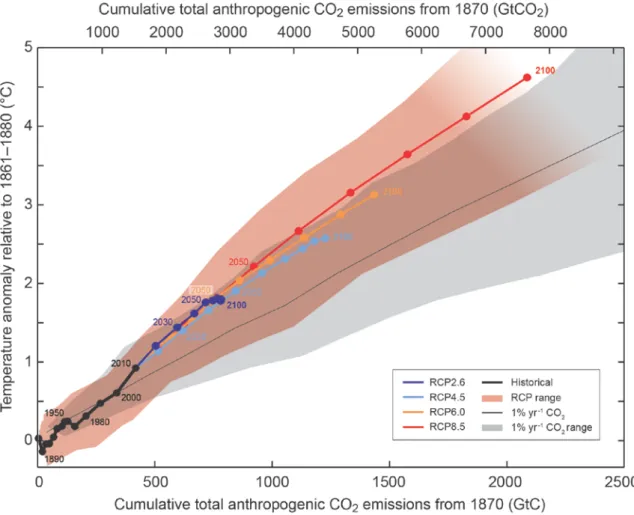
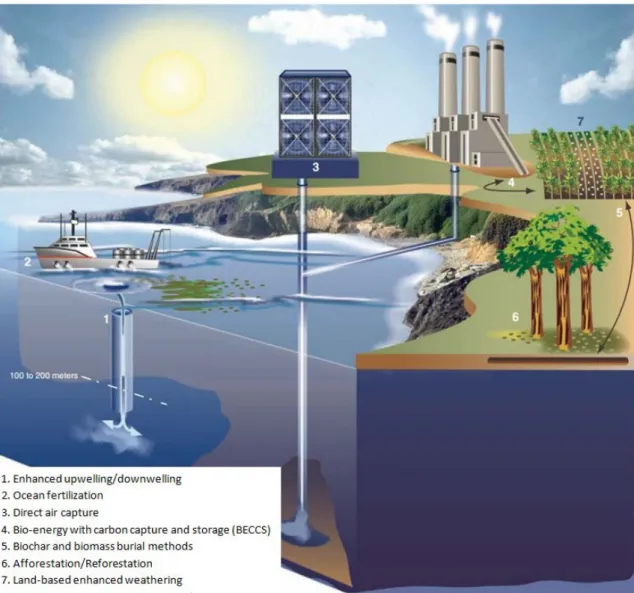
Figure 7 - Illustration of the most widely discussed Carbon Dioxide Removal methods (Source: GAO, 2010: 11). ... 31 Figure 8 - Illustration of the most widely discussed Solar Radiation Management methods. (Source: GAO, 2010: 11). ... 47 Figure 9 - The three interconnected areas in which geoengineering debates are taking place: main arguments and underlying master narratives. ... 65 Figure 10 - The Little Geo- engineer. Source: Wapner, P. (2010) ... 74 Figure 11 - Depiction of four myths of nature (derived from Thompson et al. 1990, p. 5). ... 82 Figure 12 - The myths of nature (and of the human being) that underpin the idea of a geoengineered world. ... 83
LIST OF FIGURES
This page intentionally left blank
PART I
This page intentionally left blank
"A risk management strategy for climate change will require integrating responses in mitigation with different time horizons, adaptation to an array of climate impacts, and even possible emergency responses such as ‘geoengineering’ in the face of extreme climate impacts. In the face of potential extreme impacts, the ability to quickly offset warming could help limit some of the most extreme climate impacts although deploying these geoengineering systems could create many other risks" (IPCC, 2014b: 9).
Since the adoption of the United Nations Framework Convention on Climate Change (UNFCCC), responses to address climate change have fallen within two major groups of strategies, namely:
• mitigation measures, which comprise all human interventions to reduce the anthropogenic forcing of the climate system, such as reducing greenhouse gas sources and emissions and enhancing greenhouse gas sinks, and
• adaptation measures, which include any adjustments made to natural or human systems in response to actual or expected impacts of climate change, with the aim of moderating harm or exploiting beneficial opportunities.
However, another strategy to limit the impacts and consequences of climate change has been gaining ground over the past decade: the idea of geoengineering, commonly defined as the “deliberate large-scale manipulation of the planetary environment to counteract anthropogenic climate change” (The Royal Society, 2009: 1).
Hitherto, the scientific community has regarded these proposals with scepticism, if not outright disbelief (Cicerone, 2006; Wolpert, 2008; Fleming, 2010). Indeed, in 2007 the Intergovernmental Panel on Climate Change (IPCC) still considered that “geo-engineering options, such as ocean fertilisation to remove CO2 directly from the
1. INTRODUCTION
atmosphere, or blocking sunlight by bringing material into the upper atmosphere, remain largely speculative and unproven, and with the risk of unknown side-effects” (IPCC, 2007: 15, emphasis added).
Since the publication of the AR4, geoengineering has attracted increasing attention as a means to address climate change, having been "transformed from a topic discussed largely in science fiction and esoteric scientific papers into mainstream scientific and policy debate" (Macnaghten and Szerszynski, 2013: 465). The “grossly unsuccessful” efforts to lower carbon dioxide emissions (Crutzen, 2006) — a symptom of what has been described as a “problem of political inertia” (Gardiner, 2010: 286-287) — the resonant call for greater planetary management and Earth-system control (Global Environmental Change Programmes, 2001), and the tendency to favour transformational rather than incremental responses to climate change (New et al., 2010) are all factors that may help explain why the scepticism and suspicion with which geoengineering was initially greeted is now giving way to a more pragmatic and serious consideration of its latest scientific and technological breakthroughs and the challenges ahead.
However, the understanding of the physical science basis of geoengineering is still limited, and there are still major uncertainties concerning the impacts these technologies might have on human and natural systems. The self-assertive invasion of nature’s various domains, the scale and complexity of the technoscientific tasks involved, the unpredictable long-term impacts of geoengineering actions, and the huge uncertainties that these proposals raise point to a shift in the nature of human action that requires a commensurate ethics of foresight and responsibility. If there is a decision to embark on such an ambitious project, a major effort should be made to scrutinise and gain a deeper understanding of the social and ethical implications of geoengineering.
1.1 Aim and research questions
In the prologue to her book The Human Condition, Hannah Arendt (1958) refers to the launch of the first artificial satellite in 1957 and recalls the line carved on the funeral obelisk of the Russian scientist Konstantin E. Tsiolkovsky ̶ “Mankind will not remain
bound to the earth forever” ̶ to illustrate the human capacity for making new beginnings and to reflect about the meaning of this first "step toward escape from men's imprisonment to the earth" (Idem: 1). For Arendt, the launch of Sputnik 1 is fraught with both historical and symbolic significance. It represents the first step towards realising the hubristic desire of "liberating" us from Earth - the very quintessence of the human condition. The same desire, Arendt believes, manifested in the attempt to create life in the test tube, and thus "cutting the last tie through which even man belongs among the children of nature" (Idem: 2).
This desire long precedes our knowledge, showing “that men everywhere are by no means slow to catch up and adjust to scientific discoveries and technical developments (...) Here, as in other respects, science has realized and affirmed what men anticipated in dreams that were neither wild nor idle” (Idem Ibidem). With this passage Arendt not only makes the case for the need to resist a deterministic view of the autonomy of science and technology, but also paves the way to a central discussion in (of) The Human Condition: the Earth alienation underlying the whole development of natural science in the modern age.
"This future man, whom the scientists tell us they will produce in no more than a hundred years, seems to be possessed by a rebellion against human existence as it has been given, a free gift from nowhere (secularly speaking), which he wishes to exchange, as it were, for something he has made himself. There is no reason to doubt our abilities to accomplish such an exchange, just as there is no reason to doubt our present ability to destroy all organic life on earth. The question is only whether we wish to use our new scientific and technical knowledge in this direction, and this question cannot be decided by scientific means; it is a political question of the first order and therefore can hardly be left to the decision of professional scientists or professional politicians" (Idem: 2-3).
It is with this question in mind - whether we wish to use our new scientific and technical knowledge in this direction - that I propose to examine current proposals to intentionally engineer the Earth’s climate. Motivated by a conviction that we need to move beyond the rhetoric of risk, fear, and control, which provides justification to geoengineering proposals within a "risk management strategy for climate change" (IPCC, op. cit), I take this question as the fundamental question that needs to be answered before we decide
whether geoengineering should indeed be considered as a possible emergency response to climate change. Moreover, by recognising that this fundamental question (and concomitant ones concerning geoengineering research, governance and deployment) is a political question of the first order, that cannot be decided by scientific means or left to the decision of professional scientists or professional politicians, I take as the point of departure for the present research the need to open up the discussion around geoengineering and to subject it to greater critical scrutiny. Thus, through this dissertation I hope to offer a perspective from which the very nature of geoengineering proposals can be brought into question, so as to better focus on and deal with the fundamental issues that geoengineering proposals entail. Accordingly, the aim of this dissertation is to contribute to a better understanding of the far-reaching ethical and social implications of these proposals and, to that end, find an adequate vantage point from which to address the following research questions:
• Why is geoengineering becoming a part of the portfolio of response options to anthropogenic climate change?
• What ‘imaginaries’ of science and technology underlie geoengineering debates? • How plausible are current geoengineering proposals?
• What are the expectations, the embedded values, and the ways of making sense of a geoengineered world?
• What kind of ethical framework can serve as a basis for assessing geoengineering proposals and inform policy responses to geoengineering governance?
The formulation of these questions is intended to highlight the need to unlock the geoengineering debate from the path-dependent questions that, almost invariably, provide justification for more and more research. Thus, it takes the standpoint that scientific enterprise is not merely a matter of epistemic permissibility, but also of moral permissibility. An enterprise that entails methodological choices of perspective − "What is to be studied, by what means, for what purpose?" (Strand, 2002: 172) −, which cannot be excused from moral considerations and cannot be thought of as something entirely outside the realm of action.
"We have to choose what we want to know, imposing a context; research per se often irreversibly changes the world through its invention of technology; and the course of this development is not inevitable, but has a historical character" (Idem Ibidem).
Therefore, these research questions demarcate themselves from the technically feasible and cost-effective responses that, within a utilitarian framework, have been advanced in the geoengineering debate, suggesting that only within the development of a systematic discourse, involving ethics − as accompanying research (‘Begleitforschung’) (Hronszky, 2005) − can a better understanding of the ethical and social implications of geoengineering be achieved.
1.2 Dissertation outline and content
This dissertation is organised in two parts. Part I comprises this introductory chapter and chapters 2 to 5. Chapter 2 briefly describes how the literature survey was carried out and the methodological approach taken. It introduces the main features and assumptions of discourse analysis within the general field of social constructivism and presents the relevance of discourse analysis to address the research questions identified in Chapter 1. Chapter 3 outlines the background of this research and defines the problem under analysis. In doing so, it highlights the uncertainties and controversies surrounding geoengineering and the significance of this research. Chapter 4 presents a brief summary of each paper and discusses the main findings of this dissertation. Finally, chapter 5 concludes with a summary of open questions and areas for further research. Part II of the dissertation includes all the articles published in peer-reviewed journals, as well as a chapter for publication in the book "Science, Philosophy and Sustainability: The End of the Cartesian Dream".
This page intentionally left blank
"Although discourse analysis can be applied to all areas of research, it cannot be used with all kinds of theoretical framework. Crucially, it is not to be used as a method of analysis detached from its theoretical and methodological foundations. (...) In discourse analysis, theory and method are intertwined and researchers must accept the basic philosophical premises in order to use discourse analysis as their method of empirical study" (Jorgensen and Phillips, 2002: 3-4).
In this chapter I present the methods used to conduct this dissertation. I begin with a brief description of the primary sources of information and the literature survey conducted in the initial stages of the project. This section is followed by a description and justification of the methods of discourse analysis used to address the research questions identified in the previous chapter.
2.1 Literature survey and sources of information
Given the exploratory nature of my research questions, I began this research by carrying out an extensive literature survey in order to gain a better understanding of the current debates on geoengineering (PAPER I). The initial literature survey was carried out from September 2010 to January 2011 using multiple databases: Thomson's Web of Science, Scopus (Elsevier), JSToR, Academic Search (Ebsco), and Ingentaconnect. The search was performed using the following combination of terms "geoengineering" OR "climate engineering" OR "solar radiation management" OR "carbon dioxide removal" in the title, abstract or keywords of the article. Articles published in all years were considered. References cited in the retrieved publications were also reviewed. Using Google Scholar and further web engines the literature survey was finally extended to include grey literature, media news, films, blog comments, and all kinds of visual representations of geoengineering.
2. METHODOLOGY
Over the past three years the field of geoengineering has grown dramatically, and there is an accelerating trend in the number of media and scientific publications on this topic (Belter and Seidel, 2013), therefore the collection and review of relevant documentation was an on-going process and continued throughout the later stages of the project. Accordingly, and as illustrated by the attempt to take into consideration the recent assessment of geoengineering solutions conducted by the IPCC (cf. Chapter 3 and Paper VI), the literature review was revisited at several points of this research in order to keep the dissertation continuously updated and supplemented with the latest research findings in the field of geoengineering.
At the same time as this information was being gathered and analysed, I developed a website on geoengineering aimed to facilitate further research on this topic, as well as to provide a space for reflection and debate on the social and ethical implications of geoengineering1. A short movie produced in the context of the project Technolife2 was
included in the website in order to engage the public at large in the online debate on geoengineering. Through three fictional situations, the movie presents the main aspects of geoengineering technologies and raises important questions concerning:
• the uncertainties and experimental nature of geoengineering proposals; • the conditions under which geoengineering might be deployed;
• the policy issues and governance of geoengineering technologies.
The website went online in December 2012 and has since been updated periodically with relevant information on this topic. The questionnaire and online debate provided empirical material for this research and will constitute the basis of further analysis (Chapter 5).
1 https://sites.google.com/site/geoengineeringdebate/.
2 The TECHNOLIFE project sought to develop new frameworks for the early identification,
characterization, and deliberation upon ethical issues arising from a broad range of information and communication technologies (ICTs), including their convergence with other scientific and technological fields (such as bio-nano). Providing multi-layered descriptions and normative analyses through inter-and trans-disciplinary research, the project worked to improve existing conceptual frameworks and procedures for implementing and representing the social needs and interests of citizens at early stages of policy-making and research. For more information on the Technolife Projects see: http://technolife.no/.
10
This study applies discourse analysis methods (narrative analysis and visual narrative analysis) to address the complexity of the broader scientific, political, and social context in which the geoengineering debate is taking place. In what follows, I briefly introduce the main theoretical assumptions of discourse analysis, thus providing the analytical framework which informed the methodological approach used to address the research questions presented in Chapter 1. Finally, I describe the two approaches to discourse analysis used in this dissertation and discuss their relevance to examine the plausibility of geoengineering, its objects of research, and the sociotechnical imaginaries that underpin current visions of a geoengineered world.
2.2 Science is discourse and fiction
In Laboratory Life: The Social Construction of Scientific Facts, Bruno Latour and Steve Woolgar (1986) traced the construction of scientific facts by examining the daily activities carried out in one particular neuroendocrinology laboratory3. The focus of
their analysis was the social processes involved in the establishment of thyrotropin releasing factor (Hormone) as a "scientific fact"; an analysis motivated by their concern "with the social construction of scientific knowledge in so far as this draws attention to the process by which scientists make sense of their observations"4.
Through the use of ethnographic-based discourse analysis Latour and Woolgar examined the "literary inscriptions"5 used and produced by the scientists and technicians of the
laboratory - "a strange tribe who spend the greatest part of their day coding, marking, altering, correcting, reading, and writing"6 - to illuminate the roles of inscription
3 Laboratory Life is the product of the fieldwork conducted between October 1975 and August 1977 by
Bruno Latour in the neuroendocrinology research laboratory of Roger Guillemin (who was later awarded the Nobel Prize) at the Salk Institute for Biological Studies in San Diego, California. The book was published in 1979 in co-authorship with the British sociologist Steve Woolgar.
4 Idem: 32. 5 Idem: 45. 6 Idem: 49.
11
devices7, discipline-scientific research procedures, and rhetorical strategies in the
construction of "scientific facts".
By emphasising the processes whereby scientific facts are constructed as "literary inscriptions" and "statements" with no referent to an "independent existence out there" Latour and Woolgar argued that scientific work is largely a rhetorical and linguistic activity that involves both persuasion and making of meaning; a form of "literary production" conducted by "writers and readers in the business of being convinced and convincing others"8 and which "comprises the construction and sustenance of fictional
accounts9 which are sometimes transformed into stabilised objects".
In making this case, Latour and Woolgar stressed the importance of refusing important distinctions commonly adopted both by historians and analysts of science: "the distinction between social and technical issues"; "the distinction of nature between facts and artefacts"; "the a priori distinction between commonsense and scientific reasoning"; "and even the distinction between 'thought' and craftwork needed to be avoided as an explanatory resource because it appeared to be the consequence of scientific work in the laboratory"10.
By translating scientists' practice and experiments into discursive techniques Latour and Woolgar not only contributed to contemporary efforts in the humanities and social sciences to broaden the application of discourse analysis approaches to the study of scientific knowledge, but also brought to light the intricate and frequently ambiguous relation between discourse and praxis.
7 According to the authors "an inscription device is any item of apparatus or particular configuration of
such items which can transform a material substance into a figure or diagram which is directly usable by one of the members of the office space" (Idem: 51).
8 Idem: 88.
9 In their attempt "towards making clear the link between science and literature" Latour and Woolgar
incorporate a degree of reflexivity into their own analysis, reminding the reader that all texts are stories, and "that observers of scientific activity are engaged in methods which are essentially similar to those of the practioners which they study" (Idem: 30).
10 Idem: 253.
12
It is in line with this notion of science, as discourse and fiction, that I suggest the relevance of adopting a "discursive framework" to critically analyse the documents and materials collected during the first stage of my research. All these documents and materials, despite their varied nature, are here considered as "literary inscriptions" of geoengineering, inasmuch as they seem to inform the diversity of framings of geoengineering and the way the field of geoengineering science is being defined and redefined.
As discussed in the following sections, the approaches to discourse analysis applied in this research were selected for their close attention to rhetorical forms of scientific argumentation. These approaches form the basis of my attempt to critically examine the "literary inscriptions" of geoengineering, i.e. the persuasive tools of a science-in-the-making that seems to have replaced the "laboratory ideal" by the "field ideal of experimentation" (Schwarz and Krohn, 2011), with all the consequences that this implies.
2.3 Discourse analysis
"Discourse has a quite specific meaning. It refers to groups of statements which structure the way a thing is thought, and the way we act on the basis of that thinking. In other words, discourse is a particular knowledge about the world which shapes how the world is understood and how things are done in it" (Rose, 2001: 142).
Discourse analysis "focuses on talk and texts as social practices and on the resources that are drawn on to enable those practices" (Potter, 1996: 129). It encompasses a wide range of theoretical orientations and methodological approaches (Stubbs, 1983). As pointed out by Wood and Kroger, discourse analysis "is not only about method; it is also a perspective on the nature of language and its relationship to the central issues of the social science" (Wood and Kroger, 2000: x). Accordingly, discourse analysis can be seen as a set of collection of approaches to discourse that entail not only practices of data collection and analysis, but also a set of theoretical assumptions and key premises about
how entities such as ‘language’ and ‘the subject’ are to be understood (Jorgensen and Phillips, 2002; Potter, 1996).
The general philosophical assumptions that underpin most discourse analytical approaches are found in social constructionism and were summarised by Gergen as follows:
"The terms by which we account for the world and ourselves are not dictated by the stipulated objects of such accounts (...) The terms and forms by which we achieve understanding of the world and ourselves are social artifacts, products of historically and culturally situated interchanges among people (...) The degree to which a given account of world or self is sustained across time is not dependent on the objective validity of the account but on the vicissitudes of social process (...) Language derives its significance in human affairs from the way in which it functions within patterns of relationship (...) To appraise existing forms of discourse is to evaluate patterns of cultural life; such evaluations give voice to other cultural enclaves" (Gergen, 1994: 49-53).
In addition to these general social constructionist assumptions, all discourse analytical approaches share the following key premises with respect to their views of language and the subject (Jorgensen and Phillips, 2002: 12):
• Language is not a reflection of a pre-existing reality.
• Language is structured in patterns or discourses – there is not just one general system of meaning as in Saussurian structuralism but a series of systems or discourses, whereby meanings change from discourse to discourse.
• These discursive patterns are maintained and transformed in discursive practices.
• The maintenance and transformation of the patterns should therefore be explored through analysis of the specific contexts in which language is in action. One form of discourse analysis that assumes particular significance in the context of this research is narrative analysis. Narrative analysis has been approached from many different angles across the social sciences and, depending on disciplinary priorities and
research foci, a variety of analytical perspectives and methodologies have been proposed (Thornborrow, 2012: 51).
In this dissertation I draw upon the ideas of Rouse, who claimed that scientific research is intelligible only in the context of a narrative, and therefore narrative should occupy a fundamental place within our understanding of the sciences. Four crucial considerations inform Rouse's account of the narrative dimension of scientific practice:
i) first, the epistemic importance of narrative should not be confined to a specific group of disciplines, domains of inquiry, or objects of knowledge. Narrative understanding is characteristic of any scientific practice;
ii) second, more important than the form in which the results of investigation are written, is the ways in which the practices of scientific research and the resultant knowledge acquire their intelligibility and significance from being situated within narratives;
iii) third, the intelligibility of action and of the things we encounter or use in acting depends on their already belonging to a field of possible narratives;
iv) and lastly, the epistemic significance of narrative should not be seen in terms of completed narratives. In the narrative fields of scientific practice there is no unitary authorial point of view, but multiple authors that engage in an ongoing struggle to determine the configuration of the narrative within which they are all situated. Because current scientific research does not simply focus on what will happen next, but continually reconfigures its own past, scientific understanding must be situated within narratives in continual re-construction.
According to Rouse these four considerations can be summarized in a single claim: "the intelligibility, significance, and justification of science knowledges stem from their already belonging to continually reconstructed narrative contexts supplied by the ongoing practices of scientific research" (Rouse, 1996: 161).
2.3.1 Narrative analysis
"If narratives are tools and if the crafting and sharing of stories involve morals, then a discussion of ethics is a necessary component of narrative inquiry" (Adams, 2008: 177).
Rouse's account of the narrative dimension of scientific practice offers a privileged perspective from which to address my research questions. Indeed, one possible way of looking at the geoengineering issue and the scalar dislocations it introduces into modern systems of experience and understanding is to explore the social and ethical implications of geoengineering by adopting expanded notions of narrative, which account for particular ways of rendering the world in both visual and verbal forms.
By contending that reasoning can be discovered in all sorts of symbolic actions (non-discursive as well as discursive) Walter Fisher introduced the concept of narrative rationality, suggesting that its application to specific stories11 may further clarify its
nature and value (Fisher, 1987; Fisher, 1985).
"The perspective of narrative rationality does not exclude the long tradition of rhetorical logic; it is a rhetorical logic itself. Other rhetorical logics, however, have dwelt on argument, argumentative genres, and specific standards of argumentative assessment. The perspective of narrative rationality focuses on all forms of human communication as carriers of good reasons and on a system of evaluation that incorporates the available standards of argumentative assessment but offers additional considerations (...) the concept of narrative rationality offers systematic principles, procedures, and criteria for assessing elements of discourse that provide warrants for believing or acting in particular ways" (Fisher, 1987: 49).
It is in line with these ideas that I propose to analyse the narratives of geoengineering. Within the framework of Fisher’s “narrative paradigm”, I argue that both the descriptive and explanatory elements of geoengineering narratives need to be examined in order to better understand the role specific structures play in satisfying the demands of
11 Although recognizing that technical communities have their own conceptions and criteria for judging
the rationality of communication, Fisher considered that ‘the work even of scientists is inspired by stories, hence their discourse can be interpreted usefully from the narrative perspective’ Fisher WR. (1984) Narration as human communication paradigm: The case of public moral argument. Communication Monographs 51: 1-22.
16
probability and fidelity of geoengineering proposals. The descriptive and explanatory elements of a narrative point toward the two different kinds of narrative research described by Polkinghorne: the descriptive narrative research aims “to render the narrative accounts already in place which are used by individuals or groups as their means for ordering and making temporal events meaningful"; the explanatory narrative research seeks "to construct a narrative account explaining 'why' a situation or event involving human actions has happened” (Polkinghorne, 1988: 161). I expect that the first kind of narrative research may help to disentangle the various (conflicting?) narrative schemes that lie underneath the representations of geoengineering – narrative schemes that operate not only in the realm of rationality, knowledge, and facts, but also in the realm of subjectivity, values, imagination, and fiction. However, it is only within an explanatory narrative approach that I will be able to address the fundamental question of why geoengineering is gaining more serious consideration and becoming an increasingly plausible solution to tackle climate change. Because explanatory narrative research is retrospective and retrodictive, adopting this kind of approach does not seem an easy task when considering the ongoing debates on geoengineering. Nonetheless, because an analogy can be made with prior, already-told stories – of which "the pathological history of weather and climate modification" is just one example (Fleming, 2010) –, I believe this task is not only possible, but also an imperative:
"I can only answer the question “What am I to do?” if I can answer the prior question “Of what story or stories do I find myself a part?” We enter human society, that is, with one or more imputed characters — roles into which we have been drafted — and we have to learn what they are in order to be able to understand how others respond to us and how our responses to them are apt to be construed" (MacIntyre, 1984: 216).
It is important, however, to recognise the resistance put up by science to this kind of investigation. In fact, explanatory narrative research is not typically used in the sciences, partly because “narrative truth is distinguished from other kinds of formal science truths by its emphasis on the life-like, intelligible and plausible story. Stories typically reflect a coherence (as opposed to correspondence) theory of truth in that the narrator strives for narrative probability — a story that makes sense; narrative fidelity — a story
consistent with past experiences or other stories; and aesthetic finality — a story with satisfactory closure and representation appeal” (Sandelowski, 1991: 164-165).
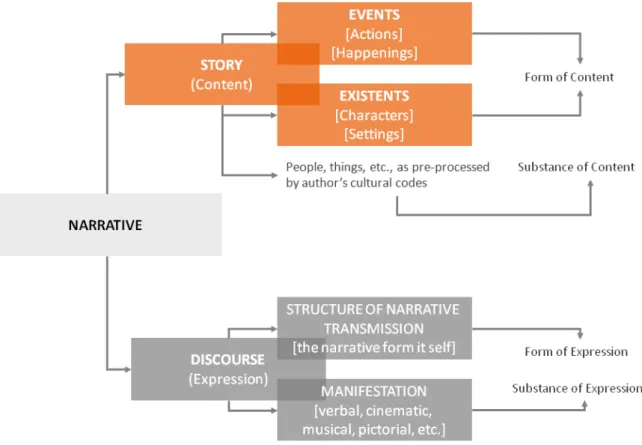
In the context of this discussion, which points to some of the presuppositions that underpin Fisher’s narrative paradigm (Fisher, 1987: 64-65; Fisher, 1984), it is important to emphasise the difference between the elements of narrative theory, a theoretical distinction stressed by structuralists who considered that each narrative has two parts: a story (what is depicted in a narrative - the content) and the discourse (how it is depicted - the expression). According to Chatman (1978: 19-22), the story consists of the content or chain of events (actions and happenings) and the existents (characters and items of setting), while the discourse refers to the means by which the content is communicated, thus comprising two subcomponents: the narrative form itself (the structure of narrative transmission) and its manifestation (its appearance in a specific materializing medium). In order to capture all elements of the communicative situation, Chatman reminds us that narrative is a semiotic structure, which presupposes a form and a substance of expression and a form and a substance of content (Figure 1).
Figure 1 - Elements of narrative theory (Adapted from Chatman, 1978, p. 29). 18
2.3.2 Visual Narrative Analysis
"(...) if images, as we claim, do not merely illustrate theoretical views, but are means of arriving at and embodying such views, then a history of science limited to theoretical and textual pronouncements misses part of the action" (Cambrosio et al., 2005: 190).
The universe of geoengineering is filled with all sorts of imageries. These imageries seem to fill the "visual science continuum" that has at one extreme the set of figures that convey data and, at the other, scientific illustrations, i.e. “representations of how something might or could be” (Ottino, 2003: 474). They are all part of the geoengineering story, revealing facts, knowledge, values, fears, desires, promises, anxieties, incredulity, about not only the idea of deliberately manipulating Earth’s climate to offset anthropogenic climate change, but also, and above all, what we know about the world and how we make sense of our place in it.
Against this background, I suggest the relevance of examining the visual representations of geoengineering in order to understand how they use a narrative way of structuring thought to make sense of a geoengineered world. Therefore, I also adopt a visual narrative approach to interpret and assess the sense-making structures of a set of pictorial narratives of geoengineering, as well as to identify the particular instance of these narratives that provide (or not) a reliable, trustworthy, and desirable guide to thought and action.
The rationale behind this approach is twofold. First, by acknowledging that the visual modes of representation (that are integral to many kinds of thinking) function as a powerful method of meaning making, and that pictorial expressions are not qualitatively different from verbal expressions (Barbatsis, 2005), it seems opportune to draw attention to the concepts of “narrative rationality” (Fisher, 1987; Fisher, 1985) and “imag[in]ing” (Ruivenkamp and Rip, 2011) in order to explore the way geoengineering images convey plausible, or implausible, arguments about current proposals to intentionally modify the global climate and how a geoengineered world could be. The second assumption underlying this approach is that the pictorial representations of
geoengineering can also provide valuable insights into its objects of research, an issue that has not received a great deal of attention but seems particularly relevant when considering the social and ethical implications of geoengineering proposals.
Accordingly, and based on the conceptual framework proposed by Pauwels for the analysis of visual representations in science (Pauwels, 2006), I will attempt to understand how particular images of geoengineering work to persuade, and how they produce their effects of "truth". By taking into consideration the “diversity that exists with regard to types of translation processes and actors in the production cycle, as well as the different purposes and intents of representations and specific contexts of use” (Idem: 4), Pauwels' framework provides a rationale to address the complex process of meaning-making that has an “impact on what can be known and how, on what is revealed or obscured, and on what is included or excluded” (Idem: 5). In order to highlight processes of persuasion that may otherwise be difficult to detect I will focus my analysis on the broad amplitude of intended or unintended choices that may influence visual representation. This broad amplitude of the representational space, in what Pauwels refers to as the “visual representational latitude”, is determined by the nature of the problem being depicted (type of referent), by the intentional and unintentional choices of the author (the context of production), and also by the characteristics of the audience in relation to a particular visual representation (the context of use).
What is climate geoengineering? Why has it recently emerged as a topic of interest and discussion within the climate science community? Why is there a need to consider the social and ethical implications of geoengineering proposals? In this section I will address these three questions in order to present the background and relevance of this research.
3.1. Why Geoengineering?
The carbon dioxide theory of climate change and the global warming forecast are not new issues. This is aptly captured in the book Historical Perspectives on Climate Change, in which James Fleming examines the historical roots of global climate change as a field of inquiry, from the Enlightenment to the late twentieth century, to provide an insightful, reflexive account of the paths through which we have arrived at our current state of knowledge and "apprehension"12 of climate change (1998). By looking back to
the work of scientists such as Joseph Fourier, John Tyndall, Svante Arrhenius, T. C. Chamberlin, Ellsworth Huntington, G. S. Callendar, Gilbert Plass, Hans Suess, and Roger Revelle he explores the historical relationships among the numerous and quite varied theories about climatic change and concludes that "the modern, scientific description of weather and climate has been gradually established since about the mid-nineteenth century" (Idem: 136).
Although our understanding of the complex processes that affect both the Earth's energy balance and the energy flows within the global climate system has increased progressively and significantly over the past two centuries, and we know a good deal more than ever before about the anthropogenic greenhouse effect and its influence on
12 Fleming uses the term "apprehension" in its threefold sense: (1) awareness or understanding, (2)
anticipation or dread, and (3) intervention (Idem: 5).
3. BACKGROUND
21
global climate change, the very latest scientific evidence on climate change provides little cause for optimism.
According to the Fifth Assessment Report (AR5) of the Intergovernmental Panel on Climate Change (IPCC, 2013b) the concentrations of the atmospheric greenhouse gases (GHGs) carbon dioxide (CO2), methane (CH4), and nitrous oxide (N2O) have increased by
about 40%, 150%, and 20%, respectively, since the beginning of the Industrial Era13 as a result of
anthropogenic emissions from fossil fuel combustion, agriculture, and land-use changes (Figure 2).
Figure 2 - Atmospheric CO2, CH4, and N2O concentrations history over the industrial era determined from
air enclosed in ice cores and firn air (colour symbols) and from direct atmospheric measurements (blue lines, measurements from the Cape Grim observatory) (MacFarling Meure et al., 2006) (Source: Ciais et al., 2013).
13 The tropospheric mixing ratio of CO
2 has increased globally from 278 ppm in 1750 to 390.5 ppm in 2011.
During the same time interval, CH4 increased from 722 ppb to 1803 ppb, and N2O from 271 ppb to 324.2
ppb.
22
The current atmospheric concentration of these GHG substantially exceed the highest concentrations recorded in ice cores during the past 800,000 years and their mean rates of increase over the past century are unprecedented with respect to the ‘highest resolution’ ice core records of the last 22,000 years (IPCC, 2013c).
This increase is the main driving cause of climate change. By reducing the flux of outgoing long-wave radiation from the Earth to space (trapping of long-wave radiation), the increasing atmospheric concentration of these (CO2, CH4, and N2O) and other GHGs
(e.g. halocarbons, O3) has been changing the balance between the incoming solar
radiation and the outgoing infrared radiation emitted by the Earth. As recently observed changes in the climate system indicate, these perturbations in the radiative energy budget of the Earth's climate system - often described in terms of Radiative Forcing (RF)14 - can have a profound influence on the Earth's climate and, consequently, on the
Earth system as a whole.
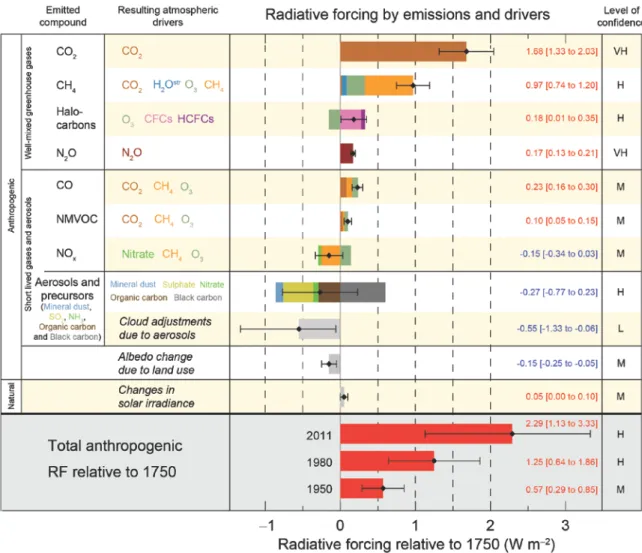
As seen in Figure 3, the total anthropogenic RF for 2011 (3.33 W m–2) relative to 1750
(1.13 W m–2) is 2.29 W m–2.15 Altogether the above-mentioned three GHGs (CO
2, CH4,
and N2O) amount to 80% of the total radiative forcing (RF) from well-mixed greenhouse
gases (WMGHGs)16. Emissions of CO
2 have made the largest contribution to the
14 The concept of radiative forcing provides a way to quantify the net change in the energy balance of the
Earth system at the top of the atmosphere as a result of an externally imposed change. It is usually expressed in watts per square meter (W m–2) averaged over a particular period of time. For a wide range of
forcings there is a nearly linear relationship between the RF and the resulting equilibrium response of global mean surface temperatures (GMST) as simulated in general circulation models (National Research Council 2005), making it valuable for comparing the influence on GMST of most individual agents affecting the Earth’s radiation balance.
15 This estimate is 43% higher than that reported in AR4 for the year 2005. This difference is primarily due
to the continued growth in most GHGs concentrations (positive RF), but also to improved estimates of RF by aerosols, which indicate a weaker net cooling effect (negative RF) Myhre G, D. Shindell, F.-M. Bréon, W. Collins, J. Fuglestvedt, J. Huang, D. Koch, J.-F. Lamarque, D. Lee, B. Mendoza, T. Nakajima, A. Robock, G. Stephens, T. Takemura and H. Zhang. (2013) Anthropogenic and Natural Radiative Forcing. In: Stocker TF, D. Qin, G.-K. Plattner, M. Tignor, S.K. Allen, J. Boschung, A. Nauels, Y. Xia, V. Bex and P.M. Midgley (ed) Climate Change 2013: The Physical Science Basis. Contribution of Working Group I to the Fifth Assessment Report of the Intergovernmental Panel on Climate Change. Cambridge, United Kingdom and New York, NY, USA: Cambridge University Press, 659-740.
16Well-mixed greenhouse gases (WMGHGs) are those GHGs "that are sufficiently mixed throughout the
troposphere that concentration measurements from a few remote surface sites can characterize the climate-relevant atmospheric burden; although these gases may still have local variation near sources and sinks and even small hemispheric gradients. Global forcing per unit emission and emission metrics for
23
increased anthropogenic RF, accounting for about 56% (1.68 W m–2) of the total RF of
WMGHGs from 1750 to present time.
Figure 3 - Radiative forcing estimates in 2011 relative to 1750 and aggregated uncertainties for the main
drivers of climate change. Values are global average radiative forcing (RF), partitioned according to the emitted compounds or processes that result in a combination of drivers. The best estimates of the net radiative forcing are shown as black diamonds with corresponding uncertainty intervals; the numerical values are provided on the right of the figure, together with the confidence level in the net forcing (VH – very high, H – high, M – medium, L – low, VL – very low). Albedo forcing due to black carbon on snow and ice is included in the black carbon aerosol bar. Small forcings due to contrails (0.05 W m–2, including
contrail induced cirrus), and HFCs, PFCs and SF6 (total 0.03 W m–2) are not shown. Concentration-based
RFs for gases can be obtained by summing the like-coloured bars. Volcanic forcing is not included as its episodic nature makes is difficult to compare to other forcing mechanisms. Total anthropogenic radiative forcing is provided for three different years relative to 1750 (IPCC, 2013c: 14).
these gases thus do not depend on the geographic location of the emission, and forcing calculations can assume even horizontal distributions. These gases, or a subset of them, have sometimes been referred to as ‘long-lived greenhouse gases’ as they are well mixed because their atmospheric lifetimes are much greater than the time scale of a few years for atmospheric mixing, but the physical property that causes the aforementioned common characteristics is more directly associated with their mixing within the atmosphere. WMGHGs include CO2, N2O, CH4, SF6, and many halogenated species" Ibid.
24
Recent observations have also strengthened the evidence that anthropogenic increases in the WMGHGs have substantially enhanced the greenhouse effect and the resulting forcing continues to increase. As seen in Figure 4(b) the forcing from CO2 and other
WMGHGs has increased significantly faster since the 1960s and evidence has grown since the Fourth Assessment Report (AR4) of the IPCC that the widespread changes observed in the climate system in the latter half of the last century (Figure 5) are primarily due to the anthropogenic increase in greenhouse gas concentrations and other anthropogenic forcings together. These results strengthen the conclusion that human activity is the dominant cause of observed warming since the mid-20th century.
Figure 4 - (a) Radiative forcing (RF) from the major WMGHGs and groups of halocarbons from 1850 to
2011. (b) Rate of change in forcing from the major WMGHGs and groups of halocarbons from 1850 to 2011 (Source: Myhre, 2013: 677).
During 2002–2011, atmospheric CO2 concentrations increased at a rate of 1.9 to 2.1
ppm yr–1. This decadal rate of increase is higher than those observed during any
previous decade since direct atmospheric concentration measurements began in 1958 (Ciais et al., 2013: 467).
Current concentration of GHGs have already contributed to an increase of the Global Mean Surface Temperature (GMST) of 0.85°C [0.65 to 1.06]°C over the period 1880-2012. Despite the cooling effect of the Mt. Pinatubo volcanic eruption in 1991, the past three decades have been among the warmest since 1860. The observed increase in GMST from 1951 to 2010 is approximately 0.6°C to 0.7°C and it is extremely
Figure 5- Overview of some of the main observed climate change indicators as listed in AR5 (cf. footnote 17 for a description of the terms in italic, as used in the IPCC's AR5 to indicate the
assessed likelihood of an outcome or a result. See Chapter 10 and Table 10.1 for further details).