Balancing coordination and synchronization cost in
Cooperative Situated Multi-agent Systems with Imperfect
Communication
Andr´ea I. Tavares
and
M´ario F. M. Campos
1Abstract. We propose a new Markov team decision model to the decentralized control of cooperative multi-agent systems with im-perfect communication. Informational classes capture system’s com-munication semantics and uncertainties about transmitted informa-tion and stochastic transmission models, including delayed and lost messages, summarize characteristics of communication devices and protocols. This model provides a quantitative solution to the prob-lem of balancing coordination and synchronization cost in cooper-ative domains, but its exact solution is computationally infeasible. We propose a generic heuristic approach, based on a off-line central-ized team plan. Decentralcentral-ized decision-making relies on Bayesian dynamic system estimators and decision-theoretic policy generators. These generators use system estimators to express agent’s uncer-tainty about system state and also to quantify expected effects of communication on local and external knowledge. Probabilities of ex-ternal team behavior, a byproduct of policy generators, are used into system estimators to infer state transition. Experimental results con-cerning two previously proposed multi-agent tasks are presented, in-cluding limited communication range and reliability.
1
INTRODUCTION
In this paper we address the problem that arises when an agent in team must autonomously define its actions to implement a pre-established coordinated plan (pre-plan). This agent acquires infor-mation about the state of the environment through sensors that are noisy and with limited capabilities and is able to act upon it with its error prone actuators. Incoherence among agents local perceptions is the main cause of coordination problems in decentralized deci-sion processes. The classical solution is to resort to interagent com-munication in order to synchronize distinct perceptual information, which brings forth key issues of what, when and to whom communi-cate. Synchronization incurs in a cost overhead and due to range and load limitations it may be unachievable or delayed. Rational decision making should establish a tradeoff between conformity to pre-plan and synchronization cost.
One possible approach is to derive synchronization policies from a centralized pre-plan by prescribing communication whenever local knowledge is not sufficient to determine the right action [7, 11]. As reliable and costless communication is assumed, this can be seen as a qualitative approach. The quantification of synchronization’s ac-tual gain is harder since all costs and uncertainties involved should be considered. In this case, decentralized Markov decision processes
1 Federal University of Minas Gerais, Belo Horizonte, Brasil email:
(MDPs) [3, 2], and more specifically those with communicating agents [12, 10, 6], are appropriate to quantitatively settle this trade-off, but they all consider reliable communication. Under total ob-servability assumption, the communication is used in [3] to arrive in a good joint action when ties exist. In our approach, this is solved before execution using lexicographic order. The use of costed com-munication to synchronize perceptions in partial observable domains where first investigated in [12]. This model assumes perfect commu-nication, that every agent has access to all transmitted messages and that external information is acquired only by communication. Deeper description of the communication process in this model is provided in [6]. Authors define a communication language and the types of messages that agents may transmitted, but reliable communication assumption still remains. There is also no means to model uncertainty about transmitted information and the relation between it and agent’s previous knowledge is not explicit. The COM-MTDP [10] also con-sider interagent communication, relaxing the assumptions about ob-servability. Despite its wide expression power, unreliable communi-cation must be treated by solution’s designer since, in the model, the only represented information are the messages that an agentsends. Delayed information was treated in the context of decentralized con-trol [1], but not from interagent communication viewpoint.
Since in situated systems failures inhere communication process and information, this article proposes an extension of COM-MTDP that explicitly considers unreliable communication. It also extends previous models by defining a communication language that is as-sociated with system state and allows expressing uncertainty about transmitted information. The communication process resembles the control process. Messages’ repositories are the communication state, including a system repository that storesdelayedmessages. Agents change communication state by performing communicative actions (c-actions). These c-actions generate messages whose payload de-pends upon theirinformational classes, the system’s communication language. Message transmission features are captured bydelay mod-elswhich establish the probability of reception cycles. This model is presented at Section 2.
per-form punctual decision making by representing uncertainties about external behavior through alternative models with associated prob-abilities. It provides a rational acting policy in general MAS and is also suitable for cooperative systems. Communication policies, con-sidering losses in messages but not delays, are also defined in the model [5], based oninformation valuewhich is actually the trade-off between coordination gain and synchronization costs. Section 3 presents a feasible and generic heuristic solution to decentralized de-cision making, based on RMMs. It relies on state-based utilities ma-trices (thepre-plan), defined before execution and shared among the team. An agent models the jointdecision making process and de-fines its control action as the one with maximum expected utility2. Bayesian inference is used to summarize agent’s knowledge and also teammates’ external knowledge. The effect of a c-action onto the de-cision processes, with delays and losses, is quantified by predicting future knowledge throw Bayesian estimators and evaluating the new utility. The expected gain in coordination is the difference of these utilities and, if it is greater than communication cost, a synchroniza-tion takes place.
We have applied our approach to two different multi-agent tasks [12, 10] and experimental results asses its adequacy to gener-ically solve the problem. In Section 4, we analyze these results un-der the assumption of reliable and unreliable communication (limited range and failures in message transmission). Our concluding remarks are presented in Section 5.
2
THE EMTDP MODEL
The Explicit communicative Markov Team Decision Problem (EMTDP) is aW-step Markovian system for a teamRofnagents, whereWis the cycle-threshold to a message’s loss. At cyclet, sys-tem is in statest
∈ S. Agents have access only to incomplete infor-mation about state, basing their acting on local histories. An EMTDP cycle is split into four synchronous stages:Observation, where ac-quired local partial observations of system’s state are incorporated into local history;Communicative Action, when agents send mes-sages to specific teammates according to their communication poli-cies and cause a transition into communication state;Communicative Observation, where received messages are incorporated onto agents’ local histories; andAction, where control actions are defined accord-ing to actaccord-ing policies. System transits to a new state defined by the joint control action and agents receive a instantaneoussharedreward. An EMTDP hR, W,S,A, Tp,O, op,ΣS,Φ, ep,Σ, mp, ri has
similar control and communication components:
Control Communication State S ΣS,Σ(repositories)
Action A Φ(c-action)
Transition Tp ep(transmission)
Observation O Σ(messages) Likelihood op mp(language)
and control components maintain their original definition [10].
Jointaction3 at−1
, defined inActionstage based on local histories
htx−1, causes system to evolve to new statest according with tran-sition functionTp(s
t−1,at−1, st). At cyclet, each agent R
x ∈ R
receives local sensorial evidenceotx∈ Oxabout this state. It is incor-porated to local historyhtx•Σusing the joint observation likelihood
2Lexicographic order is employed to break ties.
3Bold symbols are used for the cartesian product of individual agent’s sets,
i.e.,a∈A≡ A1×. . .× Anandax∈ Ax.
op(s
t
,at−1,ot) =Q xo
x
p(s
t
, atx−1, otx). Communicative stages add information to local histories in order to improve decision making atActionstage. Communication data, which comprises performed c-actions and received messages, are incorporated to the history re-sulting inht
x, that is used to define control action.
The first communication component of EMTDP is the commu-nication state hσt, σt
Si, defined by message repositories. System
repositoryσSt ∈ ΣS (abstractly) storesdelayedmessages, that is, those sent at previous cycles but not received yet.Agent repository
σtx∈Σxstores messages that areaddressedto Agent Rxreceived at cyclet. This state is changed by the performance of c-actions, which generate messages that are store at repositories. Messages’ payloads are interpreted by agents using their communication language.
2.1
C-actions and Communication Language
Like in [12], there are three types of c-actions:inform(I), where a local content is transmitted;request(R), where an external content is requested and an answer message is received; andsynchronize(S), that is equivalent to perform both previous types, but results in syn-chronization after one cycle. Messages’ semantic (or communication language [6]) is modelled byinformational classessetIand mes-sages’ transmission, including delays or losses of messages, is mod-elled bycommunication networkssetDthat represents the commu-nication media (physical devices and protocols) employed.
A c-action comprises the choice of a type, a receiver, a informa-tional class and a communication network. The set of c-actionsExof Agent Rxis defined asEx={I, R, S} × R−x× D × I. Each agent may perform up tonsc-action in a cycle, thenΦx={ExS∅}ns. A c-actione= (o,Ry, d, i)∈ Experformed by Rxat cycletgenerates a messagemwith a header composed by emitter, recipient, type, in-formational class, communication network and atimestampt. When c-action’s type isRorS, ifmactually arrives at the recipient agent, it will be answered in the next cycle. Message’s payload depends on its informational class (Rmessages have no payload).
Communication language is composed by informational classes. Each informational classi, with a payload domainFi, represents one type of information that may be exchanged among agents, for instance agent’s or obstacles’ positions, the accomplishment of a subgoal. A probability model defines the relationship among trans-mitted information and system state, analogously to domain obser-vation likelihood,providing a mechanism to automatically incorpo-rate external data onto agent’s knowledge. Thepayload likelihood
fpi(s
t
,Rx, c)ofc ∈ Fiis the probability that Agent Rx generates this payload when system state isst. It allows that an agent expresses its uncertainty about transmitted information that arises, for instance, when it is acquired using noisy sensors. When informational classes comprises features of system state,informativeandworld informa-tiontypes of messages [6] are modelled. Auxiliary procedures, like inference of state given a sub-goal accomplishment or a reward, are necessary to model other types of messages.
Thecommunicative observation likelihoodmp(s
W:t
,σt)4defines the probability that payloads of messages inσtare observed, given the lastW statessW:t. This is necessary since message’s payload is influenced by system’s state at the generation cycle and messages may be delayed up toW−1cycles. It is reasonable to assume that the payloads of two messages are conditionally independent given the system state and the emitter agent. The communication observation
4Notationsk:t is used for the values assumed by variablesin the cycles
likelihood can be defined directly from payload likelihoods as
mp(s
W:t
,σt) = Y m∈σt
fim
p (s
tm,R m, cm),
wheremis transmitted by Rmat cycletm,imis its informational class and ecmis its payload.
2.2
Messages Transmission and Communicative
Transition
As message transmission only depends the employed communica-tion media, we define thedelay modelof each communication net-workd. Letmbe a message sent by Agent Rx to Agent Ryat cy-cletusing communication networkd. The probability that it is re-ceived after exactlyw cycles iswd
p(s
t,
Rx,Ry, lm, w). Message’s delay is conditioned at its length lm (that depends on its infor-mational class), since the greater a message, the more it is error prone; at system state st, specially if a wireless device is used, since topology changes with state and there may be signal interfer-ence; and by the communicating agents, as physical distance may be determinant for transmission time. Theloss probabilityofmis
wdp(s
t
,Rx,Ry, lm, W)and the probability that it is instantaneously received iswdp(s
t
,Rx,Ry, lm,0). We assume that: (a) the delay of a message is defined at its generation cycle and does not change during its transmission; e (b) the delays of two messages are conditionally independent given their generation state, their lengths and their par-ticipants. This assumption is true if either transmission capacity is greater enough to avoid collisions or the instantaneous communica-tion load is expressed in system state.
Figure 1. Diagram for communicative transition in EMTDP.
The communicative transition functiondefines the evolution of communication statehσt, σtSi. Figure 1 shows possible messages’ flows among message repositories. At cyclet, a messagem gener-ated by Rx’s c-action inφtxis either instantaneously received (even
E1ofm ∈ σyt andm 6∈ σt −1
S ) or will be delayed or lost (event
E2, whenm ∈ σt
S andm 6∈ σ
t−1
S ). Messages in σ t−1
S may be received with delay at the present cycle (event E3 of m ∈ σyt andm ∈ σtS−1), may be delayed by one more cycle (eventE4of
m ∈ σtS andm ∈ σt −1
S ) or is lost (eventE5). Given the condi-tional independe assumptions, the communicative transition function
ep(σ
t−1
S , s
W:t,
φt,σt, σS)t
is defined as the product of individual messages’ delay probabilities for each of the five events described above. EventE1has probabilitywp(s
t,
Rx,Ry, lm,0)and eventE2 is complementary it. The the lest three events, the message has been
generated at cyclet−w, w ≥ 1and has already been delayed for
w−1cycles. Ifw=W, eventE5has probability 1 and eventsE3 andE4have both probability 0. Otherwise, eventE5has probability
0, and eventE3has probability P wp(st−w,Rx,Ry,lm,w) W
u=wwp(st−w,Rx,Ry,lm,u). Event
E4is complementary toE3and we define the transition function
ep(σ
t−1
S , s
W:t,φt,σt, σtS)
as the product of individual messages’ events.
2.3
Instantaneous Reward and Exact Solution
The last component is the shared instantaneous reward function
r(st,at,φt) =v(st)−cA(at, st)−cΦ(φt, st). The instantaneous gainv(s)is a measure of state quality with respect to task accom-plishment. The joint action costcA(a, s)allows the designer to ex-press variations in action’s cost given the system’s state and also the cooperative nature of actions. The joint c-action costcΦ(φt, st) cap-tures communication cost dependence on environment and internal features (for instance, this cost may be higher if the agent is in a low power situation). The cooperative nature of communication may be expressed by assigning greater costs to redundant c-actions (two syn-chronize between the same agents) and to states where the recipient is performing subtasks that are critical.
A team policyπ is composed by individualcommunicativeand
actingpoliciesπt
CxandπAxt for each cyclet. The communicative policy is based on pre-communication historyhtx•Σand acting
pol-icy, on the pos-communication historyht
x, where information about communicative stages are already available:
πCxt :(Ox×Φx×Σx× Ax)t −1
× Ox→Φx
πtAx:(Ox×Φx×Σx× Ax)t −1
× Ox×Φx×Σx→ Ax
The valueVπ(s)of a team policy with initial statesis a function of the expected shared instantaneous rewards, over all possible system’s evolutions5e, given an optimization criteria. Under finite horizonT, for instance, it is evaluated as:
Vπ(s) =X e
T X
t=1
Tp(s
t−1
,atπ, s t
)op(s
t
,atπ,o t
)
ep(σ
t−1
S , s
W:t
,φtπ,σ t
, σtS)mp(s
W:t
,σt)r(st,atπ,φ t π),
where atπ = (π t
A1(ht1), . . . , πtAn(h t
n)) and φtπ =
(πt
C1(ht1•Σ), . . . , πtCn(htn•Σ)). The optimal solution of EMTDP is
the policyπ∗ = arg maxπVπ(s)that maximizes the value. As a COM-MTDP may be reduced to an EMTDP, defining the optimal policy is computationally prohibitive [2, 10].
3
BaQuaRA HEURISTIC
Our generic heuristic approach to solve EMTDP is based on my-opically evaluating communication gain. It is called BaQuaRA 6 (Bayesian Quantitative Rational Acting) heuristic, for its based on Bayesian inference, quantitative a priori planning and rational decision-making based on modeling joint process by RMM. A RMM
Mxfor Agent Rxis composed by an-dimensional game matrixUx,
5A evolutioneis the sequencehs,o1,φ1
π,σ
1, σ1
S,a1π, . . .a T π, s
the joint action utilities, and alternative models for team external be-havior with associated probabilities. Each such model is either a re-cursive definition of an external agent behavior, by its own game ma-trix and the models it assigns to the other agents (including Rx), or a probability distribution over its actions.Mxsolution results in
In-tentional Probability Distributions(IPDs)ix(a−x)over external ac-tionsa−x. They summary expected team behavior from Rx’s view-point when this team has a rational reasoning. The rational policy for Rxis to choose the action that maximizes its utility, given the IPDs for the rest of the team, that is:
πAx= argu ∗
(Mx) = arg max a∈Ax
X
a−x
Ux(ha,a−xi)ix(a−x),
whereu∗(Mx) is the value that Rx expects to gain performing its best action. In BaQuaRA approach, agents’ game matrix is de-rived from a pre-plan, which providesUt(s)utilities (global mea-surements) of joint actions in each cycle and state of an EMTDP. In this work, pre-plan is obtained from the Q-values of a central-ized solution of a fully observable EMTDP, which is equivalent to an MDP. Under full observability, the decentralized policyπAx(t s) = argxmaxa∈AUt(s)(a)implements the pre-plan. Under partial
ob-servability, as the agent does not known actual system state, it main-tains probability distributions overS, namedbelief state. Letbtx(s) be Rx’s belief state at cyclet. Its RMMMxtfor cycletdecision mak-ing has as game matrix the expected value of pre-plan over this belief state:Ux=Ps∈Sb
t
x(s)×Ut(s).
Pre-plan also serves to model external behavior models and we proposed three RMM versions: Optimistic, Coordinated State and External Observation. In the first two, there is an alternative team model for each possible stateswith probabilitybtx(s). Rxassumes that its teammates actually know system state and expected it to also know system state, at the Optimistic version, that is, they implement
Ut(s). InCoordinated State, Rxassumes that its teammates expect that system’s state is the one defined by implementing pre-plan with-out error in the execution of actions7. These versions are simple, but do not express the actual decision making. In the External Obser-vation version, the agent maintains estimates about external belief states, using EMTDP model and Bayesian inference to assign proba-bilities to teammates’ local histories. It assumes that the team imple-ments an Optimistic RMM over these belief states.
Communication decision making is based on c-actions’ informa-tion value[5], which predicts the effect of a c-action onto agent’s RMM. Since communication is unreliable, it is necessary to consider every possible message’s reception cycle and its loss (t+w,0≤w≤ W). Message’s payload is also stochastic and agent has to consider everyf∈ Fi. The pos-communication valueu∗e•(Mx)t of a c-action
eisP
(w,f)pe•(w, f)u ∗
(Mx(t w, f)). The probabilityp
e•(w, f) de-pends on the payload likelihood and the delay model. The value of RMMMx(t w, f)is defined aftere’s message(s) is(are) incorporated into emitter and/or on recipient. The knowledge change is evaluated by prospective Bayesian inference of agents’ belief state (for Coor-dinate State, just the of the information being transmitted). The dif-ference between pre- and pos-communication RMM’s values is the
expected coordination gain, whilec(e)is the expected communica-tion cost. The informacommunica-tion value it(e) establishes the tradeoff be-tween coordination and synchronization cost and BaQuaRA agent’s communicative policy is the c-action(s) with maximumpositive in-formation value:
7Suitable for transition independent domains with known initial state [12, 6].
πCxt = arg max e∈Exi
t(
e) = arg max e∈Ex(u
∗
e•(Mx)t −u ∗
(Mx))t −c(e).
Belief states are obtained by Bayesian inference using EMTDP probabilistic. Pre-communication belief state btx+1•Σ summarizes htx+1•Σ, incorporatingo
t+1
x eatxto a priori belief statebtx. The main difficulty is that external actions are not directly accessible and state transition depends on joint action. We solve that by using IDPs from RMMs and defining theexternal actionlikelihoodγx(t a−x) = (1−αx)×N+αx×ixt(a−x). It is the probability that Rxassigns to its teammates’ actions at cyclet, using Bayesian average with a non-informative distributionN to avoid inconsistencies.btx+1•Σ(s)is
proportional to:
oxp(s, a
t x, otx+1)
X
sa∈S "
btx(sa)X
at −x
h
Tp(sa,a
t
, s)γx(t at−x) i
#
. (1)
Rx may maintain an estimative of Ry’s belief statebtx,y•Σ. For
this, external observation probabilities are evaluated asPr(oty) = P
s P
ayo y
p(s, ay, o
t
y)γxt−1(ay)btx•Σ(s). Using these probabilities,
Equation 1 is applied for every possible observationoty, averaging by their probabilities and using a priori valuesbt−1
x,y eγt −1
x,y(a t−1
−y). IPDsγt−1
x,y are obtained from the local RMM model of Ry.
After communicative stages, Rxevaluates its pos-communication belief state bt
x using its messages σtx and its a priori knowledge
btx•Σ. Due to conditional independence of messages, they may be
sequentially incorporated into belief state and it is sufficient to de-fine a estimator for a single messagee. An instantaneous message carries information about system statestand aw-delayed message, about state st−w
. In both cases, there are two sources of infor-mation: the transmission and the payload probabilities. The prob-ability that a message m with payload fm is sent from Ry to Rx and received after exactlyw cycles when system state is sis
wp(s,Ry,Rx, lm, w)fp(s,Ry, fm). LetSgandSr the random
vari-ables for the generation and reception states of a message. The belief statebtx(s)after the reception ofmis:
∝Pr(Sr=s) X sg∈S
h
Pr(m|Sg=sg)Pr(Sr=s|Sg=sg)Pr(Sg=sg)
i
∝bt x•Σ(s)
X
sg∈S h
wp(sg,Ry,Rx, lm, w)fp(sg,Ry, cm)
Pr(sgevolves tosinwcycles)×bt −w x (sg)
i
.
where the evolution probability is evaluated using agent’s actions and its external action likelihoods for the lastw−1cycles. The same inference procedure can be prospectively used to infer the effect of a c-action onto agent’s future belief state. Every pair(w, f) rises a specific belief state and an associated RMM. Whenw > 0, fu-ture system’s transitions are obtained by evaluating RMMs for fufu-ture cycles and thus changing belief states according to external actions likelihood and not taking future observations into account.
4
EXPERIMENTAL RESULTS
radar unit located in an unknown position (from 1 to 8) along their 10-unit length path. To espace detection by the radar,T travels at lower speed. WhenE, that always flies at the same speed, arrives at the radar, it destroys it with certainty. After this,Tstarts to fly faster if it observes the destruction, event whose likelihood is a function of theobservabilityparameterλ(within the range[0,1]) andT’s from the radar.Emay communicate the destruction toT at fixed costc
within the range [0,1]. A COM-MTDP model [10] has been pur-posed for TER to optimally balance out coordination improvement and communication cost. EMTDP model is an extension of it con-sisting of one informational class for deterministic radar’s destruc-tion, a unique communication network andE’s Inform c-action. De-lay model introduces communication unreliability in the sense that a message may be lost with probabilitypc. BaQuaRA’s solution is composed by an External Observation version toEand an Optimistic version toT. Pre-plan is obtained from a centralized MDP for TER.
Figure 2. Suboptimality of BaQuaRA under reliable communication.
As noted in [10], optimal solution to TER implements a kind of plan recognition: sometimes it is better toEto delay its communica-tion in order to infer ifT has observed radar’s destruction. Though plan recognition is not pre-defined in BaQuaRA solution, it is a con-sequence from RMM modelling. Still, our heuristic gain is some-times suboptimal, as it is shown by its difference from optimal’s gain in Figure 2. This is mainly due to little inconsistencies between the estimatedT’s belief state maintained byEand its actual value, when
Tdoes not receive an observation. Pre-plan indicates, fromE’s view-point, thatTwill fly faster, but it actually happens that it flies slowly and the team looses gain. Another source of suboptimality follows from the agent’s incapability to reason about the lack of commu-nication. If it remains just one possible position for the radar, RMM prescribes faster motion toT, even at the expense of being destroyed. Knowing thatEwould have informed it about the radar destruction,
T could better define its action.
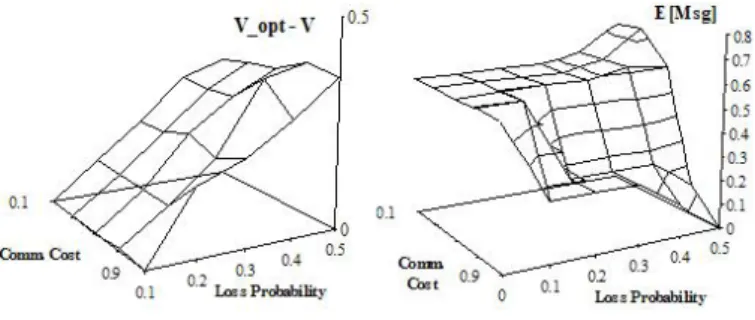
A typical performance degradation for low observability8, due to unreliable communication, is shown in Figure 3, forλ = 0.3. For high observability settings, results indicates that unreliability has lit-tle effect. The most interesting point is that performance does de-grade with greater loss probability, but communication cost has little effect as we fixpc. This is a consequence of automatically adjusting the number of sent messages, as shown in right graphic of Figure 3. For low communication costs, the expected number of messages in-creases with loss probability.Eretransmits of a message if it is lost
8 In the graphic, we are compare gains with reliable optimal ones, so the
suboptimality may be slower.
Figure 3. Performance under unreliable communication (µ= 0.3).
(fact that it can implicitly detect) and the information value of re-sending it is positive. As communication cost increases, the number of expected messagesdecreases: message loss probability is a part of communication decision and the higher is the loss probability, the lower is information value until a threshold where no communication is performed.
5
CONCLUSIONS
The EMTDP model subsumes previous purposes as it provides the capability to analyze the optimality of team decisions under imper-fectcommunication. As communication in situated systems is inher-ently unreliable, EMTDP enlarges the class of formally tractable sys-tems. Messages’ transmission and communication language are part of the model, allowing reasoning about information gain and its in-corporation in local knowledge avoiding the use of auxiliary external procedures. We have proposed a novelgenericheuristic approach that provides rational decentralized policies dealing withlostand de-layedmessages. Such a generic solution is important since unreli-able communication is just starting to be systematically treated and insights can be gained from the prescribed solutions. In particular, we have shown that BaQuaRA’s performance is suitable, despite its generality, to define almost optimal policies for a specific system. Ongoing work with different systems [12, 6] shows that this quality remains. Our future research includes the investigation of message delay impact on team decision and the extension of BaQuaRA to ful-fills the reasoning about the lack of communication.
References
[1] M. Aicardi, D. Franco, and R. Minciardi, ‘Decentralized optimal con-trol of Markov chains with a common past information set’,IEEE Transactions on Automatic Control,32(11), 1028–1031, (1987). [2] D. S. Bernstein, S. Zilberstein, and N. Immerman, ‘The complexity of
decentralized control of Markov decision processes’, inUAI-2000, pp. 32–37, (2000).
[3] C. Boutilier, ‘Sequential optimality and coordination in multiagent sys-tems’, inIJCAI-99, pp. 478–485, (1999).
[4] P. J. Gmytrasiewicz and E. H. Durfee, ‘Rational coordination in multi-agent systems’,Autonomous Agents and Multi-Agent Systems Journal, 3(4), 319–350, (2000).
[5] P. J. Gmytrasiewicz and E. H. Durfee, ‘Rational communication in multi-agent systems’,Autonomous Agents and Multi-Agent Systems Journal,4(3), 233–272, (2001).
[6] C. V. Goldman and S. Zilberstein, ‘Optimizing information exchange in cooperative multi-agent systems’, inAAMAS-03, (2003).
[8] R. Nair, M. Tambe, M. Yokoo, D. Pynadath, and S. Marsella, ‘Tam-ing decentralized POMDPs: Towards efficient policy computation for multiagent settings’, inIJCAI-2003, (2003).
[9] L. Peshkin, K. Kim, N. Meuleau, and L. P. Kaelbling, ‘Learning to co-operate via policy search’, inUAI-2000, (2000).
[10] D. V. Pynadath and M. Tambe, ‘The communicative multiagent team decision problem: Analyzing teamwork theories and models’,Journal of Artificial Intelligence Research,16, (2002).
[11] P. Xuan and V. Lesser, ‘Multi-agent policies: From centralized ones to decentralized ones’, inAAMAS02, (2002).