See discussions, stats, and author profiles for this publication at: https://www.researchgate.net/publication/267733300
Changes of the energetic proile in masters' swimmers over a season
Article in The Journal of sports medicine and physical fitness · October 2014Source: PubMed CITATION 1 READS 73 6 authors, including:
Some of the authors of this publication are also working on these related projects: PhD Projeto - Longitudinal interventions in elite swimming.View project
Psychological and physiological responses to different modes and intensities of exerciseView project Maria Ferreira
Universidade da Beira Interior
6PUBLICATIONS 26CITATIONS SEE PROFILE
Henrique P. Neiva
Universidade da Beira Interior
113PUBLICATIONS 306CITATIONS SEE PROFILE
José Vilaça Alves
Universidade de Trás-os-Montes e Alto Douro
116PUBLICATIONS 494CITATIONS SEE PROFILE
Mário Costa
Polytechnic Institute of Guarda
96PUBLICATIONS 490CITATIONS SEE PROFILE
Partial aerobic contribution was higher in female, while par-tial anaerobic contribution was greater in male.
Key words: Resistance Training - Se� - Meta�olis� - S�i�- Se� - Meta�olis� - S�i�-�ing.
I
n recent years, given the gro�th in sport partici-pation �y �asters athletes and the interest that individuals have in healthy sport participation �ith the advancing of age, the enhance�ent of the per-for�ance of �asters athletes has received increas-ing attention.1 Masters athletes include ancient eliteathletes,2 “�eekend athletes” �ho sporadically train
and co�pete, and older co�petitors �ho have re-su�ed training after long periods of physical inac-tivity.3 The �otivation �eyond the participation of
such athletes in co�petitions or of �eing involved in regular e�ercise is related �ith social aspects (e.g. enjoy�ent, travel, stress relief) and skill de-velop�ent factors like co�petition, physical fitness, health �enefits, and personal challenge.4, 5
S�i�-Aim. The aim of this study was to track and compare the
changes of performance and energetic profile of male and fe-male masters swimmers during a season.
Methods. Eleven female (age: 34.7±7.3-y) and fourteen male
(age: 35.6±7.4-y) with 4.2±3.7-y and 3.9±1.6-y of experience in masters, respectively, performed an all-out 200 m freestyle to evaluate total energy expenditure (Etot), aerobic (Aer),
an-aerobic lactic (AnL) and alactic (AnAl) contributions. The oxygen uptake (VO2) was measured immediately after the
200 m trial and the VO2 reached during the trial was
esti-mated through the backward extrapolation of the O2
recov-ery curve. Fingertip capillary blood samples were collected before the 200 m trial and 3, 5, and 7minutes after its end.
Results. Significant differences were observed
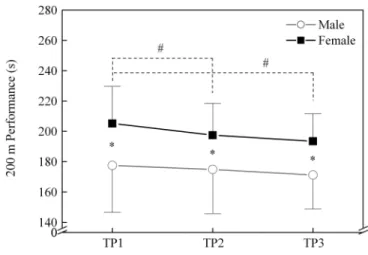
be-tween male (TP1:177.50±30.96s; TP2:174.79±29.08s;
TP3:171.21±22.38s) and female (TP1:205.18±24.47s;
TP2: 197.45±20.97s; TP3: 193.45±18.12s) for 200 m
free-style performance at the three time periods (TPs). Male presented higher Etot in all TPs (TP1:230.40±48.40kJ;
TP2:242.49±37.91kJ; TP3:257.94±46.32kJ) compared with
that found for female swimmers (TP1:188.51±35.13kJ;
TP2:193.18±20.98kJ; TP3:199.77±25.94kJ). Male
pre-sented higher AnL (TP1:33.42±6.82kJ; TP2:30.97±8.73kJ;
TP3:30.66±8.27kJ) and AnAl (TP1:30.61±3.48kJ;
TP2:30.61±3.48kJ; TP3:30.60±3.48kJ) than female
(TP1:18.83±8.45kJ; TP2:14.98±4.17kJ; TP3:18.33±8.66kJ)
and (TP1:24.32±2.22kJ; TP2:24.31±2.23kJ; TP3:
24.31±2.23kJ). Aerobic metabolism is the major contributor for Etot both in male (TP1:71.63±4.99%; TP2:74.05±5.03%;
TP3:76.14±4.46%) and female swimmers (TP1:76.87±3.86%;
TP2:79.40±3.63%; TP3:78.40±5.54%).
Conclusion. The better performance obtained by male
com-pared to female swimmers may be due to the different contri-butions of the energetic pathways. Aerobic metabolism was the major contributor to Etot in a 200 m race, in both genders.
1Department of Sport Sciences
University of Beira Interior, Covilhã, Portugal
2Research Centre in Sports
Health and Human Development, Covilhã, Portugal
3National Institute of Education
Nanyang Technological University, Singapore
4Department of Sport Sciences, Exercise and Health
University of Trás-os-Montes and Alto Douro Vila Real, Portugal
5Research Centre for Interior Development
Polytechnic Institute of Guarda, Guarda, Portugal
J SPORTS MED PHYS FITNESS 2015;55:1509-16
M. I. FERREIRA 1, 2, T. M. BARBOSA 2, 3, H. P. NEIVA 1, 2, J. VILAÇA-ALVES 2, 4, M. J. COSTA 2, 5, D. A. MARINHO 1, 2
Changes of the energetic profile
in masters’ swimmers over a season
Corresponding author: M. I. Ferreira, Departa�ento de Ciências do Desporto, Universidade da Beira Interior, Rua Marquês de Ávila e Bola-�a, 6201-001 Covilhã, Portugal. E-�ail: �[email protected]
MINER
VA MEDICA
COPYRIGHT®
y inter national cop yr ight la ws .No additional reproduction is author
iz ed. It is per mitted f or persona l use to do wnload and sa v
e only one file and pr
int only one cop
y of this Ar ticle . It is not per mitted to mak e additional copies , either pr
inted or electronic) of the Ar
ticle f or an y pur pose . It is not per mitted to dis tr ib
ute the electronic cop
y of the ar
ticle through online inter
net and/or intr
anet file shar
ing systems
, electronic mailing or an
ticle
.
The use of all or an
y par
t of the Ar
ticle f
or an
y Commercial Use is not per
mitted.
The creation of der
iv
ativ
e w
or
ks from the Ar
ticle is not per
mitted.
The production of repr
ints f
or personal or commercial use is
mitted to remo v e , co v er , o v er la y, obscure , b loc k, or change an y cop yr
ight notices or ter
ms of use wh
ich the Pub
lisher ma y post on the Ar ticle . It is not per mitted to fr ame or use fr
aming techniques to enclose an
y tr
mation of the Pub
lisher
FERREIRA ENERGETIC PROFILE IN MASTERS’SWIMMERS OVER A SEASON
� freestyle perfor�ance �as assessed. Moreover, the o�ygen uptake (VO2) at the end of the 200 � and the �a�i�al �lood lactate concentration (fro� fingertip capillary �lood sa�ples), �efore the 200 � trial and, also, 3, 5, and 7�inutes after its end, �ere �easured. Then, VO2 �as used to
calculate the aero�ic contri�ution (Aer) and the �a�i�al �lood lactate concentration (Lapeak) �as
used to calculate the anaero�ic lactic (AnL). The Aer, AnL and anaero�ic alactic (AnAl) contri�u-tions ena�led the esti�ation of the total energy e�penditure (Etot).
Subjects
Eleven fe�ale (age: 34.7±7.3-y; height: 1.63±0.05-�; �ody �ass: 58.5±5.4-kg; Body Mass Inde�: 22.1±1.8 kg·�−2; 4.2±3.7-y of e�perience in
�as-ters age-group) and fourteen �ale (age: 35.6±7.4-y; height: 1.76±0.06 �; �ody �ass: 73.7±8.3 kg; Body Mass Inde�: 23.7±2.7 kg·�−2; 3.9±1.6-y of
e�peri-ence in �asters age-group) volunteered to serve as su�jects. T�elve of the s�i��ers have �een old ath-letes and the re�aining ones started to s�i� only a fe� years ago.
All su�jects gave their �ritten infor�ed consent �efore participation. The study �as approved �y the local ethics co��ittee and is in accordance to the Declaration of Helsinki.
Procedures
S�i��ing perfor�ance �as assessed �ased on ti�e lists of the 200 � freestyle events during lo-cal, regional and national co�petitions. The ti�e �et�een the official co�petition and the testing day never e�ceeded �ore than t�o �eeks.
A 200 � freestyle ti�e trial perfor�ed in a 25 � length s�i��ing pool �as used to evaluate the per-for�ance and the s�i��ers’ energetic adaptations. In addition, the elapsed ti�e for 200 � �as �eas-ured �ith a stop�atch (S141, Seiko, Tokyo, Japan) �y t�o e�pert evaluators (ICC=0.98). The o�ygen uptake (VO2) �as �easured i��ediately after the
end of the 200 � trial (K4�2, Cos�ed, Ro�e, Italy).
The s�i��ers �ere instructed to �reath during the last cycle �efore touching the �all. After finishing the trial, the s�i��er leaned on the �all, �hile an operator fi�ed a porta�le �ask on his/her face dur-�ing is pro�a�ly the �ost or, at least, one of the
�ost popular sports for �asters athletes, providing an e�cellent opportunity to investigate the effects of age in the �eta�olic/�io�echanical deter�inants of perfor�ance,6 avoiding physical inactivity as a potential
confounding factor.7
S�i��ing perfor�ance declines �ith age 2, 8, 9
�hich �ay �e a result of a decreased training e�-ternal load 10 and physiological response to
e�er-cise.11 The a�ility to produce �echanical �ork in
s�i��ing is deter�ined �y the a�ility of the �uscle cells to provide energy. There are three path�ays to re-synthetize ATP (aero�ic, anaero�ic lactic and an-aero�ic alactic) and, therefore, to satisfy the energy require�ents of �uscles.12 Therefore, the a�ount
of energy necessary to perfor� one task (Etot) rep-resents the su� of aero�ic and anaero�ic (lactic and alactic) contri�utions.12-14 The nu��er of �orks
dealing �ith perfor�ance-oriented �asters s�i�-�ers is scarce and �ainly focuses the effects of age on perfor�ance. There are no longitudinal or cross-sectional studies related �ith aero�ic and anaero�ic contri�utions in �asters s�i��ers. For this reason, the data reported for elite s�i��ers �ill �e used as reference.
On top of that, �ost s�i��ing research is �ased on cross-sectional designs. There are so�e clai�s that only longitudinal designs (follo�-up and inter-vention progra�s) can deliver deep insights a�out such relationships. The influence of training in per-for�ance (longitudinal designs) has already �een addressed �ut only for younger, su�-elite and elite s�i��ers.15
The ai�s of this research �ere to assess the en-ergetic contri�utions to the perfor�ance in �asters s�i��ers over one season, and to co�pare the per-for�ance and energetic profiles �et�een genders. It �as hypothesized that s�i��ing perfor�ance is influenced �y energetic factors in �oth genders and, that there is a gender difference in such relationship �et�een �en and �o�en.
Material and methods
A longitudinal research design �as carried out, �eing the s�i��ers assessed in three different ti�e periods (TPs) over a season: Dece��er (TP1), March (TP2) and June (TP3). In each TP, the 200
MINER
VA MEDICA
COPYRIGHT®
y inter national cop yr ight la ws .No additional reproduction is author
iz ed. It is per mitted f or persona l use to do wnload and sa v
e only one file and pr
int only one cop
y of this Ar ticle . It is not per mitted to mak e additional copies , either pr
inted or electronic) of the Ar
ticle f or an y pur pose . It is not per mitted to dis tr ib
ute the electronic cop
y of the ar
ticle through online inter
net and/or intr
anet file shar
ing systems
, electronic mailing or an
y other
ticle
.
The use of all or an
y par
t of the Ar
ticle f
or an
y Commercial Use is not per
mitted.
The creation of der
iv
ativ
e w
or
ks from the Ar
ticle is not per
mitted.
The production of repr
ints f
or personal or commercial use is
mitted to remo v e , co v er , o v er la y, obscure , b loc k, or change an y cop yr
ight notices or ter
ms of use wh
ich the Pub
lisher ma y post on the Ar ticle . It is not per mitted to fr ame or use fr
aming techniques to enclose an
y tr
ademar
k, logo
,
mation of the Pub
lisher
�L O2) �as e�pressed in kJ assu�ing 13 an energy
equivalent of 20.9 kJ×l O2‐1.
Lastly, the alactic contri�ution (AnAl) can �e cal-culated as:
AnAl=PCr · (1- e-t/τ) · M
�here t is the ti�e duration, τ is the ti�e constant of PCr splitting at �ork onset (23.4 s, as proposed �y Binzoni et al.)19 and PCr is the phosphocreatine
concentration at rest. The energy derived fro� the utilization of the PCr stores �as esti�ated assu�ing that, in the transition fro� rest to e�haustion, the PCr concentration decreases �y 18.5 �M×kg-1 �uscle
(�et �eight) in a �a�i�ally active �uscle �ass (as-su�ed to correspond to 30% of �ody �ass).20 AnAl
can �e e�pressed in kJ �y assu�ing 21 a P/O2 ratio
of 6.25 and an energy equivalent of 0.468 kJ�M-1. Statistical analysis
The nor�ality of distri�utions �as verified using Shapiro-Wilks Tests. Para�etric or non-para�et-ric tests �ere selected accordingly. Mean plus one standard deviation and quartiles �ere co�puted for each TP. Data variation �as assessed �ith ANOVA repeated �easures follo�ed �y the Bonferroni post-hoc Test (P≤0.05), or Wilco�on Signed‐Rank Test (P≤0.05), to assess differences �et�een ti�e peri-ods. The differences �et�een genders �ere analyzed �ith Independent Sa�ple t-Test, e�cept for the aero-�ic contri�ution in TP1, �hich �as analyzed �ith the Mann-Whitney U Test (P≤0.05). Cohen’s d �as se-lected as effect size inde�, �ith 0.20≤d<0.50 repre-senting a s�all effect, 0.5≤d<0.80 a �oderate effect, and d≥0.8 a large one.22
Results Swimming performance
The 200 � freestyle perfor�ance of �ales pre-sented an insignificant i�prove�ent throughout the season (TP1-TP2:-1.5%; TP2-TP3:-2.0%; TP1
-TP3:-3.5%). On the other hand, for fe�ales
signifi-cant variations �ere found �et�een TP1-TP2 (-3.8%), and TP1-TP3 (-5.7%). Co�paring �oth genders, �ales al�ays perfor�ed �etter than fe�ales (TP1:
P=0.02, d=0.99; TP2: P=0.04, d=0.89; TP3: P=0.01,
d=1.13) (Figure 1). ing all the recovery period. No �reathing cycle �as
�ade until the porta�le �ask �as on the s�i��er’s face. The VO2 (in �L×kg‐1×�in‐1) reached during
the trial �as esti�ated through the �ack�ard e�-trapolation of the o�ygen (O2) recovery curve (�ean
value calculated �ithin 6 s after the VO2 detection, during the recovery period).16 The first �easure of
VO2 �efore the highest VO2 �easure�ent �as not considered, �ecause it corresponded to the device adaptation to the sudden change of respiratory cy-cles and to O2 uptake. The device adaptation never
e�ceeded 2 s.16, 17
Fingertip capillary �lood sa�ples �ere collected �efore the 200 � and at the 3rd, 5th, and 7th �inutes
after finishing the trial. Sa�ples �ere then used to deter�ine �lood lactate concentrations (Accusport, Boherinnger Mannhei�, Ger�any). The �a�i�al �lood lactate concentration (Lapeak) �as considered to �e the highest �lood lactate concentration in post-e�ercise condition.14
The total energy e�penditure (Etot, in kJ) �as
cal-culated for the 200 � trial, corresponding to the s�i��er’s �a�i�al effort:13
Etot=Aer+Anl+AnAl
�here Aer represents the aero�ic contri�ution (in kJ) �ased on the total o�ygen volu�e, Anl is the en-ergy derived fro� lactic acid production (in kJ) and AnAl stands for the energy derived fro� phospho-creatine (PCr) splitting in the contracting �uscles (in kJ).
The total o�ygen volu�e consu�ed during the 200 � �as esti�ated as:
VO2=VO2net · t · M
�here VO2net (in �L×kg‐1×�in‐1) is the difference
�et�een the o�ygen uptake �easured during e�er-cise and at rest, t (in �in) is the total duration of the effort and M (in kg) is the �ass of the su�ject. Aero-�ic contri�ution �as then e�pressed in kJ assu�ing an energy equivalent 13 of 20.9 kJ×lO
2-1.
The O2 equivalent (in �L O2) �as o�tained
ac-cording to:
O2Eq=Lanet · 2.7 · M
�here Lanet represents the difference �et�een the
lactate �easured at the end of the 200 � trial and the lactate at rest; 2.7 is the energy equivalent (in �L O2×��ol‐1×kg‐1) for lactate accu�ulation in
�lood.18 Thus, the anaero�ic lactic contri�ution (in
MINER
VA MEDICA
COPYRIGHT®
y inter national cop yr ight la ws .No additional reproduction is author
iz ed. It is per mitted f or persona l use to do wnload and sa v
e only one file and pr
int only one cop
y of this Ar
ticle
.
It is not per
, either pr
inted or electronic) of the Ar
ticle f or an y pur pose . It is not per mitted to dis tr ib
ute the electronic cop
y of the ar
ticle through online inter
net and/or intr
anet file shar
ing systems
ticle
.
The use of all or an
y par
t of the Ar
ticle f
or an
y Commercial Use is not per
mitted.
The creation of der
iv
ativ
e w
or
ks from the Ar
ticle is not per
mitted.
The production of repr
ints f mitted to remo v e , co v er , o v er la y, obscure , b loc k, or change an y cop yr
ight notices or ter
ms of use wh
ich the Pub
lisher ma y post on the Ar ticle . It is not per mitted to fr ame or use fr
aming techniques to enclose an
mation of the Pub
lisher
FERREIRA ENERGETIC PROFILE IN MASTERS’SWIMMERS OVER A SEASON
that calculated for fe�ales (TP1: P=0.02, d=0.99;
TP2: P<0.001, d=1.61; TP3: P<0.001, d=1.54) (Fig-ure 2).
Energetic pathways
The aero�ic contri�ution in �ale s�i��ers in-creased significantly fro� TP1-TP2, TP2-TP3 and
TP1-TP3 (7.9%, 10.7% and 19.4%, respectively).
Ho�ever, fe�ale s�i��ers sho�ed a s�aller in-crease fro� TP1-TP2, TP2-TP3 and TP1-TP3 (5.9%,
2.1% and 8.1%, respectively). Co�paring �oth groups, fe�ale s�i��ers presented a significant-ly lo�er aero�ic contri�ution than �ales in TP3
(P=0.01) (Figure 3). Cohen’s d value presented a �oderate effect in TP1 (d=0.58) and a large one in TP2 (d=0.85) and TP3 (d=1.20).
The anaero�ic lactic contri�ution (Figure 4) de-creased for �ales, fro� TP1-TP2 (-7.3%), TP2 -TP3 (-1.0%) and TP1-TP3 (-8.3%). In fe�ales, that
contri�ution sho�ed a decrease �et�een TP1-TP2
(-20.4%), �ut increased fro� TP2-TP3 (22.4%) and finally decreased once again fro� TP1-TP3 (-2.7%).
A higher anaero�ic lactic contri�ution �as found for �ales (TP1: P<0.001, d=1.90; TP2: P<0.001, d=2.33; TP3: P<0.001, d=1.46).
A decrease in Lapeak �as deter�ined for �ales
throughout all TPs: TP1-TP2 (-3.9%); TP2-TP3 (-2.3%); TP1-TP3 (-6.1%) �hereas Lapeak in fe-Total energy expenditure
The Etot value presented a negligi�le increase fro� TP1-TP2 (5.2%) and a significant one fro� TP2-TP3
(6.4%) and TP1-TP3 (12%) in �ales. The re�aining
increases �ere not significant in �oth genders. Fe-�ales presented insignificant increases over the sea-son (TP1-TP2: 2.5%; TP2-TP3: 3.4%; TP1-TP3: 6.0%).
In all TPs, �ales presented a higher Etot value than Figure 1.—Mean±SD values of the 200 � freestyle perfor�ance in the three TPs.
*Significant differences �et�een genders (TP1: P=0.02; TP2:
P=0.04; TP3: P=0.01).
#Significant differences in fe�ale 200 � perfor�ance �et�een
TP1-TP2 (P<0.001); TP1-TP3 (P<0.001).
Figure 2.—Mean±SD values of the energy e�penditure (Etot) in
the three TPs.
*Significant differences �et�een genders (TP1: P=0.02; TP2:
P<0.001; TP3: P<0.001).
#Significant differences in �ale Etot �et�een TP2-TP3 (P=0.04)
and TP1-TP3 (P<0.001).
Figure 3.—Mean±SD values of the aero�ic contri�ution (Aer) in the three TPs.
*Significant difference �et�een genders (TP3 p=0.01).
#Significant differences in �ale Aer �et�een TP1-TP2 (P=0.03);
TP2-TP3 (P=0.01); TP1-TP
MINER
3 (P<0.001).VA MEDICA
COPYRIGHT®
y inter national cop yr ight la ws .No additional reproduction is author
iz ed. It is per mitted f or persona l use to do wnload and sa v
e only one file and pr
int only one cop
y of this Ar ticle . It is not per mitted to mak e additional copies , either pr
inted or electronic) of the Ar
ticle f or an y pur pose . It is not per mitted to dis tr ib
ute the electronic cop
y of the ar
ticle through online inter
net and/or intr
anet file shar
ing systems
, electronic mailing or an
y other
ticle
.
The use of all or an
y par
t of the Ar
ticle f
or an
y Commercial Use is not per
mitted.
The creation of der
iv
ativ
e w
or
ks from the Ar
ticle is not per
mitted.
The production of repr
ints f
or personal or commercial use is
mitted to remo v e , co v er , o v er la y, obscure , b loc k, or change an y cop yr
ight notices or ter
ms of use wh
ich the Pub
lisher ma y post on the Ar ticle . It is not per mitted to fr ame or use fr
aming techniques to enclose an
y tr
ademar
k, logo
,
mation of the Pub
lisher
s�i��ers had a significantly higher %Aer in TP1
(P=0.01) and TP2 (P=0.01) than �ale, �hereas in
TP3 non-significant differences �ere found �et�een genders. Cohen’s d values revealed large effects in TP1 (d=1.17) and TP2 (d=1.22), �ut s�all in TP3 (d=0.45).
In �ale s�i��ers, %AnL decreased significantly (-19%) �et�een TP1-TP3 (P=0.04). Ho�ever, fro� TP1-TP2 and TP2-TP3, %AnL sho�ed
non-signif-icant decreases (-11.2% and -8.8%, respectively). In fe�ale s�i��ers, a non-significant decrease fro� TP1-TP2 (-20.0%), an increase fro� TP2
-TP3 (17.1%) and a decrease fro� TP1-TP3 (-6.3%)
�ere found. Co�paring genders, �ale reached sig-nificantly higher %AnL in TP1 (P<0.001) and TP2 (P<0.001) than fe�ale. Considering Cohen’s d, TP1
and TP2 had a large effect (d=1.41, d=1.40, respec-tively) �hile TP3 presented a �oderate one (d=0.65).
Male s�i��ers had a significant variation in %AnAl fro� TP1-TP2 (P=0.04), TP2-TP3 (P=0.02) and TP1-TP3 (P<0.001), decreasing -5.7%, -7.0%
and -12.3%, respectively. On the other hand, fe�ale s�i��ers sho�ed a non-significant decrease �e-t�een TP1-TP2 (-4.1%), TP2-TP3 (-2.8%), TP1-TP3
(-6.7%). There �ere no significant differences in AnAl �et�een genders and the Cohen’s d values rev-eled s�all gender effects (TP1: d=0.18; TP2: d=0.11; TP3: d=0.22) in all the three TP.
�ales decreased fro� TP1-TP2 (-11.6%), increased slightly fro� TP2-TP3 (3.1%) and decreased fro�
TP1-TP3 (-8.1%). Co�paring genders, the values
of Lapeak �ere higher in �ales (TP1:10.02±2.08
��ol·l−1; TP
2:9.63±2.66 ��ol·l−1; TP3:9.41±1.88
��ol·l−1) co�pared to that �easured for
fe-�ales (TP1:7.64±2.54; TP2:6.75±1.34 ��ol·l−1;
TP3:6.96±1.60 ��ol·l−1). Cohen’s d revealed large
effects in all TPs (TP1: d=1.03; TP2: d=1.37; TP3: d=1.40).
Finally, anaero�ic alactic contri�ution (Figure 5) presented variations over ti�e in the fe�ale group. Also, there �ere significant differences �et�een gen-ders (TP1: P<0.001, d=2.15; TP2: P<0.001, d=2.15;
TP3: P<0.001, d=2.25).
Partial contribution to total energy
Aero�ic �eta�olis� (%Aer) �as the �ajor partial contri�utor for Etot in �oth genders (Ta�le I).
Anaer-o�ic alactic (%AnAl) and anaerAnaer-o�ic lactic (%AnL) �eta�olis� �ere the second �ajor contri�utors for Etot in fe�ale and �ale, respectively. Male s�i�-�ers increased significantly %Aer fro� TP1-TP2
(P=0.03, 3.4%) and TP1-TP3 (P=0.01, 6.3%),
�here-as �et�een TP2-TP3 a non-significant increase �as o�tained (2.8%). Fe�ale s�i��ers sho�ed a non-significant increase fro� TP1-TP2 (3.3%), a decrease
fro� TP2-TP3 (-1.3%) and, finally, an increase fro�
TP1-TP3 (2.0%). Co�paring �oth genders, fe�ale
Figure 4.—Mean±SD values of the anaero�ic lactic contri�ution (AnL) in the three TPs.
*Significant differences �et�een genders (TP1: P<0.001; TP2:
P<0.001; TP3: P<0.001).
Figure 5.—Mean±SD values of the anaero�ic alactic contri�ution (AnAl) in the three TPs.
*Significant differences �et�een genders (TP1: P<0.001; TP2:
P<0.001; TP3: P<0.001).
#Significant differences in fe�ale AnAl �et�een TP1-TP2
(P=0.02); TP1-TP3 (P<0.001).
MINER
VA MEDICA
COPYRIGHT®
y inter national cop yr ight la ws .No additional reproduction is author
iz ed. It is per mitted f or persona l use to do wnload and sa v
e only one file and pr
int only one cop
y of this Ar
ticle
.
It is not per
, either pr
inted or electronic) of the Ar
ticle f or an y pur pose . It is not per mitted to dis tr ib
ute the electronic cop
y of the ar
ticle through online inter
net and/or intr
anet file shar
ing systems
ticle
.
The use of all or an
y par
t of the Ar
ticle f
or an
y Commercial Use is not per
mitted.
The creation of der
iv
ativ
e w
or
ks from the Ar
ticle is not per
mitted.
The production of repr
ints f mitted to remo v e , co v er , o v er la y, obscure , b loc k, or change an y cop yr
ight notices or ter
ms of use wh
ich the Pub
lisher ma y post on the Ar ticle . It is not per mitted to fr ame or use fr
aming techniques to enclose an
mation of the Pub
lisher
FERREIRA ENERGETIC PROFILE IN MASTERS’SWIMMERS OVER A SEASON
i�prove�ent of s�i��ing perfor�ance o�served in the fe�ale s�i��ers �ay �e one of the reasons for the slight increase verified in this cohort group. Co�paring these results �ith those in the literature reported for younger and elite s�i��ers,25, 26 �oth
�ale and fe�ale �asters presented lo�er Etot values. This difference �ay rely on the sa�ple character-istics (�asters vs. elite) and age group (�asters vs. young s�i��ers).
Energetic pathways
The higher aero�ic �orkout in the �asters training is one of the characteristics of this cohort. Co�par-ing �oth genders, fe�ale s�i��ers present a signifi-cant aero�ic contri�ution �ut lo�er than that found in their �ale counterparts. T�o �ajor reasons can �e put for�ard:27 lo�er �lood he�oglo�in
concentra-tion and s�aller size of the heart in relaconcentra-tion to total �uscle �ass in fe�ales, co�pared to �en resulting in a less o�ygen-carrying capacity.
The lack of i�prove�ent in AnL and AnAl for �oth genders can �e attri�uted to the lo�er anaero�ic training load (TP1: 7.19%; TP2: 9.65%; TP3: 8.64%)
throughout the season. Indeed, this is a characteristic reported for training sessions of �asters athletes and periodization progra�s11. Further�ore, the decrease
in anaero�ic perfor�ance �ay also �e attri�uted to changes in �orphological factors (decreased �us-cle �ass and type II �us�us-cle fi�er atrophy), �us�us-cle contractile property (decreased rate of force devel-op�ent) and �io�echanical aspects (changes in enzy�e activity and decreased lactate production) arising fro� ageing.28 The AnL is also gender
de-pendent. The �ajor �echanis� e�plaining this gen-der difference in anaero�ic perfor�ance appears to �e related to the greater rates of type II fi�er
atro-Discussion
The ai� of this study �as to co�pare the changes of perfor�ance and energetic profile of �ale and fe�ale �asters s�i��ers over a season. Fe�ale i�proved their perfor�ance throughout the season and presented lo�er Aer, AnL and AnAl contri�utions than �ale. The �ajor contri�utor for Etot in �oth genders �as %Aer, fol-lo�ed �y %AnL for �ale and %AnAl for fe�ale.
Swimming performance
Male and fe�ale �asters s�i��ers i�proved their perfor�ance over the season, �ut only fe�ales pre-sented a significant variation. The po�er and capacity of the i��ediate (ATP-PCr), short-ter� (anaero�ic glycolysis), and long-ter� (o�idative phosphoryla-tion) syste�s of energy production are the �ajor fac-tors in deter�ining s�i��ing perfor�ance.23 Over
the season, �e found a decrease in the anaero�ic contri�utors in �o�en, although only AnAl sho�ed �eaningful decreases. The AnL decreased �y 20.4% fro� TP1-TP2 and, other�ise, Aer increased 5.9%. In
�ale s�i��ers, in the sa�e ti�efra�e, the �agnitude of AnL decrease �as not as sharp as the one found in fe�ale (-7.3%). Moreover, the Aer i�prove�ent in �ales �as si�ilar to that seen in �o�en (7.9%). Not surprisingly, �en had �etter perfor�ances than �o�en. This can �e e�plained �y the different con-tri�ution of the energetic path�ays for the overall en-ergy e�penditure, �hich is nota�ly the highest deliver fro� the anaero�ic path�ay (AnL and AnAl) �y �ale co�pared to fe�ale.
Total energy expenditure
The increase in Etot o�served for �oth genders �ay �e related �ith the increase in speed.24 The
Table I.—Partial contribution of aerobic (%Aer), anaerobic lactic (%AnL) and anaerobic alactic (%AnAl) energy sources to total metabolic power output for both genders in the 200 m freestyle race over a full season.
Fe�ale Male
TP1 TP2 TP3 TP1 TP2 TP3
%Aer 76.87±3.86* 79.40±3.63* 78.40±5.54 71.63±4.99*# 74.05±5.03*# 76.14±4.46#
%AnL 9.94±3.41* 7.95±2.76* 9.31±4.71 14.76±3.44*# 13.11±4.41* 11.96±3.32#
%AnAl 13.19±2.02 12.65±1.14 12.30±1.48 13.61±2.54# 12.84±2.13# 11.94±1.82#
* Significant difference �et�een �ale and fe�ale �asters s�i��ers %Aer TP1 (P=0.01) and %Aer TP2 (P=0.01); %AnL TP1 (P<0.001) and %AnL TP2 (P<0.001); # significant difference in �ale %Aer �et�een TP1-TP2 (P=0.03), TP1-TP3 (P=0.01); %AnL �et�een TP1-TP3 ((P=0.04); %AnAl �et�een TP1-TP2 (P=0.04); TP2-TP3 (P=0.02); TP1-TP3 (P<0.001).
MINER
VA MEDICA
COPYRIGHT®
y inter national cop yr ight la ws .No additional reproduction is author
iz ed. It is per mitted f or persona l use to do wnload and sa v
e only one file and pr
int only one cop
y of this Ar ticle . It is not per mitted to mak e additional copies , either pr
inted or electronic) of the Ar
ticle f or an y pur pose . It is not per mitted to dis tr ib
ute the electronic cop
y of the ar
ticle through online inter
net and/or intr
anet file shar
ing systems
, electronic mailing or an
y other
ticle
.
The use of all or an
y par
t of the Ar
ticle f
or an
y Commercial Use is not per
mitted.
The creation of der
iv
ativ
e w
or
ks from the Ar
ticle is not per
mitted.
The production of repr
ints f
or personal or commercial use is
mitted to remo v e , co v er , o v er la y, obscure , b loc k, or change an y cop yr
ight notices or ter
ms of use wh
ich the Pub
lisher ma y post on the Ar ticle . It is not per mitted to fr ame or use fr
aming techniques to enclose an
y tr
ademar
k, logo
,
mation of the Pub
lisher
younger s�i��ers train for endurance, strength, speed, and po�er.10 The %AnL values �ere lo�er
than those o�tained �y Capelli et al.,21 and
Pender-gast et al.24 With increasing age, anaero�ic capacity
decreases 7, 8, 28 and the hu�an skeletal �uscle
un-dergoes �oth structural and functional changes, the �ost striking of �hich are the reduction in �uscle volu�e and �uscle strength.32 The area of �uscle
�ass of old individuals �as found to �e significantly s�aller and the total nu��er of fi�ers significantly fe�er than those of young individuals. The nu��er of fi�ers see�s to have the greatest influence on the �uscle area. For all age groups, average type II fi�er size is di�inished �ith age �hile the size of type I fi�ers is �uch less affected, �arking short contrac-tion ti�e and the a�ility to produce high tension, as already �entioned.
The %AnAl values are si�ilar to those o�tained �y Capelli et al. 21 and Sousa et al. 26 �eing, ho�ever,
lo�er than those of Pendergast et al. 24 and
Figue-iredo et al.25 These differences �ay �e attri�uted
to the �ethod of esti�ation of AnAl. Capelli et al.
21 considered that PCr concentration decreases, in
transition fro� rest to e�haustion, �y 18.5 �M×kg-1
�uscle (�et �eight) in a �a�i�ally active �uscle �ass equal to 30% of the overall �ody �ass (si�i-lar to our study), �ut Figueiredo et al. 25 found that
this value �as 27.75 �M×kg-1 and assu�ed that the
�a�i�ally active �uscle �ass corresponds to 50% of �ody �ass. This last assu�ption does not see� to �e appropriate for �asters s�i��ers since, �ith ageing, there is a decrease in skeletal �uscle �ass 33
�here�y it is unlikely that 50% of the total �ass cor-responds to �uscle �ass. Thus, assu�ing the value of 30% of active �uscle �ass see�s to �e �ore ap-propriate for this age group.
Conclusions
The �etter perfor�ance o�tained �y �ale co�-pared �ith fe�ale s�i��ers �ay �e due to the dif-ferent contri�utions of energetic path�ays. Male s�i��ers present higher Aer, AnL and AnAl con-tri�utions than fe�ale. Aero�ic �eta�olis� �as the �ajor contri�utor to Etot in a 200 � race, in �oth
genders. Partial aero�ic contri�ution �as higher in fe�ale, �hile partial anaero�ic contri�ution �as greater in �ale.
phy 29 and to the lo�er peak �lood lactate follo�ing
anaero�ic perfor�ance 28 e�hi�ited �y �o�en. The
type II fi�er uses anaero�ic �eta�olic processes to generate ATP, ena�ling short contraction ti�e and the a�ility to produce high tension.28 Therefore, it is
e�pected that fe�ale s�i��ers �uscles lose their a�ility for po�er strength as a result of the preferen-tial fi�ers atrophy 29 and lo�er anaero�ic
contri�u-tion.
Wo�en have less lean �uscle in relation to total �ody �eight and lo�er total stores of ATP, PCr and glycogen than �en.30 Moreover, older �o�en
pre-sent type I and type II fi�ers �ith s�aller areas than older �en.10
Partial contribution to total energy
The %Aer �as the �ajor partial contri�utor for Etot in �oth genders �hereas the %AnAl and %AnL �ere the second one for fe�ales and �ales, respectively. Each syste� is �est suited to provide a higher con-tri�ution to ATP re-synthesis according to the race characteristics. The role of aero�ic energy syste� during high intensity e�ercise �as reported �y Gastin
12 and the data of the present study are in agree�ent
�ith previous studies as �ell.21, 24-26 The increase of
%Aer verified in �oth genders is pro�a�ly due to the higher percentage of �orkout focused on the aero-�ic capacity. The aeroaero-�ic contri�ution e�pressed as a percentage of total �ork acco�plish�ent is greater in fe�ale co�pared �ith �ale; other�ise %AnL and %AnAl are higher in �ale. Co�paring �oth genders, the greater aero�ic contri�ution, o�tained in �o�en co�pared to �en �ay �e assigned to the lo�er s�i�-�ing speed achieved.31 For shorter distances, the
an-aero�ic perfor�ance of elite �ale �asters s�i��ers in 50 � and 100 � is 10% �etter than fe�ale �as-ters. This can �e e�plained �y gender differences in �uscle �ass, lo�er Lapeak and greater rates of type II fi�er atrophy.8
Availa�le literature reports that the �ajor contri�u-tor to Etot is also %Aer even though no study
recruit-ed �asters s�i��ers as su�jects. An effort of a�out 75 seconds derives energy fro� �oth aero�ic and an-aero�ic energy sources and, fro� this �o�ent, aero-�ic �eta�olis� increases �hile the anaeroaero-�ic contri-�ution decreases,12 �hich is �hat occurs in the 200
� trial. Masters s�i��ers have a higher prevalence of aero�ic �orkout during their training �hereas
MINER
VA MEDICA
COPYRIGHT®
y inter national cop yr ight la ws .No additional reproduction is author
iz ed. It is per mitted f or persona l use to do wnload and sa v
e only one file and pr
int only one cop
y of this Ar
ticle
.
It is not per
, either pr
inted or electronic) of the Ar
ticle f or an y pur pose . It is not per mitted to dis tr ib
ute the electronic cop
y of the ar
ticle through online inter
net and/or intr
anet file shar
ing systems
ticle
.
The use of all or an
y par
t of the Ar
ticle f
or an
y Commercial Use is not per
mitted.
The creation of der
iv
ativ
e w
or
ks from the Ar
ticle is not per
mitted.
The production of repr
ints f mitted to remo v e , co v er , o v er la y, obscure , b loc k, or change an y cop yr
ight notices or ter
ms of use wh
ich the Pub
lisher ma y post on the Ar ticle . It is not per mitted to fr ame or use fr
aming techniques to enclose an
mation of the Pub
lisher
FERREIRA ENERGETIC PROFILE IN MASTERS’SWIMMERS OVER A SEASON
18. Di Pra�pero PE, Ferretti G. The energetics of anaero�ic �uscle �e-ta�olis�: a reappraisal of older and recent concepts. Respir Physiol 1999;118:103-15.
19. Binzoni T, Ferretti G, Schenker K, Cerretelli P. Phosphocreatine hydrolysis �y 31P-NMR at the onset of constant-load e�ercise in hu�ans. J Appl Physiol 1992;73:1644-9.
20. Za�paro P, Pendergast DR, Mollendorf J, Ter�in A, Minetti AE. An energy �alance of front cra�l. Eur J Appl Physiol 2005;94:134-44.
21. Capelli C, Pendergast DR, Ter�in B. Energetics of s�i��ing at �a�i�al speeds in hu�ans. Eur J Appl Physiol Occup Physiol 1998;78:385-93.
22. Cohen J. Statistical Po�er Analysis for the Behavioral Sciences. Second edition. In: Hillsdale N, editor. Hillsdalle, NJ: La�rence Earl�au� Associates;1988.
23. Toussaint HM, Hollander AP. Energetics of co�petitive s�i��ing. I�plications for training progra��es. Sport Med 1994;18:384-405. 24. Pendergast DR, Capelli C, Capelli AB, diPra�pero PE, Minetti AE, Mollendorf J, Ter�in II A. Biophysics in s�i��ing. Rev Port Ciên-cias do Desporto 2006;6:185-9.
25. Figueiredo P, Za�paro P, Sousa A, Vilas-Boas JP, Fernandes RJ. An energy �alance of the 200 � front cra�l race. Eur J Appl Physiol 2011;111:767-77.
26. Sousa A, Figueiredo P, Za�paro P, Vilas-Boas JP, Fernandes RJ. Anaero�ic alactic energy assess�ent in �iddle distance s�i��ing. Eur J Appl Physiol 2013;113:2153-8.
27. Weiss EP, Spina RJ, Holloszy JO, Ehsan AA. Gender differences in the decline in aero�ic capacity and its physiological deter�inants during the later decades of life. J Appl Physiol 2006;101:938-44. 28. Rea�urn P, Dasco��e B. Anaero�ic perfor�ance in �asters
ath-letes. Eur Rev Aging Phys Act 2009;6:39-53.
29. Macaluso A, Vito G. Muscle strength, po�er and adaptations to re-sistance training in older people. Eur J Appl Physiol 2004;91:450-72.
30. McGlynn G. Dyna�ics of Fitness: A Practical Approach. Furth edi-tion. Madison, WI: Bro�n & Bench�ark;1996.
31. Pendergast DR, Za�paro P. Balance of Bio�echanical and Physi-ological Contri�utions to S�i��ing Perfor�ance. Port J Sport Sci 2011;11(Suppl 3):51-9.
32. Faulkner AJ, Larkin LM, Claflin DR, Brooks SV. Age-related changes in the structure and function of skeletal �uscles. Clin E�p Phar�acol Physiol 2007;34:1091-6.
33. Doherty TJ. The influence of aging and se� on skeletal �uscle �ass and strength. Curr Opin Clin Nutr Meta� Care 2001;4:503-8.
Acknowledgments.—The authors �ould like to thank all the s�i��ers and their coaches �ho participated in this study.
Funding.—This �ork �as supported �y University of Beira In-terior and Santander Totta �ank (UBI/FCSH/Santander/2010).
Conflicts of interest.—The authors certify that there is no con-flict of interest �ith any financial organization regarding the �ate-rial discussed in the �anuscript.
Received on June 1, 2014.
Accepted for pu�lication on Octo�er 23, 2014. Epu� ahead of print on Octo�er 30, 2014. References
1. Ransdell LB, Vener J, Hu�erty J. Masters athletes: an analysis of running, s�i��ing and cycling perfor�ance �y age and gender. J E�erc Sci Fit 2009;7:61-73.
2. Bongard V, McDer�ott AY, Dallal GE, Schaefer EJ. Effects of age and gender on physical perfor�ance. Age (O�aha) 2007;29:77-85.
3. Maron BJ, Araújo CGS, Tho�pson PD, Fletcher GF, Luna AB, Fleg JL, et al. Reco��endations for Preparticipation Screening and the Assess�ent of Cardiovascular Disease in Masters Athletes. Circula-tion 2001;103:327-34.
4. Tantru� M, Hodge K. Motives for participating in �asters s�i�-�ing. Ne� Zeal J Heal Phys Educ Recreat 1993;26:3-7.
5. Hastings D, Kurth S, Schloder M, Cyr D. Reasons for Participat-ing in a Serious Leisure Career: Co�parison of Canadian and U.S. Masters S�i��ers. Int Re�ie� Sociol Sport 1995;30:101-19. 6. Za�paro P, Gatta G, Pra�pero PE. The deter�inants of
perfor-�ance in �aster s�i��ers: an analysis of �aster �orld records. Eur J Appl Physiol 2012;112:3511-18.
7. Benelli P, Ditroilo M, Forte R, De Vito G, Stocchi V. Assess�ent of post-co�petition peak �lood lactate in �ale and fe�ale �aster s�i��ers aged 40-79 years and its relationship �ith s�i��ing perfor�ance. Eur J Appl Physiol 2007;99:685-93.
8. Donato AJ, Tench K, Glueck DH, Seals DR, Eskurza I, Tanaka H. Declines in physiological functional capacity �ith age: a lon-gitudinal study in peak s�i��ing perfor�ance. J Appl Physiol 2003;94:764-9.
9. Tanaka H, Seals DR. Age and gender interactions in physiological functional capacity: insight fro� s�i��ing perfor�ance. J Appl Physiol 1997;82:846-51.
10. Weir PL, Kerr T, Hodges NJ, McKay SM, Starkes JL. Master s�i�-�ers: Ho� are they different fro� younger elite s�i��ers? An e�-a�ination of practice and perfor�ance patterns. J Aging Phys Act 2002;10:41-63.
11. Eskurza I, Donato AJ, Moreau KL, et al. Changes in �a�i�al aero-�ic capacity �ith age in endurance-trained �o�en: 7-yr follo�-up. J Appl Physiol 2002;92:2303-8.
12. Gastin PB. Energy syste� interaction and relative contri�ution dur-ing �a�i�al e�ercise. Sport Med 2001;31:725-41.
13. Za�paro P, Capelli C, Pendergast D. Energetics of s�i��ing: a historical perspective. Eur J Appl Physiol 2011;111:367-78. 14. Ter�in B, Pendergast DR. Training using the stroke
frequency-ve-locity relationship to co��ine �io�echanical and �eta�olic para-dig�s. J S�i� Res 2000;14:9-17.
15. Costa MJ, Bragada JA, Mejias JE, Louro H, Marinho DA, Silva AJ, Bar�osa TM. Tracking the perfor�ance, energetics and �io�e-chanics of international versus national level s�i��ers during a co�petitive season. Eur J Appl Physiol 2012;112:811-20.
16. Laffite LP, Vilas-Boas JP, De�arle A, Silva J, Fernandes R, Bil-lat VL. Changes in physiological and stroke para�eters during a �a�i�al 400-� free s�i��ing test in elite s�i��ers. Can J Appl Physiol 2004;29(S1):S17-S31.
17. Costa MJ, Marinho DA, Reis VM, Silva AJ, Marques MC, Bragada JA, Bar�osa TM. Tracking the perfor�ance of �orld-ranked s�i�-�ers. J Sport Sci Med 2010;9:411-7.
MINER
VA MEDICA
COPYRIGHT®
y inter national cop yr ight la ws .No additional reproduction is author
iz ed. It is per mitted f or persona l use to do wnload and sa v
e only one file and pr
int only one cop
y of this Ar ticle . It is not per mitted to mak e additional copies , either pr
inted or electronic) of the Ar
ticle f or an y pur pose . It is not per mitted to dis tr ib
ute the electronic cop
y of the ar
ticle through online inter
net and/or intr
anet file shar
ing systems , electronic mailing or an y other w access to the Ar ticle .
The use of all or an
y par
t of the Ar
ticle f
or an
y Commercial Use is not per
mitted.
The creation of der
iv
ativ
e w
or
ks from the Ar
ticle is not per
mitted.
The production of repr
ints f
or personal or commercial use is
mitted to remo v e , co v er , o v er la y, obscure , b loc k, or change an y cop yr
ight notices or ter
ms of use wh
ich the Pub
lisher ma y post on the Ar ticle . It is not per mitted to fr ame or use fr
aming techniques to enclose an
y tr ademar k, logo , y inf or
mation of the Pub
lisher