Maria João da Costa Novais
June 2014
Molecular mechanisms linking the
phosphorylation of the protein Bax
to its activation during apoptosis
UMinho|20
14
Maria João da Costa No
vais
Molecular mechanisms linking t
he phosphor
ylation of t
he pro
tein Bax to its activ
ation during apop
tosis
Universidade do Minho
Escola de Ciências
Maria João da Costa Novais
June 2014
Master in Applied Biochemistry
Specialisation in Biomedicine
Molecular mechanisms linking the
phosphorylation of the protein Bax
to its activation during apoptosis
Universidade do Minho
Escola de Ciências
Work performed under the supervision of
Doctor Stéphen Manon (Institut de Biochimie et de Génétique
Cellulaires/CNRS, Université Bordeaux Ségalen)
Doctor Manuela Côrte‐Real (Centro de Biologia Molecular e
Ambiental/Departamento de Biologia, Universidade do Minho)
iii
Acknowledgments
First of all I want to thank my supervisor Dr Stephen Manon who gave me the chance to carry my master thesis in their research group. I must thank for the research guidance and for sharing scientific knowledge. Thanks for all the time invested on me.
I also want to thank everyone in the lab in Bordeaux for the support and hospitality. I must mention Lillit, Nadine, Axel and Cécile who were always available to help.
Thanks to my supervisor Dr Manuela Côrte-Real for her guidance, advice and support, for introducing me to the Bcl-2 family proteins, and all the help in this past year.
Thanks to Patrícia, Cristiana, Graciela, Paula, Cláudia, Bruno e Céu for their friendship and for making the distance seem very little.
Thanks to Maria, Rowan, Quentin, Jenny, Marion, Adena and Joana for helping me to forget some of the less good results, and make Bordeaux my new home.
Thanks to my parents Maria de Fátima and José Novais, for the unconditional support and all the knowledge given to me all these years.
Thanks to my sister Lígia Novais, for all her enthusiasm and support along the years. Thanks to my family for all the good moments and the laughs shared.
Special thanks to my godmother Fernanda Figueiras, for the great demonstration of strength and endurance, for all the joy and love, and for everything she taught me over the years.
v
Molecular mechanisms linking the phosphorylation of the
protein Bax to its activation during apoptosis
Abstract
Programmed cell death is an important process to the normal development of an organism. Apoptosis is a type of programmed cell death process that can occur by two pathways the extrinsic or intrinsic. The intrinsic pathway is unleashed by an internal signal that actives the pro-apoptotic members of the Bcl-2 protein family. This protein family has an important role in the regulation of outer mitochondrial membrane permeabilization that may lead to the release of cytochrome c, and trigger the apoptotic cascade. These proteins differ in their structure and therefore in the function they perform.
Bax is a pro-apoptotic protein and its activation can be regulated in different ways. The activation can occur by interaction with other members of Bcl-2 protein family, by post-translation modification by phosphorylation of specific residues, and by interaction with lipids. Bax activation and its regulators can have an important role in diseases involving apoptotic dysfunctions.
Our working hypothesis was that the protein kinase Akt regulates the activation of Bax and its insertion in mitochondria directly (by phosphorylation of the residue Serine 184) or indirectly (by interaction with other proteins of the family Bcl-2). For this reason the objective of this work was to characterize the contribution of the presence of Akt in Bax activation, in yeast, using the mutant S184V (mimics the phosphorylation of the residue Serine 184).
Our results demonstrate that Akt presents an important role in activation of Bax, its effect may be directly connected with the phosphorylation of the residue Serine 184 but other effect might also be involved.
In conclusion, our results suggest that Akt contributes to the activation of Bax and the consequent cell death, but the exact mechanism of the interaction of this proteins is still to undercover.
vii
Mecanismos moleculares vinculados à fosforilação da Proteína
Bax e à sua ativação durante a apoptose
Resumo
Morte celular programada é um processo importante no desenvolvimento normal de um organismo. Apoptose é um tipo de morte celular programada que pode ocorrer por duas vias, a intrínseca ou a extrínseca. A via intrínseca é desencadeada por um sinal interno que ativa os membros pró-apoptóticos da família de proteínas Bcl-2. Esta família de proteínas tem um papel importante na regulação da permeabilização da membrana mitocondrial externa, que pode levar à libertação de citocromo c, e desencadear a cascata apoptótica. Estas proteínas diferem na sua estrutura e por consequente na sua função.
Bax é uma proteína pro-apoptótica e a sua ativação é regulada de diferentes formas. A ativação pode ocorrer por interação com outros membros da família proteica Bcl-2, por modificações pós-translacionais por fosforilação de resíduos específicos e pela interação com lípidos. A sua ativação e os reguladores podem ter um importante papel no desenvolvimento de doenças que envolvam disfunções apoptóticas.
A hipótese de trabalho deste projeto consistiu na suposição de que a proteína cinase Akt regula a ativação de Bax e a sua inserção na mitocôndria diretamente (fosforilação do resíduo Serina 184) ou indiretamente (interação com outras proteínas da família Bcl-2). Por essa razão foi nosso objetivo caracterizar a contribuição da presença de Akt na ativação de Bax, em levedura, usando o mutante S184V (mímica a fosforilação do resíduo Serina 184).
Os resultados demonstraram que Akt apresenta um papel na ativação de Bax, podendo ser diretamente ligada pela fosforilação do resíduo Serina 184 ou outro mecanismo.
Em conclusão, os resultados sugerem que Akt contribui para a ativação de Bax e posteriormente para a morte celular sendo que o exato mecanismo desta interação ainda está por descobrir.
ix
Index
Acknowledgment………..……...……...…... iii Abstract ………...………..…………...…….. v Resumo ………...…….… vi Index ………..………...…... ix Abbreviations ………..……… xi 1. Introduction ……….. 11.1. Bcl-2 protein family – crucial regulators of apoptotic cell death ……… 3
1.1.1. The caspases ………...………… 4
1.1.2. The extrinsic apoptotic pathway (or death-receptors pathway) ……. 5
1.1.3. The intrinsic apoptotic pathway (or mitochondrial pathway) …….... 6
1.1.4. The Bcl-2 family ……… 8
1.2. The pro-apoptotic Bax (Bcl-2 associated X) Protein ……….. 10
1.2.1. Bax structure and function ………...… 10
1.2.2. Bax signalling pathways ……….………….……. 12
1.3. Mechanisms involved on Bax regulation ………...….………… 14
1.3.1. Bax regulation by interaction with other members of bcl-2 family...14
1.3.2. Bax regulation by post-translation modification by phosporylation..17
1.3.3. Bax regulation by lipids ………... 20
1.4. Yeast as a model system ……….. 22
2. Objectives ……….. 25
3. Material and Methods ………. 29
3.1. Yeast strains, plasmids and growth conditions ……….... 31
3.2. Preparation of protein extracts ……….…… 32
3.3. Cytochrome Measurements ……….……… 35
x
4. Results ……… 39 4.1. Co-expression of Bax with protein Kinase AKT in Saccharomyces
cerevisiae………....………..41
4.2. Co-expression of Bax with protein Kinase Akt and Bcl-xL in Saccharomyces
cerevisiaec………...………….…... 47
4.3. Evaluation of the action of Akt and Bcl-xL on Bax stability in Saccharomyces
cerevisiae………. 52
5. Discussion and Future perspectives ………...………...……..59 6.References ... 67
xi
Abbreviations
AIF - apoptosis inducing factor Akt/PKB - Protein kinase A
APAF-1 - Apoptotic protease-activating factor 1 Apoptosis Protein (IAP)-Binding Protein With ATP - Adenosine Triphosphate
BSA - Bovine Serum Albumin
c-FLIP - Cellular-FLICE (FADD-like IL-1β- converting enzyme)-inhibitory Protein Co-IP - Co-immunoiprecipitation
C-terminal - Carboxyl-terminal
DISC - Death Inducing Signaling Complex DNA - Deoxyribonucleic acid
EDTA - Ethylenediaminetetraacetic acid Endo G - Endonuclease G
ER - Endoplasmatic Reticulum
FADD - Fas-Associated Death Domain GFP - Green Fluorescent Protein GSK3 β - Glycogen Synthase Kinase
H2O2 – Hydrogen Peroxide
HtrA2/Omi - High Temperature Requirement IAPs - Inhibitors of Apoptosis Proteins JNK - Jun N-terminal kinase
MAC - Mitochondrial Apoptosis-induced Channel MAPK - Mitogen-activated Protein Kinases MOMP - Mitochondrial Outer Membrane NADH - Nicotinamide Adenine Dinucleotide NADPH - Nicotinamide Adenine Dinucleotide N-terminal - Amino-terminal
OMM - Outer mitochondrial membrane PKA - Protein kinase A
xii
PKC - Protein kinase C
PTP - Permeability Transient Pore ROS - Reactive oxygen species SDS - Sodium Dodecyl Sulfate
Smac/Diablo - Second mitochondria-derived activator of caspases/IAP-binding mitochondrial protein
TM - Transmembrane TNF - Tumor necrosis factor
TNF-R - Tumor-Necrosis Factor Receptor
TOM - Translocase of the outer membrane complex TRADD - TNF-R-Associated Death Domain
TRAIL-R - TNF-related Apoptosis-Inducing UV – Ultraviolet
1
3
1.1. Bcl-2 protein family – crucial regulators of apoptotic cell death
Cell death is a crucial biological process for tissue homeostasis and the development of a multicellular organism, and has been studied for the last decades (Galluzzi et al., 2012, for review). Programmed cell death was first mentioned in 1965 when Lockshin and Williams used this term to differentiate this type of cell death from the accidental cell death. Posterior apoptosis that was known to be a type of cell death genetically controlled was considered the equivalent of programed cell death, being necrosis an accidental cell death. This nomenclature has been altered when it was proved that necrosis can also be regulated (Kerr et al., 1972; Galluzzi et al., 2012).
The various processes that lead to cell death can be classified depending on morphological appearance, enzymatic aspects such as involvement of caspases, the functional aspects (if is programmed or accidental) or the immunological characteristics (Kroemer et al., 2009).
Apoptotic cell death does not affect the surrounding cells and is an essential process in embryonic and post-embryonic development, regulation of tissue homeostasis and elimination of damaged cells. This process occurs when a cell activates a suicide program as a result of an external stress signal or intracellular stress signal (Bras et al., 2005; Galluzzi et al., 2012). Cell suicide can be set off by changes in the cell equilibrium such as DNA damage or cell cycle aberrations and by other cells through signals and receptors that regulate gene expression (Hengartner, 2000; Fulda et
al., 2010). This process is characterized by cellular shrinkage, degradation of
chromosomal DNA, chromatin condensation and cell fragmentation into membrane- enclosed apoptotic bodies that are phagocyted by neighboring cells, not affecting the surrounding cells (Bursch et al., 2000 ; Kroemer et al., 2009). Its malfunction can lead to a variety of pathologies, including cancer and degenerative diseases (Adams and Cory, 2001; Green and Even, 2002).
4
Figure 1. The three major cell death pathways: apoptosis, autophagy and necrosis.
Demonstrating the molecular and morphological events associated with the cause and execution of the three forms of cell death (Hotchkiss et al., 2009).
1.1.1. The caspases
Apoptosis cell death can be triggered by an extrinsic pathway or an intrinsic pathway, depending on the type of stimulus received. Both pathways ultimately lead to the activation of a particular group of proteases, called caspases. Caspases are present in cells in an inactive form, after receiving an apoptotic stimulus, these caspases become activated through a sequence of proteolytic events that lead to structural changes, oligomerization, and further activation (Hengartner, 2000). These proteases contain a cysteine residue as the catalytic nucleophile and cleave substrates after an aspartic acid residue (hence their name that means Cysteine Aspartate Proteases). Caspases can be put in three types depending on the amino acid sequence that they target that is related to their cellular function. Initiator capases 8, 10, 9 and 2 participate to the signaling of apoptosis. Effector caspases 3, 6 and 7 participate to the degradation of specific substrates during apoptosis. Inflammatory caspases 1, 4 and 5 participate to the inflammation response and to necrosis but do not participate to apoptosis (Alnemri et
al., 1996; Frejlich et al., 2013). Caspases are synthesized as a proenzyme (pro-caspase)
with a pro-domain that is cleaved during their activation. The remaining protein is cleaved in two subunits, long and short, that form a heterotetramer formed by two long
5
subunits and two short subunits (Nicholson et al., 1995; Alnemri et al., 1996; Ho and
Hawkins, 2005). Caspases 8 and 10 contain a dead effector domain and are involved in the extrinsic apoptotic pathway, whereas caspases 2 and 9 contain a caspase activation and a recruitment domain (CARD) and are involved in the intrinsic apoptotic pathway.
1.1.2. The extrinsic apoptotic pathway (or death-receptors pathway)
The extrinsic pathway is triggered by extracellular stimuli such as response to lack of nutrients, to an impact of chemical substances, to deficiency of physical factors or to a response to hormones and cytokines (Frejlich et al., 2013). Stimuli are sensed and propagated by death receptors present on the plasma membrane. These receptors have a cytoplasmic domain, also referred as death domain. Extracellular messengers, such as FAS/CD95 ligand, tumor necrosis factor α (TNFα) and TNF-related apoptosis inducing ligand (TRAIL), bind to their respective death receptors FAS/CD95, TNFα receptor 1(TNFR1) and TRAIL receptor (TRAILR). Upon ligand binding, the receptor suffers a conformational change that leads to the oligomerization of the death domains allowing the attachment of adaptor proteins, such as FADD and TRADD that possess a domain
homologous to the death domain (Kischkel et al., 1995; Galluzzi et al., 2012).
Upon the formation of the Death Inducing Signaling Complex (DISC), it will recruit procaspases 8 or 10, provoking their activation. After their activation the caspases 8 or 10 (initiation caspases) trigger the activation of effector caspases 3, 6 and 7 that will cleave different substrates, resulting in cell death (Kischkel et al., 1995; Hengartner, 2000; Ho and Hawkins, 2005).
The extrinsic apoptotic pathway can be down regulated by the action of viral proteins FADD-like ICE inhibitory proteins (vFLIPs). These proteins prevent the recruitment of procaspases by the DISC; other viral proteins such as CrmA, directly inhibit the proteolytic activation of the initiator proscapases. Apoptosis can also be regulated by the expression of decoy receptors for TRAIL that sequesters TRAIL ligand preventing its binding to the extracellular messengers (reviewed by Budihardjo et. al., 1999).
Extrinsic apoptosis can also occur through the action of dependence receptors such as netrin receptors UNC5A-D and DDC (deleted in colorectal carcinoma), leading to the caspase-9 and caspase-3 activation and cell death (Mehlen and Bredesen; 2011, Galluzzi et al., 2012).
6
1.1.3. The intrinsic apoptotic pathway (or mitochondrial pathway)
The intrinsic pathway, also known as the mitochondrial pathway, is triggered by
intracellular signals such as DNA damage, oxidative stress, cytosolic Ca²⁺ overload,
endoplasmic reticulum (ER) stress, and accumulation of incorrectly folded proteins, cellular deprivation of growth factors, and excessive production of reactive oxygen species (ROS) and the presence of oncogenes. These conditions generate pro-apoptotic signals that after being received by the mitochondria, leading to mitochondrial outer membrane permeabilization (MOMP). At the same time as the pro-apoptotic signal is propagated, anti-apoptotic signals are also emanating from different intracellular compartments, to allow cells to cope with the stress, these signals converge and the signal that prevails is integrated and decides the cell’s fate (Kroemer et al., 2007; Galluzzi et al., 2012).
Mitochondria plays a crucial role in apoptosis trough the release of apoptogenic factors from the intermenbrane space to the cytosol, upon permeabilization of the mitochondrial outer membrane. These are cytochrome c, apoptosis inducing factor (AIF), Endonuclease G (Endo G), Second Mitochondria-derived Activator of Caspases/Direct Inhibitor of Apoptosis Protein (IAP)-Binding Protein With Low Pi (Smac/Diablo) and High Temperature Requirement protein A2 (HtrA2/Omi). When released in the cytosol, these proteins participate to the activation of caspases.
When cytochrome c is released, it binds to apoptotic protease-activating factor 1(APAF-1) and deoxyadenosine triphosphate (dATP) forming a large complex, the apoptossome, that will recruit pro-caspase 9, leading to activation of caspase 9 and caspase 3 provoking an apoptotic phenotype (Adams and Cory, 2007; Kroemer et al., 2007).
Smac/DIABLO and HtrA2/Omi also favor intrinsic apoptosis dependent of caspases by sequestering and degrading IAPs (Inhibitors of Apoptosis Proteins), that are endogenous inhibitors of caspases, thereby indirectly activate caspases. On note, the protein HtrA2/Omi also promotes caspase independent apoptosis by the action of its serine protease activity that cleaves cellular substrates such as cytoskeletal proteins. Like HtrA2/Omi, the proteins AIF and Endo G participate in a caspase-independent apoptosis. After relocating to the nucleus, these proteins mediate chromatin
7
condensation and large-scale DNA fragmentation (Kroemer et al., 2007; Galluzzi et al., 2012) (Figure 2).
A dissipation of the mitochondrial transmembrane potential can also take place with interruption of ATP synthesis and transport activities, that are both dependent on it. Also, the loss of mitochondrial cytochrome c inhibits the respiratory chain promoting ROS overproduction that will lead to an amplification of the apoptotic signal (Desagher and Martinou, 2000; Loeffler et al., 2001; Kroemer et al., 2007; Galluzzi et al., 2012).
The extrinsic and intrinsic pathways can be connected: indeed, caspase-8 can cleave the BH3-only protein Bid, generating a truncated fragment (truncated BID, tBID) that provokes the permeabilization of the outer mitochondrial membrane and consequentially the activation of caspase 3 by proteolytic cascade of caspase 9 that usually occurs in the intrinsic pathway (Antonsson, 2001; Favaloro et al., 2012).
Figure 2. Intrinsic apoptosis, the caspase dependent and independent pathway: In response to multiple
intracellular stress conditions, that generate death signals (pro-survival or pro-death). When the pro-death signal prevails the mitochondrial outer membrane permeabilization (MOMP) occurs. Leading to the release of proteins normally confined within the mitochondrial intermembrane space (cytochrome c, Diablo, HtrA2/Omi, AIF, ENDOG). The release of these proteins will lead to apoptosis dependent or independent of caspase (Galluzzi et al., 2012).
8
1.1.4. The Bcl-2 family
The permeabilization of the mitochondrial membrane is due to the formation or the activation of a pore (termed permeability transition pore complex (PTPC)) in the mitochondrial outer membrane (Galluzzi et al., 2012). The formation and the regulation of this pores is controlled by a family of proteins, called the Bcl-2 family.
Bcl-2 family members play a crucial role in the regulation of the apoptotic pathway. They are able to activate cell death via the apoptotic program integrating diverse survival and death signals generated outside or inside the cell and directly regulate the permeability of the outer mitochondrial membrane (Vaux and Korsmeyer, 1999; Cory and Adams, 2002).
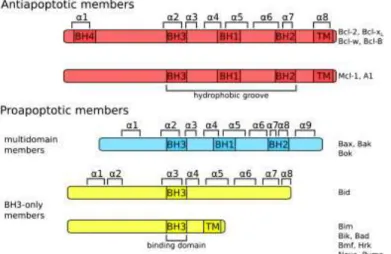
In 1985, the Bcl-2 (B-cell leukemia/lymphoma-2) protein was identified as an anti-apoptotic protein (Tsujimoto et al., 1985). Other proteins of the family were next identified based on the presence of Bcl-2 homology domains (BH1, BH2, BH3, and BH4). The proteins of this family are classified by the number of domains they contain, every member containing at least one of these domains. This structural classification reflects different functions (see below). It should be noted that several proteins that have a BH3 domain are not members of the Bcl-2 family, such as the autophagy regulator Beclin-1.
This family is divided in two functional groups, anti-apoptotic proteins and pro-apoptotic proteins. Pro-pro-apoptotic proteins are subclassified as multidomain proteins and BH3-only proteins (Aouacheria et al., 2005; Er et al., 2006).
The anti-apoptotic proteins Bcl-2, Bcl-xL, Bcl-W, Bcl-B, Mcl-1 and A1 are
characterized by the presence of a transmembrane domain (TM) localized at the
C-terminal end of the proteins. Bcl-2, Bcl-xL, Bcl-W, Bcl-B present 4 BH domains (BH1,
BH2, BH3 and BH4) whereas Mcl-1 and A1 do not have a BH4 domain (Er et al.,
2006). The domains BH1, BH3 and BH4 present in Bcl-2 and Bcl-xL are required for
the anti-apoptotic function of the proteins (Huang et al., 1998; Shimizu et al., 2000). The pro-apoptotic multidomain proteins include the members Bax, Bak and Bok/Mtd and have a similarity in the sequence of the three homology domains BH1, BH2 and BH3. The presence of the BH3 domain in these proteins has been shown essential to their killing activity. This domain binds with the hydrophobic pocket of other proteins (Suzuki et al., 2000; Er et al., 2006). These proteins also have a
C-9
terminal hydrophobic helix, but it is still unclear if this helix is a genuine transmembrane domain.
The BH3 only proteins Bid, Bad, Puma, Bmf, Noxa Bim, Bik, Blk, Hrk/DP5, Bnip3 and Nix share only the BH3 domain. In this group, Bid is the only protein that does not present a transmembrane domain. The BH3 only proteins can promote apoptosis by activating pro-apoptotic Bcl-2 members or inhibiting anti-apoptotic Bcl-2 members, depending on the proteins involved. This behavior suggests that these proteins act like sensors and that the multidomain Bcl-2 pro-apototic proteins (Bax and Bak) are the executioners of those cell death signals. When BH3 only proteins are absent or inhibited in a cell, the anti-apoptotic Bcl-2 proteins block the action of the pro-apoptotic members (Antonsson, 2001; Er et al., 2006; Gallenne et al., 2009) (Figure 3).
Figure 3. The Protein Bcl-2 family: The three groups of Bcl-2 protein family are defined by the
homologous structures, functions and the presence of BH domains. In this figure are represented the transmembrane domain (TM) and the helix (α), that constitute these proteins (Renault and Manon, 2011).
Anti-apoptotic proteins prevent the release of apoptogenic molecules from mitochondria like cytochrome c, hindering caspase activation, while pro-apoptotic Bcl-2 proteins favor this release. Therefore the relative protein concentrations of Bcl-2 family members can determine the cell response to the apoptotic stimuli (Antonsson, 2001; Schlesinger et al., 1997). These proteins can be detected in various locations, besides the outer mitochondrial membrane (OMM), such as the endoplasmic reticulum, the cytosol and microtubules. The regulation of this localization in different subcellular compartments can be accomplished, namely, by the formation of heterodimers, phosphorylation, and proteolysis (Sharpe et al., 2003).
10
The proteins of this family can regulate the permeability of the OMM, which is considered to be a major checkpoint of apoptosis. The molecular mechanism is still unclear, but it is generally considered that Bax and Bak suffer a conformational alteration that will lead to their membrane insertion, oligomerization and formation of a large channel permeable to small proteins, like cytochrome c. The control of OMM permeability by the Bcl-2 family members could also be related to the interaction of these proteins with pre-existing mitochondrial membrane pores or to the alteration of the membrane lipid order and the formation of lipidic pores, leading to the subsequent release of larger proteins, such as AIF. The presence of cytosolic Ca2+ can accelerate OMM permeabilization (Aouacheria et al., 2005; Er et al., 2006; Gallenne et al., 2009; Silva et al., 2011;). The phosphorylation of Bcl-2 family members can lead to a loss of function decreasing their binding to BH3 only protein members (Basu et al., 2006).
1.2. The pro-apoptotic Bax (Bcl-2 associated X) protein
Bax promotes cell death, and exists predominantly in the cytosol, as a monomer, before the induction of apoptosis by a stimulus. When cell death is induced, conformationnal changes lead to its translocation to mitochondria, and insertion in the OMM (Hsu et al., 1997). The insertion of Bax in mitochondria is associated to its activation and the formation of pores in the OMM conveying in apoptosis (Hsu et al., 1997; Goping et al., 1998; reviewed by Renault and Manon, 2011)
1.2.1. Bax structure and function
The structure of soluble Bax (reflecting its cytosolic conformation) has been determined by NMR. It is constituted by nine α helices connected by loops; six hydrophilic α helices and the hydrophobic α9, are clustered around two amphipathic α helices in a central position (α5 and α6). The BH3 domain is enveloped by helix α2, and the loop between the α2 and α3 helices presents rigidity. Bax has three flexible regions the N-terminal tail (15 residues), the loop between α1 and α2 helices (18 residues) and the loop between helices α8 and α9 (5 residues) (Suzuki et al., 2000; Petros et al., 2004).
Helices α2, α3 and α4 form a hydrophobic grove. The helices α7 and α8 form the BH2 domain, and the gap between helices α4 and α5 is filled by BH1 domain. The
C-11
terminal α helix is mostly hydrophobic. Hydrophilic residues Thr172, Thr174, Thr182 and
Thr186, are exposed to the solvent, but Ser184, is oriented towards the hydrophobic
pocket (Suzuki et al., 2000; Petros et al., 2004) (Figure 4).
The structure of Bax presents a strong similarity with Bcl-xL, in contrast with the
relatively low degree of sequence similarity (Petros et al., 2004). The Bax C-Terminal α
helix corresponds to the carboxy-terminal transmembrane domain of Bcl-xL and Bcl-2
(Petros et al., 2004). While this α-helix of Bcl-xL and Bcl-2 acts as a membrane anchor
and a membrane-targeting signal (Janiak et al., 1994; Priault et al., 2003b), this role is less clear for the C-terminal α-helix of Bax: indeed, Bax can be located to the OMM even when the C-terminal α-helix is absent or replaced by a hydrophilic sequence (Priault et al., 2003b). However, the C-Terminal domain of Bax could participate to the formation of pores on the OMM, since it is able, by itself, to disrupt the barrier properties of membranes (Martinez-Senac et al., 2001). This helix may also play an important role in the localization of Bax, by defining the orientation and packing of the helices α2, α3 and α4 (Suzuki et al., 2000).
Figure 4 – Structure of Bax monomer determined by RMN, where the helices constituents of bax are observed, being the helix α9 represented at light green (Suzuki et al., 2000).
12
The binding of the C-terminus to the hydrophobic pocket containing the BH3 domain prevents the exposure of the BH3 prior apoptosis, and consequently prevents the dimerization and oligomerization events leading to the formation of a pore. The interaction of Bax BH3 domain with other Bcl-2 family proteins is very unlikely to happen, because of the binding existing between with C-terminal helix and its BH3 pocket, that prevents the exposure of the BH3 domain prior apoptosis (Suzuki et al., 2000).
The N-terminal of Bax, sometimes termed ART (Apoptotic Regulation of Targeting) is constituted by 20 mobile residues of which the deletion activates Bax. The connection between ART and the α1 helix support major conformational changes during Bax activation, since an antibody directed at this domain (6A7), is able to discriminate between the inactive and active conformations of Bax (Hsu and Youle, 1997).
The α1 helix, that presents some similarity to mitochondrial targeting sequences, might have an important regulatory function by allowing the interaction of Bax with mitochondrial receptors, such as Tom22 (Priault et al., 2003b, Bellot et al., 2007, Renault et al., 2012).
1.2.2. Bax signalling pathways
Bax activation is essential to its action on the permeabilization of OMM. After activation, and its binding to the OMM, the protein forms oligomers (Zhang et al., 2010). This oligomerization leads to the permeabilization of the OMM (Antonsson et
al., 2001). Bax activation promotes apoptosis following exposure of the N-terminal,
mitochondrial translocation, oligomerization, and focal clustering on the mitochondrial membrane (Sharpe et al., 2003).
Apoptotic stimuli can induce several conformational changes in Bax protein, which include interaction with BH3-only proteins such as Bim and Bid, exposure to chemical agents such as H2O2, low pH, mild heat treatment, proteolytic cleavage, and post-translational modification such as phosphorylation (Khaled et al., 1999; Westphal
et al., 2011). It has been shown that conformational changes in the N- and C-terminal,
BH3 domain and hydrophobic groove of Bax protein are related to its insertion on OMM (Suzuki et al., 2000; Priault et al., 2003b). Independently of the stimuli, the inactive conformation of Bax changes, exposing its inner hydrophobic surfaces and causing Bax activation (Gavathiotis et al., 2010).
13
When Bax activation occurs by the binding of BH3-only proteins to the α1/α6 trigger site (rear pocket) or to the hydrophobic groove, the binding leads to the opening of the α1-α2 loop, and its further displacement, that is followed by allosteric changes of the Bax BH3 domain and the helix α9. These conformational changes expose the N-terminal epitope (6A7), the BH3 domain (α2) and the helix α9. Following these conformational changes, Bax will be translocated to the OMM and will oligmerize, leading to OMM permeabilization, and subsequent release of cytochrome c (Hsu et al, 1997; Hsu and Youle, 1997; Lucken-Ardjomande and Martinou, 2005; Gavathiotis et
al, 2008; Westphal et al, 2011). It is however still unclear in which order these changes
take place (Westphal et al, 2011) (Figure 5).
The exposure of BH3 domain is essential to Bax oligomerization, since the exposure of the helix α9 facilitates Bax translocation and insertion in the OMM under an active conformation. Bax activation can also occur by auto-activating interactions between its own BH3 domain and trigger site (Gavathiotis et al, 2010; Westphal et al, 2011).
Bax oligomerization can occur by two different interfaces, one by the interface between front surfaces of neighboring molecules, such as interaction between α6 helices, or by interaction of the rear surfaces. The formations of these interfaces are dependent of one another. The oligomers can create pores with an undefined size by disrupting the lipid bilayer (Zhang et al., 2010) (Figure 6). Based on its conductance, it has been estimated that 10 Bax monomers are needed to form the pore (Martinez-Caballero et al., 2009).
Figure 5– Model of Bax activation by
the family member BH3-only Bid, Bax in Blue is away from mitochondria by anti-apoptotic proteins Bcl-2 and Bcl-xL (red), after the apoptotic stimuli BH3-only proteins trap anti-apoptotic proteins, and the protein Bid helps the addressing and insertion of Bax to
mitochondria membrane and its
posterior oligmerization (adapted from Renault and Manon, 2011).
14
The outer mitochondrial membrane translocator (TOM) complex may play an important role in the Bax insertion into the mitochondria, acting as a receptor (Renault and Manon, 2011). However, mitochondrial Bax can also act as a receptor for cytosolic Bax (Bellot et al., 2007).
The interaction of other members of the Bcl-2 family, like Bcl-xL, with Bax can prevent the Bax conformational rearrangements, and therefore prevent its activation (Lucken-Ardjomande and Martinou, 2005; Jourdain and Martinou, 2009).
1.3. Mechanisms involved on Bax regulation
1.3.1. Bax regulation by interaction with Bcl-2 family members
Bax activity can be regulated by its interaction with other proteins from the Bcl-2
family. The anti-apoptotic proteins like Bcl-2 and Bcl-xL are well known as Bax
inhibitors. The direct interaction of Bcl-2 and Bcl-xL leads to the inhibition of Bax activity. In another hand, the heterodimers formed by this interaction (Bax/Bcl-2 or
Bax/Bcl-xL) can be destabilized by BH3-only proteins (Bad, tBid), by competing with
Bax for the binding with these proteins (Billen et al., 2008; Renault and Manon, 2011; Gautier et al., 2011). In 2011, Gautier and colleagues suggested that the inhibition of
the direct interaction between Bcl-xL and Bax can lead to apoptosis dependent on Bax,
without the presence of efficient BH3 activators, suggesting that the release of Bax from its interaction with Bcl-xL is sufficient to promote Bax activation. The presence of molecules such ABT-737 or Terphenyl-K, that mimic BH3-only proteins, can induce apoptosis in these cases.
Figure 6 – Bax oligomerization model posterior Bax conformational changes, beginning in the
15
Bax interaction with BH3-only proteins like tBid, Bim and PUMA can lead to its activation, and therefore promote apoptosis. Bid is a cytosolic protein, that is activated by the cleavage of is amino portion by active caspase 8 (Lou et al., 1998). Activated Bid (tBid), interacts with Bax, inducing Bax N-terminal exposure and its oligomerization, mitochondrial permeability and subsequent cell death (Desagher et al., 1999; Moreau et
al., 2003). This activation can require the direct interaction with BH3-only protein or
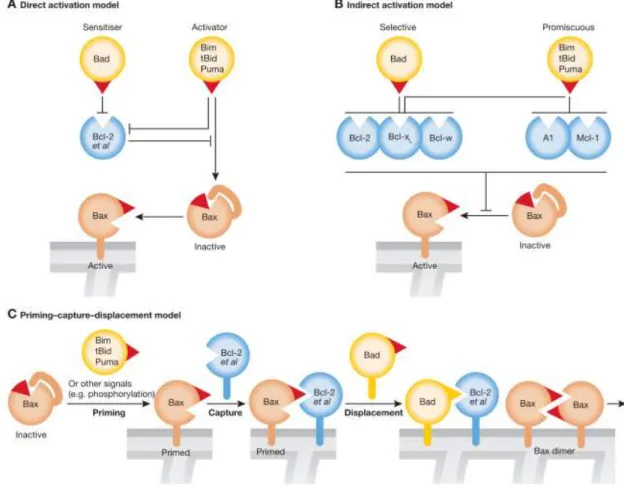
not. Bax activation can be achieved by three paths: direct activation, indirect activation and priming–capture–displacement (Zhang et al., 2010; Strasser et al., 2011).
In the model of direct activation, BH3-only proteins bind directly to the BH3 domain of Bax, leading to its recruitment into the OMM.
In the indirect model, BH3-only proteins bind to the pro-survival proteins, preventing the already activated Bax to be neutralized by pro-survival proteins. This permits its oligomerization, so apoptosis can proceed when all pro-survival proteins are neutralized by the BH3-only proteins.
In the priming–capture–displacement model, Bax, that becomes active by direct activation by BH3-only proteins binding or by other signals, is captured by pro-survival relatives, these proteins remain bound to Bax until they are displaced by BH3-only proteins as in the indirect activation model (Adams and Cory, 2007; Strasser et al., 2011) (Figure 7).
16
Figure 7 – Models for Bax activation triggered by interaction with BH3-only protein, A- representation of
the direct activation; B - indirect activation C- priming–capture–displacement, in which the red triangle represents the BH3 domain of Bax and the BH3-only proteins (Strasser et al., 2011).
The propagation of the death signal can be also executed by the auto-activation of Bax, by the interaction between its own BH3 domain and trigger site as discussed above (Gavathiotis et al., 2010). tBid can also indirectly help the formation of Bax-dependent lipidic pores by rearranging lipids, favoring Bax insertion into the OMM (Kuwana et al., 2002).
BH3-only proteins PUMA and Bim can regulate the activation of Bax by inducing structural changes in the α1/α2 loop of Bax (Gallenne et al., 2009; Gavathiotis et al., 2010; Gautier et al., 2011). BH3-only proteins like Bad, Bik and Noxa lack the capability to activate Bax protein and only bind to anti-apoptotic proteins (Moreau et
al., 2003).
The exact mechanism underlying Bax inhibition by Bcl-xL and Bcl-2 is still
debated. These studies came to raise the question if the interaction between the
heterodimers Bax/Bcl-2 and Bax/Bcl-xL would prevent the formation of homodimers of
retro-17
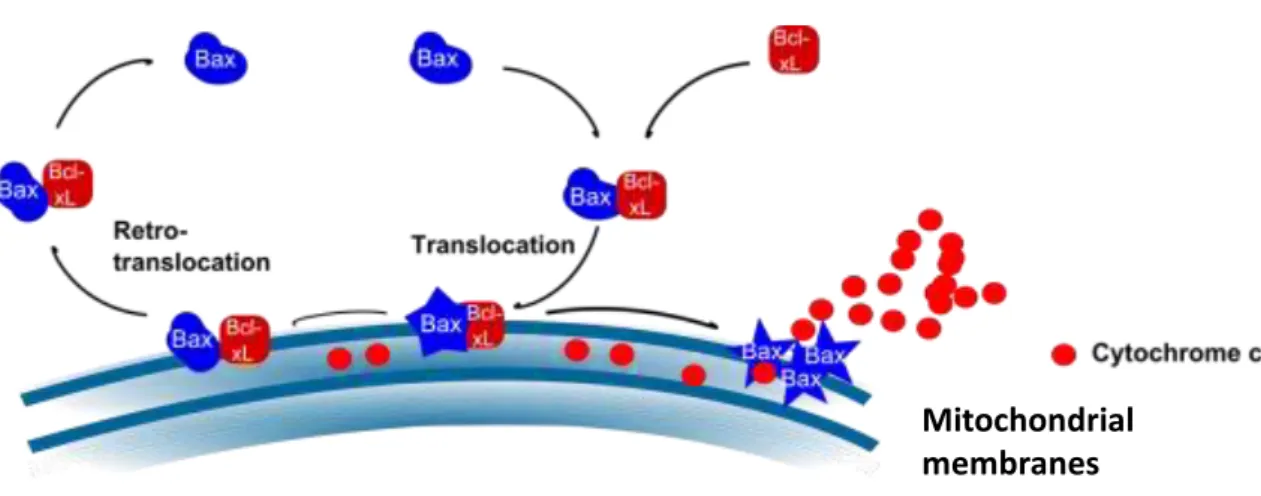
translocation of Bax mediated by Bcl-xL. It is proposed that the protein Bcl-xL plays a
role in the retro-translocation of Bax from mitochondria to the cytosol. Conversely, it was also observed that the presence of Bcl-xL increases the localization of Bax to
mitochondria (Renault, PhD thesis, 2010). This suggests that Bcl-xL would regulate the
"cycling" of Bax between mitochondria and the cytosol.
In 2013 Schellenberg and colleagues proposed that the interaction between Bax
and Bcl-xL occurs in the helix α9 (C-terminal) of Bax and that this interaction promotes
the translocation of Bax to the outer mitochondrial membrane (Figure 8).
1.3.2. Bax regulation by phosphorylation
The functions of Bcl-2 family proteins can also be regulated by post-translational modifications like phosphorylation. Bax activity can be regulated by the phosphorylation of some of its residues, with an impact on its translocation and activation (Er et al., 2006; Arokium et al., 2007). Ser184 phosphorylation prevents Bax translocation to mitochondria. This serine is present in the middle of α9 helix, oriented towards the core of the protein. The substitution of Ser184 by Asp, adds a negative charge, that prevents its insertion into the OMM. This might also be favorable to the heterodimerization with anti-apoptotic Bcl-2 proteins (Gardai et al., 2004).
Figure 8. Role of Bcl-xL in the localization of Bax in cells: A representative model of the interaction of Bax with Bcl-xL and its possible outcome. The interaction between inactive Bax sequesters Bax to the mitochondrial membrane, and permits conformational changes in Bax to its activation. When this interaction stops active Bax induces the liberation of cytochrome c to cytosol (Renault, PhD thesis. 2010).
Mitochondrial membranes
18
Phosphorylation of Ser163 can regulate Bax activity, and promotes Bax dependent apoptosis (Linseman et al., 2004). Substitution of Ser163 to Asp did not increase, by itself, Bax activity. But when this mutation was introduced in the protein already carrying the substitutions Pro168 to Ala and Ser60 to Ala, the resulting triple mutant is highly active. This suggests that the addition of a negative charge on Ser163 can help the movement of Bax N-terminal, in the presence of other conformational changes (Linseman et al., 2004; Arokium et al., 2007) (Figure 9).
In vivo, these phosphorylations can be performed by the Glycogen Synthase Kinase (GSK3 β), Protein kinases PKA, Akt/PKB, PKC and Jun N-terminal kinase (JNK) and p38 kinase.
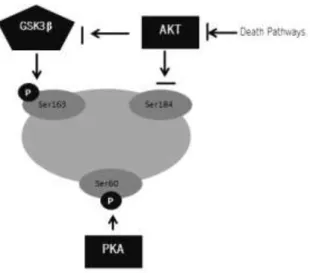
GSK3 β can phosphorylate Ser163 inducing Bax activation. GSK3 β can be phosphorylated and inactivated by Akt/PKB (Linseman et al., 2004). Akt/PKB can inhibit Bax activation by phosphorylating Ser184, which prevents Bax translocation. Akt also can inhibit Bax activation by indirectly phosphorylating GSK3β thus preventing phosphorylation on Ser163 (Linseman et al., 2004; Gardai et al., 2004). PKC isoforms can also regulate Bax activity by increasing Bax content and stability (Silva et
al., 2010). However, PKCζ was shown to phosphorylate Ser184, like Akt.
Other residues, like Ser60, might also affect Bax activity when phosphorylated. Although it has not directly demonstrated, Ser60 is a target for PKA. This residue is closed to a salt bridge formed by Asp33 and Lys64, which is involved in the
Figure 9. Primary structures of human Bax. Constitued by 192 aminoacids, organized in nine
helices Where the potentially phophorylatable serines are represented (Renault and Manon, 2011). .
19
maintenance of α1/α2 loop. The negative charge brought by Ser60 phosphorylation might destabilize this bridge. Indeed, the substitution of Ser60 by Asp triggered Bax activation. It has been hypothesized that the phosphorylation of Ser60 by PKA might require the dephosphorylation of Ser184 and the phosphorylation of Ser163, that induce conformational changes that allow the accessibility of Ser 60 to PKA (Arokium et al., 2007) (Figure 10).
Xin and Deng, in 2006, proposed that nicotine can inactivate Bax through Ser184 phosphorylation and that Protein Phosphatase 2A can directly dephosphorylate and activate Bax. This dephosphorylation results in the exposure of the 6A7 epitope in Bax, facilitating its translocation to mitochondria, an disrupts Bcl-2/Bax binding, preventing Bcl-2 to inhibit Bax activation.
JNK and p38 kinase can phosphorylate Bax when activated by exposure to
apoptosis-inducing agents such as staurosporine, H2O2, etoposide, and UV. These
proline-directed Ser/Thr protein kinases phosphorylate Thr167, leading to Bax activation by the exposure of its N-terminus and possibly its C-terminal transmembrane domain (Kim et al., 2006). It should be noted that the phosphorylation of Ser163 by GSK3β may require the previous phosphorylation of Thr167.
Phosphorylation of other Bcl-2 family members can indirectly affect Bax
activation, like Bcl-xL phosphorylation by PKC isoforms (Silva et al., 2012).
Figure 10 - Hypothesis of regulation of Bax by phosphorylation. Phosphorylation
of Ser163 by GSK3 β and phosphorylation of Ser60 by PKA. (adapted from Arokium et al., 2007).
20
1.3.3. Bax regulation by sphingolipids
Bax interaction with lipids can induce the reorganization of the bilayer membrane structure and lead to the formation of lipidic pores (Basanez et al., 1999; Sharpe et al., 2003). This pore formation reveals to be more efficient in lipids with large head groups that induce curvature to membranes (Basanez et al., 2002; Billen et al., 2008).
Ceramide can form channels in the OMM that are permeable to proteins. This sphingolipid is found in membranes as is composed by an N-acylated sphingosine. Mitochondria contain enzymes responsible for ceramide synthesis and hydrolysis, such as ceramide synthase and ceramidase (Siskind, 2005). Both outer and inner mitochondrial membranes present acylated exogenous sphingosine, therefore are capable to generate ceramide. Mitochondria-associated membranes also contain ceramide synthases (Bionda et al., 2004). The levels of ceramide in mitochondria increase prior OMM permeabilization, thereby this permeabilization can be regulated by mitochondrial ceramide levels (Siskind, 2005). Apoptosis induced by CD95, TNFα (Tumor necrosis factor α), and UV radiation have been shown to occur via an increase in mitochondrial ceramide levels (Siskind, 2005).
The ceramide channels formed in the OMM are eliminated when ceramide is removed. These channels are not specific to cytochrome c, they also allow the release of low molecular weight proteins from mitochondria, such other pro-apoptotic proteins (Siskind, 2005).
Sphingolipids metabolism can regulate Bax activation. Ceramide can lead to Bax activation indirectly via PP2A-mediated Ser184 dephosphorylation (Xin and Deng, 2006) or, with Ser184 phosphorylated, by outer mitochondrial membrane reorganization. Ceramide forms a platform that allows Bax insertion, leading to its oligmerization (Lee et al., 2011; Chipuk et al., 2012).
Cardiolipin is essentially to the formation of Bax membrane pores, but its regulation is performed indirectly. Cardiolipin participates in the activation of Bid, that subsequently activates Bax. If cardiolipin is present in the OMM it will increase outer membrane sensitivity to Bax (Kuwana et al., 2002).
21
1.4. Yeast as a model system
Yeast is a unicellular eukaryotic organism that can be used as a model system to study the molecular mechanisms underlying mitochondria-dependent apoptosis. The actions of mammalian Bcl-2 family members on mitochondria are conserved when these proteins are expressed in yeast. Yeast model is therefore an important tool to study Bax regulation and find new modulators of its bioactivity (Pereira et al., 2008; Silva et
al., 2011).
Yeast can be easily manipulated and can be used to study mitochondrial respiration, and allows cell cycle control and genetic tractability. In yeast, in contrast with mammalian cells, most apoptotic regulators are encoded by single copy genes (Clapp et al., 2012). Yeast presents apoptotic regulators that are homologs to the mammalian caspases (YCA1), a BH3-containing protein (yBH3p), an apoptosis inducing factor (AIF), an OMI serine protease (NMA111), and an Endonuclease G (NUC1) (Clapp et al, 2012). However yeast does not have homologs of mammalian Bcl-2 family members (Silva et al., 2011).
Yeast will trigger apoptosis in response osmolarity alteration, pH variation, the over expression of caspases, oxidative stress and acid acetic (Clapp et al., 2012). During apoptosis the mitochondrial structure can suffer alterations like hyperpolarization and depolarization, production of reactive oxygen species (ROS), release of cytochrome c, yeast apoptosis inducing factor (Aif1p), and yeast endonuclease G (Nuc1p). Mitochondrial swelling, fragmentation and degradation can also be observed (Pereira et
al., 2008).
To study apoptosis it is possible to use "humanized" yeast cells in which mammalian apoptotic regulators, like Bcl-2 family proteins, are expressed. When these proteins are expressed in yeast they maintain many molecular and biochemical functions, conserving the effects that these proteins have in apoptosis. These yeast cells are very important in the pursuit of knowledge concerning apoptosis mammalian regulators (Manon et al., 1997; Silva et al., 2011).
Like in mammalian cells, the heterologous expression of full-length Bax in yeast does not lead to its spontaneous interaction with mitochondria. Further Bax activation, through conformational changes, is required to its transition to the OMM. The deletion of either N- and C-terminal, increases Bax translocation and causes a stronger interaction with mitochondria (Cartron et al., 2003; Arokium et al., 2004). Also,
22
substitutions of residues located in critical domains of the protein, such as Pro13 (ART), Asp33 (helix α1), Glu69 (BH3 domain), Pro168 (α8-α9 loop) or Thr174 (α9 helix) promote Bax translocation and activation (Arokium et al, 2004, 2007).
The formation of a mitochondrial apoptosis-induced channel (MAC), similar to that observed in mammalian cells, is involved in OMM permeabilization after Bax is activated in yeast. This channel allows proteins like cytochrome c to diffuse to the OMM. VDAC or TOM do not have any role in the formation of MAC, this channel being formed only by Bax (Pavlov et al., 2001).
It was shown that tBid can stimulate cytochrome c release, by facilitating Bax oligomerization. Bax can also activate another cell death pathway, that involves mitochondrial protein Uth1p (Priault et al., 2003b; Pereira et al., 2008).
Some results show that the lack of cytochrome c release does not affect yeast cell death once Bax is activated, indicating that release of cytochrome c from mitochondria is not essential for Bax mediated cell death in yeast, suggesting that, once OMM permeabilization has occurred, the following death is not apoptotic (Manon et al., 1997; Roucou et al., 2000; Priault et al., 2003b) (Figure 11).
Figure 11 - Bax inducted outer mitochondrial membrane permeabilization. Formation of MAC,
23
Bax activity in yeast can be regulated by PKC, the expression of PKCα (PKC isoform α) can increase the translocation and the OMM insertion of an active variant of Bax. PKCα enhances its cytotoxic effects like mitochondrial fragmentation, loss of viability, cytochrome c release and ROS production, but does not phosphorylate Bax (Silva et al., 2010). The authors propose that other subfamilies of PKC might regulate Bax in different ways (Saraiva et al., 2006).
Substitutions of phosphorylatable residues of Bax Ser184, Ser163 and Ser60 have been done in yeast (see above). Like in mammalian cells, the phosphorylation of Ser184 was found to prevent Bax translocation, while the phosphorylation of Ser60 and Ser163
was found to favor Bax translocation (Arokium et al., 2007; Renault,PhD thesis, 2010).
The co-expression of Bax with other Bcl-2 family members has also been done in
yeast. Both Bcl-2 and Bcl-xL prevent the activation of Bax and subsequent death
(Manon et al., 1997; Priault et al., 1999).
Priault et al. (2003), demonstrated that in yeast Bid and tc-Bid (truncated form of Bid) were unable to induce the conformational change of Bax that leads to its activation. But when Bax was already activated tc-Bid increases its effect, suggesting that tc-Bid plays a part in the oligomerization process of Bax (Gonzalvez et al., 2005).
The yeast model also provided new information about BH3-only protein Puma. Indeed, Puma is able to activate Bax when both proteins are co-expressed in yeast (Gallenne et al., 2009).
25
27
This work aimed to understand the molecular mechanisms underlying Bax regulation by phosphorylation and its consequences in the different steps of Bax activation. A second objective is to assess the interaction of Bax protein and the
anti-apoptotic protein Bcl-xL and the outcome that Bax phosphorylation can provoke on
this interaction, affecting the process of apoptosis.
In addition to its localization to mitochondria, and its ability to be inserted in the OMM, Bax activation will be monitored by its capacity to promote the release of cytochrome c.
In this study, we will use humanized yeast cells, expressing human Bcl-2 family proteins co-expressed with protein kinases of interest.
The kinase AKT is already known to target Bax. The plasmids expressing AKT under the control of the regulatable promoter tet-off are already available. Wild-type, constitutively active, and constitutively inactive versions of this kinases will be co-expressed in yeast with wild-type Bax, and with different Bax mutants representing different steps of Bax activation (movement of the N-terminal end, of helix α1, of helix α9), to test if these kinases are able to modulate these conformational changes.
29
31
3.1. Yeast strains, plasmids and growth conditions
The wild-type haploid Sacharomyces cerevisiae strain W303-1B (mat a, ade1,
his3, leu2, trp1, ura3) was used in this study. The cDNA encoding human Bax was
cloned in the plasmid pYES3/CT and the cDNA encoding Bcl-xL was cloned in the plasmid pLM. Both genes are placed under the control of a GAL1 promoter that allows the inducible expression of the proteins following the addition of galactose. The cDNA encoding the kinase AKT was cloned in the plasmid pCM189, under the control of the
tet-off promoter that is repressed by doxycycline. The plasmids carry yeast selectable
markers, namely TRP1 for pYES3/CT, LEU2 for pLM, and URA3 for pCM189.
For the transformation of the W303-1B cells, the yeast cells were maintained in 10 mL of a YPD complete medium at a OD550 of 0.4 during 2 hours of incubation at 28ºC on a mechanical shaker. The cells were collected by centrifugation, washed with water, and resuspended and washed with LiAc-TE buffer (Lithium acetate 0.1 M, Tris-HCL 10 mM, EDTA (Ethylenediaminetetraacetic acid) 1 mM, pH 8.0), in a final volume of 250 µl. 10 µl of DNA carrier (Salmon sperm 10 mg/mL, Invitrogen) and 100 ng of the plasmid of interest were added to 200µl of the cells and incubated at 4ºC for 10 minutes. 600 µl of a solution of LiAc-TE/PEG (Lithium acetate 0.1 M, Tris-HCL 10mM, EDTA (Ethylenediaminetetraacetic acid) 1 mM, PEG (Polyethylene glycol) 50% w/v, pH 8.0), were then added and the suspension was incubated for 30 minutes at 28ºC, then 15 minutes at 42ºC and finally 10 minutes at 4ºC. The cells were collected by centrifugation and resuspended in 100 µl of sterile water. After the cells were plated on selective YNB medium with the appropriate antibiotic (doxycyclin is added to repress the expression of AKT) and lacking the appropriate selective markers for selection, and grown at 28°C for 3-4 days. The clones were chosen and put in culture in a liquid glucose YNB (Yeast Nitrogen Base) medium with the appropriate markers and antibiotics.
The yeast strains were stored at -80 ° C in their culture medium containing 50% glycerol.
Strains transformed with plasmid were grown in a YNB medium at pH 5.5 constituted by Yeast Nitrogen Base without aminoacids and ammonium sulfate 0.175%
(1.75 g/L) (Becton-Dickinson), ammonium sulfate ((NH4)2SO4) 0.5% (5 g/L),
32
following aminoacids A, R, N, D, C, E, Q, G, I, M, F, P, S, T, Y, V) 0.2% (2 g/L), glucose or lactate 2% (20 g/L), and the auxotrophic markers (Adenine, Uracile, H, L, K, W) 100 mg/L with the exception of the selectable markers already carried by the plasmids. To solid mediums is added agar 2.5% (25g/L).
The growth of the cells is accomplished in Erlenmeyer flasks containing a 5:1 ratio of air to liquid phase, and incubation on a mechanical shaker at 28ºC. The optical density is measured at 550 nm.
Yeast cells were first grown in an YNB medium with glucose as a source of carbon, inducing a rapid growth of the cells, in the presence of doxycycline 5 µg/ml that represses the expression of the kinase AKT. The cells were then transferred to a medium with lactate as the carbon source to allow the respiratory growth and an optimal differentiation of mitochondria. When needed, the expression of AKT was induced by washing cells 3 times and resuspended them in the same medium without doxycyclin. The expression of proteins controlled by the promoter GAL1 is done by adding 0.8% galactose to the medium. The cells were cultured for 6 to 14 hours at 28ºC.
3.2. Preparation of protein extracts
Mitochondria isolation
Cells were grown in 1600 ml of lactate medium, up to an OD at 550 nm between 3 and 6. The first steps aimed at converting cells to spheroplasts. After being washed with water, cells were treated (0.5 M β Mercaptoethanol, 0.1 M Tris, pH 9.3) to reduce the disulfide bonds of the cell wall. The pellet was incubated for 20 minutes with 10 ml of buffer per gram of dry weight (0.5 mg dry weight is the amount in one liter of culture 1 OD550nm). Cells were then washed twice with Tris/KCl buffer (10 mM Tris, 0.5 M KCl, pH 7). To digest the cell wall , the cells were subjected to a 30 minutes incubation
in 10 ml of digestion buffer (Sorbitol 1.35 M, Citric Acid 25 mM, Na2HPO4 25 mM,
EGTA 1 mM, pH 5.8) for mg of dry weight containing 1 mg/ml of Zymolyaze 20T (from Arhrobacter luteus). After 30 minutres, the cells were observed under a microscope to verify if the digestion took place. If the cells were still not completely digested, 10 to 15 minutes of incubation were added.
33
Spheroplats are collected by centrifugation (10 minutes, 5000 x g) and washed twice (0.75 M Sorbitol, 0.4 M Mannitol, 10 mM Tris-maleate, BSA 0.1% w/v, pH 6.8) to remove zymolyase.
Spheroplasts were resuspended in a buffer that is hypo-osmotic for cells and iso-osmotic for mitochondria (0.6 M Mannitol, 0.2% BSA w/v, 10 mM Tris-maleate, 2mM EGTA, pH 6.8). Spheroplats are homogeneized with a Waring Blendor (3 times, 5 seconds). The homogenate is centrifuged at 900 x g for 10 min to remove cellular fragments, nuclei, etc... The supernatant was centrifuged at 17000 x g for 10 min to collect the mitochondria-enriched fraction. Mitochondrial fraction was resuspended in the same buffer without BSA (recuperation buffer), gently homogeneized with a Teflon Potter, and the previous centrifugation steps were repeated to increase its purity.
Mitochondria were resuspended in recuperation buffer and preserved at -80 ºC. The concentration of proteins was determined by the biuret method.
The Biuret method
The concentration of protein was determined by the comparison of absorbance
obtained at 540 nm from the samples to evaluate with known BSA (Bovine Serum Albumin) concentrations (BSA content in the samples used as standard from 0 to 0.5 mg). 25 µl of sample or the necessary quantity of a pre-prepared BSA solution with known concentration were added to water completing the volume of 100 µl, then 200 µl of Cholate 4% were added to the samples. After 10 minutes of reaction is added 2.7 ml
of NaOH 10% and 0.3 ml of CuSO4 1%. After 20 minutes of reaction the absorbance
was read at 540 nm.
Total extracts preparation
0.5 ml of culture were added with 50 µL of a lysis solution (NaOH 2 M, β- Mercaptoethanol 3.5%) and were incubated for at least 15 minutes at 4 °C. Proteins were then precipitated with 50 µL of TCA 3 M. The pellet of proteins was washed twice with acetone, dried and resuspended in a Laemmli buffer for further electrophoresis.
34
Preparation of mitochondrial proteins for SDS-PAGE
1 mg of mitochondrial or cellular proteins were suspended in 0.5 mL of recuperation buffer, were precipitated through a 15 minutes-incubation at 4ºC after the addiction of 50 µl of 3 M Trichloroacetic acid (TCA). After a 5-minutes 10000 x g centrifugation, the pellet was washed 2 times with acetone. The proteins were solubilized in 30 µl of a SDS 2%, NaOH 0.1 N mixture, batch-sonicated, and added with 15 µl of Laemmli buffer 3X (150 mM Tris/HCl, pH 8.6, 6% SDS, 6% β-mercaptoethanol, 60% glycerol and 0,002% bromophenol blue).
Mitochondrial insertion of proteins
1 mg of mitochondria was suspended in 1 mL of recuperation buffer (Mannitol 0.6 M, EGTA 2 mM, Tris/Maleate 10 mM, pH 6.8) and subjected to three treatments: one of the samples is added with 100 µl of recuperation buffer as a control, to other sample 100 µl of 1M Na2CO3 pH 10 to remove non-inserted protein, and to the last sample 100 µl of 1% Triton Tx100 to remove inserted proteins. The samples were incubated for 10 minutes in ice, and centrifuged for 15 minutes at 100,000 x g at 4ºC. The pellet was resuspended with 100 µl of water and precipitated with TCA, washed with acetone and solubilized in Laemmli buffer.
Co-immunoprecipitation
Co-immunoprecipitation (CoIP) is a technique used to identify protein-protein interactions. This technique is based on the immunoprecipitation of a protein with specific antibodies, and the detection of proteins bound to the target protein.
20 mL of culture at a OD of 3 to 5 (at 550 mn), were collected by centrifugation and cells were resuspended in 1,75 mL of Recuperation buffer with Anti-proteases (Complete Protease inhibitor cocktail tablets, EDTA free, 1 tablet for 50 mL of recuperation buffer). The cells were then broken by vortexing with glass beads for 3 minutes. The lysate was then centrifuged at 900 x g for 5 minutes to remove the remaining beads cell debris. To the supernatant was then added 175 µl of 10x IP Buffer
35
(Sigma Protein G Immunoprecipitation Kit), and was incubated in the cold room for 45 minutes under gentle mixing.
2 µl (~4.4 µg) of Bax 2D2 antibody are added and the immunoprecipitation is done at 4º C over night under gentle mixing. The complex formed by the antibody and the proteins was then precipitated by the addition of 50 µl per sample of agarose beads coupled to protein G, for 4 hours at 4º C, to form a complex with beads/antibody/proteins. The samples with the beads were then transferred to a column with a filter and washed 5 times with IP Lysis buffer 1x. After washing the Laemmli buffer 1x (glycerol 20%, SDS 2%, Tris-HCl 50 mM, β Mercaptoethanol 3%, Blue bromophenol 0.04%, pH 6.8) is added to the samples and incubated at 75ºC for 30 minutes to elute the proteins, by breaking the interaction between protein G, antibody and the proteins of interest. After the incubation, the samples were centrifuged at 10 000 x g for 1 minute, to recover the solublized proteins through the column filter, the beads were then washed again with 5 µl of Laemmli buffer 1x and centrifuged at 10 000 rpm for 1 minute.
The obtained samples are ready to be separated on SDS-PAGE.
3.3. Cytochrome Measurements
Assessment of cytochrome c content was measured by redox spectra of isolated mitochondria. Differential spectra of the reduced (sodium dithionite) minus oxidized (potassium ferricyanide) extracts were recorded in a double-beam spectrophotometer (Varian Cary 4000). The difference spectra were acquired between 500 and 650 nm. Cytochromes content was measured from the differences of absorbance at the peak (550nm, 561nm and 603nm for cytochromes c+c1, b and a+a3, respectively) minus the absorbance at the isobestic points (540nm, 575nm and 630nm, respectively). Cytochrome b is a membrane protein that is not released and served as an internal standard, to normalize the protein content in different samples (Figure 12).
Due to the drift caused by the high optical density of the sample, isobestic points do not always gave the same values and a corrective factor was introduced.
36
[Acytochrome c]corr.= (A550 −A540) – 2/7x δ [Acytochrome b]corr.= (A561 −A575)+ 2/5x δ
These values of absorbance can be converted to absolute cytochrome contents,
with a molar extinction coefficient of 18,000M-1 for both cytochrome c and cytochrome
b.
3.4. SDS polyacrylamide gel electrophoresis/Western blot
The desnaturating gel electrophoresis permits the separation of proteins as a function of their molecular mass. The samples were separated on 12.5% SDS-PAGE gels and transferred to PVDF membranes. The membranes were blocked with 3% milk or 1% BSA in PBS-Tween (PBS with 1% (v/v) Tween-20) or TBS-Tween (TBS with 1% (v/v) Tween-20) for 30 minutes at room temperature. Membranes were then incubated overnight at 4 °C with primary antibodies directed against human Bax (mouse monoclonal 2D2, 1:2000; Santa Cruz Biotechnology), yeast porin (mouse monoclonal,
1:50000; Invitrogen), human Bcl-xL (rabbit polyclonal, 1:2000; BD Transduction),
human AKT (rabbit polyclonal, 1:2000; Cell Signaling) Membranes were incubated for 45 minutes at room temperature with peroxidase-coupled secondary antibodies directed to the specified IgG of the primary antibody.
Figure 12. Spectrum redox of mitochondrial cytochrome. Representing the absorbance peaks and isobestic points used to calculate the release of cytochrome c (adapted from Renault, PhD thesis, 2010).
R el ea se d cy toc hr om e c
37
After washing the membranes 7 times with PBS-tween or TBS-tween, the membranes were revealed with a solution of ECL reactive (Enhanced ChemiLuminescece, PerkiElmer), that permits the detection of the peroxidase activity coupled to the secondary antibodies. The light emitted is recorded in a camera GeneSys system.
39