Repositório ISCTE-IUL
Deposited in Repositório ISCTE-IUL: 2019-04-01
Deposited version: Post-print
Peer-review status of attached file: Peer-reviewed
Citation for published item:
Bina, O., Mateus, S., Pereira, L. & Caffa, A. (2017). The future imagined: exploring fiction as a means of reflecting on today’s grand societal challenges and tomorrow’s options. Futures. 86, 166-184
Further information on publisher's website: 10.1016/j.futures.2016.05.009
Publisher's copyright statement:
This is the peer reviewed version of the following article: Bina, O., Mateus, S., Pereira, L. & Caffa, A. (2017). The future imagined: exploring fiction as a means of reflecting on today’s grand societal challenges and tomorrow’s options. Futures. 86, 166-184, which has been published in final form at https://dx.doi.org/10.1016/j.futures.2016.05.009. This article may be used for non-commercial purposes in accordance with the Publisher's Terms and Conditions for self-archiving.
Use policy
Creative Commons CC BY 4.0
The full-text may be used and/or reproduced, and given to third parties in any format or medium, without prior permission or charge, for personal research or study, educational, or not-for-profit purposes provided that:
• a full bibliographic reference is made to the original source • a link is made to the metadata record in the Repository • the full-text is not changed in any way
The full-text must not be sold in any format or medium without the formal permission of the copyright holders.
Serviços de Informação e Documentação, Instituto Universitário de Lisboa (ISCTE-IUL) Av. das Forças Armadas, Edifício II, 1649-026 Lisboa Portugal
The future imagined: exploring fiction as a means of
reflecting on today’s Grand Societal Challenges and
tomorrow’s options
Olivia Bina*, Sandra Mateus***, Lavinia Pereira**,
and Annalisa Caffa**
* Instituto de Ciências Sociais, Universidade de Lisboa; Geography and Resource Management, the Chinese University of Hong Kong
* Corresponding author: Olivia Bina - [email protected] ** Instituto de Ciências Sociais, Universidade de Lisboa *** Instituto Universitário de Lisboa, ISCTE-IUL, CIES, Lisboa, Portugal
Abstract
European science policy (so-called Horizon 2020) is guided by Grand Societal Challenges (GSCs) with the explicit aim of shaping the future. In this paper we propose an innovative approach to the analysis and critique of Europe's GSCs. The aim is to explore how
speculative and creative fiction offer ways of embodying, telling, imagining, and symbolising ‘futures’, that can provide alternative frames and understandings to enrich the grand
challenges of the 21st century, and the related rationale and agendas for ERA and H2020. We identify six ways in which filmic and literary representations can be considered creative foresight methods (i.e. through: creative input, detail, warning, reflection, critique,
involvement) and can provide alternative perspectives on these central challenges, and warning signals for the science policy they inform. The inquiry involved the selection of 64 novels and movies engaging with notions of the future, produced over the last 150 years. Content analysis based on a standardised matrix of major themes and sub-domains, allows to build a hierarchy of themes and to identify major patterns of long-lasting concerns about humanity's future. The study highlights how fiction sees oppression, inequality and a range of ethical issues linked to human and nature’s dignity as central to, and inseparable from innovation, technology and science. It concludes identifying warning signals in four major domains, arguing that these signals are compelling, and ought to be heard, not least because elements of such future have already escaped the imaginary world to make part of today’s experience. It identifies areas poorly defined or absent from Europe's science agenda, and argues for the need to increase research into human, social, political and cultural processes involved in techno-science endeavours.
Keywords: Cinema, Literature, Warning signals, Grand Societal Challenges, Science policy, Horizon
2020, FLAGSHIP
Acknowledgements
This research was funded by the 7th Framework Programme of the European Commission: "Forward
Looking Analysis of Grand Societal Challenges and Innovative Policies ", Grant agreement no: 320330 (http://www.urbachina.eu/index.php/en/ ). An earlier version of this paper was presented at the 5th International Conference on Future-Oriented Technology Analysis (FTA 2014) - Engage today to shape tomorrow. We are grateful for the comments received by participants, and for the excellent suggestions of two anonymous reviewers.
1) Introduction: framing challenges and research agendas
Today’s historical context of multiple, interrelated crises, underpins a widespread concern, curiosity and interest about the future and its challenges. This research is premised on the idea that the way challenges for the future are framed determines – to a large extent – how we search for answers and solutions, and what we decide to prioritise in terms of public and private funding for research and policy implementation. Research agendas are called upon to find solutions that can deliver a more sustainable common future (UN, 2012; UNESCO, 2014). They are an exercise in future thinking with the aim of identifying what is wanted (e.g. employment), and not wanted (e.g. pollution). Research agendas thus help to shape preferable futures by planning to create the knowledge that will bring about desired change and transformation (Keenan et al., 2013; Voros, 2001).
The Grand Societal Challenges (GSCs) or Grand Challenges (GCs)1 approach is widely referred to in European policy-making and is one of the principles guiding Europe’s research area (ERA) and agenda: Horizon 2020. The GSC approach has been developing over the last decade, starting with a Green Paper (The European Research Area: New Perspectives, EC, 2007) identifying six ‘ERA dimensions’, and subsequently defining ways to make ERA meaningful and relevant to Europe’s citizens and political leaders:
‘to focus continued effort on ERA by engaging with a series of Grand Challenges that capture the political and public imagination and connecting ERA with these challenges… These challenges are both economic and more broadly concerned with social and environmental goals. This approach can shift perceptions as well as focus from deficit to opportunity’ (EC 2008: 5, 36).
The identification of GSCs for the future of Europe came from the Bureau of European Policy Advisors of the European Commission (BEPA), with contributions from institutes including the Joint Research Centre-Institute for Prospective Technological Studies (JRC-IPTS). The aim was to map the ‘main trends ahead and possible disruptive global challenges in the future and to examine how the EU could position itself to take an active role in shaping a response to them’, adapting to situations before they occur and, crucially, to be able to ‘shape the future’ (Boden et al. 2010: 1). More contributions came from research projects such as iKnow, an FP7 project aimed at ‘interconnecting Knowledge on issues and development potentially
shaking or shaping the future of science, technology and innovation (STI) in Europe and the world’ (Ravetz et al., 2011: 9), which proposed 21 GCs. Eventually, the new research agenda for ERA, known as Horizon 2020, was structured around seven Societal Challenges for H2020 (EUCO, 2013: Article 3, 3):2
1. Health, demographic change and wellbeing;
2. Food security, sustainable agriculture and forestry, marine and maritime and inland water research, and the Bioeconomy;
3. Secure, clean and efficient energy; 4. Smart, green and integrated transport;
5. Climate action, environment, resource efficiency and raw materials; 6. Europe in a changing world - inclusive, innovative and reflective societies; 7. Secure societies - protecting freedom and security of Europe and its citizens.
Focus on GSCs is meant to provide orientation for science, technology, and innovation policies, seeking to address multi-level complexity of actors, trends and tensions (Kuhlmann & Rip, 2014). In doing so, GSCs also invoke and establish notions of human and social progress, hence, the way they are framed matters significantly. Challenges are organized as open-ended missions concerning the socioeconomic system as a whole, inducing or requiring system transformation. As an approach, they presuppose and reinforce the central role of science and technology in the shaping of the societies of the future, and for this reason ‘[t]he agenda-setting, coordination and conduct of science, and the ways in which scientific knowledge is diffused and used, are critical’ (Keenan et al., 2013).
Given that research agendas contribute to shaping futures, they are necessarily subject to detailed scrutiny, and H2020 is not without criticism. Many have noted its narrow innovation-focused utilitarianism, or insufficient focus on Social Sciences and Humanities (Keenan et al., 2012; Levidow and Neubaue, 2012; Mayer et al, 2013), and the Vilnius Declaration emphasizes the narrowness of the concept of innovation itself, which should be ‘ driven not only by technological advances, but also by societal expectations, values and demands’ (Mayer et al, 2013: 25).
This inquiry makes an original contribution towards a pluralistic critique of the way EU GSCs are framed and of the progress principles they represent: it investigates fiction in the form of filmic and literary representations of ‘futures’ as a form of forward-looking technique (hereafter: foresight), capable of providing
2 See also: http://ec.europa.eu/programmes/horizon2020/en/h2020-‐section/societal-‐challenges. In
alternative insights into what challenges lie ahead.3 The idea is to engage with fiction as significant inspiration for future ‘possibilities’ and ‘warning signals’ (Bergman et al., 2010; Lombardo and Ramos, 2015; Miles, 1990; 1993; Polak, 1973; Popper, 2009; Stableford et al., 1993). The aim is to see how speculative and creative fiction can provide alternative frames and understandings to enrich the so called-GSCs of the 21st century (Boden et al 2010; 2010a; EC 2010; EC 2012; EUCO 2013)4 and the resulting agendas for ERA and H2020. Beyond the more traditional and techno-scientific fields of foresight, cinema and literature offer ways of embodying, telling, imagining, and symbolising ‘futures’ (Lawler 1980; Miles, 1990) that can provide alternative views of how the main challenges facing societies in the present and into the future are being understood and framed (Stableford et al., 1993). Crucially for this inquiry, by identifying a range of films and novels that have had a significant impact on how the future is imagined, we can explore how these influential texts have framed the challenges of imagined future societies, identifying ‘other’ major trends, paradoxes and emerging issues, that can further enrich research policy-making, namely by (re)establishing priorities, as is traditional in scenario building (Schultz, 1995).
In the next section we explain the conceptual basis for the inquiry examining the role of fiction in shaping futures and as creative forward-looking technique, and describe the process of selection and analysis of the material. Section 3 describes the results of a qualitative and quantitative content analysis revealing the range of humanity’s concerns and challenges envisaged in fiction, and their similarities and differences compared to GSC policies. Section 4 discusses the implications of these findings as potential warning signals of relevance to Europe’s research agenda.
3 The research presented here is part of a European funded project: Forward Looking Analysis of
Grand Societal Challenges and Innovative Policies (FLAGSHIP) www.flagship-‐project.eu
4 Most recently defined here: http://ec.europa.eu/programmes/horizon2020/en/h2020-‐
2) Fiction matters and methodological approaches
2.1) Future visions and foresight: fiction’s place
The starting point for our inquiry is that speculative fiction (mostly labelled as ‘science fiction’ – hereafter ‘fiction’)5, foresight and the broad field of future studies share the ‘future’ as their topic (Miles, 1990). First we review ideas of fiction’s complex range of ‘social functions’ (Stableford et al., 1993), second we discuss the relationship between fiction and foresight and third, we consider fiction from the perspective of foresight.
The science of fiction
Scholars associate a wide range of goals (Miles 1990), benefits (Lawler 1980) and functions (Stableford et al., 1993) to fiction. There is a close link between fiction and technology and innovation, at the heart of research agendas: fiction has the capacity to identify and assess innovative concepts and technologies, shaping fields of development such as genomics and cloning, and leading scholars to talk about mutual engagement and co-constitution of innovation (Bassett et al., 2013; Raitt and Battrick, 2001; Robinson et al., 2013). These authors suggest that fiction helps identify what research is needed in terms of new knowledge, techniques, and materials.6 It implies a sense of possibility of social and technological change, widening the repertoire of possibilities (Stableford et al., 1993), and helping to shape the future (Miles, 1990), or at least our thinking about it and our imaginative processes. In this sense, Lawler (1980: 12) talks of ‘epistemic’ benefits of fiction and fantasy, as they change our ways of imagining and the representations of collective imagination, leading to possible ‘new realities’. It can also explain where we have come from, point to where we are going and inspire us towards the future recurring to archetypal units of meaning and heroes (Polak, 1973).
By drawing on the desire to reflect upon the past and present, artists imagine more or less plausible futures, often resulting from the extrapolation of tendencies and trends in their social, environmental and economic context. These texts of
5 While a significant part of our material can be labeled as science fiction, we prefer to use the term
speculative fiction (after Lawler, 1980 – who also speaks of futures fictional narratives),
acknowledging that the ‘sci fi’ genre remains mutable (Rieder, 2010) and not homogenous (Stableford et al., 1993).
6 The European Space Agency reviews past and present science fiction (literature, artwork and films)
in order to identify and assess innovative technologies and concepts described there, which could be possibly developed further for space applications (Raitt and Battrick, 2001).
popular art, which in our study arise from both novels and films, can offer a form of social and historical critique through their account and analysis of social structure, power, politics, and agency. Moreover, filmic and literary representations convey future visions to a much broader public through their narrative configuration, compared to more theoretical approaches (Ricoeur, 1990). They transmit cultural codes and values, thus they reflect cultures and ideologies of specific historical moments and societies. ‘[They] not only provide a conveniently simple model for describing the general direction of society, but at the same time, they supply a frame-work for understanding historical and current events.’ (Clardy, 2011:44). Their imaginary and narrative configuration (the building of a plot) helps us make sense out of the ‘chaotic’ experience of daily life.
Jameson’s (1982: 148) critique, goes further, supporting the idea of fiction as a vast ‘pensée sauvage’ about history itself, whether personal or collective, capable of contributing ‘"concepts" like progress or cyclical return, which can somehow be tested for their objective or even scientific validity’, rather than being limited to ‘a reflection of collective past or future as ‘"merely" mythical, archetypal, and projective’. Polak (1973) views this art as a movement towards the future, not limited to the expression of its time.
These arguments link to acknowledgements of this art’s transformative power through storytelling (Stupart and Dillon 2015) and the educational nature of fiction. Suvin (1970) contends that science fiction characters both reflect and transform humans, promoting considerations on the nature of problems and where these might be heading. Fiction is, in Suvin’s words, an educational literary form, operating through imaginative frameworks that are alternative to the author’s empirical environment, promoting a fruitful interaction between ‘estrangement’ and ‘cognition’. In a more direct sense, fiction and mass media content are seen as a major source of information about science for non-expert audiences (Dahlstrom, 2014).
Fiction can also be useful in recognizing and foreseeing technology’s social consequences (Bergman et al., 2010; Birtchnell and Urry, 2013; Fowles, 1978; Miles, 1990; 1993). It can be designed to undermine, or show the ‘dark side’ of established views of the future (Miles, 1990). Fiction can be propaedeutic to ethics because it presents imaginary and plausible situations in which we can imagine ourselves facing dilemmas, options, having to envision possible solutions in adverse scenarios (Ricoeur, 1990). Lawler (1980: 5) talks of ‘normative’ benefits of fiction, viewing the ‘admonition’ in these narratives as an encouragement ‘to examine our present goals
and priorities not only in terms of their all too probable effects in the future but also in terms of their moral character’.
The fiction-foresight relationship
This is where fiction and foresight come together. Having reviewed some of the most prescient views on fiction’s social function and how these contribute to ways of knowing, we now turn to explore its relationship with foresight. There is wide support for the idea of strong and mutual multi-varied influence, including in terms of theory and methods (Bassett et al., 2013; Lombard and Ramos, 2015; Miles, 1990; 1993). Notably, two authors included in our empirical review (Appendix A), H G Wells (The Time Machine, 1895), and John Brunner (Stand on Zanzibar, 1968) – published works in both fiction and foresight (Miles, 1990).
Fiction provides the medium to guide, inspire, predict and warn about the future, leading to potential action in the present – and, as we go on to argue, contributing to reveal knowledge gaps (beyond those serving innovation, above) and research priorities. Despite recognised limits of imagination in speculative fiction (it can demonstrates ‘our incapacity to imagine the future’ according to Jameson (1982: 153)), its predictive qualities can help avert possible futures, and serve as ‘a sort of
early warning system’: the ‘cautionary’ benefit according to Lawler (1980: 5).
For Bergman and colleagues (2010) science fiction is a statement about the future, that makes explanatory rather than truth (i.e. it will happen) claims, delving in mechanisms that can cause events ‘forecasted’ and thus offering possible explanations of the imagined phenomena. Its archetypal, mythic, cosmic qualities, informed and inspired by science, can inspire and warn (Lombard and Ramos, 2015). It also provides a powerful way of experiencing and engaging with the future that allows us to live, feel and intimately connect with the story, gaining meaningful insights (Lombard and Ramos, 2015; Schultz, 1995).
The foresight methods perspective
From foresight’s perspective, fiction can be considered one of its methods. Popper (2009: 72) proposes a way to classify foresight methods by ‘considering their ability to gather or process information based on evidence, expertise, interaction or creativity (see also Slaughter, 2012). These attributes are the building blocks of the Foresight Diamond’. Within the Diamond, ‘science fictioning’ is included among the
category of ‘other methods’, together with ‘genius forecast’, ‘acting/role playing’, ‘benchmarking’ and others – and is located very close to the top end characterised by creativity methods, including: ‘gaming, the identification of wild cards and weak signals, and the exploitation of science fiction literature’ (Popper, 2009: 76, see Figure 1). Creativity refers to:
‘the mixture of original and imaginative thinking and is often provided by artists or technology ‘gurus’, for example. These methods rely heavily on the inventiveness and ingenuity of very skilled individuals, such as science fiction writers or the inspiration that emerges from groups of people involved in brainstorming sessions’ (p. 73).
Methods intended to examine the future include three main approaches: predictive techniques (a more quantitative approach) inquiring about future scenarios through calculation tools, based in the information we have now; exploratory techniques, envision what future will be like, by extending into the future the present trends, and normative procedures, designing more desirable futures and conceiving the best ways to achieve them. As discussed above, artistic discourse can contribute in predicting and exploring potential risks, identifying warning signals, and it can also identify promises and threats in normative terms, harnessing the capacity for imagination and speculation beyond reason and instrumental analyses – by tapping into emotional and overtly subjective ways of knowing (Slaughter, 2012; Voros, 2001). It creates an immersive simulative experience that can enrich our understanding of ‘risks and opportunities involved in… strategic issues’ and scenario narratives (Ogilvy and Schwartz 2004: 1).
Fiction as a foresight method can thus embody simultaneously a warning dimension representing future risks, by taking things to an extreme form, and an innovative potentiality, giving us ‘often divergent, images, options, arenas of possibility that lie beyond reason and instrumental analysis… and feed our capacities for speculation, imagination and social innovation’ (Collie, 2011: 425). By providing a detailed picture of the type of future being envisioned, these narratives can form collective imaginaries, and provide alternative meaningful visions able to support policy-making, or to help question assumptions and ideals of progress. As Booker (1994:3) states, ‘imaginative literature is one of the most important means by which any culture can investigate new ways of defining itself and of exploring alternatives to the social and political status quo’.
Based on this three-parts review we identify six ways in which fiction can contribute to enrich foresight practice (Box 1): creative input, detail, warning, reflection, critique and involvement.
Box 1. Fiction’s contributions to foresight
Creative input • To balance the use of methods based on evidence, expertise, interaction, with creative inputs; strengthening the power of inspiration and widening the repertoire of possibilities;
Detail • To offer detailed insights of daily lives or events (embodying, telling, imagining, and symbolizing) which add richness to proposed futures;
o it overcomes the tendency to decouple future research agendas (which tend towards abstraction) from the individual experience and understanding;
o it offers a narrative that counters the macro systemic perspective with a micro scale description of human lives and what it means to be human;
Warning • To provide anticipatory knowledge, contributing to predict and explore potential future risks, identifying possible warning signals;
Reflection • To help reflect on cultural codes, values and ideologies;
• To help a culture to investigate new ways of defining itself, and to explore alternatives to the social and political status quo;
Critique • To offer a social and historical critique of social structure, power, politics and agency;
• To help decision-‐makers to consider the ethical implications and dilemmas raised by alternative futures;
Involvement • To reach a wide audience and thus amplify participation in the debate and reflection of what future we want;
• To identify dimensions and themes that resonate widely with the public (in the case of popular films and novels).
The rise of neoconservatism and neoliberalism have been near-fateful to utopia, speculative fiction and even to foresight and future studies. Miles (1990: 89) suggests that utopian fiction was a casualty of the ‘war on the 1960s’, and that the political climate of the 1970s and 1980s ‘stemmed the growth of [future studies], and even undermined established FS institutions’. However, as he anticipated back in 1990, in recent years the rise of global ecological challenges is giving both fiction and foresight a new lease of life:
‘…the growing importance of literature, film, and art for how individuals and groups figure, imagine, or anticipate what is to come. Indeed, as future scenarios have taken greater significance in public life, the line separating science from fiction has become
increasingly blurred, reflected in the emerging genre of “cli-fi,” the proliferation of apocalyptic novels and film, and the reemergence and redeployment of utopian and dystopian fiction… the recent works of Canadian novelist Margaret Atwood… open opportunities for exploring political imaginaries of climate change, blending utopian and dystopian imaginations of socioecological transformation while developing explicitly feminist themes… the science fiction of Ursula Le Guin... provide[s] critical perspective on the growing “degrowth” movement’ (Braun, 2015: 241).
These are additional reason why this study is an important reflection of our times: the GSCs require innovation and creativity, including the masterful use of the imagination through the arts. Given the six contributions of fiction to foresight, we now propose to explore a set of films and novels on speculative futures, to question the framing of the EU challenges (GSCs) themselves, and of ERA and H2020’s research agendas meant to provide solutions to them.
2.2) Methodology for selection and analysis
Fictional films and novels about the future are a prolific field. We therefore defined a methodological framework that combined and pondered different kinds of criteria, in order to ensure the relevance, quality, influential character and diversity of the final list. We focused on novels and films that interpret the future of humanity on Earth. These were initially listed using relevant online sources with large datasets, and then classified and ranked according to quality, influence, regional diversity and thematic coverage, and organized historically (Table 1). This produced a first list of 120 novels and 126 films covering the period from 1815 to 2013. A rigorous process of progressive focusing led to the final choice of 64 texts as the basis for this study. The procedures ensured a wide coverage, and guaranteed the conditions to select among major literary and cinematographic works, those which have had a very significant and lasting impact on the public imagination.7
7 Relevance was guaranteed by the presence of the films and novels on specific online databases, the
reference on thematic lists and articles, and by the coverage of specific identification parameters. Texts were initially identified using online sources. IMDB, LUMIERE, Cineuropa and the National Film
Preservation Board were the sources used for films. With respect to novels, sources were librarything, goodreads, and isbndb. Other criteria was used to score each of the texts identified: quality (number
of nominations and awards concerning literary or film merit); influence (countries of release, editions, translation languages), regional diversity (the diversification of contexts of production was intentionally a pursuit) and thematic coverage (number of topics covered within GSCs). The final score of each text considered the sum of all the previous indicators and allowed the ranking of the texts and the final selection.
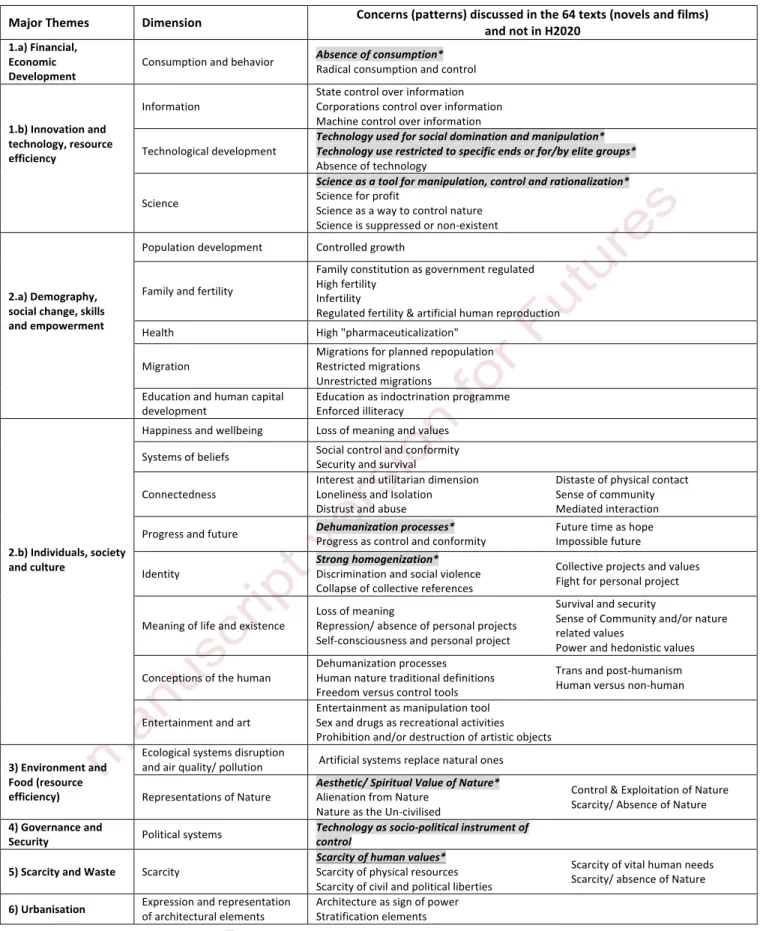
Through the consultation of abstracts, resumes and plots, texts were scrutinised and classified for their relevance to a list of major themes, which combined GSC-related topics as framed in FLAGSHIP (2013) and in H2020 (EUCO, 2013). Texts with high coverage of these major themes were prioritised. The same list of themes, enriched with relevant futures topics arising from the texts themselves, provides the core structure for the overall analysis. The connection between H2020 GSCs and the final list of major themes is shown in figure 1.
Figure 1 connection between H2020 GSCs and major themes
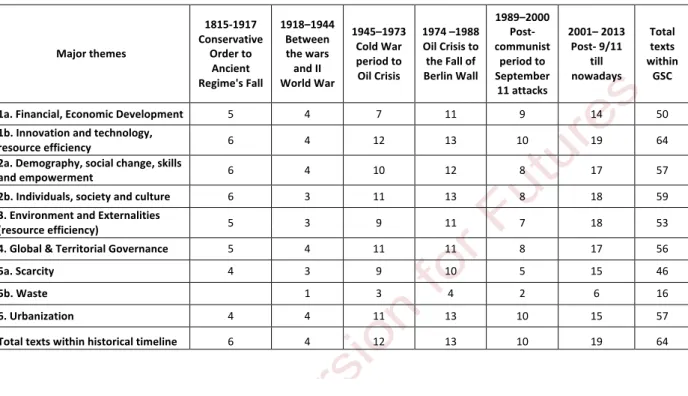
A historical timeline was also introduced to establish the correspondence and influence of major socio-political events on fiction (Table 1),8 and consider how fiction is partly a critique of historical moments. The final selection corresponds to the best classified 27 novels and 37 films (see appendix A), covering six historical periods, with a particular incidence on the last decade (30% of the texts) considered
8 This historical map follows the theories of Mayer (1981) who envisages the 19th as a long century
and Hobsbawn (1994) who argues that the 20th was a short century; we also draw from Koselleck with his studies on Utopia, Progress, Emancipation (2002) and the works of Enzo Traverso on the violence in the 20th century (2007).
particularly relevant for our reflections on science policy. The previous five periods provide an important –if quantitatively limited- perspective on the changing and/or persisting concerns explored in fiction (see section 3).
Table 1: Texts by major theme and historical timeline
Major themes 1815-‐1917 Conservative Order to Ancient Regime's Fall 1918–1944 Between the wars and II World War 1945–1973 Cold War period to Oil Crisis 1974 –1988 Oil Crisis to the Fall of Berlin Wall 1989–2000 Post-‐ communist period to September 11 attacks 2001– 2013 Post-‐ 9/11 till nowadays Total texts within GSC 1a. Financial, Economic Development 5 4 7 11 9 14 50
1b. Innovation and technology,
resource efficiency 6 4 12 13 10 19 64 2a. Demography, social change, skills
and empowerment 6 4 10 12 8 17 57
2b. Individuals, society and culture 6 3 11 13 8 18 59
3. Environment and Externalities
(resource efficiency) 5 3 9 11 7 18 53 4. Global & Territorial Governance 5 4 11 11 8 17 56
5a. Scarcity 4 3 9 10 5 15 46
5b. Waste 1 3 4 2 6 16
6. Urbanization 4 4 11 13 10 15 57
Total texts within historical timeline 6 4 12 13 10 19 64
Content analysis methods were used to examine systematically both the explicit and the implicit meanings of the 64 selected texts. The guidelines for the content analysis were set through a list of content descriptors developed from the list of major themes. These were broken down into a matrix with 42 dimensions and 212 sub dimensions, providing a template for the content analysis of the 64 texts. The content analysis was focused on the representations as defined and reflected by the authors, taking into account both the historical moment of production of the fiction and the overall text and the ways in which it illuminates and explores future societies (Denzin, 2004). The templates allowed for an interpretative analysis, building hierarchies of themes and accounting for major patterns within each dimension (Berg, 2001). The resulting list of final patterns is rooted in the observed data, and was debated and agreed between four members of the interdisciplinary team, incorporating different views and theoretical references. It expresses the ways in which the major themes are represented and describes and synthesizes major characteristics and tensions of the future societies portrayed in fiction.
Final categories describing observed patterns were registered in an overall database that linked all the information collected concerning each one of the texts, using SPSS software. This allowed the analysis of their observed frequency, the relative weight of each theme, and pattern (positive or negative orientation or portraying of the topics) in each text. This combination of the qualitative and quantitative methods allowed for a meaningful, articulated picture of the way GSC-related patterns are expressed in future's fiction. It enabled a reflexive interpretation of results, where we sought to comprehend, rather than quantify, topics, and to note prevalent patterns through history.
The rigorous selection criteria applied, guarantees the level of representativeness and importance of each text selected, providing an in-depth overview of key themes. Inevitably, due to the limited number of novels and films, generalizations should not be extrapolated beyond the defined set of texts. Finally, given the purpose of this inquiry, we did not seek to engage with the cultural production and rich variety of types and sub-genres in future fictions.
3) Results: major patterns arising from fiction
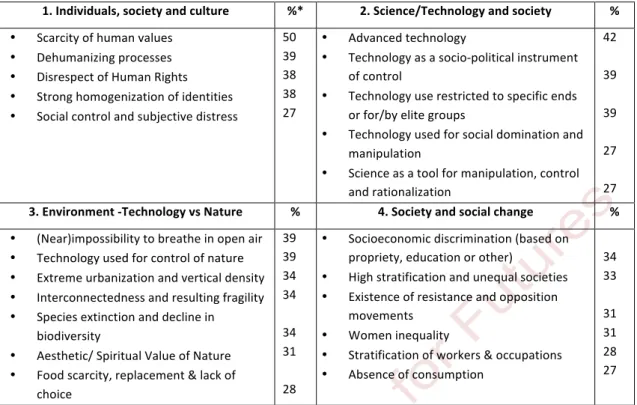
Having collected detailed records for each text, we identify arising patterns related to 42 dimensions and 212 sub dimensions. Table 2 presents the 23 most significant and frequent (defined in section 2.2) patterns of concern. These are organised under four ‘Core Challenges’:
1. Individuals, society and culture, expressing the patterns connected with individual dignity, values, wellbeing, rights, and identities.
2. Science/Technology and society, concerning the purposes, roles and centrality of technology in the ways societies will organize itself in the future.
3. Environment - Technology versus Nature, related with the complex and contradictory relationships between humans and nature, ranging from fulfilment to destruction.
4. Society and social change, concerning social conditions, discrimination and the ways societies are structured and hierarchical.
Table 2: Major patterns describing future societies portrayed in fiction, grouped according to their relevance to four core challenges
1. Individuals, society and culture %* 2. Science/Technology and society %
• Scarcity of human values • Dehumanizing processes • Disrespect of Human Rights • Strong homogenization of identities • Social control and subjective distress
50 39 38 38 27 • Advanced technology
• Technology as a socio-‐political instrument of control
• Technology use restricted to specific ends or for/by elite groups
• Technology used for social domination and manipulation
• Science as a tool for manipulation, control and rationalization 42 39 39 27 27
3. Environment -‐Technology vs Nature % 4. Society and social change %
• (Near)impossibility to breathe in open air • Technology used for control of nature • Extreme urbanization and vertical density • Interconnectedness and resulting fragility • Species extinction and decline in
biodiversity
• Aesthetic/ Spiritual Value of Nature • Food scarcity, replacement & lack of
choice 39 39 34 34 34 31 28
• Socioeconomic discrimination (based on propriety, education or other)
• High stratification and unequal societies • Existence of resistance and opposition
movements • Women inequality
• Stratification of workers & occupations • Absence of consumption
34 33 31 31 28 27
* the percentage refers to the proportion of the 64 texts engaging with each pattern
Many of the 23 patterns interconnect with different core challenges, exemplifying the complexity of the extrapolations made by the futures’ narratives. We discuss each core challenge in turn, summarising results and reflecting on their implications for GSCs agendas.
3.1) The other side of ‘scarcity’: a dehumanized future?
The most frequent pattern found in fiction is the ‘scarcity of human values’. Literature on scarcity is closely linked to economic theory over centuries, and more recently to environmental studies (Bina, 2013). Resource scarcity is increasingly perceived as one of the greatest security risks of the 21st century, and when related with competition for natural resources, is considered a global challenge (Mildner et al., 2011). Here we propose a broader definition of scarcity, observing instead the ways in which future societies emphasise any kind of insufficiency, rarity or limited supply.
As a result, patterns of insufficiency are found in relation to: natural resources, human values, vital human needs, but also civil and political liberties and human capital. The scarcity of human values is observable in 32 texts, and can be further explained in terms of the absence of values such as:
• self-direction (1984; The Handmaid’s Tale; Logan's Run; Twelve Monkeys), dignity (The Tomorrow File; A Clockwork Orange; The Hunger Games)
• hope (Soylent Green; On the Beach; Blade Runner; Children of Men)
• sentiments and emotionality (We; Do Androids Dream of Electric Sheep?; The Giver), love (The Handmaid’s Tale)
• identity (We; Uglies; Twelve Monkeys), privacy (Stand on Zanzibar; Minority Report), idealism and creativity (Paris in the Twentieth Century; Brazil) • freedom (Escape from L.A.), security and protection (The Time Machine,;
Mad Max), equality (Metropolis; Elysium), peace (Appleseed), justice (Elysium).
This pattern (scarcity of human values) speaks of individual dignity, values and wellbeing, creating a strong link with the ‘Individuals, society and culture’ theme. Closely linked to this are dehumanizing processes depriving individuals or societies of their human qualities. This pattern synthesizes the following situations: the human being is seen as means to an end (e.g.: seen as consumer or as a source of energy); situations of submission to mechanical power; and situations of submission to ideology, social control or repression. The most relevant aspect of this nihilistic situation (defined by the collapse of traditional moral values and of religious/spiritual known references) is not the collapse itself, but the resulting loss of meaning and inability of give meaning.
In the core challenge ‘Individuals, society and culture’ we also find reference to violation of human rights (38%), strong homogenization of identities (38%) and social control and subjective distress (27%). The latter condenses the following multiple forms of social pressure:
a) Overcrowded spaces, where demographic growth and lack of space conflicts with the need for individual privacy (The Fifth Element or Blade Runner); b) The need for individuals to conform to the main social standards, in order to
be accepted and recognized as a member of it, (Uglies);
c) The strong individualistic culture of very complex societies, where competition produces a huge strain over personal performance (Infinite Jest);
d) Manipulation and mind control becomes more pervasive, through the use of technological tools: cases where permanent surveillance creates very poor psychological conditions, (V for Vendetta, Minority Report).
These stories speak of damage to psychological wellbeing, including individuals being affected by feelings of anxiety, fear and even madness:
your reason and rob your common sense. Fear got the best of you.’ (V for Vendetta, 2005)
Lastly, disrespect of human rights and loss of citizenship depicts the crisis of democratic systems leading to exclusion and disrespect of citizens, through the avoidance of anti-discrimination laws and the replacement of citizen with consumers. Two systems are represented: those where political repression leads to disrespect of human rights and those in which, under the pressure of corporate power, civil rights are cancelled to reinforce a logic of profit.
What do the patterns reveal of today’s framing of GSCs? The core challenge ‘individuals, culture and society’ is both the most significant in fiction, and the one where the greatest discrepancy between H2020 and fiction is revealed. While in H2020 challenges cultural values are addressed as important dimensions in the construction of inclusive societies, contributing to social cohesion, future fiction is concerned with the detailed nature and limits of the human condition. Fiction reveals important patterns pointing out the harmful effects of repressive and/or extremely technological societies over the life of individuals. ‘Social control and subjective distress’ and ‘strong homogenization of identities’ are just a few examples of the warning signals (sections 1 and 2.1) arising from fiction, and which are largely unaddressed in H2020. The human community may already be facing disruptive situations where the absence of meaning and ethics may expose the fragilities of the contemporary human condition.
According to H2020 challenges, the mechanism to promote smart, sustainable and inclusive growth is described as implying ‘substantial changes in the way growth and societal well-being are defined, measured (including through the measurement of progress beyond the commonly used GDP indicator), generated and sustained over time’ (EUCO, 2013: 1023). We note that H2020 challenge 6, ‘Europe in a changing world’, reflects already awareness of the need to understand societal wellbeing beyond the GDP indicator, and to recognise ‘human, social, environmental and economic costs’; however, the warnings arising from fiction, provide support to recent critiques (section 4.3) whereby more should be done to address social, cultural and human dimensions of GSCs.
While H2020 challenges address concerns related with security, democracy and the role of civil society to the construction of open and transparent institutions and societies, future fiction portrays the results of societies where all these values
are in danger or completely absent. Fiction about the future warns us about the fragility of such democratic values through rapid change and the risk of collapse of political institutions.
3.3) The future is technology
The ‘Science/Technology and society’ core challenge (quadrant of Table 2), reveals the classic theme of fiction. 27 of the 64 texts rely heavily on technological advancements, namely in the fields of biotechnology, cybertechnology, genetics, robotics, computing and other advanced technologies. These themes are distributed throughout all six historical periods, but are particularly frequent in texts from 1990 onwards.
The positive impacts of the pattern on advanced technology are imagined and described in terms of empowerment and performance improvement (in the economy or health), echoing specific ideals of progress. Technologies contribute to correct problematic aspects of reality, such as depressive moods and unhappiness, genetic traits, nature’s limits, and survival challenges (e.g.: The Lathe of Heaven, Neuromancer, The Diamond Age, Logan's Run, Code 46 or Minority Report). They can lead to new forms of determinism and inequality: what Atkinson (2007) calls genetic utopianism, or utopian states through the removal of unwanted elements, genetic abnormalities and crime, rather than through the fulfilment of positive ideals.
Despite its many utopian projects, fiction tends to be critical of techno-science developments, highlighting both planned and un-wanted negative effects, resulting from the use of technology for specific ends and for/by restricted elite groups (which happens in 25 of the 64 texts). Such uses are centred around military and security needs (and to a lesser extent, transportation), often serving exclusively specific elite groups, like the rich and high-powered Elysium inhabitants, the dominant corporations of The Space Merchants, the oppressive military state in the Handmaids Tale, the genetic oppressive state in Uglies or Gattaca, or the security utopia of Minority Report, among others.
Harmful impacts of techno-science in imagined futures are further recorded in the pattern on social domination and manipulation. 17 texts portray technology as a means of social domination, rationalization and manipulation by governments and corporations, leading sometimes to the loss of rights and privacy. All this takes place in societies, sometimes depicted as utopic, where everything can be seen and,
consequently, where nothing is outside the aegis of the state or the corporation's (Atkinson, 2007); societies with new and higher possibilities of genetic discrimination, social fragmentation, totalitarianism, surveillance, environmental degradation, addiction and mind control (Dinello, 2005).
The concern with social domination through techno-science seems mostly significant in fiction since the beginning of the cold war, but persists into the present. It applies to all domains of social life, such as birth, healthcare, and even pleasure (Tomorrow File), and to surveillance and capture systems (Fahrenheit 451). Science contributes to the reengineering of humanity and to the rational organization of all systems, may it be genetic, reproductive, social, administrative, economic, or others, (Brave New World). In The Lathe of Heaven, technology can control the content of individuals’ dreams. This is also illustrated in the novel Feed, where technology guarantees appropriation of mind and emotions: ‘Everything we think and feel is taken in by the corporations’ (p. 48).
Another predominant pattern concerning science/technology in futures fiction relates with control of nature, within core challenge: ‘3. Environment & Technology vs Nature’ (Table 2). In these texts, technology controls nature and promotes increasingly artificial forms of life, sometimes leading to destruction and chaos. In some cases, technology replaces landscape with an entirely built and controlled environment where nature is rendered invisible, and where technology itself has become a landscape (Fukuyama, 2002), as shown by the existence of ‘farm’ landscapes of artificial meat production, or artificial weather (Feed). This pattern is found continuously throughout the project’s historical timeline. Humanity’s increasing alienation from nature is emblematically illustrated early in the 20th century by Forster's The Machine Stops (1909):
‘the civilization that had mistaken the functions of the system, and had used it for bringing people to things, instead of for bringing things to people. Those funny old days, when men went for a change of air instead of changing the air in their rooms!’ (p. 5).
In these narratives, science and technology assumes an almost mystical role, enabling the total reshape of society and absolute control and separation from nature. Illustrations include the neutralization the earth's diurnal revolution (The Machine Stops), the growing of human beings in artificial wombs (Brave New World), Earth-forming technology (The Diamond Age), or climate weather and air regulation (Feed).
Returning to core challenge 2, we also find reference the pattern of science as a tool for manipulation, control and rationalization (27%). In our texts, science is primarily presented as a system at the service of ruling structures (either governments or corporations), for manipulation, control and rationalization. Politics and science are essentially merged and the notion of a nation is shaped by its scientific and technological performance (e.g The Tomorrow File, We and Brave New World). Science blurs the boundaries between the human and non human, the natural and artificial, and in doing so, as Danny Witwer, the skeptical character in Minority Report, explains: ‘Science has stolen most of our miracles.’
Science is what distinguishes the ‘work of men’ from the (imperfect) ‘work from nature’, a way to dehumanize the subjects, accomplish a project of human improvement, abolish chaos and build perfection (The Giver, Gattaca). This pattern is present in all the historical periods covered, but is more frequent from 2001 onwards, reflecting increasing rationalization and centrality of science systems in dealing with contemporary challenges, including H2020. A new understanding of the inherent dangers of science and technology seems to become paradigmatic along the years, especially with the rise of consumer capitalism (Hall, 2009).
Futures narratives show, overall, a central tension between control, production and intentions (who produces science and technology, and why?), access (who benefits from it) and impacts (either beneficial or harmful). In fiction, innovation and technology become risks, not solutions. The described patterns express the harmful impacts of science and technology over individual life and social systems: instead of contributing to a real emancipation process, science is mainly oriented to the development of technological applications. It ‘seeks not knowledge but information, not understanding but practical application. It thus leads not to genuine enlightenment but to re-inscription within the new myth of the power of technology’ (Booker, 1994: 12). Governance emerges as a central question: science and technology are controlled either by corporations or by states, citizens tend to be passive or absent from political life, and are essentially portrayed as victims both of (intended and unintended) harmful decisions, and of increasingly sophisticated manipulation. Major concerns expressed through novels and films include (the lack of) ethics and the possibility of growing inequalities (old and new).
Turning back to science and technology in GSCs literature (section 1), these are generally aimed at solving problems and serving the economy and society’s needs (notably, Challenge 4: Smart, green and integrated transport, aimed at tools to
improve urban infrastructures, services, and housing). In H2020 (EUCO 2013) ICT and digital inclusiveness (digital economy and digital technologies) are central tools for key societal challenges such as community relations, consumer behaviour, political participation and public governance. H2020 ‘will promote inclusive ICT solutions and the effective acquisition of digital skills leading to the empowerment of citizens and a competitive workforce’ (EUCO 2013: 1024).
However, the oppression, inequality and the ethical issues that fiction envisages as central to, and inseparable from innovation, technology and science, are almost absent from GSC formulations. In futures fiction scientific and technological developments emerge less as conditions for economic growth and resource efficiency, and more as the solution for increasingly complex health and environmental problems, and they often transform from solution into an even greater problem, leading to anti-utopian futures (see patterns in Table 2). Science and technology are mainly portrayed as directed to power, profit, order and control (exemplified by the pattern: ‘science as a tool for manipulation, control and rationalization’, with 27% of incidence), with significantly negative impacts on human beings and society.
There is a strong link between the warning signals raised by fiction in terms of techno-science, and in those discussed above in terms of scarcity. The GSC-driven research agenda recognises problems such as the growing digital divide, an insufficient digital literacy, and the safety and security risks associated with the digital world. But it tends to address some of the potential negative ‘side effects’ in reductionist ways, calling for more innovation and multi-disciplinarity, and reiterating that technology and the growth of the ICT industry are seen as the fundamental drivers for the knowledge society (and economy) and empowerment of the citizens. A more explicit and comprehensive consideration of potential anti-utopian effects of techno-science would seem, at least welcome precaution.
3.4) Humans and nature: will we be able to breathe in the future?
Turning to the ‘Environment - Technology versus Nature’ core challenge, we find 25 texts (39% of all texts) contributing to a pattern that exemplifies the dramatic degradation of the relationship between humans and nature: categorized as ‘(near)impossibility to breathe in open air’. A complex range of human choices in managing nature – often leading to disastrous events linked to industrial production resulting in severe air pollution (references to nuclear disasters, acid rain or climate
change), underpin the imagined future (The Machine Stops, The Space Merchants, Cloud Atlas, Logan's Run, Avatar or The Day After Tomorrow, just to mention a few). The common trait of these 25 texts is that humans will find it almost impossible to breathe naturally in the open air. This dominant aspect of the future in fiction is remarkable given the symbolic nature of breathing as the act that ensures life, and to our ability to be conscious of ourselves. It seems to represent the ultimate alienation from nature, and from our nature.
Another major pattern has to do with urbanization, and relates to the extreme density of urban spaces, associated with the verticality of the buildings, and wide development of urban and/or industrial areas (present in 22 of the 64 texts). It condenses recurrent visions related with futuristic and high-tech scenarios, wide industrial landscapes, and artificial cities, landscapes and features over our six historical periods. Alphaville, Logan’s Run, Minority Report and Blade Runner are some of the examples of the ultimate vision of a technological city, in mainly the late capitalist settings, where the urban fabric is the visual mirror for technological progress and, or, industrial achievement. The city can also become an entirely artificial environment, where cities are under glass domes, with no contact with the exterior (The Machine Stops, Logan's Run, Cloud Atlas), or where natural elements were replaced by artificial green (The Tomorrow File, The Space Merchants).
Thus, the analysis of fiction reveals a profound connection between built environments, individual alienation and social collapse. Future urban settings are not only visual backdrops of the eminent social collapse, but also, and most importantly, they are at the very origin of the hostile, awkward, absurd systems in themselves. This finding is confirmed by the critiques of urban scenarios and science fiction (Collie, 2011: 428) stressing ‘the alienation produced in subjects in and by built environments; the relationship between built environments and nature; the effects of a centralization of oppressive or controlling power upon individual freedoms (...)’.
Another pattern in this core challenge is ‘aesthetic/ spiritual value of nature’. It is depicted in 20 texts, nine of which belong to the post 9/11 fiction (2001 to nowadays). Where Earth has fallen victim of what we might call the Anthropocene and its devastations (Avatar; Elysium; and Waterworld’s), nature is the paradise lost. Invisible, and yet absolute annihilation of nature is suggested in The Matrix: images of ‘reality’ show desert and urban destruction, suggesting that man-made (or natural) catastrophic events have led to current destruction: Morpheus: ‘Welcome to the desert of the real’ (The Matrix). In this pattern, nature is a synonym of escape,
renewal and eternity, where nature is valued as an end in itself (The Road), as a source of peacefulness (Mad Max), as an experience of redemption:
‘It was possible Richards would take him outside to do it. Wolgast hoped he would, someplace he could see trees and feel the touch of sunlight on his skin, before Richards put a bullet in his head. Maybe he’d even ask. Would you mind? he’d say. If it’s not too much trouble. I’d like to be looking at the trees.’ (The Passage, 2010, p.478-479).
It is seen as an idyllic, poetic dimension, and valued in an aesthetic and spiritual sense, as in We, Fahrenheit 451 or The Space Merchants; or envisaged as the last non-corrupted domain, as in Winston’s dreams and experience in 1984. Nature represents an occasional and brief escape from the oppression of the system (The Handmaid's Tale). There is a theme of hope and return: hope that one day one might find the way back to the surface of planet earth, for the enjoyment of the contact with nature, a place of comfort, a return to the origins – The Machine Stops; hope to restore the link between humans’ rational and intuitive nature (Children of Men, Brasil, Twelve Monkeys). Nature is the last non-corrupted domain that needs no human intervention to exist and be beautiful: ‘Nature, at least, didn’t need an operation to be beautiful. It just was.’ (Uglies); it is the embodiment of interconnectedness and continuity:
‘A network of energy that flows through all living things’, ‘Energy is only borrowed, one day you have to give it back’ (Avatar).
Nature also becomes the embodiment of utopia: an imaginary representation to help ‘sell’ a new colony, outside planet earth:
‘a whole planet to sell… a highly imaginative series of shots of Venus as it would be when the child grew up —verdant valleys, crystal lakes, brilliant mountain vistas’ (The Space Merchants).
Imagined futures relating to this core challenge also promote reflexions about themes high on today’s environmental policy agendas: increasing environmental interconnectedness and resulting fragility (34%), species extinction and decline in biodiversity (34%) and the threat of food scarcity, as well of its artificial replacement and lack of choice (28%).
The prevailing pattern of ‘food scarcity, replacement & lack of choice’ can be found in 18 texts, and has strong links with the idea of the ‘end of nature’ and technological solutions. Fiction vividly depicts worlds with limited or no natural food: food synthesized from petroleum (The Tomorrow File; We); food derived from soya (The Lathe of Heaven) or artificially created from all kind of waste (The Diamond
Age); genetically modified (The Passage; Feed) and engineered (Soylent Green); food as pills (Vexille) or in the shape of an illusion: in The Matrix no traditional forms of food are left, except as illusions in the world created by the Matrix, while in the real world a soup is described as a ‘bowl of snot’. In The Tomorrow File we have petrol-based food: ‘I ate my prochick and, drank my petrowine, and asked myself no questions.’ (p.53)
In terms of scarcity, several stories illustrate it, for example: delicacies such as bean curd, ripe peaches, cheese costs two weeks' salary and bottles of wine are secured in safe boxes in banks (Do Androids Dream of Electric Sheep?); food is rationed (1984) or scarce (Windup Girl); raw meat and canned food (District 9); famines are sometimes central to the narratives (The Tomorrow File; We; The Lathe of Heaven).
This core challenge embraces aspects from three of H2020’s GSCs: 2, 4 and 5, and once again, fiction offers warning signals and raises issues that are absent from H2020 framings of the challenges. It shares, in particular, H2020’s emphasis on food’s (in)security when projected into the future. And yet, the significant overlap of issues discussed, is characterized by major differences in the way these are conceived and developed. The focus of GSC 2, Food security, which seeks to promote bioindustry, biotechnology, new sources of food and agribusiness, compares with the far more multidimensional discussion in fiction: including quality and availability with issues of control, manipulation and denial of real choice at the expense of human health. Fiction also emphasizes impacts such as ‘loss of biodiversity’ and the ‘growing interconnectedness and resulting fragility’ of future worlds. The last decade’s debate surrounding genetically modified organisms, and the food scarcity uprisings in the late 2000s are just two cases in which fiction warnings are matched in daily news.
H2020 GSC 5, Climate action, environment, resource efficiency and raw materials, emphasises efficiency and sustainability of energy production/ consumption and the transition towards a more green economy and society. In contrast, fiction engages with the issues of this GSC through, inter alia, three of the highest frequency patterns identified throughout our study: ‘Interconnectedness and resulting fragility’, ‘Species extinction and decline in biodiversity’, and ‘(Near)impossibility to breathe in open air’ are among the most represented patterns depicted by the analysis of the texts. The tendency is to conceive of the problems in a highly interconnected and interdependent manner, shifting the more traditional
focus on environmental implications, towards the broader theme of the impoverished relationship between humans and nature.
In stark contrast with the prevailing tone of H2020 priorities, fiction reveals a high frequency pattern: ‘Aesthetic/ Spiritual Value of Nature’ which stands out for the depth and breadth of themes and concerns embraced. In future imaginaries, the balance of natural environment is not only represented as essential condition to the survival of the human species but as a value in itself, adding an aesthetical and spiritual value to human life, which – fiction emphasizes – the urban fabric cannot provide. This sense of alienation from nature echoes with critiques of the dominant socio-economic model that seek to go beyond the immediate implications of ecological disruption, to reveal a deeper but possibly more pervasive impact on quality of life, and meaning of life (Washington, 2013).
3.5) Future societies are highly stratified and unequal
The fourth core challenge ‘Society and social change’ reveals how speculative and science fiction portrays societies with high levels of ‘stratification and inequality’ (pattern present in 21 texts) resulting from: 1) granting importance to intrinsic traits such as: genetic raking, IQ measures, and ability; 2) external appearance; and 3) being labelled as primitive or evolved, human or not human (The Tomorrow File, We, Brave New World, Stand On Zanzibar, The Windup Girl, Gattaca, Distric 9, and Applesed). In some of these texts individuals are ‘produced’ and conditioned for specific social positions, as is the case described in Brave New World:
‘I suppose Epsilons don't really mind being Epsilons,’ she said aloud. ‘Of course they don't. How can they? They don't know what it's like being anything else. We'd mind, of course. But then we've been differently conditioned. Besides, we start with a different heredity.’ (chapter 5)
Or biological stratification in Do Androids Dream of Electric Sheep? :
‘classed as biologically unacceptable, a menace to the pristine heredity of the race. Once pegged as special, a citizen, even if accepting sterilization, dropped out of history. He ceased, in effect, to be part of mankind.’ (p.15)
Overall, futures fiction offers a strong representation of the continuity and deepening of the social inequalities, namely through the effects of classic institutions and structures such as property and education, leading to significant loss of human dignity. 22 narratives portray societies where individuals are differentiated according