A Work Project, presented as part of the requirements for the Award of a Masters Degree in Management from the NOVA – School of Business and Economics.
HOW DOES INTRODUCING LOVE IMPACT MANAGEMENT?
TOMÁS MARIA LEITÃO PILÓ LÍBANO MONTEIRO
# 1345
A Project carried out on the Organizational Science area, under the supervision of:
Professor Miguel Pina e Cunha
2
1. Abstract
Religion at work is nowadays a hot-topic for organizational researchers. Studies have been conducted in order to understand whether there is a possible connection between God and management. This study aims to understand what is the impact of managing through God’s Love. It was found that managing with Love contributes for a new organizational culture characterized by the way managers face work (Culture of Identification), the way they use their characteristics for the benefit of the organization (Culture of Integration), the way human relations are developed (Culture of Bonds) and that it creates sustainable value (Culture of Entrepreneurship) for organizations. Main implications of these results are presented below.
Key words: Catholicism, purpose of work, human relations, Role Theory, management, business ethics
3
1. Purpose of the project
“When businesses and markets work swiftly they are focused on serving the common wealth, they contribute immensely for the material and even spiritual well-being of the society. However, recent evidence has also showed the evil caused by their failures. At the same time they brought several benefits, the evolutions we have witnessed – globalization, communication technologies and the financialization – have created bigger problems such as inequality, economic relocation, excess information, financial instability and many other pressures that interfer with the service of the common good.”
The Vocation of the Business Leader, Pontifical Council for Justice and Peace, 2013
“A new command I give you: Love one another. As I have loved you, so you must love one another.”
Saint John’s Gospel, The Holy Bible
Love has been a hot topic amongst Portuguese Managers’ thoughts since António Pinto Leite, CEO of ACEGE (Christian Association for Businessman and Managers), wrote “Love as a management criterion”. He proposed a new way of looking into companies and into the people working on those companies which could revolutionize the ways of management. It has also proven a hot topic around the world according to Chan-Serafin, Suzanne et al. (2012) “Contemplations about religion and the concept of God appear to be on the rise, at least in, but not confined to, the American workplace”.
In his book, Pinto Leite suggests that Love has a significant economic value and it all comes down to the way managers relate with their peers, superiors, clients, suppliers
4 and all the stakeholders. And that Love can also be a reasonable and solid criterion for managers when taking the responsibility to lead any organization. It goes beyond the ethical background crucial for any manager, says Pinto Leite, and can be a powerfull tool to make organizations succeed in the competitive set of nowadays economy.
Theories such as the shareholder theory, “suggesting that business is an economic enterprise to manage for the wealth of its owners” (Sandelands, 2008), forget an essential part of businesses: the human being. When workers are seen exclusively as an economic instrument, organizations lose a vital part of its structure. The care for people and the way human relations are enhanced through management practices represents a shift on organizational thinking.
Never before, in this manly world of management, had the word Love been used to determine one’s actions and comments have arised about what does it really comprise and how can Love, as an expression of Christian Love and ways of acting, impact companies and the economy. Love as a new way to manage professional relationships. Every relationship between two or more persons should be based on this simple principal of being available to understand and respect the other and to find for them the most sincere love, as Christ did for all of us.
Although some work has been done in the academy regarding the relation between God and work, “the implications of religion for organizational life have not been adequately addressed in the organizational sciences” (Chan-Serafin, Suzanne et al., 2012).
The main difficulty for academics when suggesting any connection between God and economy can be explained by a scission between God and man, as Sandelands (2003) suggests because “today’s postmodernism declares even the surest facts to be cultural
5 franchises”, and God has become just another culture or a personal conviction. However, he suggests that God is implicated in management, organization and social life as these models are all based on principles such as common good, respect for others and the sense of sustainable organizations.
Further research on these matters conducted by Cunha, Miguel P. et al. (2014), in a similar process to this research work, has come up with two major conclusions. First of all, Love, or the presence of Christ in organizations, is in fact an organizational phenomenon as it can impact managerial attitudes. The second conclusion is that this Love is interpreted by managers in two different ways: the sense of a human working community and also the orientation to virtue. It confirms the initial assumption that it is possible to identify Christ’s love inside organizations.
Going further down in the research, it is relevant to research how can God and Work be related and what are the inherent gains of this relationship. Hence, the goal of this work is to find out whether acting as Catholics amongst organizations can in fact (positively) impact companies and enhance them to achieve better results. In other words, “what is the real impact of acting as a Catholic inside our organizations?”
2. Method
To conduct this study, a qualitative research approach was conducted, deducing from the interviews performed the main information for the analysis. To extract information for the research, semi-structured interviews with open questions were written and 16 Catholic managers were interviewed. A simple open-question script (Appendix 1) was drawn and sent for the informants, focusing on their experience as Catholics, the critical factors for professional and organizational success and what are the key
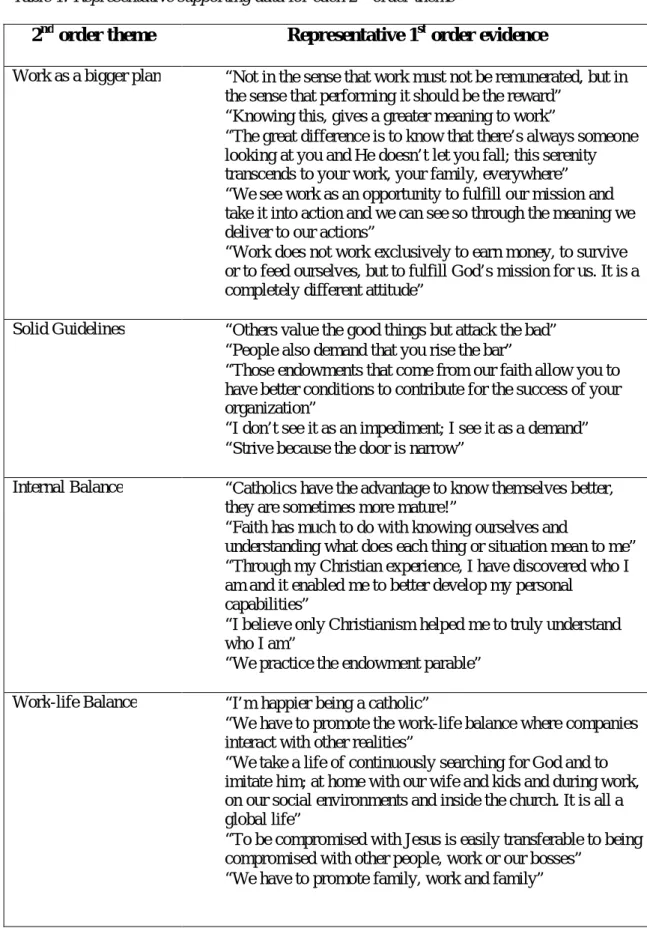
6 contributions of Catholics for organizations’ daily activities and functions. Interviews were conducted live, ranging from 14 to 39 minutes, recorded and then transcribed for further in-depth analysis. All the information collected was conducted to sustain a grounded theory, which involves the discovery of theory from data (Glaser & Strauss, 1967); it presupposes qualitative inquiries and new findings drawn from those investigations. Assuming that people in organizations know what they are trying to do and can explain their thoughts, intentions, and actions (Gioia et al., 2012), the “analysis followed the principles of grounded theory, progressing from a very detailed, empirical reading to greater generality” (Mantere et al., 2012). Following this methodology, the first step was to identify common and critical evidence among the interviews on what is the impact of Catholicism in organizations. Direct information was taken from the interviews and systematized to draw first order concepts. The next step was to cluster them into major second-order themes (Appendix 2). Eight major themes were constructed and grouped two by two to infer four dimensions, through a process called axial coding which consists of putting data together in new ways, allowing researchers to make connections between categories (Dillon, Deborah, 2012). Through this coding process it was possible to elaborate the following four aggregate dimensions: Culture of Identification, Culture of Integration, Culture of Ties and Culture of Entrepreneurship (Appendix 2). To validate the results, a reliability check was taken with some of the informants to confirm the interpretations and see whether the conclusions were plausible, as Mantere et al. (2012) suggest.
3. Sample
Sixteen informants were considered in this research. All of them had to ensure two conditions: to be a catholic and to work in an organization with managerial functions.
7 As the aim of the study is to find out what is the impact of catholic action inside the organizations, considering that managers employ actual efforts to act this way, we only considered catholic for the sample. In total, 14 men and 2 women were interviewed and considered in this research. The informants had an average of 43 years old, ranging from 24 to 57. The sample included managers, engineers, lawyers and economists, all with managerial experience.
For the matters of this study, a catholic manager is someone that professes his faith in Jesus Christ, through actions and prayer, and tries, to the best of his efforts, to create a sense of harmony and respect inside its organization, enduring ethical practices and acting as Christ would in every situation. It is not something imposed to others, or practices that managers force their peers to follow, not even a war horse to impose some practices or ideas.
4. Research Findings
Through the analysis of the conducted interviews, the first thing worth to notice is that acting as a catholic inside the organizations adds a concrete, lasting and positive value to those organizations. The four main dimensions found during the research, suggest that it is a matter of creating a new culture, a new way to create bounds between members of any organization, exploring the powerful benefits of human relations for the wealth of the organizations. More, living in total harmony with one’s characteristics, being a catholic included, will potentiate its own actions and deliver better performances. Through this new culture, members of organizations can feel safer, more fulfilled and work towards clear goals and objectives, while in total balance between themselves and the organizations. Moreover, organizations are believed to
8 endure in the long term, building solid grounds for sustainable and human practices. This new culture can be separated in four dimensions which are now explained.
Culture of identification
What are the reasons for one to work? Insights from the informants suggest that the purpose of work is more than just to make money, as it is a limited approach to work. Catholic beliefs may help identifying the purpose of work. Information from the interviews suggests two underlying topics:
Second order theme (a): Work as a bigger plan
Informants consider that their catholic experience suggests them that they are not acting on their one, or exclusively for their own benefit. It was common throughout all the interviews that the informants considered their jobs not only as a means to achieve something (usually monetary wealth) but essentially as the fulfillment of God’s desire for their lives, a calling. It helps them face work as a constant act of service, not only looking for personal glory, but looking for a greater good. Managers are called to perform their responsibilities, for the responsibilities itself and not for the reward, which is a constant challenge. Some informants call it Work Gratuity.
Second order theme (b): Solid guidelines
“Wearing” the catholic shirt is seen by the informants as differentiating. Not because they feel discriminated, but because they sense upon them greater expectations from their peers. One of the informants said “One must expect others to value their good deeds and actions, but also to be more fiercely “attacked” when making a mistake”. We may call it the Catholic burden. The informants believe that their faith contributes for a stronger background and that it enhances their ethical guidelines. This idea is sustained
9 by Chan-Serafin et al. (2012) when saying “one’s engagement in religious activities is associated positively with the personality trait of conscientiousness and this personality trait has been found to be associated positively with job performance suggest that religious workers may be especially valuable”. As said, a catholic is expected to act ethically but also to go beyond that. In this sense, acting as role models and through a servant leadership attitude will allow managers to better connect with their peers and to better exercise their functions.
Aggregate dimension of the Culture of Identification
The combined characteristics previously explained will set a new reality for catholic managers: “work brings personal fulfillment, the satisfaction of feeling good at what one does and, at the same time, doing something good for the society, said a informant. According to Novak (1993), “sufficiency of food, shelter and employment will not satisfy the hunger of the human spirit” but knowing to be set in each job as a mission or vocation, will allow managers to better perform and to understand the reason why they stand where they stand. Identifying their personal beliefs and the purpose of work is a powerful tool for managers to find strengths to perform properly their jobs. As Wrzesniewski (2003) said, considering jobs as a Calling, will allow people to work more, even though their time may not be fully compensated.
Culture of integration
For one of the interviewees, “companies are made of their workers”. Therefore, proper integration of each one’s individuality is crucial for the success of every organization. Let us call it the Culture of Integration:
10 Self-knowledge is essential for every manager. And Catholicism is a way to endure it. Through meditation and prayer, the informants sense they can search their inner balance and perform with a different maturity and equilibrium. Knowing one’s limits, discerning over what would make one feel good and where is one’s place, helps managers to connect to their working place and to its functions. This is an idea expressed by Chan-Serafin et al. (2012) when saying that “self-control has been argued to be necessary for people to behave ethically (Baumester and Exline 1999); Baumester et al. (1994) suggested that religion, as an external source of discipline, can be helpful to people in exercising self-control”. It is also a powerful tool to better identify and admit personal flaws, enabling one to improve its actions and to deliver higher results to the organizations.
Second order theme (d): Work-life balance
Informants state it is impossible to dissociate both lives: the spiritual and the professional. Moreover, some say that spiritual organization contributes to their professional organization. Skills acquired from the catholic experience such as time management, people management, material goods management can easily (and should always) be transferred and used during the professional life, granting a greater commitment to professional tasks and other peers. According to one of the informants, “we live one single life, made of two moments: the personal and the professional”. Also, if one does not separate its spiritual life from professional life, most informants sense a greater happiness at work.
11 Let us call this aggregate dimension the Culture of Integration, concluding that internal and external balance is crucial for workers to be aligned with their tasks and, ultimately, for them to be aligned with the organizations’ needs and vision. It is important to always take into consideration what is cyclical or structural in each situation. One ought to be capable to be at home or at work and to act as himself, not hiding either his personal beliefs or his professional abilities or concerns. Mastering both these realities will bring a higher sense of fulfillment. Informants believe that their Catholic experience has matured them, and they use this maturity in behalf of the organization they represent.
Culture of Bonds
Organizations are made of people and people interact through daily ties. Informants propose that Catholicism inside the organizations will potentiate these ties and create higher value.
Second order theme (e): Act through love
Informants say that the experience of being loved by God, drives them to love the others in a different way. They do so trying to respect every one, independently of hierarchical positions. This new culture of caring for all the people in the organization can make their workplaces a place for personal fulfillment and where people feel safe, over performing. The common basis is to “treat people as we would like to be treated”. This way, no harm can be done to others. An informant tells in his interview that acting through love towards the others helped him recover a team of people in his organization tearing apart with lack of trust between them and low interaction practices. Also, according to one informant, “managing internal pressure is key for
12 organizations”. The way pressure is dealt with along the hierarchical chain, can influence results and the relations inside organizations.
Second order theme (f): Care for stakeholders
The informants suggest that companies should move from Shareholder Satisfaction towards Stakeholder Satisfaction. “Profit has to be taken as the financial and non-financial revenue from the investment spent.” Stakeholder theory, as the care for the relations between an organization and all the third parties it interacts with, gains a greater importance when one acts through love not only to its peers but also to their clients, suppliers, competitors. The informants state that looking at Christ’s example of altruistic love helps them engaging third parties and searching for mutual benefits and understanding.
Aggregate dimension of the Culture of Bonds
Culture of bonds consists on believing that each one’s identity - and everyone must assert its own identity and use it for good - is set and trained for bonding with others. Mastering and nurturing these bonds will produce an unimaginable benefit to whoever takes that bond. Informants suggest it as a culture of Love. Therefore, if managers create ties with the people they work with, with whom they spend most of their days, treating everyone as they would like to be treated, internal and external environment will produce stronger relations, benefiting the organizations. The benefits from this Culture of ties are, as Cunha, Miguel P. et al. (2014) concluded, “the sense of a human working community and also the orientation to virtue”.
13 Culture of Entrepreneurship
Catholics are usually associated with behaviors that help or benefit others, volunteering, solidarity and entrepreneurial activities (Chan-Serafin, Suzanne et al., 2012). Through the necessity of finding new and creative solutions for some organizational obstacles and with the sense of lasting, sustainable actions, they have the privileged tools to create greater value for their organizations.
Second order theme (g): Value creation
One thing unequivocal amongst all informants is that being a catholic and acting as such inside their companies is a value added position. As said, it provides some situations in which some creativity is demanded and it creates new value for the company. Also, informants sense that knowing that on the other side of the table is another catholic manager, will enhance interaction between both parties. Some assume that they have higher disposition and availability to engage negotiations with third parties when knowing they are Catholics. Informants are clear when stating that this includes believing in every worker and empowering them to make decisions and actively contribute for the organizations. We can see it as an additional confidence between external and internal relations. Informants feel a higher sense of respect from their clients. A clear example of this attitude is the “Commitment to pay within the established deadlines” signed by 25 Portuguese businessmen, conscious of the benefits that an on-time payment can bring to their suppliers.
Second order theme (h): Long run effects
We live in “times of instant satisfaction and excess of information” (The vocation of the Business Leader, 2013). A significant finding from the interviews is that managers
14 do not expect, and it usually does not happen, to collect benefits from these practices on the short run. They consider it a multiple round game and, so, they must act now in order to observe future results. This places a great responsibility upon them. As they act as a model, if they fail to do so, the organization will go the wrong way. Also, as it is not possible to reach everyone inside the organizations, they believe their actions can have a multiplier effect. People will feel inspired by their actions and start acting the same way, producing a long run and global effect.
Aggregate dimension of the Culture of Entrepreneurship
These two second order themes suggest that Catholicism fosters entrepreneurship, as the urge to look for new solutions and the process from getting an idea until it is placed as a real asset. As Novak (1993) suggested, “the true moral strength of capitalism lies in its promotion of human creativity”, proving the relevance of this dimension. Evidence from the interviews suggests that through the catholic experience, managers are more willing for out-of-the-box solutions, especially those safeguarding organizations’ members. Through this on-going attitude, the informants believe they can capture greater human value and use for the good of the organization and of those peers.
5. Reliability check
The main findings and conclusions of this study were presented to some informants to conduct a reliability check and assess the adequacy of the results proposed. All of them agreed with the matrix proposed and believe that the four types of cultures concluded are indeed benefits from Catholic management practices. One informant contested that the Culture of Identification and the Culture of Integration may prove more important
15 on the daily life of managers. However, they consider this is a solid proposal and none of the dimensions of this culture is stronger than others, unless in specific situations. The only referred concern by one informant was that Love in organizations is not seen as a scheme or a set of practices that can be set to achieve some results; it is all a matter of faith and the way managers manage their relation with God and their work and peers. Hence, this reliability check indicates that results and interpretations have been consistently drawn from this research process and are considered adequate for the topic.
6. Discussion
From the analysis and research process undertaken, there are two main conclusions that can be drawn: being a catholic manager creates a new culture inside organizations, one with stronger human relations and where individuals are valued and the second conclusion is related to the role theory, which can be applied in the sense that the greater interaction and integration there is between personal and professional roles, the greater will be the meaning of our actions and the greater will be the value of our work. Both stand as a shift in nowadays mentality.
One important note from these interviews is that no informant sees acting as a catholic in their organizations as a preaching tool. They do not seek to convert people to their own faith, their own intent is to act according to their beliefs. None of the informants believed they face a privileged position for being a catholic; all sense that their practices and attempts to love their organization can positively affect their peers and love inside organizations is a matter for every person, not only for other Catholics.
16 As all informants, this is also a trial and error practice. Although, Chan-Serafin et al. (2012) suggest that “the sense of hope, agreeable persons, consciousness and forgiveness suggest that more religious workers may view themselves as being and may actually be better, more virtuous organizational members, as well as better adjusted”, there is no sense of immunity on their actions, and, actually, the self-knowledge and self-control they all sense to acquire for being a catholic helps them to better identify and admit guilt whenever something goes wrong. Nevertheless, as “a saint is someone that, whenever he falls, stands up again”, they try every day harder to live their daily actions in a catholic way and contribute for the good of their organizations.
Getting back to the results, what the Catholicism doctrine promotes is a new culture based on the four dimensions achieved by this study. A culture established on a higher sense of human bonds that ultimately will deliver greater values for the organizations. Catholic managers are driven by this sense of community and human organizations, loving their peers, independently of their hierarchical positions, as they would want to be loved. Their experience of being close to and loved by God, is an experience which they cannot separate from their professional lives and, believing that God has a clear plan for each person, allows them to face their daily problems and difficulties with a greater sense of hope and knowing it will all have a reason in the end. The PCJP supports this idea saying that “separation from faith and the daily business practice may drive us to imbalances and to devotion to worldly success; one of world’s most serious problem”.
One key dimension of this culture is the quest for the purpose of work. Facing their jobs as more than a money maker opportunity gives them the serenity to deal with job
17 uncertainty, job pressure or job changes. And “recognizing the subjective dimension of work leads us to accept its dignity and relevance, helping us to see that “work is for men” and not “the man if for the work” (PCJP, 2012). It does not mean that one will always have the perfect job or that there will be no troubles in our professional tasks, but the fact that one should trust that there’s a bigger plan for every person and that if we deliver our best fortune will come, gives the extra serenity to be successful at what we do. This idea is supported by Wrzesniewsky (2003) when saying that finding a meaning for work will have positive impacts for that person but also for the organization.
Furthermore, when they make efforts to act as catholic managers at their organizations, they sense a greater fulfillment and happiness, inducing them to go further along this path. It means they won’t stop being a Catholic when entering every morning in the office. That is exactly when they are most needed because that is where they spend the major part of their days, so that is where God wants Catholics to act as Catholics. It does not only mean that they must not stop being Catholics at work, it also means that they must work as themselves, not repressing who they are. The day they act as their best self, they’ll be able to fully identify with their work and to potentiate their actions. This can be wrought through work-life balance but goes beyond that, promoting a work-identity balance.
We may relate this finding to the Organizational Role Theory. Role Theory focuses on the interaction between different roles in work-oriented and organizational systems (Parker and Wickham, 2005). Let us focus on a specific topic of Role Theory, related with Role-Conflict. As Miles and Perreault (1976) suggested, conflict will arise if one social trait or role conflict with other role. Evidence from this research suggests that
18 when managers best articulate their Catholic role with their work, they will better identify with their jobs and better perform. Hence, when acting according to one’s beliefs will originate higher value for themselves and organizations.
The Culture of Entrepreneurship is also an interesting finding. A relevant conclusion is the one related with the long-run effects, the sense of creating value through people for the future. Being a Catholic means to constantly search to act in the name of Christ and as Christ would. Acting through that this servant leadership and role model attitude will infect the ones closest to us and then it is expected that they will replicate the same practices, connecting all members of organizations in this human network. The creativity dimension is enhanced, for example, when trying to consider people ahead of profits, as we can see in “Justiça nas organizações:discutindo a matéria, reflectindo sobre realidades “sensíveis” by Rego and Melo (2013). The long-term relevance of this dimension is sustained by the interviews collected, where informants sense that by promoting autonomy, communication and responsibility for each worker, they are creating an environment that will enhance and empower each worker’s creativity, multiplying the long-term effects of each practice and decision.
7. Limitations and further research
As a qualitative research, this research has some limitations. For starters, the limited sample and the interpretative component can limit the results. Conclusions are drawn from interpretation of the interviews and can be misinterpreted. Also, considering only Catholics for the interviews might biase the sample and the obtained findings. “Researchers have repeatedly shown that people, on average, tend to think they are more charitable, cooperative, and fair than the typical person (Chan-Serafin, Suzanne et
19 al. 2012)”, which can influence the obtained results. Also, the fact that I am a professed catholic, some conclusions or assumptions may be biased towards my personal beliefs.
Further research can be made first of all including non-Catholics in a similar process and adding the outside vision of this proposed culture. Real impact on financial and operating results can be searched to sustain the assumptions drawn during this study.
8. Conclusion
Based on the results obtained, the first conclusion to formulate is that there is actual evidence that, when God and work are aligned, the impact is clearly positive. We may see more visible and direct evidence on managers and that influences organizational practice.
When Catholics see their work as a means to achieve something higher for the community and not only for themselves (Culture of Identification), organizations become a room for personal fulfillment (Culture of Integration) and for human relations to be developed (Culture of Bonds), sustainable and valuable actions and alternatives are witnessed (Culture of Entrepreneurship), defining a new organizational culture.
Results support the idea that if managers live in harmony with both their catholic and professional role, they will offer the community and organization a higher value and will feel more aligned with their purpose of work.
Through their catholic experience, a new culture of mutual respect grows, enhancing creativity and promoting more sustainable organizations.
Organizations and their managers may not be ready to adhere to this culture, but it will prove a powerful one. Although this study concluded that there is a relevant impact of
20 Catholicism at work for catholic managers, research must be done to see whether this new culture can have an impact on companies’ financial results.
9. References
Pontifical Council for Justice and Peace (2013). The Vocation of the Business Leader
Saint John’s Gospel, The Holy Bible
Suzanne Chan-Serafin, Arthur P. Brief, Jennifer M. George (2013). PERSPECTIVE—How Does Religion Matter and Why? Religion and the Organizational Sciences. Organization Science 24(5):1585-1600.
Cunha, Miguel Pina e, Stewart R. Clegg, Cláudia Costa, António Pinto Leite, Arménio Rego, Ace Volkmann Simpson, Marta Oom de Sousa (2014). All you need is love? A contemporary organizational phenomenon
Glaser, Barney G & Strauss, Anselm L., 1967. The Discovery of Grounded Theory:
Strategies for Qualitative Research. Chicago, Aldine Publishing Company
Gioia, Dennis A., Evelyn Pitre (1990). Source: Multiparadigm Perspectives on Theory Building. The Academy of Management Review, Vol. 15, No. 4 (Oct., 1990), pp. 584-602
Mantere, Saku, Henri A. Schildt, John A. A. Sillince (2012). Reversal of Strategic Change. Academy of Management Journal, 55, 172-196
Dillon, Deborah (2012). Grounded Theory and Qualitative Research. The
21 Novak, Michael (1993). The Catholic Ethic and the Spirit of Capitalism. New York, Free Press
Wrzesniewski, Amy (2003). Finding positive meaning in work. Positive
Organizational Scholarship. San Francisco: Berrett-Koehler.
Parker, Melissa, and Mark Wickham. Organizational Role Theory and the Multi-Faceted Worker. Diss. 2005
Miles, Robert H., William D. Perreault Jr. (1976). Organizational role conflict: Its antecedents and consequences. Organizational Behavior and Human Performance, 17(1), 19-44.
Rego, Arménio, Pedro Rocha e Melo (2013). “Justiça nas organizações: discutindo a matéria, refletindo sobre realidades «sensíveis»”. Comportamento organizacional no século XXI, pg 39 – 55
Sandelands, Lloyd E. (2003). "The argument for God from organization studies." Journal of
Management Inquiry 12.2: 168-177.
Sandelands, Lloyd E. (2009) "The business of business is the human person: Lessons from the Catholic social tradition." Journal of Business Ethics 85.1: 93-101.
22
10. Appendix
Table 1: Representative supporting data for each 2nd order theme
2nd order theme Representative 1st order evidence
Work as a bigger plan “Not in the sense that work must not be remunerated, but in the sense that performing it should be the reward”
“Knowing this, gives a greater meaning to work”
“The great difference is to know that there’s always someone looking at you and He doesn’t let you fall; this serenity transcends to your work, your family, everywhere” “We see work as an opportunity to fulfill our mission and
take it into action and we can see so through the meaning we deliver to our actions”
“Work does not work exclusively to earn money, to survive or to feed ourselves, but to fulfill God’s mission for us. It is a completely different attitude”
Solid Guidelines “Others value the good things but attack the bad” “People also demand that you rise the bar”
“Those endowments that come from our faith allow you to have better conditions to contribute for the success of your organization”
“I don’t see it as an impediment; I see it as a demand” “Strive because the door is narrow”
Internal Balance “Catholics have the advantage to know themselves better, they are sometimes more mature!”
“Faith has much to do with knowing ourselves and
understanding what does each thing or situation mean to me” “Through my Christian experience, I have discovered who I
am and it enabled me to better develop my personal capabilities”
“I believe only Christianism helped me to truly understand who I am”
“We practice the endowment parable” Work-life Balance “I’m happier being a catholic”
“We have to promote the work-life balance where companies interact with other realities”
“We take a life of continuously searching for God and to imitate him; at home with our wife and kids and during work, on our social environments and inside the church. It is all a global life”
“To be compromised with Jesus is easily transferable to being compromised with other people, work or our bosses”
23 Act through love “Love to the ones near us, that love that was given to us, the
Love of God for us and that we have to take to others” “Love to the ones near us, in sharing time, in sharing our
goods”
“Catholics have a great treasure and they must take it to to ones around them”
“We must be like windows or open doors to the people and the world”
“It means to respect each one’s freedom”
Care for stakeholders “Connecting to my peers, managing the people with whom I work, but also to the stakeholders of my company”
“A company’s goal is not all about profit, but also about its workers’ fulfillment”
“And all that, not being made in order to obtain a profit, has a huge profit for the company”
“It must be a place that creates value for their shareholders but also for their stakeholders”
Value Creation “It forces us to be more creative and to look for solutions that most times are innovative and that may surprise for being non common solutions”
“If I go to a meeting in which I know the other party is catholic, there’s immediately a thrust relationship, no doubt” “For being a catholic, I have managed to win the respect from
my clients because they believe we will not deceive them” “Knowing someone is catholic, I automatically create a
connection with him and I sense it from the other side also” “There’s a positive predisposition when on the other side of the table there’s a catholic. We create a trustful connection, that can be advantageous”
Long Run Effects “We cannot know every person inside our organization, but we spread these ideas everywhere, this need to go and meet people and to know them, it’s a powerful valorization” “A man that know how to look at others, to be creative and to
pull out of situations that value the company, not only on the short-run, but looking at the medium and long-run”
“We must not be oriented for the short run scope. And with this in mind, the fact that we are catholic, the way we take decisions, the criterion we put in them, the justice and guidance for a common goal, it will fructify”
“This is a multiple round game. Not a single round game” “It does not amputate, but potentiates more serious and
24 Appendix 1: Interview Script
1. For starters, let me ask you to introduce yourself
2. What do you think are the critical characteristics for managers to be successful in nowadays organizational environment?
3. Are you a catholic? Tell me something about that experience
4. At your company, do people know you are a catholic?
5. Do you feel any different treatment by the fact that you are a catholic?
6. As catholics, do we have advantages in the professional environment? 7. Does the fact of being catholic, limit you in any way as a manager?
8. A catholic is someone that has a solid ethical background, but has more than that. What do you think are the key characteristics of any catholic? Are they relevant for the professional environment?
9. Is it hard to balance spiritual life with professional life?
10. Can you give me a clear example of a situation in which you obtained a different outcome due to the fact that you are a catholic?
11. What can a catholic add to an organization?
12. As from your point of view, do you think new generations care more about this topic than older generations?
25 Appendix 2: Data Structure