BioOne sees sustainable scholarly publishing as an inherently collaborative enterprise connecting authors, nonprofit publishers, academic institutions, research libraries, and research funders in the common goal of maximizing access to critical research.
Protection Hypothesis’ Revisited
Author(s) :Bárbara A. Pires, Anabela F. Belo, and João E. Rabaça
Source: The Wilson Journal of Ornithology, 124(1):162-165. 2012.
Published By: The Wilson Ornithological Society
DOI:
http://dx.doi.org/10.1676/11-102.1
URL:
http://www.bioone.org/doi/full/10.1676/11-102.1
BioOne (
www.bioone.org
) is a nonprofit, online aggregation of core research in the
biological, ecological, and environmental sciences. BioOne provides a sustainable online
platform for over 170 journals and books published by nonprofit societies, associations,
museums, institutions, and presses.
Your use of this PDF, the BioOne Web site, and all posted and associated content
indicates your acceptance of BioOne’s Terms of Use, available at
www.bioone.org/page/
terms_of_use
.
Usage of BioOne content is strictly limited to personal, educational, and non-commercial
use. Commercial inquiries or rights and permissions requests should be directed to the
individual publisher as copyright holder.
The Wilson Journal of Ornithology 124(1):162–165, 2012
Aromatic Plants in Eurasian Blue Tit Nests:
The ‘Nest Protection Hypothesis’ Revisited
Ba´rbara A. Pires,
1Anabela F. Belo,
2,4and Joa˜o E. Rabac¸a
3,4,5ABSTRACT.—The ‘Nest Protection Hypothesis’ suggests that some birds add aromatic plants to their nests to repel or kill ectoparasites. This behavior has been described for several species, including the Eurasian Blue Tit (Cyanistes caeruleus). We studied the reproductive performance, based on 26 nests (in nest boxes), of this species in mixed forested areas of Quercus spp. and Pinus pinea in the Parque Florestal de Monsanto, the largest park of Lisbon, Portugal. The frequency of aromatic plants in nests was compared with frequency of these plants in the study area. The three most frequent aromatic plants (Dittrichia viscosa, Lavandula dentata, Calamintha baetica) in nests were used more than expected from their availability in the study area. We could not reject the null hypothesis that nest survival rate is independent of the presence of aromatic plants in the nest. Received 17 June 2011. Accepted 17 September 2011.
Some birds use fragments of fresh plants in their nests different from those used in nest cup construc-tion. For example, raptors include fragments of resinous conifers (Dykstra et al. 2009) in their nests and passerines use herbaceous and shrubby species (Wimberger 1984, Lambrechts and Dos Santos 2000). These fragments are incorporated into the nest cup (Ontiveros et al. 2007) and several hypotheses have been presented to explain this behavior (e.g., Ban´bura et al. 1995, Gwinner and Berger 2006, Mennerat et al. 2009b). The ‘Nest Protection Hypothesis’ (NPH) seems to be the most plausible explanation for this behavior when the green material is aromatic. This hypothesis suggests that sprigs of aromatic plants are added to nests because of the presence of volatile secondary
chemical compounds (e.g., Wimberger 1984), name-ly terpenes (Camacho et al. 2000), to reduce ectoparasite loads. Clark and Mason (1988) explained that volatile compounds can affect ectoparasite feeding, even if numbers of ectoparasites in nests do not decrease with presence of aromatic plants.
The NPH should be more relevant for hole-nesting birds which may reuse the same cavity for several breeding attempts, thus increasing the probability of detrimental ectoparasite attacks. This trait has been documented for European Starlings (Sturnus vulgaris) (e.g., Gwinner and Berger 2005) and Eurasian Blue Tits (Cyanistes caeruleus) (e.g., Lambrechts and Dos Santos 2000, Mennerat et al. 2009b). Female Eurasian Blue Tits, a few days before egg laying, start to add fresh aromatic plant material to their nest (Mennerat et al. 2009a) and continue this behavior throughout the reproductive cycle (Lambrechts and Dos Santos 2000).
Our objective was to examine if Eurasian Blue Tits nesting in nest boxes use aromatic plants in their nests more than would be expected according to availabil-ity of these plants in the study area and, if so, which species are used. An additional objective can be established if aromatic plants are better represented in nests than predicted, indicating a selective plant search: does the presence of aromatic plants in the nests influence Eurasian Blue Tit nest survival rate?
METHODS
Study Area.—The study was conducted in Parque Florestal de Monsanto, Lisbon, Portugal, the largest park in the city with ,900 ha. The park has extensive forested areas dominated by Quercus spp. (Q. robur, Q. suber, Q. coccifera, Q. rotundifolia, Q. faginea, and Q. pyrenaica), Pinus pinea, P. halepensis, and Eucalyptus globulus. Four Quercus spp. and Pinus pinea mixed stands of ,8 ha each were selected as study sites. We placed 484 (121/stand) pine wood nest boxes (chamber size: internal height 3 width 3 depth 5 17 3 10.5 3 13.5 cm; entrance hole diameter 5 3.5 cm) attached to a branch with a hook or wire away from hard substrate, 3 to 6 m above the 1Avenida 5 de Outubro, 267 2uDto 1600-035 Lisboa,
Portugal.
2Laboratory of Botany, Department of Biology, Univer-sity of E´ vora, 7002-554 E´vora, Portugal.
3Laboratory of Ornithology, Department of Biology, Univer-sity of E´ vora, 7002-554 E´vora, Portugal.
4Mediterranean Ecosystems and Landscapes Research Group, Institute of Mediterranean Agricultural and Environ-mental Sciences, University of E´ vora, 7002-554 E´vora, Portugal.
ground and oriented south or east to avoid the dominant moderate-strong winds from north and west (e.g., Lambrechts et al. 2010). Nest boxes were equally spaced from each other in a grid arrangement of 25 3 25 m (1 nest box/25 3 25 m2). Nest boxes could not be placed at a few
points due to site constraints (lack of trees, ponds, etc.).
Eurasian Blue Tit Breeding Performance.— Fifty nest boxes were randomly selected in each stand in the 2009 breeding season. We searched for reproductive events of cavity nesting birds and monitored the breeding performance of Eurasian Blue Tits. All occupied nest boxes were checked weekly from 1 March to 3 July to ascertain: (1) clutch size, (2) hatching rate (percent of eggs incubated to term that hatched), (3) nest survival rate (percent of fledglings per number of hatched eggs), and (4) breeding success (percent of fledglings per clutch). All nests were removed at the end of the breeding season, individually sealed in plastic bags, and analyzed in the laboratory.
Aromatic Plants Available in Study Area and Nests.—We considered aromatic plants to be all those with an obvious odor, i.e., those rich in volatile compounds (Clark and Mason 1985, Gwinner 1997). The presence of these plants was assessed by conducting line transects along the E-W line of the nest box grids. Plants visible on each side of the transect line were recorded in 140 consecutive sample units of 50 3 50 m. Aromatic plant fragments in the nests were identified through morphological features or scent.
Statistical Analyses.—We used Wilson’s 95% Confidence Interval (CI) (following Newcombe 1998) to compare use of aromatic plant species in nests with their availability in the study area. Similarly to Dykstra et al. (2009), we considered that an aromatic species was used more or less than expected if the proportion of sample units containing that species was respectively below or above the 95% CI for the proportion of nests
using that same aromatic species. We used x2with
contingency tables to test the null hypothesis (Ho) that nest survival rate is independent of the presence of aromatic plants in the nest.
RESULTS
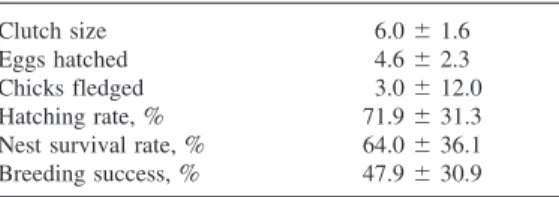
We found 26 (34.2%) Eurasian Blue Tit nests in 76 nest boxes with confirmed breeding attempts of cavity nesting species (Table 1).
Aromatic Plants in the Study Area and Nests.— Twelve aromatic plant species were detected on line transects; two others were recorded only in nest contents (Table 2). Another 10 aromatic plants were identified in the study area (Achillea ageratum, Eucalyptus camaldulensis, Juniperus oxycedrus, Lavandula pedunculata, Myrtus com-munis, Phagnalon saxatile, Pinus halepensis, P. pinea, Ruta chalepensis, Thymus sp.). All taxa are autochthonous from the Mediterranean Region except for Eucalyptus camaldulensis. Fragments from aromatic plants in nests represented a small part of the nest material and were placed in the nest cup between other materials (BAP, pers. obs.). We recorded fragments from one herbaceous and seven aromatic shrubby species in 16 of the 26 analyzed nests. The average 6 SE number of aromatic plant species per nest was 0.96 6 0.39.
Use vs. Availability.—Wilson’s 95% CI assess-ment indicated that Dittrichia viscosa, Lavandula dentata, and Calamintha baetica were the most frequent aromatic plants identified in nest material and were used by Eurasian Blue Tits more than expected according to availability in the study area (Table 2). Some aromatic fragments recorded in nests were from plant species not detected on transects (Lavandula dentata and Mentha spp.).
Aromatic Plants and Nest Survival Rate of Eurasian Blue Tits.—We detected predation of nestlings in five nests and excluded them from this analysis. We grouped survival rates (SR) from the 21 remaining nests into three classes: SR , 50%, 50% # SR , 75%, and SR $ 75%, and tested the null hypothesis that nest survival rate was independent of the presence of aromatic plants in the nest. Use of x2 with contingency
tables did not allow us to reject Ho (x2 5 2.87, df 5 1, critical value 5 3.84, a 5 0.05).
DISCUSSION
Aromatic species in Eurasian Blue Tit nests were a small proportion of all scented plants in the study area, suggesting non-random use of those species (e.g., Petit et al. 2002, Mennerat et al. TABLE 1. Breeding parameters (mean 6 SD) of
Eurasian Blue Tits using nest boxes in Parque Florestal de Monsanto (n 5 26).
Clutch size 6.0 6 1.6 Eggs hatched 4.6 6 2.3 Chicks fledged 3.0 6 12.0 Hatching rate,% 71.9 6 31.3 Nest survival rate,% 64.0 6 36.1 Breeding success,% 47.9 6 30.9
2009b). Mennerat et al. (2009a) found that choice of aromatic plants in nests was related to individual female preferences repeatable both within and across years. The major use of the three aromatic shrubby species most frequently detected in nests (D. viscosa, L. dentata, and C. baetica) suggests Eurasian Blue Tits actively search for plants that give them protection, as demonstrated by Lambrechts and Dos Santos (2000). This major use may be explained by the richness of terpenes with insecticidal properties: D. viscosa has in its chemical composition sesquiterpenes and monoterpenes working as insecticides, bactericides, and fungicides (Ibrahim et al. 2001, Blanc et al. 2006, Mamoci et al. 2011); C. baetica extracts and essential oils have showed positive effects against bacteria, fungi, and insects that affect stocked cereals and seeds (Matos 2011); L. dentata has an intense fragrance produced by oils rich in beta-pinene (Bousmaha et al. 2005), a chemical compound known as a potent insect repellent (Freeman and Beattie 2008).
Our observations of nest composition and structure indicate dried needles of P. pinea were used as a building material. However, a second function of pine needles as aromatic fragments cannot be ignored due to the richness of Pinus spp. in terpenes. Macchioni et al. (2002) found that 58.9 to 62.5% of the essential oils of needles, branches, and cones of P. pinea are limonene, a
compound known to decrease malaria parasite progression (Moura et al. 2001), and to reduce fleas and ticks on domestic animals (Hinkle 2010). We could not reject the null hypothesis that nest survival rate was independent of the presence of aromatic plants in the nest. This may be due to: (1) the small sample size of nests, and (2) because, ultimately, nearly all nests contained fragments of aromatic plants considering the presence of pine needles in 25 of the 26 nests.
ACKNOWLEDGMENTS
We thank Rita S. C. A. Moreira and the Lisbon City Hall for field support and facilities. We are grateful to Ade`le Mennerat and an anonymous referee for helpful comments improving an earlier version of the manuscript.
LITERATURE CITED
BAN´ BURA, J., J. BLONDEL, H. WILDE-LAMBRECHTS,ANDP. PERRET. 1995. Why do female Blue Tits (Parus caeruleus) bring fresh plants to their nests? Journal of Ornithology 136:217–221.
BLANC, M.-C., P. BRADESI, M. J. GONC¸ ALVES, L. SALGUEIRO, ANDJ. CASANOVA. 2006. Essential oil of Dittrichia viscosa ssp. viscosa: analysis by 13C-NMR and antimicrobial activity. Flavour and Fragrance Journal 21:324–332. BOUSMAHA, L., F. A. BEKKARA, F. TOMI, AND J.
CASANOVA. 2005. Advances in the chemical compo-sition of Lavandula dentata L. essential oil from Algeria. Journal of Essential Oil Research 17:292–295. CAMACHO, A., A. FERNANDE´ Z, C. FERNANDE´ Z, J. A LTA-REJOS, ANDR. LAURENT. 2000. Composition of the TABLE 2. Aromatic species in nests of Eurasian Blue Tits vs. available aromatic species in nesting habitats. Assessment is based on Wilson’s 95% CI comparing the percentage of nests with fragments of each aromatic species (Use) with the percentage of sampling units with that species (Availability).
Aromatic plant speciesa
Percent of nests with aromatic plant species (Use)
Percent of sample units containing
the species (Availability) Use vs. Availabilityb
Mean 95% CI
Calamintha baetica 30.77 12.68–48.86 2.14 More Cistus psilosepalus 3.85 0–11.38 0.71 No difference
C. salviifolius 3.85 0–11.38 2.14 No difference
Daphne gnidium 0 – 2.86 Less
Dittrichia viscosa 30.77 12.68–48.86 2.86 More
Foeniculum vulgare 0 – 0.71 Less
Geranium robertianum 0 – 7.86 Less
Hypericum perfoliatum 0 – 2.14 Less
Juniperus phoenicia 0 – 0.71 Less
Lavandula dentata 15.38 1.24–29.53 0 More
Lonicera periclymenum 0 – 0.71 Less
Mentha spp. 7.69 0–18.14 0 No difference
Origanum virens 3.85 0–11.38 2.14 No difference
Rosmarinus officinalis 0 – 1.43 Less
a
Species are listed in alphabetical order. Only species detected in nests and on line transects are listed.
b
We consider that an aromatic species was used more or less than expected if the proportion of sample units containing that species was respectively below or above the 95% CI.
essential oil of Dittrichia viscosa (L.). W. Greuter. Rivista Italiana EPPOS 29:3–8.
CLARK, L.ANDJ. R. MASON. 1985. Use of nest material as insecticidal and anti-pathogenic agents by the Euro-pean Starling. Oecologia 67:169–176.
CLARK, L.AND J. R. MASON. 1988. Effect of biological active plants used as nest material and the derived benefit to starling nestlings. Oecologia 77:174–180. DYKSTRA, C., J. HAYS,ANDM. SIMON. 2009. Selection of
fresh vegetation for nest lining by Red-shouldered Hawks. Wilson Journal of Ornithology 121:208–211. FREEMAN, B. C.ANDG. A. BEATTIE. 2008. An overview of
plant defenses against pathogens and herbivores. The plant health instructor. Iowa State University, Ames, USA. http://www.apsnet.org/edcenter/intropp/topics/ Pages/OverviewOfPlantDiseases.aspx
GWINNER, H. 1997. The function of green plants in nests of European Starlings Sturnus vulgaris. Behaviour 134: 337–351.
GWINNER, H. ANDS. BERGER. 2005. European Starlings: nestling condition, parasites and green nest material during the breeding season. International Journal of Ornithology 146:365–371.
GWINNER, H.ANDS. BERGER. 2006. Parasite defence in birds: the role of volatiles. Acta Zoologica Sinica 52:280–283. HINKLE, N. 2010. Animals: pets (companion animals)
external parasite control. Georgia pest management handbook. College of Agricultural and Environmental Sciences, University of Georgia, Athens, USA. http:// www.ent.uga.edu/pmh/
IBRAHIM, M., P. KAINULAINEN, A. AFLATUNI, K. T IILIK-KALA,ANDJ. HOLOPAINEN. 2001. Insecticidal, repel-lent, antimicrobial activity and phytotoxicity of essential oils: with special reference to limonene and its suitability for control of insect pests. Agricultural and Food Science in Finland 10:243–259.
LAMBRECHTS, M. M.ANDA. DOSSANTOS. 2000. Aromatic herbs in Corsican Blue Tit nests: the ‘Potpourri’ hypothesis. Acta Oecologica 21:175–178.
LAMBRECHTS, M. M., F. ADRIAENSEN, D. R. ARDIA, A. V. ARTEMYEV, F. ATIE´ NZAR, J. BAN´ BURA, E. BARBA, J.-C. BOUVIER, J. CAMPRODON, C. B. COOPER, R. D. DAWSON, M. EENS, T. EEVA, B. FAIVRE, L. Z. GARAMSZEGI, A. E. GOODENOUGH, A. G. GOSLER, A. GRE´ GOIRE, S. C. GRIFFITH, L. GUSTAFSSON, L. S. JOHNSON, W. KANIA, O. KEISˇ S, P. E. LLAMBIAS, M. C. MAINWARING, R. MA¨ ND, B. MASSA, T. D. MAZGAJSKI, A. P. MØLLER, J. MORENO, B. NAEF-DAENZER, J.-A˚ . NILSSON, A. C. NORTE, M. ORELL, K. A. OTTER, CH. R. PARK, CH. M. PERRINS, J. PINOWSKI, J. PORKERT, J. POTTI, V. REMES, H. RICHNER, S. RYTKO¨ NEN, M.-T.
SHIAO, B. SILVERIN, T. SLAGSVOLD, H. G. SMITH, A. SORACE, M. J. STENNING, I. STEWART, CH. F. THOMPSON, J. TO¨ RO¨K, P. TRYJANOWSKI, A. J. VAN NOORDWIJK, D. W. WINKLER,AND N. ZIANE. 2010. The design of artificial nestboxes for the study of secondary hole-nesting birds: a review of methodo-logical inconsistencies and potential biases. Acta Ornithologica 45:1–26.
MACCHIONI, F., P. L. CIONI, G. FLAMINI, I. MORELLI, S. MACCIONI,ANDM. ANSALDI. 2002. Chemical compo-sition of essential oils from needles, branches and cones of Pinus pinea, P. halepensis, P. pinaster and P. nigra from central Italy. Flavour and Fragrance Journal 18:139–143.
MAMOCI, E., I. CAVOSKI, V. SIMEONE, D. MONDELLI, L. AL -BITAR,ANDP. CABONI. 2011. Chemical composition and in vitro activity of plant extracts from Ferula communis and Dittrichia viscosa against postharvest fungi. Molecules 16:2609–2625.
MATOS, O. 2011. The use of plants to fight toxin producers’ pests and microorganisms that cause diseases in animals and humans via food (in Portuguese). Page 7 in I Garcia de Orta Conference—Medicinal plants. Institute of Hygiene and Tropical Medicine, Lisbon, Portugal. MENNERAT, A., P. PERRET,ANDM. M. LAMBRECHTS. 2009a.
Local individual preferences for nest materials in a passerine bird. PLoS ONE 4(4):e5104. DOI:10.1371/ journal.pone.0005104
MENNERAT, A., P. PERRET, P. BOURGAULT, J. BLONDEL, O. GIMENEZ, D. W. THOMAS, P. HEEB, AND M. M. LAMBRECHTS. 2009b. Aromatic plants in nests of Blue Tits: positive effects on nestlings. Animal Behaviour 77:569–574.
MOURA, I., G. WUNDERLICH, M. UHRIG, A. COUTO, V. PERES, A. KATZIN,ANDE. KIMURA. 2001. Limonene arrests parasite development and inhibits isoprenyla-tion of proteins in Plasmodium falciparum. Antimi-crobial Agents and Chemotherapy 45:2553–2558. NEWCOMBE, R. G. 1998. Two-sided confidence intervals for
the single proportion: comparison of seven methods. Statistics Medicine 17:857–872.
ONTIVEROS, D., J. CARO,ANDJ. M. PLEGUEZUELOS. 2007. Green plant material versus ectoparasites in nests of Bonelli’s Eagle. Journal of Zoology 27:99–104. PETIT, C., M. HOSSAERT-MCKEY, P. PERRET, J. BLONDEL,
ANDM. M. LAMBRECHTS. 2002. Blue Tits use selected plants and olfaction to maintain an aromatic environ-ment for nestlings. Ecology Letters 5:585–589. WIMBERGER, P. H. 1984. The use of green plant material in