Palavras chave: qualidade da madeira poda biomassa diâmetro do galho comprimento do galho Histórico: Recebido 13/12/2013 Aceito 13/04/2015 Keyworks: wood quality pruning biomass branch diameter branch length
Correspondence: [email protected]
DOI: 10.1590/01047760201521031806
Leif Nutto1, Ricardo Malinovski1, Mário Dobner Jr.1, Martin Brunsmeier2
BRANCH DEVELOPMENT OF EUCALYPTS MANAGED FOR SAWLOGS
ABSTRACT: Species of the genus Eucalyptus managed for sawlogs in fast-growing plantations show high potential for substitution for valuable native hardwoods. To obtain high quality wood, technical pruning is necessary.The objective of the study is to analyse the development of the branches for the first and second pruning lifts and to quantify the biomass of the pruned branches. For the study two stands of Eucalyptus grandis were selected (age 18 and 36 months) for evaluating a pruning lift from 0 to 3 m and 3 to 6 m. The average branch diameter and length were 18 mm and 2.1 m in the younger stand and 21 mm and 2.3 m in the older one. The relation between branch diameter and branch length could be expressed in a linear model (R² = 0.8). In both stands a higher proportion of branches were already dead. The oven-dry biomass of the pruned branches was 2.2 ton.ha-1 in the first pruning lift and 1.2 ton.ha-1 in the second. The results showed that branch development in wide spaced and early thinned eucalypt plantations is in line with the objective of high quality wood production. Pruning should take place before 18 month to avoid dead branches. The oven-dry branch biomass cut in the two pruning lifts shows a low volume making a commercial utilization difficult.
DESENVOLVIMENTO DE GALHOS NO FUSTE DE EUCALIPTOS MANEJADOS PARA SERRARIA
RESUMO: Espécies do gênero Eucalyptus, manejadas com o objetivo de produzir madeira para serraria em plantios de rápido crescimento, demonstram um grande potencial para substituir madeiras nativas nobres. Para que madeira de alta qualidade seja obtida, povoamentos precisam ser necessariamente podados. O objetivo do estudo é analisar o desenvolvimento dos galhos presentes no momento da primeira e segunda podas e quantificar a biomassa obtida com a remoção dos mesmos. Dois povoamentos de Eucalyptus grandis foram selecionados (idades 18 e 36 meses) para a avaliação das podas de 0 a 3 m e de 3 a 6 m. O diâmetro e comprimento médios foram 18 mm e 2,1 m no povoamento mais jovem e 21 mm e 2,3 m no mais velho. A relação entre o diâmetro e o comprimento dos galhos pode ser expressa em um modelo linear (R²=0,8). Nos dois povoamentos uma maior proporção de galhos já estava morta. O peso seco em estufa da biomassa produzida pela poda dos galhos foi 2,2 ton.ha-1 na primeira intervenção e 1,2 ton.ha-1 na segunda. Os resultados demonstraram que o desenvolvimento dos galhos em plantações de eucalipto estabelecidas com espaçamentos amplos e desbastadas estão de acordo com o objetivo de se produzir madeira de alta qualidade. A poda, entretanto, precisa iniciar antes dos 18 meses para evitar galhos mortos. O peso seco da biomassa de galhos produzida nas duas intervenções é insuficiente para permitir sua utilização comercial.
1 UFPR, Curitiba, Paraná, Brasil
INTRODUCTION
In the last decade the hardwood volumes coming from tropical rainforests in Brazil have been reduced by half (SFB; IMAZON, 2010). It is becoming more and more difficult for the wood industry based on high quality hardwood timber to meet their demand from native forests. A clear trend can be seen for sustainably managed high-grade tropical hardwood plantations to play a more important role. Besides well-known plantation-grown hardwood species like teak or gmelina, eucalypts also show high potential for providing wood of outstanding quality in relatively short rotation cycles. Eucalyptus plantations in Brazil are mainly managed under pulp-wood regimes (ABRAF 2013). However, considerable areas of eucalypts have been planted and managed for sawlog production in recent years all over the world (FAO 2010). The initial spacing is kept to less than 750 trees.ha-1 and the first thinning is conducted before 2 years of age. An early first pruning lift up to 3 m is conducted at the age of 15 to 20 months and a second one up to 6 m at 36 to 40 months in order to guarantee high quality wood. Little is known about branch development with such low initial spacing, specifically about the branch length, branch diameter, and biomass of the branches in the first 6 m, which are removed during the pruning process and make up part of the forest residues.
Although the use of eucalypts for solid-wood products in Brazil is relatively confined, in Australia, the genus dominate the solid-wood appearance product market, particularly for flooring, home fittings and, to a lesser extent, for furniture (Wough 2004). According to the same author, industries started being supplied by high-quality old-growth resources. However, over the last decades, it has been adapted to younger, faster-grown stands.
Knots have been the major grade-limiting factor, whether recovery was evaluated using structural or appearance criteria (WASHUSEN et al., 2000). Previous studies indicated that thinning and pruning are the key silvicultural interventions for managed sawn-log eucalypt plantations (SHIELD, 2004; NUTTO; TOUZA VÁZQUEZ, 2006; FORRESTER et al., 2013; WASHUSEN, 2013). Without both interventions, the
timber produced will not be capable of commanding the stumpage price levels potentially available.
The presence of knots is the most common grade-limiting defect affecting the products of sawn timber from eucalypt plantations in terms of appearance and structural grade. Several authors described a significant improvement of up to 35% in the appearance grade of timber in pruned material relative to unpruned material (MAESTRI et al., 2004). Pruning is undertaken to maximize the amount of clear wood produced by a tree. Studies from Australia, South Africa, and Southern Europe strongly recommend pruning for eucalypt sawlog production (BREDENKAMP et al., 1980; HENSKENS et al., 2001; NUTTO; TOUZA VÁZQUEZ, 2006; PINKARD; BEADLE, 1998a, b; SCHÖNAU, 2002). The targeted specifications for logs should be based on a maximum allowable knotty core diameter (STACKPOLE, 2001). For example, to produce a 90% clear wood volume from a 6 m log would require an average log diameter at harvest of 50 cm and a knotty core diameter of 15 cm (GERRAND et al., 1997). To optimize the time and height of pruning, more information about the branchiness of fast-growing eucalypts is needed (SCHÖNAU, 2002; ALCORN et al., 2007).
Another widely discussed issue in tropical plantations is the potential use of forest residues for bio-energy. Branches from pruning operations in plantations managed for sawlogs as well as material from pre-commercial thinnings offer additional raw material for energy generation (COUTO et al., 1984; FOELKEL, 2007).
The overall objective of the study is to analyse the branch development of an 18- and a 36-month-old Eucalyptus grandis stand with an initial spacing of 5 × 2.8 m for the first two pruning lifts up to 3 and 6 m height.
The detailed objectives are: a) analysis of diameter, length and status (live or dead) of branches; b) analysis of number of branches per tree; c) quantification of the available branch biomass from pruning operations for potential use.
MATERIAL AND METHODS
54° east, with a predominantly sub-tropical climate. For the first pruning lift an 18-month-old stand of Eucalyptus grandis Hill ex Maiden was selected. The trees of the clone G23 were planted with an initial spacing of 5 x 2.8 m (715 trees.ha-1). No silvicultural intervention besides mechanical cleaning of weeds occurred until this age. The stand selected for the second pruning lift was a 36-month-old plantation of E. grandis, also planted with an initial spacing of 5 × 2.8 m. At the age of 17 months a first pruning lift up to 3 m height was performed on 475 trees.ha-1, and at the age of 20 months thinning was performed where the unpruned trees were removed.
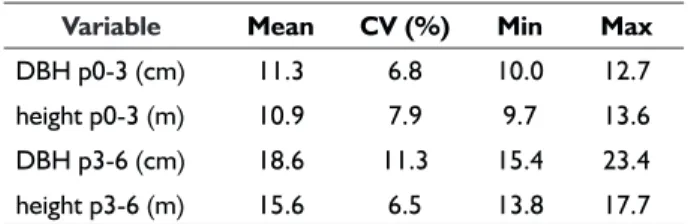
For the experiment, 180 trees in each age class were pruned and the total number of branches cut per tree during the pruning process was counted. At every tenth tree the diameter and length of all cut branches bigger than 7 mm were measured and the green weight without leaves was determined. The 7-mm limit was chosen because almost all of these branches were already dead and could not be separated from naturally pruned branches found on the forest floor. With regard to potential utilization, these twigs are very small and cannot be collected with a mechanical harvesting system for forest residues. From all branches cut from an individual tree, one branch representing the average diameter and length plus or minus one standard deviation was selected for measurement of moisture content. The leaves were removed because they would not make up part of the biomass utilized. The cut branches remain in the forest for several weeks and the leaves fall off during this time. For all trees, the diameter at 1.3 m height (DBH) was measured with a diameter tape and the tree height (h) was measured using a Forestor Vertex IV (Table 1).
The trees used in the study are very homogeneous in diameter and height development.
The green weight of all branches larger than 7 mm per tree was measured with a balance (precision: ± 10 g) immediately after pruning. To measure the branch diameter, a calliper with a precision of 0.1 mm was used, measuring two diameters in an angle of 90° at the base of the branch. Branch length was assessed with a measuring tape, following the curvature of the branch. Branches used for moisture determination were cut and packed in plastic bags directly after data collection. In the laboratory the green weight of the branch was measured
with a high precision balance before oven-drying the sample until it reached a constant weight. The oven-dry weight was measured with the same balance.
TABLE 1 Mean value, coefficient of variation, minimum and maximum values of diameter at 1.3 m height (DBH), and height of the trees after the pruning lifts (p0-3 m and p3-6 m).
TABELA 1 Valores médios, coeficiente de variação, valores mínimo e máximo para o diâmetro a 1.3 m de altura (DAP), e altura das árvores no experimento após as podas (p0-3 m e p3-6 m).
Variable Mean CV (%) Min Max
DBH p0-3 (cm) 11.3 6.8 10.0 12.7
height p0-3 (m) 10.9 7.9 9.7 13.6 DBH p3-6 (cm) 18.6 11.3 15.4 23.4 height p3-6 (m) 15.6 6.5 13.8 17.7
All statistical calculations were done using the software SAS® version 9.1.3 (SAS Cooperation Inc, 2006). For multivariate modelling the approach “forward selection” was used, which involves starting with no variables in the model, testing the addition of each variable using a chosen model comparison criterion, adding the variable that improves the model the most, and repeating this process until none improves the model.
RESULTS
To evaluate the natural conditions for pruning of the 18-month-old eucalypts, the tree parameters related to the pruning operations are presented (Table 2).
Considerable differences in branch development of the individual trees could be found. The average branch diameter in the second pruning lift is slightly higher compared to the one at 3 m, but the maximum diameter does not exceed 40 mm, while in the younger stand bottom branches up to 50 mm in diameter were found. The coefficient of variation for both pruning lifts is identical for branch diameter, while for branch length it is 6% higher for the second lift. The average branch length also increases up to 6 m height, but as the Tukey test shows, the mean values are not significantly different.
TABLE 2 Branch data of the material used in the pruning experiment (N = 180 trees per pruning lift). Branch diameters and lengths were only measured at every tenth pruned tree, while the number of branches per tree was counted for every tree. The Tukey test is at p < 5%; values with the same letters are not signifi cantly different (p0-3 m and p3-6 m). TABELA 2 Dados relacionados aos galhos podados no presente experimento (N = 180 árvores por intervenção). O diâmetro
e o comprimento dos galhos foram medidos a cada décima árvore, enquanto o número de galhos por árvore foi contado em todas. Teste de Tukey com p < 5 %; valores seguidos da mesma letra não diferem entre si (p0-3 m and p3-6 m).
Variables mean minimum maximum CV (%)
p0-3 p3-6 p0-3 p3-6 p0-3 p3-6 p0-3 p3-6
branch diameter (mm) 17.8 (A) 20.2 (B) 7.3 8.3 50.7 40.9 33 33
living branch 19.8 26.4 9.2 17.2 50.7 40.9 30 19
dead branch 14.2 16.7 7.3 8.3 29.5 30.0 28 28
branch length (m) 2.18 (A) 2.33 (A) 1.08 0.91 4.92 4.52 28 34
living branch 2.41 3.02 1.15 1.75 4.92 4.52 24 20
dead branch 1.65 1.94 1.08 0.89 2.42 3.22 21 27
branch/tree (N) 18.0 (A) 11.6 (B) 15 6 21 17 10 28
living branch 11.2 4.3 5 0 16 11 36 74
dead branch 6.8 7.3 1 0 14 15 57 58
FIGURE 1 Branch length over branch diameter, showing a
strong linear correlation between the two variables (R² = 0.82).
FIGURA 1 Comprimento dos galhos em função dos seus respectivos diâmetros, demonstrando uma forte correlação linear entre as duas variáveis (R² = 0.82).
There is a strong correlation between branch length and branch diameter. The maximum diameters are bigger in the younger stand, reaching more than 50 mm in some cases. In the upper heights of the older stand, the branch diameter does not exceed 41 mm. If the number of branches per tree is compared, differences between the two pruning lifts become more apparent. The average number of pruned branches per tree in the fi rst pruning lift is 18. About one third of these branches are already dead at the age of 18 months, even with an initial spacing of 5 × 2.8 m.
This relation changes in the second pruning lift between 3 and 6 m. At the age of 36 months, 60% of the branches are already dead at the respective height. The coeffi cient of variation among the pruned branches per tree is 74% for living branches and 58% for dead branches, indicating a high variability.
The results show that in eucalypt plantations established with wide initial spacing and managed for sawlog production, relatively long branches with big diameters had already formed at the age of 18 months. While branch length is not significantly different, branch diameter increases (10%) and the number of branches per tree decreases (65%) significantly between pruning procedures.
The green weight of the branches per individual tree did not differ signifi cantly between the two pruning heights. At the fi rst pruning lift an average of 8.36 kg of branches (without leaves) bigger than 7 mm was removed. In the second lift this value decreased to 6.74 kg. Since the measured value included dead and living branches, the moisture content varied between 36 and 56%.
TABLE 3 Model parameters for estimation of green weight of branches (in kg) bigger than 7 mm per tree (without leaves) for the fi rst pruning lift up to 3 m. TABELA 3 Parâmetros do modelo para estimar o peso verde
dos galhos maiores que 7 mm por árvore (sem folhas) para a primeira poda até 3 m de altura.
Variables Parameter estimate
Standard Error
Type II
SS F Value Pr > F
intercept -35.662 8.539 22.816 17.44 <0.001
DBH (cm) 1.315 0.405 13.793 10.54 0.007
branch
length (m)* 8.348 1.771 29.054 22.21 0.003
N branches 0.622 0.161 19.573 14.96 0.002
Type II SS: = For main-effects models and regression models, the
gen-eral form of estimable functions can be manipulated to provide tests
of hypotheses involving only the parameters of the effect in question.
The same result can also be obtained by entering each effect in turn as the last effect in the model and obtaining the Type I SS for that effect.
These are the Type II SS; F Value: is the ratio of the Model Mean Square
to the Error Mean Square; Pr: predicted value; *Mean value per tree.
A summary of the stepwise selection proce-dure is shown in Table 4. The overall model fit for the selected variables is shown in Table 3. A coefficient of determination of 0.68, a standard error of estima-tion of 18.9 % and a C (p) of 3.918 is reached with the three variables entered in the model. The over-all model is significant (Pr > F 0.001). The graphic analysis of residual distribution among the predicted green weight is given in Figure 2 (0-3 m).
The most important variable explaining most of the variance in the model is branch length, fol-lowed by number of branches and diameter at 1.3 m height.
TABLE 4 Summary of the stepwise regression procedure fitted for estimation of the green weight of branches (in kg) bigger than 7 mm per tree (without leaves) for the first pruning lift up to 3 m.
TABELA 4 Resumo da regressão stepwise para estimar o peso de galhos com mais de 7 mm (sem folhas) para a primeira poda até 3 m de altura. Step Variable Partial
R²
Model
R² F Value Pr > F
1 branch length 0.266 0.266 5.81 0.0285
2 N branches 0.169 0.435 4.47 0.0516
3 DBH 0.243 0.678 10.54 0.0058
FIGURE 2 Residual distribution among the predicted green weight for both prunning operations: 0-3 m and 3-6 m height.
FIGURE 2 Distribuição residual entre o peso verde previsto para ambas as operações poda : 0-3 m e 3-6 m de altura.
For the second pruning lift at the tree height of 3 to 6 m, the variables explaining most of the variance are again branch length and branch diameter. Instead of DBH, tree height enters the model (Table 5).
TABLE 5 Model fi tted for estimation of green weight of branches (kg) bigger than 7 mm (without leaves) per tree for the second pruning lift from 3 to 6 m. TABELA 5 Parâmetros do modelo para estimar o peso
(kg) verde dos galhos maiores que 7 mm por árvore (sem folhas) para a segunda poda de 3 a 6 m de altura.
Variable Parameter estimate
Standard Error
Type II SS
F
Value Pr > F
Intercept -13.618 7.931 11.806 2.95 0.108
height (m) -0.890 0.538 10.955 2.74 0.094 branch length
(m) 10.880 1.738 156.792 39.15 <0.001
to 3 m is about 21% higher than that of the cut branches of the 3- to 6-m section in the 36-month-old stand. The available oven-dry branch biomass is 2.2 metric tons per hectare in the first pruning lift, which is 91% more than the value reached at the second pruning lift (1.2 metric tons) applying the sawlog management regime described in this study. For the pruning operations performed by the company an oven-dry biomass of 3.6 tons per hectare is produced as forest residues in one rotation cycle.
TABLE 7 Weight of biomass of pruned branches per tree and per hectare estimated with the models pre-sented in Tables 3 and 5 and Equation 2, using the mean values from the tables.
TABELA 7 Peso da biomassa obtida com a poda dos galhos por árvore e por hectare, estimada a partir dos modelos apresentados nas Tabelas 3 e 5 e Equa-ção 2, considerando valores médios.
Prunning lift
Green weight (kg.tree-1)
Oven-dry weight (kg.tree-1)
Pruned trees
Oven-dry biomass (ton.ha-1)
1 (0 to 3m)* 8.4 4.69 475 2.228
2 (3 to 6m)** 6.6 3.88 300 1.164
*mean values used: DBH=11.3cm; branch length=2.18m; number of branches > 7mm=18; ** mean values used: tree height=15.6m; branch length=2.33m; number of branches > 7mm=11.6.
DISCUSSION
The analysis of the branch data showed that the management for sawlogs, including wider initial spacing and early thinning, may lead to branches with large diameters. The mean branch diameters of 18 and 20 mm for P3 and P6, respectively, should not be a problem for a fast and efficient wound occlusion after pruning. Interestingly, the larger maximum branch diameters are found in younger stands. This is linked to the fact that the analysed clone tends to develop one or two strong branches at the bottom of the stem with the initial spacing used for planting. The biggest branches are found at the bottom of the younger trees, all at a height of between 20 and 30 cm. This fact is a genetic peculiarity of the analysed 18-month-old material and could be found in 30% of the stems pruned for the study. Whether or not these branches develop well depends on the position of the buds of these branches during planting: if they are oriented in line, they do not have enough sunlight and develop normally (MONTAGU et al 2003). If they have space to grow between the 5 m lines, A summary of the stepwise selection
proce-dure is shown in Table 6. The overall model fit for the selected variables is shown in Table 5. A coefficient of determination of 0.76, a standard error of estimation of 37.1 % and a C (p) of 3.391 is reached with the vari -ables entered in the model. The overall model is signif -icant (Pr > F 0.001). The graphic analysis of residual distribution among the predicted green weight is given in Figure 2 (3-6 m).
TABLE 6 Summary of the stepwise regression procedure fitted for estimation of green weight of branches bigger than 7 mm (without leaves) per tree for the second pruning lift from 3 to 6 m.
TABLE 6 Resumo da regressão stepwise para estimar o peso de galhos com mais de 7 mm (sem folhas) para a segunda poda de 3 a 6 m de altura.
Step Variable Partial R² Model R² F Value Pr > F
1 branch length 0.363 0.363 9.13 0.008
2 N branches 0.352 0.715 18.51 <0.001
3 Height 0.046 0.761 2.74 0.090
The models allow estimation of the green weight of pruned branches of the individual tree at the first and second pruning lifts with good precision. Since moisture content is variable, a conversion from fresh to oven-dry weight is useful for evaluation of harvesting, transport, and potential utilization.
The data of moisture content measured in subsamples in the laboratory allowed the correlation between fresh and dry weight of the cut branches to be analysed. A simple linear model of both variables resulted in the model: Oven-dry weight (g) = 0.5491 * green weight (g) – 26.802 (R² = 0.98)
Using the models presented in Tables 3 and 5 and Equation 2, the oven-dry weight of the forest residues produced in these operations could be calculated. Since branch development might be influenced by initial spacing and thinning, the calculated values are only valid for this specific kind of management, where the values of the independent variables are in the range of the data collected in the study (Table 2).
they grow to larger diameters of up to 50 mm or more at the age of 18 months. This could be observed with other clones too, but no studies about this are available. The clonal material usually planted in the plantations come from breeding programs established by the pulp and paper companies, where denser initial spacings are used and branch development is of less importance. For further investigation, specific breeding programmes for plantations aimed at producing solid wood products should be started. According to Wardlaw and Neilsen (1999) the risk of internal decay or rottenness increases significantly with branches of more than 30 mm in diameter because of the delay in the occlusion process of the wounds caused by pruning. The time of cicatrization depends on the size of the wound and the diameter increment during the period of occlusion. A higher diameter growth allows the tree to occlude an even bigger wound in a short time and therefore to avoid the risk of decay (WARDLAW & NEILSEN 1999). The average diameter increment of the 18-month-old stand exceeds 7 cm.yr-1, while that of the older stand is still more than 6 cm.yr-1. This might be one reason why in eucalypt stands managed for sawlog production decay is rarely found because of pruning activities in Brazil, even if branches bigger than 50 mm are cut (KÖNIG, 2005).
The wider initial spacing with distances of 5 m between the planting rows leads to branches of up to 5 m length. A strong correlation between branch length and diameter could also be observed in the study material. In early studies this relationship was already proved for conifers (DELEUZE et al., 1996), broadleaved softwoods (NELSON et al., 1981) and hardwood species (HENSKENS et al., 2001). The average branch length ranges between 2.2 and 2.4 m, indicating that in planting rows with 5 m spacing the branches tend to occupy the space between the rows. Since the branch angle in eucalypts is rarely horizontal, some of the branches develop more vigorously and reach lengths of more than 4 m. The fact that branch length remains constant between the 18- and 36-month-old stands indicates that competition between trees, even with thinning at month 20, remains almost the same. Crown expansion no longer happens at tree heights between 3 and 6 m. The average height growth of the 18-month-old stand is about 7.2 m.yr-1, while that of the older stand is 5.2 m.yr-1. The adequate height growth dynamic prevents the further development of branches in the lower parts
of the crown subject to pruning.
Another important finding is that more than half of the branches in the younger stand and almost two thirds of the branches in the older stand were already dead, reaching diameters up to 30 mm with averages between 14 and 17 mm. For good quality pruning of eucalypts, pruning of green branches is highly recommended (NUTTO E VÁZQUEZ 2006) Natural pruning of E. grandis is debated in the literature. While early studies state that eucalypts show good self-pruning, studies from Australia and South Africa strongly recommend pruning for eucalypt sawlog production (HENSKENS et al., 2001; PINKARD; BEADLE, 1998a; SCHÖNAU, 2002). Especially when managed under a fast-growing regime, species of the genus Eucalyptus tend to include dead branches partly in the wood of the bole. Thus, a knotty core of larger dimension is sustained, reducing the value of the wood. With more growing space the crown develops more vigorously and the branches stay alive for a longer period. Therefore, if the aim is to produce more clear wood, artificial pruning is recommended (MEDHURST et al., 2001). Pruning of dead branches, however, leads to pockets in the stem wood which are filled with gum, resulting in checks and undesired disturbances in the fibre flow in the inner part of the stem. In the case of the spacing and growth conditions found in the study area, the first pruning lift should take place earlier, before branches start to die. However, about 50% of the green crown should remain in order to avoid influencing tree growth negatively (PINKARD E BEADLE 1998b). That would be the case with tree heights of around 6 to 7 m, while the material for the first pruning lift was already 11 m high. Considering the height growth dynamic found in the stand, the first pruning should take place earlier, at heights of 7 to 8 m, and the second between 18 and 24 months, when the trees reach heights of about 12 m. This would avoid the pruning of dead branches and lead to higher pruning quality with reduced knotty cores. According to previous observations, crowns with lengths of 3-4 m are enough to guarantee diameter growths similar to the ones observed on unpruned trees (SEITZ, 2004, personal communication).
18 months. The branches in the second pruning zone are already suffering from more intra-tree and inner-tree competition, resulting in a reduction of biomass in this zone. The weight of oven-dry biomass of the pruned branches is about 3.4 metric ton.ha-1, while two-thirds of it are from the first pruning lift. This quantity can hardly be collected in an economically feasible way with existing harvesting technologies. Calculations for the mechanized collection of harvesting residues after a clear cut of eucalypt plantations managed for pulpwood production show difficulties in reaching the break-even point for the harvesting costs, even with 20 to 30 tons of biomass per hectare (FOELKEL, 2007). Studies estimating only the branch biomass of pruning lifts are rare. Most of the studies focus on calculating the biomass of the whole tree and its compartments, separating them into stem wood, bark, and branches (COUTO et al., 1984). On the other hand, the development of forest machinery and new equipment may offer solutions for harvesting smaller quantities of pruning biomass in the future (LEINONEN, 2004). Additional biomass is produced by pre-commercial thinnings which might increase the available residue volumes to economically interesting volumes. On the other hand, the accumulated branch biomass on the forest floor may cause a higher risk of forest fires (MAGALHÃES, 2006). The federal Brazilian forest legislation as well as local regulations are dealing more and more with the problems and risks caused by forest plantation management and also wasting of forest biomass, forcing producers to innovate and optimize their management and logistic concepts (Norma ABNT NBR 10004/1987).
Finally, it has to be mentioned that harvesting all residues from a forest stand might not be intended due to the reduction of nutrient cycling by increasing nutrient exportation. Further investigations should address this additional issue.
CONCLUSIONS
For the studied conditions, and for a good quality of pruning (pruning of green branches), the 1st pruning operation (0-3 m height) should be carried out before 18 months, at the moment trees reach ~8 m height. The second pruning procedure (3-6 m) is optimally undergone by the time trees reach ~12 m height, between 18-24 months.
Pruning of the 0-6 m basis segment of E. grandis trees deliver ~3.4 metric tons of oven dry biomass, two-thirds of which during the first intervention (0-3 m).
Regression models were successfully fitted for estimating the green weight of branches obtained in the two pruning operations.
REFERENCES
ABRAF. Anuário Estatístico ABRAF 2013 anos base 2012. ABRAF, Brasil 148p, 2013.
ALCORN, P. J.; PYTTEL, P.; BAUHUS, J.; SMITH, G. R.; THOMAS, D.; JAMES, R.; NICOTRA, A. Effects of initial planting density on branch development in 4-year-old plantation grown Eucalyptus pilularis and Eucalyptus cloeziana trees. Forest Ecology and Management, v. 252, p. 41-51, 2007.
BREDENKAMP, B. V.; MALAN, F. S.; CONRADI, W. E. Some effects of pruning on growth and timber quality of Eucalyptus grandis in Zululand. South African Forestry Journal, v. 114, p. 29-34, 1980.
COUTO, H. T. Z.; BRITO, J. O.; TOMAZELLO FILHO, M. Quantificação de resíduos florestais para produção de energia em povoamento de Eucalyptus saligna. IPEF, v. 26, p. 19-23, 1984.
DELEUZE, C.; HERVE, J. C.; COLIN, F.; RIBEYROLLES, L. Modelling crown shape of Picea abies: spacing effects. Canadian Journal of Forest Research, v. 26 p. 1957-1966, 1996.
FAO. Global Forest Resources Assessment. FAO, Roma 2010.
FOELKEL, C. Gestão ecoeficiente dos resíduos florestais lenhosos da eucaliptocultura. Eucalyptus Online Book, 2007. www.eucalyptus.com.br. Acc. January 12, 2013. FORRESTER, D. I.; MEDHURST, J. L.; WOOD, M.; BEADLE,
C. L.; VALENCIA, J. C.; HARWOOD, C. 2013. The effect of solid-wood silviculture on growth, form and wood properties in Eucalyptus plantations: an Australian perspective. Forest & Wood Products Australia, Project no. PNB291-1112B, Melbourne, 102 p., 2013.
GERRAND, A. M.; NEILSEN, W. A.; MEDHURST, J. L. Thinning and pruning eucalypt plantations for sawlog production in Tasmania. Tasforests, v. 9, p. 15-34, 1997.
KÖNIG, C. Optimizing the production of high value timber in fast growing Eucalyptus plantations in Brazil. Master thesis at the University of Freiburg, Germany, 2005.
LEINONEN, A. Harvesting Technology of Forest residues for fuel in the USA and Finland. VTT Research Notes 2229, VTT, Valopaino Oy, Helsinki, 2004.
MAESTRI, R.; SATORI, R. C.; MATTOS, J. L. M., NUTTO, L. Wood properties of fast grown plantation eucalypts in Brazilfor high value timber production. Electronic Publication (CD), Lugo, Spain, 15p., 2004.
MAGALHÃES, T. G. D. O uso da biomassa na gestão do risco de incêndio florestal no concelho de FAFE. Dissertation, University of Porto, Portugal, 2006.
MEDHURST, J. L.; BEADLE, C. L.; NEILSEN, W. A. Early-age and later-age thinning affects growth, dominance, and intraspecific competition in E. nitens plantations. Canadian Journal of Forest Research, v. 31, p. 187-197, 2001. MONTAGU, K.; KEARNEY, D.; SMITH, G. Pruning eucalypts:
the biology and silviculture of clear wood production in planted eucalypts. RIRDC n. 02/152, Rural Industries Research and Development Corporation, Canberra. 2003.
NELSON, N. D.; BURK, T.; ISEBRANDS, J. G. Crown architecture of short-rotation intensively cultivated Populus. Effects of clone and spacing on first-order branch characteristics. Canadian Journal of Forest Research, v. 11, p. 73-81, 1981.
NUTTO, L., TOUZA VÁZQUEZ, M. C. Modelos de producción de madera sólida en plantaciones de Eucalyptus globulus de Galicia. Boletín del CIDEU, v. 2, p. 37-50, 2006.
PINKARD, E. A.; BEADLE, C. L. Effects of green pruning on growth and stem shape of Eucalyptus nitens (Deane and Maiden) Maiden. Canadian Journal of Forest Research, v.15, n.2, p. 107-126, 1998a.
PINKARD, E. A.; BEADLE, C. L. Regulation of Photosynthesis in Eucalyptus nitens (Deane and Maiden) Maiden following green pruning. Trees, n. 12, p. 366-376, 1998b.
SAS Institute Inc. Base SAS® 9.1.3 Procedures Guide, Second Edition, Volumes 1, 2, 3, and 4. Cary, NC: SAS Institute Inc, 1906,p, 2006.
SHIELD, E. Silviculture for sawlog – a review of the key elements, with special reference to Eucalyptus grandis. In: Borralho N. et al. (2004) Eucalyptus in a changing world. Proceedings of IUFRO conference, Aveiro, 2004.
SCHÖNAU, A. P. G. The effect of planting espacement and pruning on growth, yield and timber density of Eucalyptus grandis. South African Forestry Journal, v. 88, p. 16-23, 2002.
SFB, IMAZON. A atividade madeireira na Amazônia brasileira: produção, receita e mercados. Rep. CDD: 333.7509811, 2010.
STACKPOLE, D. Eucalypt stem pruning. Agriculture Notes AG0773:1-2, 2001.
WARDLAW, T. J.; NEILSEN, W. A. Decay and other defects associated with pruned branches of Eucalyptus nitens. Tasforests, v. 11, p. 49-57, 1999.
WASHUSEN, R.; WAUGH, G.; VINDEN, P.; HUDSON, I. Appearance product potential of plantation hardwoods from medium rainfall areas of the southern Murray-Darling Basin. Green product recovery. Australian Forestry, v. 63, p. 66-71, 2000.
WASHUSEN, R. Processing methods for production of solid wood products from plantation-grown Eucalyptus species of importance to Australia. Forest & Wood Products Australia, Project no. PNB291-1112A, 58 p., 2013.
WAUGH, G. Growing Eucalyptus globulus for high quality sawn products. In: Borralho N. et al. (2004) Eucalyptus