DIFFERENT VIEWS ON WEB 2.0: AN OVERVIEW
Johannes Reiter
Erasmus Student of Computer Engineering Faculty of Science and Technology University Fernando Pessoa, Porto, Portugal
Luis Borges Gouveia
Associate Professor
Faculty of Science and Technology University Fernando Pessoa, Porto, Portugal
ISSN: 1646-0499
83
ABSTRACT
Web 2.0 is nowadays a popular concept. This concept was introduced in 2004 and it fast became widely used. It also produced a number of changes in the way we use and interact with the World Wide Web. From a more technologic oriented view, the Web 2.0 introduced a more distributed and functional approach based on people, in contents and in interaction between groups of individuals.
This paper presents the Web 2.0 from a number of perspectives, aiming to show the broad impact that Web 2.0 can achieve as a concept proposal based on the value it can provide to the Internet user.
KEYWORDS
Web 2.0, Internet tools, information society, digital technology
RESUMO
A Web 2.0 é um conceito em voga. Introduzido durante o ano de 2004 rapidamente se tornou bastante popular e produziu mudanças significativas na forma como a Internet e em especial a World Wide Web é explorada. De uma perspectiva mais tecnológica, a Web 2.0 in-troduziu uma preocupação mais distribuída e funcional, assente em pessoas, nos conteúdos e na interacção proporcionada a grupos de indivíduos.
Este trabalho apresenta a Web 2.0 de acordo com diversas perspectivas, demonstrando o impacte alargado que a Web 2.0, enquanto conceito, pode proporcionar ao utilizador da Internet.
PALAVRAS-CHAVE
on that new platform
and described more detailed in an article written and published by Tim O’Reilly, the owner of O’Reilly Media in the year 2005. This article is used as a basic definition for the topic Web 2.0. But up to now no exact definition of the term Web 2.0 exists, so there can be different views, which depend on the viewer’s side on the term.
This paper tries to describe four different views, the technological view, the economical view, the social view and the political view. The technological view describes the basic te-chniques which enabled the creation of Web 2.0 Applications. For this purpose the terms Ajax, RIA, SLATES, and CMS get analyzed. These basic technologies enabled the creation of new applications, which are used on one side for the economical view named Enterprise 2.0, which is a new way for enterprises to deal with the topic World Wide Web and which is also described in this paper.
On the other side they are also very useful for the social view which can be divided into so-cial software and private data distribution. Soso-cial software enables a person to interact with every other person in the world using Web 2.0 technologies. There exist different networks for private and business collaboration. The term private data distribution means that a per-son can access his data from everywhere in the world. The last part of this paper tries to sum-marise the political view which describes the problems that can occur with personal data stored in the internet. A big problem nowadays is the demolition of data privacy because of inadequate company policies. A big problem for the future will be the balance between governs and governors. The conclusion tries to figure out a solution for this problem.
2.
TECHNOLOGICAL VIEW
The combination of different already existing technologies enabled the creation of new ap-plications which are now covered under the term Web 2.0. The following chapter describes some of the main technological conditions that contribute to the success of the Web 2.0 as growing phenomena.
The term Ajax (Asynchronous JavaScript and XML) covers desktop-like applications such as internet interfaces or rich text applications which are realized through asynchronous data transfer from the web server to the client in the background of the application (O’Reilly). The term Ajax was used the first time in 2005, but the basic technology behind it, the asyn-chronous data transfer was already introduced in 1996. Ajax applications use normally the following technologies (WP-Ajax):
85
• DOM (Document Object Model) for accessing the different parts on the website;
• XML (Extensible Markup Language) for the manipulation of the website content and the exchange of data;
• The XMLHttpRequest protocol is used for the asynchronous communication between the server and the client, which is normally the internet browser;
• JavaScript is the scripting language in the background of the Ajax application and is used for connecting the different technologies.
Out of these five technologies which are much older than the term Web 2.0, a frameset for the development of WebApps (Web Applications) was created. In the field of software en-gineering a WebApp is defined as an application that is accessed via a web browser over a network such as the Internet or an Intranet. It is also a computer software application that is coded in a browser-supported language (such as (X)HTML, JavaScript, Java, etc.) and reliant on a common web browser to render the application executable (WP-WebApp).
Web applications are popular due to the ubiquity of a client. The ability to update and main-tain web applications without distributing and installing software on potentially thousands of client computers is a key reason for their popularity.
The combination of different technologies as described previously enabled the develop-ment of Rich Internet applications (RIA) which are defined as web applications that have the features and functionalities of traditional desktop applications. RIAs typically form a stateful client application with a separate services layer on the backend. RIAs typically run in a web browser, which means that they do not require a software installation and they run locally in a secure environment called a sandbox which is equal to a high security level of the ap-plication (WP-RIA).
The Harvard Professor Andrew McAfee defined some more basic technologies referring to Web 2.0. He published an article in which he defined the abbreviation SLATES (McAfee):
• Search: fast information retrieval through a keyword search makes a program valuable;
• Links: guide to the important pieces of information;
• Authoring: the ability to create constantly updated content like wikis or blogs;
• Tags: categorization of content by one-word descriptions to facilitate searching;
• Extensions: automation of work and pattern matching by using algorithms;
• Signals: the use of RSS technology to notify users with any changes of the content.
3.
ECONOMICAL VIEW
The Web 2.0 technologies and tools are used to improve the existing management models for companies or the presentation of the company in the World Wide Web to gain new cus-tomers or to improve the efficiency and productivity of the company.
A narrow definition of Enterprise 2.0 is the use of emergent social software platforms within companies, or between companies and their partners or customers. A wider definition of Enterprise 2.0 means the use of all Web 2.0 applications for project management, knowled-ge manaknowled-gement and internal and external communication in a company (Geiknowled-ger). The Web 2.0 applications support the exchange of knowledge and content between the employees. But Enterprise 2.0 is not only a term which describes the tools it is also a trend to change the culture within a company, from the old hierarchic, central management model towards an autonomic control of teams moderated by the managers.
Enterprise 2.0 can be divided into two main areas (McAfee). The first area is the sharing-think business versions of Wikipedia, MySpace, and Flickr. This means blogs, wikis, RSS feeds and Content Management Systems are used within companies for collaboration. Instead of mass mailing with new information a wiki can be used as the start page in the company’s intranet. But that is only interesting for companies which have complex processes or a huge number of information to exchange.
The second area is voice and messaging, where VoIP (Voice over Internet Protocol), instant messaging, presence and video-conferencing are used for internal and external communi-cation. In companies where several employees work together in a project and because of that have to write documents together, share appointments and tasks, tools like messengers or group editors can tighten the processes.
Some discrete companies, mostly represented in the financial sector, ignore the movement towards Enterprise 2.0. They are in risk of losing their competitiveness in the next years, because rich, collaborative software platforms that include a slate of technologies like wikis, blogs, integrated search, and unified communications will be the norm (Hoover).
The attraction of new business contacts over special social networks for companies like XING is also part of the field Enterprise 2.0. The advantage out of social networks for compa-nies is that the regional limit is bridged over (Wolff ).
Companies can also improve their website by using the Ajax technology. An E-Commerce--Shop can attract customers if it contains the following parts (Geiger):
87
• A possibility to show the information incrementally;
• Photos and diagrams instead of or in addition to technical descriptions;
• A shopping cart or a basket for saving products enlarge the customers comfort;
• A intuitive user-interface to navigate on the website.
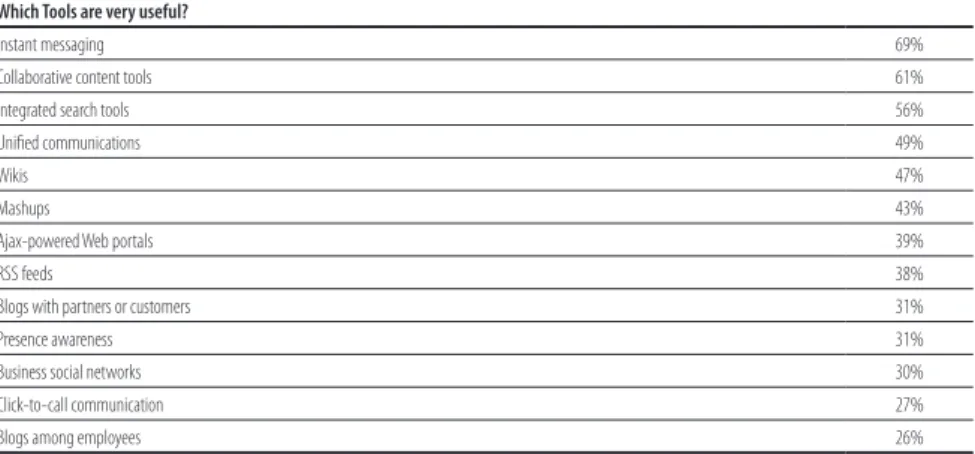
The following table shows the results of a survey, which was held in the year 2006. Business technology professionals were asked for their opinion about useful Web 2.0 tools.
Table 1. Useful Web 2.0 Tools for Enterprises (Hoover, 2007)
Which Tools are very useful?
Instant messaging 69%
Collaborative content tools 61%
Integrated search tools 56%
Unified communications 49%
Wikis 47%
Mashups 43%
Ajax-powered Web portals 39%
RSS feeds 38%
Blogs with partners or customers 31%
Presence awareness 31%
Business social networks 30%
Click-to-call communication 27%
Blogs among employees 26%
Note: % of respondents, based on a 1-5 scale where 4 and 5 are very useful Data: InformationWeek Research survey of 250 business technology professionals
4.
SOCIAL VIEW
The term social software is usually used for systems which are designed for communication, collaboration within and integration of people into a community. The problem with this definition is that every system which involves more than one user can be defined as social software, for example an E-Mailing or Enterprise Resource Planning (ERP) System, which covers more than one department of a company. To limit the term an additional criterion was introduced. Social software must support the creation, the self-management and the regulation of communities (Alby).
A community is characterized by social interaction of the participants, which is generally the exchange of information. The community members have shared interests and targets and they meet each other on a shared place, which can be also in the World Wide Web (Alby).
Examples for social networks which have a community with millions of participants are for private persons Facebook and MySpace and for companies XING and Plaxo.
A different part in the social view on the topic Web 2.0 is the distribution of data of an indi-vidual over different types of media; normally via the internet. The possibility to store data either online, on flash drives, on MP3 (MPEG-1 Audio Layer 3)-Players, on mobile phones or on a PDA (Personal Digital Assistant) makes it difficult for users to keep the overview over their private data. An alternative which will get more important in the near future is the storage of data in the internet.
The most basic related problem is that the process of data distribution can cause different risks for the user. The two most important problems, the data protection and the missing balance between govern and governors are described in the following section.
5.
POLITICAL VIEW
Considering the political view, dealing with information can be an issue: especially if this information is about people and may have implications in current controversial topics (wi-tch is why it is called information in the first place…). As a result, data protection ranks high within political concerns. As defended by (Meyers), Data Protection means that
the characteristics of information processing and information storing systems are created with the objective to secure the confidentiality, the availability and the integrity through a good design of the processing, storing and communication.
Different reasons can harm the data protection of the social view applications. One risk is a possible change in the data protection laws of countries. Some companies moved their headquarters to countries with weak or even nonexistent data protection laws. The personal data can be linked to big data collections.
Another possibility is that a company which provides Web 2.0 applications alters its policies for data protection and because of that; the possibility of selling personal information to others is created.
You agree that by posting any material or information anywhere on the ICQ Servi-ces and Information you surrender your copyright and any other proprietary right in the posted material or information. You further agree that ICQ Inc. is entitled to use at its own discretion any of the posted material or information in any manner it deems fit, including, but not limited to, publishing the material or distributing it. (ICQ).
89
can be stored in a database even if the user is not an active part of community anymore. Anopen-source-tool called libSNA offers the possibility to analyse the data in social networks, which opens the door for personalized marketing and advertisement out of the individual interests of a person.
The German social networking platform StudiVZ changed their general business terms. The owner company wanted to use the data of the members to show them personalized ad-vertisement on the website to enlarge their incomes in this sector. The formulation of the business terms fits to the current data security law in Germany, but law experts and data protection officers warned the users to accept the changes. The users’ reaction was the cre-ation of Fake-Accounts, which are accounts without useful informcre-ation, or a removing of their personal data. The social network community forced the provider to offer a possibility to completely delete all stored data and the account which was not possible before (W3Pro-jekt) and (Wieschowski).
A complete other field which can cause problems in the near future is the missing control authority for companies which provide Web 2.0 services. The following problems can occur with providers who store data in the internet:
The economical situation of the provider causes insolvency. There are two possibilities for this scenario. Another company buys the provider and all the stored data or the provider goes bankrupt and all data gets lost. Another problem is the liability. Normally when im-portant data gets lost somebody is liable for it and has to pay a compensation for it. Is it the same for this kind of service? Storage media has only a limited life cycle. If an initial error occurs, can it be replaced through a new access/gather operation. What happens with the old storage media? Is Data which is on it destroyed or can another person take possession of it. How secure is the transmission way from the personal input device to the storage. The existing internet infrastructure is protected through security protocols on the network layer. Are these protocols used for the transmission or can personal data be written from a third person? And there is always the field of data privacy which was described before. Who gua-rantees for the privacy of the data? (Kremp)
It is not possible to answer these questions at the moment because a governor for this spe-cial field in the Internet business is missing, although some attempts are appearing in more advanced countries as the case of USE and Obama’s’ administration Internet Kaiser recently created post. In the final remarks section two possible solutions to set up such a regulation authority are presented.
6.
FINAL REMARKS
dard. Companies which fulfil the previously defined requirements to security and liability are audited by the national standards authority and get the certain ISO certificate. This certifica-te is a sign for customers that the company has a high level in these fields and so they are attracted. The market will regulate itself and the companies which don’t have the certificate will lose market shares or disappear from the market.
Base on this introductory essay, the authors defend that more research is needed and must be considered a priority for further improvement and assessment of the Web 2.0 tools within the use of information and information services to support society.
ACKNOWLEDGEMENTS
The authors want to acknowledge the comments provide by reviewers who help to impro-ve this text with many excellent suggestions.
BIBLIOGRAPHY
Alby, T. Web 2.0 Konzepte, Anwendungen, Technologien. Munich: Carl Hanser Verlag, 2006.
Bager, J. „Google-der Datenkrake.“ Heise Zeitschriftenverlag: C’t 10 (2006): 168. Internet. 3 Dec. 2009. <http://www.heise.de/ct/06/10/168>.
Bodendorf, F. Daten- und Wissensmanagement. Berlin ; Heidelberg: Springer Verlag, 2003.
Daniel, Caroline, and Maija Palmer. „Google’s Goal: to Organise Your Daily Life.“ FT.com. 22 May 2007. Internet. 3 Dec. 2009. <http://www.ft.com/cms/s/2/c3e49548-088e-11dc-b11e-000b5df10621.html>.
Geiger, Jörg. «Ihr Unternehmen 2.0.» CHIP Online. 7 Nov. 2008. Internet. 3 Dec. 2009. <http:// www.chip.de/artikel/Web-2.0-im-Unternehmen_33312650.html>.
Hoover, N. «Most Business Tech Pros Wary About Web 2.0 Tools In Business.» Information Week. 24 Feb. 2007. Internet. 3 Dec. 2009. <http://www.informationweek.com/story/sho-wArticle.jhtml?articleID=197008457>.
“Terms of Use.” ICQ. 2007. Internet. 3 Dec. 2009. <http://www.icq.com/legal/policy.html>.
91
Koop, H., et al. Erfolgsfaktor Content Management: Vom Web Content bis zum KnowledgeMa-nagement. Braunschweig ; Wiesbaden: Vieweg Verlag, 2001.
Kremp, M. „Datenspeicher Internet. „ Spiegel Online. 2006. Internet. 3 Dec. 2009. <http://www. spiegel.de/netzwelt/tech/0,1518,452958,00.html>.
McAfee, A. „Enterprise 2.0: The Dawn of Emergent Colloboration.“ MIT Slogan Management Review Spring 47.3 (2006). 1 Apr. 2006. Internet. 3 Dec. 2009. <http://sloanreview.mit.edu/ smr/issue/2006/spring/06/>.
O’Reilly, Tim. “What Is Web 2.0: Design Patterns and Business Models for the next Generation of Software.” O’Reilly Media. 30 Sept. 2005. Internet. 3 Dec. 2009. <http://oreilly.com/web2/ archive/what-is-web-20.html>.
“Soziale Netzwerke Des Web 2.0 Contra Datensicherheit.” W3Projekt.com. 2008. Internet. <http://w3projekt.com/soziale-netzwerke-des-web-20-contra-datensicherheit.html>.
Wieschowski, S. “ Studenten demonstrieren gegen das SchnüffelVZ. “ Spiegel Online. 2007. Inter- Inter-net. 3 Dec. 2009. <http://www.spiegel.de/netzwelt/web/0,1518,523906,00.html>.