ADHERENCE AND
in vitro
FERMENTATION
OF TROPICAL FORAGE LEGUMES
Relação entre componentes químicos, aderência bacteriana e fermentação in vitro de leguminosas forrageiras tropicais
Ana Carolina Fluck1, Gilberto Vilmar Kozloski2, Andressa Ana Martins1,
Mariana Patricia Mezzomo1, Filipe Zanferari1, Simone Stefanello1
ABSTRACT
Inclusion of forage legumes in diet may improve tropical ruminant systems productivity and sustainability. However, it is not well stablished which chemical components more impact their nutritional value. The relationship between chemical composition and in vitro fermentation of tropical forage legume was evaluated with the objective of obtaining indicators of their nutritional value. Samples of Crotalaria spectabilis, Cajanus cajan, Macrotyloma axillare, Mucuna aterrina, Stylosantis sp. and Canavalia ensiformis, cut from plants at growth age between 47 to 110 days, were analysed. Total gas production showed negative correlation (P<0.05) with total N (R=-0.51), acid detergent fibre (ADF, R=-0.62) and acid detergent lignin (ADL, R=-0.65), and positive correlation with non-fibre carbohydrates (NFC, R=0.70). Gas production rate was negatively related (P<0.05) to NDF (R=-0.73), ADF (R=-0.62) and ADL (R=-0.74). Ammonia concentration in the incubation medium was positively related (P<0.05) to total (R=0.74) and soluble (R=0.56) N, and negatively related to NFC (R=-0.81). The level of bacterial adhesion on residue of incubation was negatively related (P<0.05) to cell wall components, mainly to ADL (R=-0.57). The inclusion of polyehtylene glycol increased both gas volume and gas production rate whereas decreased ammonia concentration (P<0.05). In conclusion, even at low concentrations tannins impact the in vitro fermentation of tropical legumes. However, among the analyzed chemical components, the ADL was the best indicator of the nutritional value of the tropical forage legumes.
Index terms: Gas production, lignin, nutritional value, phenolic compounds, tannins.
RESUMO
A inclusão de leguminosas na dieta tem o potencial de melhorar a produtividade e sustentabilidade dos sistemas de produção de ruminantes em regiões tropicais. Contudo, não está bem estabelecido quais componentes químicos são os mais determinantes do seu valor nutricional. Este estudo avaliou a relação entre componentes químicos e a digestão in vitro de leguminosas forrageiras tropicais, com o objetivo de obter indicadores de seu potencial nutricional. Foram incluídas amostras de Crotalaria spectabilis, Cajanus cajan,
Macrotyloma axillare, Mucuna aterrina, Stylosantis sp. e Canavalia ensiformis cortadas de plantas com idades de crescimento entre 47 a 110 dias. O volume de gases apresentou correlação negativa (P<0,05) com os teores de N (R=-0,51), fibra em detergente ácido (FDA, R=-0.62) e lignina em detergente ácido (LDA, R=-0,65), e positiva com o teor de carboidratos não fibrosos (CNF, R=0,70) das leguminosas. A taxa de produção de gases foi negativamente relacionada (P<0.05) com os teores de FDN (R=-0.73), FDA (R=-0.62) e LDA (R=-0.74). A concentração de amônia no meio foi positivamente correlacionada (P<0.05) com o teor de N total (R=0.74) e N solúvel (R=0.56) e, negativamente, correlacionada com o teor de CNF (R=-0.81). O grau de aderência bacteriana no resíduo de incubação foi negativamente relacionada (P<0.05) com os componentes da parede celular, principalmente com o teor de LDA (R=-0.57). A adição de polietileno glicol aumentou o volume e a taxa de produção de gases das leguminosas, e reduziu a concentração de amônia no meio de incubação (P<0,05). Em conclusão, mesmo em baixas concentrações, os taninos impactam a fermentação ruminal de leguminosas forrageiras tropicais. Contudo, o teor de LDA representa o melhor indicador do potencial nutricional dessas forrageiras.
Termos para indexação: Produção de gases, lignina, valor nutricional, compostos fenólicos, taninos.
(Received in march 15, 2013 and approved in july 25, 2013)
1Universidade Federal de Santa Maria/UFSM – Departamento de Zootecnia – Santa Maria – RS – Brasil
2Universidade Federal de Santa Maria/UFSM – Departamento de Zootecnia – Campus Universitário Camobi – 97105-900 – Santa Maria – RS – Brasil – [email protected]
INTRODUCTION
The productivity of ruminant systems which are based on tropical grasses could be improved by inclusion of forage legumes in diet. Compared to grasses, forage legumes have higher content of crude protein, lower
several tropical legume species contain variable concentrations of phenolic compounds, mainly lignin and tannins. These poliphenols usually decrease forage intake, ruminal fermentation of carbohydrates and proteins, and may also exert a negative effect on intestinal digestibility of pr oteins (REED, 1995; FRUTOS et al., 2004; JAYANEGARA, LEIBER; KREUZER, 2012). Some in vitro
and in vivo studies were already conducted to evaluate
tropical forage legume species (SALLAM et al., 2010; LONGO et al., 2012). However, several relevant legume species were not included in those studies. Moreover, they focused mainly on tannin effects whereas the effect of other chemical components on the nutritional value of legumes was not considered.
The objectives of the present study were: i) to analyse the chemical composition of some relevant tropical forage legumes; ii) to evaluate the in vitro fermentation and bacterial adherence on these forages; iii) to evaluate the potential effect of tannins on in vitro fermentation through the inclusion polyethylene glycol (PEG) in the incubation medium, and iv) to relate chemical components with fermentative variables aiming to obtain indicators of the nutritional value of these forages.
MATERIAL AND METHODS
Forage samples and chemical analysis
Th e study included samples of Crotalaria
spectabilis, Stylosantis sp., Canavalia ensiformis,
Cajanus cajan, Macrotyloma axillare and Mucuna
aterrina. The forage legumes were established in 10 m2
plots in October 2007, in Santa Maria, RS (29º43´ S, 53º42¢ W, 95 masl.).Samples of whole plants present in a 0.25 m2
square into the plot were cut 5 cm above the ground level. Excepting for Canavalia ensiformis (two samples at growth ages of 47 and 68 days) and Stylosantis sp. (three samples at growth ages of 68, 89 and 89 days), four samples from each specie at growth age of 47, 68, 89 and 110 days were taken, as to obtain representative samples of the vegetative cicle of forages. Samples were dried in a forced-air oven at 55 °C and ground (1 mm screen) for analysis and in vitro
incubation.
Dry matter (DM) content was determined by drying at 105 °C for at least 16 h (SILVA; QUEIROZ, 2002). Ash was determined after combustion at 550 °C for 3 h and OM by mass difference. Total N was assayed by a Kjeldahl method (Method 984.13; ASSOCIATION OF OFFICIAL ANALYTICAL – AOAC, 1997). The neutral detergent fibre (NDF) was analysed according to procedures described by Mertens (2002), and acid detergent fibre (ADF)
according to Method 973.18 of AOAC (AOAC, 1997), excepting that the samples were weighed into polyester filter bags (porosity of 25µ) and treated with neutral or acid detergent in an autoclave at 110 oC for 40 min (SENGER
et al., 2008). Concentration of sulphuric acid detergent lignin (ADL) was analyzed by soaking the bags containing ADF residue in 12M H2SO4 during three hours (Method 973.18 of AOAC, 1997). Analysis of acid detergent insoluble N (ADIN) and neutral detergent insoluble N (NDIN) were performed according to Licitra, Hernandez a Van Soest (1996). Ether extract (EE) concentration was determined in a reflux system (Soxtherm 2000 S 306 M, Gerhardt; Königswinter, Germany) with ethyl ether at 180 oC
for 2 h. The content of non-fiber carbohydrates (NFC, g/ kg) was calculated as: OM – [(NDF - (NDIN 6.25)) +
(N 6.25) + EE], according to Van Soest et al. (1991).
Total phenolic compounds were analysed with the Folin-Cicalteau method described by Makkar (2000).
In vitro bath culture for measuring gas production and
ammonia concentration
Gas production from forage legume samples was evaluated using the semi-automated in vitro/gas method (MAURÍCIO et al., 1999). Three runs were carried out. In each run approximately 1 g of dried and ground samples were weighed in 160 mL bottles and incubated in 100 mL buffered rumen fluid at 39 °C. Four bottles were used for each sample. Two of them were added with 2 g of polyethylene glycol (PEG) as to evaluate the effect of tannins on fermentation (MAKKAR et al., 1995). Buffer solution contained 80 mg L-1 of N and the proportion buffer:inoculum
was 8:2. Rumen fluid (inoculum) was obtained from a rumen-cannulated steer grazing a ryegrass (Lolium multiflorum) pasture, and filtered through four cheesecloth layers before incubation. All manipulations were under continuous flushing with CO2. Gas production was measured at 2, 3, 4, 5, 6, 9, 12, 18, 24, 30, 36, 48, 72 and 96 h using a pressure transducer. Data were corrected for gas productions in blank bottles. Gas production rate was calculated from cumulative values using the one-pool logistic model of Schofield, Pitt e Pell (1994) through the NLIN procedure of the Statystical Analysis System – SAS (2001).
Because in usual digestibility in vitro systems feed samples are submitted to degradation by rumen bacteria during 48 hours, ammonia concentration and total gas produced after this incubation time were included among the criteria for comparing the legume species.
In vitro bath culture for measuring forage
degradability and bacterial adherence
Approximately 1 g of dried and ground forage samples were weighed in polyester bags (5 × 5 cm, porosity of 50 µ), which were sealed and fermented in vitro for 24 h. In vitro
fermentation was conducted anaerobically in a slow-stir incubator (Incubadora in vitro Tecnal, Piracicaba, SP, Brazil) at 39 °C, in 3-L glass flasks equipped with Bunsen type valve. Flasks contained 1600 mL of a buffer solution (TILLEY; TERRY, 1963), 400 mL of strained rumen fluid, and 21 bags (i.e. one bag for each forage sample). Two runs with four flasks per run were carried out. In two of the four flasks 20 g of PEG was added. The procedures for rumen fluid collection and processing were the same as described for the Assay 1. After 24 h, fermentation was stopped, bags were removed from the flasks, washed in tap water, soaked in saline (9 g L-1 NaCl) solution for 10 minutes to extract the
non-adhered bacteria, washed again with distilled water and dried in air-forced oven at 55 °C. In a preview study it was observed that maximal bacteria colonization of forage particles occurs at this incubation time (KOZLOSKI et al., 2008). A third run was conducted using the same procedures described above, except that after 24 hours of incubation, the bags were treated with neutral detergent solution in autoclave (SENGER et al., 2008), washed in tap water and dried in an air-forced oven at 55 °C.
An aliquot of the residue of each bag, including those treated with neutral detergent, was taken for P analysis. Remained material was oven dried at 105 °C for DM determination. Phosphorus was analyzed using a colorimetric method adapted from Fiske e Subbarov (1925) as follows. Approximately 0.2 g of the residue of each bag was weighed in a 20 mL beaker and burned in a muffle oven at 550 ºC for 3 h. Thereafter, 10 mL of a solution containing three parts of 2.76 N HCl and one part of 1.59 N HNO3 was addedand placed over a heating plate, which was set at 200 °C, until a residual volume of approximately 2 mL remained. This content was transferred, by washing the beaker with distilled water, to a 50 mL volumetric flask. The volume was completed with distilled water and content filtered through a fast filtration paper. The filtrate was stored frozen for subsequent colorimetric determination of P as follows: into a test tube was sequentially added 1000 µl of the filtrate, 1000 µl of a complexing solution (i.e. a solution containing 3.8 g L-1 of
ammonium molybdate ((NH4)6Mo7O24 .4H2O), 71 mL L-1 of
HCl p.a., and 5 g L-1 of boric acid (H
3BO3) in distilled
water) and 100 µl of a reducing solution (i.e. a solution containing 0.5 g L-1 of amino-naphtholsulfonic acid
(NH2C10H5(OH)SO3H), 1.0 g L-1 of sodium sulfite (Na 2SO3),
and 29.2 g L-1 of sodium metabisulfite (Na
2S2O5) in distilled
water). This reaction medium was maintained for 20 min at room temperature and absorbance was read at 660 nm against a blank which included 0.1 N HCl instead of filtrate. The standard curve included test tubes containing 2 to 10 ug of P from a standard solution (1 g L-1) of monobasic potassium
phosphate (KH2PO4)dilutedin distilled water. After 24 hours on fermentation, it was assumed that the content of neutral detergent soluble P in residue was from bacteria cell (BLÜMMEL; LEBZIEN, 2001). Thus, the level of bacteria adherence was calculated as the difference between the P content in residual DM minus the P content in residual NDF.
Statistical analysis
Data were analyzed with the SAS (2001) software. Data of replicate samples of in vitro/gas assays were averaged within each run for analysis. Data were analyzed through a variance-covariance model that included legume specie, PEG and legume specie × PEG interaction as fixed effects, and the plant age as covariate. When significant (P<0.05), legume species were compared through the Student t test. The chemical fractions of the forages were related to fermentation variables through Pearson correlation. When relevant, chemical and fermentation variables were also related through linear and unlinear regression analysis.
RESULTS AND DISCUSSION
There was not any legume specie × PEG significant interaction. The chemical composition was different between tropical forage legumes (Table 1), what impacted the variables of in vitro fermentation. Total gas production and ammonia concentration, gas production rate and level of bacteria adhesion on the residue of incubation were different (P<0.05) between legume species (Table 2).
production rate was negatively related (P<0.05) to NDF (R=-0.73), ADF (R=-0.62) and ADL (R=-0.74) contents. However, different from expected, this variable did not show a positive correlation with the NFC content. This discrepancy is probably due this fraction have represented
in average only approximatelly 0.23 of total OM. Moreover, analysis of cumulative gas production curve was performed through a unicompartmental model, which does not consider the fermentability differences between fibre and non-fibre carbohydrates.
Table 1 – Chemical composition of forage legumes1.
1 Samples of whole plant at growth age varying between 47 to 110 days and cut 5 cm above ground. Values are mean ± standard deviation.
Table 2 – Total gas production, ammonia concentration and gas production rate from tropical forage legumes incubated
in vitro.
a,b,c: Means in the same row followed by different letter differ by Student t test (P<0.05). GP = gas production (mL), GPR = gas production rate (% h-1), NH
3 = ammonia concentration (mg dL
-1), BA = bacteria adhesion (mg of P g-1 of residual dry matter), SD = Standard deviation.
Table 3 – Pearson correlation coeficients between chemical components† and fermentation variables of tropical forage
legumes incubated in vitro.
* P<0.05; ** P<0.01.
Nt = total N, Nsol = buffer soluble N, NDF = neutral detergent fibre, ADF = acid detergent fibre, NFC = non fibre carbohydrates, ADL = acid detergent lignin, TF = total soluble phenols.
Item
Legume species
SD P value
Crotalaria spectabilis
Stylosantis
sp.
Cajanus cajan
Canavalia ensiformis
Macrotyloma axillare
Mucuna aterrina
GP 101b 111a 81c 105b 109ab 93c 19.0 <0.001
GPR 3.61a 3.20b 2.92b 3.33b 3.26b 3.22b 0.510 <0.001
NH3 28.6b 26.4b 33.3a 34.2a 26.6b 33.6a 8.39 <0.001
BA 0.83b 0.26c 0.22c 1.00a 0.28c 0.29c 0.163 <0.001
Variables Nt Nsol NDF ADF NFC ADL TF
Total gas production -0.51* -0.26* -0.33* -0.62* 0.70** -0.65* -0.06
Ammonia concentration 0.74** 0.56* -0.01 0.17 -0.81** 0.22 0.21
Gas production rate 0.32* 0.31* -0.73** -0.62** 0.14 -0.74** -0.02
Bacteria adhesion 0.26* 0.17 -0.39* -0.42* -0.14 -0.57* 0.13
Item Crotalaria
spectabilis
Stylosantis
sp.
Cajanus cajan
Canavalia ensiformis
Macrotyloma axillare
Mucuna aterrina
g kg-1 of dry matter:
Organic matter 918±19.7 913±10.9 946±16.0 907±7.4 933±18.6 926±15.2
Total N 29±7.2 19±6.0 29±4.8 36±3.5 26±3.3 40±4.4
Buffer-soluble N 18±0.5 14±0.6 16±0.9 20±0.5 15±0.3 22±0.6
Neutral detergent insoluble N 9.6±2.24 4.0±1.21 4.6±0.46 3.4±0.46 5.2±1.10 10.5±1.52
Acid detergent insoluble N 2.3±0.65 1.8±0.69 2.7±0.60 1.9±0.47 2.0±0.44 3.7±0.53
Ether extract 72±19.2 55±12.2 93±18.1 100±6.1 74±17.1 70±18.1
Neutral detergent fibre 460±46.7 497±32.1 518±37.3 444±14.1 447±8.3 504±24.0
Acid detergent fibre 277±32.0 279±21.0 343±9.2 261±4.9 273±14.0 302±15.1
Acid detergent lignin 59±12.6 81±3.6 124±7.5 58±2.5 70±5.9 85±10.2
Non-fibre carbohydrates 263±50.5 268±44.7 180±50.6 158±29.4 282±49.1 169±44.1
Ammonia concentration in the incubation medium was positively related (P<0.05) to total (R=0.74) and soluble (R=0.56) N, and negatively related to NFC (R=-0.81) content. The ammonia concentration in the medium at any time of incubation, corrected for that ammonia initially available, results fr om the both opposite pr ocesses feed N compounds degradation and N uptake by bacteria cells (RAAB et al., 1983). In the present study, total gas production increased at increased levels of NFC and, consequently, bacterial cells mass also increased reducing ammonia concentration in the incubation medium.
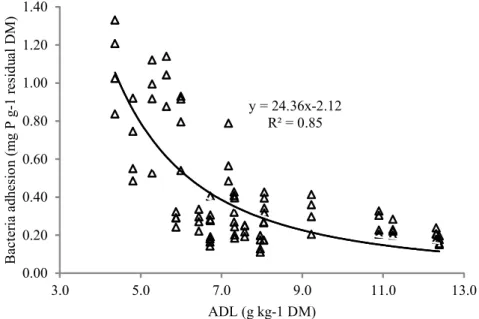
Bacterial adhesion is essential for microbial development and feed digestion in the rumen (MCALLISTER et al., 1994). The adhesion process is affected by factors associated to bacteria cells, substrate type and rumen environment (MIRON; BEN-GHEDALLIA; MORRISON, 2001). In forages, the cutin present on particle surface, and the phenolic compounds (i.e. tannins and ADL), are barriers for bacteria attachment and penetration (McAllister et al.,1994). In the present study, as expected, the amount of bacteria adhered on residues after 24 hours of incubation was negatively related (P<0.05) to cell wall components, mainly with ADL (R=-0.57). However, the impact of ADL on this variable was stronger at ADL concentrations lower than approximately 7 g kg-1 DM (Figure 1). This is coherent with
the observation that the negative effect of lignin on forage degradation in the rumen decreases at increased levels of lignin content (VAN SOEST, 1994).
Several tropical legume species with potential use as forage have low nutritional value due their high tannin content. Tannins are polyphenolic compounds that complex with dietary proteins and microbial enzymes reducing the ruminal degradation of OM (WAGHORN; MCNABB, 2003). In the present study, the tannin content of forage legumes was not analyzed. However, the effect of tannins on in vitro fermentation may be indirectly evaluated through the inclusion of PEG in the incubation medium (MAKKAR; BLUMMEL; BECKER, 1995). Frutos et al. (2004) reported that the impact of tannins on digestibility is significant at tannins concentration above 50 g kg-1 of DM. Sallam et al. (2010), for example, reported
that PEG inclusion in the incubation medium increased gas production from tropical forage legumes containing high levels of soluble phenolic compounds. In the present study, the inclusion of PEG increased both gas volume and gas production rate whereas decreased ammonia concentrations in the incubation medium (P<0.05, Figure 2). The content of total soluble phenolic compounds in forage legumes varied from 10 to 20 g kg-1 of DM.
Consequently, the tannin concentration in these forages, whether present, was very lower than 50 g kg-1 of DM.
These results indicate that tannins in forage legumes may reduce fermentation even at low concentration. Moreover, results also indicate that tannins had a low effect on protein degradation whereas impacted mainly the carbohydrates fermentation. The reduction of ammonia
Figure 1 – Relationship between acid detergent lignin (ADL) content and level of bacteria adhesion on residue of tropical forage legumes incubated in vitro during 24 hours. DM, dry matter.
y = 24.36x-2.12 R² = 0.85
0.00 0.20 0.40 0.60 0.80 1.00 1.20 1.40
3.0 5.0 7.0 9.0 11.0 13.0
B
ac
te
ri
a
ad
h
es
io
n
(
m
g
P
g
-1
r
es
id
u
al
D
M
)
CONCLUSIONS
Even at low concentrations, tannins impact the fermentation of forage legumes. However, among the analyzed chemical components, the ADL content was the best indicator of the nutritional value of the tropical forage legumes.
REFERENCES
ASSOCIATION OF OFFICIAL ANALYTICAL CHEMISTS – AOAC. Official methods of analysis. 16th. ed.
Gaithersburg: AOAC International, Washington D.C., 1997. BLÜMMEL, M.; LEBZIEN, P. Predicting ruminal microbial efficiencies of dairy rations by in vitro
techniques. Livestock Production Science, Amsterdam, v.68, n.2, p.107–117, 2001.
DIJKSTRA, J. et al. Application of the gas production technique to feed evaluation systems for ruminants.
Animal Feed Science and Technology, Amsterdam, v.123-124, n.2001, 561-578, 2005.
FRUTOS, P. et al. Review: Tannins and ruminant nutrition. Spanish Journal of Agricultural Research,
Madrid, v.2, n.2, p.191-202, 2004.
JAYANEGARA, A.; LEIBER, F.; KREUZER, M. Meta-analysis of the relationship between dietary tannin level and methane formation in ruminants from in vivo and in
vitro experiments. Journal of Animal Physiology and
Animal Nutrition, v.96, p. 365-375, 2012.
KOZLOSKI, G.V. et al. Microbial colonization and degradation of forage samples incubated in vitro at different initial pH. Animal Feed Science and
Technology, Amsterdam, v.141, n. 3-4, p. 356-367, 2008. LICITRA, G.; HERNANDEZ, T.M.; VAN SOEST, P.J. Standardization of procedures for nitrogen fractionation of ruminant feeds. Animal Feed Science Technology,
Amsterdam,v. 57, n.4, p. 347-358, 1996.
LONGO, C. et al. Chemical characterization and in vitro
biological activity of four tropical legumes,
Styzolobium aterrimum L., Styzolobium deeringianum,
Leucaena leucocephala and Mimosa
caesalpiniaefolia, as compared to a tropical grass,
Cynodon spp for the use in ruminant diets. Czech
Journal of Animal Science, Prague, v.57, n.6, 255-264, 2012.
Figure 2 – Total gas production, ammonia concentration and gas production rate of tropical forage legumes incubated in vitro with or without polyethyleneglicol (PEG). Effect of PEG: P<0.05 for all variables.
concentration due the PEG was probably an indirect consequence of increased gas production. The dietary conditions where the effects of tannins may have positive or negative impact on nutrients supply to animals fed diets containing tropical forage legumes needs to be established.
0 20 40 60 80 100 120
With PEG Without PEG
MAKKAR, H. P. S. et al. Quantification of tannins in Tree Foliage. (Laboratory manual) Vienna: FAO/IAEA, 2000. 26p.
MAKKAR, H. P. S.; BLUMMEL, L.; BECKER, K. Formation of complexes between polyvinyl pyrrolidones or polyethylene glycols and tannins, and their
implication in gas production and true digestibility in in
vitro techniques. British Journal of Nutrition, London,
v. 73, n.6, p. 897-913, 1995.
MAURÍCIO, R.M. et al. A semi – automated in vitro gas production technique for ruminant feedstuff evaluation.
Animal Feed Science Technology, Amsterdam, v. 79, n.4, p. 321-330, 1999.
MCALLISTER, T.A. et al. Microbial attachment and feed digestion in the rumen. Journal of Animal Science, Savoy, v. 72, n.11, p. 3004–3018, 1994.
MERTENS, D.R. Gravimetric determination of amylase-treated neutral detergent fibre in feeds with refluxing beakers or crucibles: A collaborative study. Journal of the Association of Official Analytical Chemists, Washington D.C.,v.85, n.6, p.1217-1240, 2002. MIRON, J.; BEN-GHEDALIA, D.; MORRISON, M. Adhesion mechanisms of rumen cellulolytic bacteria.
Journal of Dairy Science, Champaign, v.84, n.1, 1294-1309, 2001.
OSUJII, P.; ODENYO, A.A. The role of legume forages as supplements to low quality roughages - ILRI experience.
Animal Feed Science Technology, Amsterdam, v.69, n.1-3, p. 27-38, 1997.
PATRA, A.K.; SAXENA, J. Exploitation of dietary tannins to improve rumen metabolism and ruminant nutrition. Journal of the Science of Food and Agriculture, London, v. 91, n.1, p. 24-37, 2010. RAAB, L. et al. Rumen protein degradation and biosynthesis 1. A new method for determination of protein degradation in rumen fluid in vitro. British Journal of Nutrition, Cambridge, v.50, n.3, 569-582, 1983.
REED, J.D. Nutritional toxicology of tannins and related polyphenols in forage legumes. Journal of Animal Science, Savoy, v.73, n.5, p.1516-1528, 1995. SALLAM, S.M.A.H. et al. Ruminal fermentation and tannins bioactivity of some browses using a semi-automated gas production technique. Tropical and Subtropical Agroecosystems, Yucatán, v.12, n.1, p.1-10, 2010.
STATYSTICAL ANALYSIS SYSTEM – SAS. Statistical analysis user’s guide. Version 8.2. Cary: SAS Institute, 2001. 1686 p.
SCHOFIELD, P.; PITT, R.E.; PELL, A.N. Kinetic of fiber digestion from in vitro gas production. Journal of Animal Science, Savoy, v.72, n.11, p.2980-2991, 1994.
SENGER, C.C.D. et al. Evaluation of autoclave
procedures for fibre analysis in forage and concentrate feedstuffs. Animal Feed Science and Technology, Amsterdam, v.146, n.1, p.169-174, 2008.
SILVA, D.J.; QUEIROZ, A.C. Análise de alimentos, 3nd ed.Viçosa: UFV, 2002. 235 p.
VAN SOEST, P.J. Nutritional ecology of the ruminant.
2nd ed. New York: Cornell University Press, 1994. 476p.
VAN SOEST, P.J.; ROBERTSON, J.B.; LEWIS, B.A. Carbohydrate methodology, metabolism, and nutritional implications in dairy cattle. Journal of Dairy Science, Champaign, v.74, n.10, p. 3583-3597, 1991.
WAGHORN, G.C.; McNABB, W.C. Consequences of plant phenolic compounds for productivity and health of ruminants. Proceedings of the Nutrition Society,
Cambridge, v.62, n.2, p.383-392, 2003.