Luís Miguel Ferreira Costa Mendonça
Botnet Detection
A Numerical and Heuristic Analysis
Luís Miguel Ferreira Costa Mendonça
Botnet Detection
A Numerical and Heuristic Analysis
Master Thesis
Master in Communication Networks and Services
Engineering
Research oriented by:
Henrique Manuel Dinis dos Santos
“Information is not knowledge”
Table of Contents
1.
Introduction ... 1
1.1 Goals ... 2
1.2 Research Methodology ... 3
1.3 Document Organization and Notes of Attention ... 4
1.4 Research Calendar ... 5
2.
Botnet Characterization ... 7
2.1 Definition ... 7
2.2 Propagation and Recruitment ... 7
2.3 Command and Control ... 11
2.4 Maintenance and Availability ... 20
2.5 Attacks ... 23
2.6 Botnet History: The Malware Chronicles ... 27
2.7 Conclusions ... 29
3.
Botnet Detection and Analysis ...31
3.1 Honeynets, Honeypots and SPAM Traps ... 31
3.2 Signature-based Methods ... 31
3.3 DNS-based Methods ... 32
3.4 Anomaly-based Methods ... 34
3.5 Related Work ... 34
3.6 Conclusions ... 36
4.
Botnet Anomaly-Based Detection ...39
4.1 Bot Behavior ... 41
4.2 Botnet Behavior ... 42
4.4 Conclusions ... 44
5.
Proposed Model and Prototype ...47
5.1 Initial Research ... 47
5.2 Netflow as the Traffic Feature Source ... 55
5.3 Traffic Attributes Heuristics ... 57
5.4 Communications Fingerprints ... 61
5.5 Detection Framework Implementation ... 63
5.6 Prototype Implementation ... 70
5.7 Conclusions ... 72
6.
Experimental Setup, Results and Analysis ...73
6.1 Test Datasets Characterization ... 73
6.2 Prototype Test Environment ... 76
6.3 Testing Methodology ... 78
6.4 Detection Sensitivity and Specificity Analysis ... 82
6.5 Performance and Storage: Real-Time? ... 89
6.6 Final Results and Conclusions... 91
7.
Discussion, Future Work and Conclusions ...95
8.
References ...99
List of Figures
Figure 1: IRC Botnet Topology ... 12
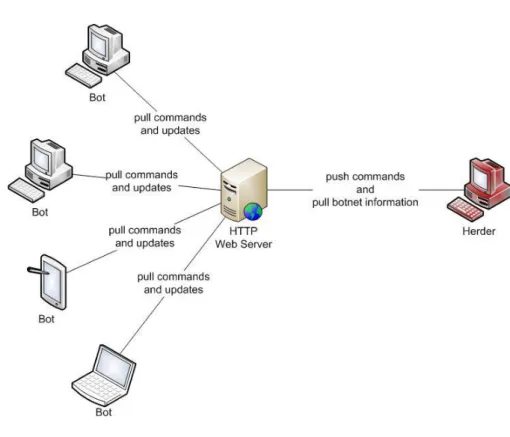
Figure 2: HTTP Botnet Topology ... 13
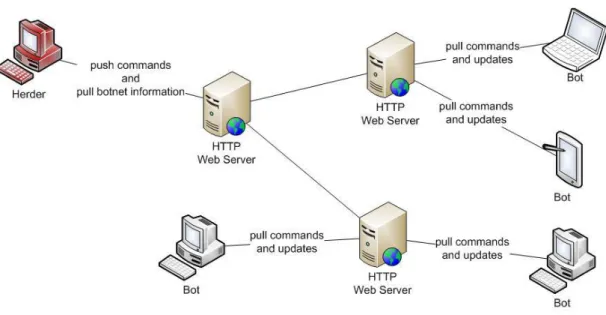
Figure 3: HTTP Botnet Hierarchic Topology ... 14
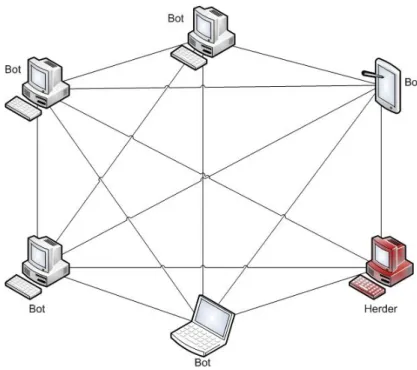
Figure 4: P2P Botnet Topology ... 15
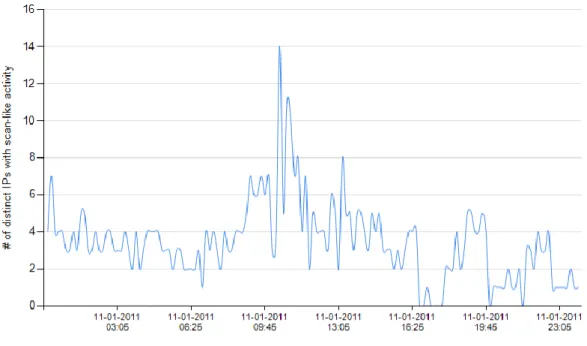
Figure 5: Number of distinct hosts with scan-like activity ... 49
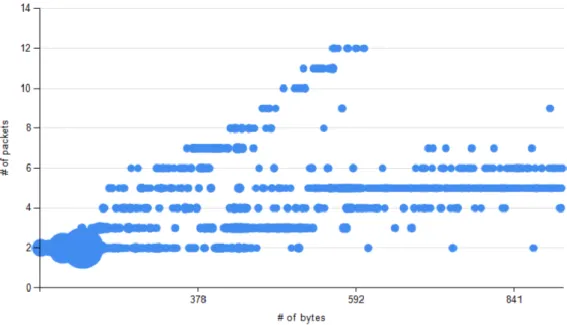
Figure 6: Distinct source IPs per number of bytes and packets ... 51
Figure 7: Number of distinct Source IPs with crowd-like behavior per ten-minute period ... 52
Figure 8: Number of distinct hosts connecting to SQL Server ports per bytes per packet ... 53
Figure 9: Communication Fingerprints (example) ... 62
Figure 10: Scanner Communication Fingerprints ... 62
Figure 11: Malicious Host Fingerprints ... 63
Figure 12: HTTP Server Fingerprints ... 63
Figure 13: Clustering Database Tables ... 69
Figure 14: Padre Integrated Development Environment ... 71
Figure 15: SQL Server Scripts Test Examples ... 71
Figure 16: Typical University of Minho 24-hour traffic shown in Nfsen (12th January 2011) . 74 Figure 17: Netflow Capture System ... 74
Figure 18: Distinct active hosts for each hourly period (16th November 2011) ... 76
Figure 19: Distinct active hosts for each hourly period present in blacklists (16th November 2011) ... 76
Figure 20: nfsen "testplugin" command-line tool ... 77
Figure 21: ROC Plot for CAST variation ... 83
Figure 22: First-Pass Detection - Sensitivity versus Specificity ... 84
Figure 23: MNACT ROC plots with (left) and without (right) clustering analysis ... 85
Figure 24: ROC Plot for detection without clustering analysis for MNACT=70 and HAST=950 ... 86
Figure 25: Hosts detected without clustering analysis for MNACT=70 and HAST=950 ... 87
Figure 26: Hosts detected using clustering analysis for MNACT=70 and HAST=950 ... 88
Figure 27: ROC Plot for detection with clustering analysis for MNACT=70 and HAST=990 ... 88
Figure 29: Performance Evaluation Chart ... 90
List of Tables
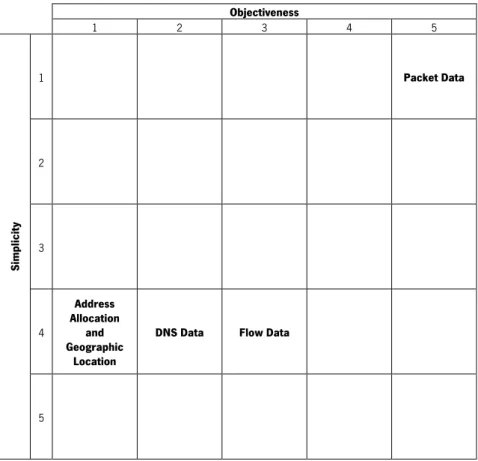
Table 1: Network Traffic Data Source Classification ... 46Table 2: Top 5 bytes per packet clusters with higher SQL Server scan activity ... 53
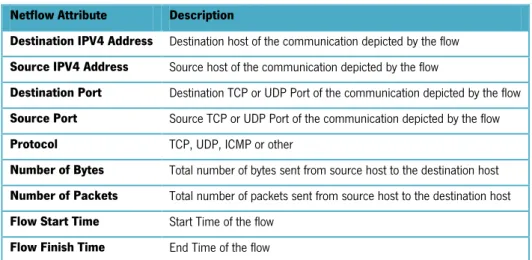
Table 3: Netflow Traffic Attributes Selected ... 56
Table 4: Sample Communication Fingerpint Values ... 61
Table 5: Connection Anomaly Score Weights ... 66
Table 6: Test Datasets – Description and Size ... 73
Table 7: Botnet Blacklists Sources and Number of Hosts ... 75
Table 8: CAST variation framwork's response (rates in %) ... 83
List of Equations
Equation 1: Simpson's Diversity Index ... 57Equation 2: Simpson's Diversity Index (inverted) ... 57
Equation 3: Bytes per Packet Anomaly Score ... 65
Equation 4: Packets per Flow Anomaly Score ... 65
Equation 5: Time Between Flows Anomaly Score ... 66
Equation 6: Flow Duration Anomaly Score ... 66
Equation 7: Connection Anomaly Score ... 67
Equation 8: Host's Anomaly Score ... 69
Equation 9: Unidirectional Anomaly Score ... 70
Equation 10: True Positives and True Negatives ... 79
Equation 11: False Positives ... 79
Equation 12: False Negatives ... 79
Equation 13: True Positive Rate ... 80
Equation 14: True Negative Rate ... 80
Equation 15: False Positive Rate ... 80
Acknowledgements
This research has only been possible thanks to the cooperation and help of some people and institutions.
First of all I have to thank the University of Minho and the Headship of Technologies and Information Systems that allowed me to take this master degree. Secondly I have to thank the Communications Services of University of Minho responsible for giving me access to all the real traffic used in this research.
For the guidance, help, and introduction to the research process, I’d like to thank Henrique Santos that was always there when I needed allowing me to really feel the research way of life and participate in the scientific community. Henrique’s words were, and still are, a powerful motivational engine.
Last, but not least, for the backup in all the late-night research shifts, a big thanks to my wife Helena. Not forgetting the constantly growing joy that kept me going, a heart-full thanks to my, already, five year old son Miguel.
1. Introduction
“A journey of a thousand miles begins with a single step.” Zen Proverb
Internet security has been targeted in innumerous ways throughout the ages and Internet cyber criminality has been changing its ways since the old days where attacks were greatly motivated by recognition and glory. A new era of cyber criminals are on the move. Real armies of robots (bots) swarm the internet perpetrating precise, objective and coordinated attacks on individuals and organizations. Many of these bots are now coordinated by real cybercrime organizations in an almost open-source driven development resulting in the fast proliferation of many bot variants with refined capabilities and increased detection complexity. One example of such open-source development could be found during the year 2011 in the Russian criminal underground. The release of the Zeus botnet framework source-code led to the development of, at least, a new and improved botnet framework: Ice IX. [1]
Concerning attack tools, the combination of many well-known techniques has been making botnets an untraceable, effective, dynamic and powerful mean to perpetrate all kinds of malicious activities such as Distributed Denial of Service (DDoS) attacks, espionage, email spam, malware spreading, data theft, click and identity frauds, among others [2].
Economical and reputation damages are difficult to quantify but the scale is widening. It’s up to one’s own imagination to figure out how much was lost in April of 2007 when Estonia suffered a well-known distributed attack on its internet country-wide infrastructure.
Among the techniques available to mitigate the botnet threat, detection plays an important role. Despite recent year’s evolution in botnet detection technology, a definitive solution is far from being found. New constantly appearing bot and worm developments in areas such as host infection, deployment, maintenance, control and dissimulation of bots are permanently changing the detection vectors thought and developed.
In that way, research and implementation of anomaly-based botnet detection systems are fundamental to pinpoint and track all the continuously changing polymorphic botnets variants, which are impossible to identify by simple signature-based systems.
1.1 Goals
The detection of bots (sometimes called zombies or drones when referring to the machines infected) and botnets is critical, and can be made using three distinct methodologies according to [3]: cooperative behavior analysis, attack behavior analysis and signature analysis. This thesis will focus on the first two approaches having in mind that botnet detection should be time-efficient [4] and that the communications between bots and herders can be included in the cooperative behavior analysis group.
Objectively, there is a desire to contribute to all the research already done by the scientific community in the botnet detection and tracking area focusing on network behavior analysis. The advantage of network behavior analysis approach is its relative simplicity and possible operation in a network core with no packet and no host-based inspections.
In the end, this thesis delivers:
1. A deep survey on the existing botnet and network anomalies detection models and approaches focusing in behavior analysis methodology
2. Numerical and heuristic models capable of characterizing network botnet related anomalous activity
3. Prototype of an anomaly and behavior based botnet detection framework capable of identifying botnet activity ideally in real-time scenarios
For that matter, different types of botnets (IRC, HTTP and P2P, among others) are initially studied and followed by the analysis of some existing detection techniques and tools like Honeynet, BotSniffer and BotMinner. Some numerical and heuristic aspects of both normal and bot traffic are then investigated in order to propose a set of traffic parameters aiming fast and precise botnet detection, with, ideally, low false positive rate.
In the end, a botnet detection framework prototype is presented together with usage analysis of the proposed traffic parameters. The detection framework is finally put under test and evaluated under real network traffic.
All the findings in this thesis will, hopefully, be valuable assets to organizations wishing to increase its own network security levels or even enterprises with products and services in the Intrusion Detection Systems (IDS) and Intrusion Prevention Systems (IPS) areas.
1.2 Research Methodology
In order to accomplish this investigation, a Design Science approach was undertaken focusing on the seven guidelines provided by Hevner et al in [5]: artifact, problem relevance, research rigor, design as a search process, design evaluation, research contributions, and research communication.
1.2.1 Artifact
This thesis presents a functional botnet detection framework and model. This framework is customizable through the definition of parameters and detection thresholds in order to allow its application in the most different supervised networks scenarios.
1.2.2 Problem Relevance
The botnet phenomenon is a recent, fast growing menace to internet safety so the development of new and improved detection vectors is crucial to internet effective supervision.
1.2.3 Research Rigor
The proposed methods and frameworks were tested using real traffic datasets in order to correctly evaluate its utility and efficacy taking in account data privacy. To verify the proposed framework and model accuracy, detection rates were evaluated.
All results, methods and developed software were also verified several times before any conclusions were taken.
1.2.4 Design as a Search Process and Evaluation, Research Contributions and Communication
An initial part of this work was already submitted to the 10th European Conference on Information Warfare and Security thus pretending to be an academic contribution to this field of study. All the detection framework prototype code produced in this thesis will be submitted to open-source repositories in order to contribute for further research in the matter.
1.3 Document Organization and Notes of Attention
Beyond this introduction where thesis goals, methodology and calendar are presented, the reminder of this paper is organized as follows: in section 2, botnet characterization is done in order to better understand what kind of threats botnets present nowadays. Sections 3 and 4 presents, analyzes and discusses existing botnet detection research vectors as well as some of the related work on the matter.
Section 5 proposes a botnet anomaly-based detection model, presenting at the same time all developed heuristics as well as an implementation prototype for the detection system proposed. The initial research and results of the paper “Botnet Detection: A Numerical and Heuristic Analysis” published in the proceedings of the 10th European Conference on Information Warfare and Security (ECIW’11) begin this section since they were this thesis’ jumpstart and are useful for a better understanding of the thesis research path.
In section 6, the test bed built, corresponding framework testing and results are analyzed in order to validate the detection heuristics considered.
This thesis ends in the 7th section of this document where an analysis and discussion of the proposed detection model is promoted as well as several possible solutions for the weaknesses found.
A very important aspect is that all decimal data presented in this section uses the Portuguese decimal notation with comma (“,”) as decimal separator.
1.4 Research Calendar
The research calendar is shown below.
Tasks Approx. Dates Milestones
Preliminary study of different methodologies used for Botnet detection and related work survey.
Nov/Dec 2010 *
Definition of a botnet characterization model Jan 2011
Collection of necessary network traffic datasets for analysis Jan/Feb **
Tests on the model and datasets collected. Extraction of numerical properties of the traffic analyzed
Feb/May Creation of a set of heuristics and statistics capable of identifying botnet
network traffic activity
May/Jun ***
Detection System Prototype based on the defined models and heuristics as well as final tests
May/Oct
Final thesis writing, revisions and rectifications Oct/Nov ****
Delivery of full thesis Dec 2011 *****
* Thesis draft delivered to thesis coordinator
** All traffic datasets necessary collected
*** Thesis draft with all the heuristics that will be analyzed in the thesis tested and described as well as
a complete related work survey
**** Full thesis draft delivered to thesis coordinator
2. Botnet Characterization
“The general who wins the battle makes many calculations in his temple before the battle is fought. The general who loses makes but few calculations beforehand.” Sun Tzu. The Art of War.
Global bot development status and modus operandi are analyzed in this section in order to achieve Botnet characterization. This step is fundamental to create coherent and comprehensive botnet detection methods.
Though it is true that botnets exist in a great variety of forms, some types of activity are shared and can be observed in all of them. These stereotyped activities must exist in botnet regular operations in order to make it useful to herders.
This section also presents some basic botnet information besides fundamental vocabulary to understand the rest of this document.
2.1 Definition
For this thesis purpose, botnet is considered to be a group of two or more distinct hosts performing malicious coordinated activities. Coordinated operations are achieved with the help of computer programs running in each host (bots).
2.2 Propagation and Recruitment
By this thesis botnet definition, botnets are built upon recruited hosts and, as in army forces, recruitment can be volunteer and non-volunteer.
Volunteer bot recruitment is not the norm but can be found within some social activists actions. One recent example was the Anonymous and Wikileaks matter where a botnet was
built, and grown, upon many of the world citizens’ will to participate in the cause of Wikileaks through the “infections” of their own personal computers [6].
Non-volunteer recruitment involves the unawareness of host’s owners and normally includes the installation of some form of malware (backdoor, virus or worm among others).
Volunteer recruitment is a basic and straightforward process that simply involves the willingly installation of some binary by the host user. The installed code will put the software and hardware on which is installed under the herder’s orders. Non-volunteer recruitment is a far more complex procedure and will be discussed throughout the rest of this subsection.
There are several ways a herder can use to recruit new hosts to its botnet without the host’s user consent. They all end up involving some form of user or host vulnerabilities exploitation. Users are vulnerable in the way that they can be tricked into installing malicious programs unconsciously. On the other hand, hosts are vulnerable in the way that they run (sometimes) faulty, misconfigured or insecure applications.
Either way, the host’s takeover process is achieved through a computer program executed directly by the host’s user or by the herder through a host’s vulnerability. This initial action, known as the Initial Infection is the kick start for other applications installation such as Virus, Worms, Trojans, Backdoors or Bots. [7]
2.2.1 Initial infection
Host vulnerabilities exploitation can have its origins in human or bot actions. On the human related actions, hacker’s attacks on servers’ services are in small number when compared to all the user-activated malicious payloads contributing to successful Initial Infections. User-activated infections are based in the execution of code accessed through driven-by-downloads, malicious email attachments or infected removable media. Bots, on the other hand, are also known to exploit unsecure or misconfigured services and applications as well as sending SPAM emails containing additional malicious payloads thus contributing to more and more drive-by-download infections.
As mentioned before, misconfigurations and bugs in host services and applications such as browsers are some of the vulnerabilities exploited to run malware droppers1 on a given target host. Some of these infection vectors are briefly described below.
Exploitation through removable media is one of such infection vectors. This form of infection is achieved when malware present in removable drives is executed by the host’s user or by the auto-run feature of some operating systems.
Another widespread infection vector is known as drive-by-downloads. Through social engineering, emails can trick a user to click on a malicious link or execute some form of attached malware. Like emails, web-based driven-by-downloads also use social engineering tricks in order to attract the user attention. Web surfers are “invited” to click on web links that are apparently safe triggering the infection.
Two known paths to web-based driven-by-download infections are widely used by hackers. The first path is leaded by browser exploitations such as those involving cross-site scripting (XSS) and IFRAME browser vulnerabilities. Normally, such browser vulnerabilities allow malicious code to be executed in the browser’s security context creating, in the end, an open door for malware installation. The second path requires additional doses of social engineering to trick the user into clicking, downloading, and installing the malware itself.
On the attacker, hacker or herder’s point-of-view, Microsoft Windows server services such as Netbios and SQL Server are great sources of vulnerabilities exploited to compromise systems. Using week passwords in Netbios shares is a good example of a vulnerability that can be exploited by both hackers and bots through dictionary brute-force attacks. SQL injection exploitation is transversal to all database engines and is related to poor software design. SQL Server service, on the other hand, is known for its buffer overflow vulnerabilities. Slammer worm used such vulnerabilities in order to turn itself into the fastest known spreading malware of its time jumping into the news headlines, for example. [8]
2.2.2 Bot code installation or activation
Exploitation code and droppers are normally light and small sized components. More advanced features means heavier malware.
Beyond autonomous work in malicious activities and own survival in a hostile environment, Virus, Worms and Trojans, can upgrade themselves or the compromised system itself in order to allow controlled communications between all the bots and the herder. In this thesis context, installing or activating a malware so it can participate in a botnet and perform coordinated actions, is defined as Bot Code Installation.
When a communications network is created between two or more infected hosts and the attacker, a Command and Control Channel (C&C) is said to be established. The infected hosts become Zombies or Bots and the attacker becomes a Controller, Botmaster or Herder. The described network is said to be a Botnet.
2.2.3 Virus, Worms and Trojans
Although being used interchangeably when referring to malware, the terms Trojan, Worm and Virus have different meanings.
Virus is a computer program that attaches itself to a binary (infects it) and performs malicious activities. In order to perform its activities, the infected binary must be run by a user. In this way, virus infections and operations always involve user interaction.
Worms, on the other hand, don’t require human interaction to spread their infection to other hosts or systems. They’re a form of Virus in the way that they also perform malicious activities.
Finally, Trojans are different from the malware above in the sense that they don’t spread any infection though being able to perform malicious activities such as file deletion. Trojans serve the same purpose as its wooden homonym that allowed the Greeks to enter the city of Troy in Greek mythology. When a Trojan is run by a user, a backdoor is normally created in order to allow remote access to the host running the Trojan.
Either way, the functionalities of Virus, Trojans and Worms are many times blended into a single malware application in order to improve its reproduction and damage capabilities.
2.3 Command and Control
There are many ways a herder can control its botnet and there can be found centralized, decentralized and mixed control topologies. [9][10]
On the centralized topologies corner, IRC and HTTP rule de Command and Control (C&C) panorama. Simplicity of deployment made these two protocols preferred by initial botnet programmers and designers. With simplicity, though, came easier botnet takedowns.
In this section it will be provided an overlook of several C&C topologies together with some C&C related methods used to improve a botnet’s resilience.
2.3.1 Internet Relay Chat (IRC)
Internet Relay Chat (IRC) is a widely-used synchronous protocol used for real-time text-messaging in internet. It was designed having in mind group communications or conferencing. [11]
Figure 1: IRC Botnet Topology
In this C&C topology, all bots connect to the same IRC channel and wait for commands in the form of chat messages issued by the herder (typically a normal IRC user). In a small variant of this type of botnet organization, direct communications between bots have also been observed. As a result of the inherent protocol operation, the problem of command broadcast to multiple bots is simplified in this architecture since messages sent to a specific channel are viewed by all subscribers.
IRC topology is considered to be a centralized one since communications between all participants in the botnet (bots and herder) must exist in the same IRC server and channel. One way of disrupting IRC botnet operations is shutting down the control server or the channel used to control the bots. A deep analysis of an IRC botnet behavior can be done by subscribing to the botnet channel and listening to messages exchanged between the bots and the command server.
2.3.2 Hypertext Transfer Protocol (HTTP)
In this C&C architecture, a basic web server acts as the command center to all bots’ operations. On the bot’s viewpoint, HTTP operates in pull-style mode [12]. Bots can pull orders from a web file published in the command server by the herder.
Figure 2: HTTP Botnet Topology
Unlike the C&C architecture of IRC botnets, this type of C&C forces bots to have some sort of synchronization method in order to start the pull messages process.
IRC protocol is synchronous in the way that every client (bot) subscribing a botnet channel receives commands in the moment they are issued. HTTP clients, on the other hand, pull data only when needed (asynchronously). In that way, completely synchronized bot actions are more difficult to trigger using an asynchronous-based C&C than using synchronous-based architectures.
To minimize lag between bot responses, bots must contact very often its HTTP command center. This timely behavior can be used to track bot existence in a network.
Variations of the HTTP architecture can be established in order to hide the herder and improve a botnet’s resilience. One example of such variations is a topology where several HTTP servers are assigned the command of several sub-botnets. That way, the single point-of-failure that represented the unique web server is minimized. Taking down an intermediary control server only compromises part of the botnet. An image describing such topology can be found in Figure 3.
Figure 3: HTTP Botnet Hierarchic Topology
A similar but more resilient hierarchic HTTP topology can also be established by using bots as control servers. This kind of topology is also known as fast-flux [13], [14]. Hierarchic topologies can also be deployed in IRC-based bots as described in [4].
Unique servers acting as heads of the botnet were a big point-of-failure to botnet operations since they could also be attacked or blacklisted thus compromising partially or even entirely the botnet. Among other strategies, botnet designers turned their heads to Domain Name Systems (DNS) [15–17] in order to improve botnet resiliency.
One approach taken by botnet developers to harden botnets was to embed in bot code, one or more fixed domain names where control servers could be contacted. Domain records could be changed to new IP addresses if the control server became compromised. Although it’s possible to blacklist DNS records, it’s hard to do it efficiently on a large scale basis in non-controlled Autonomous Systems (AS).
HTTP-based architectures are simple and can be implemented in numerous ways including the use of free services such as Twitter that available in internet. Botmasters can use several twitter accounts to publish its botnet commands [18].
2.3.3 Peer-to-Peer (P2P)
In a P2P network, nodes are both clients and servers. In a content-based publish/subscribe-style communication, a node acting as a server can publish a file (for example) by using an identifier derived from a hash of the published file.
.
Knowing the public hash function, client nodes can subscribe to the file published using the hash provided by the server node. P2P network system then searches for the file and delivers it to subscribed clients.
Many file-sharing systems such as Gnutella, eMule, or BitTorrent use unauthenticated communications. The unauthenticated file share behavior, used by all the popular file sharing systems, implies that any file received by a client node that matches the subscription is assumed to be correct [19]. Unauthenticated file sharing can be used to disseminate malware hidden in supposedly benign software.
In P2P file sharing systems the publishers and consumers information is almost inexistent. Nor the receivers know who’s publishing, nor do the publishers know who’s receiving. This property turns P2P file sharing systems attractive to botnet developers. [19]
P2P networks can be considered structured or unstructured. CHORD distributed hash table protocol (DHT) and Content Addressable Network (CAN) are examples of structured P2P topologies [10]. On the other hand, unstructured topologies can also be found in hub-and-spoke networks [10], for example.
P2P botnet communications design follows two orientations: using already implemented P2P protocols and using own P2P proprietary protocols. The Storm (Peacomm) Worm/Botnet is a good starting point for P2P bot communications analysis since it implemented both forms on different versions of the worm/botnet.
The first version of the Storm Worm used Overnet, a Kademlia-based P2P distributed hash table protocol (DHT). From October 2007, besides using Overnet, newer versions of Storm started using its own P2P network protocol. Though being identical to Overnet, the Storm P2P network improved resiliency by implementing XOR encryption of the communications. [19] In a P2P botnet, malicious command file identifiers (keys) are generated using current date and other random variables. Sharing the key generation algorithm between the control servers and the hosts allow the herders to publish commands for the botnet P2P nodes (bots) to consume. [19]
Besides encryption, there are some other methods to improve a P2P botnet resiliency. Some P2P botnets, for example, limit each peer connections in order to hide knowledge of the entire botnet if a bot node is compromised. [20]
When open P2P file sharing systems are used to deploy a botnet it is very difficult to tell bots from normal P2P clients apart. Some properties of P2P can be used, though, in order to tell Traders (normal clients) from Plotters (bots) [21]. Among such properties we can find traffic volume, node persistence, peer churn2 as well as regularity and periodicity. While traders normally download large files, plotters don’t. Plotters (bots) use the P2P network exchanging small volumes of information. Moreover, since Plotters don’t control network access, their connections tend to be more persistent and opportunistic in order to guarantee access to the commands issued by the botmaster. [21]
Peer churn can be used to distinguish Traders from Plotters since Traders have higher peer churn than Plotters. Plotters only try to maintain their connectivity. Finally, finding regularity and periodicity in communications is helpful in telling human from computer-driven actions. [21]
Disabling a P2P botnet is not an easy task but can be done. P2P botnets takedown normally involves pollution of the key space used by the botnet commands. In order to know the botnet P2P key space it is necessary, in first hand, to disassemble the bot’s code and reverse engineer the algorithm behind key generation. This will allow the creation of botnet command file keys. The objective of a pollution attack is to flood the entire botnet P2P network with false or empty commands in order to disable installed bots. This is indeed a race against the botnet’s herder to get the maximum command keys into the P2P network nodes. [19]
2.3.4 Fast-fluxing and Domain Name Systems for Improved Resilience
There are several ways DNS can be used in order to improve a botnet’s resilience.
One method is the use of Dynamic DNS (DynDNS). Some DynDNS companies operate in countries difficult to reach by international law allowing herders to create and maintain domains even when abuse reports are issued. DynDNS allows herder to change their servers from country to country (and jurisdiction) making it very difficult to shut them down.
Fast-flux service networks take DNS usage one step further bringing redundancy and load-balancing features to botnet control channels. Fast-flux operations are based on two concepts: Round Robin DNS (RRDNS) and, the more advanced, Content Distribution Networks (CDN). [13]
RRDNS implementations are found when DNS servers answer “A” queries with several IP addresses for one given domain and the order of the IP addresses returned changes on every query made following a Round-Robin algorithm.
CDNs are very similar to RRDNS but its name servers are a bit more sophisticated. When queried, CDN name servers are able to return a list of possible IP addresses for a given domain based on client proximity to the IPs returned. Network Topologies, link characteristics and type of content requested are factors that contribute to the CDN “proximity” calculations. [13]
Botnets can take advantage of fast-flux servicing by deploying their own name and content servers on infected hosts. Beyond HTTP and DNS services, fast-fluxing techniques are also used to deploy SMTP, IMAP and POP services [22]. Compromised hosts can then act as name and email servers, participate in malware updates as well as deliver malicious content. Fast-fluxing botnets can be implemented in two ways: single-flux and double-flux [22]. While single-flux networks use mechanisms such as RRDNS to constantly change the IP address of a domain, double-flux networks add an extra layer of protection by also changing the authoritative name servers responding a given request.
The purpose of deploying custom DNS servers is to restrict access to the correct control server. The process is done by deploying a list of domains and corresponding IP addresses to all the infected hosts through a C&C channel. This way, herders can point a well-known domain such as google.com to a malicious IP making very hard to black-hole the botnet
communications. In addition, researchers and law enforcement authorities trying to find control servers by resolving the domain found in the bot code will be directed to different results appearing that a given domain doesn’t exist.
Adding more layers of security and obfuscation to the system can be done using Domain Generation Algorithms (DGAs). DGAs are normally based on inputs such as the host system’s date and some other random values. With a known DGA shared between bots and herder’s control servers, control domains can be generated on a daily (or even hourly) basis allowing constant changes of the control channels. This procedure is also known as Domain Fluxing [13], [14].
In a real typical Domain Fluxing operation, several possible domains are generated daily or hourly. Herders only need to register some of them and install corresponding control servers. Bots then try to contact all possible control domains one after another until one working is found. Communication is then started with the server until new change in control domains. Although being highly dynamic, fast-flux domain operation gives researchers the opportunity to control, totally or partially, a botnet. Once a DGA-based bot is captured and its code disassembled, the DGA can be reverse engineered. Knowing the DGA, researchers can register some domains ahead of the herders making it possible to control the botnet. This procedure has been taken in the Torpig botnet take-down described in [23].
Some efforts made to detect DNS techniques involve the regular check of DNS entries looking for domains having low Time-To-Live (TTL) values. Rogue and malicious related DNS entries have typically low TTL values in order to allow rapid changes propagation [15], [24]. In order to improve such detection approach accuracy, the number and change rate of A and NS records returned in a DNS as well as the presence of broadband or dialup networks is taken in account after low TTL DNS entries have been found. [22]
Though very evolved, flux node agents keep one old bot behavior by regularly contacting the control server to announce availability as well as check for updates [22]. Such behavior represents the Achilles heel of the botnet and can be used for detection purposes.
In the end, real botnets use interchangeably all described architectures to operate their malicious activities. P2P, IRC or HTTP can be used in the communications between bots and herders to exchange botnet management information as well as downloading updates and attack information (SPAM mailing lists for example).
2.4 Maintenance and Availability
Like all software, bots must have their bugs fixed and features upgraded in order to keep high availability as well as improve attack vectors. This section will present bot and botnet features not related to C&C that contribute for higher botnet availabilities.
2.4.1 Updates and Upgrades
In a maintenance and availability context, bot updates mean improved skills to survive hostile environments. Survival is a constant struggle between bots and its hunters. On the other side of the bot’s barricades, security products evolve every day. Upgrades and updates (UU) are the only way a bot can keep up with security products evolution (as well as the other way around).
Updating and upgrading (UU) a bot are processes that can be triggered by both the bot and the herder through its control servers. Bots can start the process every time they contact the control server by checking the availability of updates and then downloading them. This is usually what happens in pull-type bots like the ones using HTTP topology architectures. Herders can also start the UU process in push-type topologies like the ones in IRC botnets. To accomplish that, botmasters send commands to desired bots instructing them to update and, at the same time, indicating how to perform such task (download servers addresses, protocols, etc.). Updated binaries can be distributed using control servers, files shared in P2P networks, file-sharing websites, and others.
2.4.2 Deception
Longer malware lifecycles also rely on deception. By hiding their presence and activities in hosts and networks, bots improve their chances of survival. Besides hiding its presence, hiding its code and algorithms from researcher’s eyes is also an important bot deceiving behavior.
Data encryption helps bots communications to keep its anonymity. Messages exchanged between bots and herders in clear text can be used to create very simple signature based Intrusion Detection Systems (IDS). Beyond the ability to help evade signature-based IDS’s, encryption allows to hide bot commands from network sniffers.
Malware can also inject its code into system processes. Process injection is used by bots to elevate execution privileges in a host as well as hide its presence from firewalls and antivirus. Code injected into a system process is executed in the own system process security context evading in that way some firewalls policies as well as antivirus detection.
Code obfuscation and compression processes work like data encryption but on an executable level. Obfuscation and compression makes bot’s code and algorithms harder to analyze. Rootkits3 are very often packed with bots. They hide the bot’s presence from the host’s users by hooking to system functions and hiding operating services queries results where the bot’s trace could appear. Some of the first rootkits that appeared in Unix systems substituted the system “ps” tool by an altered version. The rootkit’s “ps” tool simply returned all running processes in the system except those intended to hide.
Botnets can also be used as proxies in order to accomplish deception. Herders can use bot-based proxies’ networks in order to hide activities and evade identification. [2]
3 The origin of the term rootkit comes from initial Unix operating system ages. It is a concatenation of the word
2.4.3 Malware wars
Besides antivirus, firewalls, IDS’s and other security software, bots need to be aware of another menace to its integrity: other malware. What happens when an already infected host is infected by other malware? Perhaps biomimetic can help to find an answer.
An infected host in computer science is like a host in biology: an organism that harbors a parasite. In biology, different parasites can coexist and even help each other but they can also be opponents.
In infected computers, malware can act the same way as parasites in biology. If occasionally it is possible that certain malware even installs other “friendly” malicious programs, it can also happen that antagonist malware ends up installed in the same host. Some bots are prepared to work as real antivirus, detecting and removing other foe malware. This is the case of the TDL bot for example. [25]
Concerning maintenance and botnet availability, there are two very important statistics to the herders: number of active bots and bot lifetime.
2.4.4 Number of active bots
The number of installed bots is different from the number of available bots listening to commands in a state of readiness.
The number of available bots is related to hosts connectivity issues and time-zones. Bots installed on laptops and other mobile equipment not always connected to the internet result in intermittent availability and readiness of the bot task force. On the other hand, bots installed on distinct time-zones have different availability schedules since many hosts are turned off during the night.
A very high number of active bots is the objective of every herder. For that matter, many botnet’s management consoles have features like IP geo localization and bot’s time-zone
information. These features allow herders to evaluate and correctly preview the entire botnet’s readiness state.
2.4.5 Bots lifetime
Another important data for the herder is the malware lifetime. Host recruiting is a hard task and, has seen before in this section, good malware design is important in order to achieve longer malware lifecycles and maximization of the infection effort.
Well-designed bots are like strong and prepared soldiers which have a better chance to survive in hostile environments.
2.5 Attacks
After all the infection and survival efforts there comes a time when bots start executing the tasks they were designed for. These specific malicious tasks, known as attacks, can have their motivation in financial gains, personal pride, social, politic and religious causes, war, as well as simple access to confidential information.
In this section, known attacks are described and briefly analyzed.
2.5.1 Denial of Service (DoS)
Denial of service attacks involve successive malicious connections to a specific target host in order to reduce or disrupt its ability to respond to legitimate requests. DoS can become a Distributed Denial of Service (DDoS) if the source of malicious connections is spread across many hosts. [2]
In order to force a host or server to enter a Denial of Service state, the attacker can use a variety of well-known exploits such as ICMP and SYN flooding. Other forms involve access to a server in a brute-force manner. This can be achieved by instructing thousands of bots in a
botnet to retrieve a specific webpage at the same time or get a specific file from a specific peer in a P2P network. Besides hosts and servers, DoS attacks can even target phones everywhere by simply flooding them with calls using compromised communications servers.
2.5.2 Theft
In the Theft Attack group we can find all sorts of information interesting enough to be stolen such as online banking credentials, credit card information as well as personal and industrial confidential information.
As DoS, theft can target users, governments, companies, and even security agencies using social engineering and other exploits already mentioned in the subsection related to “Initial Infection”. Theft can be achieved by the herder through automated bot processes in charge of collecting browser cookies or hijacking user web sessions. Key loggers also allow bots to collect and send user’s password information to the herder. Anyway, the goal of the herder is always access some, otherwise inaccessible, private information in order to achieve some form of gain (financial or not).
2.5.3 Click fraud
Ad programs such as the Google Adsense Program are becoming a more and more popular form of income in web businesses. Ad programs allow companies or users delivering web content to be paid when other users click on ads shown together with their web content. Bots can be used to produce credible false user clicks on specific websites in order to artificially increase ad-based profits.
2.5.4 BlackHat SEO
A BlackHat SEO attack is capable of changing search engines results making malicious pages to show in the first positions of a web search. This increases the visits to malicious web sites and, thus, the chances of spreading malware and increase botnet host recruiting.
BlackHat SEO strategies can also be used in P2P networks. The attacker can deploy a malicious payload in a server and then instructs all its bots to subscribe that particular file. This action will make the malicious file to rank high in Torrents search engines producing the same result as the Web search strategy.
2.5.5 Spam
SPAM email is one of the biggest internet problems nowadays. The Symantec September 2011 Intelligence Report indicates that SPAM email reached the value of 74,80% of all email communications on that month. [26]
SPAM email is used to spread infections being an attack that leads the way for more attacks. SPAM is normally used to perform Nigerian scam types, distribution of malware and links to malicious websites as well as phishing scams.
2.5.6 Adware, Spyware, Scareware
Bots are also capable of adware, spyware and scareware installation.
Adware is a piece of software that shows unsolicited ads to the user. Besides the annoying fact of constantly popping-up windows to the user, Adware can itself promote links to malicious websites.
Spyware category can include key loggers, screen capture utilities as well as search for online credentials. Spyware can collect and send to the attacker user keystrokes and snapshots of a
user’s desktop as well as look for online credentials to services such as home banking websites and other payment services.
2.5.7 Brute Force
Brute Force attacks are related to password protected access to information or resources. Many network services such as Netbios, FTP, SMTP, and SSH are password protected services. Bots can flood a service with authentication requests until the correct credentials are found. To help in the process, botnets can use cooperative bot behavior to launch distributed brute force attacks as well as use dictionaries4 and rainbow tables5 to speed the success of the attack.
2.5.8 Gaming
Not very often mentioned in scientific works, game bots are used to play online games on behalf of real users. Real gamers can create game characters and ask the bots to play for them. Online games such as Travian and World of Warcraft are good examples since they need timely user interactions to evolve in the game. Bots can automatically do required actions for the gamer as well as cooperatively help the botnet “guild” and make it grow in the game itself.
Gaming bots have two main goals in mind: Pride and Profit. Pride comes when the gamer wins the online game (even cheating). Financial profit can also exist in online games since real marketplaces are available to gamers. Such marketplaces allow the exchange of virtual artifacts and characters for real money. Game character evolution can thus bring real profits to online gamers.
4 Dictionary attacks give the attacker the ability to use a dictionary of normally used words for passphrases. This
can reduce drastically a brute force attack when week passwords are used to protect services access.
5 Rainbow tables work like dictionary attacks but use hashes of possible passwords. Passwords are often kept in
a database not in clear text but hashed. Deciphering a hashed password using brute force is a time consuming task. Rainbow tables act as dictionaries between real passwords and their hashed values. This fact lights up the task of deciphering hashed passwords when the attacker is able to get them.
2.6 Botnet History: The Malware Chronicles
“If you know the enemy and know yourself, your victory will not stand in doubt.” Sun Tzu. The Art of War.
After basic aspects of botnet operations are known, some real botnets were analyzed in order to establish strong foundations for the work to come as well as relate some of the theoretical aspects discussed before to the real botnet world. The work done collecting all botnet information was needed since, at the time of this study, no simple, transversal and centralized study of major botnets could be found in scientific published researches. To confirm the data collected, information was checked between several long established security companies and entities as well as crossed with some of the few scientific papers published.
The study made on known, important and evolved botnets can be considered, along with the previous subsections and all scientific work referenced, one of this thesis cornerstones supporting behavior analysis and posterior dissection of all botnet operations. It has been fully disclosed in Appendix A.
Real botnet analysis can also be seen as the previous work done by a general when preparing for battle. All aspects of war must be known. As Sun Tzu pointed out very well, the knowledge of the enemy is primordial. Therefore, the study presented in Apendix A reinforces real botnet knowledge building a bridge between theory and existing botnets operations in real networks spread around the world.
All analyzed botnets were selected taking in account their specific capabilities and weight in malware dissemination and number of controlled hosts but many other botnets such as Akbot, Asprox, Bobax, CutWail, Gumblar, Kraken, Spamthru or others, also exist. It was possible to observe though that, generally, botnets not presented in Apendix A tend to use the same infection, spreading, maintenance and attack vectors shown and analyzed.
Important implementation variations and functionalities, though, were found in the Stuxnet and Zeus botnets. Stuxnet included PLCs to possible attack targets which was a behavior not
seen previously in other botnets. On the other hand, Zeus was the first publicly known botnet framework to deliver a full bot and C&C server programming IDE allowing faster and custom botnet development.
It was also possible to observe and conclude that detection efforts need to be constantly updated in order to be effective. Both procedures taken by herders to upgrade bots and polymorphic versions of malware turn signature-based bot detection a difficult and challenging task.
Vulnerabilities patch timing lag was found to be an important aspect of all infections achieved by malware products. Stuxnet, for example, was known to exploit two Microsoft OS vulnerabilities identified by codes MS10-061 and MS10-046. First malware samples using such vulnerabilities were found in the months of April and June of 2009. Microsoft patched these vulnerabilities in August and September 2010 taking more than a year to respond. [27] On a host level, botnet detection and mitigation can be made by antivirus or firewall products using signature-based methods to detect infections as they occur. Among the anomalous behaviors that can be observed and detected, connections on strange ports not frequently used are strong indicators of malware activity.
On a network level, it was possible to observe that botnet operations are evolving towards encrypted communications and proprietary ad-hoc networks many times based on existing P2P protocols or domain fast-fluxing. Command and Control channels are also being embedded on existing networks formed by bots. This behavior turns bots into command servers and vice-versa making C&C server’s detection and takedown a difficult task.
Since bots are designed to hide their presence, attack behaviors turn out to be moments where bot presence is most noticed. This behavior is inherent to attack behaviors since attacks intend to change something in the otherwise “normal” environment. In the end, and at a network communications level, detection is possible upon three possible bot behaviors: infection and proliferation (including scan behavior), C&C communications and attack.
Fortunately, like all software, botnet development is made under many constraints such as human resources (developers, testers, etc.) as well as available time and money. This
contributes to the existence of “unbalanced” bots and botnets. If some botnets have evolved skills in terms of maintenance and resiliency, others turn out to be strong in terms of attacks and proliferation. They all end up, one way or another, having at least one point-of-failure that allows researchers and law-enforcement agencies to achieve their takedown.
2.7 Conclusions
In this section major types of bot and botnet behaviors were analyzed. From proliferation and maintenance to attacks, a research was made allowing the organization of structured information that allowed better knowledge of botnet development, operations and strategies. The gathered information is useful in botnet characterization.
An important aspect of the gathered data is that botnet design is evolving very rapidly in all its development vectors: from infection, to dissimulation and attack capabilities. The ideal botnet is virtually undetectable, constantly updated and upgraded, with high proliferation resources, as well as capable of launching all kinds of attacks exploiting all known system’s vulnerabilities.
On a botnet detection point-of-view, several bot characteristics and behaviors are passible of being used in time-efficient detections (before attacks occur). Every bot or herder action, such as those related with C&C communications and bot updates, results in network traffic capable of being captured and analyzed.
3. Botnet Detection and Analysis
“The quieter you become, the more you can hear.” Baba Ram Dass
Although the thought of “silence” in a noisy environment can be considered awkward, when there is very good knowledge of the “background” noise, “silence” can be observed. Different sounds can then be distinguished from the background like seagulls screaming in a noisy sea shore.
In this section some methods of detecting and analyzing bot and botnet presence in a network or host are explained.
3.1 Honeynets, Honeypots and SPAM Traps
Honeypots are vulnerable hosts with internet connections waiting to be infected by malicious herders or malware. Hosts are left vulnerable on purpose by researchers so malware can be captured for further analysis. Occasionally, honeypots are infected conscientiously by researchers using previously collected malware through SPAM traps for example. A network of Honeypots is known as a Honeynet. [4]
SPAM traps can be deployed using publicly available email accounts to collect malware sent through SPAM email. Malware collected directly from an email or retrieved from included links is then kept safely for later analysis and debugging.
Honeypots, along with SPAM traps, are the privileged methods of gathering malware binaries.
3.2 Signature-based Methods
Malware signatures can exist in numerous forms. The most common malware signature dictionaries can be found in antivirus or antimalware software.
Every malware code, after compilation, produces a binary (executable) that has unique hexadecimal string characteristics that differentiates it from other programs. It is like a car’s license plate or a person’s signature. After analyzing the malware collected in honeypots and SPAM traps, a stream of bytes is retrieved from the malicious binary and put in a dictionary along with a malware name. These streams of bytes become identifiers of malware.
Signatures can be extracted from other sources than malware binaries. Communications payload and protocols can also be used to create signatures. Example of application detection using analysis of payload streams can be found in [28]. Exchanged messages can also be used to create a signature. Number of bytes sent and received as well as time intervals between messages become like barcodes. [29],[30]
Other signature-based methods exist to detect IRC botnets. One of them is presented in [31] and is based on the knowledge that bot’s generated IRC nicknames usually follow fixed rules for creation. In this case, IRC nicknames become the botnet signature.
Finally, Deep Packet Inspection6 can assist by allowing the creation of email signatures (among other applications) using network traffic monitoring. Email signatures are based in contents, line spacing and character count [4].
3.3 DNS-based Methods
There are three ways Domain Name Systems (DNS) can assist in botnet detection. These methods are presented below.
3.3.1 DNS records analysis
In order to hide and rapidly change C&C server’s locations, some botnets use Dynamic DNS services (DDNS) [24], [32], [33]. These services allow a botnet designer to change the IP address reference of a C&C server to the much more volatile domain name. Herders can then
6 Deep Packet Inspection, also known as DPI, is a network traffic monitoring technique that allows the verification
more easily change C&C server’s locations and IP addresses without the need to inform the bots of such change. Bots can remain connected to the same C&C domain name. Herders just need to change the DNS record corresponding to the C&C server.
In order to use and keep such system’s high availability, corresponding DNS records need to have low Time-to-live (TTL) values. High TTL values are responsible for longer DNS cache values. Low TTL values contribute to volatile DNS records. Such volatile records end up to force more frequent DNS records refreshes in network equipment and hosts contributing to lower time lag responses to C&C channels changes by bots [24], [34].
As seen, botnet detection can thus be based DNS records analysis. Short DNS records TTL values are indicators of volatile domain names and possibly botnet C&C servers. If such DNS records tend to change frequently, then it is a good idea to analyze such domains.
3.3.2 DNS queries analysis
Although the analysis of low TTL DNS records is a possible detection approach, it has been observed that many legitimate domains (gmail.com and yahoo.com for example) also use in its DNS records such low TTL values. In [24] an approach based on the analysis of recurring NXDOMAIN replies to DNS queries proves to be more effective than TTL value analysis. Considering previous knowledge of botnet C&C servers’ domain names, every request made to a DNS server in order to resolve such names can be considered to be originated in a bot and thus used for detection purposes.
3.3.3 DNSBL queries analysis
DNS blacklisting is used by system administrators to block malicious network traffic. DNS blacklists are widely available throughout internet and can be used to check the reputation of a determined domain system.
Herders, and even bots, tend to consult frequently such lists in order to find out if their C&C servers were detected and thus in the way of being compromised. This way, frequent, specific DNSBL requests from same hosts are strong evidence of botnet presence. [35]
3.4 Anomaly-based Methods
Considering this section initial considerations, anomaly-based methods try to distinguish the seagulls from the noisy background in the seashore. In a network traffic analysis context, unusual or abnormal events are sought in order to trigger alarms.
There are two main approaches to anomaly-based detections: one involving previous network traffic captures of what should be considered normal behaviors, and other involving the formal definition of normal or abnormal behaviors.
Although providing theoretical detection for zero-day threats, both approaches end up suffering from the same disadvantage: It is hard to prove that the expected normal behavior used as model in both approaches is really normal. If we consider that the first approach can be based on real traffic capture, existing abnormal behaviors in initial traffic captured can interfere in the definition of the systems normality compromising anomaly detections. Likewise, a faulty formal definition can endanger the posterior detection phase and is prone to become outdated with new network services appearing every day.
Since this thesis focus is on botnet anomaly-based detection, a deeper analysis of such methods is done in section 4.
3.5 Related Work
The analysis of botnet network behavior is a relatively recent research area but has already produced some interesting and coherent results. Some of these researches are presented in this section.
BotHunter [36] tracks communication flows between internal and external hosts correlating them to IDS events in order to effectively detect internal host malware infections.
BotSniffer [12] uses statistical algorithms to analyze topology-centric botnets and detect their hosts crowd-like behaviors. BotSniffer work was complemented with BotMiner [37], where a correlation between C&C (Command and Control) communication and corresponding malicious activity is also established.
BotMiner [37] introduces a new way of grouping communications filtering, at the same time, communications to top 100 Alexa.com websites in order to reduce the traffic under analysis. This strategy can fail in cases such as Twitter-based C&C channels. Discarding all traffic to Twitter will turn twitter-based botnets invisible.
In BotMiner [37] it was used real botnet traffic in order to evaluate its FPR. FPR, though, is evaluated based solely on injected known malicious network traffic. Although published detection rates are near 100%, there is no way of knowing for sure the existence of other botnets in the collected traffic. The total number of detections is also omitted in the research making it difficult to really sense the real accuracy of the proposed detection method.
In [38] three metrics are proposed to detect a botnet cooperative behavior: relationship, response and synchronization. In this work, IRC bots operations are studied and analyzed in order to identify anomalous IRC channel structures as well as synchronized traffic and similar bot response times. Similarly, Strayer manages to establish a correlation between inter-arrival time and packet size [39].
BotCop [40] analyses the temporal-frequent characteristic of flows to differentiate the malicious communication traffic created by bots from normal traffic generated by human beings. The work done in [41] contributes to the botnet detection research by establishing a distance metric between a pre-defined IRC botnet traffic model and passively collected network traffic (flows).
However, distinct approaches from the aforementioned botnet detection vectors exist: DNS traffic analysis is one of them. This detection vector was explored in [24], [16], [32] and by BotXRayer [17]. Both Dynamic DNS and Canonical DNS Request Rates (studied previously by
David Dagon) are analyzed and tested in [24]. In [16] the host’s reaction to DNS responses was studied along with the implementation of a host-based bot detector.
Another important area of botnet detection research is botnet measuring and characterization. In [10] the authors made an important contribution to this research by presenting a model for botnet operation and size estimation. On the characterization side, Honeynets and Honeypots keep the lead in the bot hijacking processes allowing researchers to deeply study bot code and modus-operandi.
Veronica C. Estrada enumerates in [18] many existing botnet weaknesses capable of being exploited by network administrators in order to detect or disrupt their operations. This work also identifies some points of the failure in intrusion detection research.
In [21] P2P botnet detection based on high-level P2P network traffic characteristics such as volume of exchanged data, host persistence on the P2P network and peer churn is studied. A good analysis on the system accuracy is provided although values presented suffer from problems similar to the ones pointed out in the BotMiner [37] research.
Many different botnet detection approaches have been taken in recent years and authors are unanimous regarding the fact that best systems should be hybrid ones gathering the strengths of different methods.
Besides all the matters regarding detection approach there could not be found uniformity in the methods used to evaluate all the frameworks studied. The biggest problem found was the lack of detail in False Positive Rates evaluation.
Another area lacking scientific publication is real botnet studies. Useful and complete information regarding bot and botnet operations could only been found, almost always, in major anti-malware companies.
3.6 Conclusions
Like everything in life, every detection method has pros and cons, advantages and disadvantages.
Anomaly-based methods are known to detect zero-day menaces [42]. This is true considering that the goal of such methods is the detection of activities that deviate from known normal behaviors. This advantage, however, falls to the ground when high false positive detection occurs, thus turning alert management by a system administrator into hell.
On the other hand, signature-based methods allow simple detection of already known and analyzed malware. They have the advantages of performing detection with low computing overhead and low false positive detection ratios [42].
An ideal and complete detection system should use all known detection methods to create a hybrid approach reaching the best of each method. At the same time, Honeypots, SPAM traps and malware analysis could be used to collect and retrieve unknown malware characteristics and signatures. Finally, working side-by-side, an anomaly-based system could handle all the zero-day malware operations.