Efficacy and safety of ceftazidime-avibactam in the treatment of
complicated intra-abdominal infections (CIAIs) and complicated
urinary tract infections (CUTIs): A meta-analysis of randomized
controlled trials
YUE ZHANG1, LI-NA TAO1, XIAO-YU QU1, JUN-QI NIU2, YAN-HUA DING3, SI-XI ZHANG4*
1MA.Sc, Department of Pharmacy, The First Hospital of Jilin University, Changchun, China
2MD, PhD, Professor of the Department of Hepatology, The First Hospital of Jilin University, Changchun, China 3MD, PhD, Professor of the Phase I Clinical Trial Unit, The First Hospital of Jilin University, Changchun, China 4MD, PhD, Department of Pharmacy, The First Hospital of Jilin University, Changchun, China
S
UMMARYYue Zhang and Li-na Tao are both first coauthors, having contributed equally to the study
Study conducted at The First Hospital of Jilin University, Changchun, China
Article received: 6/13/2017
Accepted for publication: 8/7/2017
*Correspondence:
The First Hospital of Jilin University Address: Changchu, Jilin – China Postal code: 130021 [email protected]
http://dx.doi.org/10.1590/1806-9282.64.03.253
Objective: The aim of this study was to assess the efficacy and safety of ceftazidime- -avibactam in the treatment of complicated intra-abdominal infections (CIAIs) and complicated urinary tract infections (CUTIs) with meta-analysis method.
Method: We included six randomized clinical trials identified from Medline, Embase, Cochrane Library, “ISRCTN Register” and “ClinicalTrials.gov” which compared ceftazidime-avibactam with comparison group. The meta-analysis was performed using Review Manager software version 5.3.
Results: Ceftazidime-avibactam versus active comparisons demonstrated a statistically significant higher rate of microbiological response success on microbiological evaluable populations at the test-of-cure visit (95CI 1.10-2.38, p=0.02) and late-follow-up visit (95CI 1.09-2.23, p=0.02) for the treatment of CUTIs. Ceftazidime-avibactam versus active comparisons demonstrated a statistically significant higher rate of microbiological response success on EME populations at the test-of-cure visit (95CI 1.08-4.27, p=0.03) and late-follow-up visit (OR=1.75, 95CI 1.33-2.29, p<0.0001) for the treatment of CUTIs. Similar results were obtained at the late-follow-up visit (OR = 1.58, 95CI 1.26-1.97, p<0.0001) on microbiologically modified intent-to-treat (mMITT) populations for the treatment of CUTIs. We can find better eradication rates for E. coli and
Klebsiella pneumoniae based on mMITT populations. In terms of AEs, SAEs and mortality, ceftazidime-avibactam had a safety and tolerability profile broadly similar to the comparison group.
Conclusion: This meta-analysis provides evidence of the efficacy of ceftazidime--avibactam as a potential alternative for the treatment of patients with CUTIs,
and CIAIs.
Keywords: Meta-analysis. Ceftazidime. Azabicyclo Compounds. Urinary Tract Infections. Intra-abdominal Infections. Efficacy. Safety.
I
NTRODUCTIONThe incidence of infection with antibiotic-resistant bac-teria is steadily increasing in the world, and the treatment of drug-resistant bacterial infection has become a chal-lenge.1 Complicated urinary tract infections (CUTIs) and
complicated intra-abdominal infections (CIAIs) are problematic conditions frequently encountered by
phy-sicians. CIAIs generally result from perforation or ne-crosis of the gastrointestinal tract and release of bacteria into the peritoneal and retroperitoneal space2 as well as
ZHANG Y ETAL.
254 REV ASSOC MED BRAS 2018; 64(3):253-263
spp.3 CUTIs include emphysematous pyelonephritis,
emphysematous pyelitis/cystitis, xanthogranulomatous pyelonephritis, renal/perirenal abscess and renal papil-lary necrosis.4 The bacterial epidemiology of CUTIs in
this study is similar to that generally reported elsewhere in North America, Latin America and Europe. E. coli
remains the most frequently isolated uropathogen, fol-lowed by Pseudomonas aeruginosa (P. aeruginosa) and Pro-teus spp.5,6E. coli is the predominant Gram-negative
uro-pathogen.7 In the past three decades, β-lactam antibiotics
including second- and third-generation cephalosporins,
β-lactam/β-lactamase inhibitor combinations and car-bapenems have been widely used in clinical practice for the treatment of CIAIs and CUTIs because of their broad coverage of clinically important Gram-negative bacteria.8
Pathogens in these infections are often highly-resistant to standard antibiotics9,10 in some regions and
coun-tries. Thus, there is an urgent requirement for CIAI and CUTI therapies.11,12 Ceftazidime-avibactam has been
shown to be effective in phase II clinical trials conduct-ed in patients with CIAIs or CUTIs and has also been shown to be generally well tolerated, with a safety profile so far seen to be broadly similar to the established safe-ty profile of ceftazidime.13-15 Ceftazidime-avibactam is
an important new option for such cases in CIAIs (in combination with metronidazole) and CUTIs patients. Ceftazidime is a widely used expanded-spectrum anti--pseudomonal cephalosporin and avibactam with a nov-el non-β-lactam β-lactamase inhibitor.13,14
Ceftazidime--avibactam was recently granted accelerated approval by the FDA for the treatment of CUTIs and CIAIs combined with metronidazole in adult patients when treatment options are limited.16 Ceftazidime-avibactam is an
anti-bacterial agent that consists of an existing third-genera-tion cephalosporin combined with a novel β-lactamase inhibitor. An important advantage of ceftazidime-avi-bactam is that aviceftazidime-avi-bactam can expand the antibacterial activity of ceftazidime against Enterobacteriaceae and P. aeruginosa by inhibiting AmpC, extended-spectrum
β-lactamase, and carbapenemase producing strains.17
We conducted a meta-analysis of RCTs to clarify wheth-er the use of ceftazidime-avibactam could be associated with improved outcomes in comparison with those achieved with other antibiotics for the treatment of in-fections, including CIAIs and CUTIs.
M
ETHODSearch strategy and selection criteria
To identify relevant randomized trials, we searched the literature through PubMed, Embase and Cochrane Library
up to 30 June 2016 with the search strategies “ceftazidime--avibactam” or “ceftazidime/NXL104” and “randomized controlled trials” or “randomized” or “randomized.” To identify relevant unpublished studies, we searched “ISRCTN Register” and “ClinicalTrials.gov” with the same search strategies up to 30 June 2016. In addition, we searched all references in the relevant articles and reviews for addi-tional eligible studies.
Two reviewers (Zhang and Tao) searched and exam-ined relevant studies independently. Individual RCTs on the efficacy and safety of ceftazidime-avibactam in com-parison with other antibiotics for the treatment of patients with CIAIs and CUTIs were included for analysis. We excluded the following articles: experimental trials re-searched in animals, articles focusing on pharmacoki-netic or pharmacodynamic variables and trials focusing on the in-vitro activity of ceftazidime-avibactam.
Data extraction
The following data were extracted from each study: year of publication, type of trial design, number of patients, antimicrobial agents and dosage used, treatment duration, time from treatment to test of cure, clinical and micro-biological outcomes and adverse effects. Two reviewers (Zhang and Tao) independently extracted the relevant data. Disagreements were resolved by discussion with a third author (Qu).
Analyzed outcomes
The efficacy outcomes of this meta-analysis were clinical treatment success (defined as “clinical cure”), clinical re-sponse and microbiological rere-sponse, respectively as-sessed at the test-of-cure (TOC) visit, late-follow-up (LFU) visit and end-of-treatment (EOT) visit based on modified intent-to-treat (MITT) population, microbio-logically modified intent-to-treat (mMITT) population, clinically evaluable (CE) population, microbiological evaluable (ME) population or extended microbiologi-cally valuable (EME) population in each individual study and incidence of adverse events (AEs).
The EME population was a subset of ME population. The safety population included all patients who received
any IV study therapy.
Clinical cure was the disappearance of acute signs and symptoms related to infection with no requirement for further antibiotic therapy. Clinical response was de-fined as resolution of all or most pre-therapy signs or symp-toms with no further requirement for antibiotics or surgery. Microbiological response was defined as eradication of baseline pathogen.
Quality assessment
The two reviewers (Zhang and Tao) independently extract-ed the relevant data. The methodological quality of the RCTs was evaluated using the Jadad scoring system18 on
the basis of details of randomization, generation of random numbers, details of the double-blinding procedure, infor-mation on withdrawals and allocation concealment. One point was awarded for the specification of each criterion, with a maximum of 5. High-quality RCTs scored 3 or more points. The study quality assessment for unpublished tri-als could not be done because information on study design was not available from clinical trial registries.
Statistical analysis
The meta-analysis was done using Review Manager, ver-sion 5.3. We assessed heterogeneity with Q statistics gen-erated from the χ2 test and inconsistency with I2 measure.19
Significant heterogeneity was judged with p-values less than 0.10 or I2 more than 50%. The publication bias was
assessed by using the funnel plot. We chose to use a Man-tel-Haenszel fixed-effect model (FEM) for pooling odds ratio (OR) and 95% confidence interval (CI) for all out-comes (including the MITT, mMITT, ME, EME and CE population) when heterogeneity was not significant. We chose to use a DerSimonian and Laird random-effects model (REM) when heterogeneity was obvious.
R
ESULTSStudy selection outcomes
A total of 56 articles related to this study were retrieved from the literature and subjected to the selection process. Among the 56 potentially relevant articles, 35 were ex-cluded because the studies described in these articles were non-RCTs or had no results available. Another 15 articles were excluded, as they described part of RCTs that had been already included in the meta-analysis. Finally, six randomized studies were included in the meta-analysis: five published trials and one unpublished trial (NCT01726023 as study 1).
Study characteristics
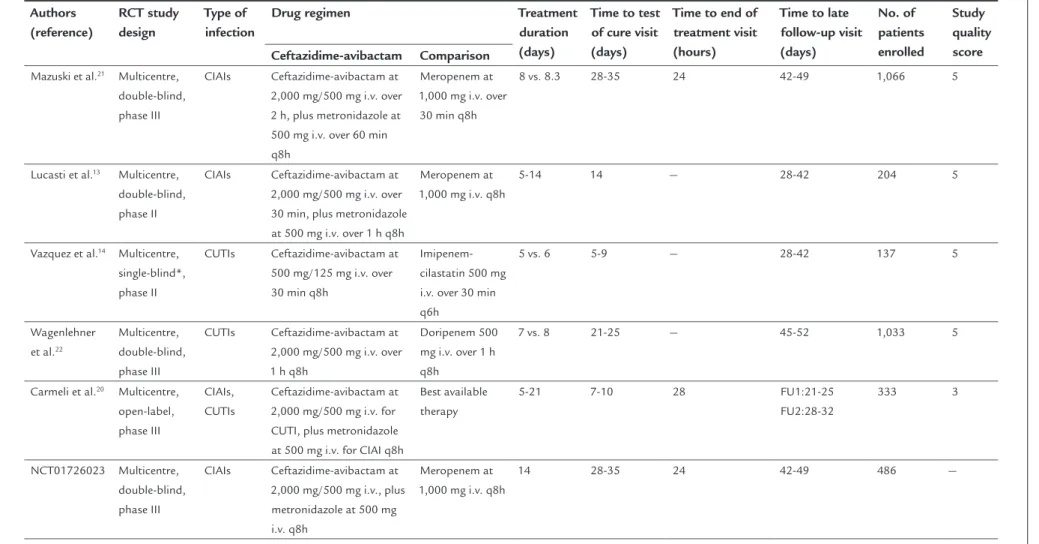
Table 1 shows the following characteristics of the includ-ed RCTs: study design, type of infection, number of pa-tients (MITT, mMITT, CE, ME, EME), mean age, drug information and Jadad score. The meta-analysis was com-posed of six RCTs for CIAIs and CUTIs. All included stud-ies were RCTs conducted between 2012 and 2016. All included trials were multinational studies. The total sample of the included trials was 3,259 subjects and all trials were conducted exclusively in populations aged 18-90 years. Most subjects in ceftazidime-avibactam groups (for CIAIs in combination with metronidazole) received ceftazidime-avibactam 2,000 mg of ceftazidime and 500 mg of avibactam as intravenous infusion every 8 hours, followed by metronidazole (500 mg as intravenous infu-sion every 8 hours) for CIAIs.13,20-22 That, except for one
study, in which patients received different doses of ceftazi-dime-avibactam (500 mg of ceftazidime and 125 mg of avibactam as intravenous infusion every 8 hours).14 The
mean Jadad score of the five publication RCTs was 4.6 (rang 3-5) and four trials had a high score of 5.
Clinical cure success for the treatment of CIAIs
Z H AN G Y ET AL . 2 5 6 R EV A SS O C M ED B R AS 2 0 1 8 ; 6 4 (3 ):2 5 3 -2 6 3
TABLE 1 The main characteristics of the trials included.
Authors (reference) RCT study design Type of infection
Drug regimen Treatment
duration (days)
Time to test of cure visit (days)
Time to end of treatment visit (hours)
Time to late follow-up visit (days) No. of patients enrolled Study quality score Ceftazidime-avibactam Comparison
Mazuski et al.21 Multicentre,
double-blind, phase III
CIAIs Ceftazidime-avibactam at 2,000 mg/500 mg i.v. over 2 h, plus metronidazole at 500 mg i.v. over 60 min q8h
Meropenem at 1,000 mg i.v. over 30 min q8h
8 vs. 8.3 28-35 24 42-49 1,066 5
Lucasti et al.13 Multicentre,
double-blind, phase II
CIAIs Ceftazidime-avibactam at 2,000 mg/500 mg i.v. over 30 min, plus metronidazole at 500 mg i.v. over 1 h q8h
Meropenem at 1,000 mg i.v. q8h
5-14 14 — 28-42 204 5
Vazquez et al.14 Multicentre,
single-blind*, phase II
CUTIs Ceftazidime-avibactam at 500 mg/125 mg i.v. over 30 min q8h
Imipenem-cilastatin 500 mg i.v. over 30 min q6h
5 vs. 6 5-9 — 28-42 137 5
Wagenlehner et al.22
Multicentre, double-blind, phase III
CUTIs Ceftazidime-avibactam at 2,000 mg/500 mg i.v. over 1 h q8h
Doripenem 500 mg i.v. over 1 h q8h
7 vs. 8 21-25 — 45-52 1,033 5
Carmeli et al.20 Multicentre,
open-label, phase III
CIAIs, CUTIs
Ceftazidime-avibactam at 2,000 mg/500 mg i.v. for CUTI, plus metronidazole at 500 mg i.v. for CIAI q8h
Best available therapy
5-21 7-10 28 FU1:21-25
FU2:28-32
333 3
NCT01726023 Multicentre, double-blind, phase III
CIAIs Ceftazidime-avibactam at 2,000 mg/500 mg i.v., plus metronidazole at 500 mg i.v. q8h
Meropenem at 1,000 mg i.v. q8h
14 28-35 24 42-49 486 —
*This study was investigator and patient-blind.
95CI 0.24-2.27, p=0.60, Table 2) and LFU visit (202 pa-tients, OR = 0.76, 95CI 0.25-2.35, p=0.64, Table 2), but at EOT visit shows higher success rate than comparison group (224 patients, OR = 1.52, 95CI 0.35-6.52, p=0.57, Table 2) and the difference was not significant. Data on EME patients was provided in one trial, and the clinical cure success rate of the ceftazidime-avibactam group was also lower than that of the comparison group at TOC visit (219 patients, OR = 0.71, 95CI 0.23-2.17, p=0.54, Table 2), EOT visit (232 patients, OR = 1.44, 95CI 0.34-6.19, p=0.62, Table 2) and LFU visit (209 patients, OR = 0.73, 95CI 0.24-2.24, p=0.58, Table 2), but again the difference was not significant at TOC visit, EOT visit and LFU visit.
Clinical cure success for the treatment of CUTIs
Clinical cure success rate for the treatment of CUTIs on the mMITT sample was provided only in one trial. The
ceftazi-dime-avibactam group was associated with lower rate of clinical cure success, but the difference was not significant at TOC visit, EOT visit or LFU visit (for TOC visit, p=0.42; for EOT visit, p=0.60; for LFU visit, p=0.88, Table 2). In our meta-analysis, the study of Carmeli et al.20 was split because
in this study the LFU visit was divided into FU1 visit (21-25 days post-therapy) and FU2 visit (28-32 days post-therapy).
Microbiological response success for the treatment of CIAIs
Data on the microbiological response success for the treat-ment of CIAIs were provided in two of the included RCTs with mMITT and EME patients. For mMITT patients, in total, 127 (83.0%) of the 153 patients in the ceftazidime--avibactam therapy group and 141 (86.5%) of the 163 pa-tients in the comparison therapy group achieved micro-biological response success. The ceftazidime-avibactam therapy group failed to produce a significant difference in
TABLE 2 Effect of study/patient characteristics for the treatment of CIAIs of clinical cure success and microbiological response success and for the treatment of CUTIs of clinical cure success.
Type of infection Treatment success
by population
Patients Analysis model Odds ratio (95CI) Heterogeneity
(I2, p-value) Clinical cure
success
CIAIs mMITT-TOC 1,139 FEM 0.77 (0.56-1.06) 21%, 0.11 mMITT-EOT 1,139 REM 0.74 (0.35-1.58) 54%, 0.44 mMITT-LFU 1,139 FEM 0.82 (0.60-1.13) 21%, 0.23 MITT-TOC 1,043 — 0.84 (0.60-1.17) —, 0.30 MITT-EOT 1,043 — 0.64 (0.42-0.97) —, 0.04 MITT-LFU 1,043 — 0.94 (0.68-1.30) —, 0.71 CE-TOC 1,187 FEM 0.91 (0.59-1.41) 0%, 0.66 CE-EOT 1,212 FEM 0.78 (0.47-1.29) 13%, 0.33 CE-LFU 1,173 FEM 0.95 (0.64-1.43) 0%, 0.81 ME-TOC 212 — 0.74 (0.24-2.27) —, 0.60 ME-EOT 224 — 1.52 (0.35-6.52) —, 0.57 ME-LFU 202 — 0.76 (0.25-2.35) —, 0.64 EME-TOC 219 — 0.71 (0.23-2.17) —, 0.54 EME-EOT 232 — 1.44 (0.34-6.19) —, 0.62 EME-LFU 209 — 0.73 (0.24-2.24) —, 0.58 Microbiological
response success
CIAIs mMITT-TOC 316 REM 1.11 (0.23-5.29) 61%, 0.89 mMITT-EOT 316 REM 1.68 (0.16-18.03) 73%, 0.67 mMITT-LFU 316 REM 1.12 (0.25-5.08) 59%, 0.88 ME-TOC 212 — 0.74 (0.24-2.27) —, 0.60 ME-EOT 224 — 1.52 (0.35-6.52) —, 0.57 ME-LFU 202 — 0.76 (0.25-2.35) —, 0.64 EME-TOC 232 — 0.71 (0.23-2.17) —, 0.54 EME-EOT 246 — 1.44 (0.34-6.19) —, 0.62 EME-LFU 221 — 0.73 (0.24-2.24) —, 0.58 Clinical cure
success
CUTIs mMITT-TOC 281 — 0.68 (0.27-1.72) —, 0.42 mMITT-EOT 281 — 0.52 (0.05-5.82) —, 0.60 mMITT-LFU 562 REM 0.96 (0.59-1.58) 0%, 0.88 “—” shows that data in this study was provided only in one trial.
ZHANG Y ETAL.
258 REV ASSOC MED BRAS 2018; 64(3):253-263
the number of patients achieving microbiological response sucess at TOC visit (OR = 1.11, 95CI 0.23-5.29, Table 2), EOT visit (OR = 1.68, 95CI 0.16-18.03, Table 2) and LFU visit (OR = 1.12, 95CI 0.25-5.08, Table 2). Similar results were confirmed in the EME analysis with patients with lower rate of microbiological response success in the ceftazidime-avibactam therapy group (at TOC visit, 232 patients, OR = 0.71, 95CI 0.23-2.17; at EOT visit, 246 pa-tients, OR = 1.44, 95CI 0.34-6.19; at LFU visit, 221 papa-tients, OR = 0.73, 95CI 0.24-2.24, Table 2). Data on the micro-biological response success for the treatment of CIAIs were provided in one of the included RCTs on ME patients. In both comparisons, ceftazidime-avibactam shows lower success rate than comparison group at TOC visit (p=0.60, Table 2) and LFU visit (p=0.64, Table 2), but at EOT visit
shows higher success rate than comparison group (p=0.57, Table 2) and the difference was not significant.
Microbiological response success for the treatment of CUTIs
Data on the microbiological response success for the treatment of CUTIs were provided in two of the included RCTs with mMITT patients. The ceftazidime-avibactam group was associated with higher rate of microbiological response success, but the difference was not significant at TOC visit and EOT visit (for TOC visit, p=0.05, Figure 1A; for EOT visit, p=0.87, Figure 1B). In total, 470 (69.0%) of the 681 patients in the ceftazidime-avibactam therapy group and 405 (58.6%) of the 691 patients in the com-parison therapy group achieved microbiological response success at LFU visit. The ceftazidime-avibactam therapy group was associated with significantly more patients achieving microbiological response success at LFU visit (OR = 1.58, 95CI 1.26-1.97, p<0.0001, Figure 1C). Data on the microbiological response success for the treatment of CUTIs were provided in one of the included RCTs on MITT patients. In both comparisons, ceftazidime-avibac-tam shows higher success rate than comparison group at TOC visit (95 patients, OR = 1.20, 95CI 0.51-2.80, p=0.67, data not shown in the figure) and LFU visit (95 patients, OR = 1.13, 95CI 0.51-2.53, p=0.77, data not shown in the figure), but at EOT visit shows lower success rate than comparison group (95 patients, OR = 0.59, 95CI 0.16-2.25, p=0.44, data not shown in the figure) and the difference was not significant. Data on the microbiological response success for the treatment of CUTIs were provided in two of the included RCTs on ME patients. In all, 260 (83.1%) of the 313 patients in the ceftazidime-avibactam therapy group and 250 (75.1%) of the 333 patients in the com-parison therapy group achieved microbiological response success at TOC visit. The ceftazidime-avibactam therapy
group was associated with significantly more patients achieving microbiological response success at TOC visit (OR = 1.61, 95CI 1.10-2.38, p=0.02, Figure 1D). In all, 197 (72.7%) of the 271 patients in the ceftazidime-avibactam therapy group and 184 (63.0%) of the 292 patients in the comparison therapy group achieved microbiological re-sponse success at LFU visit. The ceftazidime-avibactam therapy group was associated with significantly more patients achieving microbiological response success at LFU visit (OR = 1.56, 95CI 1.09-2.23, p=0.02, Figure 1F). The ceftazidime-avibactam group was associated with a lower rate of microbiological response success and the difference was no significant at EOT visit (p=0.85, Figure 1E). The treatment success of two RCTs was based on EME populations. There was no significant difference in treatment success at EOT visit between patients treated with ceftazidime-avibactam and those treated with com-parisons (p=0.97, Figure 1H). However, in EME popula-tions, the success of ceftazidime-avibactam treatment in the CUTIs subgroup was significantly higher than that in the comparison groups at the TOC visit and LFU visit (for TOC visit, 858 patients, OR = 2.15, 95CI 1.08-4.27, p=0.03, Figure 1G; for the LFU visit, 1,001 patients, OR = 1.75, 95CI 1.33-2.29, p<0.0001, Figure 1I). In our
meta-analysis, this part of the study of Carmeli et al.20 was split
because in this study the LFU visit was divided into FU1 visit (21-25 days post-therapy) and FU2 visit (28-32 days post-therapy) for mMITT patients and EME patients.
Microbiological response success in the treatment of mMITT populations infected with E. coli, Klebsiella pneumoniae, and P. aeruginosa
Four RCTs included in the meta-analysis reported data on mMITT patients. In our meta-analysis, the study of Car-meli et al.20 was split according to the treatment of CUTIs
Study or subgroup Experimental Control Odds ratio Odds ratio
Events Total Events Total Weight M-H, random, 95CI M-H, random, 95CI
A mMITT-TOC
Favors [experimental] Favors [control] 0.01 0.1 1 10 100
Carmeli et al.20 118 144 88 137 42.8% 2.53 [1.46, 4.38] Wagenlehner et al.22 299 393 291 417 57.2% 1.38 [1.01, 1.88] Subtotal (95CI) 537 554 100.0% 1.79 [0.99, 3.22] Total events 417 379
Heterogeneity: Tau2 = 0.13; Chi2 = 3.54, df = 1 (p=0.06); I2 = 72% Test for overall effect: Z = 1.93 (p=0.05)
Study or subgroup Experimental Control Odds ratio Odds ratio
Events Total Events Total Weight M-H, fixed, 95CI M-H, fixed, 95CI
B mMITT-EOT
Favors [experimental] Favors [control] 0.01 0.1 1 10 100
Carmeli et al.20 136 144 130 137 28.5% 0.92 [0.32, 2.60] Wagenlehner et al.22 374 393 395 417 71.5% 1.10 [0.58, 2.06] Subtotal (95CI) 537 554 100.0% 1.04 [0.61, 1.79]
Total events 510 525
Heterogeneity: Chi2 = 0.08, df = 1 (p=0.77); I2 = 0% Test for overall effect: Z = 0.16 (p=0.87)
Study or subgroup Experimental Control Odds ratio Odds ratio
Events Total Events Total Weight M-H, fixed, 95CI M-H, fixed, 95CI
C mMITT-LFU
Favors [experimental] Favors [control] 0.01 0.1 1 10 100
Carmeli et al.20 99 144 73 137 18.8% 1.93 [1.19, 3.14] Carmeli et al.20 103 144 78 137 18.3% 1.90 [1.16, 3.12] Wagenlehner et al.22 268 393 254 417 62.9% 1.38 [1.03, 1.84] Subtotal (95CI) 681 691 100.0% 1.58 [1.26, 1.97]
Total events 470 405
Heterogeneity: Chi2 = 2.06, df = 2 (p=0.36); I2 = 3% Test for overall effect: Z = 4.01 (p<0.0001)
Study or subgroup Experimental Control Odds ratio Odds ratio
Events Total Events Total Weight M-H, fixed, 95CI M-H, fixed, 95CI
D ME-TOC
Favors [experimental] Favors [control] 0.01 0.1 1 10 100
Vazquez et al.14 19 27 25 35 15.7% 0.95 [0.31, 2.87] Wagenlehner et al.22 241 286 225 298 84.3% 1.74 [1.15, 2.63] Subtotal (95CI) 313 333 100.0% 1.61 [1.10, 2.38]
Total events 260 250
ZHANG Y ETAL.
260 REV ASSOC MED BRAS 2018; 64(3):253-263
Study or subgroup Experimental Control Odds ratio Odds ratio
Events Total Events Total Weight M-H, fixed, 95CI M-H, fixed, 95CI
E ME-EOT
Favors [experimental] Favors [control] 0.01 0.1 1 10 100
Vazquez et al.14 25 26 34 34 61.5% 0.25 [0.01, 6.30] Wagenlehner et al.22 324 325 359 361 38.5% 1.81 [0.16, 20.00] Subtotal (95CI) 351 395 100.0% 0.85 [0.15, 4.87]
Total events 349 393
Heterogeneity: Chi2 = 0.94, df = 1 (p=0.33); I2 = 0% Test for overall effect: Z = 0.19 (p=0.85)
Study or subgroup Experimental Control Odds ratio Odds ratio
Events Total Events Total Weight M-H, fixed, 95CI M-H, fixed, 95CI
F ME-LFU
Favors [experimental] Favors [control] 0.01 0.1 1 10 100
Vazquez et al.14 15 26 18 30 14.6% 0.91 [0.31, 2.64] Wagenlehner et al.22 182 245 166 262 85.4% 1.67 [1.14, 2.45] Subtotal (95CI) 271 292 100.0% 1.56 [1.09, 2.23]
Total events 197 184
Heterogeneity: Chi2 = 1.11, df = 1 (p=0.29); I2 = 10% Test for overall effect: Z = 2.43 (p=0.02)
Study or subgroup Experimental Control Odds ratio Odds ratio
Events Total Events Total Weight M-H, random, 95CI M-H, random, 95CI
G EME-TOC
Favors [experimental] Favors [control] 0.01 0.1 1 10 100
Carmeli et al.20 114 131 84 124 43.7% 3.19 [1.69, 6.02] Wagenlehner et al.22 243 292 236 311 56.3% 1.58 [1.05, 2.36] Subtotal (95CI) 423 435 100.0% 2.15 [1.08, 4.27] Total events 357 320
Heterogeneity: Tau2 = 0.18, Chi2 = 3.40, df = 1 (p=0.07); I2 = 71% Test for overall effect: Z = 2.18 (p=0.03)
Study or subgroup Experimental Control Odds ratio Odds ratio
Events Total Events Total Weight M-H, fixed, 95CI M-H, fixed, 95CI
H EME-EOT
Favors [experimental] Favors [control] 0.01 0.1 1 10 100
Carmeli et al.20 133 134 127 127 58.2% 0.35 [0.01, 8.65] Wagenlehner et al.22 335 336 369 371 41.8% 1.82 [0.16, 20.12] Subtotal (95CI) 470 498 100.0% 0.96 [0.16, 5.65]
Total events 468 496
Microbiological response success in the treatment of ME populations infected with E. coli, Klebsiella pneumoniae, and P. aeruginosa
Three RCTs included in the meta-analysis reported data on ME patients. The total microbiological treatment suc-cess for the ceftazidime-avibactam group was numeri-cally lower than that for the comparison group in the ME population at the TOC visit, but there was no significant difference (144 patients, OR = 0.73, 95CI 0.21-2.50, p=0.61, data not shown in the figure). More specifically, treatment with ceftazidime-avibactam was associated with numeri-cally lower eradication rates for E. coli, Klebsiella pneumoni-ae, and P. aeruginosa (for E. coli, 309 strains, OR = 0.88, 95CI 0.42-1.87, p=0.74; for Klebsiella pneumoniae, 68 strains, OR = 0.75, 95CI 0.04-12.70, p=0.84; for P. aeruginosa, 42 strains, OR = 1.86, 95CI 0.15-23.00, p=0.63, data not shown in the figure). However, there were no significant differences in eradication for all these species.
Adverse effects
Data on AEs possibly or probably related to the study med-ications were reported in all of the included trials. Accord-ing to the data in the meta-analysis, ceftazidime-avibactam was numerically higher than comparisons on incidence of AEs, but the difference was not significant (3,180 subjects, OR = 1.09, 95CI 0.94-1.25, p=0.26, data not shown in the figure). There was no significant difference in the propor-tions of patients who developed serious adverse events
(SAEs) in the ceftazidime-avibactam groups and compari-son groups (six RCTs, 3,180 subjects, OR = 1.14, 95CI 0.84-1.54, p=0.40, data not shown in the figure). In our meta-analysis, the study of Carmeli et al.20 was split because the
treatment of CIAIs and CUTIs were both used in this study.
Mortality
All-cause mortality and mortality possibly related to the study drug during the study period were available in four of the six included trials. Although numerically higher mortality was found in the ceftazidime-avibactam groups, there was no significant difference in mortality between the ceftazidime-avibactam and comparison groups (2,029 patients, FEM, OR = 1.36, 95CI 0.70-2.65, p=0.37, data not shown in the figure). In our meta-analysis, the study of Carmeli et al.20 was split because the treatment of CIAIs
and CUTIs were both used in this study.
D
ISCUSSIONOur study is the first systematic review with meta-analy-sis comparing the efficacy and safety of ceftazidime-avi-bactam with comparison for CIAIs and CUTIs. Therefore, it provides valuable information for clinicians and repre-sents an important addition to the ceftazidime-avibactam trial program, providing supporting data for the treatment of CIAIs and CUTIs.
The results of our meta-analysis suggest that ceftazi-dime-avibactam is as effective as comparison antibiotics for
FIGURE 1 Meta-analysis of microbiological response success for the treatment of CUTIs based on mMITT populations, ME populations and
EME populations: (A) microbiological response success at test-of-cure visit on mMITT populations; (B) microbiological response success at end-of-treatment visit on mMITT populations; (C) microbiological response success at late-follow-up visit on mMITT populations; (D) microbio-logical response success at test-of-cure visit on ME populations; (E) microbiomicrobio-logical response success at end-of-treatment visit on ME popula-tions; (F) microbiological response success at late-follow-up visit on ME populapopula-tions; (G) microbiological response success at test-of-cure visit on EME populations; (H) microbiological response success at end-of-treatment visit on EME populations; (I) microbiological response success at late-follow-up visit on EME populations. Vertical line indicates no difference between linezolid and vancomycin. The size of each square denotes the proportion of information given by each trial. CI: confidence interval.
Study or subgroup Experimental Control Odds ratio Odds ratio
Events Total Events Total Weight M-H, fixed, 95CI M-H, fixed, 95CI
I EME-LFU
Favors [experimental] Favors [control] 0.01 0.1 1 10 100
Carmeli et al.20 85 117 68 115 23.4% 1.84 [1.06, 3.18] Carmeli et al.20 98 126 75 120 21.3% 2.10 [1.20, 3.67] Wagenlehner et al.22 184 251 173 272 55.3% 1.57 [1.08, 2.28] Subtotal (95CI) 494 507 100.0% 1.75 [1.33, 2.29]
Total events 367 316
ZHANG Y ETAL.
262 REV ASSOC MED BRAS 2018; 64(3):253-263
the treatment of patients with CUTIs and CIAIs. Six RCTs, five published and one unpublished (four double blinded, one open labeled), met the inclusion criteria of our meta-analysis. Our findings suggest that ceftazidime-avibactam shows comparable efficacy in clinical cure and microbio-logical response compared with meropenem and best avail-able therapy for CIAIs on mMITT, ME and EME populations at the TOC visit, EOT visit and LFU visit. Similarly, there was no significant difference in the numbers of clinical cure success between patients treated with ceftazidime-avibactam and the imipenem-cilastatin, doripenem or best available therapy for CUTIs based on mMITT populations at the TOC visit, EOT visit and LFU visit in these RCTs. Ceftazi-dime-avibactam versus active comparison drugs demon-strated a statistically significant higher rate of microbio-logical response success in ME and EME populations at the TOC visit and LFU visit for the treatment of CUTIs. Similar results are presented at the LFU visit on mMITT popula-tions for the treatment of CUTIs. E. coli remains the most frequently isolated uropathogen, followed by P. aeruginosa
and Proteus spp. Although ceftazidime-avibactam therapy showed no significant difference in eradiation rate from that of the comparison groups for almost all types of patho-gens, we can find better eradication rates for E. coli and Kleb-siella pneumoniae based on mMITT populations. Based on statistics of these three pathogens, we found no significant difference in eradication rate. One possible reason for that is the relatively small number of patients included. If more RCTs were included in the meta-analysis, the bacterial eradication rate would be more convincing.
Our meta-analysis revealed that there was no significant difference in the numbers of AEs, SAEs and mortality be-tween patients treated with ceftazidime-avibactam and the comparison drugs. AEs occur predominantly in the gas-trointestinal tract (including diarrhea, nausea, vomiting), nervous system (including headache, dizziness) and liver (including alanine aminotransferase increased, aspartate aminotransferase increased), and were also confirmed to be the adverse drug reactions most often reported in both comparison groups and clinically infected patients in many other studies of ceftazidime-avibactam treatment. Consid-ering the known safety profile for metronidazole (for the treatment of CIAIs), no new safety signals for ceftazidime--avibactam were identified, and the overall safety profile was similar to that reported for ceftazidime alone and the cephalosporin class. Most AEs were mild or moderate in both groups, with low incidences of discontinuations or death due to AEs and few SAEs.
We attempted to apply best practices in this system-atic review. Its strengths are: (1) as far as we know, this
is the first systematic review with meta-analysis compar-ing the efficacy and safety of ceftazidime-avibactam with comparison for CIAIs and CUTIs; (2) in the present meta-analysis, we considered each infection separately (CUTIs and CIAIs) thereby reducing clinical heterogene-ity at the design level; (3) in the present meta-analysis, we considered each populations separately (mMITT populations, MITT populations, CE populations, ME populations and EME populations) thereby reducing clinical heterogeneity at the design level; (4) in the pres-ent meta-analysis, we considered clinical cure success and microbiological response success thereby reducing clinical heterogeneity at the design level.
The findings of the present study must be viewed in the context of potential limitations. First, in most of the included trials, the comparison antibiotic was not the first-line recommended antibiotic for the assessed indica-tion. Second, all RCTs included in our review were indus-try sponsored, involving authors related to the drug com-pany. Such trials are more likely to report positive outcomes than trials funded by other sources.23 Third,
the meta-analysis is based on a relatively small number of RCTs and we acknowledge that using a limited number of studies raises the possibility of a second-order sampling error.24 Fourth, there is heterogeneity in some of the
rel-evant aspects (for example: comparative drugs included and different kinds of pathogens). Given this uncertain-ty resulting from clinical heterogeneiuncertain-ty, subgroup analy-sis should be performed on different patients and com-parative drugs about treatment success.
C
ONCLUSIONIn conclusion, ceftazidime-avibactam as a potential alterna-tive to carbapenems for treating CUTIs and CIAIs was ef-fective and comparable to those of ceftazidime, metronida-zole, meropenem and best available therapy and so on. It can play an important role in patients with Gram-negative pathogens resistant to ceftazidime and similar to its own efficacy against ceftazidime-susceptible infections. How-ever, to obtain more definite conclusions, further investiga-tion on ceftazidime-avibactam treatment is warranted.
A
CKNOWLEDGMENTSAll authors revised the final manuscript and confirmed that it would not be published anywhere else.
F
UNDINGE
THICALAPPROVALNot required.
R
EFERENCES1. Souli M, Galani I, Giamarellou H. Emergence of extensively drug-resistant and pandrug-resistant Gram-negative bacilli in Europe. Euro Surveill. 2008;13(47). Pii : 19045.
2. Sartelli M, Viale P, Catena F, Ansaloni L, Moore E, Malangoni M, et al. 2013 WSES guidelines for management of intra-abdominal infections. World J Emerg Surg. 2013;8(1):3.
3. Solomkin JS, Mazuski JE, Bradley JS, Rodvold KA, Goldstein EJ, Baron EJ, et al. Diagnosis and management of complicated intra-abdominal infection in adults and children: guidelines by the Surgical Infection Society and the Infectious Diseases Society of America. Clin Infect Dis. 2010;50(2):133-64. 4. Mnif MF, Kamoun M, Kacem FH, Bouaziz Z, Charfi N, Mnif F, et al. Complicated urinary tract infections associated with diabetes mellitus: pathogenesis, diagnosis and management. Indian J Endocrinol Metab. 2013;17(3):442-5.
5. Foxman B. The epidemiology of urinary tract infections. Nat Rev Urol. 2010;7(12):653-60.
6. Wagenlehner FM, Cek M, Naber KG, Kiyota H, Bjerklund-Johansen TE. Epidemiology, treatment and prevention of healthcare-associated urinary tract infections. World J Urol. 2012;30(1):59-67.
7. Castanheira M, Farrell SE, Krause KM, Jones RN, Sader HS. Contemporary diversity β-lactamase among Enterobacteriaceae in the nine U.S. census re-gions and ceftazidime-avibactam activity tested against isolates producing the most prevalent β-lactamase groups. Antimicrob Agents Chemother. 2014;58(2):833-8.
8. Mawal Y, Critchley IA, Riccobene TA, Talley AK. Ceftazidime-avibactam for the treatment of complicated urinary tract infections and complicated intra-abdominal infections. Expert Rev Clin Pharmacol. 2015;8(6):691-707. 9. Nordmann P, Poirel L, Walsh TR, Livermore DM. The emerging NDM
carbapenemases. Trends Microbiol. 2011;19(12):588-95.
10. Perez F, Van Duin D. Carbapenem-resistant Enterobacteriaceae: a menace to our most vulnerable patients. Cleve Clin J Med. 2013;80(4):225-33. 11. Drawz SM, Bonomo RA. Three decades of beta-lactamase inhibitors. Clin
Microbiol Rev. 2010;23(1):160-201.
12. Kanj SS, Kanafani ZA. Current concepts in antimicrobial therapy against resistant gram-negative organisms: extended-spectrum beta-lactamase-producing Enterobacteriaceae, carbapenem-resistant Enterobacteriaceae, and multidrug-resistant Pseudomonas aeruginosa. Mayo Clin Proc. 2011;86(3):250-9. 13. Lucasti C, Popescu I, Ramesh MK, Lipka J, Sable C. Comparative study of
the efficacy and safety of ceftazidime/avibactam plus metronidazole versus meropenem in the treatment of complicated intra-abdominal infections in
hospitalized adults: results of a randomized, double-blind, Phase II trial. J Antimicrob Chemother. 2013;68(5):1183-92.
14. Vazquez JA, González Patzán LD, Stricklin D, Duttaroy DD, Kreidly Z, Lipka J, et al. Efficacy and safety of ceftazidime-avibactam versus imipenem-cilastatin in the treatment of complicated urinary tract infections, including acute pyelonephritis, in hospitalized adults: results of a prospective, investigator-blinded, randomized study. Curr Med Res Opin. 2012;28(12):1921-31.
15. Merdjan H, Rangaraju M, Tarral A. Safety and pharmacokinetics of single and multiple ascending doses of avibactam alone and in combination with ceftazidime in healthy male volunteers: results of two randomized, placebo-controlled studies. Clin Drug Investig. 2015;35(5):307-17.
16. Sharma R, Park TE, Moy S. Ceftazidime-avibactam: a novel cephalosporin/ β-lactamase inhibitor combination for the treatment of resistant gram-negative organisms. Clin Ther. 2016;38(3):431-44.
17. Endimiani A, Choudhary Y, Bonomo RA. In vitro activity of NXL104 in combination with beta-lactams against Klebsiella pneumoniae isolates producing KPC carbapenemases. Antimicrob Agents Chemother. 2009;53(8):3599-601.
18. Adie S1, Harris IA, Naylor JM, Mittal R. Assessing the quality of report of randomized clinical trials: is blinding necessary. Control Clin Trials. 1996;17:1-12.
19. Higgins JP, Thompson SG, Deeks JJ, Altman DG. Measuring inconsistency in meta-analyses. BMJ. 2003;327(7414):557-60.
20. Carmeli Y, Armstrong J, Laud PJ, Newell P, Stone G, Wardman A, et alhttps:// www.ncbi.nlm.nih.gov/pubmed/?term=Gasink LB%5BAuthor%5D&cauth or=true&cauthor_uid=27107460. Ceftazidime-avibactam or best available therapy in patients with ceftazidime-resistant Enterobacteriaceae and Pseudomonas aeruginosa complicated urinary tract infections or complicated intra-abdominal infections (REPRISE): a randomised, pathogen-directed, phase 3 study. Lancet Infect Dis. 2016;16(6):661-73.
21. Mazuski JE, Gasink LB, Armstrong J, Broadhurst H, Stone GG, Rank D, et al. Efficacy and safety of ceftazidime-avibactam plus metronidazole versus meropenem in the treatment of complicated intra-abdominal infection: results from a randomized, controlled, double-blind, phase 3 program. Clin Infect Dis. 2016;62(11):1380-9.
22. Wagenlehner FM, Sobel JD, Newell P, Armstrong J, Huang X, Stone GG, et al. Ceftazidime-avibactam versus doripenem for the treatment of complicated urinary tract infections, including acute pyelonephritis: RECAPTURE, a phase 3 randomized trial program. Clin Infect Dis. 2016;63(6):754-62.
23. Bourgeois FT, Murthy S, Mandl KD. Outcome reporting among drug tri-als registered in ClinicalTritri-als.gov. Ann Intern Med. 2010;153(3):158-66. 24. Higgins J, Thompson S, Deeks J, Altman D. Statistical heterogeneity in systematic reviews of clinical trials: a critical appraisal of guidelines and practice. J Health Serv Res Policy. 2002;7(1):51-61.