Article
Printed in Brazil - ©2013 Sociedade Brasileira de Química0103 - 5053 $6.00+0.00
A
*e-mail: [email protected]
Nonsteroidal Anti-Inflammatory Drug Determination in Water Samples by
HPLC-DAD under Isocratic Conditions
Loreto Ascar,* Inés Ahumada, Alicia López, Francia Quintanilla and Karla Leiva
Departamento de Química Inorgánica y Analítica, Facultad de Ciencias Químicas y Farmacéuticas. Universidad de Chile, Casilla 233, Santiago, Chile
Fármacos anti-inflamatórios não-esteroidais (NSAIDs) são um grupo de medicamentos largamente utilizados para combater certas doenças. No entanto, após o consumo, podem ser excretados em águas residuais com consequente efeito ambiental. NSAIDs são disruptores endócrinos que podem causar alterações na fisiologia animal. O objetivo deste estudo foi desenvolver um método de análise que permita a determinação da presença de NSAIDs em água. A extração do composto foi realizada por extração em fase sólida (SPE), usando um cartucho Oasis HLB. Os analitos foram analisados por cromatografia líquida de alta eficiência com detecção por arranjo de diodos (HPLC-DAD). O método foi aplicado em águas do Rio Maipo e de uma estação de tratamento de águas residuais vizinha à Região Metropolitana dos pontos de amostragem Pajaritos, Viña, Tuberia, Unión e Gansos no Chile. Este método mostrou-se adequado na determinação dos NSAIDs em amostras de água com percentagens de recuperação acima de 80%. Naproxeno e ibuprofeno foram detectados principalmente em amostras de água do Rio Maipo, com concentrações variando entre 0,33 e 0,83 µg L-1.
Nonsteroidal anti-inflammatory drugs (NSAIDs) are a group of medications widely used by man to heal certain ailments. However, after consumption, they may be excreted in wastewaters with consequent environmental effects. NSAIDs are endocrine disruptors that can cause changes in animal physiology. The purpose of this study was to implement an analytical method that permits the determination of the presence of NSAIDs in water. Compound extraction was performed by solid-phase extraction (SPE) using an Oasis HLB cartridge. Analytes were analyzed by high-performance liquid chromatography with diode array detection (HPLC-DAD). The method was applied in water from the Maipo River and from a neighboring wastewater treatment plant in the Metropolitan Region of Pajaritos, Viña, Tuberia, Unión and Gansos sampling points in Chile. This method turned out to be adequate for the determination of NSAIDs in water samples with recovery percentages above 80%. Naproxen and ibuprofen were mostly detected in the Maipo River water samples, with concentrations ranging from 0.33 to 0.83 µg L-1.
Keywords: anti-inflammatory drugs, HPLC, solid-phase extraction
Introduction
Although substances of pharmaceutical origin have been in the environment for a long time, they have been classified in the group of emerging contaminants because large amounts of them enter the environment as a result of the increasing consumption both for human use and in veterinary practice.1
NSAIDs are among the pharmaceutical drugs the most widely used by humans all over the world. They are
easily accessible, common-use compounds in many cases
over-the-counter drugs,2 which permits their presence in
different environmental compartments.
The most widely used NSAIDs include ketoprofen, naproxen, diclofenac and ibuprofen, with different chemical structures but similar properties and features.
From a practical point of view, procedures are needed for the extraction of polar compounds from water samples since several neutral pharmaceutical compounds may exhibit significant hydrophobicity. In the last years, polymeric sorbents have been created in order to increase polar compound retention whether by new functional groups in the polymeric structure or by increasing the surface area. One of the most widely used sorbents is a copolymer of divinylbenzene and
vinylpyrrolidone, marketed as Oasis HLB. Weigel et al.4
demonstrated that this sorbent may simultaneously extract acid, neutral and basic compounds at neutral pH.
On the other hand, Gros et al.5 compared the extraction
of pharmaceutical compounds by working with different solid-phase extraction materials, including cation-exchange and nonpolar polymeric sorbents, and in the case of ibuprofen and naproxen, the highest recoveries were obtained with Oasis HLB, the first humidifiable copolymer
with hydrophilic (n-vinylpyrrolidone)-hydrophobic
(divinylbenzene) balance, reverse phase, optimum for any kind of sample clean-up, and unique for its purity, reproducibility, stability, retention characteristics, suitable
for solid-phase extraction of all kinds of compounds.6
The purpose of this study was the implementation and validation of an analytical method that would permit the determination of NSAIDs in water by making use of a simple method and readily available instruments such as high-performance liquid chromatography with diode array detection (HPLC-DAD).
Experimental
Reagents
Ketoprofen, naproxen, diclofenac and ibuprofen (97-100% purity) were obtained from Sigma-Aldrich (Germany). Monthly preparations were carried out of
500 mg L-1 solutions of each of the analytes in methanol,
stored at 4 ºC in the dark to prevent possible decomposition. All the solutions were prepared with Milli-Q water
(Millipore Corporation, USA) with 18 MΩ cm resistivity.
The solvents employed (methanol, acetone, acetonitrile,
n-hexane and ethyl acetate) were from Merck (Germany)
(HPLC grade). Potassium dihydrogen phosphate was also from Merck (analytical grade). Nitrogen gas was extrapure (99.995%) grade.
Solid-phase extraction (SPE) cartridges, packed with 60 mg Oasis HLB, were purchased from Waters (Ireland).
Water samples
Water samples were collected from different sites of the Maipo River in the Metropolitan Region of Chile, and also before and after passing through a wastewater treatment plant in the Metropolitan Region.
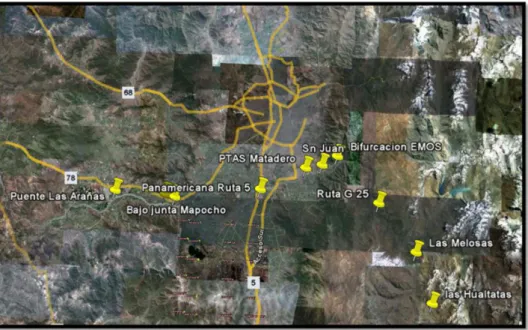
The Maipo River samples were taken at two different times in 2010, the first seven in March and the remaining six in June. The water sampling points of the Maipo River area (Figure 1) correspond to: Las Hualtatas (LH), Las Melosas (LM), Ruta G-25 (RG-25), Bifurcación Emos (BE), San Juan (SJ), PTAS Matadero (PM), Panamericana Ruta 5 (PR5), Río Maipo (RM), Bajo Junta Mapocho (BJM) and Puente Las Arañas (PLA). The water sampling points from streams neighboring a wastewater treatment plant in the Metropolitan Region, correspond to: Pajaritos, Viña, Tuberia, Unión and Gansos. Samples of surface water (0-1 m) were taken by means of a previously washed and primed bucket and 2 L were immediately transferred to amber glass bottles. Each sample was filtered with a 0.2 µm sterile membrane filter using vacuum. The samples were stored at 4 ºC until analysis.
The samples were processed using the implemented method in order to determine the presence of NSAIDs under study. The extracts thus obtained from each sample were quantified by HPLC-DAD.
Instrumentation
Chromatographic determinations were performed on a Waters HPLC set provided with binary pump (Waters 1525), Atlantis column dC18 (5 µm; 250 mm × 4.6 mm), UV-Vis detector with diode array (Waters 2998); a Rheodyne manual injector valve, model 7725i with 20 µL sample loop. Chromatograms were processed with Empower software.
Implementation and optimization of the analytical method for the determination of NSAIDs
Studies were carried out under different chromatographic conditions such as flow rate and mobile phase mixtures (acetonitrile: 50 mmol L-1 potassium dihydrogen phosphate,
pH 4.2). The best conditions for the analyte separation were obtained with isocratic elution with a 50% v/v mixture of
acetonitrile: 50 mmol L-1 potassium dihydrogen phosphate
at pH 4.2, 1 mL min-1 flow rate, at 25 ºC.
Solid-phase extraction method for NSAIDs
The cartridges were mounted on a manifold set connected to vacuum provided with an independent valve to regulate sample or elution solvent flow into the chamber. Three portions of 1 mL ethyl acetate were sequentially passed through the cartridge, followed by three portions of 1 mL methanol and three portions of 1 mL Milli-Q water. Then, the sample (500 or 1000 mL) was passed at
a rate of 1mL min-1. The cartridge was washed with three
portions of 1 mL methanol:water (at a 5:95 v/v ratio) and
three portions of 1 mL n-hexane. The analyte elution
from the cartridge was carried out with 3 aliquots of 1 mL ethyl acetate received in an amber vial. The mixture was evaporated to dryness with nitrogen gas in an evaporation set-up at room temperature, and finally, it was reconstituted
with 0.5 mL methanol.7
Calibration curve, limit of detection, linearity and recovery
In order to validate the method, studies were carried out
with Milli-Q water spiked with 1 mL of 5 and 10 mg L-1
doses of the four NSAIDs under study, which were diluted to a final volume of 250 or 500 mL, and then, cleaned and concentrated to 1 mL according to the method of solid-phase extraction previously described. They were quantified by liquid chromatography under the above described conditions.
Calibration curves of the analytes under study were obtained by linear regression in a range of 0.1 to 50 mg L-1,
using a mixture of the standards in pure methanol and in pure Milli-Q water by dilution of the concentrated standards.
Limit of detection for each NSAID was determined
according to Miller et al.8 From the equation of the
calibration, y = a + bx, were determined yB and SB terms,
where yB corresponds to the intercept (a) and SB to the
estimated standard deviation in the axis (Sy/x), finally, the
limit of detection was determined as the intercept of the calibration curve plus three times the estimated standard deviation in the axis (Sy/x). In this case, the calibration
curves were used to a higher linear range of 2 mg L-1.
For determination in water samples, volumes of 500 or 1000 mL were taken, which after applying the SPE procedure were concentrated and reconstituted in 500 µL methanol for subsequent quantification by HPLC-DAD.
In order to assess the influence of the sample matrix on analyte quantification in the samples from sites neighboring wastewater treatment plants of the Metropolitan Region, these were quantified in calibration curves prepared in methanol (MeOH), mobile phase (Ac/Fos) and Milli-Q water, and in water from the Maipo River streams: Las Melosas (LMM) and EMOS junction (EJ). The matrix effect was statistically assessed by Statgraphics program, using Tukey’s (honestly significant difference) test with 95% confidence, by comparing the difference between the measurements obtained in triplicate in different matrices.
Results and Discussion
Chromatographic separation
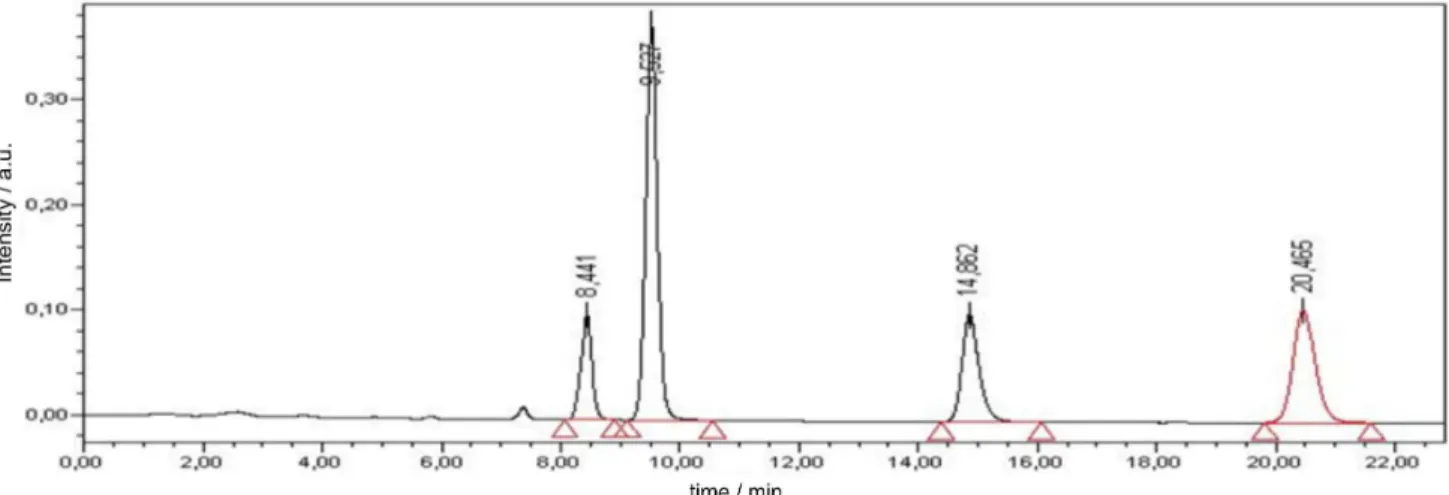
time less than 22 min. The elution order of the compounds agrees with those found by other researchers making use of similar columns, but with different mobile phases.7,9,10
According to studies carried out by Stafiej et al.,10
the effect shown by the modification in the mobile phase composition is produced because when the content of acetonitrile increases, the value of the retention factor for the more hydrophobic compounds decreases and the strength of the eluent increases, reducing the hydrophobic interaction between analytes and stationary phase.
Linearity, determination of the limits of detection (LOD) and quantification (LOQ)
From the production of calibration curves in methanol, a linear behavior was observed in the four NSAIDs up
to concentrations of 50 mg L-1, with linear correlation
coefficients above 0.9996 for all of the analytes under study (Table 1). From the four NSAIDs, naproxen showed a greater slope in the calibration curve compared with the other analytes, agreeing with the greater sensitivity. The limits of detection ranged from 5.8 to 35.4 µg L-1 and limits
of quantification were between 19.2 and 118.2 µg L-1 for the
different analytes. These values were used as a reference for the measurements to be carried out in the water samples. The limits of detection here obtained are in the range of
those obtained by Stafiej et al.,10 whose results ranged
from 20 to 770 µg L-1 for the same analytes, using HPLC
with UV detection at 230 nm. Even the results shown by
González-Barreiro et al.,11 with HPLC with fluorescence
detectors, with limits of detection from 2 to 120 µg L-1, are
not so distant from those obtained in this study, considering that the diode array detector has a lower sensitivity.
Extraction
The application of the method by the use of Oasis HLB polymeric cartridges in water solutions (1 L) spiked
with 1 mL of 5 and 10 mg L-1 of each of NSAIDs in
quintuplicate gave recovery percentages ranging from 84 to 100% (results not shown) and good recovery was found for ketoprofen and naproxen (above 90% for both enrichment levels). Diclofenac showed the lowest recovery levels even though they were not below 84%. Relative standard deviation values ranged from 1.8 to 5.4%, showing good precision in the measurements.
When the same assays were performed by carrying out the measurements on different days in order to assess reproducibility, the values of relative standard deviation ranged from 2.6 to 9.2%, except for ketoprofen spiked at
the 10 mg L-1 rate, in which the value reached was 13.2%,
showing a slight decrease in precision. On the other hand, a slight decrease was found in the recovery of all the analytes, even though always above 81% (Table 2). From
Table 1. Linear range, linear equation, coefficient of linear regression (R), limits of detection (LOD) and limits of quantification (LOQ) of the
anti-inflammatory compounds in methanol
NSAID Range / (mg L-1) y = bx + a R LOD / (mg L-1) LOQ / (mg L-1)
Ketoprofen 0.1-50 y = 64020.37x – 4381.32 0.9998 0.0158 0.0526
Naproxen 0.1-50 y = 255077.98x + 8102.39 0.9999 0.0058 0.0192
Diclofenac 0.1-50 y = 100130.22x – 4200.05 0.9996 0.0233 0.0776
Ibuprofen 0.1-50 y = 57644.79x – 633.09 0.9999 0.0354 0.1182
Figure 2. Chromatograms of a standard mixture of 10 mg L-1 of each anti-inflammatory with 50:50% (v/v) acetonitrile:KH
these results, it may be concluded that the extraction method using Oasis HLB cartridges and HPLC-DAD is adequate since high recovery values and good reproducibility were obtained. These values are comparable to those found by Weigel et al.,4 for ibuprofen and diclofenac in spiked water
samples.
Water samples
The water samples from the Maipo River showed pH values ranging from 7.28 to 8.23, thus the NSAIDs present in them should be in their neutral form since the pKa values for each of them are less than this value.
Naproxen was determined in several samples at
concentrations ranging from 0.32 to 0.55 µg L-1.
Ketoprofen and ibuprofen were found in some samples at concentrations similar to those of naproxen. Only the sample near the Matadero wastewater treatment plant, taken in June, showed the presence of diclofenac (Table 3).
The fact of finding naproxen in the largest amount of all the NSAIDs under study in the water samples might be
accounted for by the higher chromatographic sensitivity for this analyte, which permitted that small amounts could be quantified by making use of the diode array detector. Similar values have been reported for water samples by other authors, thus Fernández et al.12 reported naproxen,
ibuprofen, ketoprofen and diclofenac at concentrations of up to 640, 2784, 991 and 156 ng L-1, respectively, in water
along the Janares River in Madrid (Spain). On the other hand, Gros et al.,5 in a study carried out in water samples
in Barcelona (Spain), found naproxen, ibuprofen and diclofenac at concentrations of up to 50, 150 and 60 ng L-1, respectively. In the water samples from the sites
neighboring wastewater treatment plant in the Metropolitan Region, the pH values ranged from 6.88 to 7.52. The smaller pH values correspond to the samples taken just after passing through the treatment plant, which would indicate some acidification of the samples in the water purification process. All the water samples near Santiago wastewater purification plant showed the presence of ibuprofen at
concentrations ranging from 2.8 to 40.0 µg L-1 (Table 4),
the highest concentrations corresponding to the site after the plant discharge, which would indicate that ibuprofen is not eliminated in the water purification process applied at this plant. In addition, it was possible to quantify ketoprofen and naproxen in some of these samples, but at smaller concentrations compared to ibuprofen. This might suggest that there is a greater ibuprofen consumption by the population. None of the samples under analysis showed the presence of diclofenac. It was also possible to show the presence of ketoprofen in the water samples from the water treatment plant, but at very low concentrations, near the limit Table 2. Statistical study of anti-inflammatory analysis reproducibility in aqueous solutions amended with 1 mL of 5 and 10 mg L-1 of each NSAIDs
Spiked concentration / (mg L-1)
Ketoprofen Naproxen Diclofenac Ibuprofen
Concentration /
(mg L-1) R / %
Concentration /
(mg L-1) R / %
Concentration /
(mg L-1) R / %
Concentration /
(mg L-1) R / %
5 4.5 ± 0.3 90 4.5 ± 0.3 90 4.2 ± 0.2 84 4.1 ± 0.2 81
10 10 ±1.0 102 9.3 ± 0.4 93 8.7 ± 0.2 87 8.6 ± 0.8 86
Table 3. Concentration of the anti-inflammatory compounds in water samples from the Metropolitan Region
Sample abbreviation
Ketoprofen / (µg L-1)
Naproxen / (µg L-1)
Diclofenac / (µg L-1)
Ibuprofen / (µg L-1)
LMM nd 0.4952 nd nd
RG25M 0.3512 0.3827 nd 0.3809
BEM nd nd nd nd
PMM nd nd nd nd
RMM 0.3655 0.3855 nd nd
BJMM nd 0.3490 nd nd
PLAM 0.3348 0.3201 nd nd
LHJ nd nd nd nd
BEJ nd nd nd nd
SJJ nd 0.3293 nd nd
PMJ 0.8309 nd 0.8741 0.5483
PR5J nd nd nd nd
RMJ nd 0.5477 nd 0.7887
Subscripts correspond to M: March, J: June; nd: not detected.
Table 4. Concentration (mean ± standard deviation) of anti-inflammatory compounds in wastewater samples near treatment plants
Sample Ketoprofen / (µg L-1)
Naproxen / (µg L-1)
Diclofenac / (µg L-1)
Ibuprofen / (µg L-1)
Pajaritos nd 1.6 ± 0.2 nd 11.6 ± 2.8
Viña nd 0.12 ± 0.02 nd 2.8 ± 0.3
Tubería 0.08 ± 0.01 nd nd 40.0 ± 5.6 Unión 4.5 ± 0.3 2.61 ± 0.06 nd 32.7 ± 3.7
Table 5. Concentration of the anti-inflammatory compounds in wastewater samples near treatment plants, in different matrices
Sample Ketoprofen /(µg L-1) Naproxen /(µg L-1) Diclofenac /(µg L-1) Ibuprofen /(µg L-1)
Pajaritos MeOH nd 1.61 nd 11.65
Pajaritos Ac/Fos nd 1.67 nd 11.93
Pajaritos MilliQ nd 1.68 nd 12.66
Pajaritos LMM nd 1.69 nd 13.85
Pajaritos BEM nd 1.66 nd 12.73
Viña MeOH nd 0.12 nd 2.85
Viña Ac/Fos nd 0.17 nd 2.89
Viña MilliQ nd 0.13 nd 3.01
Viña LMM nd 0.17 nd 3.40
Viña BEM nd 0.17 nd 2.94
Tubería MeOH 0.08 nd nd 40.03
Tubería Ac/Fos 0.03* nd nd 40.63
Tubería MilliQ 0.09 nd nd 41.91
Tubería LMM 0.07 nd nd 47.72
Tubería BEM 0.20* nd nd 40.84
Unión MeOH 4.51 2.61 nd 32.66
Unión Ac/Fos 4.40 2.62 nd 33.42
Unión MilliQ 4.43 2.71 nd 34.33
Unión LMM 4.90 2.71 nd 38.93
Unión BEM 4.50 2.66 nd 33.54
Gansos MeOH nd 0.61* nd 3.94
Gansos Ac/Fos nd 0.65 nd 4.01
Gansos Milli-Q nd 0.64 nd 4.13*
Gansos LMM nd 0.66 nd 4.70
Gansos BEM nd 0.65 nd 4.03*
Mean (n = 3). *Values accompanied by the asterisk in each column for the same sample have no statistically significant differences at p < 0.05, according to Tukey HSD. nd: not detected.
of quantification. According to the results obtained by Santos
et al.,7 in a study done on affluent and effluent water of a
water treatment plant in Sevilla, ibuprofen was also found in the greatest amount, reaching values of up to 143 µg L-1,
diclofenac could not be quantified and the values reported for naproxen and ketoprofen are within the range of those obtained in this study.
The statistical study (Table 5) shows that, in most cases, there were no significant differences in the measurements done on the different matrices in use, only the Gansos sample showed a difference in ibuprofen quantification with the calibration curve for water from the Maipo River Las Melosas site, which might be attributed to the presence of traces of this NSAID in these samples or to other compounds in the matrix that interfere in this chromatographic zone. Therefore, it may be concluded that there is no matrix effect on the calibration curve of the quantification of these samples.
Conclusions
The chromatographic separation of NSAIDs under study using as a mobile phase a mixture of acetonitrile: diacid potassium phosphate (pH 4.2-4.5) at a 50:50% (v/v)
ratio, a flow rate of 1 mL min-1, was adequate, attaining
compound separation in less than 22 min, with limits of
detection ranging from 5.8 to 35.4 µg L-1, suitable for
determination in actual water samples.
The method of extraction using Oasis HLB cartridges turned out to be adequate to determine the analytes under study in water samples since recovery percentages ranged from 84 to 100%. Likewise, repeatability showed recovery values above 81% with relative standard deviations below 14%.
ranging from 0.32 to 0.49 µg L-1, while diclofenac was only
found in the sample near Matadero wastewater treatment plant (JMP).
Ibuprofen was mostly found in the water samples near the wastewater treatment plant of the Metropolitan Region, at concentrations 10 to 100 times those of ketoprofen and naproxen. Diclofenac was not found in quantifiable amounts.
The analyte concentrations near the wastewater treatment plant were independent of the matrix of the calibration curve in use, which simplified measurements.
The resulting method permits the determination of NSAIDs under study in water, making use of a massive method such as high performance liquid chromatography with diode array detection, which is available for routine analyses in many chemical laboratories.
Acknowledgment
The authors thank FONDECYT Project 11090287 for financial support.
References
1. Jones, O.; Lester, J.; Voulvoulis, N.; Trends Biotechnol. 2005, 23, 163.
2. Bori, G.; Hernández, B.; Gobbo, M; Lanas, Á.; Salazar, M.; Terán, L.; Díaz, J.; Espinosa, R.; Galván, F.; García, L.; Álvarado-Garcia, J.; Ávila, H.; Carmona, L.; Rivera, J.; Ventura, L.; Reumatol. Clin. 2009, 5, 3.
3. Díaz-Cruz, M.; Barceló, D.; TrAC, Trends Anal. Chem. 2005, 24, 645.
4. Weigel, S., Berger, U.; Jensen, E.; Kallenborn, R.; Thoresen, H.; Hühnerfuss, H.; Chemosphere 2004, 56, 583.
5. Gros, M.; Petrovic, M.; Barceló, D.; Talanta 2006, 70, 678. 6. Waters Oasis; Chromatography Columns and Supplies Catalog
2008-2009; Waters Corporation, USA.
7. Santos, J.; Aparicio, I.; Alonso, E.; Callejón, M.; Anal. Chim. Acta 2005, 550, 116.
8. Miller N. J.; Miller J. C.; Estadística y Quimiometría para Química Analítica; Pearson Education S. A.: Madrid, 2002, p. 111-152.
9. Kot-Wasik, A.; Debska, J.; Wasik, A.; Namiesnik, J.; Chromatographia 2006, 64, 13.
10. Stafiej, A.; Pyrzynska, K.; Regan, F.; J. Sep. Sci. 2007, 30, 985. 11. González-Barreiro, C.; Lores, M.; Casais, M.; Cela, R.;
J. Chromatogr., A 2003, 993, 29.
12. Fernández, C.; González-Doncel, M.; Pro, J.; Carbonell, G.; Tarazona, J.; Sci Total Environ. 2010, 4008, 543.
Submitted: November 27, 2012