Article
Two New Cneorubin Related Diterpenes from the Leaves of Guarea guidonia (Meliaceae)
Claudia B. Brochinia and Nidia F. Roquea,b
a
Instituto de Química, Universidade de São Paulo, CP 26077, 05513-970, São Paulo - SP, Brazil
b
Instituto de Química, Universidade Federal da Bahia,Campus Universitário de Ondina 40170-290, Salvador- BA, Brazil
Dois novos diterpenos do tipo das cneorubinas, além de dois conhecidos, foram isolados das folhas da Guarea guidonia (Meliaceae). Um dos novos diterpenos possui o sistema trans biciclo [5.1.0] octano, encontrado muito raramente entre os produtos naturais. As estruturas foram determinadas com base na análise de dados espectrais. A análise dos espectros de RMN dos diterpenos conhecidos permitiu uma re-atribuição de dados da literatura.
Two new and two known cneorubin related diterpenes were isolated from the leaves of Guarea
guidonia (Meliaceae). One of the new diterpenes has the unusual trans bicyclo[5.1.0]octane ring
system. The structures were elucidated by spectral data. The analysis of the NMR spectra of the known diterpenes allowed the reassignment of their NMR data.
Keywords: Guarea guidonia, Meliaceae, diterpenes, cneorubinanes, NMR data
J. Braz. Chem. Soc., Vol. 11, No. 4, 361-364, 2000.
Printed in Brazil
c 2000 Soc. Bras. Química 0103 - 5053 $6.00+0.00
Introduction
Guarea guidonia (L) Sleumer is a brazilian Meliaceae
species occurring all over the country. The leaves of G.
guidonia have already been chemically investigated and
different compositions have been found for specimens col-lected in different country regions1-3. We are now
investi-gating the leaves of a specimen collected in Campo Grande-MS, western of Brazil.
This paper describes the isolation and identification of two known (1 and 2) and two novel (3 and 4) diterpenes besides sitosterol, stigmasterol, β-selinene and a mixture of unidentified hydrocarbon sesquiterpenes obtained from the hexane fraction of the methanolic extract of G.
guidonia leaves. Despite the report of the known
com-pounds from Cneorum tricoccom, Cneoracea, 19 years ago4, it is particularly surprising that they have not been
identified from any other natural source. Furthermore, no structurally related natural products have been isolated from plant sources. There is only a report about the isola-tion of emmottene, a related diterpene from Briareum
polyanthes, a Bermudian gorgonian5 .
Results and discussion
The 13C NMR data of diterpenes 1 and 2 isolated from
Guarea guidonia are identical to those reported for
cneorubin Y and X, respectively4. Comparison of the 13C
and 1H NMR data of 2 with those reported for the
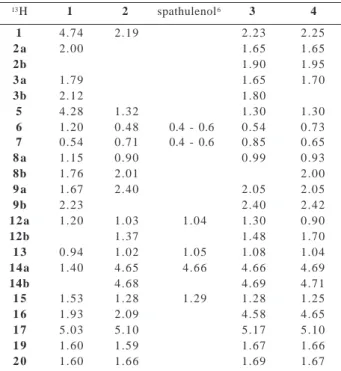
aromadendrane sesquiterpene, spathulenol,6 showed that the diterpene and the sesquiterpene have identical ring sys-tem, including the stereochemistry (Tables 1 and 2). How-ever, the five and seven membered rings of cneorubin X (2) are not cis-fused as previously proposed7 but trans-fused. The analysis of the 2D NMR (1H-1H COSY and 13C-1H
COSY) spectra allowed the reassignment of the NMR data for 1 and 2 . The former has the same ring system as the sesquiterpene bicyclogermacrene8.
1
3
6 9 14
15
H
H HO
H R
R1 3
9 14
15 7
13
19
(1) (2) R=αH, R1=H (Cneorubin X)
(3) R=αH, R1=OH (Cneorubin A)
(4) R=βH, R1=OH (Cneorubin B)
H
H HO
H H
3
9 14
15 7
13
H H H
H
3
9 14
15 7
13
362 Brochini & Roque J. Braz. Chem. Soc.
at C-16. Comparison of the 13C NMR data of 3 with
those of 2 suggested that both present the same stere-ochemistry on the ring system. The permanence of the more protected methyl group on the cyclopropyl ring indicated that the lateral chain, which differentiate 2 and 3 from spathulenol, is located at C-12 on the α side of the cyclopropane ring. The methyl group is more pro-tected in 2 (δ 13,6) and 3 (δ 14,6) than in spathulenol (δ 16,3) because of the γ effect of C-16. A NOESY spectrum of 3 (Table 3) confirmed that the relative stereochemistry of the molecule is the same as in spathulenol.
Table 1. 13C NMR data for 1, 2(50 MHz), 3, 4 (100MHz) and
spathulenol. (δ, CDCl3).
13C 1 2 spathulenol6 3 4
1 124.8 52.9 54.3 51.4 48.3
2 26.0 26.3 26.7 25.6 24.0
3 41.2 41.6 41.7 41.0 39.5
4 127.9 81.0 81.0 80.6 80.0
5 126.4 53.8 53.4 53.3 53.0
6 26.5 29.1 29.9 26.5 25.0a
7 29.4 26.8 27.5 27.4 25.2a
8 26.9 24.8 24.8 24.8 25.3
9 37.2 38.9 38.8 38.8 39.0
1 0 140.8 153.5 153.4 153.5 154.5
11 23.8 24.3 20.2 21.7 20.7
1 2 43.6 43.2 28.6 49.8 49.7
1 3 12.8 13.6 16.3 14.6 13.2
1 4 20.8 106.2 106.2 106.5 106.5
1 5 17.6 25.7a 26.1 25.1 23.3
1 6 25.0 25.2 - 67.2 66.5
1 7 124.8 124.8 - 128.4 128.2
1 8 130.9 131.1 - 134.8 134.5
1 9 16.5 17.6 - 18.1 18.2
2 0 25.7 25.9a - 25.8 25.7
a Values can be interchanged
Table 2. 1H NMR data for 1, 2 (200MHz), 3, 4 (400MHz) and
spathulenol (δ, CDCl3).
13H 1 2 spathulenol6 3 4
1 4.74 2.19 2.23 2.25
2 a 2.00 1.65 1.65
2b 1.90 1.95
3 a 1.79 1.65 1.70
3b 2.12 1.80
5 4.28 1.32 1.30 1.30
6 1.20 0.48 0.4 - 0.6 0.54 0.73
7 0.54 0.71 0.4 - 0.6 0.85 0.65
8 a 1.15 0.90 0.99 0.93
8b 1.76 2.01 2.00
9 a 1.67 2.40 2.05 2.05
9b 2.23 2.40 2.42
1 2 a 1.20 1.03 1.04 1.30 0.90
12b 1.37 1.48 1.70
1 3 0.94 1.02 1.05 1.08 1.04
1 4 a 1.40 4.65 4.66 4.66 4.69
14b 4.68 4.69 4.71
1 5 1.53 1.28 1.29 1.28 1.25
1 6 1.93 2.09 4.58 4.65
1 7 5.03 5.10 5.17 5.10
1 9 1.60 1.59 1.67 1.66
2 0 1.60 1.66 1.69 1.67
The diterpenes 3 and 4 have not been described yet in the literature. Their molecular formula (C20H32O2) have been deduced by the EI/MS and 13C NMR data.
Although the 1H NMR spectra of these terpenes reveal significative difference in the region between δ 0.5 and 2.0 (Table 2), the analysis of other spectral data (13C NMR, 13C–1H COSY and HMBC) showed that both have
an identical planar structure and differ from that of 2 only due to the presence of an additional hydroxyl group
Table 3. Correlation observed in the NOESY spectra for 3 and 4
(400 MHz, δ, CDCl3).
3 4
1H (δ) 1H (δ) 1H (δ) 1H (δ) H-1 (2.23) H-6 (0.54) H-1 (2.25) H-15 (1.25)
H-6 (0.70) H-15 (1.28) H-5 (1.30) H-13 (1.04) H-6 (0.54) H-15 (1.28) H-6 (0.70) H-15 (1.25) H-14a (4.66) H-9β (2.40) H-14a (4.69) H-9β (2.42) H-14b (4.69) H-2b (1.90) H-14b (4.71) H-2b (1.95) H-16 (4.58) H-13 (1.08) H-16 (4.65) H-13 (1.04) H-15 (1.28) H-19 (1.66) H-19 (1.67) H-17 (5.10) H-20 (1.67) H-17 (5.17) H-20 (1.69) H-12a (0.90)
The 13C NMR chemical shift of the exocyclic methyl-ene (δ 106.5)8 as well as the H-6 and H-7 chemical shifts (ca
Vol. 11 No. 4, 2000 Two New Cneorubin Related Diterpenes from the Leaves of Guarea guidonia 363
overlaping of the signals of H-6 and H-7 in the 1H NMR
spectrum of 4 made that analysis difficult. The observation of a spatial correlation between H-5 and H-13 in 4 and not in 3, as well as between H-15 and H-16 in 3 but not in 4 agrees with the proposed modification. No spatial correla-tion is observed between H-5 and H-6 or H-7 but a small interaction is observed between H-1 and H-6 or H-7 in 4. As in 3 we could see a correlation between H-1 and H-6, but not between H-1 and H-7, we can suggest that the correla-tion in 4 is also between H-1 and H-6. By these observacorrela-tions we proposed that 3 and 4 are epimers at C-7, so the last one has a trans bicyclo[5.1.0] system ring as in emmottene5. Inspection of molecular model showed that in 4 the methyl group at C-4 is closer to C-1 than in 3, justifying a strong nOe between H-1 and H-15 observed in the NOESY spec-trum. This observation also agrees with the shielding of the cyclopentane ring carbons in the 13C NMR spectrum of the
diterpene 4, in relation to those of 3. The structures of 4 and of emmottene5 suggest that a revision in the
stereochemis-try of aromadendrane like natural products is necessary. We named the skeleton of diterpenes 2-4 as cneorubinane.
It is interesting to mention that species of Cneora-ceae family also produce meliacins, tetranortriterpe-nes that characterise the chemical constitution of Meliaceae species.
Experimental
General Procedures
The IR spectra were registered as KBr pellets in a Perkin Elmer FT 1750 spectrometer. The low resolution mass spectra were obtained in a INCOS 50 Finnigan-Mat instrument operat-ing at 70 eV. The 1Hand 13C NMR spectra, using CDCl
3 as
solvent and TMS as internal reference, were run in a Bruker AC 200 and a Varian U-400. For the column separations Merck silica gel, 63-200 mm and 40-63 mm was used. For preparative TLC Merck silica gel 60 GF254 was employed.
Plant material
Leaves of Guarea guidonia (L.) Sleumer were collected in February 1994, in Campo Grande, Mato Grosso do Sul, Brazil. A voucher was deposited under the number 1870 in the Herbarium of the Universidade Federal do Mato Grosso do Sul.
Extraction and isolation of the compounds
Dried leaves of G. guidonia (1100 g ) were extracted at room temperature with methanol. After distillation of the solvent, 72 g of the extract were obtained. This material
was submitted to a partition between hexane and MeOH/ H2O (95:5).The hexane phase (47 g) was dissolved in hot MeOH and kept at 4 oC during 24 h. After filtration, the
soluble part was concentrated affording 25 g of a solid resi-due. This residue was submitted to chromatography on a silica gel column eluted with gradient mixtures of hexane and ethyl acetate. The first fractions were submitted to further purifica-tion on silica gel column, eluted with gradient mixtures of hexane and CH2Cl2, and to preparative TLC using silica gel impregnated with AgNO3. β-Selinene (40 mg), an unidenti-fied sesquiterpene mixture (60 mg) and 1 (60 mg) and 2 (20 mg) were isolated. The intermediary fractions afforded a mix-ture of sitosterol and stigmasterol (50 mg). The more polar fractions were chromatographed over silica gel column eluted with step gradient mixtures of hexane and isopropanol yield-ing 4 (25 mg) and 3 (20 mg).
Cneorubin-A:
(1R-*4S*)-16-dihydroxy-(5R*-6R*-7R*)-cneorubin-10 (14),17-diene (3): colourless gum. IR
υmax(KBr, cm-1) 3371, 3082, 2924, 2866, 1635, 1447,
1378, 1150, 1032. EIMS, m/z (relative intensity in %) 303 (2, M. +- H. ), 289 (16, M .+– Me. ), 287 (56, M.+-OH. ), 269 (100, M.+ - HO .-H
2O), 231 (23), 213 (11), 202 (13).1 Hand 13C NMR see Tables 1-3.
Cneorubin-B:(1R*-4S*)-16-dihydroxy-(5*R*-6R*-7S*) -16-cneorubin-10(14),17-diene (4): colourless gum. IR: υmax(KBr, cm-1) 3343, 3083, 2967, 2924, 2862, 1633, 1451, 1379, 1149, 1121, 1051. EIMS: m/z (relative inten-sity in %) 303 (2, M.+ – H.), 289 (6, M .+–Me.), 287 (65, M
.+– OH .), 269 (100, M.+ – OH .– H
2O ), 231 (14), 213 (6),
202 (13). H1 and C13 NMR see Tables 1-3.
Acknowledgements
The authors are grateful to Dr. Walmir da S. Garcez and Dr. Fernanda R. Garcez from IQ, UFMS for supplying the plant material. We would like to thank Dr. David Kingston and Dr. Leslie Gunatilaka (Virginia Tech, USA) for the 400 MHz NMR spectra, and also to FAPESP and CNPq for financial support and scholarships.
References
1. Furlan, M.; Wolter Filho,W.; Roque, N. F.
Phytochemis-try 1993, 32,1519.
2. Garcez, F. R.; Núñez, C. V.; Garcez, W. S.; Almeida, R.M.; Roque, N. F. Planta Medica 1998, 64, 79. 3. Furlan.M.; Lopes, M. N.; Fernandes, J. B.; Pirani, J. R.
Phytochemistry 1996, 41, 1159.
4. Trautmann, D.; Epe, B.; Oelbermann, U.; Mondon, A.
364 Brochini & Roque J. Braz. Chem. Soc.
5. Cronan, J. M. Jr.; Daviau,T. R.; Pannell, L.K.; Cardellina II, J. H. J.Org.Chem.1995, 60, 6864 6. Iwabuchi, H.; Yoshikura, M.; Kamisako, W. Chem.
Pharm. Bull. 1989, 37, 509.
7. Faure, R.; Ramanoelina, A R.P.; Rakotonirainy, O;
Bianchini, J. P.; Gaydou, E. M. Mag. Reson. Chem
1991, 29, 969.
8. Joulain, D.; König, W. A In The Atlas of Spectral Data
of Sesquiterpene Hydrocarbon ; E. B. Verlag;
Ham-burg, 1999.
Received: August 05, 1999.