Brazilian Journal of Physics, vol. 37, no. 2C, June, 2007 745
Charmless Hadronic Penguin
B
Decays with BaBar:
B
0(
B
0)
→
K
∗0K
0or
η
′η
′J. William Gary
Department of Physics and Astronomy, University of California, Riverside, CA 92521 USA
Received on 29 October, 2006
Recent results from the BaBar experiment on searches for New Physics using the charmless channelsB0→
K∗0K0andB0→η′η′are discussed.
Keywords:Bmesons; Rare charmless decays
I. INTRODUCTION
The BaBar experiment at SLAC studies e+e−annihilations at theϒ(4S)resonance. Theϒ(4S)is a clean, copious source ofBmesons. Theϒ(4S)decays about half the time toB0B0 pairs and the other half of the time to B+B− pairs. At the
ϒ(4S)energy, about 75% of the cross section is e+e−→qq (q=u,d,s,c) continuum events, with the remaining cross sec-tion the e+e−→ϒ(4S)→BBevents. The large continuum background is reduced by considering the kinematic variables mESand∆E, with∆E≡EB∗−Ebeam∗ andmES≡
q
Ebeam∗2 −PB∗2, whereEB∗andPB∗are the CM energy and momentum of theB meson candidate (reconstructed in the decay channel of in-terest) andEbeam∗ is half the CM energy. ForB candidates, mESis peaked at theBmass and∆E is peaked at zero, while
for continuum events mES and∆E do not have any peaking
structure. A third key variable to reducing the combinatoric background is the event shape. At theϒ(4S)energy, theBand Bmesons are produced almost at rest. Thus the event is spher-ical in momentum space. In contrast, the e+e−→qqevents are jet-like. A Fisher discriminant based on event shape infor-mation is used in conjunction withmESand∆Eto separate the
Bmeson candidates from the continuum background. The interest in charmless decays, corresponding tob→d andb→squark transitions, is that they are loop diagrams. These transitions are called “penguin” diagrams. Thus, un-like the much more copiousb→ctree-level transitions, pen-guin transitions are sensitive to physics beyond the Standard Model through the virtual production of New Physics parti-cles. Among the most important purely hadronic B0decays being studied by BaBar are the tree-levelB0→J/ΨK0decay, and the penguinB0→φK0andB0→η′K0decays. Feynman diagrams for these decays are shown in Fig. 1.
Of central interest to current studies of the B meson are measurements of the time dependent CP asymmetry inB0and
B0decays to a common final state f, defined by
ACPf (t) = [Γ(B
0→ f)](t)−[Γ(B0→f)](t)
sum (1)
= Sfsin(∆mt)−Cfcos(∆mt) (2)
This has the simple form in terms of the sin and cos functions as shown in eq. (2), with∆mthe neutralBdmass difference.
For f a CP eigenstate and for decays dominated by a single weak phase, conditions which hold for the processes shown in Fig. 1, the coefficientsSf andCfare given bySf =ηfsin(2β)
W
0
0
d
B
b
c
c
s
d
K
0
0
φ,η
B
d
b
s
s
s
d
K
W
g
FIG. 1: Feynman diagrams forB0→J/ΨK0,B0→φK0andB0→ η′K0.
andCf=0, whereηf is the CP eigenvalue (=±1) and sin(2β)
is the phase difference between theB→ f andB→B→ f decay paths. Results forSf determined from eq. (1) for the
three channels shown in Fig. 1 are presented in Fig. 2. The corresponding results forCf are found to be consistent with
zero and thus agree with the Standard Model expectation.
−1 −0.5
sin (2
0 0.5 1
J/ψK0
B0 φK0 B0 ηK0
0
[0.59 0.08] +
−
[0.687 0.032]
+
−
[0.39 0.18]
−
+
B
eff.
β
)S limits
∆
from SU(3)(90% CL)
FIG. 2: Effective measurements of sin(2β)fromB0→J/ΨK0,B0→ φK0andB0→η′K0decays, as of the ICHEP 2006 meeting.
In contrast toCf, it is seen that the two loop processes
(B0→φK0andB0→η′K0) yield results for sin(2β)which are systematically lower than the result from the tree level J/ΨK0decay. This deviation is referred to as∆S, i.e.,∆Sf =
Sf−sin(2β)with sin(2β)≡SJ/ΨK0. Deviations∆S6=0 could
746 J. William Gary
this would break the conditions leading to Sf =ηfsin(2β).
The dominant diagrams are equivalent to those shown in Fig. 1 with, for example, thet quark (but not the u quark) as the virtual quark in the propagator loop forB0→φK0and B0→η′K0. Sub-dominant processes with a different weak phase from the dominant diagrams are referred to as Standard Model pollution. Standard Model pollution to theB0→φK0 andB0→η′K0decay modes arise fromb→utransitions cor-responding to Fig. 1 with theuquark as the virtual quark and to the diagrams shown in Fig. 3.
b
d
B
0s
s
s
d
K
0φ,η
Vub λ3e−iγ
Vus=λ
~
d
b
B
0u
u
s
d
K
0η
Vus VubFIG. 3: Diagrams resulting in Standard Model pollution toB0→φK0 andB0→η′K0.
BaBar recently completed studies of theB0→K∗0K0and B0→η′η′. These are published in Refs. [1] and [2], re-spectively. The principal motivation for studying these two channels is that they can be used to set limits on the b→u amplitudes (the Standard Model pollution) inB0→φK0and B0→η′K0, using the technique based on SU(3) flavor sym-metry discussed in Ref. [3]. Consider for example, the Feyn-man diagrams for B0→K∗0K0, which are shown in Fig. 4. These are the same as the diagrams forB0→φK0 shown in Fig. 1 except that theb→squark transition has been replaced by a b→d transition. However, forB0→K∗0K0, there is no suppression of theb→upropagator term compared to the b→t andb→cterms, unlike the case forB0→φK0. The conservative procedure is then to assume that theB0→K∗0K0 decay rate is dominated by theb→uterm, and to use the ob-served rate ofB0→K∗0K0and SU(3) flavor symmetry to set an upper limit on theb→uamplitude (Standard Model pol-lution) inB0→φK0. Similarly, theB0→η′η′ decay rate is used to set an upper limit on the Standard Model pollution in B0→η′K0.
In practice, other charmless, strangeness conserving processes than the two in our study are necessary to set these SU(3) flavor limits on∆SinB0→φK0andB0→η′K0(see Ref. [3]). However, the two channels of interest for this study have been the limiting factors in this determination. The B0→K∗0K0channel has not previously been studied, while theB0→η′η′was studied with only a substantially smaller data sample.
b
d
B
0s
s
d
K
0d
K
*
0FIG. 4: Feynman diagrams forB0→K∗0K0.
II. ANALYSIS AND RESULTS
TheK∗0K0 analysis is based on 210 fb−1 of data, corre-sponding to 232 millionBBpairs. B0 candidates are recon-structed throughK∗0→K+π−andK0→K0
S→π+π
−. The η′η′analysis is based on 289 fb−1, corresponding to 324 mil-lionBBpairs. This corresponds to an increase in event statis-tics of about a factor of four compared to the previousη′η′ study. The η′ is reconstructed in two channels: the η′
ηππ mode (i.e.,η′→ηπ+π−with η→γγ) and theη′
ργmode (i.e.,
η′→ρ0γwithρ0→π+π−). To reconstructB0candidates, we useη′
ηππη′ηππandη′ηππη′ργcombinations. Theη′ργη′ργ combi-nations are not used because of excessive background.
E [GeV] ∆
-0.15 -0.1 -0.05 0 0.05 0.1 0.15
Events / 10 MeV
0 2 4 6 8 10 E [GeV] ∆
-0.15 -0.1 -0.05 0 0.05 0.1 0.15
Events / 10 MeV
0 2 4 6 8 10
BABAR
(a) Data Fit Result Background Signal ] 2 [GeV/c ES m
5.2 5.21 5.22 5.23 5.24 5.25 5.26 5.27 5.28 5.29 5.3
2
Events / 3.33 MeV/c
0 2 4 6 8 10 ] 2 [GeV/c ES m
5.2 5.21 5.22 5.23 5.24 5.25 5.26 5.27 5.28 5.29 5.3
2
Events / 3.33 MeV/c
0 2 4 6 8 10
BABAR
(b) ] 2 [GeV/c -π + K M
0.75 0.8 0.85 0.9 0.95 1 1.05 1.1 1.15 1.2
2
Events / 16 MeV/c
0 2 4 6 8 10 ] 2 [GeV/c -π + K M
0.75 0.8 0.85 0.9 0.95 1 1.05 1.1 1.15 1.2
2
Events / 16 MeV/c
0 2 4 6 8 10
BABAR
(c)
FIG. 5: Projections of the maximum likelihood results in comparison to data forB0→K∗0K0.
Brazilian Journal of Physics, vol. 37, no. 2C, June, 2007 747
tracking chambers (dE/dx) and radiation in ring imaging Cherenkov detectors. After cutting on event shape measure-ments to reduce continuum background, an extended max-imum likelihood fit is applied to the ∆E, mES and MK+π−
distributions, withMK+π− the invariant mass of theK∗0
can-didate. Projections of the fit results are shown in compari-son to the data in Fig. 5. Of the 682 events that survive the preliminary cuts, 660±75 are found to be continuum back-ground and 21+−7174background fromBBevents. The number ofB0→K∗0K0events is found to be 1.0+4.7
−3.9. The overall de-tection efficiency is 2.2%. The measured branching fraction is(0.2+−00..98−0+0..13)×10−6. We set a 90% confidence level upper limit on the branching fraction of 1.9×10⁻⁶. As mentioned above, these are the first results for this channel.
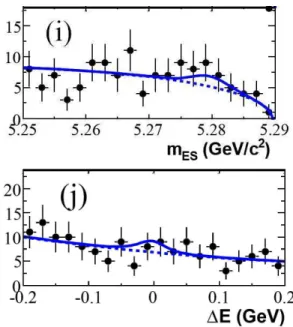
FIG. 6: Projections of the fit results in comparison to data forB0→ η′η′.
The extended maximum likelihood fit for theη′η′analysis
is based on more variables: the event shape information,∆E, mES and the twoη′ reconstructed masses. For theη′ργdecay mode, theρhelicity angle is also included in the fit. The re-sults of theη′η′fit are given in Table I. The corresponding fit projections are shown in comparison to the data in Fig. 6. The 90% confidence level upper limit we obtain for the branching fraction is 2.4×10⁻⁶, a factor of four improvement compared to the previous result.
III. SUMMARY AND CONCLUSIONS
Using the formalism of Ref. [3], we set the following limits on the level of deviation of the effective sin(2β)measurements in B0→φK0 and B0 →η′K0 compared to B0→J/ΨK0: ∆SφK0 <0.38 and∆Sη′K0 <0.15. TheφK0result is the first
for this bound. Theη′K0result can be compared to the pre-vious bound of 0.22. The SU(3) bounds we obtain are shown
TABLE I: Results from the extended maximum likelihood fit for
η′η′.
Mode Yield (evts.) Eff.(%) ∏Bi(%) S(σ) B(10−6 η′
ηππη′ηππ 1+2−1 15.2±1.0 3.1 1.2 0.8+1. 3 −0.7 η′
ηππη′ργ 9+7−5 17.6±0.8 10.3 1.5 1.2 +1.1 −0.9
η′η′ 1.8 1.0+0.8
−0.6±0.1
by the horizontal bars in Fig. 2. The observed∆Sdeviations observed for theφK0andη′K0are seen to be compatible with the sin(2β)result fromJ/ΨK0within these bounds. There-fore, we do not observe evidence for New Physics. BaBar is expected to collect data until the end of 2008 and should have a final data sample of about 1 ab−1. This will result in an increase by about a factor of three in the available num-ber of events compared to the numnum-bers used in the two studies presented here, corresponding to an expected improvement of about 60% in the∆Sbounds based on SU(3) flavor symmetry.
[1] BABAR Collaboration, B. Aubert, et al. Phys. Rev. D74, 072008 (2006).
[2] BABAR Collaboration, B. Aubert, et al. Phys. Rev. D 74,
051106(R) (2006),