818 Brazilian Journal of Physics, vol. 34, no. 3A, September, 2004
Analysis of the Nuclear Fusion Process Based on
Potential Barriers Modified by Coupling Effects
H.D. Marta
1, M.R. Spinella
2,3, J.E. Testoni
2,3, and O. Drag´un
21
Instituto de F´ısica, Facultad de Ingenier´ıa, C.C. 30, C.P. 11000, Montevideo, Uruguay 2
Departamento de F´ısica, Comisi´on Nacional de Energ´ıa At´omica,
Avda. del Libertador 8250, 1429 Buenos Aires, Argentina 3
Also at CONICET, Argentina
Received on 22 September, 2003
Partial wave analysis and the decoupling of the wave equations based on potential barriers modified by coupling effects are applied in the study of the fusion process in medium heavy nuclei. Several relevant physical quanti-ties are calculated in order to provide evidence of underline reaction mechanisms that determine characteristics of fusion excitation functions and barrier distributions. The influence of Q–values is especially considered. The
method is applied for the neutron transfer reaction in the17
O +144
Sm system.
1
Introduction
Open reaction channels in nuclear collisions leading to sion processes induce structure dependent effects in the fu-sion excitation functions [1]. The concept of barrier dis-tributions, expressed as the second derivative respect to the incident energy of the excitation functions times this energy, is an useful tool in order to put in evidence these structural effects [2].
In Ref. [3] we have recently proposed the energy– dependent modified potential barriers that include coupling effects as an appropriate method for providing an insight into the reaction mechanisms. It is our purpose to extend the study concerning the inelastic excitation of the 1.81 MeV 3−vibrational state of the target nucleus in the16O +144Sm
system, performed in that work, to one–neutron transfer re-actions in the17O +144Sm system. Experimental data in which the influence of the one-neutron pick-up on the fu-sion barrier distribution is apparent are available [4].
2
The formalism
The basic coupled–channel formalism used in the present work has been addressed in detail in Ref. [3]. The radial wavefunctionsgnℓ(r) which describe the collision process are found by solving the following set of coupled equations,
2
2µn
d2
dr2 −
ℓ(ℓ+ 1)
r2 +k
2
n
−VC(r)
gnℓ(r)
=
n′
Vn,n′(r)gn′ℓ(r). (1)
The diagonal matrix elementsVn,n(r), for both, the elas-tic and the transfer channels, are represented by the same
conventional Woods–Saxon shaped nuclear optical poten-tial. The symmetrical nondiagonal formfactors that link the elastic and transfer channels are given by the expression
Vn,n′(r) =F exp(−(r−Rtr)/atr). (2)
In order to analyze the behavior of the fusion barrier dis-tributions, energy–dependent potential barriers modified by coupling effects given by the expression
Vmod
nℓ (r) =
2
2µn
ℓ(ℓ+ 1)
r2 +VC(r)
+
n′Vn,n′(r)gn′ℓ(r) gnℓ(r)
, (3)
were proposed in Refs. [3, 5] .
Several physical quantities will be addressed, i.e. fu-sion excitation functions, σf(E); fusion barrier distribu-tions, B(E); sources (or sinks), S(r); and incoming and
outgoing currents,C(r); (see Ref. [3]).
3
Analysis of fusion cross sections
and barrier distributions
3.1
The influence of the channel coupling
The fusion excitation functions,σf(E), and the correspond-ing barrier distributions, given by the second derivative of the fusion cross section times the incident energy respect to this energy,
H.D. Martaet al. 819
are shown in Fig. 1 for the neutron stripping (Q=2.6 MeV) and the neutron pick–up (Q=-2.48 MeV) in the17
O +144
Sm system.
1E-1 1E0 1E1 1E2 1E3
σ
f(mb)
Q = 2.6 MeV (stripping) F = 0 MeV
0 500 1000 1500
d
2(E
σ
f)/dE 2(mb/MeV)
Q = 2.6 MeV (stripping) F = 0 MeV
55 60 65 70
1E-1 1E0 1E1 1E2 1E3
σ
f(mb)
Ecm (MeV)
Q = -2.48 MeV (pick-up) F = 0 MeV
55 60 65 70
0 500 1000 1500
d
2(E
σ
f)/dE 2(mb/MeV)
Ecm (MeV)
Q = -2.48 MeV (pick-up) F = 0 MeV
Figure 1. Fusion excitation functions and the corresponding bar-rier distributions when a neutron stripping or a neutron pick–up
channel is open in the17
O +144
Sm system.
As a reference,σf(E)andB(E), for the case in which the transfer channel is closed, i.e. F= 0 MeV, are plotted. Sub–Coulomb cross sections show an enhancement when the transfer channel is open. A moderate hindrance in the cross sections at energies over the Coulomb barrier takes place for the positiveQ–value. (In the following,Q-values are arbitrary selected just for illustrative reasons.) The bar-rier distributions reveal a splitting of the single peak corre-sponding toF= 0 MeV as consequence of the inclusion of an open transfer channel withF= 1.5 MeV; the split peaks are, in these cases, of different magnitude. The peak at the left in the plot for positiveQis quite smaller than the peak that arises at the right. The situation is reversed in the case of negativeQ. In both instances the reference peak is placed between the split peaks.
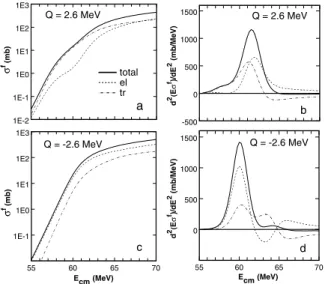
One might try to associate each split peak with one of the two involved channels, assigning, for instance, the large peaks to the elastic channel and the small ones to the trans-fer channel. Fig. 2 illustrates this issue; Fig. 2a and Fig. 2c represent the contribution of each channel to the fusion cross section. The fusion through the transfer channel dominates in the case of positiveQand through the elastic channel for negativeQ. These partial excitation functions originate two components in the barrier distributions, related to each reac-tion channel, as shown in Fig. 2b and Fig. 2d; their addireac-tion constitutes the total fusion barrier distributions. It is appar-ent that the assignation of the clearly separated peaks in the total distribution to the individual reaction channels is not a simple task. In fact, the small peak in the positiveQcase has a neat contribution from the transfer channel. However, that corresponding for negativeQis determined by the balance of relatively small differences between the positive and neg-ative contributions of the elastic and transfer channels. The big peaks, in both cases, are built by important contributions
of both channels. Therefore, the univocal assignation of a channel to a particular peak is not, in general, obvious.
1E-2 1E-1 1E0 1E1 1E2 1E3
total el tr
σ
f(mb)
Q = 2.6 MeV
a
-500 0 500 1000 1500
d
2(E
σ
f )/dE 2 (mb/MeV)
Q = 2.6 MeV
b
55 60 65 70
1E-1 1E0 1E1 1E2 1E3
σ
f(mb)
Ecm (MeV)
Q = -2.6 MeV
c
55 60 65 70
0 500 1000 1500
d
2(E
σ
f )/dE 2 (mb/MeV)
Ecm (MeV)
Q = -2.6 MeV
d
Figure 2. Contributions of the elastic and the transfer channels to the total fusion excitation function and barrier distributions for
positive and negativeQ–values.
3.2
Partial waves analysis
In order to understand some features of the behavior of fu-sion cross sections and barrier distributions, it is useful to take into account that we deal with central forces. Conse-quently, the different analyses can be performed on the ba-sis of independent sets of wavefunctions characterized by a relative angular momentumℓ. In this way, a barrier
distri-bution can be developed in partial barriers associated to each
ℓ–value.
Figure 3a shows how the fusion barrier distribution, for the simple case without coupling, i.e.F=0 MeV, is built–up as a sum of partial barriers that interfere among them; they have oscillating shapes presenting a positive peak followed by a negative one which asymptotically decays to zero. The plot showing all the partial barriers permits to visualize a characteristic envelope. In the example, up to the top of the peak, the contributions for different angular momenta fur-nish only positive values, given place to the rise of the char-acteristic peak. Then, the presence of negative values pro-duces the descendent side of the peak. For higher energies, in spite of being each partial barrier progressively bigger, they thoroughly cancel among them when they are added.
820 Brazilian Journal of Physics, vol. 34, no. 3A, September, 2004
55 60 65 70
Q = 1.3 MeV
500
250
0
-250
Ecm (MeV) F = 1.5 MeV
55 60 65 70
-500 -250 0 250 500 750 1000 1250 1500
Ecm (MeV) F = 0 MeV
d
2(E
σ
f)/dE 2 (mb/MeV)
Q = 0 MeV
Figure 3. Decomposition of the fusion barrier distribution for cases without coupling (a) and with coupling (b) according to the
contri-butions of the different relative angular momentaℓ. The partial
barrier distributions forℓ=9 are highlighted.
Particular features of the reaction mechanisms present in the fusion process can be studied considering their incidence on the partial fusion barrier distribution for eachℓ–value. As illustrates the highlighted partial barrier in the previous fig-ures, the angular momentumℓ=9 might be a good choice in order to study the behavior of a representative partial barrier distribution for the present case.
3.3
Potential barriers modified by coupling
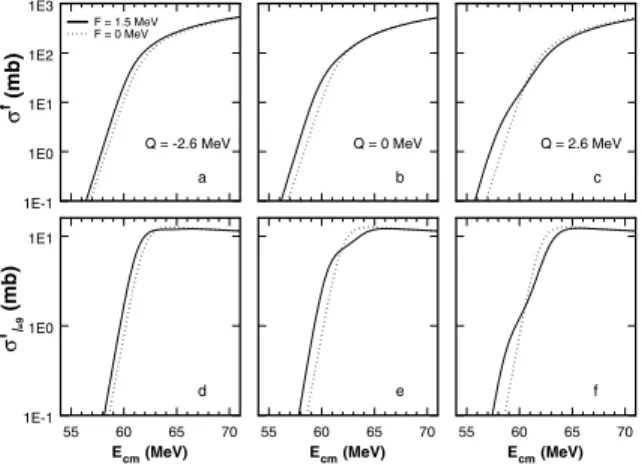
In the upper–row of Fig. 4, the total excitation functions for stripping transfer for differentQ–values, together with the excitation functions forF=0 MeV, i.e. when the transfer channel is closed, are shown. In the lower–row, the corre-sponding partial contributions forℓ=9 are plotted.
1E-1 1E0 1E1 1E2 1E3
σ
f (mb)
a
F = 1.5 MeV F = 0 MeV
Q = -2.6 MeV
b Q = 0 MeV
c Q = 2.6 MeV
55 60 65 70 1E-1
1E0 1E1
Ecm (MeV)
σ
f l=9
(mb)
d
55 60 65 70
Ecm (MeV)
e
55 60 65 70
Ecm (MeV)
f
Figure 4. Total and partial (ℓ=9) excitation functions for different
Q–values.
Figure 5 show the potential barriers modified by cou-pling effects, Vmod
nℓ (r), for selected energies, in order to
illustrate some paradigmatic situations (see Eq. (3)). As shown in Fig. 4a, an enhancement of the cross sections for stripping transfer withQ=-2.6 MeV can be observed around the Coulomb barrier energy, EC= 61.65 MeV, when it is compared with theF=0 MeV case. This fact is corrobo-rated in Fig. 5a, where the conventional barrier and the elas-tic modified barrier forEcm=61.4 MeV are plotted. At such energy, the conventional barrier is over the modified barrier, and the elastic channel energy is in between them. From the point of view of the conventional barrier we are dealing with a sub–barrier situation, while it is not the case from the point of view of the modified barrier. Consequently, it follows that an enhancement of the fusion cross section is to be expected.
10 11 12
58 59 60 61 62 63 64 65
Eel
el
V
(MeV)
r (fm) Q = -2.6 MeV E = 61.4 MeV
F=0 MeV
10 11 12
EelEtr
F=0 MeV
r (fm) Q = 0 MeV E = 64 MeV
10 11 12
Etr
Eel
el
tr F=0 MeV
r (fm) Q = 2.6 MeV E = 59.5 MeV
el tr
a b c
Figure 5. Modified barriers compared with the conventional barrier
for differentQ–values andℓ=9.
In the case ofQ=0 MeV, the Fig. 4b indicates hindrance over the Coulomb barrier and enhancement below it. At 64 MeV, the elastic, as well as the transfer modified barriers, are over the conventional one as can be seen in Fig. 5b; this situation means hindrance. At energies belowEC a situa-tion alike to that described for the negativeQ–value takes place.
As shown by Fig 4c, forQ=2.6 MeV, a hindrance simi-lar to that mentioned in the case ofQ=0 MeV occurs in the partial excitation function for energies greater than 61 MeV, and at lower energies an enhancement is present. As can be seen in Fig. 5c at 59.5 MeV the fact that the modified barriers are over the conventional barrier would suggest hin-drance and not enhancement. This apparent contradiction is clarified when it is observed that the energy in the trans-fer channel surpasses the transtrans-fer modified barrier top, while that in the elastic one is well below the top of the conven-tional barrier that is responsible for the magnitude of the cross section in theF=0 MeV reference case. Consequently, the fusion through the transfer channel is predominant, and an enhancement takes place.
3.4
The interplay between relevant physical
quantities
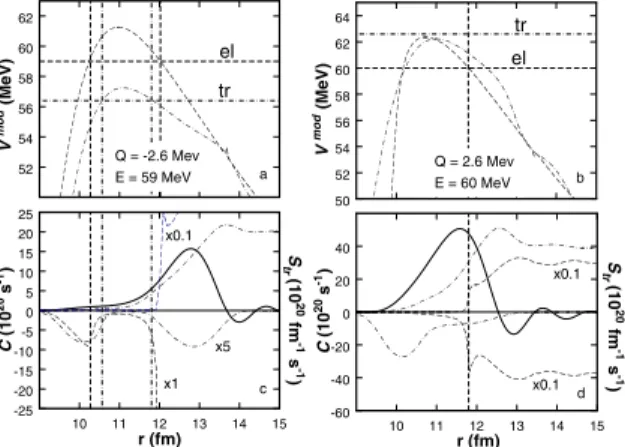
Figure 6 addresses the interplay between sources,S,
cur-rents,C, and barriers modified by coupling effects,Vmod
, for different illustrative cases. (Dashed lines refers to the elastic channel and dot-dashed lines to the transfer channel.) The modified barriers are plotted in the cases of Q=-2.6 MeV for Ecm=59 MeV, and Q=2.6 MeV for
H.D. Martaet al. 821
sources and the incoming (negative) and outgoing (positive) currents in the channels. For negativeQ–value, the source is placed outside the transfer modified barrier; the channel energies are under the top of the barriers for both channels.
52 54 56 58 60 62
V
mod
(MeV)
el
tr
Q = -2.6 Mev E = 59 MeV a
50 52 54 56 58 60 62 64
V
mod
(MeV)
el tr
Q = 2.6 Mev E = 60 MeV b
10 11 12 13 14 15
-25 -20 -15 -10 -5 0 5 10 15 20 25
C
(10
20
s
-1)
S
tr
(10
20
fm
-1
s
-1
)
r (fm)
x5 x0.1
c x1
10 11 12 13 14 15
-60 -40 -20 0 20 40
C
(10
20
s
-1)
S
tr
(10
20
fm
-1
s
-1
)
r (fm)
x0.1
x0.1 d
Figure 6. Interplay between sources,S(full line), currents,C, and
modified barriers,Vmod
nℓ (r), at sub–Coulomb energies forℓ=9 (see
text).
Most of the current is reflected and contributes to the elastic scattering and the transfer reaction. A small current, however, goes into the barrier and scarcely contributes to fusion. Dips in the incoming currents between the turning points of the specific modified barrier can be observed. It can be verified how, in the case of positiveQ, at low ener-gies, the fusion process essentially comes about through the transfer channel; the energy for the transfer channel is over the top of the corresponding modified barrier, while that for the elastic channel is under the top of its barrier. The po-sition of the source is, in the present case, quite coincident with that of the barrier, but placed somewhat in the external region. The incoming elastic current is thoroughly reflected and minimally contributes to fusion.
3.5
Summary
We summarize some characteristics of our approach to the study of the nuclear fusion in medium-heavy nuclei colli-sions, illustrated through the analysis of the 17
O +144
Sm system with a neutron transfer open channel. The influence of the Q-values is specially considered:
a) The numerical calculation of wavefunctions describ-ing the system in two channels —the elastic one and that corresponding to the transfer of one neutron— coupled by the mutual interaction in the collision of the nuclei.
b) The introduction of a third channel, the fusion pro-cess, by considering that all the absorption described by the optical model potential leads to fusion. c) The decomposition in partial waves that allows us
the evaluation of several physical quantities —as a function of the distance between nuclei or incident energy— for particular representative relative angu-lar momenta, i.e. potential barriers modified by cou-pling effects, probability densities, fusion excitation functions, the fusion barrier distributions, fusion rates, currents, and sources. These quantities permit the study of different aspects of the fusion process. Such analyses are not possible considering the total cross sections and barrier distributions.
d) The introduction of the formal decoupling through the potentials modified by coupling effects that allows us a simple comprehension of different features of the underlying reaction mechanism.
References
[1] W. Reisdorf, J. Phys. G: Nucl. Part. Phys.20, 1297 (1994)
and referencies therein.
[2] N. Rowley, G.R. Satchler, and P.H. Stelson, Phys. Lett. B254,
25 (1991); M. Dasgupta, D.J. Hinde, N. Rowley, and A.W.
Stefanini, Annu. Rev. Nucl. Part. SCI48, 401 (1998).
[3] M.R. Spinella, J.E. Testoni, O. Drag ´un, and H.D. Marta,
Nucl. Phys. A687, 4385 (2001).
[4] C.R. Morton, M. Dasgupta, D.J. Hinde, J.R. Leigh, R.C. Lemmon, J.P. Lestone, J.C. Mein, J.O. Newton, H.
Tim-mers, N. Rowley, and A.T. Kruppa, Phys. Rev. Lett.72, 4074
(1994); J.R. Leigh, M. Dasgupta, D.J. Hinde, J.C. Mein, C.R. Morton, R.C. Lemmon, J.P. Lestone, J.O. Newton, H.
Tim-mers, J.X. Wei, and N. Rowley, Phys. Rev. C52, 3151 (1995).
[5] J.E. Testoni, O. Drag´un, H. Massmann, and M.R. Spinella,