Artigo
*e-mail: [email protected]
RAPID AND SENSITIVE DETERMINATION OF PALLADIUM USING HOMOGENEOUS LIQUID-LIQUID MICROEXTRACTION VIA FLOTATION ASSISTANCE FOLLOWED BY GRAPHITE FURNACE ATOMIC ABSORPTION SPECTROMETRY
Mohammad Rezaeea,*, Reyhaneh Shadaniyanb, Majid Haji Hosseinia and Faezeh Khalilianb
aNuclear Fuel Cycle Research School, Nuclear Science & Technology Research Institute, Atomic Energy Organization of Iran,
P.O. Box 14395-836, Tehran, Iran
bDepartment of Chemistry, College of Basic Science, Yadegar -e- Imam Khomeini (RAH) Branch, Islamic Azad University,
Tehran, Iran
Recebido em 28/09/2014; aceito em 14/01/2015; publicado na web em 23/03/2015
A method for the determination of trace amounts of palladium was developed using homogeneous liquid-liquid microextraction via flotation assistance (HLLME-FA) followed by graphite furnace atomic absorption spectrometry (GFAAS). Ammonium pyrrolidine dithiocarbamate (APDC) was used as a complexing agent. This was applied to determine palladium in three types of water samples. In this study, a special extraction cell was designed to facilitate collection of the low-density solvent extraction. No centrifugation was required in this procedure. The water sample solution was added to the extraction cell which contained an appropriate mixture of extraction and homogeneous solvents. By using air flotation, the organic solvent was collected at the conical part of the designed cell. Parameters affecting extraction efficiency were investigated and optimized. Under the optimum conditions, the calibration graph was linear in the range of 1.0-200 µg L-1 with a limit of detection of 0.3 µg L-1. The performance of the method was evaluated for the extraction and determination of palladium in water samples and satisfactory results were obtained. In order to verify the accuracy of the approach, the standard addition method was applied for the determination of palladium in spiked synthetic samples and satisfactory results were obtained.
Keywords: homogeneous liquid-liquid microextraction; graphite furnace atomic absorption spectrometry; palladium.
INTRODUCTION
Palladium is an element with increasing demand in todays indus-tries, and it is one of the most widely used elements of the platinum group metals (PGM).1 Furthermore, it is used in different areas of
science and technology such as metallurgy, and it is also extensively used as a catalyst especially in hydrogenation and dehydrogenation of some of the important organic compounds.2 Due to its electrical
conductivity and durability, Pd is widely used in electronic industry for production of multi-layer ceramic (chip) capacitors, conductive tracks in hybrid integrated circuits, plating connectors and lead frames and jewellery.3,4 One of the most important applications of Pd is the
production of catalytic converters for car engines.5 Anthropogenic
pd has been reported to be mobile and bioaccumulated by aquatic organisms, generally to a larger extent than other platinum group ele-ments.6,7 Moreover, metallic pd has an allergenic potential on humans.8
The monitoring of Pd in environmental samples has great importance with respect to estimation of the future risk of the human health and the ecosystem. Palladium analysis requires analytical methods of high sensitivity, selectivity and the control of interference effects. The most widely used methods for the determination of Pd in environmental samples include graphite furnace atomic absorption spectrometry (GFAAS)9,10 and inductively coupled plasma-mass spectrometry
(ICP-MS).11,12 In environmental samples, the low concentration of
Pd often requires an enrichment step which allows an accurate and precise determination of Pd in samples with very low analyte con-tent. Co-precipitation,13 sorption and ion exchange,14,15 liquid-liquid
extraction (LLE),16,17 solid-phase extraction (SPE)18,19 and cloud point
extraction (CPE)20,21 techniques have been developed and applied for
preconcentration and separation of palladium prior to its detection.
The solvent microextraction technique such as dispersive liquid--liquid microextraction (DLLME)22-25 which overcomes these
proble-ms by reducing the amount of organic solvent.
The main disadvantage of DLLME is that the extraction solvent is generally limited to solvents of density higher than water in order to be sedimented by centrifugation. These solvents are typically chlorinated solvents such as chlorobenzene, chloroform and carbon tetrachlori-de, all of which are potentially toxic to human and environment. In addition, the use of high density solvents as extractant limits wider applicability of DLLME. This is caused by the more limited choices as the number of low-density solvents is more than high-density ones. Typically, most DLLME method has a centrifugation step, which is the extra time-consuming step in the extraction. Homogeneous liquid-liquid microextraction via flotation assistance (HLLME-FA) method was developed for the determination of polycyclic aromatic hydrocarbons (PAHs) in soil and water samples.26,27 This paper
descri-bes the development and application of HLLME-FA in combination with graphite furnace atomic absorption spectrometry (GFAAS) for the determination of palladium in water samples.
EXPERIMENTAL
Chemicals and reagents
A stock standard solution of Pd at a concentration of 1000 mg L-1
(0.37 % (w/v)) was prepared by dissolving appropriate amounts of this reagent in distilled water. Youngling ultra pure water purifica-tion system (Aqua MaxTM-ultra, Korea) was used for purification
of water. The pH of solutions was adjusted by dissolving proper amount of ammonium acetate in distilled water (2.5×10⁻³ mol L-1)
and drop wise addition of nitric acid (0.5 mol L-1) and/or sodium
hydroxide solutions (0.5 mol L-1).
Instrumentation
In this work an atomic absorption spectrometer model PG-990 with a graphite furnace atomizer and deuterium back ground correc-tion was used all determinacorrec-tions. A palladium hallow cathode lamp with a wavelength of 247.6 nm, a current of 9.0 mA, a slit with of 0.4 nm was used as radiation source. The temperature program for graphite furnace atomic absorption is given in Table 1.
HLLME-FA procedure
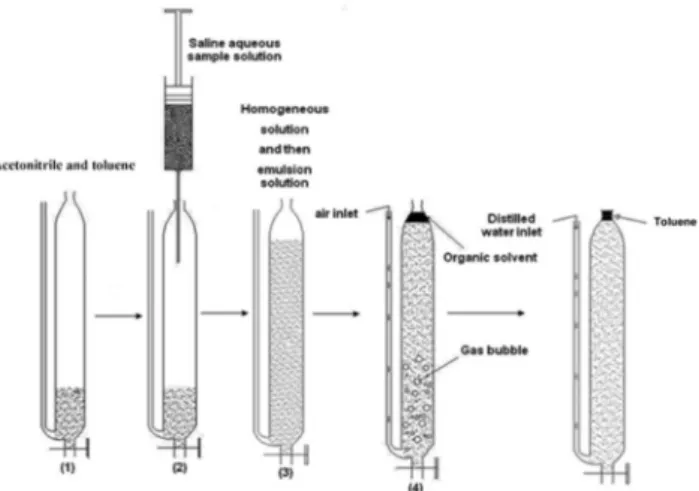
Figure 1 shows the schematic procedure of the proposed method. A mixture of 1.0 mL acetonitrile (homogeneous solvent) and 200 µL toluene (extraction solvent) were added to the home-designed extrac-tion cell (Figure 1-1). 30 µL APDC (0.37 % (w/v)) as a ligand was added into the 22 mL saline aqueous solution which pH was adjusted at 6.0. This solution was injected into the extraction cell by syringe, rapidly (Figure 1-2). In this step, in the initial state of injection, a homogeneous solution was formed and then with the continuation of injection an emulsion consisting of fine droplets of the extraction solvent were formed (Figure 1-3). After about 1 min, by using air flotation, the organic solvent was collected on the top of the solution (Figure 1-4). After separation of the two phases, a few volumes of
distilled water were added into the glass tube on the side of the cell (Figure 1-5). The floated organic solvent was raised into the conical part of the cell. Using a microsyringe, the collected organic solvent was injected into the GFAAS instrument
RESULTS AND DISCUSSION
This study explored the applicability of HLLME-FA to the analy-sis of Pd in the aqueous matrices. The effect of a number of variables, including the type and volume of extraction and homogeneous sol-vents, ionic strength, pH and concentration of APDC and extraction time on the sensitivity of the method was examined.
Selection of extraction solvent
Selection of an appropriate extraction solvent is of great impor-tance in optimization of the HLLME-FA method. In the selection of extraction solvent, some factors should be considered. The selection of a suitable extraction solvent is limited by several characteristics, they must have low water solubility, low density than water, be able to extract the analyte of interest and be compatible with the analytical instrumentation to be used. Different low density solvents (1-un-decanol, 1-octanol, and toluene) with different polarity and water solubility values were tested for this purpose. It is necessary to add an excess amount of solvent to recover an equal volume of different extraction solvents in the upper layer for comparison. The concen-tration of salt was 1.5 mol L-1 and 15.0 µL APDC (0.37 % (w/v))
was used. The results show that toluene has the highest extraction efficiency. It seems that the solubility of the complex in the toluene is more than the other tested solvents. Thus, toluene was selected for the subsequent experiments.
Selection of homogeneous solvent
Miscibility of homogeneous solvent in the extraction solvent and aqueous phase is the main point for selection of a homogeneous solvent. Therefore, acetone, acetonitrile, ethanol and methanol were selected for this purpose. A series of sample solutions was studied by 1.0 mL of each homogeneous solvent containing 200.0 µL toluene (as the extraction solvent). The concentration of salt was 1.5 mol L-1
and 15.0 µL APDC (0.37 % (w/v)) was used. The results showed that acetonitrile has the highest extraction efficiency with compare to the other tested solvents. Therefore, acetonitrile was selected as the homogeneous solvent in further experiments.
Selection of extraction and homogeneous solvent volumes
To examine the effect of extraction solvent volume, different amounts of toluene (200.0, 250.0 and 300.0 µL) were evaluated. By increasing the volume of toluene, the absorption of the analyte de-creased, owing to the increase in the volume of the collected organic solvent. Based on the experimental results, 200.0 µL toluene was adopted for further experiments.
In order to study the influence of the volume of homogeneous solvent on the extraction efficiency, different volumes of acetonitrile (0.5, 1.0, 1.5 and 2.0 mL) was used. The results showed that with increasing of homogeneous solvent volume (acetonitrile) up to the 1.0 mL, absorption increases and then decreases. It seems that at a low volume of acetonitrile, cloudy state is not formed well, thereby, the absorption decreases. At the high volume of acetonitrile, the so-lubility of the complex in water increases, therefore, the absorption decreases. Therefore, 1.0 mL was selected as the optimum volume of acetonitrile.
Table 1. Temperature program of graphite furnace for metal ion determination
Stage Start (º) End (ºC) Ramp Time (s)
Drying 80 140 40.0 5
Pyrolysis 1000 1000 30.0 20
Atomization 2700 2700 - 10
Cleanout 2800 2800 - 4
Effect of pH
In procedures involving HLLME-FA, the pH of the aqueous solution is a very important factor for the extraction of metal ion, as it controls the interactions between the analyte and the chelating reagent. Thus, the pH of sample was studied for the extraction of palladium using buffer solutions with pH values ranging from 1-8. The results are shown in the figure 2. It was observed that the best results are obtained when the pH value is 6.0. Subsequently, a buffer solution of pH 6.0 was used in all additional experiments.
Concentration of the chelating reagent
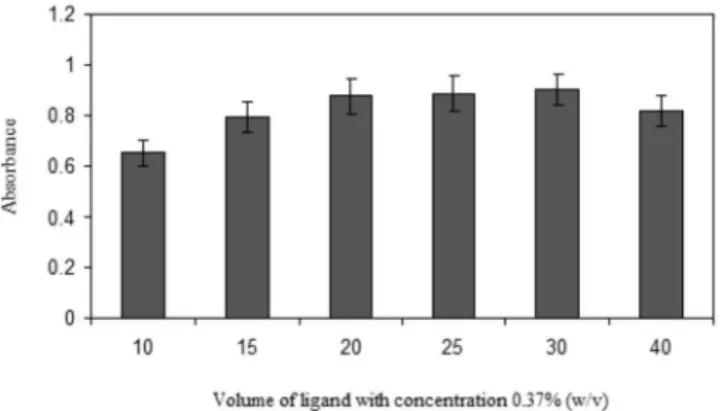
The chelating reagent used in this HLLME-FA procedure was APDC, which was studied in the volume of 10.0 to 40.0 µL at the concentration level of (0.37 % (w/v)). The effect of APDC on the amount of palladium extracted is shown in figure 3. It can be observed that the absorption of the analytical signal reached a maximum at the volume of 30 µL. It seems that slight reduction of extraction in high concentration of APDC is due to the extraction of APDC itself, which can easily saturate the small volume of the extraction solvent. Also, at high concentration of APDC, the background absorbance was increased. Thus, for further studies, we used the volume of 30 µL of APDC with the concentration of 0.37 % (w/v).
Effect of salt addition
Effect of salt addition on the extraction efficiency was studied by changing NaCl concentration from 0.5 to 5 mol L-1. Figure 4
de-monstrates the absorption of the analyte versus concentration of the NaCl. By increasing the NaCl concentration up to 3.0 mol L-1, the
extraction efficiency of the analyte increases, because of salting-out
effect. Higher than 3.0 mol L-1 of salt, decreased extraction efficiency,
because of increased solution viscosity that reduces dispersion phe-nomenon. Therefore, 3.0 mol L-1 was selected as the optimal value
for subsequent analysis.
Effect of extraction time
In this experiment, extraction time is the interval between be-ginning of the dispersion and the end of dispersion just before air flotation. Effect of extraction time was examined in the time range of 1-20 min. The results show that extraction time has no significant effect on the extraction efficiency of the analyte, because of large surface area between extraction solvent and sample solution. Hence, in the following experiments, the extraction time of 1 min was adopted to achieve maximal extraction efficiency of the analyte.
Interferences
The potential interferences of some ions on the preconcentration and determination of metal ion were examined. In these experiments, solutions of 100 µg L-1 of the analyte containing the interfering ions
were treated according to the optimized procedures. Table 2 shows to-lerance limits of the interfering ions. In addition, a number of common anions like Cl-, SO
4 2-, NO
3
-, I- and F- were tested. The results showed
that they did not interfere at the concentration up to 100 mg L-1.
Quantitative analysis
The characteristics of calibration curve was obtained under optimized conditions. Linearity was observed in the range of
Figure 2. Effect of pH on the extraction efficiency
Figure 4. Effect of NaCl concentration on the extraction efficiency
Figure 3. Effect of concentration of the chelating reagent on the extraction efficiency
Table 2. Effect of interference on preconcentration and determination of metal ion
Interference Interference to metal
ion ratio Recovery %
Cd2+ 1000 96
Ba2+ 1000 88
Cr3+ 1000 92
Fe3+ 200 97
Ag+ 500 91
Na+ 1000 96
Ca2+ 1000 94
Mg2+ 1000 93
Co2+ 400 89
1.0-200 µg L-1 for Pd with correlation coefficient (r2) of 0.9971. The
relative standard deviation (RSD) was 7.5% (n=5). The limit of de-tection (LOD), based on signal-to-noise (S/N) of three was 0.3 µg L-1.
Table 3 compares the proposed method with the other extraction methods for the determination of palladium. Comparison of the pro-posed method with cloud point extraction,20 for the extraction and
determination of the analyte indicates that this novel method has a short extraction time for the determination of the analyte. Quantitative results of the proposed method such as detection limit and linear range are better than of solid-phase extraction,28 solidification floating
organic drop microextraction based on ultrasound-dispersion29 and
dispersive liquid-liquid microextraction30 methods and comparable
with cloud point extraction method. Also, the main advantages of the proposed method are this novel method does not need centrifugation to separate the organic phase and it is possible to use of low-density extraction solvents. The limitation of the presented method is the design of the special extraction cell. However, it is easy to design and made it in every laboratory. Finally, it can be concluded that the pro-posed method is an efficient, rapid, simple and cheap microextraction method that can be a complement technique for DLLME and HLLE methods that have been used with organic solvents more dense than water for the determination of palladium in water samples. Sample analysis
During the present investigation, matrix effects on the extraction were also evaluated by investigating the applicability of the proposed method to determine palladium concentration in river, tap and sea water samples. These samples were extracted using HLLME-FA method and analyzed by GFAAS. These samples were spiked with palladium standard to assess matrix effects. The results of relative recoveries were between 92 to 95%. These results (Table 4) de-monstrate that the tap (salinity is 0%), sea (salinity is approximately 1.2%) and river water (salinity is approximately 0.007%) matrices, in our present context, had little effect on HLLME-FA method. In order to verify the accuracy of the approach, the standard addition
method was applied for the determination of palladium in spiked synthetic samples which are mentioned in Table 4. Cations which could compete significantly with for chelate formation were chosen for this purpose. The concentration of Pd in the samples was found to be 9.8 ± 0.6 and 9.9 ± 0.5 and are in good agreement with the certified value of 10.0 for Pd. Thus, the method is reliable for the determination of Pd in the water samples.
CONCLUSIONS
In the present study, a novel HLLME-FA method was developed for the extraction and determination of palladium in water samples. The method was successfully applied to the determine palladium in water samples and satisfied recoveries and suitable reproducibilites were obtained. In HLLME-FA method, consumption of toxic organic solvents is minimum. Also the proposed method has low LOD and short extraction time for the determination of palladium in water samples. We demonstrate that the optimization provides good linear ranges and improved detection limit. The proposed method was con-venient for the usage of low-density extraction solvents. Air flotation was used to break up organic solvent in water emulsion and to finish the extraction process and it does not need centrifugation to separate the organic phase.
ACKNOWLEDGEMENT
Financial support by Nuclear Fuel Cycle Research School, Nuclear Science & TechnologyResearch Institute (Tehran, Iran) for the support during the period of this research is gratefully acknowledged.
REFERENCES
1. Green Wood, N. N.; Earnshaw, A.; Chemistry of the Elements, 2nd ed., Buttewirth Heinemann: Oxford, 1997.
2. Balcerzak, M.; Anal. Sci. 2002, 18, 737. Table 3. Comparison of the proposed method with other extraction methods for the determination of palladium in water samples
Methods R.S.D.% Dynamic linear range
(µg L-1)
Limit of detection (µg L-1)
Extraction time
(min) Ref.
SFODME based on USDa-FAAS 2 2.0-400 0.6 2 [28]
DLLME-FAAS 0.7 100-2000 90 1 [29]
CPE-ICP-OES <5 0.5-1000 0.3 15 [20]
SPE-GFAAS 3.5 - 2 - [30]
HLLME-FA-GFAAS 7.5 1.0-200 0.3 1 This work
aSolidification floating organic drop microextraction based on ultrasound-dispersion.
Table 4. Determination of palladium in tap, sea and river water and relative recovery of spiked palladium in them
Sample Concentration of Pd (µg L-1) ± SDa, n=3
Added Pd (µg L-1)
Found Pd
(µg L-1) ± SDa, n=3 Relative recovery (%)
Tap water c n.d.b 10.0 9.5 ± 0.8 95
River waterd 1.8 ± 0.1 10.0 11.0 ± 0.9 92
Sea water e 1.5 ± 0.1 10.0 10.8 ± 1.0 93
Synthetic sample 1f - 10.0 9.8 ± 0.6 98
Synthetic sample 2g - 10.0 9.9 ± 0.5 99
3. Bagheri, A.; Taghizadeh, M.; Behbahani, M.; Asgharinezhad, A. A.; Salarian, M.; Dehghani, A.; Ebrahimzadeh, H.; Amini, M. M.; Talanta
2012, 99, 132.
4. Salih, B.; Celikbicak, O.; Doker, S.; Dogan, M.; Anal. Chim. Acta 2007,
587, 272.
5. Palladium emission in the environment; Zereini, F.; Alt, F., eds.; Springer-Verlag: Berlin Heidelberg, 2006.
6. Sures, B.; Zimmermann, S.; Messershmidt, J.; Von Bohlen, A.; Alt, F.;
Environ. Pollut. 2001, 113, 341.
7. Sures, B.; Zimmermann, S.; Messerschmidt, J.; Von Bohlen, A.;
Ecotoxicology 2002, 11, 385.
8. Vanketel, W. G.; Ntebber, C.; Contact Dermatitis 1981, 7, 331. 9. Bencs, L.; Ravindra, K.; Van Grieken, R.; Spectrochim. Acta, Part B
2003, 58, 1723.
10. Godlewska-Zylkiewicz, B.; Microchim. Acta 2004, 147, 189.
11. Gomez, M. B.; Gomez, M. M.; Palacios, M. A.; Anal. Chim. Acta 2000,
404, 285.
12. Rauch, S.; Motelica-Heino, M.; Morrison, G.M.; Donard, O. F. X.; J.
Anal. At. Spectrom. 2000, 15, 329.
13. Gomez, M. B.; Gomez, M. M.; Palacios, M. A.; J. Anal. At. Spectrom.
2003, 18, 80.
14. Whiteley, J. D.; Murray, F.; Sci. Total. Environ. 2003, 317, 121. 15. Elci, L.; Soylak, M.; Buyuksekerci, E. B.; Anal. Sci. 2003, 19, 1621. 16. Anthemidis, A. N.; Themelis, D. G.; Stratis, J. A.; Talanta 2001, 54, 37.
17. Pan, L.; Qin, Y. C.; Hu, B.; Jiang, Z. C.; Chem. Res. Chin. Univ. 2007,
23, 399.
18. Pyrzynska, K.; Talanta 1998, 47, 841.
19. Godlewska-Zylkiewicz, B.; Spectrochim. Acta, Part B 2003, 58, 1531. 20. Tavakoli, L.; Yamini, Y.; Ebrahimzadeh, H.; Nezhadali, A.; Shariati, S.;
Nourmohammadian, F.; J. Hazard. Mater. 2008, 152, 737.
21. Da Silva, M. A. M.; Frescura, V. L. A.; Curtius, A. J.; Spectrochim. Acta,
Part B 2001, 56, 1941.
22. Rezaee, M.; Assadi, Y.; Milani Hosseini, M.R.; Aghaee, E.; Ahmadi, F.; Berijani, S.; J. Chromatogr. A 2006, 1116, 1.
23. Rezaee, M.; Yamini, Y.; Faraji, M.; J. Chromatogr. A 2010, 1217, 2342. 24. Rezaee, M.; Yamini, Y.; Shariati, S.; Esrafili, A.; Shamsipur, M.; J.
Chromatogr A 2009, 1216, 1511.
25. Garcia-Lopez, M.; Rodriguez, I.; Cela, R.; J. Chromatogr. A 2007, 1166, 9.
26. Haji Hosseini, M.; Rezaee, M.; Mashayekhi, H. A.; Akbarian, S.; Miza-ni, F.; Pourjavid, M. R.; J. Chromatogr. A 2012, 1265, 52.
27. Haji Hosseini, M.; Rezaee, M.; Akbarian, S.; Mizani, F.; Pourjavid, M. R.; Arabieh, M.; Anal. Chim. Acta 2013, 762, 54.
28. Ojeda, C. B.; Sanchez Rojas, F.; Cano Pavon, J.; Microchim. Acta 2007,
158, 103.